Table of Contents
Imagine you are walking into an interview at Infosys, one of India’s most renowned technology companies, knowing that this could be the beginning of an exciting new chapter in your career in human resources. The interviewer warmly welcomes you, asks the first question, and from the moment you conceive, every detail in your answer will count.
Infosys HR Executive is a popular job for thousands of talented individuals, who work for it because their company is known for rapid growth, international projects, and a workplace that values its employees. This detailed guide explains the most frequently asked questions in the Infosys HR Executive Interview, provides realistic and accurate sample responses and offers some helpful tips that will make you look good. What you learn from the real people you know from your own background is real edge and you become an expert and capable of winning something that could be stressful into one where you feel you have control and are ready to succeed.
HR Executives at Infosys do much more than do paperwork. The employees in this position hire the best talent, coordinate employee relations, plan training, organize performance talks, make sure everyone works within the labor law and work with business leaders to ensure that the workforce is supporting company goals. Interviewers ask carefully what you know about these responsibilities, what you have done in other situations, and how you naturally communicate ideas. They want to see whether you fit into Infosys‘ culture of respect, innovation and continuous improvement. This article helps you see the whole process clearly, which types of questions you will have, how to answer them appropriately, and how to proceed step by step so that you come in prepared to go in confident and feel proud of how you came out.
Is being an HR your dream? Enrol now for our course on Human Resource!
Understanding the Interview Process at Infosys for HR Executive Roles
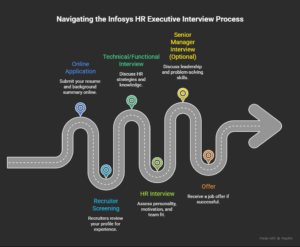
When Infosys takes on HR Executive positions they follow a clear-cut hiring path, and an understanding of each step will keep you alert and in focus throughout. It typically starts with an online application with a resume and a summary of your background. Recruiters check everything out to make sure you have the level of experience needed. If your profile is unique, you are invited to move forward, which usually means one or several interview rounds.
For HR, this often includes a technical or functional round where HR knowledge is grounded but the focus is on HR strategies, employee engagement strategies, performance management systems, and employment laws. Then it’s the HR round itself where the interviewers ask about your personality, why you want the job, your long-term goals, and how you’d fit in with the team. In some cases, especially if the position is more complex, you could also discuss with a senior manager whose interest is to better understand your leadership practice and problem solving style.
Each conversation is an extension of the other so you get a complete picture of who you are as a professional and how you would bring value to Infosys. Rounds can be anywhere from thirty to sixty minutes long and the entire process of application to offer can take several weeks. The same preparation processes can be used for the interviews—either in person at a company campus or via videoconference. Check your computer and phone for a smooth start at virtual meetings, wear comfortable work clothes, and arrive a few minutes earlier to relax. Listen attentively, respond well, and show genuine interest by gathering a few smart questions to ask at the end of each interaction. When you do that, interviewers notice your preparation and see you as someone who takes the opportunity seriously.
Mastering Behavioral Questions in the Infosys HR Executive Interview
This is a characteristic that occurs in almost every Infosys HR Executive Interview because it allows the interviewer to know what you have been doing in real-world work environments and gives them a solid idea of what you will do if you are selected. These questions tend to start with “Tell me about a time when…” or “Describe a situation where…”. The best responses are generally twofold: describe the background of the situation, what was your responsibility, what you did, and how you responded to the positive results of your efforts. This method commonly known as STAR, keeps your story logical, focused, and easy to understand by the interviewer.
First, the most common question almost everyone hears is “Tell me about yourself.” Abstain from talking about your childhood or other hobbies that are not related. Rather, connect everything to work. Start by describing your current position or position, highlights the HR experience that are specific to the job that you are applying for and finish by explaining why this job at Infosys is so appealing to you. For instance, you could say you have been doing talent acquisition and employee support for the last few years, share a success or achievement, such as shortening hiring time by improving sourcing, and then describe how excited you are to contribute to a company that is people-first and global in scope.
When interviewers ask you what you’re best at, choose two or three of your strongest strengths that truly work together for the HR Executive – building trust with people, solving problems calmly, or organizing complex processes. Support each strength with a brief, true story from your career. You could explain that listening passively has allowed you to turn difficult employee conversations into productive outcomes; or you could tell me about an instance where you helped two members of the team resolve a disagreement, helping them to collaborate more easily and make the group achieve much better results.
The weakness question often raises candidate fears, but when asked correctly, it becomes an opportunity. Choose something honest you have done the work of improving on, and describe how you improved. You may remember when you had trouble saying no to extras that sometimes stretched you thin. Describe how you improved your priorities, started using planning tools more effectively, and now manage your workload so that it provides quality while keeping energy. This type of answer demonstrates that you are looking to grow and that you are taking responsibility for what is better.
Another popular question is, “where do you want to be in five years” . Connect your answer directly to Infosys’ possibilities. Perhaps you were responding that you hoped to become a senior HR officer where you took charge of important HR initiatives, perhaps a talent strategy or employee experience program. Mention that you are looking forward to gaining expertise in areas as varied as data-driven HR decisions or organizational changes, both of which perfectly mesh with the innovative environment of Infosys. If your vision aligns with the direction of the company, interviewers feel confident that you intend to continue and contribute over the long-run.
Become an HR Expert – Enroll in Our HR Management Course Today!
Unlock the secrets to effective Human Resource Management with our expert-led course! Learn recruitment, employee relations, performance management, and more to build a thriving workplace. Start your journey toward a successful HR career today!
Know MoreKey HR Technical Questions and Strong Sample Answers
The technical questions in the Infosys HR Executive Interview focus on your understanding of human resources functions and whether you can apply theories to everyday problems. Expect topics such as hiring and firing talent, performance monitoring, ensuring law compliance, inclusion, and motivation and engagement for employees.
The question often arises of how you approach employee conflicts. Explain that you always start by listening to everyone involved so you know the whole picture but do not take sides too quickly. Then you review the relevant company policies and a respectful and honest discussion to find a fair resolution. Share a real example of sitting down with conflicted colleagues to discuss what they thought, to try to find common ground, and then follow up to check that the problem was resolved. Remember your goal is always fairness, clear communication, and strong working relationships afterward.
Recruitment questions are often posed as recruitment is a part of the role. If asked to walk you through the hiring process, go through the steps of analysis of the job requirements, posting attractive jobs, approaching candidates on a number of different channels, reviewing applications carefully, conducting structured interviews, checking references carefully and making offers as soon as possible. Call attention to the need for inclusion to make the team a reflection of different backgrounds and voices, a feature Infosys supports. Just remember that you filled a hard to find position faster than expected and brought in someone who quickly became a good performer.
Performance management questions talk about how you help people to grow. Ask each other to set achievable goals at the beginning of the year; to send weekly feedback for no surprises; to encourage periodic review conversations to highlight successes and discuss development needs honestly; to recommend new learning when something is lacking. Recall an opportunity, one when your help and comments provided a lot of improvement that brought a lot more confidence and improved the output of the team.
In a company like Infosys, labor laws and compliance are of great importance. Prepare for important Indian laws such as a review of pay, hours worked, anti-harassment measures and social security. Give yourself time to learn, and make sure policies protect employees, helping the business to avoid risk. This also assures interviewers that you handle sensitive matters with care.
Questions about diversity, equity, inclusion help you reflect on modern thinking. The steps you can take to get rid of bias in the job descriptions, use multiple interview panels, or hold awareness sessions, and measure progress through action items. Share a story from your childhood that included efforts to create a more inclusive environment that brought new ideas, increased participation, and better business outcomes.
Company-Focused Questions to Show Your Research
Infosys interviewers often ask about the company itself to see if you have taken the time to learn about where you would like to work. These are questions that tell you how serious you are.
“Why do you want to join Infosys?” gives you a chance to shine. Talk about the company’s strong reputation for technology services and consulting, its global client base and its dedication to employee development through programs of extensive learning. Also, indicate that the ethical mindset, sustainability and innovation are important to you within your organization, and that you see real opportunities to grow your HR career and contribute to a changing and expanding organization.
You may also be asked what you know about Infosys. Insist on the facts that it was founded in 1981, calls Bengaluru home, provides a full spectrum of IT, consulting and digital services to clients all over the world and is a consistent contender among the best places to work. Touch on its scale, its commitment to continuous learning, and its commitment to community and environmental causes. Specific and reliable details show you did your homework.
When asked about the role you might play, match your skills to Infosys’ priorities. Say that your experience in recruiting, staff support and change management would help the company attract and retain the right people to succeed in a rapidly changing market. Refer to a successful previous experience, one that sounds as bad as Infosys’s, showing you already think about value adding.
Effective Preparation Strategies for the Infosys HR Executive Interview
Preparation is what makes the difference between anxious and coming in ready to perform. Update your resume so that it provides numbers at any opportunity indicating what HR accomplishments you have for instance how many people you hired in one year or how high your employee satisfaction score was. Practice speaking your answers out loud; maybe even recording them to see what sounds natural and where you can improve flow or brevity.
Find out about Infosys news over the week so you can talk about projects, expansions or awards. Prepare thoughtful questions for the interviewer, such as what are the HR priorities right now, how the HR team cooperates across sites, or what the success level is in the first year. Such questions are curious and committed.
It’s important to look at yourself. A good posture, eye contact and a warm smile will make a lot of rapport. When you think about a question, take a moment to think rather than omit it. Trust is built through authenticity and preparation.
After the interview, send a short, polite thank-you email that confirms your excitement about the role and shares one positive moment from the conversation. This simple gesture allows them to think and be professional.
For candidates with a few years of experience, expect questions that question leadership and strategic thinking. Prepare to talk about changing the course of a team, how to use HR data to make decisions, or how to partner with business units to meet talent needs. Exit from real experiences where your actions produced measurable positive outcomes.
Become an HR Expert – Enroll in Our HR Management Course Today!
Unlock the secrets to effective Human Resource Management with our expert-led course! Learn recruitment, employee relations, performance management, and more to build a thriving workplace. Start your journey toward a successful HR career today!
Know MoreCommon Mistakes to Avoid During the Interview
Even trained people fail. Avoid rushing through. Look for answers that leave a bit of “hanging around” but never have an end. Never criticize former colleagues or employers because they may have attitude issues. Then be energetic and interested instead of depressed or retested.
Try not to sound like you remember every word; let your answers adjust to what the interviewer says, while remaining relevant. Watch your body language—sit up straight, nod to tell you are listening, and relax your movements. If you do not know what to say, confess it honestly and describe how you would get the information, which is integrity.
Why the Infosys HR Executive Role Offers a Rewarding Career

Infosys pays great salaries as an HR Executive. The compensation is competitive, and there are good health benefits, pensions, performance bonuses and other perks that help you stay healthy. The company is heavily devoted to learning, providing you access to the best possible training that can develop new skills and grow over time.
In many roles, there is flexibility in working hours and location, allowing for healthy balance between work and life. You get to interact with international teams and projects, and learn a different perspective and experience that few other companies can. Above all, Infosys promotes a culture of cooperation, respect and social responsibility with HR professionals receiving tangible tools to influence employee experiences and support the success of the firm.
Is being an HR your dream? Enrol now for our course on Human Resource!
Conclusion
Getting ready for an Infosys HR Executive interview involves more than going through the interview questions. It’s about spending time on this, knowing what interviewers really want, developing thoughtful responses based on real-life experience, and clearly showing why you want to be part of a company like Infosys. A well prepared candidate does not display memorized answers, but confidence, clarity and authenticity.
This book is to give you a clear and practical path for planning. You’ll learn how to respond to the most frequently asked HR questions, how to design a good response in response to real-world examples, and how to present your skills in a way consistent with Infosys’ values and culture. Preparation helps you to respond calmly and convincingly — whether it’s speaking about your strengths, responding to behavioral questions, or discussing your career goals.
Also, research on the company in depth is equally important. Interessing and professional nature is evident with an understanding of Infosys history, leadership principles, work culture, and recent initiatives. Interviewers value candidates who are willing to learn about the organization and who can articulate how their role is relevant to the overall picture.
Be who you are as you prepare. Real excitement, curiosity and a drive to help people and organizations is key in the HR profession. Practice telling your stories, how to talk about your experiences, and focus on what you contribute.
Focusing on improving now means you are in a better position to clear the interview, and to get down with confidence into a role where you can grow, make a difference, and enjoy a long and rewarding career at Infosys. It’s on your doorstep, prepare early today and make it count.
Become an HR Expert – Enroll in Our HR Management Course Today!
Unlock the secrets to effective Human Resource Management with our expert-led course! Learn recruitment, employee relations, performance management, and more to build a thriving workplace. Start your journey toward a successful HR career today!
Know MoreFrequently Asked Questions
"Tell me about yourself." How can I structure my answer to make a powerful first impression in an Infosys HR interview?
This opening question is your curated professional introduction, not your life story. The interviewer uses it to assess your communication skills, career coherence, and immediate fit. A powerful answer for Infosys should be a concise narrative arc connecting your past experience to your future potential within their ecosystem.
Begin by anchoring yourself in the present. Clearly state your current role and organization. For example, “I am currently an HR Generalist at [Company Name], where I have been for the past three years.” This establishes your starting point with authority.
Immediately, pivot to your core expertise. Highlight two or three key HR competencies most relevant to Infosys’s known needs. Given Infosys’s scale, you might say, “My core responsibilities have centered on high-volume talent acquisition for technology roles and managing the employee life-cycle for a cohort of 300+ engineers, ensuring seamless onboarding, engagement, and development.” This demonstrates you understand the type of HR work Infosys requires.
The critical part is weaving in a quantifiable achievement. This transforms your role from a list of duties to a story of impact. Continue with, “A significant achievement was redesigning our onboarding process for campus hires, which improved their time-to-productivity by 30% and increased first-year retention by 15%.” This provides concrete evidence of your ability to deliver results.
Now, bridge explicitly to Infosys. Explain why this move is logical and aspirational. “While I have valued this experience, I am now seeking to apply these skills in a global, innovation-driven environment like Infosys. I am particularly drawn to your commitment to ‘learning and earning’ and your focus on digital HR transformation. I am excited by the opportunity to contribute to your talent strategy at scale and to grow within a company that shapes the future of technology and consulting.”
Conclude with a forward-looking statement that reiterates your enthusiasm. “I believe my experience in building efficient, employee-centric HR processes aligns well with the needs of this HR Executive role, and I am very eager to bring that dedication to your team.” This answer, delivered in under two minutes, shows you are prepared, purposeful, and have done your homework, setting a tone of confident professionalism for the rest of the interview.
As an HR Executive at Infosys, how would you handle a complex conflict between a high-performing project manager and a team member who has filed a grievance about unfair workload distribution?
This scenario tests your analytical skills, adherence to due process, empathy, and ability to balance individual concerns with business outcomes—a daily reality at a project-intensive firm like Infosys. Your approach must be systematic, impartial, and rooted in Infosys’s policies and values.
Your first step is immediate, discrete containment. You would assure the team member that their grievance is taken seriously and will be investigated fairly and confidentially. Simultaneously, you would initiate a formal fact-finding process. This involves separate, confidential meetings with both individuals. Your questioning should be open-ended and non-accusatory. With the team member, you’d seek specific details: examples of the uneven distribution, timelines, and the impact on their work. With the project manager, you’d discuss their team management philosophy, current project pressures, and their perspective on the workload allocation. Crucially, you would also review project documentation, task management tools (like JIRA or similar platforms Infosys uses), and potentially gather anonymous feedback from other team members to get an objective view of the workflow.
The core of the resolution lies in differentiating between intent and impact. The high-performing manager may have been driven by tight deadlines and a belief in pushing star performers, unintentionally creating perceived inequity. Your role is to facilitate a mediated conversation, but only after individual counseling. You would coach the manager on inclusive leadership practices, transparent task allocation, and the long-term team morale risks of perceived favoritism. For the team member, you would acknowledge their feelings while also discussing channels for earlier, informal resolution.
The outcome must be restorative and forward-looking. A solution might involve implementing a more transparent workload visualization chart for the team, agreeing on regular check-ins for the concerned employee with the manager, and possibly providing the manager with targeted training on equitable delegation. You would document the entire process meticulously, in line with Infosys’s compliance requirements. Finally, you would schedule a follow-up in a few weeks to assess the health of the working relationship. This demonstrates you don’t just “close cases,” but you foster sustainable, productive work environments, protecting both employee well-being and project continuity.
Infosys is a global company. How would you approach recruiting for a niche, emerging technology role (like AI Ethics Specialist or Quantum Computing Analyst) where talent is extremely scarce?
This question probes your strategic sourcing capabilities, employer branding skills, and adaptability—key for an HR Executive in a firm at the technology frontier. A traditional job portal posting will fail; your strategy must be a multi-pronged talent-hunting campaign.
First, you would partner deeply with the business leaders and technical heads to deconstruct the role beyond the job description. What are the absolute core competencies versus the “nice-to-haves”? Often, for niche roles, you must prioritize foundational skills (e.g., a strong ethics philosophy background for the AI role) and a proven ability to learn rapidly over specific tool experience. This partnership ensures alignment and allows for flexibility in candidate assessment.
Your sourcing strategy becomes highly targeted and proactive. You would leverage specialist communities rather than general platforms. This includes: engaging with top-tier university research departments and professors in relevant fields; participating in (or sponsoring) niche online forums, GitHub communities, and academic conferences; using advanced LinkedIn Boolean searches to identify professionals who write, speak, or contribute to these fields; and potentially working with select executive search firms that have a dedicated tech practice. You are not waiting for applications; you are curating a talent pool.
The employer brand message must be compelling. Your outreach and job advertisements should highlight not just the role, but the unique problems the candidate would solve at Infosys. Emphasize the scale of impact (“shape AI implementation for Fortune 500 clients”), access to cutting-edge projects, and Infosys’s commitment to continuous learning through its Lex platform and partnerships. For passive candidates, the pitch is about career growth and intellectual challenge, not just a job.
Finally, you would redesign the selection process to engage, not interrogate, scarce talent. This might involve a technical case study or a “day-in-the-life” problem-solving session instead of a standard Q&A. The interview panel would include respected Infosys leaders in adjacent fields to ensure technical credibility. You would also be prepared to negotiate holistically, offering not just competitive compensation, but elements like dedicated research time, conference budgets, visibility with leadership, and clear paths for intellectual growth. This approach shows you understand that recruiting in the digital age, especially for Infosys, is about marketing, relationship-building, and creating compelling value propositions for in-demand experts.
Can you walk us through how you would design and implement a performance management cycle for a new business unit within Infosys?
Designing a performance management system from the ground up tests your understanding of how HR processes drive business outcomes, a critical expectation for an HR Executive partnering with business leaders. Your approach should be cyclical, integrated, and reflective of Infosys’s values of continuous learning and meritocracy.
The foundational step is Goal Setting and Alignment (Phase 1: Planning). You would work with the business unit head to cascade the unit’s objectives into clear, measurable Key Result Areas (KRAs) for each team and individual. You would advocate for a mix of objectives: Business (project deliverables, client satisfaction), Functional (skill development, process improvements), and Behavioral (embracing Infosys’s values like ‘respect’, ‘fairness’). You would introduce a framework like OKRs (Objectives and Key Results) if it fits the culture, ensuring goals are ambitious yet achievable, and, most importantly, transparently documented in a system accessible to both employee and manager.
The core of the cycle is Continuous Feedback and Development (Phase 2: Coaching). You would train managers to move away from an annual “event” mentality. Instead, institute lightweight, regular check-ins (bi-weekly or monthly) focused on progress, roadblocks, and support needed. You would emphasize that feedback should be specific, constructive, and balanced. Simultaneously, you would link the performance system to Infosys’s vast learning ecosystem (Lex, Wingspan). If an employee’s goal requires upskilling in a new cloud platform, you ensure they have a clear path to access the relevant modules. This phase frames performance management as a growth partnership.
The formal Review and Appraisal (Phase 3: Assessment) would be a summary conversation, not a surprise. Using data from the ongoing check-ins and documented achievements, manager and employee discuss performance against the pre-set KRAs. You would design a fair calibration process where leaders from across the unit meet to review ratings, ensuring consistency and mitigating individual manager bias. This upholds Infosys’s principle of fairness.
Finally, the cycle closes with Recognition, Reward, and Renewal (Phase 4: Action). Performance outcomes must be visibly linked to rewards—promotions, bonuses, and spot awards like Insta Awards. But equally important is the renewal aspect: you would guide managers and employees to jointly create a development plan for the next cycle based on strengths and gaps identified. This plan feeds directly back into the goal-setting of Phase 1, creating a closed loop. By presenting this holistic, integrated view, you demonstrate strategic HR thinking: you are not an administrator of forms, but an architect of a system that motivates, develops, and aligns talent to drive the new business unit’s success.
How would you leverage data and analytics in the HR function to provide actionable insights to business leaders at Infosys?
This question assesses your modern HR competency and business acumen. Infosys, as a technology leader, expects its HR professionals to be data-informed. Your answer should shift the perception of HR from an anecdotal, transactional function to a strategic, insight-driven partner.
Begin by framing the objective: “The goal of HR analytics is to move from reporting what happened (descriptive) to diagnosing why it happened (diagnostic) and predicting what will happen (predictive) to inform better people decisions.” You would then outline specific use cases relevant to Infosys’s context.
First, Talent Acquisition Analytics. You wouldn’t just report “time-to-fill.” You would analyze the quality of hire by correlating sourcing channel (e.g., campus drive vs. referral vs. portal) with subsequent performance ratings and retention rates after one year. This insight allows you to advise business leaders to invest more in the highest-yield channels, optimizing recruitment spend and improving long-term team quality.
Second, Employee Engagement and Retention Predictive Analytics. Using data from pulse surveys, exit interviews, and HRIS (like work patterns, promotion history, compensation benchmarks), you could build models to identify flight risk. You might tell a business leader, “Our model indicates that employees in the ‘XYZ’ project with more than 18 months without a role rotation have a 40% higher probability of attrition in the next quarter. I recommend we work on a curated internal mobility plan for that cohort.” This is proactive risk management.
Third, Productivity and Workforce Planning Analytics. By analyzing data on training completions, skill certifications, and project performance, you could identify skill gaps at a macro level. Your insight to leadership could be: “While we have strong Java capabilities, our data shows a growing deficit in Python and ML skills against projected demand from our digital pipeline. I propose a targeted upskilling campaign for 200 engineers in the next six months.” This directly links people strategy to business strategy.
To operationalize this, you would advocate for clean, integrated data systems and potentially basic upskilling for HR colleagues on data literacy. You would present insights not in complex spreadsheets, but in simple dashboards and clear narratives that focus on the “so what?” for the business. This approach proves you can speak the language of business leaders—the language of risk, ROI, and strategic foresight—making you an indispensable strategic partner, not just a support function.
Describe a time you had to champion an unpopular but necessary HR policy change (like a shift in hybrid work guidelines or a new performance rating system). How did you ensure successful adoption?
This behavioral question tests your change management skills, communication prowess, and resilience—essential for an HR Executive in a dynamic company. The STAR method is crucial here, but the emphasis must be on the “A” (Action) and “R” (Result), particularly the actions taken to manage resistance.
Situation: Start with context. “In my previous role, as we scaled, our informal, fully flexible work-from-home policy became unsustainable for collaboration and client delivery. Leadership decided to implement a structured hybrid model (3 days in office), which was met with significant apprehension from employees accustomed to full flexibility.”
Task: “My task was not just to communicate the policy, but to ensure its smooth adoption with minimal disruption to morale and productivity. I owned the change management plan.”
Action: This is the core. Detail your multi-phase action plan.
-
Transparent Communication of the ‘Why’: First, I worked with leadership to craft a clear, business-centric rationale: improving mentorship for juniors, fostering innovation through spontaneous collaboration, and meeting specific client project needs. We did not frame it as a lack of trust.
-
Pre-Launch Engagement: Before the final rollout, I organized focus groups with representatives from different departments to voice concerns. We used this feedback to tweak the policy, adding flexibility for certain client-facing or project-specific roles.
-
Multi-Channel Rollout: We launched via a live town hall with leadership, followed by detailed FAQs, manager talking points, and an open-door HR session. I ensured managers were equipped first, as they were the frontline communicators.
-
Leading with Support, Not Punishment: We focused on enabling the change: improving office amenities, subsidizing transport, and using office days for key collaborative meetings. We positioned HR as a support function to help teams navigate the transition.
-
Feedback Loop and Iteration: We committed to a three-month review period, conducting pulse surveys to identify pain points, which led to adjustments like designated “focus days” at home.
Result: “After six months, adoption was at 92%. While initially unpopular, the structured approach led to a measurable 20% increase in cross-team project innovation scores and improved onboarding feedback from new hires. The key result was that employees felt heard throughout the process, which maintained trust in HR even through a difficult change.” This shows you are a tactful change agent who balances business necessity with empathetic execution.
How do you stay updated on the evolving Indian labor laws, and how would you ensure compliance within a large, diverse organization like Infosys?
This question tests your professional diligence, risk management mindset, and operational rigor. For Infosys, with thousands of employees across states and unionized and non-unionized segments, compliance is non-negotiable. Your answer must reflect systematic, proactive governance.
First, outline your knowledge curation system. This is a blend of formal and informal channels: subscribing to official government gazettes and notifications from the Ministry of Labour & Employment; using trusted professional services like law firm updates, SHRM India, or NHRD network briefs; attending annual seminars or webinars by bodies like the Employers’ Federation of India; and being part of professional HR forums where practical interpretations of laws are discussed. You emphasize that this is a scheduled, ongoing activity, not an ad-hoc search.
Then, detail your implementation and dissemination framework within the organization. Upon identifying a relevant change (e.g., an amendment to the Industrial Relations Code or the Maternity Benefit Act), you would follow a clear process:
-
Impact Analysis: Collaborate with legal counsel to understand the precise implications for different employee segments (workmen, contract staff, permanent employees, women employees, etc.) across different states.
-
Policy Gap Analysis & Revision: Review existing company policies (Standing Orders, POSH policy, Leave policies) to identify necessary updates. Draft the changes in clear, simple language.
-
Stakeholder Communication Plan: Develop tiered communication. First, brief and train the HR business partner network and line managers on the changes and their responsibilities. Then, communicate to employees through official memos, the company intranet, and digital payslip inserts. For significant changes, organize explanatory sessions.
-
System and Process Update: Work with payroll, IT, and facilities teams to update software systems (for PF, ESI, gratuity calculations), physical notice boards, and any operational processes.
-
Audit and Verification: Schedule internal audits to ensure the change is implemented consistently across all units and departments. This is crucial for a large entity like Infosys.
You would conclude by mentioning your role in fostering a culture of proactive compliance, not fear. This involves regular training for managers, clear helplines for employee queries, and ensuring that compliance is seen as a cornerstone of Infosys’s reputation for ethical governance. This structured answer assures the interviewer that you are a vigilant and responsible custodian of one of HR’s most fundamental duties.
Infosys emphasizes a culture of “learn and earn.” How would you, as an HR Executive, promote a genuine culture of continuous learning beyond just providing access to the Lex platform?
This question moves beyond process to culture-shaping. It tests your ability to drive behavioral change and create an environment where learning is intrinsic, not just available. Your strategy should address the common hurdles: lack of time, unclear relevance, and missing social reinforcement.
Your first lever is Leadership Role Modeling and Messaging. You would work to get senior leaders to visibly share their own learning journeys—what new technology, leadership book, or course they are exploring. You would encourage managers to include “learning goals” as a standard, discussed agenda item in one-on-ones, shifting it from a private hobby to a professional expectation.
Second, you would focus on Contextualizing and Curating Learning. Instead of a vast, overwhelming library, you would create “learning pathways” tied to business goals. For instance, if a business unit is moving into cloud transformation, you would curate a specific sequence of modules from Lex, external certifications, and internal expert talks that prepare an employee for that shift. You would facilitate “learning circles” or book clubs where employees discuss and apply concepts from a course together, creating social accountability and deepening understanding.
Third, you would Integrate Learning with Career Mobility. You would champion mechanisms where completing key certifications or demonstrating new skills from learning platforms opens doors to internal gigs, special projects, or role rotations. This creates a tangible “earn” (career advancement) linked to the “learn.” You could institute a simple digital badge or internal credentialing system that is recognized across the organization.
Fourth, you would Celebrate and Recognize Learners. This goes beyond the top scorer. You would share stories in company newsletters of employees who solved a real work problem using a skill they learned, or teams that dedicated “innovation Fridays” to learning and prototyping. You might create awards for “Best Learning Ambassador” or “Most Transformative Skill Application.”
Finally, you would Empower Managers as Learning Coaches. Provide managers with toolkits to help their team members connect their career aspirations to relevant learning content on Lex and beyond. The goal is to make learning a seamless, valued, and socially reinforced part of the daily fabric at Infosys, ensuring the platform’s access translates into actual capability building and innovation.
In your view, what is the most significant challenge facing HR in the technology sector today, and how would you address it in your role at Infosys?
This strategic question evaluates your big-picture thinking and understanding of macro-trends. A compelling answer would identify a challenge that resonates deeply with Infosys’s context. One of the most salient challenges is Building and Sustaining Organizational Agility and Resilience in the Face of Rapid Technological Obsolescence.
The pace of change in AI, cloud, and cybersecurity means the skills a team possesses today may be partially irrelevant in 18-24 months. For a talent-driven company like Infosys, this is an existential HR challenge. The risk is a growing gap between the skills the business needs and the skills the workforce possesses, leading to missed market opportunities, attrition of key talent, and declining competitiveness.
Your approach to addressing this as an HR Executive would be multi-faceted:
-
Shift from Jobs to Skills: Advocate for a skills-based talent strategy. Work with leaders to define the core, emerging, and declining skills for the business, moving beyond rigid job descriptions. Implement a skills inventory or taxonomy that allows you to map existing employee capabilities against future needs.
-
Institutionalize Dynamic Reskilling: Move beyond elective learning to mandatory, role-adjacent reskilling sprints. Partner with the Infosys learning team and business units to identify cohorts of employees in roles facing automation or evolution (e.g., mainframe engineers) and create immersive, time-bound reskilling pathways into high-growth areas (e.g., cloud infrastructure). This requires investment and career transition support but mitigates large-scale redundancy.
-
Reinvent the Employee Value Proposition (EVP): In recruiting and retention, emphasize “future-proofing your career” as a core benefit of working at Infosys. Market the company not just as a place to use your skills, but as the best place to continuously acquire the most market-relevant skills in the industry.
-
Foster an Internal Talent Marketplace: Develop a robust platform that allows employees to signal their skills and interests, and managers to post short-term projects or “gigs.” This facilitates fluid internal mobility, allowing skills to be deployed dynamically where they are needed most, and giving employees agency over their career growth within the company.
By framing the challenge in terms of skills velocity and proposing concrete, systemic solutions, you position yourself as a forward-thinking HR leader who understands that the primary asset of a technology firm—its human capital—requires a fundamentally new, agile approach to management and development.
What questions do you have for us? What kind of inquiries demonstrate genuine interest and intelligence at this stage?
The questions you ask are your final opportunity to interview them and showcase your strategic mindset. Avoid transactional questions about salary or holidays, which can be discussed later. Instead, focus on questions that reveal your understanding of the role’s challenges, your desire to contribute, and your long-term alignment with Infosys.
First, ask about the business and challenges:
-
“Based on Infosys’s strategic priorities for the next 3 years, what would be the top two priorities for the HR team supporting the [relevant] business unit?”
-
“What is the biggest people-related challenge the team/department I would be joining is currently facing?” This shows you are already thinking about problem-solving.
Second, ask about success and impact:
-
“How would you define success for this role in the first 6-12 months? What key outcomes would the ideal candidate deliver?”
-
“Could you describe the career path for an HR professional who excels in this role at Infosys?” This demonstrates ambition and a desire for long-term growth.
Third, ask about culture and ways of working:
-
“How does the HR team collaborate with and add value to the business leaders in a technology-driven environment like Infosys?”
-
“Infosys has a strong culture. How is that culture actively nurtured and sustained by the HR function in a hybrid or remote work context?”
Fourth, ask the interviewer a personal, reflective question:
-
“What has been the most rewarding aspect of your own career journey at Infosys?” This builds a personal connection and provides authentic insight.