Table of Contents
Children are best introduced to fruits and vegetables via the Montessori botany activities, which are the most effective method. The purpose of these activities is not only to educate children on the importance of maintaining a healthy diet but also to stimulate their natural curiosity and encourage them to study their environment. During the process of learning about the life cycles of plants, children may engage in activities that are sensory-based and hands-on in order to examine the shapes, colors, textures, and flavors of a variety of fruits and vegetables. The participation of children in these activities at an early age helps to develop their capacity for critical thinking, independence, and the pleasure of the outdoors.
Register for the Entri Elevate Montessori Teacher Training Program! Click here to join!
Understanding Montessori Botany Lessons
Children are taught about plants, fruits, and vegetables via the use of kid-centered activities that are participatory in Montessori botany workshops. By seeing, touching, smelling, and maybe tasting the various fruits and vegetables, children are able to acquire knowledge about their qualities, as opposed to just learning their names. Children are able to acquire a more profound connection with nature, improved attention, and superior critical thinking abilities via the use of these courses, which often include activities such as sorting, categorizing, and recognizing plant components. In addition to having fun and making use of all of their senses, children engage in activities that teach them about botany and help them improve their language, problem-solving, and fine-motor skills.
Importance of Teaching Kids About Fruits and Vegetables
1: What is the primary focus of the first plane of development in the Montessori method?
Since the moment your child is born, you should begin feeding them fruits and vegetables. They will have a healthy connection with food and the enjoyment of eating healthily throughout their whole lives as a result of this event. There is some evidence that teaching children to differentiate between different shapes, colors, and textures may be beneficial to their vision and brain development. It is possible that learning about fruits and vegetables may assist you in better comprehending the fundamentals of science. The sorts of objects, the materials they are composed of, and the ways in which they change throughout the course of time are all instances of these concepts.
When children participate in research projects that contain an element of hands-on learning, they develop into better, more engaged, and more enthusiastic thinkers. As they become older, children who play this game discover new names and information, improve their ability to communicate verbally, and pay more attention to other things. People are able to enjoy themselves while studying, live in peace with the environment, and maintain their health when all of these elements are brought together.
Get Certified & Start Your Montessori Career
Montessori Teacher Training Course by Entri App: Gain expert skills, earn certification, and kickstart your teaching career.
Join Now!Key Montessori Principles Used in Botany Activities
Learning is made more meaningful, hands-on, and child-centered via the Montessori botany activities, which adhere to the following basic principles:
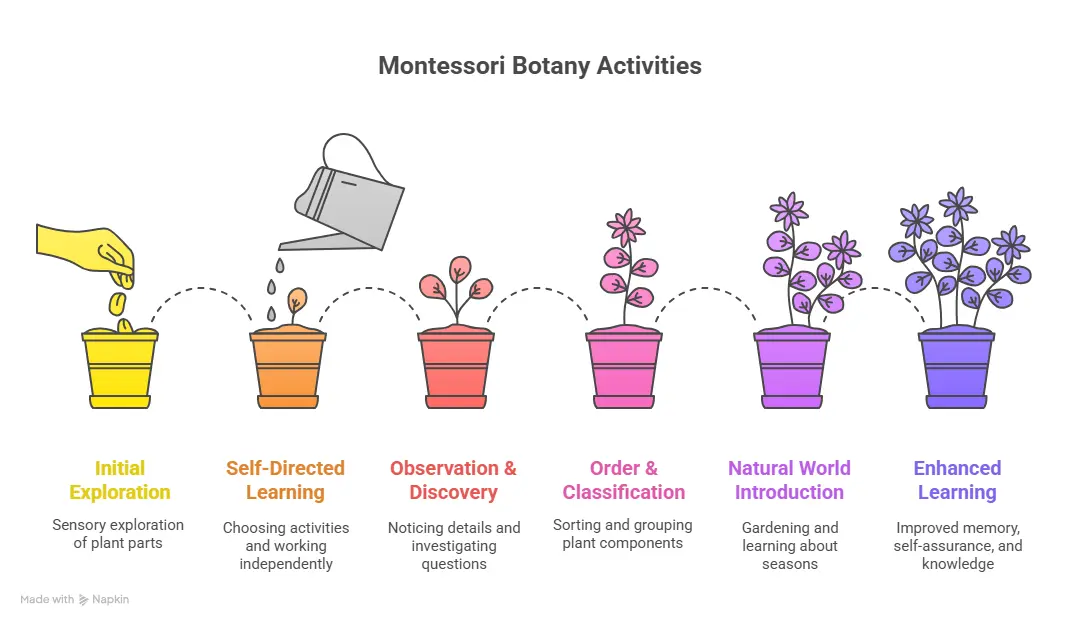
- The children use their senses to get an understanding of the forms, textures, colors, and tastes of the actual fruits, vegetables, seeds, and plants that they are examining via hands-on learning.
- Self-Directed Activity: Children have the ability to pick what they want to investigate, work at their own speed, and follow their own intuition.
- Encourages the process of noticing details, investigating questions, and autonomously finding plant properties via the use of observation and discovery.
- Fruits and vegetables are sorted and grouped according to their kind, color, size, or plant part as part of the activities that include order and classification.
- Through activities like gardening, plant development, and seasonal changes, children are introduced to the natural world via the lessons they take.
- Children are able to improve their learning, memory, and self-assurance by engaging in activities that require them to repeat them.
Montessori Activities to Teach Kids About Fruits
Children have the opportunity to learn about forms, colors, textures, and tastes via the exploration of fruits through the use of Montessori activities, which promote a joyful and engaging approach. During the process of gaining knowledge about healthy eating, children participate in a variety of activities that encourage observation, sensory exploration, and curiosity.
Adventures in the Deco Basket
Place a basket of real fruits in front of the children so that they may make use of their senses. Tell them to pay attention to the specifics, such as the dimensions, the form, the texture, and the color.
Organizing and Comparing the Data
Through the use of image cards or three-part cards, put together genuine fruits in accordance with their respective pictures. It is possible for children to categorize fruits according to size, color, or a particular variety.
The Investigation of Flavor Profiles
Young children should be given small portions of a variety of fruits so that they may try out the different flavors and textures of these fruits. “Which fruit is sweet?” or “Which one has a sour taste?” are two examples of questions that you may ask.
Seeds Being Observed
Apples, oranges, and pomegranates are some examples of fruits that may be broken open to reveal the seeds. The phases of fruit growth and seed counting are two topics that children could learn about.
Fruit Projects That Are Creative
Stamping, printing, or painting with fruits are all activities that may be done if you wish to combine learning about colors and shapes with working with art.
Montessori Activities to Teach Kids About Vegetables
Through the use of Montessori activities, children are afforded the opportunity to investigate a wide range of colors, forms, textures, and flavors that are associated with vegetables, while simultaneously acquiring information about how to make healthy food choices. Participants in these hands-on activities are encouraged to observe, classify, and be interested about the natural world via their involvement in these activities.
Investigation into the Vegetable Basket
The youngsters should be able to touch, smell, and view the genuine veggies that are included in the basket. Ask them to take note of the colors, forms, textures, and sizes that they encounter.
Classification and arranging of items
Depending on the kind of vegetable (leafy, root, stem, or fruit), color, or size, children may sort veggies. Skills in observation and critical thinking are strengthened as a result of this.
The Study of Plant Components
Carrots, broccoli, and spinach are some examples of vegetables that may be used to identify roots, stems, leaves, and edible sections of plants. Comparisons of similarities and differences may be made by children.
Activities That Are Simply Cooking or Preparing
It is possible for children to wash, peel, or chop soft vegetables while being supervised, which contributes to the development of fine motor skills and independence.
Planting and gardening are both activities
Plant seeds of vegetables in containers or in a garden to track their development. For youngsters, this teaches them about the life cycles of plants as well as responsibility.
Register for the Entri Elevate Montessori Teacher Training Program! Click here to join!
Get Certified & Start Your Montessori Career
Montessori Teacher Training Course by Entri App: Gain expert skills, earn certification, and kickstart your teaching career.
Join Now!Hands-On Nature-Based Learning Ideas
The learning of fruits, vegetables, and plants may be made more interesting and participatory for children via the use of activities that are rooted on nature. These pleasurable activities not only build a relationship with nature that would not otherwise be possible, but they also stimulate children’s curiosity, develop their observation skills, and provide them with an opportunity to learn.
Putting Back Together a Small Garden
In flower beds or containers, children should be allowed to plant seeds or small veggies. They may be responsible for tending to, observing, and watering plants in addition to learning about social responsibility and the life cycles of plants.
Nature Walks and Hikes
Introduce the children to the local flora, fauna, and produce by taking them outside and introducing them to the landscape. In addition to encouraging youngsters to become more aware of colors, shapes, and textures, you might ask them to collect leaves or other little items to study at a later time.
Feelings Seen in Trays
Plant pots may be made by combining soil, seeds, and small fruits and vegetables. Plants may be learned about by children via activities that use their senses, such as digging, touching, and exploring.
Art with Fruits and Vegetables
When it comes to writing, drawing, and pressing, you can always utilize fruits and vegetables. It is all about learning about colors, textures, and shapes, as well as utilizing your creativity to create something.
Plant Observation Journals
Help youngsters write or draw about what they see in parks or plants, and encourage them to do so. This helps patients see more clearly, in addition to enhancing their language skills and memory.
Benefits of Botany Activities in Early Childhood
- It is more probable that children will have a heightened sense of the environment if they consume a diet that is abundant in plants, fruits, and vegetables. These meals are beneficial because they stimulate the use of all five senses, which are sight, smell, taste, and touch. This is the reason why they are so popular.
- Activities that demand the use of fine motor skills, such as sorting, peeling, cutting, or planting seeds, might potentially be advantageous in this situation. It is feasible that such an activity could be useful. Consequently, there is a possibility that the synchronization between the hands and the eyes, in addition to the dexterity, will be improved with time.
- You may attempt to learn how to recognize, classify, and evaluate the many fruits and veggies that are available at your neighborhood market in order to work on improving your analytical and problem-solving abilities. You could find that this is a straightforward approach to enhancing your abilities.
- By improving your knowledge about fruits and vegetables, you will have a greater chance of establishing a preference for foods that are better for your health and will be more inclined to consume them on a regular basis. Another benefit of growing your knowledge is that you will be more likely to consume them. This is due to the fact that you will have a greater chance of experiencing the advantages that these meals provide.
- Playing independently and with their hands may help children develop a sense of wonder, strengthen their confidence, and increase their ability to make decisions. The development of each of these skills may be greatly aided by taking use of this wonderful method.
- When children are educated about the life cycles of plants, the components of plants, and the development of plants, they are laying the groundwork for their future scientific literacy which will determine their future success. Moreover, students are exposed to fundamental mathematical and scientific ideas via the medium of this kind of instruction.
- Increases the effectiveness of communication in both the spoken and written parts of the process Through the process of engaging in discussions about the many components of plants that they are familiar with, children are afforded the opportunity to acquire new vocabulary and to use language that is more descriptive.
Wrapping Up
Montessori botany lessons let kids get their hands dirty while learning about plants and food. These activities promote healthy eating habits and a love of nature while also developing cognitive, motor, and linguistic abilities via engaging the senses, encouraging observation, and encouraging autonomous learning.
Register for the Entri Elevate Montessori Teacher Training Program! Click here to join!
Get Certified & Start Your Montessori Career
Montessori Teacher Training Course by Entri App: Gain expert skills, earn certification, and kickstart your teaching career.
Join Now!Frequently Asked Questions
How can preschoolers learn more advanced botany concepts?
-
Sorting and classification: Group fruits and vegetables by family, color, or seed type.
-
Parts of a plant: Teach roots, stems, leaves, fruits, and seeds using real examples.
-
Growth cycle exploration: Use seed planting activities to demonstrate how fruits and vegetables grow.
Are there any Montessori tools for botany activities?
Yes, commonly used tools include three-part cards, magnifying glasses, trays, baskets, and real fruits and vegetables to encourage hands-on learning.
Can these activities be done at home
Absolutely! Most Montessori botany activities can be adapted for home use with simple materials, such as fruits, vegetables, pictures, and trays for sorting.
How often should these activities be conducted?
Regular, short sessions of 10–20 minutes are ideal. Observing and exploring in natural cycles, like grocery shopping or garden visits, can also reinforce learning.
How can I teach kids to identify fruits and vegetables?
Use real fruits and vegetables for children to touch, smell, and observe. Activities can include sorting by color, shape, or size, matching with picture cards, or labeling them with their names.
What age is suitable for Montessori botany activities?
Montessori botany activities can be introduced to children as early as 2 to 6 years old, depending on the complexity. Toddlers can start with basic identification, while preschoolers can explore classification, taste, and textures.