Table of Contents
A woman in her forties sits silently at her kitchen table, coffee in hand, perusing a resume that no longer reflects her.Years of nurturing children, managing errands, and mentoring youth have bestowed her with valuable skills—ones her paper self seldom displays.Now, as the house quiets down and her kids become self-sufficient, she is yearning to re-enter fulfilling work. The question is not her ability to do so, but which way will honor her experience and provide a realistic pathway back into the workforce.
The answer to this dilemma lies within the result of a Montessori course. The philosophy of Maria Montessori teaches patience, observation, empathy, and respect for a child’s natural development. As a parent of one and caregiver to two grown parents, I have learned these skills well. What the course does is adjust these skills into professional education skills necessary to be a teacher.
Many of the training programs do not require any prior teaching experience, making them ideal for career restarters. Trainees learn about child psychology, classroom management, learning materials and methods. With flexible schedules, including online and part-time options, trainees are able to study around family needs and gradually regain their sense of professional efficacy.
Completion of a Montessori course can open the door to a meaningful and rewarding job in a preschool, daycare, or other early learning environment. It can provide both the means to earn an income and the satisfaction of making a difference for children at this important stage in their lives. For some, it is a vocation, a rediscovery of self, and a source of income that does not threaten their family life.
Register for the Entri Elevate Montessori Teacher Training Program! Click here to join!
Why Montessori Teaching Is Ideal for Career Restart
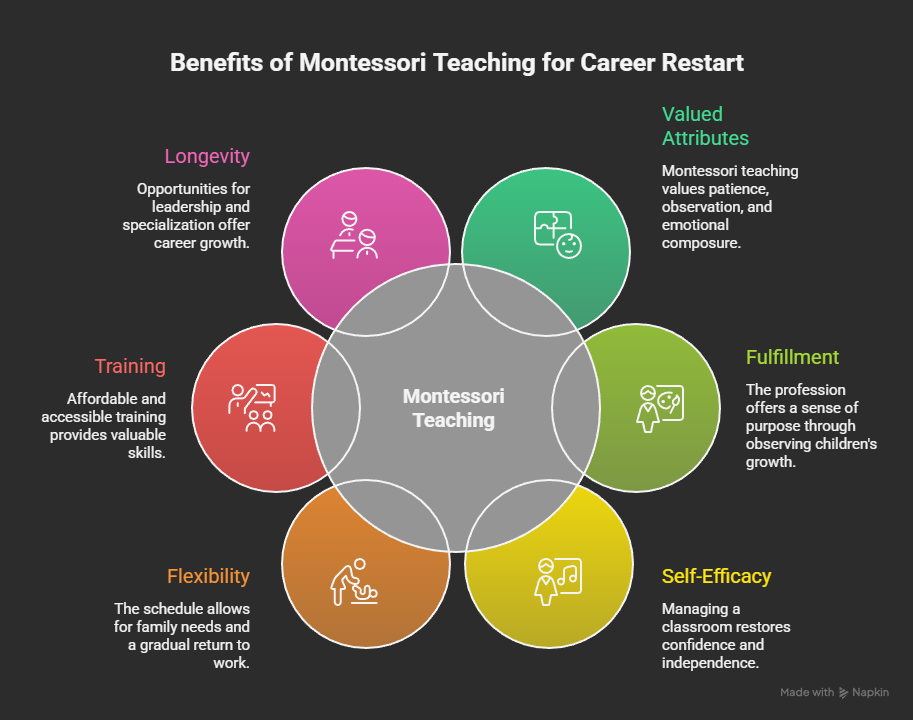
Many will leave the paid work force to care for family, help a partner, or transition through life changes. Returning can be daunting, with gaps in experience lending to self-doubt. Montessori teaching, but, values the attributes honed during a break such as patience, observation, emotional composure, and gentle guidance. Rather than recent corporate experience, schools look to maturity, empathy, and real-life experience as assets.
The daily work entails a sense of fulfillment that many desk jobs cannot offer. Teachers observe children learning through hands-on discovery, and those quiet moments of realization make a world of difference.
Managing classroom activities, promoting independence, and observing the development of the children often succeed in quickly restoring teachers’ sense of self-efficacy. The focus on the child creates a calmer environment than the traditional, test-focused systems.
The flexibility makes this profession very attractive to re-enterers, as the school schedule affords time for attending to family needs, and the part-time positions allow one to ease back into the work world. With the numbers of Montessori schools increasing in most areas of the country, there is a good supply of positions open, even in smaller communities and internationally.
Training is available and feasible. The majority of courses are relatively inexpensive in comparison to other forms of professional retraining, and the acquired skills of observation, communication, and individualized coaching have utility outside of the classroom. A number of teachers augment their practice by assisting parents, conducting workshops, or providing in-home educational counseling.
Montessori instruction on top of that offers the promise of longevity and personal advancement. Teachers have opportunities to assume leadership positions, specialize in specific areas of child development, or train new teachers. Most notably, this career path reverses the typical effect of a career hiatus. It offers meaningful engagement, flexible scheduling, and consistent employment prospects, with life experience weighed on par with formal qualifications, thus providing a highly attractive option for individuals seeking a fresh start.
Eligibility for Career Restart Candidates
1: What is the primary focus of the first plane of development in the Montessori method?

Many Adults are put off from applying to Montessori teacher training because they’re worried that taking time off from a ‘proper job’ will count against them. But in reality, the Montessori teacher training programs are actually set up to be super welcoming to people with all sorts of backgrounds.
Most places will accept a high school diploma as a minimum requirement, although a college degree can be a nice to have and sometimes even preferred. However, its not a hard and fast rule – what they really want is someone who is genuinely passionate about working with kids, who is emotionally mature and up for learning a new way of doing things.
We find that loads of parents who have spent years running their household end up being top candidates because they’ve already got the skills that make a great teacher – like creating calm routines, handling lots of different needs at the same time, and turning everyday moments into learning experiences. Program directors are always telling stories of mums or dads who came back to study after 10 years or so at home and just knocked it out the park because their life experience was basically just the same as what you need in the classroom. The thing is, you don’t have to have any teaching experience at all – what matters is that you’re enthusiastic, open to learning and a good person to be around.
People who’ve been working in nursing, retail, admin, marketing or hospitality and are now looking to get back into the workforce also do really well in this role. They bring with them the skills of organisation, communication and patience that are just as valuable in a Montessori setting as they are anywhere else. Nurses, for example, are often really attuned to spotting the early signs of developmental issues, because of their experience with observation and care.
When you put in your application, you’ll be asked to tell them in your own words why you’re now interested in doing this work, rather than just listing off all your previous jobs. This is to make sure that returners are on an even playing field with everyone else – so be honest, and tell them what is really driving you to want to become a Montessori teacher.
The timing often works out best for the parents of school-age children, as the home is quieter and the days are freer to take classes and attend school. Sometimes even grandparents enroll, attracted by the opportunity to pass on their accumulated wisdom to a new generation of students. Most programs do not have a mandatory maximum age limit, and many programs actively seek out the contributions of experienced students.
Basic fluency in the language of instruction (typically English for international or U.S.-based courses) is necessary, although multilingual candidates are given additional consideration in diverse classrooms. Familiarity with basic computer operation facilitates the online components, but the programs supply clear instructions and technical support throughout. Routine background checks are employed to ensure child safety, but a clean record is typical and not a significant barrier.
International students are welcome and many courses have provisions to help with document translation or visa information if needed. Some courses work with partner schools in the student’s home country to set up the practicum placement, which makes the logistics very straightforward.
Even if you feel your formal education ended a long time ago, you can succeed – many training providers offer preparatory modules or bridge courses that give you confidence before the start of the main course. Online self-assessments can also be a useful way to gauge your own readiness and receive personalised feedback.
Diversity is valued, so scholarships and flexible scheduling are often utilized by single parents, members of underrepresented communities, and those with multiple life roles. The physical requirements are minimal—being able to sit on the floor, move about, and play with children for a few hours at a time—which most adults can manage with practice.
In sum, eligibility is broad and inclusive. The programs understand that a lifetime in the trenches may have been a better preparation than an unbroken string of job titles. Anyone who feels called to serve young children should be included.
Get Certified & Start Your Montessori Career
Montessori Teacher Training Course by Entri App: Gain expert skills, earn certification, and kickstart your teaching career.
Join Now!Course Structure and Learning Mode
A Montessori course for a career restart follows a progression of theory, practicum, and observations in a live classroom setting. Most courses span six months to a year or more, with flexible schedules designed for adults with family or work obligations. Students pick an area of specialization in terms of age group: infant–toddler (birth to three), early childhood (two-and-a-half to six), or elementary (six to twelve). Early childhood is the most popular choice because it has the broadest range of employment opportunities in preschools and learning centers.
The course begins with the philosophy of Maria Montessori, focusing on independence, respect, and self-directed learning. Through lectures, readings, and recorded demonstrations, students investigate how children develop naturally in a prepared environment. Modules on child psychology and practical life activities articulate the ways in which simple tasks of pouring, sorting, and organizing develop concentration, coordination, and confidence.
The heart of the training is the materials. Trainees learn the specifics of the Montessori materials such as the number rods, movable alphabet, and sensorial materials. Trainees use video and performance practice to gain experience in delivering the lessons. They learn through observation training how to pace a child, how to respond to the child and how to determine readiness.
The practicum phase provides real-world experience. Students complete 100 to 200 supervised hours in a Montessori classroom under an experienced mentor. Feedback helps refine the student’s teaching approach, communication, and presence in the classroom. Many programs also offer electives such as inclusive education, special needs support, and nature-based learning.
Courses may be presented online, hybrid, or in-person. Tuition costs range from $2,000 to $6,000 on average, with flexible payment plans available. Certifications through the American Montessori Society and the Montessori Accreditation Council for Teacher Education can lend further credibility to one’s career.
By completion, graduates gain both practical skills and confidence, making the transition back into teaching structured, achievable, and professionally rewarding.
Job Opportunities After Completing the Course
Montessori coursework for career restart may enable you to seek employment in diverse settings, schedules, and levels of engagement.
Many graduates will see themselves in the role of lead teacher in a private Montessori school – getting a sense of job security, professional development opportunities, and the chance to watch kids grow. Working in a public charter school with a Montessori program can also be a great career move because they frequently come with extra perks like health insurance and the security of a steady job.
Assistantships make a pretty good entry point for recent graduates, especially if you’ve been out of the workforce for a while. You get some experience by jumping from one classroom to another and the chance to maybe snag a full-time teaching gig, which builds your confidence and those key skills you need to do a top job in the classroom.
But going to school in Montessori isn’t just about the opportunities that come with working in a school. If you’re interested in doing your own thing, Montessori training can open the door to all sorts of independent work. Families that want to create a Montessori-style home environment may be looking for someone with the training to show them the ropes. You can offer workshops for parents, some one-on-one learning support, or even coaching. This kind of work can offer a pretty good work-life balance because you get to set your own hours and rates.
If you enjoy being part of putting together educational programs, you might want to think about going for an administrative or leadership role – these kinds of roles, like being a program coordinator, curriculum planner or school administrator, tend to pay a bit better, offer some extra stability and the chance to shape education on a bigger scale.
Lastly, the rise of online and remote work has expanded opportunities for Montessori-trained graduates. You can now offer your services as a virtual tutor, curriculum designer or education support person to families all over the country (or even the world). This flexibility is a big draw for folks who want to work in Montessori but also have to consider the logistics of a job – can they get to work from home, or pick their own hours.
Networking is also very important for career development. Many graduates receive leads from training centers, alumni, and their schools. Montessori graduates can establish meaningful, stable, and flexible careers making a difference in children’s lives with diligence and experience.
Register for the Entri Elevate Montessori Teacher Training Program! Click here to join!
Conclusion
Perhaps you have taken time out of the workforce and are looking to return to a career that values your experience and fits your stage of life. Maybe you are not sure where to begin. A Montessori course can be one of the most satisfying and easiest routes back to employment. This program aims at those who withdrew from paid work due to family or personal commitments or health issues and now wish to re-enter the workforce confidently, with commitment and determination.
Why choose Montessori training? You can get started right away. Most Montessori training programs do not require prior teaching experience, and many institutes offer these programs online, in hybrid formats, or part-time so that you can complete your training on your own schedule. You can restart your career without having to rearrange your life again.
Along with accessibility, Montessori education values a number of other attributes you may have had the chance to develop during your career break: patience, observation, empathy, communication. These are valuable traits when working with young children as they begin their learning journey. You don’t start with a blank slate; you build upon existing strengths.
Montessori graduates enter a robust job market. Preschools, early learning centers, and private schools all seek out Montessori-trained teachers. The salary, hours, and work/life balance are excellent. Most find great personal satisfaction in having nurtured a child’s confidence, independence, and enthusiasm for learning.
Your first step may be easier than you think. Research accredited Montessori programs, consult with course advisors, and discover your possibilities. With proper training, you can embark on a career that honors your experiences and provides opportunities for both professional advancement and personal satisfaction.
Get Certified & Start Your Montessori Career
Montessori Teacher Training Course by Entri App: Gain expert skills, earn certification, and kickstart your teaching career.
Join Now!Frequently Asked Questions
I've been out of the workforce for over a decade. Will my long career gap prevent me from being accepted into a Montessori training program?
The concern about lengthy career gaps is perhaps the most common worry among individuals contemplating a return to work, and it is entirely understandable to feel that those years away from formal employment might count against you. However, when it comes to Montessori teacher training, the reality is quite the opposite of what you might expect. Program directors and admissions coordinators at Montessori training institutions across the country consistently report that candidates with significant career gaps, particularly those who have spent time raising children or caring for family members, often make some of the most exceptional students and subsequently, the most gifted teachers. This is not merely a matter of charitable acceptance or diversity quotas; it is a recognition that the skills developed during years of managing a household, nurturing children, coordinating family schedules, and responding to the emotional and developmental needs of growing human beings are directly transferable to the Montessori classroom environment.
The philosophy underpinning Montessori education places tremendous value on qualities such as patience, careful observation, emotional regulation, and the ability to guide without controlling. These are precisely the competencies that are honed through years of parenting and caregiving. When you have spent a decade managing the complex dynamics of family life, mediating sibling disputes, recognizing when a child is struggling with something they cannot articulate, and creating calm routines that help children feel secure, you have been engaged in a form of practical apprenticeship for Montessori teaching. Training programs understand this implicitly, which is why their application processes are designed to look beyond the chronology of employment history and instead focus on the whole person applying. You will be asked to articulate in your own words what has drawn you to this work, what experiences have prepared you for it, and what motivates your desire to work with young children. This narrative approach levels the playing field entirely, allowing you to present the richness of your life experience without being penalized for periods spent outside paid employment.
Furthermore, many Montessori training providers have observed that candidates returning after lengthy career breaks bring a level of emotional maturity and perspective that younger applicants, however enthusiastic, may not yet possess. Having navigated life’s complexities, weathered challenges, and developed a deeper understanding of human development through direct experience, these career restarters often demonstrate greater resilience in the classroom, more nuanced communication with parents, and a calmer presence that children naturally find reassuring. Program directors frequently share stories of students who entered training after fifteen or twenty years at home and not only completed their certification successfully but went on to become lead teachers, mentor trainers, and school founders. The career gap that once seemed like an obstacle transforms, in this context, into a foundation upon which professional excellence is built. Admissions committees are not looking for unbroken chains of employment; they are looking for evidence of character, commitment, and capacity for connection with children. If you possess these qualities, and your life experience demonstrates them, the length of your career gap becomes irrelevant, or indeed, becomes an asset that distinguishes you from other candidates.
What specific skills from my years as a parent or caregiver will actually help me succeed in a Montessori classroom?
The transition from parent to Montessori teacher is far more natural and seamless than many career restarters initially assume, largely because the foundational competencies developed through raising children align remarkably closely with the professional capabilities required in a Montessori learning environment. To understand this alignment fully, it is helpful to examine the specific skills that parenting cultivates and then trace how those same skills manifest in the classroom setting, where they become the tools of effective teaching and child guidance. The first and perhaps most significant of these is the art of observation, which parents practice constantly, often without conscious awareness. From the earliest days of infancy, you learn to read subtle cues, to distinguish between different cries, to notice when a child’s energy shifts, to recognize the precise moment when frustration is about to tip into overwhelm or when curiosity is sparking into focused interest. In the Montessori classroom, this refined observational capacity becomes the cornerstone of effective teaching, enabling you to know when to step in and when to step back, when to offer assistance and when to allow a child the dignity of struggling toward their own solution. Teachers who lack this observational training must develop it through practice; you may already possess it instinctively.
The second crucial skill set that parenting develops involves emotional regulation and the maintenance of calm in challenging situations. Anyone who has guided a toddler through a public meltdown, mediated conflicts between siblings, or maintained composure while a teenager tests every boundary knows that children have an extraordinary capacity to trigger emotional responses in adults. Effective parenting requires learning to manage your own reactions, to respond rather than react, and to model emotional stability even when you feel anything but stable inside. This capacity for emotional self-regulation is absolutely essential in the Montessori classroom, where children look to the teacher as a source of security and consistency. When you can remain calm amidst classroom chaos, when you can address behavioral challenges without becoming dysregulated yourself, you create the psychological safety that allows children to explore, make mistakes, and grow. Parents who have navigated the emotional terrain of family life often enter training already possessing this hard-won capability.
Additionally, parents develop sophisticated skills in what might be called environmental management and routine creation. Running a household involves coordinating multiple schedules, maintaining physical spaces that support different activities, creating rhythms that help children feel secure, and adapting environments to meet changing developmental needs. These are precisely the competencies that Montessori teachers apply in preparing the classroom environment. The way you arrange furniture, organize materials, establish daily rhythms, and create spaces that invite concentration and independence all draw upon the same practical intelligence that parents use in creating functional home environments. When you enter Montessori training after years of managing a household, you are not starting from scratch; you are building upon a foundation of practical wisdom that makes the principles of prepared environments intuitively accessible. Program directors consistently note that parents transitioning into teaching grasp these concepts more quickly and apply them more naturally than candidates without this background, precisely because they have been practicing environmental design in their own homes for years without calling it by that name.
How long does Montessori teacher training take, and can I complete it while still managing my family responsibilities?
The question of time commitment and family compatibility is absolutely central for career restarters, who typically cannot simply set aside their existing responsibilities to pursue full-time, residential study. The encouraging news is that Montessori teacher training programs have evolved significantly in recent decades to accommodate exactly the kind of student who is balancing multiple life roles, and the flexibility now available makes it entirely feasible to complete certification while continuing to manage family needs. Most Montessori training programs range from six months to eighteen months in duration, depending on the level of certification sought, the intensity of study, and whether you choose an accelerated pathway or a more gradual pace. The early childhood certification, which prepares you to work with children from two-and-a-half to six years and offers the broadest employment opportunities, typically requires between nine months and one year of combined coursework and practicum experience. This timeframe is substantial enough to ensure thorough preparation yet compressed enough to feel manageable as a finite commitment.
The structure of training programs is where flexibility truly becomes apparent. The majority of Montessori teacher training providers now offer multiple format options, recognizing that their students have diverse circumstances and cannot all attend classes on a rigid schedule. Fully online programs allow you to complete theoretical coursework entirely from home, accessing lectures, readings, and demonstrations through learning management systems that operate around the clock. You can study in the early morning before children wake, during afternoon quiet hours, or in the evening after family activities conclude, adapting your learning schedule to the rhythms of your household rather than the other way around. Hybrid programs combine online theory with periodic in-person intensives, often scheduled on weekends or during school holidays, which can work well for those who value face-to-face interaction but cannot commit to weekly classroom attendance. Even traditionally in-person programs frequently offer part-time tracks that spread coursework over a longer period, reducing weekly time demands.
The practicum component, which involves supervised teaching hours in an actual Montessori classroom, does require physical presence and scheduled availability, but even here, flexibility is often possible. Many programs allow you to complete practicum hours in your local area, arranging placement at a nearby Montessori school that fits with your schedule. Part-time practicum options let you accumulate hours gradually, perhaps working three days per week rather than five, which can be essential for those still managing school runs or caring for younger children. Some programs even offer split practicum arrangements where hours are distributed across multiple terms, giving you more time to balance teaching experience with other responsibilities. The key is to research programs thoroughly, speak with admissions advisors about your specific situation, and choose a pathway that realistically accommodates your family’s needs. Thousands of parents have completed Montessori training while raising children, and training providers have developed their structures specifically to make this possible. With honest planning and appropriate program selection, you can absolutely pursue certification without abandoning your existing family commitments.
What exactly will I learn during Montessori training, and how is it different from general early childhood education?
Understanding the distinctive content and approach of Montessori teacher training is essential for career restarters who want to make an informed decision about whether this path aligns with their interests and strengths. While general early childhood education programs provide broad preparation for working with young children, Montessori training offers a specialized, philosophically grounded approach that differs in several fundamental ways, and grasping these differences will help you determine whether the Montessori method resonates with your own values and teaching instincts. The training curriculum typically begins with an intensive exploration of Maria Montessori’s educational philosophy, which centers on the profound respect for the child as an active participant in their own development. You will study concepts such as the absorbent mind, sensitive periods, and the prepared environment, understanding how children from birth to six years possess unique learning capacities that differ fundamentally from those of older humans. This philosophical foundation is not merely theoretical background; it shapes every practical decision you will make as a teacher, from how you arrange furniture to how you respond to a child’s question to how you understand behavioral challenges.
Following the philosophical introduction, training delves into the five curriculum areas that characterize Montessori early childhood classrooms: practical life, sensorial, language, mathematics, and cultural studies. For each area, you will receive detailed, systematic instruction in the purpose and presentation of specific materials. The practical life materials, for example, include exercises in pouring, spooning, buttoning, and polishing that might appear simple to the untrained eye but are understood in Montessori training as sophisticated tools for developing concentration, coordination, independence, and executive function. You will learn not merely what these materials are but precisely how to present them, how to observe a child’s interaction with them, how to know when a child is ready for the next lesson, and how to respond when a child struggles. This level of specificity, the careful attention to the exact movements, language, and pacing of presentations, distinguishes Montessori training from general early childhood education, which typically provides broader developmental knowledge without this granular instructional methodology.
The training also emphasizes observation as a core teaching practice, and you will receive systematic instruction in how to observe children effectively, what to look for, how to record observations, and how to use observational data to guide individual children and adapt the classroom environment. This emphasis on observation reflects the Montessori understanding of the teacher as a scientist of child development, constantly studying the children in their care and adjusting their approach based on evidence rather than assumption. Additionally, you will learn classroom management techniques that align with Montessori principles, focusing on fostering independence, addressing conflicts through respectful communication, and creating a classroom culture of cooperation rather than compliance. Throughout the training, there is consistent attention to the teacher’s own development, including self-reflection, emotional awareness, and the cultivation of the personal qualities that support authentic connection with children. By completion, you will have not only practical teaching skills but also a transformed understanding of childhood and a professional identity grounded in a coherent educational philosophy that has proven its effectiveness across more than a century of practice in diverse cultural contexts worldwide.
How much does Montessori teacher training cost, and are there financial aid options for career restarters?
The financial considerations of Montessori teacher training are naturally a significant concern for career restarters, who may be navigating reduced household income, limited savings, or the need to justify educational expenses as an investment in future earning capacity. Understanding the full landscape of costs and financial support options is essential for making an informed decision and developing a realistic plan for funding your training. Tuition for Montessori teacher certification programs varies considerably depending on several factors, including the level of certification sought, the reputation and accreditation status of the training provider, the format of delivery (online, hybrid, or in-person), and the geographic location of the program. Generally speaking, you can expect tuition costs to range from approximately $2,000 to $6,000 for comprehensive early childhood certification, with some programs falling slightly below this range and intensive, prestigious programs potentially exceeding it. This range positions Montessori training as substantially more affordable than many other forms of professional retraining, such as graduate degrees in education, which can cost tens of thousands of dollars and require significantly longer time commitments.
In addition to tuition, you should budget for associated expenses that may include registration or application fees, textbooks and course materials, technology requirements for online programs, travel costs if your program includes in-person components, and potential lost income during the practicum phase if you need to reduce other work commitments. These supplementary costs typically add several hundred to perhaps a thousand dollars to your total investment, depending on your specific circumstances and program requirements. However, many programs include materials and books in their tuition fees, so it is worth asking detailed questions about what is covered and what represents an additional expense. When you calculate the complete investment, it is helpful to consider it in the context of potential returns; Montessori teachers in the United States earn salaries ranging from approximately $25,000 to $45,000 or more for entry-level positions, with lead teachers in established schools often earning higher compensation, and these figures represent income that can continue and grow over many years of employment.
Financial aid options for Montessori training have expanded significantly as the field has grown and diversified. Many training programs offer institutional scholarships specifically designed to support career restarters, single parents, members of underrepresented communities, and others who might face financial barriers to entry. These scholarships may cover partial or full tuition and are often awarded based on a combination of financial need and demonstrated commitment to Montessori education. Payment plans are nearly universal among training providers, allowing you to spread tuition costs across the duration of your program rather than paying a lump sum upfront, which can make the investment far more manageable for households operating on tight budgets. Some programs also offer work-study arrangements, where you contribute a few hours weekly to administrative or support tasks in exchange for reduced tuition. External scholarships and grants may be available through community foundations, workforce development programs, or organizations supporting women returning to work, and it is worth researching these possibilities in your local area. While federal student aid is not typically available for Montessori certification programs, some students do qualify for private educational loans, though this option should be approached cautiously and only after exhausting other possibilities. Training program admissions advisors are generally knowledgeable about financial support options and can guide you toward resources that match your situation, so do not hesitate to initiate this conversation early in your application process.
Will I need to find my own practicum placement, and how does that work for someone re-entering the workforce?
The practicum component of Montessori teacher training, during which you spend supervised hours in an actual Montessori classroom working directly with children, often generates considerable anxiety among career restarters who worry about navigating unfamiliar professional environments or competing with younger, more recently employed candidates for placement opportunities. Understanding how practicum placement actually works, and how training programs support students through this process, can alleviate much of this concern and help you approach this phase with confidence rather than apprehension. The specific arrangements for practicum placement vary among training programs, but the majority have established systems to assist students in securing appropriate sites where they can complete their required hours under qualified supervision. Many programs maintain formal relationships with networks of Montessori schools that have agreed to host practicum students, and placement coordinators work actively to match students with suitable sites based on geographic location, scheduling needs, and any special considerations. In these cases, you are not left to navigate the process alone but receive structured support from program staff who understand both the requirements of the training and the expectations of host schools.
For career restarters specifically, the practicum placement process often becomes an opportunity rather than an obstacle, as host schools frequently view mature students with extensive life experience as particularly desirable candidates for placement. When a school director considers hosting a practicum student, they are evaluating not just the candidate’s educational background but also their demeanor, reliability, emotional maturity, and ability to connect with children. Years of parenting, caregiving, or other life experiences have typically developed these qualities abundantly, making career restarters highly competitive for placements even if their formal employment history is limited. Many training program directors share stories of students who entered practicum with trepidation and emerged as favored candidates for subsequent employment at their host schools, their life experience having distinguished them positively throughout the placement period. The practicum classroom becomes a context where your accumulated wisdom becomes visible and valued, often leading to job offers before training is even complete.
The structure of the practicum itself is designed to support gradual skill development and increasing responsibility, which benefits career restarters who may be building confidence alongside competence. You typically begin by observing the classroom, learning the rhythms and routines, understanding how the lead teacher interacts with children, and familiarizing yourself with the materials and their placement. As you become more comfortable, you gradually assume more active roles, working with small groups of children, presenting lessons you have learned in your coursework, and eventually taking on greater responsibility for classroom activities, always under the guidance of an experienced mentor teacher who provides feedback and support. This graduated approach allows you to build competence progressively, without the pressure of immediate full responsibility that might feel overwhelming after years away from professional settings. The supervised hours required for certification typically range from 100 to 200 hours, which may sound substantial but spreads across several months, providing ample time to grow into the role at a sustainable pace. Throughout this process, you have regular check-ins with your training program supervisor, who ensures that your experience is meeting certification requirements and addresses any concerns that arise. By the time you complete your practicum hours, you have not only satisfied a certification requirement but have also developed practical teaching experience, professional references, and often, a clear pathway to employment.
What types of jobs can I get after completing Montessori training, and what is the earning potential?
The question of employment outcomes and financial viability is understandably central for career restarters who need to make practical decisions about investing time and resources in training. Montessori certification opens doors to a remarkably diverse range of employment opportunities, far beyond the simple image of a classroom teacher, and understanding this landscape helps you envision the possibilities that might align with your specific interests, circumstances, and financial needs. The most direct and common path following certification is employment as a Montessori teacher in a private Montessori school, where certified teachers are consistently in demand as the number of Montessori schools continues to grow across the United States and internationally. Private Montessori schools range from small, home-based programs to large, established institutions with multiple classrooms and extensive facilities, and they offer varying compensation packages, schedules, and work environments. Lead teacher positions typically command higher salaries and greater responsibility, while assistant teacher roles provide excellent entry points for recent graduates who want to gain experience and build confidence before taking on full classroom leadership. Many career restarters find that beginning as an assistant allows them to ease back into the workforce gradually, learning the specific culture of their school while applying their training in a supported context.
Beyond traditional private schools, Montessori-trained teachers find employment in public charter schools with Montessori programs, which have proliferated significantly in recent decades and often offer salaries and benefits comparable to other public school teaching positions. These positions can provide greater job security, union representation in some cases, and pension benefits that are attractive for those planning long-term careers. Early childhood centers and daycare facilities increasingly seek Montessori-trained teachers to distinguish their programs and incorporate Montessori principles into their offerings, creating additional employment opportunities that may offer more flexible scheduling than traditional school settings. Some graduates choose to work as nannies or private educators for families seeking Montessori-informed care, which can command premium compensation and offer the flexibility of self-employment. The rise of Montessori consulting and parent education has created opportunities for certified teachers to offer workshops, home consultations, and coaching services to families wanting to implement Montessori approaches at home, representing a growing niche for those who enjoy working with adults as well as children.
Earning potential in Montessori education varies considerably based on geographic location, type of employer, level of experience, and whether you hold additional credentials such as a bachelor’s degree or advanced Montessori certifications. Entry-level assistant teachers in private Montessori schools might earn between $25,000 and $35,000 annually, while lead teachers with certification and experience typically command $35,000 to $50,000 or more, depending on the region and school resources. Public Montessori charter school positions often align with local public school teacher salary schedules, which in many districts range from $40,000 to $70,000 or higher for experienced teachers. Administrative roles, such as program coordinators, curriculum specialists, or school directors, offer increased earning potential, often exceeding $60,000 to $80,000 depending on the scope of responsibility and institutional size. Self-employment options, including consulting, parent education, and private educational services, allow you to set your own rates, which can range from $50 to $150 per hour or more based on your expertise and market demand. While Montessori teaching may not offer the highest salaries in the education field, the combination of meaningful work, schedule flexibility, and growing demand creates a compelling value proposition for career restarters seeking sustainable, satisfying employment that honors their life experience.
I don't have a college degree. Will that prevent me from being accepted into Montessori training or finding a teaching job?
The concern about lacking a college degree is particularly acute for career restarters who may have postponed or forgone higher education due to family responsibilities, financial constraints, or life circumstances that made traditional degree pathways inaccessible. The reassuring news is that Montessori teacher training programs are notably more accessible than many other professional education pathways, and the absence of a bachelor’s degree rarely presents an absolute barrier to either training or employment. Most Montessori certification programs require only a high school diploma or equivalent as the minimum educational qualification for admission, with the understanding that life experience, personal qualities, and demonstrated commitment to working with children are equally or more important than formal academic credentials. Program directors recognize that the skills required for effective Montessori teaching, patience, observation, empathy, communication, and practical intelligence, are developed through many channels, not solely through university education, and their admissions processes reflect this broader understanding of qualification.
For career restarters specifically, the absence of a college degree often becomes less significant than it might initially seem because training programs evaluate applicants holistically, considering the whole person rather than reducing them to a checklist of credentials. When you apply, you will have the opportunity to articulate your motivations, describe your relevant life experiences, and demonstrate your readiness for training through interviews and personal statements. Many programs also offer preparatory modules or bridge courses that help applicants build confidence and foundational knowledge before beginning the main certification curriculum, providing additional support for those who may feel underprepared academically. The question is not whether you have a degree but whether you possess the emotional maturity, genuine interest in children, and capacity for learning that the training requires. Parents who have successfully guided their own children through early development, individuals who have volunteered in educational settings, and those who have cultivated patience and communication skills through caregiving or other life experiences often demonstrate these qualities abundantly, even without formal educational credentials.
Regarding employment after certification, the situation varies depending on the type of school or setting where you seek work. Private Montessori schools, which constitute the majority of employers, typically prioritize Montessori certification and demonstrated teaching ability over college degrees, especially for assistant teacher positions and early childhood classrooms. Many private school directors actively value the maturity and life experience that career restarters bring, recognizing that these qualities often matter more for effective teaching than academic credentials alone. Public Montessori charter schools, which receive government funding, may be subject to state regulations requiring teachers to hold bachelor’s degrees, but these positions represent only a portion of the job market. Early childhood centers, daycare programs, nannying positions, consulting work, and self-employment opportunities generally do not require college degrees, focusing instead on certification and demonstrated competence. Some graduates eventually choose to pursue degrees after establishing their teaching careers, often finding that their practical experience makes them stronger candidates for degree programs and that employers may offer tuition assistance for continuing education. The bottom line is that while a college degree can open additional doors and may increase earning potential in certain settings, it is by no means a prerequisite for entering the field, completing training, or building a satisfying career as a Montessori educator.
How do I know if Montessori teaching is truly right for me, especially after being away from work for so long?
The question of whether Montessori teaching genuinely aligns with your personal values, temperament, and life goals is perhaps the most important one you can ask, and answering it honestly requires thoughtful self-reflection rather than simply accepting that any accessible career path will suffice. After years away from formal employment, the prospect of returning to any work can feel simultaneously exciting and terrifying, and it is essential to distinguish between the natural anxiety of re-entering the workforce and the more fundamental question of whether this particular profession suits who you are and how you want to spend your working hours. Montessori teaching is not merely a job but a vocation that calls for specific personal qualities and philosophical commitments, and understanding whether these align with your own disposition will determine whether you find genuine satisfaction in the role or merely another source of stress and exhaustion.
Begin by reflecting on your natural tendencies in situations involving children and learning. Montessori teachers must be comfortable with observation, able to watch children struggle with challenges without immediately intervening to solve problems for them. If your instinct is to jump in and fix things, to direct children’s activities, or to measure success by visible, immediate results, you may find the Montessori approach counterintuitive and frustrating. Conversely, if you already find yourself watching children with curiosity, marveling at how they solve problems in their own way, and feeling respect for their independent efforts, you may discover that Montessori principles resonate deeply with your existing instincts. Consider how you respond to noise, mess, and the controlled chaos of group activities with young children. Montessori classrooms are calm relative to many other early childhood environments, but they are still active, living spaces where children move freely, make choices, and sometimes create disorder that requires patient restoration. If you need absolute quiet and perfect order to feel comfortable, the classroom may feel overwhelming; if you can find peace within activity and appreciate the beauty of children engaged in purposeful work, you will likely thrive.
Think honestly about your physical capabilities and energy levels. Montessori teaching involves sitting on the floor, bending to child height, moving around the classroom, and sometimes lifting children or materials. It requires being present and responsive for hours at a time, maintaining emotional availability even when tired or stressed. For career restarters who may have health considerations or physical limitations, it is important to assess whether the demands of classroom work are manageable and whether accommodations might be needed. Many teachers find that the physical activity of the classroom actually improves their health and energy, but honest self-assessment prevents unpleasant surprises. Consider also your relationship with professional growth and learning. Montessori teaching requires ongoing study, reflection, and adaptation. If you love learning new things, enjoy refining your practice, and find satisfaction in deepening your understanding over time, you will find endless material for growth in this field. If you prefer work that remains stable and predictable once mastered, the continual evolution of teaching practice may feel burdensome rather than fulfilling.
Finally, consider your motivation for returning to work and what you hope to gain from employment. Montessori teaching offers meaningful engagement, genuine human connection, and the satisfaction of contributing to children’s development, but it may not offer rapid advancement, high prestige, or substantial financial rewards compared to some corporate careers. If your primary goal is income maximization or career advancement, other paths might serve you better. If your deepest need is for work that feels worthwhile, that connects you to something larger than yourself, and that allows you to use your accumulated wisdom in service of others, Montessori teaching may provide exactly the fulfillment you seek. Many career restarters report that their years away from paid work gave them perspective on what truly matters, and Montessori teaching aligns with values that became clearer during that time. Visiting Montessori classrooms, observing teachers at work, talking with program graduates, and perhaps volunteering in an educational setting can provide valuable experiential data to inform your decision. Trust that your life experience has equipped you with wisdom for making this choice, and allow yourself time to discern whether Montessori teaching calls to something deep within you.
What ongoing support and professional development can I expect after completing my Montessori training?
The completion of Montessori teacher certification marks not an ending but a beginning, and understanding the landscape of ongoing support, professional development, and career advancement opportunities available to certified teachers is essential for career restarters who want to build sustainable, growing careers rather than simply finding a job and stopping there. The Montessori community places strong emphasis on continuous learning and professional growth, recognizing that effective teaching requires ongoing refinement of practice, deepening of philosophical understanding, and adaptation to changing contexts and new knowledge about child development. As a certified teacher, you become part of this professional community with access to resources, networks, and opportunities that support your development throughout your career.
Immediately following certification, many training programs offer placement support and ongoing mentorship to help recent graduates transition successfully into their first teaching positions. This may include job boards, networking events, connections with alumni who are hiring, and continued access to program faculty for guidance during the critical first year of teaching. Some programs maintain formal mentorship relationships where experienced teachers provide regular consultation to newer graduates, offering observation, feedback, and problem-solving support as you navigate the challenges of your own classroom. This transitional support can be particularly valuable for career restarters who may feel less confident navigating professional environments after time away and appreciate having knowledgeable guides available as they build their teaching practice.
Professional organizations such as the American Montessori Society and the Association Montessori Internationale provide ongoing resources including conferences, workshops, publications, and online communities where teachers connect, share ideas, and continue their education. Annual conferences bring together Montessori educators from around the world for several days of intensive learning, networking, and inspiration, offering opportunities to hear from leading thinkers in the field, attend practical workshops on specific aspects of teaching, and connect with colleagues who share your commitment to Montessori principles. Many teachers describe conferences as rejuvenating experiences that remind them why they chose this work and provide fresh ideas to bring back to their classrooms. Regional and local Montessori groups often organize more frequent, accessible events that allow for ongoing connection and learning without the travel and expense of national conferences.
Advanced certification options allow you to deepen your expertise in specific areas or expand into new levels of Montessori education. After establishing yourself in early childhood teaching, you might pursue elementary certification to work with older children, or infant-toddler certification to serve the youngest age group. Specialized training in areas such as Montessori for children with special needs, nature-based Montessori education, or Montessori leadership prepares you for focused roles and can increase your value to schools. Some teachers eventually pursue trainer certification, allowing them to teach in Montessori training programs and shape the next generation of educators. These advancement pathways mean that Montessori teaching offers genuine career progression, not merely a job you do until retirement but a profession within which you can grow, specialize, and take on new challenges over decades.
Within your own school community, ongoing professional development typically includes regular staff meetings focused on pedagogical topics, observation and feedback cycles with mentors or administrators, and support for pursuing additional training. Many schools allocate professional development budgets and provide paid time off for teachers to attend conferences or workshops, recognizing that investing in teacher growth improves the quality of the program for children and families. Peer observation and collaboration, where teachers visit each other’s classrooms and share insights, creates a culture of continuous improvement and mutual support. For career restarters who may have felt professionally isolated during time away from work, this community of colleagues engaged in shared purpose and ongoing learning can be profoundly satisfying, offering not just employment but belonging within a professional community that values your contributions and supports your continued growth.