Table of Contents
Practical life activities play a vital role in shaping a toddler’s early development by helping them gain independence, coordination, and confidence in everyday tasks. Through simple, hands-on experiences like pouring, sorting, and self-care routines, toddlers learn essential life skills while strengthening their fine motor abilities and concentration. A well-planned practical life activities lesson plan provides structure to these experiences, making learning both meaningful and enjoyable. In this blog, we will explore how thoughtfully designed activities can nurture responsibility, focus, and a love for learning in young children.
Register for the Entri Elevate Montessori Teacher Training Program! Click here to join!
Introduction
Practical Life Activities are the foundation of a toddler’s learning journey, focusing on real-world tasks that help children develop independence, confidence, and essential motor skills. At this early stage of development, toddlers are naturally curious and eager to imitate adults. Activities such as pouring water, buttoning clothes, washing hands, and organizing toys may seem simple, but they play a powerful role in strengthening coordination, concentration, and problem-solving abilities. A well-structured Practical Life Activities lesson plan transforms these everyday actions into meaningful learning experiences that support both physical and emotional growth.
A thoughtfully designed lesson plan ensures that activities are age-appropriate, safe, and engaging while encouraging toddlers to work at their own pace. These activities promote self-discipline, patience, and responsibility, helping children understand routines and develop respect for their environment. More importantly, practical life learning builds a strong sense of independence as toddlers learn to care for themselves and contribute to their surroundings. This approach not only improves fine and gross motor skills but also nurtures social development and emotional regulation.
What Are Practical Life Activities in Montessori?
Practical Life Activities in Montessori are purposeful, everyday tasks designed to help children develop independence, coordination, concentration, and a sense of responsibility. These activities are based on the philosophy of Maria Montessori, who believed that children learn best through hands-on experiences that connect them to real life. Rather than relying on toys alone, Montessori classrooms introduce children to meaningful activities such as pouring water, cleaning a table, dressing themselves, and preparing simple food.
Practical Life Activities focus on three main areas of development: motor skills, social-emotional growth, and cognitive development. When a child practices pouring, spooning, or transferring objects, they strengthen fine motor control and hand-eye coordination. These movements also prepare them for later academic skills like writing and using tools. At the same time, repeating tasks builds concentration and patience, helping children learn to complete an activity from beginning to end.
Another important purpose of Practical Life Activities is to foster independence and self-confidence. Children learn to care for themselves through activities such as washing hands, brushing hair, buttoning clothes, and tying shoelaces. They also learn to care for their environment by sweeping, watering plants, and organizing materials. These tasks teach responsibility and respect for their surroundings while giving them a sense of achievement: “I can do it myself.”
Practical Life Activities are also divided into four main categories:
-
Care of Self – dressing, grooming, eating, and hygiene activities.
-
Care of the Environment – cleaning, gardening, and organizing.
-
Grace and Courtesy – learning polite behavior, taking turns, greeting others, and using good manners.
-
Control of Movement – walking carefully, carrying objects, and coordinated body movements.
These activities are presented in a calm and structured way, allowing children to practice freely and repeatedly at their own pace. Materials are child-sized and real, not pretend, which makes learning more meaningful and respectful of the child’s abilities.
Key Components of a Practical Life Lesson Plan for Toddlers
A well-designed Practical Life lesson plan for toddlers focuses on helping children develop independence, coordination, and confidence through simple, real-life activities. These lesson plans are carefully structured to match a toddler’s developmental stage while keeping learning engaging and meaningful. Below are the key components of a Practical Life Lesson Plan for Toddlers, explained in detail with sub-descriptions.
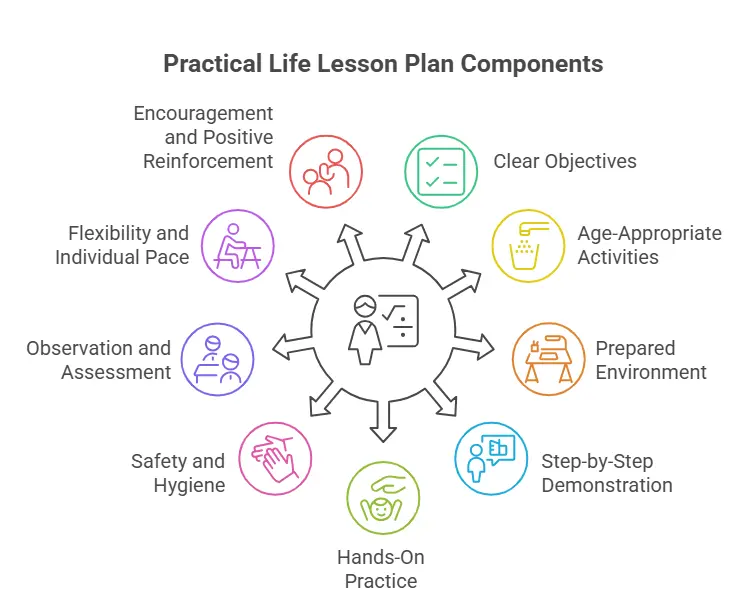
1. Clear Learning Objectives
Purpose of the activity:
Each lesson plan should begin with clear goals that define what the child will learn or practice. Objectives may include improving fine motor skills, encouraging independence, or developing concentration.
-
Focus on one or two skills at a time (pouring, buttoning, wiping).
-
Keep objectives simple and achievable for toddlers.
-
Align activities with daily life tasks to make learning meaningful.
2. Age-Appropriate Activities
Matching tasks to toddler abilities:
Activities must suit the physical and cognitive development of toddlers. Tasks should be simple, safe, and manageable while still offering a small challenge.
-
Examples: spoon transfer, pouring water, folding cloth, washing hands.
-
Avoid complex steps that may frustrate the child.
-
Ensure materials are lightweight and easy to handle.
3. Prepared Environment
Creating a child-friendly learning space:
The environment plays a crucial role in Practical Life lessons. It should be clean, organized, and designed to encourage independence.
-
Use child-sized furniture and tools.
-
Arrange materials neatly on low shelves.
-
Remove distractions to support focus and calmness.
4. Step-by-Step Demonstration
Modeling the activity clearly:
Adults should demonstrate each activity slowly and silently (or with minimal words), showing the correct method.
-
Break the task into simple steps.
-
Use deliberate movements to capture attention.
-
Allow the child to observe before trying.
5. Hands-On Practice
Learning through repetition:
Toddlers learn best by doing. After demonstration, they should be encouraged to try the activity independently.
-
Let the child repeat the activity as many times as needed.
-
Avoid interrupting unless safety is an issue.
-
Build confidence through self-correction and practice.
6. Safety and Hygiene
Ensuring a secure learning experience
Safety is a core part of any toddler lesson plan. All materials should be non-toxic, smooth-edged, and clean.
-
Supervise closely during activities involving water or small objects.
-
Teach basic hygiene like handwashing and cleaning up spills.
-
Use safe, real-life tools instead of plastic toys where possible.
7. Observation and Assessment
Understanding each child’s progress:
Teachers or parents should observe how the toddler performs the task to understand their strengths and needs.
-
Note attention span and coordination.
-
Identify when the child is ready for more advanced tasks.
-
Avoid formal testing; rely on natural observation.
8. Flexibility and Individual Pace
Respecting each child’s rhythm:
Every toddler learns differently. A good lesson plan allows flexibility and adapts to individual interests and abilities.
-
Do not rush the child through activities.
-
Repeat lessons over several days if needed.
-
Modify tasks based on skill level.
9. Encouragement and Positive Reinforcement
Building confidence and motivation:
Emotional support is just as important as physical practice.
-
Praise effort rather than perfection.
-
Use gentle guidance instead of correction.
-
Encourage independence with phrases like “You did it yourself.”
Together, these components form a strong foundation for an effective Practical Life lesson plan for toddlers. By combining structure with flexibility, safety with independence, and guidance with freedom, educators and parents can create meaningful learning experiences that nurture life skills, focus, and self-confidence from an early age.
Benefits of Practical Life Activities for Toddlers
Practical Life Activities are an essential part of early childhood development, especially during the toddler years when children are eager to explore, imitate adults, and gain independence. Rooted in the philosophy of Maria Montessori, these activities involve real-life tasks such as pouring, cleaning, dressing, and food preparation. Though simple in appearance, they offer deep developmental benefits that shape a child’s physical, emotional, social, and cognitive growth. Below are the key benefits of Practical Life Activities for toddlers explained in detail.
1. Promotes Independence and Self-Confidence
One of the greatest benefits of Practical Life Activities is that they encourage toddlers to do things by themselves. Tasks like washing hands, putting on shoes, or tidying up toys help children realize that they are capable individuals. Each successful attempt builds confidence and self-esteem. When toddlers are trusted with real responsibilities, they develop a strong sense of achievement and motivation to try new tasks. This independence also reduces frustration and dependency on adults, fostering a positive self-image from an early age.
2. Develops Fine and Gross Motor Skills
Practical Life Activities involve precise movements such as pouring water, transferring objects with a spoon, buttoning clothes, or folding cloths. These actions strengthen fine motor skills and hand-eye coordination, which are essential for future skills like writing, drawing, and using tools. Activities like carrying trays, sweeping, or walking carefully also improve gross motor control and balance. Through repeated practice, toddlers refine their physical movements in a natural and enjoyable way.
3. Improves Concentration and Focus
When toddlers engage in Practical Life tasks, they learn to complete an activity from beginning to end. These activities require attention, order, and repetition, which gradually increases their ability to concentrate. A child who carefully pours water without spilling or wipes a table with focus is training their mind to stay engaged. This improved concentration later supports academic learning and problem-solving abilities.
4. Builds a Sense of Responsibility and Order
Practical Life Activities teach toddlers to care for themselves and their environment. Cleaning spills, organizing materials, and watering plants help children understand responsibility and respect for their surroundings. They begin to see that their actions have value and purpose. This sense of order creates a calm and structured mindset, helping children feel secure and in control of their environment.
5. Enhances Social and Emotional Development
Through activities such as taking turns, saying “please” and “thank you,” and helping others, toddlers develop social awareness and emotional maturity. These lessons, often referred to as grace and courtesy, teach empathy, patience, and cooperation. Practical Life Activities also help toddlers regulate their emotions by providing purposeful work that reduces restlessness and frustration.
6. Strengthens Cognitive and Problem-Solving Skills
Every Practical Life activity involves steps and sequencing. Toddlers learn how to follow a process: pick up materials, perform the task, and return items to their place. This improves memory, logical thinking, and decision-making. When something goes wrong—such as spilling water—they learn to problem-solve by wiping it up, building resilience and adaptability.
7. Prepares for Academic Learning
Practical Life Activities indirectly prepare toddlers for future academic skills. Pouring and transferring strengthen wrist and finger control needed for writing. Sorting and organizing develop early math and classification skills. Listening and observing during demonstrations enhance language and comprehension abilities. These activities lay the groundwork for structured learning in later years.
8. Encourages Respect for Work and Routine
Toddlers begin to understand the value of routine and purposeful work. By repeating tasks daily, they develop discipline and consistency. This respect for work helps them grow into responsible and organized learners who enjoy completing tasks rather than avoiding them.
Examples of Practical Life Activities for Toddlers
Practical Life Activities help toddlers develop independence, coordination, concentration, and responsibility through simple, real-world tasks. These activities are designed to match a toddler’s natural curiosity and desire to imitate adults. By engaging in hands-on experiences, children learn essential life skills while strengthening their physical, emotional, and cognitive development. Below are detailed examples of Practical Life Activities for toddlers, along with descriptions of their purpose and benefits.
1. Pouring and Transferring Activities
Pouring water from one jug to another, transferring beans with a spoon, or moving objects using tongs are classic Practical Life activities. These tasks require controlled hand movements and careful attention.
Purpose and Benefits:
-
Develop fine motor skills and hand-eye coordination
-
Improve concentration and patience
-
Prepare the hand muscles for writing and drawing
-
Teach cause and effect (what happens if I pour too fast?)
Possible Variations:
-
Pouring water into cups
-
Transferring rice or lentils between bowls
-
Using droppers or ladles
2. Dressing and Self-Care Activities
These include buttoning, zipping, tying shoelaces, brushing hair, washing hands, and wiping the face.
Purpose and Benefits:
-
Encourage independence and self-confidence
-
Improve finger strength and coordination
-
Help toddlers take responsibility for personal hygiene
-
Build self-esteem by completing tasks alone
Possible Variations:
-
Dressing frames (buttons, zippers, Velcro)
-
Practicing putting on shoes and socks
-
Handwashing routines
3. Cleaning and Care of the Environment
Toddlers participate in simple cleaning tasks such as sweeping the floor, wiping tables, watering plants, and arranging toys.
Purpose and Benefits:
-
Develop responsibility and respect for the environment
-
Teach order and organization
-
Improve gross motor skills
-
Foster a sense of belonging and contribution
Possible Variations:
-
Dusting shelves
-
Washing small cloths
-
Sorting toys into baskets
4. Food Preparation Activities
Food-related activities include washing fruits, peeling bananas, spreading butter on bread, or pouring juice into cups.
Purpose and Benefits:
-
Strengthen fine motor control
-
Teach practical life skills used daily
-
Encourage healthy eating habits
-
Boost confidence through real responsibilities
Possible Variations:
-
Cutting soft fruits with child-safe knives
-
Making simple snacks
-
Setting the table
5. Grace and Courtesy Activities
These activities focus on social behavior such as greeting others, saying “please” and “thank you,” waiting for a turn, and offering help.
Purpose and Benefits:
-
Promote social skills and emotional development
-
Teach respect and empathy
-
Build positive communication habits
-
Encourage cooperative behavior
Possible Variations:
-
Role-playing greetings
-
Practicing sharing
-
Learning how to ask for help politely
6. Movement and Coordination Activities
Activities that involve walking carefully, carrying trays, rolling mats, or balancing objects help toddlers refine body control.
Purpose and Benefits:
-
Develop balance and body awareness
-
Improve gross motor skills
-
Teach controlled movement and safety
-
Increase confidence in physical abilities
Possible Variations:
-
Walking on a straight line
-
Carrying water without spilling
-
Climbing and stepping exercises
7. Sorting and Organizing Activities
Toddlers sort objects by size, color, or type and arrange items neatly on shelves or trays.
Purpose and Benefits:
-
Enhance cognitive and logical thinking
-
Teach classification and order
-
Improve attention span
-
Prepare for early math concepts
Possible Variations:
-
Sorting socks
-
Grouping blocks by color
-
Organizing kitchen items
8. Washing and Care Activities
Activities such as washing hands, cleaning toys, or washing small utensils involve water and gentle scrubbing.
Purpose and Benefits:
-
Teach hygiene and cleanliness
-
Improve coordination and sensory awareness
-
Encourage independence
-
Build responsibility
Possible Variations:
-
Washing toy animals
-
Cleaning cups and plates
-
Washing vegetables
9. Folding and Arranging Activities
Folding napkins, towels, or clothes helps toddlers learn order and precision.
Purpose and Benefits:
-
Strengthen fine motor skills
-
Teach neatness and organization
-
Improve concentration
-
Build practical home skills
Possible Variations:
-
Folding hand towels
-
Arranging cloths in baskets
-
Rolling mats
10. Gardening Activities
Gardening tasks include watering plants, planting seeds, and removing dry leaves.
Purpose and Benefits:
-
Teach care for living things
-
Encourage patience and observation
-
Improve physical coordination
-
Build environmental awareness
Possible Variations:
-
Watering indoor plants
-
Planting seeds in pots
-
Collecting fallen leaves
Register for the Entri Elevate Montessori Teacher Training Program! Click here to join!
Conclusion
In conclusion, a Practical Life Activities lesson plan for toddlers helps children learn important life skills in a natural and enjoyable way. Through simple tasks like pouring, cleaning, dressing, and organizing, toddlers gain independence, confidence, and better control of their movements. These activities also teach patience, responsibility, and respect for their surroundings.
By including Practical Life Activities in daily routines, parents and educators can create a calm and meaningful learning environment for young children. Each small task becomes a learning opportunity that supports physical, emotional, and social development. With the right guidance and encouragement, toddlers grow into capable, curious, and happy learners who are ready for future challenges.
Get Certified & Start Your Montessori Career
Montessori Teacher Training Course by Entri App: Gain expert skills, earn certification, and kickstart your teaching career.
Join Now!Frequently Asked Questions
What are Practical Life Activities for toddlers?
Practical Life Activities are everyday tasks that help toddlers learn independence and basic life skills. These include activities such as pouring water, washing hands, dressing themselves, cleaning tables, and organizing toys. They are designed to improve coordination, concentration, and confidence while teaching children how to take care of themselves and their environment.
At what age can toddlers start Practical Life Activities?
Toddlers can begin Practical Life Activities as early as 18 months, depending on their development. Activities should be simple, safe, and suited to their abilities. For younger toddlers, tasks like transferring objects or wiping surfaces are ideal, while older toddlers can try dressing, food preparation, and folding clothes.
How long should a Practical Life activity session last?
A Practical Life activity session can last anywhere from 10 to 30 minutes, depending on the child’s interest and attention span. The key is to let the child work at their own pace without rushing. If the child loses focus, it’s best to stop and try again later rather than forcing the activity.
What materials are needed for Practical Life Activities?
Most materials come from everyday household items such as small jugs, bowls, spoons, cloths, trays, and child-safe tools. Materials should be real, not toy versions, but always safe and child-sized. Using real objects makes the activity meaningful and helps toddlers feel trusted and capable.
How do Practical Life Activities help in child development?
These activities support physical, emotional, social, and cognitive development. They improve fine and gross motor skills, strengthen concentration, teach responsibility, and build self-confidence. Toddlers also learn problem-solving skills and emotional control by completing tasks independently.
Should parents or teachers correct toddlers during activities?
Adults should avoid frequent correction. Instead, they should demonstrate the activity slowly and allow the child to practice independently. Gentle guidance can be given only when needed for safety. Mistakes are part of learning and help children understand how to improve their actions naturally.
Can Practical Life Activities be done at home?
Yes, Practical Life Activities can easily be done at home using daily routines. Tasks like helping in the kitchen, putting toys away, watering plants, and cleaning spills are perfect learning opportunities. Parents can turn ordinary moments into meaningful lessons by involving toddlers in simple household work.
How often should Practical Life Activities be included in a toddler’s routine?
Practical Life Activities can be included daily as part of a child’s routine. Even 2–3 small activities each day can make a big difference. Consistency helps toddlers develop discipline, independence, and confidence over time.