Table of Contents
Robot navigation engineering is the new reality of the world. A technology allowing robots to think, sense and move through the real world without any obstacles.
Autonomous cars, drones, and service robots managing warehouses without human intervention is the reality of the hour and not science fiction anymore.
Robot navigation engineering is an AI-driven system connecting algorithms, mathematics and AI-driven tools. If you’re passionate about robotics and want to be a part of the future that is autonomous, robot navigation engineering is the apt career path that you can opt for to build a high-potential global career opportunity. The world is ready to shape the autonomous future; the real question is, are you?
– Robot navigation engineering is a multidisciplinary field combining AI, robotics, software engineering and control systems.
– Robot navigation engineering focuses on the autonomous movement of robots through known and unknown environments.
– The key function of a robot’s navigation is the localisation, mapping, planning and control of the autonomous movement of the robot.
– Core technologies used in robot navigation engineering include SLAM, LiDAR, IMU, GPS and control sensors.
– Key skills required for the robot navigation engineer include C++, Python, ROS, Kalman and particle filters.
– Robot navigation engineering is a high-demand career which provides Global opportunities and career prospects, with a competitive salary awaiting.
Who is a Robot Navigation Engineer?
A robot navigation engineer is also known as a robotics specialist who builds the system for the robots to move precisely through the known and unknown environment.
A robot navigation engineer is now becoming the high-demand career. The robot navigation engineering industry is booming as it turns into a future-proof career with a high salary and career advancements.

A robot navigation engineer is responsible for the safety while navigating through the real-world environment. The robot navigation engineers aid the robots in navigating without being obstructed. They allow the robots to familiarise themselves with the surroundings and identify their position in the environment they are working with.
The systems will also help the robots to understand the paths and determine the movement through the paths from one point to another without any external interference or influence.
The robot navigation engineers are the ones who facilitate proper navigation facilities for the robots with the assistance of advanced technologies and tools. The robot navigation engineers inculcate mathematical foundations along with the algorithms and robotics tools.
Start learning robotics today! Build strong fundamentals with expert-led training.
How they Work?
They work by using technologies such as LiDAR sensors, SLAM, GPS, IMUs, etc. The AI-driven algorithms help them to navigate and manage their movements from one point to another without human intervention.
The artificial intelligence clubbed with software development tools and techniques, and robotics develops solutions for robotic navigation.
The robotic navigation is widely used in drones, autonomous vehicles, defence sectors, warehouse and industrial automation, and industries that develop service robots on a large scale.
A robot navigation engineer typically focuses on
- Robot localization
- Path planning
- Autonomous navigation algorithm development
- SLAM, LiDAR and computer vision technology development
The average salary range of the robot navigation engineer is as follows-
- Entry Level- $ 85,000-$ 110,000
- Mid Level- $ 110,000- $140,000
- Senior Level-$140,000+
Why Robot Navigation Engineers Are Critical in Autonomous Robotics
The autonomous robots are no longer a future concept but a reality that is increasingly operational. The robotics of our century relies mainly on the navigation systems that are accurate and reliable.
Developing an automated robotic system that relies on a navigation system that is designed for the user to navigate and manage the environment.
Rather than just being a programmable machine, the artificial intelligence makes the robots more self-reliant and autonomous. This can help the robots to understand the paths they ought to travel and navigate the environment without any obstacles.
Robot navigation engineers play a crucial role in the following areas-
- Avoiding the real-time obstacles
- Optimising the dynamic routes
- Facilitating the mobility both indoors and outdoors
- Allows the smooth interaction between humans and robots
The artificial intelligence system allows navigation to be smoother and error-free. The robot navigation engineers are responsible for ensuring the safety, accuracy and efficiency of delivery drones, autonomous taxis and agricultural robots, etc.
The demand for robot navigation engineers is increasing on a daily basis, as they are the professionals who allow the robots to operate without obstacles.
Master Robotics and AI!
Ready to build the future? Join our comprehensive robotics course to bridge the gap between complex code and physical motion. You’ll gain hands-on experience giving you the technical edge needed to lead in the age of automation.
Know MoreUnderstanding Robot Navigation in Modern Robotics
In a real-world dynamic environment, AI has shifted the way autonomous AI-driven systems work to facilitate more reliable services to humankind.
From the autonomous movement of the cars and delivery drones to the warehouse robots, agricultural robots, and cleaning and cooking robots, the AI-driven system has come a long way. Now the robots are moving independently through the known and unknown environment without assistance from human beings.
The navigation system has advanced, which allows the robots to locate themselves both in known and unknown environments. Interpreting, sensing, locating and mapping their surroundings becomes crucial for a robot; and the field of robot navigation engineering came into being.
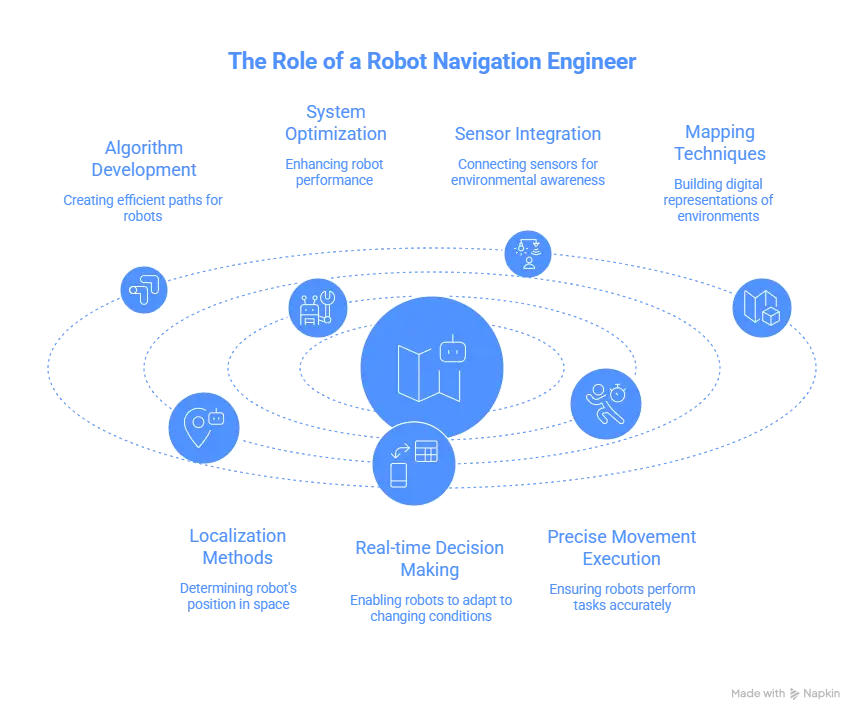
The changing environments, obstacles and complex human interactions challenged their movement. But the robot navigation engineering complied with algorithms, sensors, AI, and control systems to provide the complete autonomous movement to the robots.
The industry is rapidly progressing, and now the robot navigation engineering has gained currency. It has slowly changed into the cornerstone of modern autonomous robotics.
Modern robotics helps in the process of building and maintaining robotic navigation through various processes, such as
- Localisation
- Mapping
- Path planning
- Motion control
Let’s break it down,
- Localisation is the process of understanding where it is placed
- Mapping is the process of understanding and familiarising with the known and unknown environment
- Path planning is the process of deciding the path they ought to take
- Motion control is yet another process of moving safely across without any obstacles
Core Technologies
The modern navigation systems cover the core technologies that can help in facilitating advanced navigation.
SLAM
SLAM, or Simultaneous Localisation and Mapping, allows the robots to develop a map. This map will help to track their location while they are in unknown environments.
LiDAR Sensors
With the help of laser pulses, LiDAR sensors will provide precise distance measurements.
Computer Vision
Visual data from cameras can be obtained and interpreted with the help of computer vision.
Path Planning Algorithms
This is the algorithm for path planning. The paths through which the robots ought to move will be determined by A*, RRT, DWA, and Dijkstra.
The robot navigation engineers combine all these elements into the most reliable systems that can work both in predictable and unpredictable environments.
What Does a Robot Navigation Engineer Do?
The robot navigation engineers will design, develop, implement, test and optimise the autonomous movement of the robots.
Key Responsibilities
Here are the key responsibilities of the Robot Navigation Engineer
- Localisation system development
Development of the positioning system based on GPS, LiDAR, and vision systems
- Mapping systems development
Using SLAM frameworks, the development of the mapping solutions for the smooth movement of robots
- Path planning algorithm development
Computing and development of the algorithms that help in the safe travels of the robots
- Sensor fusion
In order to enhance the accuracy of the movement, data from radar, GPS and LiDAR are combined.
- Simulation and Testing
The navigation can be simulated with the help of tools such as Gazebo, ROS, Python, etc.
- Performance optimisation
Reliability enhancement while reducing the computational load and complexity
- Safety compliance ensuring
To meet the industrial and automotive standards, the safety measures are tested and implemented.
Tools and Skills
The tools and skills that are inevitable for the robot navigation engineers include-
- Framework- ROS
- Programming – C++ , Python
- Mathematics – Probability, Linear Algebra
- AI/ML – particle filters, neural networks, Kalman filters
- Hardware Sensors and embedded systems
- A robot navigation engineer should have a strong grip on software engineering, along with robotics theory, to build a proper system.
Master Robotics and AI!
Ready to build the future? Join our comprehensive robotics course to bridge the gap between complex code and physical motion. You’ll gain hands-on experience giving you the technical edge needed to lead in the age of automation.
Know MoreRobot Navigation Engineer Salary & Career Outlook
The career growth opportunities for the robot navigation engineers are tremendously increasing. With most of the industries moving towards automation, the field of robot navigation engineers looks extremely prosperous.
The career opportunities for the Robot Navigation Engineer include-
- Autonomous Systems Lead
- Senior Navigation Architect
- Robotics Research Scientist
- AI Engineer
- CTO in robotics Startups
The average salary range of the robot navigation engineer is as follows-
| Robot Navigation Engineer | Salary Scale/ year |
| Entry Level | $ 85,000-$ 110,000 |
| Mid Level | $ 110,000- $140,000 |
| Senior Level | $140,000+ |
Robot Navigation Engineer vs Robotics Engineer
A robotics engineer is the one who is responsible for building robots. The robot navigation engineer is the one who determines the movement of the robot by inculcating AI and algorithms.
| Robot Navigation Engineer | Robotics Engineer |
| Movement and navigation focus | Robot design focus |
| SLAM and path planning design | Mechanical and electronic system design |
| Works on AI and sensors | Works on software |
Why This Role Matters in Autonomous Systems
Within an unpredictable environment, the autonomous systems must work by sticking to the safety standards.
Navigation engineers work this out by increasing greenhouse efficiency standards, reducing accidents in autonomous vehicles, enabling delivery drones, supporting disaster response robots, and enabling automation in the agricultural field. The accuracy in navigation facilitates the automation of the robots.
As we are living in a modern environment, the automated operations have slowly turned into a critical need of the hour.
Start learning robotics today! Build strong fundamentals with expert-led training.
Pros and Challenges of Becoming a Robot Navigation Engineer
Here is the list of the pros and challenges of becoming a robot navigation engineer
| Pros | Challenges |
| High salary | Have to deal with complex algorithms. |
| High-standard career | Required high-performance computing |
| Future coverage | Life-long learning |
| International and national interests | Safety concerns |
| Global opportunities | Continuous work on redevelopment |
| Innovation and Security | Constant testing and modification |
The robot navigation engineers need to update their learning every single day. They should also have strong analytical skills.
Educational Path & Certifications
The following are the required educational qualifications for the robot navigation engineers.
- Bachelor’s degree in robotics, mechatronics, computer science, or electrical engineering.
- Master’s degree in computer vision, control systems, AI and Machine Learning, autonomous systems
- Tools and Techniques
-
- ROS
- C++
- Python
- MATLAB
- Simulation Platforms
Certification and Online courses
Here is the list of certifications and online courses that you can depend on to enhance performance
- AI and Machine learning certification
- Entri’s Robotics & AI Course
- Robotics certification
- Certification in Autonomous Systems
- Practical Project Experience
Conclusion
Robot navigation engineers are in high demand as the field is gaining popularity day by day. Autonomous innovations are the need of the hour, and this can be easily facilitated by the robot navigation engineers.
They are responsible for designing and developing systems that will help the machines to perceive, analyse and interpret the environment they are placed in. Automation is increasingly inculcated in the working of industries, which in turn creates the urgent demand for robot navigation engineers.
Aspiring robot navigation engineers can make use of this opportunity to build a strong foundation in robot navigation, as the career offers highly rewarding opportunities.
Master Robotics and AI!
Ready to build the future? Join our comprehensive robotics course to bridge the gap between complex code and physical motion. You’ll gain hands-on experience giving you the technical edge needed to lead in the age of automation.
Know MoreFrequently Asked Questions
Who is a robot navigation engineer?
A robot navigation engineer is responsible for the safety while navigating through the real-world environment. The robot navigation engineers aid the robots in navigating without being obstructed.
What are the key skills required for the robot navigation engineer?
Key skills required for the robot navigation engineer include C++, Python, ROS, Kalman and particle filters.
Whart is the significance of a robot navigation engineer in today's world?
Navigation engineers work this out by increasing greenhouse efficiency standards, reducing accidents in autonomous vehicles, enabling delivery drones, supporting disaster response robots, and enabling automation in the agricultural field.
What is path planning algorithm?
This is the algorithm for path planning. The paths through which the robots ought to move will be determined by A*, RRT, DWA, and Dijkstra.
What is SLAM?
SLAM, or Simultaneous Localisation and Mapping, allows the robots to develop a map. This map will help to track their location while they are in unknown environments.