Table of Contents
Proper interview guidance is important to tackle this aggressive field. Advance preparation positively helps applicants explain complex ideas, demonstrate hands-on project experience, and answer position-based questions effectively. It also reduces jitter and improves readability at certain points in technical discussions. Understanding the most common questions helps candidates focus on strengthening weak areas and deliver their talent in the established way.
In this article, you will gain a comprehensive understanding of the most important robotics engineer interview questions and detailed sample answers. You may also even discover about key technical topics frequently examined in interviews, behavioral questions to count on, and sensible suggestions to decorate your overall performance. Whether you’re a graduate or an skilled expert, this manual will assist you approach your robotics engineering interview with self assurance and clarity.
Start learning robotics today! Build strong fundamentals with expert-led training.
Introduction
Robotics engineering is a multidisciplinary area that combines mechanical engineering, electric engineering, pc technological know-how, and artificial intelligence to layout, build, and operate robots. These robots can variety from business machines utilized in production vegetation to self sustaining cars, medical surgical robots, drones, and carrier robots utilized in everyday lifestyles. Robotics engineers are liable for developing intelligent structures which could sense their surroundings, procedure facts, and carry out responsibilities with precision and performance. As generation continues to conform, robotics is playing a essential function in industries consisting of healthcare, defense, agriculture, logistics, and space exploration.
Because robotics engineering integrates a couple of technical domains, interviews for these roles are frequently rigorous and tremendously technical. Employers compare now not handiest theoretical know-how however also practical abilties, problem-fixing capability, programming understanding, and know-how of hardware structures. Candidates may be asked approximately kinematics, control systems, sensors, actuators, embedded systems, artificial intelligence, and programming frameworks like ROS. In addition to technical information, organizations additionally check communique capabilities, teamwork, and the potential to address actual-world demanding situations.
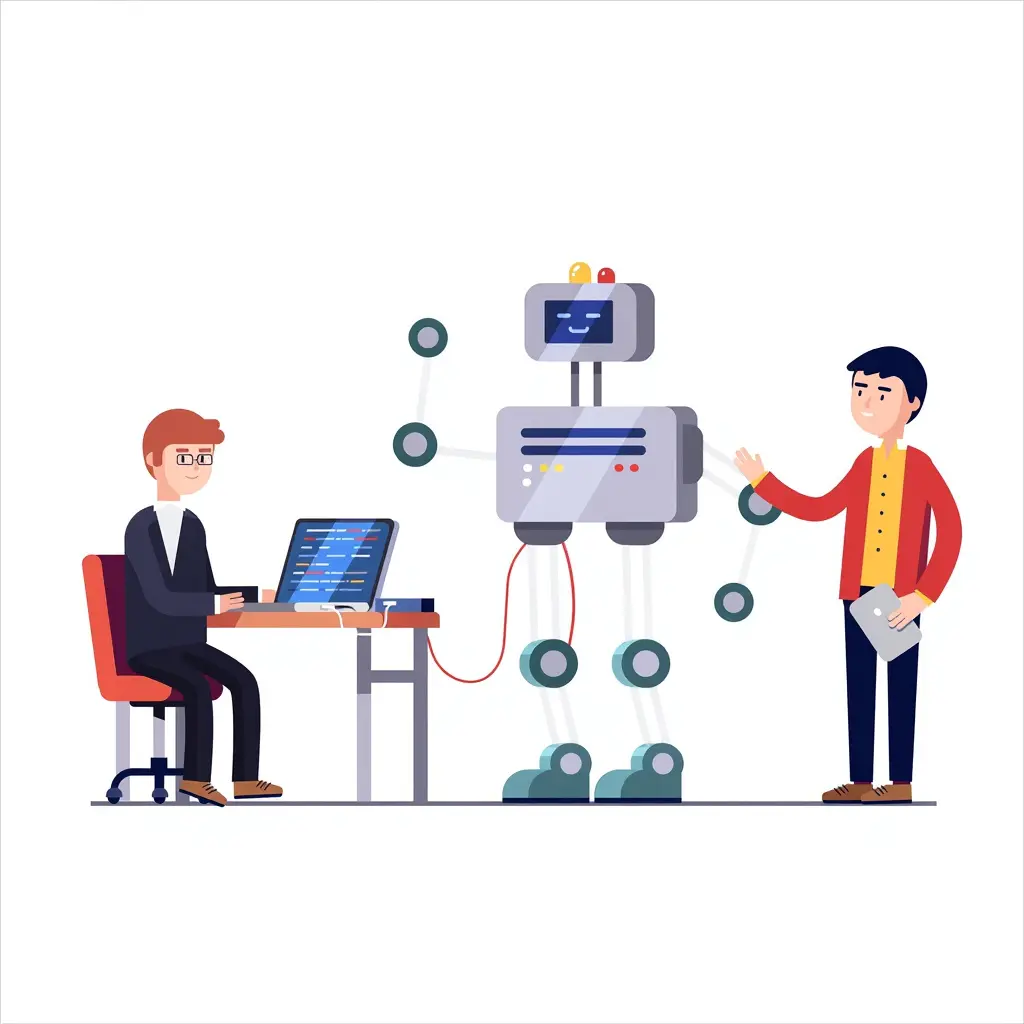
Roles & Responsibilities of a Robotics Engineer
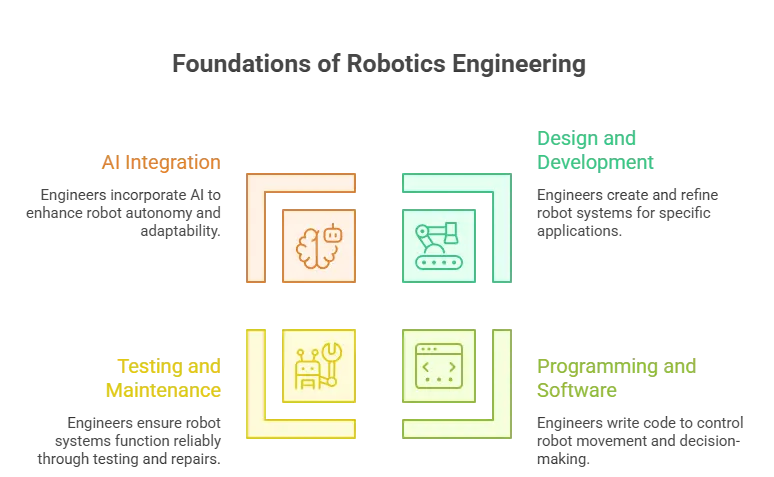
1. Design and Development of Robotic Systems
Robotics engineers are answerable for designing and developing robot systems tailored to particular industrial or commercial applications. This procedure begins with information undertaking necessities and creating particular gadget designs, which include mechanical structures, electrical circuits, and manipulate architectures. Engineers pick suitable components together with automobiles, sensors, actuators, and controllers to make certain greatest performance. They also create prototypes and use simulation gear to check feasibility before very last manufacturing. Safety, efficiency, durability, and price-effectiveness are key concerns at some stage in the improvement degree.
2. Programming and Software Development (C++, Python, ROS, etc.)
Programming is a core responsibility in robotics engineering. Engineers write and optimize code that controls robotic movement, notion, and choice-making methods. Common programming languages include C++ and Python, whilst frameworks like Robot Operating System (ROS) assist combine numerous hardware and software components. Tasks consist of motion planning, sensor records processing, pathfinding algorithms, and real-time manage systems. Strong coding talents make certain robots perform smoothly, reply accurately to inputs, and carry out tasks efficaciously.
3. Testing, Troubleshooting, and Maintenance
After development, robotics engineers behavior great testing to validate system capability and performance. They run simulations and real-international trials to hit upon errors or inefficiencies. Troubleshooting includes diagnosing issues related to hardware malfunctions, software program insects, communication screw ups, or sensor inaccuracies. Engineers put into effect corrective measures and optimize machine performance. Regular renovation, firmware updates, and calibration also are crucial to make certain lengthy-term reliability and operational protection.
4. AI and Machine Learning Integration
Modern robotics is based closely on synthetic intelligence and machine mastering to decorate autonomy and adaptability. Robotics engineers combine AI techniques along with laptop vision, item popularity, and reinforcement learning into robotic systems.These era permit robots to analyze facts, learn from enjoy, and make smart picks in dynamic environments. AI integration improves navigation, impediment avoidance, and undertaking precision, making robots more green and succesful at some point of various industries.
Master Robotics and AI!
Ready to build the future? Join our comprehensive robotics course to bridge the gap between complex code and physical motion. You’ll gain hands-on experience giving you the technical edge needed to lead in the age of automation.
Know MoreTechnical Interview Questions and Answers
A. Core Robotics Concepts
1. What do you meant by robotics?
Answer: Robotics is an interdisciplinary branch of engineering and technological understanding that focuses on the design, construction, function and programming of robots. It integrates mechanical systems, electronics, sensors, control structures and artificial intelligence to create machines capable of performing tasks routinely or semi-autonomously.
2. Explain what is forward kinematics.
Answer: Forward kinematics determines the placement and orientation of a robotic’s quit-effector based totally on recognized joint angles and hyperlink parameters. It is commonly utilized in robot fingers to calculate the final position from given inputs.
3. Explain what is inverse kinematics.
Answer: Inverse kinematics calculates the desired joint angles to reap a selected quit-effector function. It is more complicated than ahead kinematics and essential for precise robot manipulation.
4. What are the Degrees of Freedom (DOF)?
Answer: DOF refers to the variety of unbiased moves a robotic can carry out. A 6-DOF robot can flow alongside 3 axes (X, Y, Z) and rotate approximately them.
5. Difference among open-loop and closed-loop control systems?
Answer: Open-loop structures operate with out comments and can’t accurate errors. Closed-loop structures use remarks to observe output with the favored result and automatically modify usual overall performance.
6. What is a robotic manipulator?
Answer: A robot manipulator is a mechanical arm with joints and links designed to address substances or device.
7. What is workspace?
Answer:Workspace is the overall place inside which a robotic can function or reach.
8. What is a control system?
Answer: A control device regulates robotic behavior by processing input alerts and generating appropriate outputs.
B. Programming & Software
9. Which programming languages are used in robotics?
Answer: The common languages consist of C, Python, MATLAB, and Java. C and Python are extensively used with the ROS for robot manipulate and AI integration.
10. Explain ROS (Robot Operating System).
Answer: The ROS is an open-source middleware that provides libraries, tools, and communication infrastructure for developing the robotic applications using nodes, topics, and services.
11. What is SLAM?
Answer: SLAM (Simultaneous Localization and Mapping) enables a robot to build a map of an unknown environment while tracking its position within it.
12. What is meant by path planning?
Answer: Path planning identifies the optimal route from a start point to a goal while avoiding the obstacles.
13. What is meant by motion planning?
Answer: Motion planning calculates joint movements required to safely and efficiently execute tasks.
14. How do you debug the robotic code?
Answer: Debugging involves simulations, logging outputs, hardware testing, using breakpoints, and validating the sensor data to isolate errors.
15. What is meant by Gazebo?
Answer: The Gazebo is a 3D robotics simulator used with ROS to test algorithms in virtual environments.
16. What are real-time systems?
Answer: The Real-time systems process inputs and generate outputs within the strict timing constraints to ensure immediate responses.
C. Electronics & Hardware
17. What kinds of sensors are used in robotics?
Answer: Robots use ultrasonic sensors, LiDAR, infrared sensors, cameras, accelerometers, gyroscopes, encoders, and proximity sensors to acquire environmental information.
18. What are actuators?
Answer: Actuators convert electric alerts into mechanical motion. Examples include DC vehicles, servo vehicles, and hydraulic systems.
19. Explain PID control.
Answer: PID control makes use of proportional, indispensable, and spinoff additives to decrease error and stabilize system output.
20. What is a servo motor?
Answer: A servo motor is a rotary actuator that allows particular control of angular function.
21. Microcontrollers vs microprocessors?
Answer: Microcontrollers combine CPU, reminiscence, and peripherals on one chip for embedded obligations. Microprocessors are extra effective however require outside additives.
22. What is an encoder?
Answer: An encoder gives feedback on function, pace, and path of rotating components.
23. What is power management?
Answer: Power management guarantees efficient electricity intake and battery optimization in robotic structures.
D. AI & Machine Learning in Robotics
24. What are the role of computer vision in robotics field?
Answer: Computer vision lets in robots to interpret visible statistics for object detection, navigation, inspection, and excellent manage.
25. What are path planning algorithms?
Answer: Algorithms consisting of A*, Dijkstra’s, RRT, and D* calculate most useful navigation paths in complex environments.
26. What do you meant by reinforcement learning?
Answer: Reinforcement getting to know is a device getting to know approach in which dealers learn highest quality movements thru rewards and penalties.
27. What do you meant by supervised learning?
Answer: Supervised studying trains fashions the usage of categorized datasets to understand styles and make predictions.
28. What is object recognition?
Answer: Object popularity identifies and classifies objects in photographs the use of AI models and characteristic extraction techniques.
29. What is sensor fusion?
Answer: Sensor fusion combines statistics from more than one sensors to enhance accuracy, reliability, and environmental understanding.
30. How is AI improving robotics?
Answer: AI enhances robotic autonomy, adaptability, choice-making, and precision. It enables robots to examine from records, modify to dynamic environments, and carry out complex tasks efficiently.
Scenario-Based/ Practical Interview Questions
1. How might you design a robotic arm for assembly responsibilities?
Answer: To design a robot arm for assembly, I could first define challenge requirements which include payload potential, precision, velocity, and workspace. Then, I might determine the desired Degrees of Freedom (typically 5–6 DOF for flexibility). Next, I might choose appropriate actuators (servo or stepper vehicles), sensors (encoders for role remarks), and substances for sturdiness. I could model the arm the use of CAD software and simulate movement earlier than prototyping. Control algorithms like PID would make certain specific movement, and ROS could manipulate communication among hardware and software. Testing could encompass accuracy validation, load testing, and safety checks before deployment.
2. A robot is not reaching its target accurately. How could you troubleshoot?
Answer: I could first test sensor calibration, especially encoders and role sensors. Then, I could examine the manipulate system parameters, specially PID tuning. I could look into mechanical additives for wear or backlash. Next, I would verify software calculations for kinematics mistakes. Simulation gear ought to assist isolate whether the difficulty is mechanical or algorithmic.
3. How might you construct an autonomous mobile robot?
Answer: I would begin with defining navigation desires and surroundings kind. Hardware choice could include motors, LiDAR, cameras, and microcontrollers. For software, I would put in force SLAM for mapping and localization, along with path making plans algorithms like A*. ROS could handle verbal exchange. Testing would arise in simulation before real-world trials.
4. How would you deal with sensor failure throughout operation?
Answer: I would put into effect redundancy thru sensor fusion. If one sensor fails, others can compensate. Real-time diagnostics would come across anomalies. The robotic should switch to safe mode until upkeep are made.
5. Design a robotic system for warehouse automation.
Answer: The device might consist of cell robots with barcode scanners and impediment detection sensors. AI-based totally route making plans could optimize routes. Cloud connectivity might song stock. Safety mechanisms would prevent collisions.
6. How might you optimize robot battery existence?
Answer: I might use green automobiles, optimize code to lessen processing load, enforce sleep modes, and monitor electricity consumption using strength control systems.
Interview Tips for Robotics Engineers
1. Portfolio Preparation
A strong portfolio is one of the maximum powerful equipment in a robotics interview. Instead of most effective listing projects to your resume, prepare a well-established portfolio that showcases your realistic paintings. Include specific descriptions of robotics initiatives, your specific role, technology used (e.G., ROS, Python, C , SLAM, PID manipulate), and measurable outcomes. Add photos, CAD designs, circuit diagrams, GitHub links, simulation screenshots, or demo videos if possible.
Clearly give an explanation for the trouble declaration, your method, challenges confronted, and final outcomes. Employers price applicants who can show actual-international utility of principles. If you labored on team initiatives, specify your character contributions. Keep your portfolio prepared, concise, and smooth to navigate—both as a PDF, non-public internet site, or GitHub repository.
2. Demonstrating Hands-On Experience
Robotics is rather realistic, so interviewers search for candidates who’ve implemented theoretical expertise in actual eventualities. Be prepared to discuss internships, lab paintings, competitions, research, or personal robotics builds.
When explaining your experience, focus on:
- Hardware integration (sensors, actuators, microcontrollers)
- Programming implementation (ROS nodes, route planning, debugging)
- Testing and troubleshooting methods
- Performance improvements you executed
Use precise examples. Instead of announcing “I labored on a robotic arm,” provide an explanation for the way you designed the kinematics, tuned PID controllers, or optimized motion accuracy. Quantifying results (e.G., advanced efficiency by 20%) makes your experience more impactful.
3. Explaining Technical Concepts Clearly
In robotics interviews, technical understanding isn’t always sufficient—you should communicate it without a doubt. Practice explaining complicated subjects like inverse kinematics, SLAM, or reinforcement gaining knowledge of in easy, dependent language.
Use step-by means of-step reasons:
- Define the idea briefly.
- Explain how it works.
- Provide a sensible instance.
Avoid overusing jargon until important. Interviewers might also take a look at your depth by using asking observe-up questions, so ensure you understand the fundamentals. Good verbal exchange shows confidence, readability of thought, and strong engineering reasoning.
4. Common Mistakes to Avoid
- Giving vague or theoretical answers without practical examples.
- Failing to revise core concepts like control systems and kinematics.
- Not preparing for behavioral or scenario-based questions.
- Overstating skills you cannot confidently explain.
- Ignoring safety, testing, and real-world constraints in answers.
Start learning robotics today! Build strong fundamentals with expert-led training.
Master Robotics and AI!
Ready to build the future? Join our comprehensive robotics course to bridge the gap between complex code and physical motion. You’ll gain hands-on experience giving you the technical edge needed to lead in the age of automation.
Know MoreConclusion
Preparing for a robotics engineer interview calls for a robust stability of theoretical information, sensible enjoy, and clean verbal exchange capabilities. From studying core standards like kinematics, manage structures, and ranges of freedom to knowledge programming tools such as C , Python, and ROS, candidates must demonstrate each intensity and flexibility. In addition, understanding of electronics, sensors, actuators, and AI technologies like pc imaginative and prescient and reinforcement mastering performs a essential role in nowadays’s advanced robotics landscape.
Beyond technical know-how, employers additionally look for hassle-solving ability, teamwork, adaptability, and real-international undertaking experience. Scenario-based and behavioral questions are designed to assess how efficaciously you may practice your understanding in practical conditions. A properly-organized portfolio, structured answers, and the ability to give an explanation for complicated thoughts absolutely can significantly enhance your chances of success.
By very well reviewing commonplace interview questions, practising hands-on capabilities, and staying up to date with emerging technologies, you could approach your robotics engineering interview with self assurance and professionalism. With the right preparation, you’ll be properly-prepared to secure opportunities on this innovative and swiftly evolving discipline.
Master Robotics and AI!
Ready to build the future? Join our comprehensive robotics course to bridge the gap between complex code and physical motion. You’ll gain hands-on experience giving you the technical edge needed to lead in the age of automation.
Know MoreFrequently Asked Questions
What qualifications are required to become a robotics engineer?
Most robotics engineers hold a bachelor’s degree in robotics engineering, mechanical engineering, electrical engineering, computer science, or a related field. Advanced roles may require a master’s degree or specialization in AI, automation, or control systems. Strong knowledge of mathematics, programming, electronics, and mechanics is essential. Certifications in ROS, embedded systems, or machine learning can also strengthen your profile.
What technical skills are most important for robotics interviews?
Key technical skills include kinematics, control systems, programming (C++, Python), ROS, sensor integration, embedded systems, and basic AI concepts. Employers also expect knowledge of path planning, SLAM, PID control, and real-time systems. Practical experience with hardware and debugging is highly valued.
Is ROS mandatory for robotics jobs?
While not always mandatory, ROS (Robot Operating System) is widely used in research and industry. Many companies expect candidates to have at least basic familiarity with ROS concepts such as nodes, topics, services, and packages. Hands-on ROS project experience can significantly improve job prospects.
How can fresh graduates prepare for robotics interviews?
Fresh graduates should focus on strengthening core concepts, building small robotics projects, participating in competitions, and contributing to open-source platforms. Creating a strong GitHub portfolio and practicing common interview questions can help demonstrate practical skills despite limited work experience.
What types of projects should I include in my portfolio?
Include projects that demonstrate hardware integration, programming, control systems, and AI implementation. Examples include robotic arms, autonomous mobile robots, drones, line-following robots, object detection systems, or SLAM-based navigation systems. Highlight your individual contributions and measurable results.
How important are problem-solving skills in robotics interviews?
Problem-solving skills are extremely important because robotics involves real-world challenges such as sensor noise, hardware failures, and algorithm optimization. Interviewers often ask scenario-based questions to evaluate your analytical thinking and troubleshooting approach.
What behavioral qualities do employers look for in robotics engineers?
Employers look for teamwork, communication skills, adaptability, attention to detail, and the ability to work under pressure. Robotics projects are multidisciplinary, so collaboration and clear communication are essential.
What is the average salary of a robotics engineer?
Salaries vary based on location, experience, and industry. Entry-level robotics engineers may earn moderate salaries, while experienced professionals working in AI-driven automation, aerospace, or advanced manufacturing can earn significantly higher pay.
How can I improve my chances of clearing technical interviews?
Practice explaining concepts clearly, revise fundamentals, work on hands-on projects, and conduct mock interviews. Reviewing common technical and behavioral questions helps build confidence and reduces nervousness.
Is robotics engineering a good career choice for the future?
Yes, robotics is a rapidly growing field with increasing demand in automation, healthcare, logistics, defense, and AI applications. With continuous advancements in artificial intelligence and smart technologies, robotics engineering offers strong career growth and innovation opportunities.