Table of Contents
Robotic engineers provide robotic applications for a wide range of sectors, such as manufacturing, aerospace, healthcare, military, agriculture, and many more. They create, construct, and run a robot and a robot system. Robotics engineers are in great demand worldwide since they are essential to the latest developments in technology and innovation. They also get a high average compensation for the important portion of their employment. This article will discuss the typical income for robotics engineers in Germany as well as the key factors that contribute to their higher earning potential.
Step into the Future of Robotics! Learn the Basics Today – Enroll Now!
Overview of Robotics Engineering in Germany
To begin, let us take a quick look at the situation before we move on to discussing the financial aspects of the issue. The creation of automated systems or robots, as well as their testing and construction, fall under the purview of a robotics engineer. Industrial arms, autonomous mobile robots, medical robots, and research initiatives at universities are all examples of projects that you might be working on. Having a bachelor’s degree in computer science, electrical engineering, mechanical engineering, or a field that is closely related is typically required for these professions. On the other hand, having a master’s degree or a specialization can sometimes improve your chances of finding work in the field.
Average Robotics Engineer Salary in Germany
Due to the fact that the government of Germany supports modern manufacturing, automation, and engineering, Germany is an excellent destination for roboticists to search for employment. Robotics engineers can earn a good living depending on their skills, experience, and where they live. The starting wage for an engineer often falls around between fifty thousand and sixty thousand euros. The integration of artificial intelligence, robotic design, and industrial automation can result in annual incomes that are greater than €80,000. All three cities of Frankfurt, Stuttgart, and Munich have robust industrial and automotive industries, which contributes to the high pricing of these cities. A profession in robotics engineering is not only secure and appealing in Germany, but it also offers a great deal of untapped potential for advancement.
| Experience Level | Typical Salary (€) | Notes |
|---|---|---|
| Entry-Level (0–3 yrs) | 50,000 – 60,000 | Gaining practical experience and learning tools/software |
| Mid-Level (3–7 yrs) | 60,000 – 70,000 | Handle projects independently, may start specializing |
| Senior (7+ yrs) | 70,000 – 80,000+ | Experts or team leads, specialized in AI/automation |
| Top Specialists | 80,000+ | Advanced skills in industrial robotics, R&D, or management roles |
Master Robotics and AI!
Ready to build the future? Join our comprehensive robotics course to bridge the gap between complex code and physical motion. You’ll gain hands-on experience giving you the technical edge needed to lead in the age of automation.
Know MoreAverage Robotics Engineer Salary in Germany By Cities
Due to variations in living costs, demand for automation competence, and concentration of industrial businesses, the remuneration of Robotics Engineers in Germany differs by city. Salary ranges are higher in cities that are hubs for electronics, manufacturing, and automobiles. For instance, owing to the concentration of top engineering and robotics companies in larger cities like Frankfurt, Stuttgart, and Munich, the wages in these areas tend to be higher, but smaller cities or eastern regions may provide slightly lower wages. Expert Robotics Engineers in in-demand areas can command salaries of €80,000 to €50,000 per year, on top of the typical salary range. Picking the right city for your work can have a major influence on your income and advancement prospects.
| City | Average Salary (€) | Notes |
|---|---|---|
| Munich | 65,000 – 80,000 | High cost of living, major tech & automotive hub |
| Stuttgart | 63,000 – 78,000 | Strong industrial and automotive presence |
| Frankfurt | 62,000 – 75,000 | Large tech and finance industries |
| Berlin | 58,000 – 70,000 | Growing robotics and startup scene |
| Hamburg | 57,000 – 68,000 | Focus on shipping, automation, and manufacturing |
| Leipzig | 50,000 – 60,000 | Lower cost of living, smaller industrial demand |
Average Robotics Engineer Salary in Germany By Education
There is a significant relationship between the amount of money that a Robotics Engineer earns in Germany and the level of education that they have as a professional. On the other hand, engineers who have a Master’s or PhD degree in robotics, mechatronics, or a field that is comparable typically make a lot more than that because of their advanced research abilities and technical proficiency at the beginning of their careers. Those engineers who have a Bachelor’s degree might anticipate a good starting income. There is a possibility that you may be able to earn a higher salary if you possess specialist certifications in subject areas such as industrial automation, control systems, and artificial intelligence. Robotics’ potential for financial gain. For engineers who have a Bachelor’s degree, the annual pay can vary from €50,000 to €65,000; for those who have a Master’s degree, the salary can range from €60,000 to €75,000; and for those who have a PhD program or are highly specialized, the annual compensation can be €75,000 or more.
| Education Level | Typical Salary (€) | Notes |
|---|---|---|
| Bachelor’s Degree | 50,000 – 65,000 | Entry-level positions, foundational roles |
| Master’s Degree | 60,000 – 75,000 | More responsibilities, specialized projects |
| PhD / Specialist | 75,000+ | Research roles, R&D, advanced robotics projects |
| Certifications (AI, Automation, etc.) | +5,000 – 10,000 bonus potential | Enhances expertise and salary prospects |
New to Robotics? Start from the Basics. Join Now!
Master Robotics and AI!
Ready to build the future? Join our comprehensive robotics course to bridge the gap between complex code and physical motion. You’ll gain hands-on experience giving you the technical edge needed to lead in the age of automation.
Know MoreAverage Robotics Engineer Salary in Germany By Experience
As a German robotics engineer gets more experience, their compensation increases up. Entry-level engineers get a fair starting salary and get to work on robotics projects to learn more about the technology. Engineers with three to seven years of experience can work on their own and choose to focus on either AI integration or industrial automation. This lets them make more money. Senior engineers and team leaders with more than seven years of experience also help junior engineers learn, work on sophisticated robotic systems, and run huge projects. They also make more money. The amount of experience a robotics worker has is one of the most important variables that determines how much they make.
| Experience Level | Typical Salary (€) | Notes |
|---|---|---|
| Entry-Level (0–3 yrs) | 50,000 – 60,000 | Getting more hands-on training in the software field |
| Mid-Level (3–7 yrs) | 60,000 – 70,000 | Takes on projects on their own and may focus on AI or automation |
| Senior (7+ yrs) | 70,000 – 80,000+ | Runs projects, guides younger workers, and works on complex robotics systems |
In Germany, there are a number of elements besides experience that determine a Robotics Engineer’s income. Professionals can strategically plan their career growth and demand greater pay by understanding these elements.
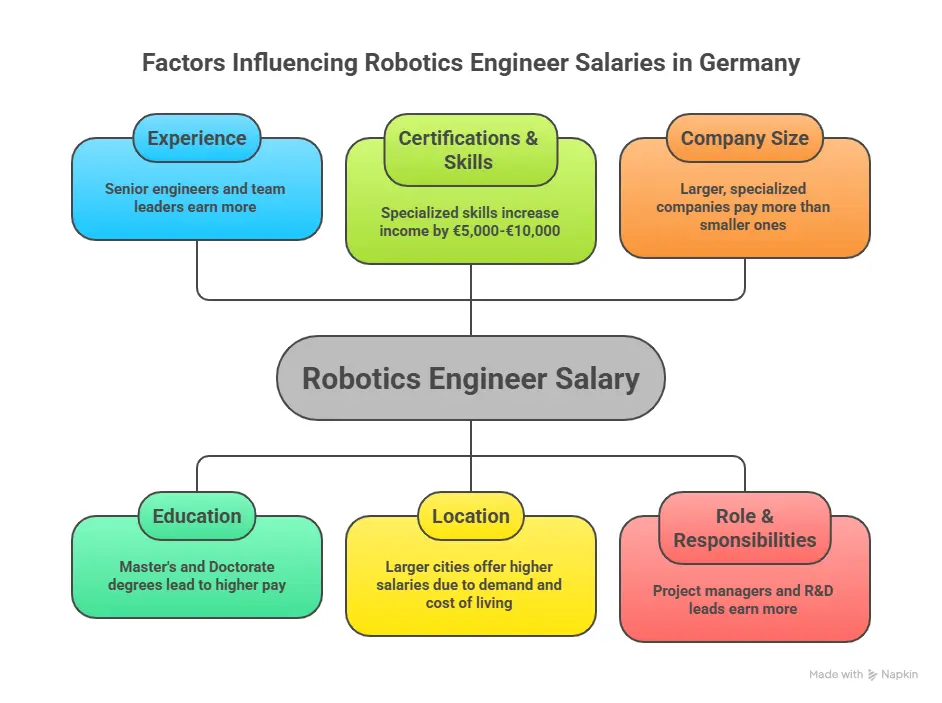
- Salary is directly proportional to years of experience in the field of robotics or automation. Earnings for senior engineers and team leaders are substantially higher than those for entry-level engineers.
- Gaining a Master’s or Doctorate degree can open doors to higher-paying jobs in research, artificial intelligence, and industrial robotics, among other fields.
- Certifications and specialized skills can increase a basic income by €5,000 to €10,000. Skill sets in artificial intelligence (AI), industrial automation (IA), control systems (CS), or robotics programming (RPG) can do the same.
- Salary ranges from lower in smaller towns to higher in larger cities like Munich, Stuttgart, and Frankfurt, owing to increased demand and higher living expenses.
- Pay is generally higher in larger, more specialized robotics companies or global corporations than in smaller, more locally based businesses.
- Engineers who manage projects, lead teams, or work on research and development initiatives often make more money.
Benefits and Work Environment
It is possible to earn a good salary and work in an environment that encourages collaboration and innovation in Germany. It is because of Germany’s robust engineering culture, its emphasis on technology, and its acceptable working conditions that the country is able to recruit experts in robotics and automation. Work-life balance, professional development, and job satisfaction are all areas that give benefits to employees of organizations.
- In addition to other benefits, employees are provided with health insurance and Social Security.
- Employees receive between 25 and 30 days of paid leave and holidays from the government each year. Holidays are also included in this benefit.
- Workshops, certifications, and conferences devoted to engineering or robotics are all examples of professional development opportunities.
- A great number of businesses provide hybrid work arrangements or flexible scheduling options.
- In progressive workplaces, cutting-edge robots, automation, and artificial intelligence technologies are utilized.
- There are set routes to senior jobs, project directors, and research and development specialists that are included in career growth.
- Growth in Germany’s robots and automation sectors has resulted in the creation of both short-term and long-term employment opportunities available.
Career Outlook for Robotics Engineers in Germany
Due to the country’s high level of automation, innovative business ideas, and advanced manufacturing, Germany is an excellent location for experts working in the field of robotics. Some of the most successful manufacturing, aerospace, and automotive companies in the world are located in Germany. Research and development, making things more efficient, and doing things more accurately are all areas in which these companies rely on robots’ assistance. There will always be chances for employment for robot engineers in the fields of industrial robotics, autonomous systems, artificial intelligence integration, and smart manufacturing. This is due to the growing demand for robot engineers in these areas. The culture of start-ups that exists in Berlin and other innovation areas has resulted in engineers working on new robotics projects.
In addition, there are many possibilities for advancement and specialization in the field of Robotics Engineering in Germany. Experts can go to management jobs supervising automation projects, research and development, or senior engineering. Expert engineers in programming, control systems, and robotic design will be in great demand as artificial intelligence (AI), machine learning (ML), and Industry 4.0 (I4.0) continue to evolve. If you are a robotics expert with a love for technology and creativity, Germany offers a steady and lucrative career path.
Step into the Future of Robotics! Learn the Basics Today – Enroll Now!
Final Thoughts
Beginning a career as a Robotics Engineer in Germany offers a number of benefits, including the opportunity to earn rich income, grow in one’s professional career, and gain access to cutting-edge technology. There are a number of famous locations in Germany, like Munich, Stuttgart, and Berlin, where engineers have the opportunity to choose roles that correspond with their skills and the lifestyle they prefer. However, benefits such as health insurance, paid leave, professional advancement, and a work atmosphere that is conducive to success boost the attraction of the career. Factors such as experience, education, specialized abilities, and the size of the organization all have a significant impact on pay. Robotics Engineers in Germany may anticipate sustainable employment, engaging projects, and ongoing professional advancement as a result of the advent of automation and Industry 4.0. This makes the field of robotics engineering a highly attractive field for both recent graduates and seasoned professionals.
|
RELATED POSTS |
|
|
Skills Needed for a Successful Career in Robotics Engineering |
|
|
What is Robotics? A Beginner’s Guide to Understanding Robotics |
|
Master Robotics and AI!
Ready to build the future? Join our comprehensive robotics course to bridge the gap between complex code and physical motion. You’ll gain hands-on experience giving you the technical edge needed to lead in the age of automation.
Know MoreFrequently Asked Questions
Which cities in Germany pay the highest for Robotics Engineers?
Munich, Stuttgart, and Frankfurt offer the highest salaries due to demand and cost of living, while cities like Leipzig or smaller towns pay slightly less.
What industries hire Robotics Engineers in Germany?
Major industries include automotive, aerospace, manufacturing, AI & automation, and robotics startups.
Can I start a robotics career without prior experience?
Yes! Many courses and entry-level roles allow beginners to learn the basics, gain hands-on skills, and grow into advanced positions.
Are robotics jobs in Germany suitable for international professionals?
Absolutely. Germany welcomes skilled professionals, and many companies offer support for work visas, relocation, and English-friendly workplaces, especially in tech hubs.
Does education level affect a Robotics Engineer’s salary?
Yes. Master’s or PhD holders generally earn more than Bachelor’s degree holders. Certifications in AI, industrial automation, or control systems can also increase pay.