Table of Contents
Are you looking for a career in the cybersecurity domain? If yes, start your interview preparation at the earliest to secure a financially stable and highly prestigious career opportunity as a SOC analyst. Learn how to crack the SOC Analyst interview easily here!
Introduction to the SOC Analyst Role
An SOC analyst, or security operations centre analyst, is responsible for protecting organisations from being exposed to cyberattacks. The organisations are safe under the responsible supervision of SOC analysts. SOC analysts are known for their keen observational skills. The SOC analyst monitor movements within the organisations and eliminate the threats on the spot. They analyse the applications, systems and networks. They develop applications that are powerful enough to eliminate cyber threats and attacks. The business of an organisation goes uninterrupted with the help of SOC analysts. The security is guaranteed if the SOC analyst you hire is experienced and capable enough to manage issues effectively. The SOC analyst monitors the system and network and works to handle the threat alerts more logically. Tools such as the SIEM platform allow the SOC analyst to identify the errors and vulnerabilities in the system and respond promptly. The SOC analysts should have strong analytical skills and problem-solving capabilities; they should respond to the details after analysing the problem and should develop strong stress management strategies to keep themselves calm in chaotic situations. Levels (L1) and (L2) are the two analytical wings of the SOC roles. The Level 1 and Level 2 analysts have different senses of representation and responsibilities. The interviewer will ask questions to get clarity on the level of your practical and theoretical understanding of the various cybersecurity topics. Once you attend the SOC analyst interview, you should have a thorough knowledge of the fundamentals of cybersecurity, analysis of the logs, prompt response to sudden changes, and familiarity with the tools that are widely used for SOC analysis. With proper guidance, you will get clarity on the basic preparation methods.
Enroll in Entri’s AI-Powered Cybersecurity course now!
SOC Analyst Interview Questions for Freshers
The cybersecurity concepts are being discussed by the interviewers with the freshers, as they are new to the domain. They can expect questions related to cyberspace and security, SOC and learning quests.
- What is SOC?
- Who is an SOC analyst?
- What is the major job role of a SOC analyst?
- What are the key responsibilities of an SOC analyst?
- What are the functions of an SOC analyst?
- Define an incident?
- Elaborate on false positives?
- Define an alert.
- What is malware?
- What is a firewall?
- Define IDS.
- What are the key differences between authentication and authorisation?
- What is antivirus software?
- Elaborate on IPS.
- What is endpoint security?
- What is threat intelligence?
- Define brute force attacks.
- Elaborate on SIEM.
- Define phishing.
- Define the CIA triad.
- Define the importance of documentation in SOC.
- What are the key concepts of entry-level security?
- Define vulnerability.
- What is ransomware?
SOC L1 vs L2 Interview Questions
SOC L1 analysts are responsible for the proper monitoring of the security of the system, whereas SOC L2 analysts are responsible for investigation and proper response to the threat:
- Who is an SOC L1 analyst?
- What is the role of an SOC L1 analyst?
- What are KPIs?
- What is the escalation criteria?
- Elaborate on the ticketing systems.
- Who is an SOC L2 analyst?
- Define the key responsibilities of SOC L1 analysts.
- Define alert triage.
- What is severity?
- How to identify false positives?
- Define log correlation.
- What is threat hunting?
- How to run malware behaviour analysis?
- What are the key job responsibilities of SOC L2 analysts?
- What is root cause analysis?
- Define Log analysis
- Log analysis is regarded as the key foundation of SOC analysis.
- How is log analysis important?
- What are the different types of logs in SOC?
- What is the difference between system logs and application logs?
- What is log correlation?
- Log analysis questions
- What is a log?
- What is log analysis?
- Elaborate on the baseline behaviour.
- How to detect brute force attacks
- What is event time, and how is it different from ingestion time?
Enroll in Entri’s AI-Powered Cybersecurity course now!
Log Analysis & SIEM Questions
Here is the list of interview questions for log analysis and SIEM for you to refer to.
- What is SIEM?
- How does SIEM work?
- Define incident response.
- What are the different phases of incident response?
- How to handle malware?
- What should be done to execute phishing?
- Define dashboards.
- What is parsing?
- What is alert fatigue?
- Define threat intelligence.
Incident Response & Alert Handling
The SOC analyst should be in a position to understand the incident response and should be able to handle alerts in an efficient manner.
- How to manage multiple alerts?
- How to reduce false positives?
- What is MTTD?
- How to generate ransomware alerts?
- How is eradication done smoothly?
- What are severity and priority?
- Define alert prioritisation.
- What is MTTR?
Enroll in Entri’s AI-Powered Cybersecurity course now!
MITRE ATT&CK Framework Questions
SOC environments make use of MITRE attacks. The ATT&CK framework provides the base for the SOC analysis.
- What is the significance of SOC analysts?
- What are TTPs?
- Define ATT & CK.
- What is the MITRE attack?
- How to manage ATT&CK
- Define threat hunting.
- How to use ATT&CK for detection engineering
- What is a cyber kill chain?
- What KD mapping alerts to ATT & CK?
- How to improve detection?
Tools-Based Questions (Splunk, QRadar, Sentinel)
Familiarise yourself with the tools used in the SOC analysis. You have to expect tool-based questions for the interview. 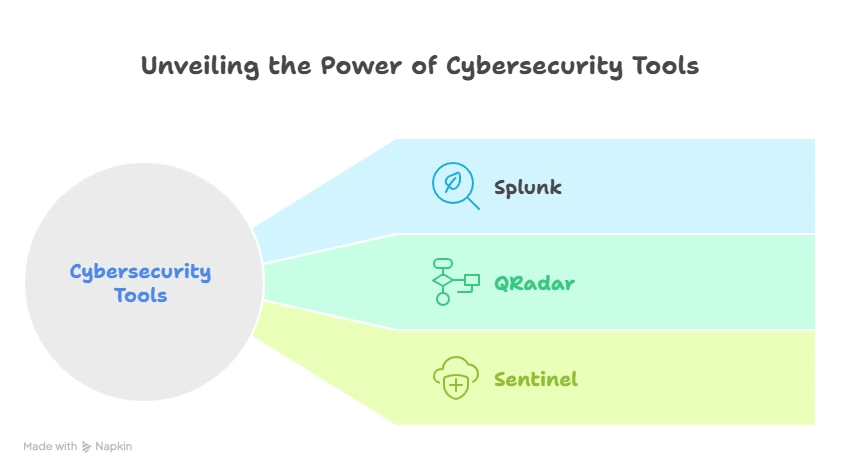
- Define source types.
- What are alerts?
- What is Splunk?
- What are Microsoft Sentinel and KQL?
- Elaborate on incident management.
- Elaborate on Azure Log Analytics.
- What are automation playbooks?
- What is SPL?
- What are indices?
- Define noise reduction.
- What is IBM QRadar?
- What is QRadar?
- What is AQL?
- What is CRE?
Shift-Based & Real-Time Scenario Questions
Shift-based work is the core environment of SOC roles. The interviewer can ask questions based on how you handle high-pressure working conditions.
- What are the key factors affecting accuracy?
- Is it possible to work with fragmented information?
- What are the steps to handle system downtime?
- How will you handle night shifts?
- Are you willing to handle night shifts?
- How to handle multiple critical alert situations?
- How to do shift handovers?
Pro Tips to Crack the SOC Analyst Interview
To crack the SOC analyst interview, you need to understand the working nature and environment of a SOC analyst in depth.
- Familiarise yourself with the working nature of a SOC analyst.
- Regular practice of log analysis
- Master SIEM tools.
- Understand the MITRE ATT&CK framework.
- Practice with real-world scenarios
- Learn SOC documentation.
- Keep updating your skills.
Entri’s AI-Powered Cybersecurity course will equip you to qualify as a SOC Analyst and offers myriad possibilities in the cybersecurity domain. The expert guidance will allow you to learn the nuances of SOC analysis in a real-time environment. The interview-focused training helps the learners to understand the areas where they have to put in extra stress.
Conclusion
SOC analyst interviews evaluate your skills in handling the situation, which requires presence of mind. You need to analyse the cyber threats and respond on time. Structured preparation, methodological learning, systematic analysis and assessment, proper response to incidents and learning the basic SIEM tools will help you to clear the SOC Analyst interview with more confidence. You can step into the world of SOC analysis with the help of expert guidance in Entri.
Frequently Asked Questions
Who is an SOC Analyst?
An SOC analyst, or security operations centre analyst, is responsible for protecting organisations from being exposed to cyberattacks.
What is L1 and L2 in SOC Analysis?
Levels (L1) and (L2) are the two analytical wings of the SOC roles. The Level 1 and Level 2 analysts have different senses of representation and responsibilities. The interviewer will ask questions to get clarity on the level of your practical and theoretical understanding of the various cybersecurity topics.
What are the key roles of SOC Analyst?
They monitor movements within the organisations and eliminate the threats on the spot. They analyse the applications, systems and networks. They develop applications that are powerful enough to eliminate cyber threats and attacks.
What are the basic tools used in SOC Analysis?
The basic tools used in SOC Analysis include Splunk, QRadar and Sentinel
Why is analytical skills important for SOC analyst?
The SOC analysts should have strong analytical skills and problem-solving capabilities; they should respond to the details after analysing the problem and should develop strong stress management strategies to keep themselves calm in chaotic situations.