Table of Contents
The Spoon Transfer Activity Lesson Plan is a fun and engaging hands-on activity designed to help preschool and kindergarten children develop essential fine motor skills. This simple yet effective classroom activity encourages hand-eye coordination, concentration, and early independence through playful learning. Perfect for early childhood education settings, the spoon transfer activity uses everyday materials to create an interactive experience that supports motor development and sensory exploration. Whether you are a teacher planning a preschool lesson or a parent looking for easy learning activities at home, this spoon transfer activity is a practical and skill-building addition to your early learning curriculum.
Unlock your passion for education and shape young minds as a Montessori teacher!
Introduction
The Spoon Transfer Activity Lesson Plan is a simple yet highly effective early childhood activity designed to strengthen fine motor skills, improve hand-eye coordination, and build concentration in young learners. This hands-on learning experience is especially beneficial for preschoolers, toddlers, and kindergarten students who are in the early stages of developing essential motor control and independence. By using basic classroom or household materials such as spoons, bowls, and small objects like beans, rice, or pom-poms, children engage in purposeful play that supports both physical and cognitive development.
In early childhood education, activities that combine movement with focus are key to building foundational skills. The spoon transfer activity encourages children to practice grasping, scooping, balancing, and carefully transferring objects from one container to another. These actions help strengthen the small muscles in the hands and fingers, which are crucial for later skills such as writing, buttoning clothes, and using scissors. At the same time, the activity enhances patience, attention span, and problem-solving abilities as children learn to control their movements and avoid spills.
This spoon transfer lesson plan is easy to set up, adaptable for different age groups, and suitable for both classroom and home learning environments. Teachers can incorporate it into fine motor skill stations, sensory play centers, or practical life activities, while parents can use it as a fun and educational indoor activity. With clear objectives, simple materials, and flexible variations, this activity supports early learning goals in a playful and engaging way.
What is the Spoon Transfer Activity in Montessori?
The Spoon Transfer Activity in Montessori is a foundational Practical Life exercise designed to help young children develop fine motor skills, coordination, concentration, and independence. It is a simple yet purposeful activity where a child uses a spoon to transfer small objects—such as beans, rice, lentils, or small beads—from one bowl to another. Although it may appear basic, this exercise plays a crucial role in a child’s early development within the Montessori method.
In Montessori education, Practical Life activities are carefully designed to mirror real-life tasks. The spoon transfer activity reflects everyday actions like serving food, cooking, or handling utensils. Through repetition and focused movement, children refine both their physical abilities and their mental discipline.
Purpose of the Spoon Transfer Activity
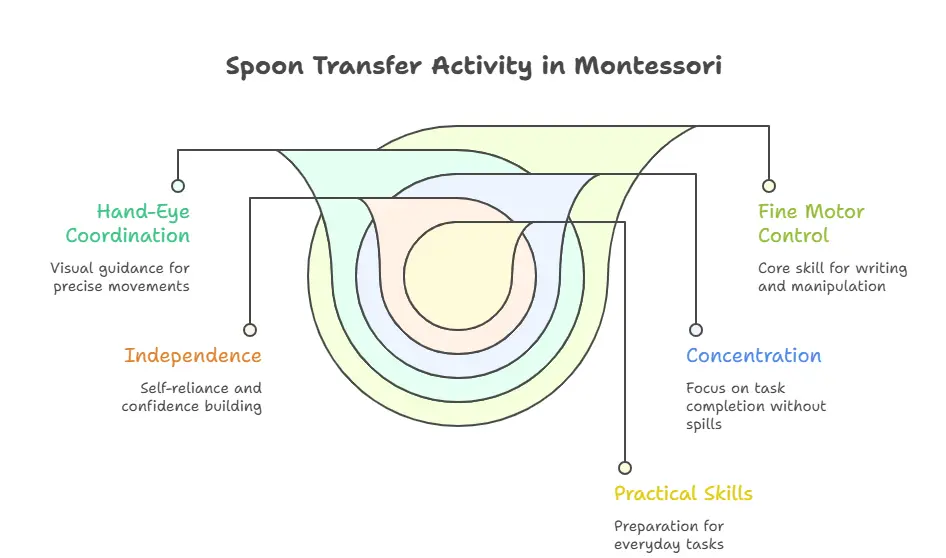
The primary purpose of the spoon transfer activity is to develop fine motor control and hand-eye coordination. When children scoop and carefully move items from one container to another, they strengthen the small muscles in their hands and fingers. These muscles are essential for later skills such as writing, drawing, buttoning clothes, and using scissors.
Additionally, the activity promotes:
-
Concentration: Children focus on completing the task without spilling.
-
Coordination of movement: The hand and eye work together smoothly.
-
Independence: The child performs the task independently, building confidence.
-
Order and sequencing: The process follows a clear beginning, middle, and end.
-
Control and precision: The child learns to regulate movement carefully.
In Montessori philosophy, even the simplest activity is meaningful. The spoon transfer activity teaches children to move deliberately and with purpose.
Materials Used in the Spoon Transfer Activity
One of the reasons this activity is popular in Montessori classrooms is its simplicity. The materials are minimal but thoughtfully arranged. Typically, the setup includes:
-
A small tray to define the workspace
-
Two small identical bowls
-
A child-sized spoon
-
A dry material such as beans, rice, lentils, seeds, or small pebbles
Everything is placed neatly on the tray to promote order. The materials are proportioned for the child’s size to encourage independence and proper control.
How the Spoon Transfer Activity is Presented
In a Montessori classroom, the teacher (often called a guide) presents the activity slowly and carefully. The demonstration is done in silence or with minimal words so the child can focus on observing the movements.
The typical presentation includes:
-
Carrying the tray carefully to the table.
-
Sitting properly and placing the tray neatly.
-
Holding the spoon correctly.
-
Scooping a small amount of material.
-
Slowly transferring it into the empty bowl.
-
Repeating until all items are transferred.
-
Returning the materials to their place.
The slow and precise movements are intentional. The child is invited to repeat the activity as many times as desired, which supports mastery and self-discipline.
Developmental Benefits of the Spoon Transfer Activity
1. Fine Motor Development
The careful scooping and transferring motion strengthens finger muscles and improves grip control, preparing children for writing.
2. Hand-Eye Coordination
Children must visually guide their hand to avoid spills, improving coordination.
3. Concentration and Focus
Repetitive, purposeful movement encourages deep concentration, a key principle in Montessori education.
4. Independence and Confidence
Successfully completing the task without assistance builds self-esteem and independence.
5. Preparation for Practical Skills
This activity prepares children for real-life tasks such as serving food, cooking, and self-care.
Variations of the Spoon Transfer Activity
As children gain mastery, the activity can be modified to increase challenge and maintain interest:
-
Using smaller items like tiny beads.
-
Transferring liquids with a spoon.
-
Moving objects across multiple containers.
-
Introducing different spoon sizes.
These variations gradually refine motor control and adaptability.
Why the Spoon Transfer Activity is Important in Montessori Education
In Montessori philosophy, learning happens through purposeful activity and movement. The spoon transfer activity may seem simple to adults, but for a young child, it is a powerful learning experience. It teaches patience, precision, and responsibility. It also supports the development of the “absorbent mind,” where children naturally take in skills from their environment.
By allowing children to work independently with carefully prepared materials, Montessori education fosters confidence and intrinsic motivation. The spoon transfer activity embodies these principles by combining simplicity, structure, and meaningful engagement.
Objectives of the Spoon Transfer Activity Lesson Plan
The Spoon Transfer Activity Lesson Plan is designed with clear developmental goals in mind. While the activity may look simple—just moving items from one bowl to another using a spoon—it serves many important purposes in early childhood education. Each objective supports a child’s physical, cognitive, social, and emotional growth in a natural and engaging way.
1. To Develop Fine Motor Skills
One of the primary objectives of the spoon transfer activity is to strengthen fine motor skills. Fine motor skills involve the small muscles in the hands and fingers that children use for tasks like writing, drawing, buttoning clothes, and holding tools.
When children grip the spoon, scoop materials, and carefully transfer them into another bowl, they are exercising these small muscles. Repeated practice helps improve hand strength, finger control, and wrist movement. Over time, this builds the foundation for better handwriting and other daily life skills.
2. To Improve Hand-Eye Coordination
Another important objective is improving hand-eye coordination. During the activity, children must look at the bowl, control the spoon, and guide the materials accurately into the empty container.
This coordination between what the eyes see and how the hands move is essential for many future learning tasks. It helps children with activities such as reading, writing, catching a ball, drawing shapes, and even using classroom tools correctly.
3. To Build Concentration and Focus
The spoon transfer activity encourages children to slow down and focus on one task at a time. Since the goal is to move the materials carefully without spilling, children naturally develop patience and attention to detail.
This objective is very important in early education. The ability to concentrate for longer periods helps children succeed in academic tasks later on. Through repetition, children learn to stay engaged, complete what they start, and take pride in their work.
4. To Encourage Independence
A key objective of this lesson plan is to promote independence. The materials are simple and child-sized so that children can perform the activity without adult help.
When a child completes the task independently, they feel capable and confident. This sense of achievement builds self-esteem and motivates them to try new activities. Encouraging independence at an early age supports emotional development and self-reliance.
5. To Develop Coordination and Control of Movement
The spoon transfer activity helps children refine their body movements. They learn how to control the amount they scoop, how to move their hand steadily, and how to avoid unnecessary spills.
This objective supports overall coordination and balance. Controlled movements also prepare children for more complex activities such as pouring liquids, cutting with scissors, and participating in sports or physical play.
6. To Teach Order and Sequencing
Another objective of the lesson plan is to help children understand order and sequence. The activity follows a clear process:
-
Start with one full bowl and one empty bowl.
-
Transfer all materials carefully.
-
Finish when the bowls have switched roles.
This simple sequence teaches children that tasks have a beginning, middle, and end. Understanding order helps build logical thinking and problem-solving skills.
7. To Promote Patience and Self-Discipline
Children learn that rushing may cause spills, so they naturally begin to slow down and control their actions. This helps develop patience and self-discipline.
By practicing calm and careful movements, children build emotional regulation skills. They learn to stay composed even if a small mistake happens, such as dropping a few beans. This objective supports both emotional maturity and resilience.
8. To Prepare for Practical Life Skills
The spoon transfer activity also prepares children for real-life tasks. Using a spoon is something they will do every day while eating or serving food. Practicing this skill in a structured way makes everyday routines easier and more manageable.
This objective connects classroom learning with real-world experiences, making education meaningful and practical.
Materials and Setup for Spoon Transfer Activity
The Spoon Transfer Activity is simple to prepare, yet the way you arrange the materials makes a big difference in how effective and meaningful the activity becomes. In Montessori and early childhood classrooms, the setup is just as important as the activity itself. A neat, organized presentation helps children feel calm, focused, and ready to work independently.
1. A Sturdy Tray to Define the Workspace
The first and most important item is a small tray. The tray helps define the child’s workspace and keeps everything contained in one place. It also makes it easier for the child to carry the materials from the shelf to the table independently.
Choose a tray that:
-
Is lightweight and easy for small hands to carry
-
Has slightly raised edges to catch spills
-
Is large enough to hold all materials comfortably
The tray teaches children about boundaries and order. Everything needed for the activity should fit neatly on it, showing the child that each item has a proper place.
2. Two Small Matching Bowls
You will need two small bowls for the spoon transfer activity. It is best to use matching bowls so the child focuses on the transferring process rather than comparing sizes.
When choosing bowls, consider:
-
Lightweight but stable material (ceramic, stainless steel, or thick plastic)
-
A size that is easy for small hands to manage
-
A wide enough opening for easy scooping
At the beginning of the activity, one bowl is filled with the chosen material, and the other bowl remains empty. The goal is for the child to transfer all items from the full bowl to the empty one.
Matching bowls also help maintain visual balance and order, which is important in Montessori environments.
3. A Child-Sized Spoon
The spoon should fit comfortably in the child’s hand. A spoon that is too large or too heavy can make the task frustrating.
Look for a spoon that:
-
Is lightweight
-
Has a short handle
-
Has a shallow scoop for easier control
Metal teaspoons often work well, but sturdy plastic or wooden spoons are also good options. The spoon should allow the child to practice proper grip and wrist movement, helping strengthen fine motor skills.
4. Transfer Materials (Dry Items)
The material used for transferring is a key part of the activity. Dry materials are usually best for beginners because they are easier to manage and clean up.
Common options include:
-
Dry beans
-
Lentils
-
Rice
-
Chickpeas
-
Small pasta shapes
-
Pom-poms
Start with larger items like beans or pom-poms for younger children. These are easier to scoop and less likely to spill. As the child gains confidence and control, you can introduce smaller items like rice to increase the level of challenge.
The material should not be sharp, too small (to avoid choking hazards), or messy at the beginner stage.
5. Preparing the Activity Step-by-Step
To set up the activity:
-
Place the tray on a clean, flat surface.
-
Put the two bowls side by side on the tray.
-
Fill one bowl about halfway with the chosen transfer material.
-
Place the spoon in front of the bowls or resting inside the filled bowl.
-
Make sure everything looks neat and inviting.
Avoid overfilling the bowl. Too much material can overwhelm the child and increase spills.
The presentation should look calm and attractive. A tidy setup invites the child to participate and helps them understand that this is meaningful work.
6. Creating a Calm and Organized Environment
The environment plays a big role in the success of the spoon transfer activity. Choose a quiet area with minimal distractions. A small child-sized table works best, but the activity can also be done on the floor with a mat.
Make sure:
-
The child can sit comfortably
-
The lighting is good
-
There is enough space for movement
After the activity, teach the child how to clean up spills and return the tray to its original place. This step encourages responsibility and care for the learning space.
Skills Developed Through Spoon Transfer Activity
The Spoon Transfer Activity may look like a simple task, but it supports many important developmental skills in young children. When a child scoops small items from one bowl and transfers them carefully into another, they are doing much more than just playing. They are building essential physical, cognitive, and emotional skills that will support their learning journey.
1. Fine Motor Skills
One of the most important skills developed through this activity is fine motor control.
When children:
-
Hold the spoon
-
Scoop materials carefully
-
Adjust their grip
-
Control wrist movements
They strengthen the small muscles in their hands and fingers. These muscles are essential for:
-
Writing and drawing
-
Coloring within lines
-
Cutting with scissors
-
Buttoning clothes and zipping jackets
Repeated practice improves hand strength and finger coordination, preparing children for future academic and daily tasks.
2. Hand-Eye Coordination
The spoon transfer activity greatly improves hand-eye coordination.
Children must:
-
Watch the spoon closely
-
Guide it steadily toward the empty bowl
-
Avoid spilling the materials
This coordination between what the eyes see and how the hands move is very important. It helps children perform tasks such as:
-
Catching or throwing a ball
-
Writing letters correctly
-
Completing puzzles
-
Building blocks accurately
Strong hand-eye coordination builds confidence in both classroom and play activities.
3. Concentration and Focus
The activity naturally encourages deep concentration.
Since children want to transfer the items without spilling, they begin to:
-
Slow down their movements
-
Pay close attention
-
Stay focused on one task
This helps improve their attention span over time. The ability to concentrate is essential for:
-
Listening to instructions
-
Completing school assignments
-
Reading and problem-solving
Through repetition, children learn the value of careful and focused work.
4. Patience and Self-Control
The spoon transfer activity teaches children to be patient.
If they rush, the items may spill. So they learn to:
-
Control their speed
-
Move carefully
-
Try again calmly if mistakes happen
This builds emotional regulation and self-discipline. Children begin to understand that careful effort leads to better results. These skills are important for managing emotions and handling challenges.
5. Independence and Confidence
This activity is designed so children can complete it on their own. When they successfully transfer all the items without help, they feel proud of their achievement.
They develop:
-
A sense of responsibility
-
Self-confidence
-
Trust in their abilities
Independence encourages children to explore new activities and take initiative in their learning.
6. Coordination and Controlled Movement
The activity improves overall body coordination and movement control.
Children practice:
-
Balancing the spoon
-
Managing small movements
-
Coordinating both hands when needed
These skills prepare them for more advanced tasks like pouring liquids, tying shoelaces, and participating in sports.
7. Problem-Solving Skills
Even in a simple activity, children face small challenges. For example:
-
How much should they scoop at one time?
-
What should they do if something spills?
They learn through trial and error. This builds basic problem-solving skills and encourages critical thinking.
8. Understanding Order and Sequence
The spoon transfer activity follows a clear process:
-
Start with one full bowl.
-
Transfer all materials carefully.
-
Finish when the second bowl becomes full.
This teaches children about sequence and logical order. Understanding steps and routines helps with daily tasks and academic learning.
9. Sensory Awareness
If materials like rice, beans, or lentils are used, children also experience different textures and sounds. This supports sensory development and helps them become more aware of their environment.
Unlock your passion for education and shape young minds as a Montessori teacher!
Conclusion
The Spoon Transfer Activity may seem simple at first glance, but it plays a powerful role in a child’s early development. Through the careful act of scooping and transferring materials, children strengthen their fine motor skills, improve hand-eye coordination, and build concentration in a natural and enjoyable way. This hands-on activity supports independence, patience, and confidence while preparing young learners for important academic and daily life tasks.
One of the greatest strengths of the spoon transfer activity is its simplicity. With just a few basic materials and a calm, organized setup, teachers and parents can create a meaningful learning experience. The activity encourages children to slow down, focus on their movements, and take pride in completing a task independently. These small moments of success help build a strong foundation for lifelong learning.
Whether used in a Montessori classroom, preschool setting, or at home, the spoon transfer activity is a valuable addition to any early childhood lesson plan. It proves that even the simplest activities can have a big impact on a child’s physical, cognitive, and emotional growth. By incorporating this purposeful and engaging exercise into daily routines, educators and parents can support holistic development in a gentle and effective way.
Get Certified & Start Your Montessori Career
Montessori Teacher Training Course by Entri App: Gain expert skills, earn certification, and kickstart your teaching career.
Join Now!Frequently Asked Questions
What is the Spoon Transfer Activity?
The Spoon Transfer Activity is a simple hands-on learning exercise where children use a spoon to move small objects from one bowl to another. It is commonly used in Montessori and preschool classrooms to develop fine motor skills, coordination, and concentration. Although the activity looks easy, it plays an important role in strengthening hand muscles and improving focus in young children.
What age group is the Spoon Transfer Activity suitable for?
The Spoon Transfer Activity is most suitable for toddlers and preschoolers, typically between 2 to 5 years old. Younger children can start with larger objects like pom-poms or big beans, while older preschoolers can handle smaller items such as rice or lentils for more precision and control.
What materials are needed for the Spoon Transfer Activity?
The activity requires very simple materials:
-
A small tray
-
Two small bowls
-
A child-sized spoon
-
Dry materials such as beans, rice, lentils, pasta, or pom-poms
All materials should be safe, child-friendly, and easy to handle. The setup should be neat and organized to encourage independence.
What skills does the Spoon Transfer Activity develop?
This activity helps develop multiple skills, including:
-
Fine motor skills
-
Hand-eye coordination
-
Concentration and focus
-
Patience and self-control
-
Independence
-
Coordination of movement
These skills are important for writing, daily tasks, and overall early childhood development.
Why is the Spoon Transfer Activity important in Montessori education?
In Montessori education, Practical Life activities are essential. The Spoon Transfer Activity teaches children real-life skills like using utensils while also building concentration and independence. It follows Montessori principles of purposeful movement, repetition, and hands-on learning.
How long should a child spend on the Spoon Transfer Activity?
There is no fixed time limit. Children should be allowed to repeat the activity for as long as they are interested and focused. Some may work on it for 5–10 minutes, while others may spend longer. The key is to allow self-paced learning without pressure.
How can I make the Spoon Transfer Activity more challenging?
Once a child masters the basic version, you can increase the difficulty by:
-
Using smaller materials like rice
-
Using different spoon sizes
-
Adding more bowls
-
Introducing liquid transfer with supervision
These variations help refine motor control and maintain interest.
Can the Spoon Transfer Activity be done at home?
Yes, this activity is perfect for home learning. Parents can easily set it up using kitchen items. It is a great way to keep children engaged in a productive activity while supporting skill development in a fun and meaningful way.
What should I do if my child keeps spilling the materials?
Spilling is a natural part of learning. Instead of correcting harshly, gently encourage the child to slow down and try again. You can also model the movement slowly. Teaching children how to clean up small spills builds responsibility and confidence.
How often should the Spoon Transfer Activity be included in a lesson plan?
The Spoon Transfer Activity can be included regularly as part of fine motor or practical life sessions. It can be offered weekly or even daily in early learning environments. Repetition strengthens skills and helps children gain mastery over time.