
• Teaching
    • Montessori Teacher Training 🔥
    • Yoga Teacher Training
  • Coding
    • Full Stack Development Course
    • Data Science Course
    • Python Programming Course
    • Software Testing Course
    • Architecting on AWS
  • Commerce
    • ACCA Course
    • SAP Fico Course
    • Practical Accounting Course
    • SAP MM Course
    • HR Management Course in Kerala
    • CMA USA Online Classes
    • Enrolled Agent Course
    • PwC Edge : Strategic Accounting and Finance Programme
  • Technical
    • Structural Design Course
    • Embedded Systems Software Engineering in Kerala
    • MEP Course
    • BIM Training Course
    • Quantity Survey Course
  • Finacademy
    • Stock Market Course
    • Mutual Funds Course
    • Forex Trading Course
  • Digital Marketing
    • Digital Marketing Course
    • Performance Marketing Course
  • Language Learning
    • Spoken English Course
    • German Language Course
    • IELTS Exam Coaching
  • Exam Preparation
    • Kerala PSC Coaching
    • Kerala PSC LGS Coaching
    • KAS Coaching
    • Kerala PSC LDC Coaching
    • Kerala PSC LSGS Coaching
    • KPSC Industries Extension Officer Coaching
    • KPSC Technical Mechanical Coaching
    • KPSC Technical Electrical Coaching
    • Kerala PSC Technical Exam Preparation
    • KPSC Technical Civil Coaching
    • SBI PO Coaching
    • IBPS Clerk Coaching
    • IBPS PO Coaching
    • IBPS SO Coaching
    • Bank Exam Coaching
    • Lecturer in DIET Course
    • Kpsc HSA Coaching
    • KPSC LP UP Assistant Coaching
    • EMRS Coaching
    • KTET Coaching
    • SSC Coaching
    • SSC JE Coaching
    • SSC CGL Coaching
    • SSC CHSL Coaching
    • SSC MTS Coaching
    • UPSC Coaching
  • Health Care
    • Hospital Administration Course
  • Other Exams
    • GATE Coaching
    • CAT Coaching
    • MAT Online Coaching
    • KMAT Online Coaching
Entri Blog
No Result
View All Result
Friday, February 13, 2026
  • Kerala PSC
    • Kerala PSC General
      • Kerala PSC Exams
      • KAS Exam
      • Kerala PSC VEO Notification
      • Kerala Police SI
      • Kerala PSC LDC Notification
      • Kerala PSC Village Field Assistant Notification
      • Kerala PSC LD Typist Notification
      • Kerala PSC Food Safety Officer
      • Kerala PSC Excise Inspector Notification
      • Kerala PSC BDO Notification
      • Kerala PSC CPO Notification
      • Kerala PSC LGS Notification
      • Fire and Rescue Officer
      • Women Fire and Rescue Officer
    • Kerala PSC Teaching
      • Kerala PSC HSA
      • Kerala PSC HSST
      • KTET
      • LP/UP Assistant
      • KVS
      • Railway Teacher
    • Kerala PSC Technical
      • LSGD AE
      • Draftsman/Overseer
      • IEO
      • ATP
      • Polytechnic Lecturer
      • AE Electronics
      • Assistant Engineer
  • Banking
    • IBPS PO Notification
    • IBPS Clerk Notification
    • SBI PO Notification
    • SBI Clerk Notification
    • SBI SO Notification
    • SBI Apprentice Notification
    • Canara Bank PO Notification
    • Indian Bank PO Notification
    • RBI Assistant Notification
    • RBI Office Attendant Notification
    • IBPS RRB Notification
    • IBPS RRB Office Assistant Notification
  • Skilling
    • Coding
    • Spoken English
    • Stock Market
      • Stock Market Weekly Report
    • Digital Marketing
    • Accounting Course
    • SAP
    • German
    • IELTS
    • Quantity Survey
    • MEP
    • Structural Design
    • Montessori
    • Yoga Teaching
    • HR Management
    • Embedded Systems
  • Courses
    • AI Powered Data Science Course
      • Data Science Malayalam
      • Data Science Course in Tamil
      • Data Science Course in Telugu
      • Data Science Training in Kochi
      • Data Science Training in Trivandrum
      • Data Science Course in Calicut
      • Data Science Training in Thrissur
    • AI Powered Data Analytics Course
      • Data Analytics Course in Malayalam
      • Data Analytics Course in Tamil
      • Data Analytics Course in Telugu
    • BIM Course in Kerala
      • BIM Course in Kochi
      • BIM Course in Trivandrum
      • BIM Course in Calicut
    • Quantity Surveying Course
      • Quantity Surveyor Course in Tamil
      • Quantity Surveying Course in Telugu
      • Quantity Surveyor Course in Hyderabad
      • Quantity Surveying Course in Chennai
      • Quantity Surveying Course in Vijayawada
      • Quantity Surveying Course in Guntur
      • Quantity Surveying Course in Warangal
      • Quantity Surveying Course in Karimnagar
    • Structural Design Course
      • Structural Design Course in Hyderabad
      • Structural Design Course in Chennai
      • Structural Design Course in Kochi
      • Steel Structure Design Course
      • RCC Design Course
    • MEP Course
      • MEP Design Course in Kerala
      • HVAC Course
      • MEP Course in Kochi
    • Robotics and AI Course
    • Embedded System Course
      • Embedded Systems Software Engineering in Calicut
      • Embedded Systems Software Engineering in Kochi
      • Embedded Systems Software Engineering in Trivandrum
    • AI-Enhanced Full Stack Developer Course
      • Full Stack Development Malayalam
      • Full Stack Development Hindi
      • Full Stack Development Tamil
      • Full Stack Development Telugu
      • Full Stack Development Kannada
    • Stock Market Course
      • Stock Market Course in Malayalam
      • Stock Market Course in Tamil
      • Options Trading Course
    • Mutual Funds Course
      • Mutual Funds Course in Kerala
      • Mutual Funds Course in Tamil
    • Forex Trading Course
    • Spoken English Course
      • Spoken English Course in Malayalam
      • Spoken English Course in Hindi
      • Spoken English Course in Telugu
      • Spoken English Course in Tamil
      • Spoken English Course in Kannada
    • AI-Driven Python Programming Course
    • Ui Ux Designer Course
    • AI-Powered Software Testing Course
      • Software Testing Course in Malayalam
      • Software Testing Course in Tamil
      • Software Testing Course in Telugu
    • Ai-Powered Cybersecurity Course
    • AI Tools Mastery
    • AI Powered AWS Solutions Architect Associate Course
    • AI Powered Practical Accounting Course
      • Accounting Course in Malayalam
      • Accounting Course in Tamil
      • GCC VAT Course
      • Taxation Course
      • GST Practitioner Course in Kerala
      • GST Course
      • UAE Accounting
      • Tally Course
      • Zoho Books Training
    • SAP Training Courses
      • SAP FICO Course
      • SAP MM Course
      • SAP SD Training
      • SAP FICO Course in Tamil
      • SAP MM Course in Tamil
    • Enrolled Agent Course in Kerala
      • Enrolled Agent Course in Calicut
      • Enrolled Agent Course in Kochi
      • Enrolled Agent Course in Trivandrum
    • ACCA Training Online
      • ACCA Course in Kerala
      • ACCA Performance Management PM F5 Course
      • ACCA Taxation TX F6 Course
      • ACCA Financial Reporting FR F7 Course
      • ACCA Audit and Assurance AA F8 Course
      • ACCA Financial Management FM F9 Course
    • CMA USA Online Classes
    • HR Management Course
      • HR Management Course in Kochi
      • HR Management Course in Trivandrum
      • HR Management Course in Calicut
    • PwC Edge : Strategic Accounting and Finance Programme
    • Performance Marketing Course
    • Mern Stack Developer Course
      • Full Stack Developer Course in Kochi
      • Full Stack Developer Course in Trivandrum
      • Full Stack Developer Course in Calicut
      • Full Stack Developer Course in Pune
      • Full Stack Developer Course in Bangalore
      • Full Stack Developer Course in Hyderabad
      • Full Stack Developer Course in Chennai
      • Full Stack Developer Course in Indore
      • Full Stack Developer Course in Jaipur
      • Full Stack Developer Course in Coimbatore
    • AI Powered Digital Marketing Training
      • Digital Marketing Course in Kerala
      • Digital Marketing Course in Kochi
      • Digital Marketing Course in Trivandrum
      • Digital Marketing Course in Calicut
      • Digital Marketing Course in Kollam
      • Digital Marketing Course in Thrissur
      • Digital Marketing Course in Kottayam
      • Digital Marketing Course in Kannur
    • Hospital and Healthcare Administration
    • Montessori Teacher Training
      • Montessori Teacher Training in Calicut
      • Montessori Teacher Training in Kochi, Ernakulam
      • Montessori Teacher Training in Trivandrum
      • Montessori Teacher Training in Kollam
      • Montessori Teacher Training in Malayalam
      • Montessori Teacher Training in Kannada
    • Other Courses
      • German Language Course
      • ChatGPT Course
      • Yoga Teacher Training Course
      • Advanced Fashion Designing and Boutique Management
  • Others
    • Railway
      • RRB Technician Notification
      • RRB JE Notification
      • RRB ALP Notification
      • RRB NTPC Notification
      • RRB RPF Notification
      • RRB RPF SI Notification
      • RRB RPF Constable Notification
      • RRB Group D Notification
      • RRB RPSF SI Notification
      • RRB SSE Notification
    • SSC
      • SSC CPO Notification
      • SSC MTS Notification
      • SSC CGL Notification
      • SSC CHSL Notification
      • SSC GD Constable Notification
      • SSC Stenographer Notification
      • SSC JE Notification
      • SSC CAPF Notification
      • SSC JHT Notification
      • Delhi Police Constable Notification
      • Delhi Police SI Notification
    • GATE
    • MAT
    • KMAT
      • KMAT Kerala 2024
    • TET
      • APTET
      • CTET
      • DSSSB
      • Karnataka TET
      • Kerala TET
        • KTET Notification
      • KVS
      • MPTET
      • SUPER TET
      • TNTET
      • TSTET
      • UPTET
    • UPSC
      • UPSC CAPF Notification
      • UPSC CDS Notification
      • UPSC NDA Notification
      • UPSC Civil service Notification
  • Free Learn
    • Free Courses
      • Free Coding Courses
        • C Langauge Courses
        • Free Data Science Courses
        • Free Python Programming Courses
        • Free Full Stack Developer Courses
      • Free Accounting Courses
        • Free Accounting Course in Malayalam
        • Free ZohoBooks Course in Malayalam
        • Free Tally Course for Beginners in Malayalam
        • Free ACCA Foundation Course in Malayalam
        • Free Gulf VAT and Accounting Course in Malayalam
      • Free Digital Marketing Courses
        • Free SEO Courses
        • Web Development for Marketers
      • Engineering Upskilling Courses
        • Free Quantity Surveying Course in Telugu
        • Free Embedded Systems Foundation Course
        • Free AutoCAD Course in Malayalam
        • Free Planswift Course
        • Free MEP Course in Malayalam
        • Free Quantity Surveying Course for Beginners
      • Free Hospital Administration Courses
      • Free Management Courses
      • Free SAP Courses
        • Free SAP FICO Tutorial for Beginners in Malayalam
      • Free German Courses
      • Free IELTS Courses
      • Free Teachers Training Courses
      • Free Trading Courses
        • Introduction To Stock Trading in Tamil
        • EMI Traps Explained by Sharique Samshudheen
        • Free Trading Psychology for Beginners by Nagaraj Sir
        • Free Beginner’s Guide to Investments by Nagaraj Sir
        • Free Stock Market Courses in Malayalam
        • Free Mutual Funds Course by Nagaraj Sir
        • Free Options Trading Course Malayalam
        • Free Forex Trading Courses Malayalam
        • Free Personal Finance Courses Malayalam
        • Free Health Insurance Masterclass by Sharique Samshudheen
    • Question Answer
    • Aptitude Questions
    • Webinars
  • Test Prep
    • Kerala PSC Coaching
      • KPSC Degree Level Exam Preparation
      • Kerala PSC 12th Level Exam Preparation
      • Kerala PSC 10th Level Exam Preparation
      • KAS Coaching
      • Kerala PSC LDC Coaching
      • Kerala PSC LD Typist Coaching
      • Kerala PSC Fireman Coaching
      • KSFE Assistant Exam Preparation
      • Secretariat Office Attendant Coaching
      • Secretariat Assistant Coaching
      • Kerala PSC SI Exam Coaching
      • Khadi Board LDC Exam Preparation
      • Devaswom Board LDC Coaching
      • University LGS Exam Preparation
      • University Assistant Exam Coaching
      • KPSC Scientific Officer Exam Coaching
      • KPSC Probation Officer Grade II
      • KPSC Food Safety Officer Coaching
      • KWA Sanitary Chemist Coaching
      • KPSC Diary Farm Instructor Exam Coaching
      • Kerala PSC KWA Lab Assistant Exam Coaching
      • Kerala PSC ICDS Supervisor Exam Coaching
      • KPSC Finger Print Searcher Coaching
      • Kerala PSC Welfare Officer Gr. II Exam Coaching
      • KPSC Assistant Dental Surgeon Coaching
    • KPSC Teaching Exams
      • HSA Exam Preparation
      • KPSC HSA Social Science Coaching
      • KPSC HSA Physical Science Coaching
      • KPSC HSA English Coaching
      • KPSC Junior Language Teacher Hindi
      • KTET Coaching
      • SET Coaching
      • LP/UP Assistant Exam Coaching
      • HSST Exam Preparation
      • HSST Commerce Exam Coaching
      • Kerala PSC Lecturer in Diet Coaching
      • KVS PGT/TGT Coaching
    • Kerala PSC Technical Exams Coaching
      • Assistant Engineer Electrical Exam Coaching
      • Assistant Engineer Electronics Coaching
      • Assistant Engineer Mechanical Coaching
      • Kerala PSC Industries Extension Officer Coaching
      • KPSC LSGD AE Exam Coaching
      • KPSC Civil Engineering Exam Coaching
      • KPSC Mechanical Engineering Exam Coaching
      • KPSC Electrical Engineering Exam Coaching
      • KPSC Electronics Engineering Exam Coaching
      • KPSC Technical Computer Science Coaching
      • KPSC Tradesman Turning Coaching
      • Kerala PSC Overseer Exam Coaching
      • KPSC Assistant Town Planner Coaching
      • Lecturer in Polytechnic Electronics Coaching
    • Teaching Exams Coaching
      • CSIR NET Exam Coaching
      • EMRS Coaching
      • CTET Exam Online Coaching
    • IELTS Training Online
    • Bank Exam Coaching Online
      • SEBI Grade A Coaching
      • IBPS SO Online Coaching
      • IBPSC PO Online Coaching
      • IBPSC Clerk Online Coaching
      • SBI PO Coaching
      • SBI Clerk Online Coaching
      • SBI Apprentice Class
      • SBI SO Online Coaching
      • RBI Grade B Coaching
      • RBI Assistant Coaching
      • CSEB Exam Coaching
      • IBPS RRB Coaching
      • IBPS RRB PO Coaching
      • Canara Bank Po Exam Coaching
      • Kerala Gramin Bank Coaching
      • Kerala Bank Exam Coaching
        • Kerala Bank Clerk Exam Coaching
        • Kerala Bank Office Attendant Exam Coaching
        • Kerala Bank Assistant Manager Exam Coaching
      • JCI Exam Coaching
      • NABARD Grade A Coaching
      • LIC AAO Coaching Online
    • UPSC Online Coaching
      • UPSC CAPF Online Coaching
    • SSC Online Coaching
      • SSC JE Online Coaching
      • SSC CGL Coaching
      • SSC CGL AAO Coaching
      • SSC CHSL Coaching
      • SSC CGL CBI Inspector Coaching
      • SSC MTS Coaching
      • SSC Stenographer Coaching
      • SSC GD Online Coaching
    • RRB Exams Coaching
      • RRB RPF Exam Coaching
      • RRB NTPC Exam Coaching
      • RRB JE Online Coaching
      • RRB JE Electronics Coaching
      • RRB ALP Exam Coaching
      • RRB Technician Exam Coaching
    • CAT Online Coaching
    • CMAT Online Coaching
    • XAT Exam Coaching
    • GATE Online Coaching
      • GATE CE Online Coaching
      • GATE ME Online Coaching
      • GATE EE Online Coaching
    • NMAT Exam Coaching
      • AAI ATC Jr Executive Coaching
    • Cochin Shipyard Executive Trainee Coaching
    • BEL Probationary Engineer Coaching
    • HPCL Junior Executive Coaching
Free Courses
Entri Blog
  • HTML Tutorial
  • DSA Tutorials
  • Tutorials in Hindi
    • HTML Tutorial for Beginners in Hindi
    • Python Tutorial for Beginners in Hindi
    • GIT and GITHUB Tutorial for Beginners in Hindi
  • Tutorials in Tamil
    • JavaScript Tutorial in Tamil
  • Tutorials in Telugu
    • HTML Tutorial For Beginners in Telugu
    • CSS Tutorial for Beginners in Telugu
    • Bootstrap Tutorial for Beginner in Telugu
  • Tutorials in Kannada
    • HTML Tutorial For Beginners in Kannada
entri exclusive offers entri exclusive offers
Home Articles

5 things schools look for when hiring Montessori teachers today

by Sravan Prakash
February 13, 2026
in Articles, Montessori Teaching
5 things schools look for when hiring Montessori teachers today
Share on FacebookShare on WhatsAppShare on Telegram

Table of Contents

  • Introduction
  • Conclusion

Introduction

Step into most Montessori classrooms on a good morning and you’ll feel it immediately: children floating between shelves, selecting work that engages them, settling into extended periods of quiet concentration while a caring adult circulates among them—not directing each moment, only providing a comforting presence.

This is what draws many of us to the profession of Montessori teaching in the first place, and as increasing numbers of parents seek out this style of education that encourages blossoming at a child’s own pace, independence, and curiosity as a driving force, Montessori schools become increasingly selective. Montessori schools seek those who embody the philosophy and can nurture the peaceful, purposeful environment for children and families, not just a diploma and a few years of experience.

Maria Montessori gave us the blueprint more than a century ago: mixed-age groups, beautifully prepared environments, hands-on materials that invite discovery, and adults who guide rather than command.

 Today’s hiring teams want to see that those ideas are alive in you. The five things that consistently rise to the top when schools make their decision are:

  • reputable Montessori certification and training
  • quality time spent actually working within Montessori classrooms
  • an instinctively sincere way of prioritizing the child
  • clear, kind, two-way communication (especially with parents)
  • and a deep, steady passion for early childhood that doesn’t fade when things get hard

When you can show real strength in these five areas, schools start to picture you as part of their team almost immediately.The right Montessori teacher doesn’t just follow a method—they help children fall in love with learning, gain confidence they carry for life, and feel deeply respected every single day. If you’re aspiring to a Montessori position currently, or just wishing to progress in your career, these are the areas worth investing your effort. Read through each of them, consider your strengths and where you could improve, and know that any progress you make here will lead you toward fulfilling work for a long time to come.

Register for the Entri Elevate Montessori Teacher Training Program! Click here to join!

Teaching Certification & Training Quality

montessori certification

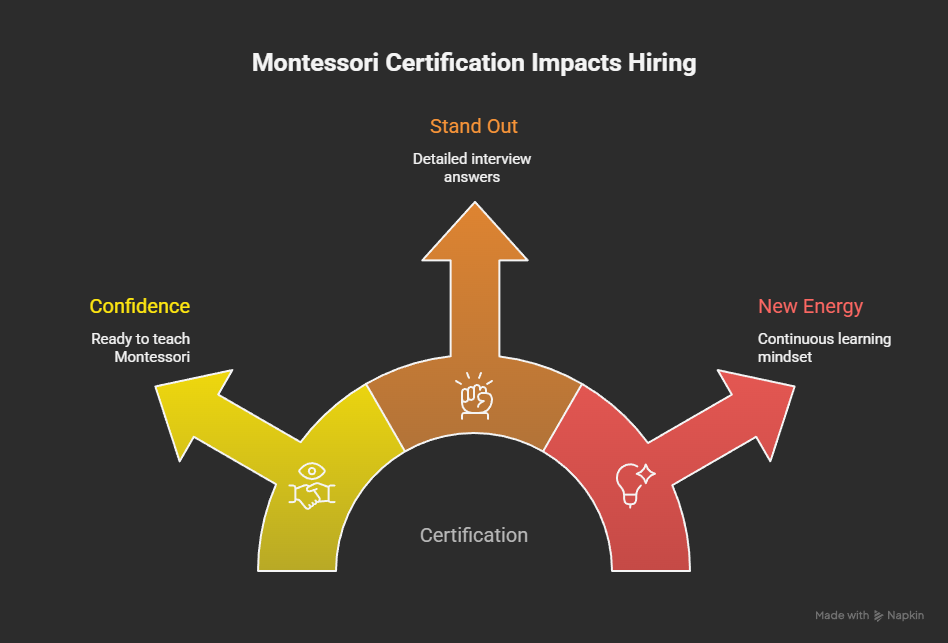
The first thing nearly every Montessori school looks for is your certification—and not just any certification, but one from a serious, accredited program (AMI or AMS, usually). This tells them you have spent hundreds of hours learning the core of the method: sensitive periods and the prepared environment; the theory behind every single material; the skills of observation; and how to present a lesson so that the child will want to try it again on their own. Certification training is not a quick and dirty online course; it is an immersive experience in theory and long periods of supervised practice, learning to watch a child for weeks before you and your mentor decide the child is ready for the binomial cube, or when to step back when your four-year-old is working in frustration with the sandpaper numbers so that she can figure it out herself.

Hiring teams ask direct questions in interviews. What training center did you attend? How many hours of classroom practicum did you complete? Take us through presenting the pink tower or the moveable alphabet. Those who easily provide detailed answers about what they learned and how it changed their work with children stand out immediately. Schools notice those who continue learning after their certification by taking renewal workshops, courses on inclusion, sessions about emotional regulation, or short courses on how to use technology without disrupting hands-on work. This curiosity about learning signifies that candidates are in it for the long haul and will bring new energy to their program.

Additional training in practices such as supporting children who learn differently, peaceful conflict circles, or cultural responsiveness, for example, may make the difference in a school serving a diverse family population. At the end of the day, strong certification from a reputable source gives schools the confidence that you won’t need years to “get” Montessori—you already do, and you’re ready to bring it to their children from your very first week.

Practical Classroom Experience

Certification gets your foot in the door, but real classroom time is what convinces schools you belong there. Most postings these days ask for at least two or three years leading (or assisting long-term in) a Montessori environment. Why? Because book knowledge is one thing, but standing in a room with twenty-five children of three different ages, keeping the peace while everyone works at their own pace, knowing exactly when to offer help and when to stay silent—that only comes from doing it, day after day.

The most compelling candidates come up with stories they love to tell: the shy five-year-old who finally sat down to work with the bead chains after weeks of watching his more confident friends, the morning the toddler crossed the room with a tray of water without spilling a drop, the afternoon a petty fight over possession of the moveable alphabet turned into a lovely conversation about kindness.

When you tell those moments with ease in an interview, the panel can almost see you in their classroom. Experience in several different settings, perhaps urban schools, or rural programs, inclusive classrooms with children who have special needs, or schools with families from many cultures demonstrates you can adapt the method without losing the essence. Early years with a seasoned mentor can leave a lasting impression as well; many teachers describe how their first few years working alongside a wise colleague taught them more than any lecture could.

Longer stays at one school carry weight as well. They show a willingness to commit, to grow through the ups and downs, to become part of a community rather than treating the job as a stepping stone. Schools want Montessori teachers who already know how to create that calm, focused hum where children concentrate deeply and take real ownership of their learning. When your track record proves you’ve done it before, the hiring team feels safe saying yes.

Child-Centric Teaching Skills

If there is one non-negotiable quality schools look for, it is this: everything you do begins with the child in front of you. Not the group, not the clock, not what ought to happen next week—the child, today. Great Montessori teachers acquire the quiet knack for sensing readiness. They notice when the three-year-old is stealing glances at the knobbed cylinders, when the six-year-old is suddenly interested in exploring the checkerboard, when a child needs a moment with them before settling into work. Then the teacher offers the right invitation at the right time.

Flexibility is part of it. Plans change when a child arrives full of energy or unexpectedly quiet. You learn to redirect gently, to preserve choice while keeping the room harmonious. You know the materials inside out – the way the pink tower teaches size discrimination and visual memory, the way the moveable alphabet lets language explode once the child is ready – so you can present them in a way that feels like magic rather than instruction. And you wait. You wait while a child tries the pouring work ten times and spills nine. You wait while they sound out a word slowly. That patient waiting is one of the hardest and most important skills, because it teaches children they are capable.

Inclusivity matters to you in the classroom of today’s child. You make a necessary adaptation to your materials to accommodate their smaller hands, you place them with buddies, you recognize their need for a quieter space. Testing is not how their progress is measured; it happens through your observations, your quick notes, your small conversations about what they uncovered today. Schools want teachers whose child-first mindset permeates their practice to create a roomful of safety, respect, and possibility for each child, every day.

Communication & Parent Interaction Skills

Montessori is not a 9 to 3—it’s a circle of trust that naturally includes family. Schools look for teachers who communicate with warmth, clarity, and consistency that parents are partners and teammates—not visitors with special permission. A kind hello gate-side, a quick note about how the child shared something beautiful today during work time, listening to a parent’s concerns about their child having trouble going to bed at night—these small things go a long way.

Written communication is important as well. A well-crafted, accessible newsletter that explains the importance of practical life activities, a report on progress that acknowledges effort and growth as opposed to just grades, a brief note via the class application when a student has mastered tying their shoes – these are all ways to keep families connected with the broader context. During parent-teacher conferences, excellent teachers begin the discussion with the child’s strengths and interests, then, ease into the areas for growth, seeking input from parents. When sensitive issues arise, an effective teacher listens attentively, responds with composure, and collaboratively searches for resolutions.

That includes being culturally sensitive, especially now, paying attention to how you speak and ensuring all families feel recognized and valued. Some teachers encourage parents to visit for an observation in the morning or assist with a special project to understand the process from the inside. Schools appreciate those who communicate and create a sense of warmth between the home and the classroom, as the child’s experience is enhanced and consistent when the family feels included and heard.

Passion for Early Childhood Education

Finally, schools want to feel your heart in this work. Passion is not flashy or ostentatious. It is the silent eagerness that returns each morning, the sparkle on your face when describing a child’s revelation, the origin of your goosebumps stirred by a toddler diligently attempting to button for twenty minutes. In interviews, it is uncovered in anecdotes—the moment you witnessed Montessori in action, the child who converted your perception of learning, the motivation to persevere despite the challenging days.

Passionate teachers stay curious. They read new books, attend workshops, talk with colleagues about fresh ideas, all while holding tight to the core of Montessori.

 That inner fire also brings resilience. A noisy morning or a child who takes months to settle doesn’t shake them for long because the joy of seeing independence bloom is so much bigger. Many find extra meaning in mentoring newer teachers or sharing what they’ve learned with the wider community.

Hiring teams can sense this spark almost right away. They know it’s what keeps someone in the classroom for twenty years instead of two and what makes the room sing with kindness and wonder. They choose teachers whose love for young children and for this gentle way of teaching runs deep and steady—because that steady warmth is what children remember forever.

Register for the Entri Elevate Montessori Teacher Training Program! Click here to join!

Conclusion

1: What is the primary focus of the first plane of development in the Montessori method?
2: According to Montessori practices, children are allowed to choose their work instead of the teacher choosing the work for them. Therefore:

3: There are totally ______ types and levels of Montessori education in practice.

4: Based on the Montessori Method, children have a natural desire to:

5: The Association Montessori Internationale has its headquarters at __________.

    Fill out the form to see the results


    Ever wondered how much you really know? It's time to put your brain to the test!

    Today’s Montessori schools look for more than just credentials from their prospective teachers. They want a theoretically sound philosophy based on the work of Maria Montessori and practical experience in the classroom that demonstrates confidence in those guiding principles. They seek teachers who have a strong understanding of child development and allow that knowledge to inform every decision they make. A child-centered approach, respecting the child’s pace, and creating prepared environments that foster independence, curiosity, and responsibility are hallmarks of the true Montessori teacher.

    Communication is also critical beyond philosophy and practice. Montessori schools expect teachers to establish relationships with parents, communicate the classroom practices, and include the parents as partners in their child’s development. Communication fosters trust, and trust fortifies the community of the school. And commitment—teaching is a profession with many rewards as well as challenges. Schools look for teachers who are consistent, thoughtful, and committed throughout the process.

    To those who embark on this journey anew, whether as trainees, interns, or assistant guides, or those considering stepping into a leadership role, remember that you are here because you belong here. Growth takes time. Patience, observation, reflection, and the willingness to continue learning are all necessary. There is a growing need for thoughtful and engaged Montessori teachers. The schools are seeking you, the ones who see the child and believe in the child.

    Believe in yourself. Believe in your preparation. Continue polishing your practice. Your efforts will be recognized by the right school, as will your unique strengths. The children who come into your classroom are waiting for one who will understand them, respect them, and guide them to becoming capable, joyful human beings ready to embrace all life has to offer.


    Get Certified & Start Your Montessori Career

    Montessori Teacher Training Course by Entri App: Gain expert skills, earn certification, and kickstart your teaching career.

    Join Now!

    Frequently Asked Questions

    What specific Montessori certification do I need, and does it really matter which program I choose?

    The question of which Montessori certification to pursue is perhaps the most significant decision you will make in your professional preparation, and yes, the specific program you choose carries substantial weight in the hiring process. Montessori education is unique among teaching methodologies in that it operates with a relatively decentralized certification landscape, yet certain accrediting bodies have established themselves as gold standards that hiring committees recognize and trust implicitly. The two most widely recognized and respected accrediting organizations are the Association Montessori Internationale (AMI), founded by Maria Montessori herself in 1929, and the American Montessori Society (AMS), which has adapted the Montessori approach with American cultural and educational sensibilities while maintaining fidelity to core principles. When a school advertises for a Montessori teacher and states that they require certification from an accredited program, they are almost invariably referring to AMI, AMS, or occasionally other established organizations that have demonstrated rigorous training standards over many decades.

    The distinction between these programs is not merely administrative but philosophical and pedagogical. AMI training adheres closely to the original practices Maria Montessori developed, with careful preservation of her specific lesson sequences, material usage, and classroom structures. Students in AMI training programs spend extensive hours practicing presentations exactly as they appear in the original curriculum, with master trainers who have themselves undergone years of apprenticeship. AMS training, while still deeply committed to Montessori principles, offers somewhat more flexibility in how the method is interpreted and implemented, encouraging teachers to integrate contemporary educational research and adapt materials for diverse populations while maintaining the essential child-centered philosophy. Neither approach is inherently superior, and excellent teachers emerge from both traditions. However, discerning schools often have preferences based on their own philosophical orientation, and understanding these nuances allows you to target your applications strategically.

    Beyond the AMI and AMS distinction, you must also consider the level of certification you pursue. Montessori credentials are typically age-specific, with common designations including Infant and Toddler (birth to age three), Early Childhood (ages three to six), Lower Elementary (ages six to nine), Upper Elementary (ages nine to twelve), and Secondary (adolescent programs). Each level requires its own comprehensive training program, usually spanning an academic year and including both academic coursework and supervised practicum experiences. Some teachers pursue multiple certifications over the course of their careers, which substantially increases their versatility and value to schools that operate multiple classroom levels. Additionally, you should investigate whether programs offer full-time intensive summer institutes, which compress training into several consecutive months, or academic-year programs that distribute coursework across a traditional school calendar. Your choice here should reflect your personal circumstances, learning preferences, and financial considerations.

    The quality of your training institution extends beyond its accreditation status to include specific factors such as the experience and reputation of the trainer leading your cohort, the richness of the materials library available for your practice, the diversity of practicum sites available for your student teaching, and the strength of the alumni network you will join upon completion. Seasoned Montessori administrators often have personal knowledge of specific training centers and trainers, and they form impressions about which programs produce graduates with particularly strong observational skills, material presentation abilities, or classroom management capabilities. When you interview, mentioning that you trained under a respected and well-known trainer can immediately signal that you received rigorous preparation. Furthermore, some training programs have established relationships with particular schools or school networks, creating pipelines for student teaching placements and eventual employment that can significantly ease your entry into the profession.

    The financial investment in Montessori certification is substantial, often ranging from five thousand to fifteen thousand dollars depending on the program and level, and this does not include the income you forgo during intensive training periods or the costs of traveling to training centers if you do not live in a major metropolitan area. However, virtually every experienced Montessori educator will tell you that this investment is worthwhile and that shortcuts through quick online certifications or weekend workshops simply do not prepare you adequately for the complexity of guiding a Montessori classroom. Schools have become increasingly sophisticated at identifying candidates who completed abbreviated or non-accredited programs, and these candidates rarely advance past the initial resume screening. Your certification is not merely a credential but evidence that you have submitted yourself to the discipline of deep immersion in Montessori philosophy and practice, and this transformative experience will inform every interaction you have with children throughout your career. The right certification from the right program opens doors not only to employment but to a professional community that will support and challenge you for decades.

    How much classroom experience do I need before Montessori schools will consider me for a lead teacher position?

    The question of required classroom experience is one that provokes considerable anxiety among aspiring Montessori teachers, particularly those making a career transition or recent graduates from training programs, and the answer involves a nuanced understanding of what schools mean when they specify experience requirements in job postings. While many listings explicitly state two to three years of experience in a Montessori environment, this figure represents an ideal rather than an absolute barrier, and schools evaluate experience holistically, considering not merely the quantity of years but the quality, relevance, and depth of your classroom exposure. The fundamental challenge facing hiring committees is that Montessori teaching requires a constellation of skills that simply cannot be developed through coursework alone, no matter how excellent the training program. You must internalize the rhythm of an uninterrupted three-hour work cycle, develop the peripheral vision to monitor twenty-five children engaged in twenty-five different activities simultaneously, learn to recognize the subtle physical cues indicating that a child is approaching readiness for a new presentation, and cultivate the patience to watch a child struggle productively with a challenging task without intervening prematurely. These competencies emerge only through sustained immersion in authentic Montessori environments.

    For candidates who have recently completed their certification, the practicum component of your training represents your most significant and verifiable classroom experience. Accredited Montessori training programs require extensive supervised practice, typically ranging from several hundred to over a thousand hours depending on the level and specific program requirements. During this period, you are not merely observing but actively guiding children, presenting materials, maintaining the prepared environment, and receiving detailed feedback from a supervising teacher who has been trained in mentorship. When you describe your practicum experience in interviews and application materials, you must resist the temptation to summarize it in vague terms and instead provide specific, vivid details that demonstrate the depth of your immersion. Describe the classroom community you joined, the age range of children you served, the particular materials you became expert in presenting, the challenges you navigated with individual children, and the feedback you received from your supervising teacher. This specificity transforms your practicum from a graduation requirement into compelling evidence that you have already begun the process of becoming a reflective, skilled practitioner.

    Many successful Montessori teachers begin their careers as assistants or associate teachers, positions that provide continued immersion in authentic Montessori practice while allowing you to refine your skills with reduced administrative responsibility. A year or two serving as an assistant in a well-run Montessori classroom, particularly under the guidance of an experienced lead teacher who is committed to mentoring, can be as valuable as several years of lead teaching experience in a less supportive environment. During this period, you have the opportunity to observe hundreds of lessons presented by a master teacher, to practice your observational skills without the pressure of being ultimately responsible for every child’s progress, to build relationships with families and learn the rhythms of parent communication, and to develop classroom management strategies through careful attention to what works and what does not. Schools that hire lead teachers view assistant experience very favorably, particularly when you can articulate specific lessons learned and skills developed during that period. You should document your assistant experience meticulously, noting particular children whose development you followed closely, materials you became proficient in presenting, and contributions you made to the prepared environment or classroom community.

    For career changers who bring classroom experience from conventional educational settings or related fields such as occupational therapy, speech pathology, or early intervention, you possess transferable skills that can significantly accelerate your readiness for Montessori lead teaching. Experience managing groups of children, communicating with families, differentiating instruction for diverse learners, and collaborating with colleagues are valuable in any educational context, and you should explicitly identify these transferable competencies in your applications. However, you must also demonstrate that you understand the fundamental differences between conventional and Montessori pedagogy and that you are not simply attempting to transplant traditional teaching methods into a Montessori environment. The most compelling career change candidates are those who can articulate precisely how their previous experience informs their Montessori practice while clearly distinguishing between approaches that align with Montessori philosophy and those that do not. You must convince hiring committees that you are not fleeing conventional education but rather embracing Montessori as a more authentic and effective expression of your educational values.

    Ultimately, schools are seeking evidence of competence and readiness, not merely a tally of years served. A candidate with one year of intensive, reflective practice in a high-fidelity Montessori classroom who can speak eloquently about specific children’s developmental journeys, present lessons with confidence and precision, and articulate a coherent philosophy grounded in Montessori principles will consistently be chosen over a candidate with five years of experience but limited depth of engagement. Your task in the hiring process is to transform your experience, whatever its duration, into a compelling narrative of professional growth and pedagogical skill. Document your observations, reflect on your challenges and failures as well as your successes, seek feedback continuously, and approach each day in the classroom as both service to children and investment in your own development as a Montessori educator. When you can demonstrate that you have learned deeply from whatever experience you possess, you become, in effect, more experienced than the calendar alone would suggest.

    What exactly does it mean to be child-centered in a Montessori classroom, and how do I demonstrate this during an interview?

    The concept of being child-centered is so frequently invoked in Montessori discourse that it risks becoming a platitude, yet hiring committees rightly treat it as the single most important indicator of a teacher’s alignment with authentic Montessori practice. To be genuinely child-centered is to undergo a fundamental reorientation of your professional identity, moving from the conventional teacher’s role as knowledge dispenser, behavior manager, and activity director to something far more subtle and demanding. The child-centered Montessori teacher understands herself not as the protagonist of the classroom drama but as its stage manager, set designer, and supporting actor. Your primary creative work occurs before the children arrive, when you prepare the environment with carefully selected materials, arrange the shelves to invite exploration, and ensure that every object is complete, clean, and beautifully displayed. During the work period, your role is to be exquisitely present yet nearly invisible, observing with focused attention while intervening only when genuinely necessary. This radical decentering of the adult ego is counterintuitive and, for many teachers, genuinely difficult, particularly those who entered education because they enjoy being the center of attention or derive satisfaction from direct instruction.

    The child-centered orientation manifests in dozens of daily decisions that hiring committees probe during interviews, often through indirect questions or hypothetical scenarios. When a child is struggling with the knobbed cylinders, unable to fit the blocks into their corresponding sockets, the conventional response might be to offer verbal guidance, demonstrate the correct approach, or even complete the work for the child to preserve the orderly appearance of the shelf. The child-centered response, by contrast, begins with patient observation to determine precisely where the difficulty lies. Is the child failing to discriminate size differences visually, or is the challenge purely motoric? Has the child successfully completed this work previously and is now experiencing an off day, or is this a first attempt requiring more foundational preparation? Perhaps the cylinders are arranged on the wrong tray, or the child is fatigued and would benefit from a different activity. Only after this diagnostic observation does the teacher act, and her action may be as subtle as adjusting the position of the tray, offering a single word of encouragement, or simply remaining present and attentive while the child continues to struggle productively. The child-centered teacher measures her success not by how smoothly the classroom operates but by how deeply children are engaged, how confidently they approach challenges, and how independently they function.

    During interviews, you can demonstrate your child-centered orientation through the stories you choose to tell and the language you use to describe your work. Avoid narratives that position you as the hero who rescued children from their own inadequacies or who engineered clever solutions to classroom problems. Instead, share stories that highlight children’s agency, competence, and capacity for independent problem-solving. Describe the three-year-old who spent forty-five minutes working with the dressing frames, repeatedly failing and restarting, until finally achieving success and radiating quiet satisfaction. Discuss the four-year-old who resolved a peer conflict without adult intervention, using language she had absorbed from classroom community meetings. Reflect on what you learned from observing a particular child over time, how your initial assumptions were challenged, and how you adapted your approach based on deeper understanding. The language you use should consistently position children as active agents in their own development and position yourself as privileged witness and occasional facilitator. When interviewers ask how you handle challenging behaviors, frame your response not in terms of consequences and incentives but in terms of unmet needs, environmental factors, and developmental appropriateness.

    The child-centered teacher also demonstrates a sophisticated understanding of the relationship between freedom and responsibility, recognizing that genuine autonomy must be earned through demonstrated competence and that the prepared environment provides natural limits that render arbitrary adult intervention largely unnecessary. You understand that a child who is freely choosing work, using materials respectfully, and returning them to the shelf properly prepared for the next child is experiencing both freedom and responsibility simultaneously, and your role is to protect this delicate balance. When a child violates classroom norms, your response is neither punitive nor permissive but rather grounded in helping the child understand the natural consequences of their actions and supporting them in making amends. This approach requires tremendous self-regulation on your part, as you must set aside your own frustration, disappointment, or desire for control and instead focus on what the child needs to learn and how the environment or your expectations might be adjusted to better support success. Interviewers who have spent years observing teachers can distinguish almost immediately between candidates who have genuinely internalized this orientation and those who have simply learned the appropriate vocabulary.

    Finally, being child-centered means recognizing that each child is engaged in an unique developmental journey that cannot be accelerated without cost and should not be compared unfavorably to the journeys of peers. You resist the subtle pressure from parents or administrators to push children toward academic benchmarks before they are ready, understanding that premature instruction produces superficial compliance rather than deep understanding. You celebrate the child who spends weeks repeating the same practical life activity, refining fine motor control and building concentration, even as his peers are moving enthusiastically into language or mathematics. You trust the Montessori developmental sequence, not as rigid prescription but as accumulated wisdom about how human beings naturally acquire skills and understanding when provided appropriate conditions. This trust is palpable in your interactions and reflections, and discerning interviewers recognize it as the hallmark of a teacher who will remain steady when external pressures mount and who will advocate effectively for children’s authentic developmental needs. Your child-centered practice is ultimately your most powerful credential, more persuasive than any certificate or degree, because it demonstrates that you have understood Montessori’s deepest insight: that education is not something adults do to children but rather something children do for themselves, with our humble and reverent assistance.

    How do Montessori teachers handle challenging behaviors without traditional discipline systems?

    The Montessori approach to challenging behavior represents one of the most significant departures from conventional educational practice, and your ability to articulate and implement this approach will be carefully scrutinized by hiring committees. In traditional classrooms, behavior management typically relies on external systems of rewards and consequences, with teachers wielding privileges and sanctions to shape student conduct according to predetermined expectations. Montessori philosophy fundamentally rejects this paradigm, not because Montessori teachers are permissive or unwilling to establish boundaries, but because we recognize that external control systems undermine the very independence and intrinsic motivation our method seeks to cultivate. When a child behaves prosocially in exchange for a sticker, a treat, or even verbal praise, they learn to value the reward rather than the behavior itself, and their moral development remains dependent on external authorities rather than becoming self-governing. Similarly, when children experience punishment for transgressions, they may learn to avoid detection rather than understanding the impact of their actions and developing genuine remorse and restitution. The Montessori teacher’s task is therefore far more challenging than simply applying predetermined consequences; we must understand the root causes of challenging behavior, address underlying needs, and support children’s gradual development of self-regulation and social competence.

    Your foundational tool in addressing challenging behavior is careful, systematic observation conducted over time and across contexts. Before you can effectively support a child who is struggling, you must understand the nature, timing, and possible origins of their difficulties. Does the child act out primarily during transitions, suggesting difficulty with shifting attention or anxiety about what comes next? Are behavioral challenges concentrated during the work period, perhaps indicating that the child lacks materials at an appropriate challenge level or has not yet developed the concentration to engage meaningfully with available activities? Does the child struggle more in large group settings than in small groups or individual interactions, suggesting sensory overload or social anxiety? Perhaps the challenging behavior occurs most frequently at particular times of day, before lunch when blood sugar is low, or late in the afternoon when fatigue sets in. You might notice patterns related to specific peers, particular materials, or certain types of demands. This diagnostic observation is not a one-time assessment but an ongoing practice, and your understanding of a child’s challenges will deepen and shift as you gather more information over weeks and months. During interviews, you should be prepared to describe this observational process in detail, demonstrating that your response to challenging behavior is grounded in evidence rather than impulse or convention.

    Once you have developed a preliminary understanding of the behavior’s function and context, your intervention typically begins with the prepared environment, which Maria Montessori identified as the most powerful influence on children’s behavior. Perhaps the classroom is too crowded, with insufficient space between work rugs, leading to inevitable collisions and conflicts. Perhaps the shelves are disorganized or incomplete, with missing pieces frustrating children’s attempts to complete work cycles. Perhaps the aesthetic quality of the environment has deteriorated, with faded materials, cluttered displays, or inadequate lighting affecting children’s mood and energy. Perhaps the daily schedule has become rushed, with insufficient time for deep concentration and excessive transitions fragmenting attention. Perhaps the expectations for a particular child are misaligned with their developmental capabilities, setting them up for repeated failure and resulting frustration. In each of these cases, the most effective intervention is not directed at the child at all but at the conditions surrounding them. Seasoned Montessori teachers develop an almost reflexive habit of examining environmental factors before attributing difficulties to individual children, recognizing that our first responsibility is to remove obstacles to healthy development. When you describe your approach to challenging behavior in interviews, ensure that environmental analysis features prominently, as this demonstrates sophisticated understanding of Montessori principles.

    When environmental adjustments prove insufficient and you must engage directly with a child experiencing behavioral difficulties, your approach remains fundamentally respectful and collaborative. You recognize that challenging behavior often communicates legitimate needs that the child cannot yet articulate appropriately: a need for more active movement, for greater autonomy, for connection with a caring adult, for relief from overwhelming sensory input, for clearer expectations, or for assistance with undeveloped social skills. Your conversation with a child after a difficult moment is not an interrogation designed to extract confession and assign blame but rather a genuine inquiry into what happened and how similar difficulties might be prevented in the future. You use language that separates the child’s essential goodness from their problematic behavior, communicating clearly that certain actions are unacceptable while the child themselves remains valued and beloved. You involve the child in generating solutions, recognizing that children are more committed to plans they have helped create and that the problem-solving process itself builds exactly the executive function skills the child needs to develop. You avoid public shaming or humiliation, understanding that these approaches damage the trust relationship essential to your work and teach children that powerful people dominate vulnerable people rather than supporting them.

    Restorative practices represent an increasingly formalized approach to addressing harm within Montessori communities, and familiarity with these practices strengthens your candidacy considerably. When one child has harmed another, whether physically or emotionally, your role is not to punish the offender but to facilitate repair. This might involve bringing the children together with a trained adult mediator, providing structured language for expressing feelings and needs, supporting the offending child in understanding the impact of their actions, and collaboratively developing a plan for making things right. The restitution might include repairing or replacing damaged materials, creating a card or picture expressing remorse, or engaging in an act of kindness toward the harmed child. This process addresses the legitimate needs of both children: the harmed child receives acknowledgment and repair, while the offending child learns that their actions affect others and that they have capacity to contribute positively to their community. This approach requires significant emotional regulation and communication skill from the teacher, who must manage their own feelings about the incident while maintaining neutrality and hope. Schools desperately need teachers who can facilitate these difficult conversations rather than defaulting to punishment or exclusion, and your ability to articulate restorative approaches will distinguish you from candidates who have not developed this sophisticated repertoire.

    How do Montessori teachers communicate with parents, and what makes parent-teacher relationships successful?

    The relationship between Montessori teachers and parents is simultaneously one of the most rewarding and most challenging dimensions of our professional practice, and schools evaluate candidates’ communication competence with particular care because they understand that parent satisfaction and retention depend heavily on the quality of these relationships. Unlike conventional educational settings where parent-teacher contact is often limited to scheduled conferences and emergency situations, Montessori education invites families into genuine partnership, recognizing that children develop optimally when home and school environments are aligned in their fundamental approach to human development. However, this invitation to partnership also creates complexity, as parents may have incomplete or inaccurate understanding of Montessori principles, may experience anxiety about their child’s progress relative to conventional academic timelines, or may struggle to reconcile Montessori emphasis on independence with their own protective instincts. The successful Montessori teacher navigates these complexities with warmth, clarity, and unwavering commitment to the child’s best interests, building trust gradually through consistent, authentic communication.

    Daily informal communication establishes the foundation for effective parent-teacher relationships, and your approach to these seemingly minor interactions significantly influences how families perceive you and the school. The greeting at morning arrival and afternoon dismissal, though brief, communicates volumes about your attentiveness to each child and your openness to family connection. You make eye contact, use parents’ names, share a specific positive observation about the child’s morning or afternoon, and convey genuine pleasure in the relationship. When a child has had a difficult day, you do not ambush parents at dismissal with detailed accounts of misbehavior but rather schedule a separate conversation or provide a brief, gentle acknowledgment that you would like to discuss the day further when there is adequate time. Your written communication, whether through daily notes, weekly newsletters, or digital platforms, is professional, accessible, and positive. You explain Montessori practices in plain language that connects abstract principles to concrete, observable benefits for children. You celebrate classroom community events and individual milestones with equal enthusiasm. You avoid educational jargon and acronyms that might alienate parents who are not education professionals. Throughout these routine communications, you are building a reservoir of trust that will sustain the relationship when more challenging conversations become necessary.

    Parent-teacher conferences in Montessori settings differ substantially from conventional report card delivery sessions, and your skill in conducting these conferences will be carefully evaluated by administrators who may observe them directly or solicit feedback from families. The Montessori conference is not primarily an opportunity for you to deliver information about the child’s performance relative to benchmarks or peers but rather a collaborative dialogue in which you and the parent share observations, insights, and questions about the child’s development. You prepare thoroughly, reviewing your observation records, work samples, and progress notes to create a rich, multidimensional portrait of the child as learner and community member. You begin the conference by inviting parents to share their observations and questions, communicating that their perspective is valued and that you recognize their expertise regarding their own child. You describe the child’s strengths, interests, and areas of growth with specific, vivid examples rather than vague generalizations or comparative statements. You share work samples that illustrate developmental progress, not merely finished products but the process of engagement, problem-solving, and persistence. When you discuss areas requiring additional support, you frame these as opportunities for collaboration rather than deficits requiring remediation. You conclude with concrete, mutually agreeable next steps and schedule follow-up communication to maintain momentum. Parents who experience this approach consistently report feeling respected, informed, and genuinely partnered with their child’s teacher.

    Addressing sensitive topics with parents requires particular skill and courage, and your willingness to engage in difficult conversations when children’s needs demand it demonstrates professional maturity and commitment to your ethical obligations. Whether the topic involves possible developmental delays, social difficulties, concerns about the home environment’s alignment with school values, or feedback about parent behavior that is affecting the child, you approach these conversations with humility, specificity, and genuine care. You schedule adequate time in a private, comfortable setting, eliminating the possibility of interruption or time pressure. You open the conversation by affirming your positive regard for the child and your shared commitment to their wellbeing. You describe your observations in specific, nonjudgmental language, distinguishing clearly between facts you have directly observed and interpretations you have developed. You invite parents to share their own observations and perspectives, genuinely listening to understand rather than formulating your response while they speak. You acknowledge your own limitations and uncertainties, positioning yourself as fellow seeker of understanding rather than infallible authority. You collaborate on next steps that respect the family’s values and circumstances while maintaining fidelity to the child’s developmental needs. You document these conversations professionally and follow through on commitments reliably. Parents who experience such respectful, honest communication from their child’s teacher, even when the content is difficult, typically report increased trust and appreciation rather than defensiveness or withdrawal.

    Cultural competence in parent communication has become increasingly essential as Montessori schools serve more diverse populations, and your awareness of cultural differences in communication styles, family structures, and educational expectations will significantly impact your effectiveness with families from varied backgrounds. You recognize that direct eye contact, physical proximity, conversational turn-taking, and comfort with disagreement are culturally mediated and adjust your approach accordingly rather than imposing a single communication paradigm on all families. You learn to pronounce all family members’ names correctly, asking for guidance when uncertain and practicing until fluent. You seek to understand families’ educational aspirations for their children, which may differ from your assumptions based on your own cultural position. You avoid deficit framing when families’ practices differ from mainstream or Montessori norms, recognizing that there are many valid approaches to raising healthy, capable children. You welcome families’ contributions to the classroom community that reflect their cultural knowledge and traditions, enriching all children’s experience. You advocate for interpretation services and translated materials when language barriers exist, recognizing that equitable communication is a matter of justice, not convenience. Schools committed to diversity, equity, and inclusion actively seek teachers who demonstrate this sophisticated cultural competence, understanding that technical Montessori knowledge alone is insufficient for serving contemporary families effectively.

    What does professional growth look like for Montessori teachers after initial certification?

    The completion of your initial Montessori certification, whether through AMI, AMS, or another accredited program, represents not an endpoint but a commencement, the beginning of a professional journey that should continue throughout your entire career in Montessori education. Schools invest substantially in teacher recruitment and development, and they seek candidates who demonstrate not merely current competence but also capacity and appetite for continued growth. The most valuable Montessori teachers are those who approach their practice with what psychologist Carol Dweck terms a growth mindset, viewing challenges as opportunities for learning, seeking feedback actively, and maintaining intellectual curiosity about child development, educational philosophy, and pedagogical technique. During interviews and throughout your career, you should be prepared to articulate not only what you have already accomplished but also what you are currently learning and what you hope to explore in the future. Your professional growth trajectory signals to employers whether you will bring fresh energy and ideas to their program over many years or whether you will gradually become stagnant, repeating the same lessons and approaches regardless of changing circumstances and emerging knowledge.

    Advanced certifications and endorsements represent one formal pathway for professional growth, allowing you to deepen expertise within your current age level or expand into new developmental stages. Many Montessori teachers initially certify in Early Childhood and later pursue Elementary I training, recognizing that following a cohort of children from preschool through lower elementary creates extraordinary continuity and depth of relationship. Others begin with Elementary certification and later add Early Childhood credentials to better understand the foundational experiences of children entering their classrooms. Still others pursue specialized endorsements in areas such as Montessori for aging and dementia, Montessori for children with neurodevelopmental differences, or Montessori principles applied to adult learning and organizational development. Each additional certification requires substantial investment of time, energy, and financial resources, yet teachers who pursue these pathways consistently report that the investment is repaid many times over in deepened understanding, expanded career opportunities, and renewed professional enthusiasm. Schools committed to program development often provide financial support and scheduling flexibility for teachers pursuing additional certifications, recognizing that their investment in individual teachers yields returns for the entire institution through enhanced program quality and teacher retention. When you interview, inquiring about professional development support signals your long-term orientation and your understanding that excellent Montessori programs are built by teachers who never stop learning.

    Beyond formal certification programs, targeted professional development in specific domains of practice allows you to address particular challenges or interests in your classroom while connecting with colleagues who share your focus. Workshops on supporting children with sensory processing differences, for example, might transform your ability to serve students who struggle with the intense sensory demands of a busy classroom environment. Training in trauma-informed practice might provide you with frameworks for understanding and responding to children who have experienced adverse early experiences that affect their capacity for trust, self-regulation, and relationship. Courses on anti-bias education might help you examine your own implicit biases, adapt your materials and curriculum to reflect diverse human experiences, and facilitate children’s development of positive identities and cross-cultural competence. Study of Montessori mathematics or language arts at an advanced level might deepen your understanding of the developmental progression underlying materials you have presented for years, revealing new layers of meaning and possibility. Each of these focused learning experiences enriches your practice in specific, immediately applicable ways while contributing to your professional vitality and sense of purpose.

    The habit of systematic reflection distinguishes Montessori teachers who grow continuously from those who simply accumulate years of experience without corresponding development in wisdom and skill. Reflection is not vague rumination about whether the day went well but rather a disciplined practice of examining specific situations, decisions, and outcomes with genuine curiosity and non-defensive openness. You might maintain a professional journal in which you document particular children’s developmental journeys, noting your observations, interventions, and questions that remain unanswered. You might record yourself presenting lessons and review the recordings privately, attending to your language, pacing, and nonverbal communication with the same objective attention you bring to observing children. You might invite a trusted colleague to observe your classroom and provide feedback on a specific dimension of your practice, reciprocating by observing their classroom in turn. You might participate in a professional learning community with other Montessori teachers in your region, meeting regularly to discuss shared challenges and celebrate successes. You might engage in action research, systematically implementing and evaluating an innovation in your classroom practice and sharing your findings with colleagues. Each of these reflective practices transforms experience into genuine learning, preventing the stagnation that afflicts teachers who stop questioning themselves and their methods.

    Mentoring relationships, whether as mentor or mentee, provide particularly powerful contexts for professional growth throughout your career. Early in your career, a wise mentor can accelerate your development dramatically by sharing their accumulated practical knowledge, observing your practice and offering specific feedback, modeling difficult conversations with parents, and providing emotional support during the inevitable challenges of establishing yourself in a new professional community. Later in your career, serving as mentor to newer teachers offers equally valuable opportunities for growth, as articulating your tacit knowledge to others clarifies and deepens your own understanding. The questions asked by novice teachers often reveal assumptions you had not previously examined or inconsistencies you had not noticed, prompting you to reconsider practices that had become habitual rather than intentional. The success of your mentees becomes a source of genuine professional satisfaction and legacy. Schools with strong professional cultures recognize mentoring as essential work and provide training, compensation, and recognition for teachers who serve effectively in this role. When you interview, expressing interest in both receiving mentorship and eventually providing mentorship to others signals your understanding that Montessori teaching is fundamentally collaborative and intergenerational, each generation building upon and extending the contributions of those who came before.

    How important is knowledge of specific Montessori materials during the hiring process?

    The question of materials knowledge during Montessori hiring processes is one that generates considerable anxiety among candidates, particularly those who completed their training years ago or who trained in programs with varying emphases on material mastery. The honest answer is that your knowledge of Montessori materials is extremely important, but the nature and depth of knowledge hiring committees seek differs substantially from what many candidates assume. You are not expected to function as a human catalog, reciting the precise dimensions and placement of every material across multiple developmental levels. You are expected, however, to demonstrate that you understand the pedagogical purpose, developmental sequence, and presentation principles underlying the materials appropriate to the position you seek. This distinction between rote memorization and genuine understanding is critical, and your ability to discuss materials in terms of child development rather than merely mechanical procedure will significantly influence how your candidacy is perceived. When an interviewer asks you to describe presenting the binomial cube, they are not primarily testing whether you remember that the red and blue cubes should be placed on the left and the prisms on the right; they are investigating whether you understand what this material teaches about mathematical relationships, what readiness signs indicate a child is prepared for this presentation, how you respond when a child struggles, and how this work connects to earlier and later materials in the mathematics sequence.

    Your training experience shapes your relationship with Montessori materials in profound ways that perceptible during interviews. Candidates who completed rigorous, extended training programs typically demonstrate ease and fluency when discussing materials, describing not only the presentation itself but also the control of error, points of interest, isolation of difficulty, and connections to broader developmental sequences. They can discuss multiple presentations of the same material across different developmental levels, recognizing that the pink tower, for example, serves three-year-olds developing visual discrimination of size, four-year-olds refining vocabulary through comparative language exercises, and five-year-olds exploring mathematical relationships when combined with the brown stair and red rods. They understand that materials are not merely teaching tools but embodiments of Montessori’s profound insights about how human beings acquire particular concepts and skills, and they treat the materials with the respect this understanding warrants. Candidates whose training was abbreviated or primarily online often speak about materials in more superficial terms, focusing on mechanics rather than meaning, and this difference is readily apparent to experienced Montessori administrators who have interviewed hundreds of candidates over their careers.

    The particular materials you are asked about will depend on the age level of the position and the preferences of individual interviewers, but certain materials appear frequently enough that you should prepare to discuss them thoughtfully. For Early Childhood positions, you should expect questions about practical life materials, particularly those involving care of person and environment that form the foundation of Montessori for three-to-six-year-olds. You should be prepared to discuss the sensory materials comprehensively, understanding that these materials develop not only the senses themselves but also the intellect’s capacity to organize, compare, and categorize perceptual information. You should know the language materials sequence from sandpaper letters through movable alphabet to early reading and writing, understanding that Montessori’s approach to literacy is fundamentally different from conventional phonics instruction. You should be familiar with the mathematics materials sequence from number rods through golden beads to the stamp game and beyond, recognizing that Montessori children develop mathematical understanding through concrete manipulation before abstract representation. For Elementary positions, you should expect questions about the great stories, the timeline of life and timeline of humans, the grammar symbols and sentence analysis materials, and the advanced mathematics and geometry materials. For Infant and Toddler positions, you should be prepared to discuss materials supporting movement, language acquisition, and practical skills appropriate for very young children.

    Your ability to discuss material adaptations and extensions is increasingly valued by hiring committees, as contemporary Montessori classrooms serve more diverse populations than Maria Montessori’s original Casa dei Bambini. You should be prepared to describe how you have adapted materials for children with fine motor delays, visual or hearing impairments, or cognitive differences that affect their engagement with standard presentations. You might discuss extending materials to sustain the interest of children who master basic presentations quickly and require additional challenge, or simplifying materials for children who need more gradual introduction to complex concepts. You might describe creating supplementary materials that address particular cultural or linguistic backgrounds of children in your classroom, ensuring that all children see their experiences and identities reflected in the prepared environment. You should be able to articulate principles governing appropriate adaptation versus inappropriate modification, recognizing that materials have essential characteristics that must be preserved if they are to function as Montessori intended. Candidates who demonstrate this flexible, thoughtful approach to materials signal that they will be creative problem-solvers rather than rigid prescription-followers, adapting the method to serve actual children rather than insisting that children conform to rigid implementation.

    Beyond your knowledge of specific materials, your overall relationship with the prepared environment communicates volumes about your alignment with Montessori principles. You should be able to describe how you organize classroom shelving to create logical sequences and invite exploration, how you rotate materials to maintain interest while preserving familiar anchors, how you maintain materials in complete, clean, attractive condition that communicates respect and invites care. You should understand that the aesthetic qualities of the environment—natural light, order, beauty, plants and living things, art at children’s eye level—are not decorative enhancements but essential features supporting concentration and psychological safety. You should recognize that the prepared environment includes not only the materials on shelves but also the outdoor space, the hallway and common areas, and even the virtual environment if your program uses technology meaningfully. When you speak about the classroom environment with reverence and specificity, you demonstrate that you understand Montessori’s radical insight that the environment, not the teacher, is the primary agent of education. This understanding, expressed through confident, fluent discussion of materials and their arrangement, will reassure hiring committees that you can step into their classroom and immediately create the conditions for children’s flourishing development.

    What role does observation play in Montessori teaching, and how do I demonstrate strong observation skills?

    Observation is not merely one technique among many in the Montessori teacher’s repertoire but rather the foundational practice upon which all other practices depend, the essential competency without which authentic Montessori implementation is impossible. Maria Montessori was herself a scientist whose educational method emerged from thousands of hours of systematic observation of children’s spontaneous activity, and she insisted that teachers must adopt this same scientific attitude, setting aside preconceptions and prejudices to see children as they actually are rather than as we assume them to be. The Montessori teacher’s observation is not passive watching but active, disciplined attention directed toward specific questions: What work is this child choosing, and how long does she persist? What obstacles interrupt his concentration, and how does he respond to them? How does she navigate social interactions, and what skills are emerging or underdeveloped? What sensory, motor, cognitive, or emotional needs are expressed through his behavior? These observations are not casual impressions but systematic data collection that informs every subsequent decision about the environment, materials, presentations, and individual guidance. During the hiring process, your ability to articulate your observation practice and demonstrate observation skills will significantly influence how your candidacy is evaluated.

    The mechanics of effective observation involve specific, learnable skills that distinguish professional Montessori practice from casual watching. You establish regular, protected time for observation, ideally daily, during which you resist all competing demands for your attention and devote yourself entirely to seeing children clearly. You position yourself unobtrusively, seated at the edge of the classroom activity where you can observe without interfering, maintaining neutral facial expression and minimal movement. You record observations systematically, using whatever format supports your purposes: running records capturing continuous narrative of a child’s activity, time sampling tracking specific behaviors at regular intervals, event sampling documenting particular occurrences of targeted behaviors, or developmental checklists noting emerging competencies. You distinguish clearly between objective description of observable phenomena and subjective interpretation, perhaps using a two-column format with factual observations on one side and your reflections, questions, and hypotheses on the other. You maintain confidentiality and professionalism in all observation documentation, recognizing that these records contain sensitive information about children and families. When you describe your observation practice in interviews, including these specific procedural details demonstrates that you have moved beyond conceptual understanding to consistent, skilled implementation.

    The interpretive dimension of observation transforms raw data into actionable understanding, and your ability to articulate this interpretive process is perhaps more revealing than your description of observation mechanics. Having documented that a four-year-old child spent forty-five minutes working with the knobbed cylinders, successfully completing all four blocks and repeating the activity twice, what meaning do you make of this observation? Perhaps you recognize readiness for the pink tower, which extends the same visual discrimination of size into three dimensions. Perhaps you note this child’s developing capacity for sustained concentration and plan to offer increasingly complex materials that will continue to engage this emerging skill. Perhaps you connect this observation to your knowledge of sensitive periods, hypothesizing that this child is in a sensitive period for refinement of visual discrimination and will benefit from abundant opportunities to exercise this developing capacity. Perhaps you consider whether the classroom environment adequately supports this child’s interests and abilities, or whether there are children who have not yet found their work who might benefit from similar materials presented at an earlier point in the sequence. The movement from observation to interpretation to action is the fundamental rhythm of Montessori practice, and your ability to describe this rhythm fluently, with specific examples from your own experience, provides compelling evidence of your readiness for independent classroom leadership.

    Your observation skills are themselves observable during the interview process, even when you are not explicitly describing your practice. Interviewers attend carefully to how you listen and respond to their questions, noting whether you demonstrate the same attentive presence you would bring to children. Do you maintain comfortable eye contact, or does your gaze drift around the room? Do you ask clarifying questions when you do not understand, or do you forge ahead based on assumptions? Do you remember details from earlier in the conversation and refer back to them, demonstrating integrated attention? Do you notice and respond to nonverbal cues from your interviewers, adjusting your approach based on their engagement and comfort? Each of these behaviors reflects habits of attention that you have developed over years of practice, and perceptive interviewers recognize candidates whose interpersonal observation skills match the professional demands of Montessori teaching. Similarly, the questions you ask during interviews reveal your observational priorities. Inquiring about a typical child’s experience in the classroom, the rhythms of the daily schedule, the composition of the classroom community, or the school’s approach to supporting children with particular needs demonstrates that your professional attention is oriented toward the phenomena that matter most for effective practice.

    Documentation of your observations represents another opportunity to demonstrate your competency, particularly if you are invited for a full-day interview or classroom visit. Some schools ask candidates to conduct a brief observation during the interview process and discuss their observations with the hiring committee, providing direct evidence of your observational skill. In this situation, you should demonstrate the same systematic approach you use in your daily practice: finding an unobtrusive observation point, attending silently for an extended period before drawing conclusions, recording specific behavioral details rather than general impressions, and articulating tentative interpretations while acknowledging alternative possibilities. You might note particular children’s work choices, concentration duration, social interactions, or material use, connecting your observations to Montessori developmental theory. You might comment on the prepared environment, noting how shelf arrangement, material completeness, or aesthetic qualities appear to support or constrain children’s activity. You might identify questions that emerged during your observation, demonstrating intellectual humility and genuine curiosity. This direct demonstration of observation skill, when combined with articulate description of your ongoing observation practice, provides exceptionally compelling evidence of your readiness for Montessori teaching and your alignment with the method’s fundamental scientific orientation.

    How do Montessori schools evaluate candidates who come from non-Montessori teaching backgrounds?

    The path into Montessori teaching for candidates with experience in conventional educational settings is simultaneously promising and fraught, presenting opportunities to leverage transferable skills while navigating significant philosophical and practical differences. Montessori schools receive applications from many excellent conventional teachers who have become disillusioned with test-driven accountability systems, behaviorist discipline approaches, or the developmental inappropriateness of many conventional early childhood and elementary practices. These candidates often possess valuable experience managing classrooms, communicating with families, collaborating with colleagues, and differentiating instruction for diverse learners. However, hiring committees also harbor legitimate concerns about whether conventional teachers can unlearn deeply embedded habits and assumptions that conflict with Montessori principles, whether they genuinely understand and embrace the philosophical foundations of the method rather than merely seeking escape from unsatisfactory conditions, and whether they have the humility and patience to begin again as novices in a new pedagogical paradigm. Your success in transitioning from conventional to Montessori teaching depends significantly on how effectively you address these concerns during the hiring process while simultaneously demonstrating the genuine assets you bring from your previous experience.

    The most successful career-changing candidates approach the transition with explicit recognition that Montessori teaching requires fundamental reorientation rather than mere adaptation of existing practices. You must demonstrate that you understand the differences between conventional and Montessori pedagogy are not merely surface-level variations in classroom arrangement or scheduling but reflect profoundly different assumptions about the nature of children, the purposes of education, and the role of the teacher. You should be prepared to articulate specific ways your conventional teaching practice was misaligned with Montessori principles and how you have already begun the process of transformation. Perhaps you previously relied heavily on extrinsic rewards and consequences and have been exploring how Montessori classrooms cultivate intrinsic motivation. Perhaps you taught primarily through whole-group instruction and have been learning to trust children’s capacity for self-directed, individualized work. Perhaps you evaluated students primarily through tests and grades and have been discovering the richness of observational assessment. This explicit acknowledgment of differences, offered without defensiveness or disparagement of your previous context, demonstrates self-awareness and genuine commitment to Montessori principles rather than superficial compliance.

    Simultaneously, you must help hiring committees recognize the genuine assets you bring from your conventional experience without appearing to suggest that this experience substitutes for Montessori-specific preparation. Your experience managing groups of twenty or more children, often with minimal support and challenging conditions, has developed classroom management competencies that many traditionally-trained Montessori teachers lack. Your familiarity with special education processes, including individualized education programs, response to intervention, and collaborative teaching models, positions you to support children with diverse learning needs within inclusive Montessori environments. Your experience communicating with families from varied backgrounds, conducting productive parent-teacher conferences, and navigating sensitive conversations about developmental concerns transfers directly to Montessori contexts. Your knowledge of child development, curriculum standards, and assessment practices provides valuable perspective for collaborating with conventional schools and programs or for Montessori schools seeking to articulate their outcomes to external audiences. The key is presenting these assets as complementary to your emerging Montessori competence rather than as substitutes for it, additional tools in a growing toolkit rather than replacements for Montessori-specific knowledge and skill.

    Your training pathway is particularly critical for career-changing candidates, and your choices about Montessori education will significantly influence how schools perceive your readiness and commitment. Completing a rigorous, accredited certification program before seeking lead teaching positions is strongly advisable, as this demonstrates that you have invested substantially in your professional transformation and have submitted yourself to systematic retraining. Some candidates attempt to enter Montessori classrooms as assistants or associate teachers while pursuing certification, a pathway that provides valuable immersion and income during training but requires patience and may extend the timeline to lead teaching. Other candidates complete intensive summer institutes while maintaining conventional teaching positions during the academic year, a demanding but efficient approach that allows you to transition directly from certification to Montessori employment. Whichever pathway you choose, you should be prepared to discuss your training experience in detail during interviews, describing what you learned, how it challenged your previous assumptions, and how it has already begun transforming your practice. Candidates who have invested substantially in formal Montessori education signal their serious commitment to this career transition and their respect for the method’s integrity.

    The narrative you construct about your career transition significantly influences how hiring committees interpret your conventional experience. The most compelling narratives emphasize continuity of fundamental values alongside transformation of specific practices. You might describe how you always believed children should be respected as active agents in their own learning but lacked a coherent methodology for enacting this belief until you discovered Montessori. You might explain that your frustration with conventional education stemmed not from dissatisfaction with teaching itself but from recognition that your students deserved something more developmentally authentic than the system allowed. You might share moments of recognition when you first observed a Montessori classroom and realized, with relief and excitement, that the education you had always envisioned actually existed and had been developed a century ago. These narratives position your conventional experience not as irrelevant detour but as essential preparation that clarified your values and built your determination to find a more authentic practice. They reframe your career transition as homecoming rather than escape, return to educational principles that originally drew you to teaching before institutional constraints distorted your practice. Hiring committees who encounter such narratives, supported by evidence of substantial Montessori preparation and genuine philosophical alignment, will recognize you as a candidate whose conventional experience has been transformed from potential liability into distinctive asset.

    What trends are shaping Montessori education today, and how can I position myself as a forward-thinking candidate?

    Montessori education in the twenty-first century exists at a fascinating intersection of tradition and innovation, preserving Maria Montessori’s profound insights about human development while engaging with contemporary scientific research, demographic changes, technological advances, and evolving cultural understandings. Schools seek teachers who respect the method’s integrity while recognizing that authentic Montessori practice has always been dynamic and responsive, adapting to serve actual children in actual contexts rather than rigidly preserving forms divorced from their animating principles. Your awareness of current trends and your thoughtful position regarding innovation versus preservation will significantly influence how hiring committees evaluate your candidacy, particularly for schools positioning themselves as leaders rather than followers in Montessori education. You should be prepared to discuss several significant developments shaping contemporary Montessori practice, articulating informed perspectives that demonstrate both knowledge of current conversations and commitment to core Montessori principles.

    The intersection of Montessori education with neuroscience and developmental psychology represents one of the most exciting and productive areas of contemporary development. Researchers are increasingly investigating Montessori practices using sophisticated methodologies, publishing studies in peer-reviewed scientific journals that examine outcomes for Montessori students across multiple domains. This research generally supports Montessori principles while also revealing nuances and variations that inform ongoing practice development. For example, recent studies on executive functions have illuminated why Montessori’s emphasis on sustained concentration, self-regulation, and intrinsic motivation produces such powerful developmental outcomes. Research on sensitive periods has found neuroscientific confirmation for Montessori’s observations about optimal timing for particular types of learning. Studies of stress and learning have validated Montessori’s attention to psychological safety and respectful relationships as foundations for cognitive development. As a forward-thinking candidate, you should be familiar with this emerging research literature and prepared to discuss how scientific findings inform and confirm Montessori practice. You might describe how knowledge about executive function development shapes your approach to supporting children’s self-regulation, or how understanding of stress physiology influences your design of classroom environment and daily rhythm. This integration of traditional Montessori wisdom with contemporary scientific evidence demonstrates sophisticated professional practice and positions you as a teacher who respects both historical foundations and ongoing knowledge development.

    Diversity, equity, inclusion, and belonging have emerged as central concerns for Montessori schools serving increasingly diverse populations and operating within societies confronting long histories of exclusion and inequity. The Montessori community has engaged in significant self-examination regarding Maria Montessori’s own complex legacy regarding race and colonialism, the historical homogeneity of Montessori educators and families, the representation or absence of diverse human experiences within Montessori materials and curriculum, and the accessibility of Montessori education across lines of race, class, language, and disability status. Forward-thinking Montessori teachers approach this work not as optional addition to their practice but as essential dimension of authentic Montessori implementation. You should be prepared to discuss how you examine your own implicit biases and their potential impact on your interactions with children and families. You should describe specific ways you have adapted your classroom environment and curriculum to reflect diverse human experiences and support positive identity development for all children. You should articulate your approach to communicating with families from varied cultural and linguistic backgrounds, recognizing and valuing differences while maintaining fidelity to Montessori principles. You should demonstrate awareness of how socioeconomic barriers limit Montessori access and express commitment to advocacy and action that extends opportunity to children currently excluded. Schools committed to equity actively seek candidates who bring sophisticated understanding of these issues and demonstrated capacity for culturally responsive practice, recognizing that technical Montessori knowledge without cultural competence is insufficient for serving contemporary children and families.

    Technology integration in Montessori environments remains controversial, with positions ranging from complete technological exclusion through developmental-stage-limited access to comprehensive technology integration across all age levels. Your thoughtful position on this contested issue will significantly influence hiring committees’ assessment of your judgment and philosophical alignment. Few schools today maintain completely technology-free environments, recognizing that children will inevitably encounter digital tools and that thoughtful, developmentally-appropriate technology integration can support rather than undermine Montessori principles. However, substantial disagreement persists regarding appropriate timing, tools, purposes, and limits for technology in Montessori classrooms. The most credible positions on this issue are nuanced, rejecting both uncritical enthusiasm and reflexive opposition in favor of principle-based discernment. You might articulate criteria for evaluating technology tools, considering whether they maintain the essential characteristics of Montessori materials: isolation of difficulty, control of error, opportunities for repetition, aesthetic quality, and connection to concrete experience. You might describe appropriate technology integration at upper elementary or adolescent levels supporting research, documentation, creative production, or connection with global Montessori communities while maintaining restrictions at early childhood levels. You might discuss how technology supports rather than replaces teacher observation and documentation, or how digital tools can enhance communication with families without violating children’s privacy or substituting for authentic relationship. Whatever your specific position, demonstrating thoughtful engagement with this complex issue signals your readiness for leadership in contemporary Montessori practice.

    Environmental sustainability and outdoor education represent another significant trend in contemporary Montessori practice, reflecting both urgent global ecological concerns and recognition that Maria Montessori’s vision of cosmic education prepared children for precisely such responsibilities. Forward-thinking Montessori schools increasingly emphasize connection with nature, outdoor classroom environments, garden and animal care programs, and curriculum addressing ecological interdependence and human environmental impact. Teachers with knowledge and experience in outdoor education, place-based learning, regenerative agriculture, or environmental science bring valuable assets to schools developing these programmatic dimensions. You might describe how you have extended the prepared environment into outdoor spaces, creating opportunities for gross motor development, sensory exploration, practical life work, and scientific observation beyond classroom walls. You might discuss how cosmic education in elementary classrooms can address climate change, biodiversity loss, and environmental justice while maintaining children’s hope and sense of agency. You might articulate connections between Montessori principles of respect, responsibility, and interdependence and the ecological values schools seek to cultivate. Schools committed to sustainability as integral dimension of their mission and identity will recognize and value candidates who bring this orientation and competence.

    Finally, the most significant trend shaping contemporary Montessori education may be simply its continued growth and diversification. Montessori schools are opening in communities previously without access to this educational approach, serving increasingly diverse populations across all dimensions of difference, and adapting to varied institutional contexts including public Montessori schools, faith-based Montessori programs, Montessori-inspired homeschool cooperatives, and international Montessori schools adapting the method to varied cultural contexts. This growth creates unprecedented opportunities for Montessori teachers while also generating tensions regarding fidelity, accessibility, and professional identity. Your awareness of this broader context, your understanding that Montessori education is neither monolithic nor static but rather a living tradition continually interpreted and enacted by practitioners in varied settings, and your commitment to contributing constructively to this ongoing development will distinguish you as candidate prepared not merely to occupy a classroom but to participate in a movement. Schools seek teachers who understand that they are joining not merely an individual school community but an international community of educators extending across generations and continents, united by shared commitment to children’s flourishing and to Maria Montessori’s revolutionary vision of education as aid to life.

    Share61SendShare

    Sravan Prakash

    Related Posts

    Kerala PSC LSGD Tracer Mock Test 2026 – Practice Online Now
    Articles

    Kerala PSC LSGD Tracer Mock Test 2026 – Practice Online Now

    February 13, 2026
    Kerala PSC LSGD Tracer Study Materials 2026 - Syllabus, Exam Pattern & PYQs
    Articles

    Kerala PSC LSGD Tracer Study Materials 2026 – Syllabus, Exam Pattern & PYQs

    February 13, 2026
    How Non-IT Background Professionals Can Become Social Media Strategists
    Articles

    How Non-IT Background Professionals Can Become Social Media Strategists

    February 13, 2026
    Next Post
    Kerala PSC LSGD Tracer Preparation Tips 2026

    How to Prepare for Kerala PSC LSGD Tracer 2026 – Expert Strategy, Mock Tests & PYQs

    montessori banner montessori banner montessori banner

    City Wise Montessori Training

    • Montessori Teachers Training in Calicut
    • Montessori Teachers Training in Kochi, Ernakulam
    • Montessori Teachers Training in Trivandrum
    • Montessori Teachers Training in Kollam

    Language Wise Montessori Training

    • Montessori Teacher Training in Malayalam
    • Montessori Teacher Training in Tamil

    Explore More Courses

    • Yoga Teachers Training Course Online In Kerala
    • Advanced Yoga Instructor Course
    • Spoken English Course Online
    • Digital Marketing Course Online
    • Advanced Fashion Designing and Boutique Management
    • AI for Teachers Course
    • PG Diploma Montessori TTC
    • Nursery Teacher Training Course

    Recent Posts

    • Kerala PSC LSGD Tracer Mock Test 2026 – Practice Online Now
    • Kerala PSC LSGD Tracer Study Materials 2026 – Syllabus, Exam Pattern & PYQs
    • How Non-IT Background Professionals Can Become Social Media Strategists
    • How Union Budget 2026 Announcements Influence Defence Stocks
    • Unlock Coding Mastery in Malayalam: Top 2026 Courses!

    Courses

    • Data Science With GenAI
    • AI Enhanced Full Stack Developer Course
    • AWS Solution Architect Course
    • AI Powered Software Testing Course
    • AI-Powered Cybersecurity Course in Kerala
    • AI Enhanced Python Programming Course
    • AI Powered Data Analytics Course
    • AI-Integrated UI/UX Design Course in Kerala
    • Data Science Course in Kerala
    • Data Analytics Courses in Kerala
    • Full Stack Developer Course in Kerala
    • AI Powered Digital Marketing Course
    • Digital Marketing Course in Kerala
    • Practical Accounting Course
    • Structural Design Course
    • Quantity Surveying Course
    • Robotics and AI Course
    • Embedded Systems Course in Kerala
    • BIM Course
    • MEP Course
    • Stock Market Course
    • Stock Market Course in Malayalam
    • Stock Market Course in Tamil
    • Forex Trading Course
    • Mutual Funds Course
    • Mutual Funds Course in Kerala
    • Mutual Funds Course in Tamil
    • PwC Edge : Strategic Accounting and Finance Programme
    • SAP FICO Training
    • SAP MM Training
    • SAP SD Training
    • ACCA Online Course
    • HR Management Course
    • CMA USA Course
    • Enrolled Agent Course

    Company

    • Become a teacher
    • Login to Entri Web

    Spoken English Courses

    • Spoken English Course
    • Spoken English Course in Malayalam
    • Spoken English Course in Hindi
    • Spoken English Course in Tamil
    • Spoken English Course in Telugu
    • Spoken English Course in Kannada
    • Spoken English Course for Housewives
    • Spoken English Course for Working Professionals
    • Spoken English Course for School Students
    • Spoken English Course for College Students
    • Spoken English Course for Job Seekers
    • AI Powered Spoken English Course

    Quick Links

    • Explore Free Courses
    • Aptitude Questions
    • Articles
    • Videos
    • Entri Daily Quiz Practice
    • Current Affairs & GK
    • News Capsule – eBook
    • Preparation Tips
    • Kerala PSC Gold
    • Entri Skilling
    • Kerala PSC

    Other Courses

    • Montessori Teachers Training
    • Performance Marketing Course
    • German Language Course
    • Yoga Teacher Training Course
    • Options Trading Course
    • German Language A1 Course
    • German Language A2 Course
    • German Language B1 Course
    • German Language B2 Course
    • Hospital Administration Course
    • Advanced Fashion Designing and Boutique Management

    Popular Exam

    • IBPS Exam
    • SBI Exam
    • Railway RRB Exam
    • Kerala PSC
    • Tamil Nadu PSC
    • Telangana PSC
    • Andhra Pradesh PSC
    • MPPSC
    • UPPSC
    • Karnataka PSC
    • Staff Selection Commission Exam
    • GATE

    © 2023 Entri.app - Privacy Policy | Terms of Service

    No Result
    View All Result
    • Kerala PSC
      • Kerala PSC General
        • Kerala PSC Exams
        • KAS Exam
        • Kerala PSC VEO Notification
        • Kerala Police SI
        • Kerala PSC LDC Notification
        • Kerala PSC Village Field Assistant Notification
        • Kerala PSC LD Typist Notification
        • Kerala PSC Food Safety Officer
        • Kerala PSC Excise Inspector Notification
        • Kerala PSC BDO Notification
        • Kerala PSC CPO Notification
        • Kerala PSC LGS Notification
        • Fire and Rescue Officer
        • Women Fire and Rescue Officer
      • Kerala PSC Teaching
        • Kerala PSC HSA
        • Kerala PSC HSST
        • KTET
        • LP/UP Assistant
        • KVS
        • Railway Teacher
      • Kerala PSC Technical
        • LSGD AE
        • Draftsman/Overseer
        • IEO
        • ATP
        • Polytechnic Lecturer
        • AE Electronics
        • Assistant Engineer
    • Banking
      • IBPS PO Notification
      • IBPS Clerk Notification
      • SBI PO Notification
      • SBI Clerk Notification
      • SBI SO Notification
      • SBI Apprentice Notification
      • Canara Bank PO Notification
      • Indian Bank PO Notification
      • RBI Assistant Notification
      • RBI Office Attendant Notification
      • IBPS RRB Notification
      • IBPS RRB Office Assistant Notification
    • Skilling
      • Coding
      • Spoken English
      • Stock Market
        • Stock Market Weekly Report
      • Digital Marketing
      • Accounting Course
      • SAP
      • German
      • IELTS
      • Quantity Survey
      • MEP
      • Structural Design
      • Montessori
      • Yoga Teaching
      • HR Management
      • Embedded Systems
    • Courses
      • AI Powered Data Science Course
        • Data Science Malayalam
        • Data Science Course in Tamil
        • Data Science Course in Telugu
        • Data Science Training in Kochi
        • Data Science Training in Trivandrum
        • Data Science Course in Calicut
        • Data Science Training in Thrissur
      • AI Powered Data Analytics Course
        • Data Analytics Course in Malayalam
        • Data Analytics Course in Tamil
        • Data Analytics Course in Telugu
      • BIM Course in Kerala
        • BIM Course in Kochi
        • BIM Course in Trivandrum
        • BIM Course in Calicut
      • Quantity Surveying Course
        • Quantity Surveyor Course in Tamil
        • Quantity Surveying Course in Telugu
        • Quantity Surveyor Course in Hyderabad
        • Quantity Surveying Course in Chennai
        • Quantity Surveying Course in Vijayawada
        • Quantity Surveying Course in Guntur
        • Quantity Surveying Course in Warangal
        • Quantity Surveying Course in Karimnagar
      • Structural Design Course
        • Structural Design Course in Hyderabad
        • Structural Design Course in Chennai
        • Structural Design Course in Kochi
        • Steel Structure Design Course
        • RCC Design Course
      • MEP Course
        • MEP Design Course in Kerala
        • HVAC Course
        • MEP Course in Kochi
      • Robotics and AI Course
      • Embedded System Course
        • Embedded Systems Software Engineering in Calicut
        • Embedded Systems Software Engineering in Kochi
        • Embedded Systems Software Engineering in Trivandrum
      • AI-Enhanced Full Stack Developer Course
        • Full Stack Development Malayalam
        • Full Stack Development Hindi
        • Full Stack Development Tamil
        • Full Stack Development Telugu
        • Full Stack Development Kannada
      • Stock Market Course
        • Stock Market Course in Malayalam
        • Stock Market Course in Tamil
        • Options Trading Course
      • Mutual Funds Course
        • Mutual Funds Course in Kerala
        • Mutual Funds Course in Tamil
      • Forex Trading Course
      • Spoken English Course
        • Spoken English Course in Malayalam
        • Spoken English Course in Hindi
        • Spoken English Course in Telugu
        • Spoken English Course in Tamil
        • Spoken English Course in Kannada
      • AI-Driven Python Programming Course
      • Ui Ux Designer Course
      • AI-Powered Software Testing Course
        • Software Testing Course in Malayalam
        • Software Testing Course in Tamil
        • Software Testing Course in Telugu
      • Ai-Powered Cybersecurity Course
      • AI Tools Mastery
      • AI Powered AWS Solutions Architect Associate Course
      • AI Powered Practical Accounting Course
        • Accounting Course in Malayalam
        • Accounting Course in Tamil
        • GCC VAT Course
        • Taxation Course
        • GST Practitioner Course in Kerala
        • GST Course
        • UAE Accounting
        • Tally Course
        • Zoho Books Training
      • SAP Training Courses
        • SAP FICO Course
        • SAP MM Course
        • SAP SD Training
        • SAP FICO Course in Tamil
        • SAP MM Course in Tamil
      • Enrolled Agent Course in Kerala
        • Enrolled Agent Course in Calicut
        • Enrolled Agent Course in Kochi
        • Enrolled Agent Course in Trivandrum
      • ACCA Training Online
        • ACCA Course in Kerala
        • ACCA Performance Management PM F5 Course
        • ACCA Taxation TX F6 Course
        • ACCA Financial Reporting FR F7 Course
        • ACCA Audit and Assurance AA F8 Course
        • ACCA Financial Management FM F9 Course
      • CMA USA Online Classes
      • HR Management Course
        • HR Management Course in Kochi
        • HR Management Course in Trivandrum
        • HR Management Course in Calicut
      • PwC Edge : Strategic Accounting and Finance Programme
      • Performance Marketing Course
      • Mern Stack Developer Course
        • Full Stack Developer Course in Kochi
        • Full Stack Developer Course in Trivandrum
        • Full Stack Developer Course in Calicut
        • Full Stack Developer Course in Pune
        • Full Stack Developer Course in Bangalore
        • Full Stack Developer Course in Hyderabad
        • Full Stack Developer Course in Chennai
        • Full Stack Developer Course in Indore
        • Full Stack Developer Course in Jaipur
        • Full Stack Developer Course in Coimbatore
      • AI Powered Digital Marketing Training
        • Digital Marketing Course in Kerala
        • Digital Marketing Course in Kochi
        • Digital Marketing Course in Trivandrum
        • Digital Marketing Course in Calicut
        • Digital Marketing Course in Kollam
        • Digital Marketing Course in Thrissur
        • Digital Marketing Course in Kottayam
        • Digital Marketing Course in Kannur
      • Hospital and Healthcare Administration
      • Montessori Teacher Training
        • Montessori Teacher Training in Calicut
        • Montessori Teacher Training in Kochi, Ernakulam
        • Montessori Teacher Training in Trivandrum
        • Montessori Teacher Training in Kollam
        • Montessori Teacher Training in Malayalam
        • Montessori Teacher Training in Kannada
      • Other Courses
        • German Language Course
        • ChatGPT Course
        • Yoga Teacher Training Course
        • Advanced Fashion Designing and Boutique Management
    • Others
      • Railway
        • RRB Technician Notification
        • RRB JE Notification
        • RRB ALP Notification
        • RRB NTPC Notification
        • RRB RPF Notification
        • RRB RPF SI Notification
        • RRB RPF Constable Notification
        • RRB Group D Notification
        • RRB RPSF SI Notification
        • RRB SSE Notification
      • SSC
        • SSC CPO Notification
        • SSC MTS Notification
        • SSC CGL Notification
        • SSC CHSL Notification
        • SSC GD Constable Notification
        • SSC Stenographer Notification
        • SSC JE Notification
        • SSC CAPF Notification
        • SSC JHT Notification
        • Delhi Police Constable Notification
        • Delhi Police SI Notification
      • GATE
      • MAT
      • KMAT
        • KMAT Kerala 2024
      • TET
        • APTET
        • CTET
        • DSSSB
        • Karnataka TET
        • Kerala TET
        • KVS
        • MPTET
        • SUPER TET
        • TNTET
        • TSTET
        • UPTET
      • UPSC
        • UPSC CAPF Notification
        • UPSC CDS Notification
        • UPSC NDA Notification
        • UPSC Civil service Notification
    • Free Learn
      • Free Courses
        • Free Coding Courses
        • Free Accounting Courses
        • Free Digital Marketing Courses
        • Engineering Upskilling Courses
        • Free Hospital Administration Courses
        • Free Management Courses
        • Free SAP Courses
        • Free German Courses
        • Free IELTS Courses
        • Free Teachers Training Courses
        • Free Trading Courses
      • Question Answer
      • Aptitude Questions
      • Webinars
    • Test Prep
      • Kerala PSC Coaching
        • KPSC Degree Level Exam Preparation
        • Kerala PSC 12th Level Exam Preparation
        • Kerala PSC 10th Level Exam Preparation
        • KAS Coaching
        • Kerala PSC LDC Coaching
        • Kerala PSC LD Typist Coaching
        • Kerala PSC Fireman Coaching
        • KSFE Assistant Exam Preparation
        • Secretariat Office Attendant Coaching
        • Secretariat Assistant Coaching
        • Kerala PSC SI Exam Coaching
        • Khadi Board LDC Exam Preparation
        • Devaswom Board LDC Coaching
        • University LGS Exam Preparation
        • University Assistant Exam Coaching
        • KPSC Scientific Officer Exam Coaching
        • KPSC Probation Officer Grade II
        • KPSC Food Safety Officer Coaching
        • KWA Sanitary Chemist Coaching
        • KPSC Diary Farm Instructor Exam Coaching
        • Kerala PSC KWA Lab Assistant Exam Coaching
        • Kerala PSC ICDS Supervisor Exam Coaching
        • KPSC Finger Print Searcher Coaching
        • Kerala PSC Welfare Officer Gr. II Exam Coaching
        • KPSC Assistant Dental Surgeon Coaching
      • KPSC Teaching Exams
        • HSA Exam Preparation
        • KPSC HSA Social Science Coaching
        • KPSC HSA Physical Science Coaching
        • KPSC HSA English Coaching
        • KPSC Junior Language Teacher Hindi
        • KTET Coaching
        • SET Coaching
        • LP/UP Assistant Exam Coaching
        • HSST Exam Preparation
        • HSST Commerce Exam Coaching
        • Kerala PSC Lecturer in Diet Coaching
        • KVS PGT/TGT Coaching
      • Kerala PSC Technical Exams Coaching
        • Assistant Engineer Electrical Exam Coaching
        • Assistant Engineer Electronics Coaching
        • Assistant Engineer Mechanical Coaching
        • Kerala PSC Industries Extension Officer Coaching
        • KPSC LSGD AE Exam Coaching
        • KPSC Civil Engineering Exam Coaching
        • KPSC Mechanical Engineering Exam Coaching
        • KPSC Electrical Engineering Exam Coaching
        • KPSC Electronics Engineering Exam Coaching
        • KPSC Technical Computer Science Coaching
        • KPSC Tradesman Turning Coaching
        • Kerala PSC Overseer Exam Coaching
        • KPSC Assistant Town Planner Coaching
        • Lecturer in Polytechnic Electronics Coaching
      • Teaching Exams Coaching
        • CSIR NET Exam Coaching
        • EMRS Coaching
        • CTET Exam Online Coaching
      • IELTS Training Online
      • Bank Exam Coaching Online
        • SEBI Grade A Coaching
        • IBPS SO Online Coaching
        • IBPSC PO Online Coaching
        • IBPSC Clerk Online Coaching
        • SBI PO Coaching
        • SBI Clerk Online Coaching
        • SBI Apprentice Class
        • SBI SO Online Coaching
        • RBI Grade B Coaching
        • RBI Assistant Coaching
        • CSEB Exam Coaching
        • IBPS RRB Coaching
        • IBPS RRB PO Coaching
        • Canara Bank Po Exam Coaching
        • Kerala Gramin Bank Coaching
        • Kerala Bank Exam Coaching
        • JCI Exam Coaching
        • NABARD Grade A Coaching
        • LIC AAO Coaching Online
      • UPSC Online Coaching
        • UPSC CAPF Online Coaching
      • SSC Online Coaching
        • SSC JE Online Coaching
        • SSC CGL Coaching
        • SSC CGL AAO Coaching
        • SSC CHSL Coaching
        • SSC CGL CBI Inspector Coaching
        • SSC MTS Coaching
        • SSC Stenographer Coaching
        • SSC GD Online Coaching
      • RRB Exams Coaching
        • RRB RPF Exam Coaching
        • RRB NTPC Exam Coaching
        • RRB JE Online Coaching
        • RRB JE Electronics Coaching
        • RRB ALP Exam Coaching
        • RRB Technician Exam Coaching
      • CAT Online Coaching
      • CMAT Online Coaching
      • XAT Exam Coaching
      • GATE Online Coaching
        • GATE CE Online Coaching
        • GATE ME Online Coaching
        • GATE EE Online Coaching
      • NMAT Exam Coaching
        • AAI ATC Jr Executive Coaching
      • Cochin Shipyard Executive Trainee Coaching
      • BEL Probationary Engineer Coaching
      • HPCL Junior Executive Coaching

    © 2023 Entri.app - Privacy Policy | Terms of Service

    Montessori
    x