Table of Contents
Introduction
A digital marketing executive is often the first step into the fast-growing world of digital marketing. As an entry-level role, it introduces individuals to how businesses promote their products and services online using multiple digital channels. Instead of focusing on just one area, this role offers a broad understanding of digital marketing fundamentals, making it an excellent starting point for anyone looking to build a long-term career in this field.
One of the key advantages of this role is the exposure it provides across different digital marketing functions. A digital marketing executive typically works with SEO to improve website visibility, manages or supports paid advertising campaigns, assists with social media content and engagement, and tracks performance through analytics and reporting. This hands-on experience helps beginners understand how strategies are planned, executed, measured, and optimized in real-world scenarios.
Because the role balances creativity and data-driven decision-making, it allows freshers to discover their strengths and interests early on. Some may lean toward content and social media, while others may enjoy analytics, SEO, or paid campaigns. This flexibility makes the position especially valuable for career starters who want clarity before specializing.
Who is a Digital Marketing Executive?
1: What is the primary goal of SEO (Search Engine Optimization)?
A Digital Marketing Executive is a professional responsible for executing the day-to-day digital marketing activities of a business. This role focuses on implementation rather than strategy, making it a crucial support function within digital marketing teams. Digital marketing executives work closely with specialists, managers, and team leads to ensure that campaigns are executed accurately, consistently, and on time.
Day-to-Day Execution of Digital Marketing Activities
The primary responsibility of a digital marketing executive is to carry out daily marketing tasks across various digital channels. This may include publishing content on websites or social media platforms, updating keywords and metadata for SEO, setting up or monitoring paid advertising campaigns, and managing email marketing tools. While they may not design high-level strategies, they play a key role in turning plans into action.
Supporting Specialists and Managers
Digital marketing executives act as the backbone of the marketing team. They support SEO specialists, performance marketers, content creators, and social media managers by handling execution, data collection, and basic optimization tasks. For example, they may prepare reports for managers, conduct keyword research for SEO teams, or monitor ad performance and flag issues early. This support allows senior team members to focus on planning and optimization.
Exposure Across Multiple Digital Channels
One of the biggest advantages of this role is the exposure it provides. Digital marketing executives typically work across SEO, paid ads, social media, content marketing, and analytics. This hands-on experience helps them understand how different channels work together to achieve business goals and gives them clarity on which area they may want to specialize in later.
Common in Agencies and In-House Teams
Digital marketing executives are commonly found in both digital agencies and in-house marketing teams. In agencies, they often work on multiple client accounts, gaining fast-paced experience across industries. In in-house teams, they focus on promoting a single brand, allowing deeper understanding of business goals and long-term campaigns.
Become an AI-powered Digital Marketing Expert
Master AI-Driven Digital Marketing: Learn Core Skills and Tools to Lead the Industry!
Explore CourseDaily Routine of Digital Marketing Executive
The daily routine of a digital marketing executive is dynamic and structured, balancing execution, analysis, and continuous learning. While no two days are exactly the same, most follow a general rhythm that helps keep campaigns organized and performance on track.
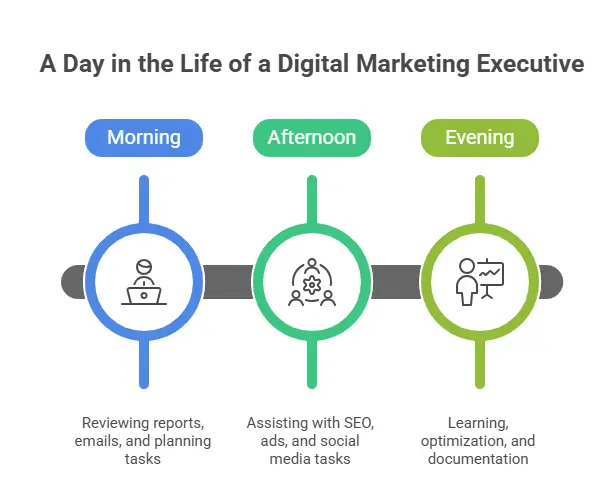
Morning: Reports, Emails, and Task Planning
The day usually begins with reviewing emails, internal messages, and updates from clients or team members. Digital marketing executives often start by checking performance reports from the previous day, such as website traffic, ad performance, social media engagement, or email campaign results. This helps identify what is working and what needs attention.
Morning hours are also used to update trackers and dashboards that monitor ongoing campaigns. Executives may prepare basic reports for managers or specialists, highlighting key metrics and flagging any issues. Task allocation and prioritization happen at this stage, often through team meetings or project management tools. Clear planning in the morning ensures smooth execution throughout the day.
Afternoon: Assisting SEO, Ads, and Social Media Tasks
The afternoon is typically dedicated to execution and collaboration. Digital marketing executives assist SEO teams by conducting keyword research, updating meta tags, optimizing on-page content, or checking technical SEO issues. For paid advertising, they may help set up campaigns, update ad creatives, monitor budgets, or track conversions.
Social media tasks are also common during this time. This includes scheduling posts, responding to comments or messages, coordinating with content teams, and analyzing engagement metrics. Executives often work closely with specialists, ensuring that tasks are completed accurately and on time. This hands-on exposure across channels builds practical skills and confidence.
Evening: Learning, Optimization, and Documentation
The latter part of the day is usually quieter and more focused. Many digital marketing executives use this time to learn new tools, explore platform updates, or improve their understanding of SEO, ads, or analytics. Continuous learning is essential in digital marketing, as platforms and algorithms change frequently.
Executives may also update internal documentation, trackers, and reports to ensure data is accurate and up to date. Reviewing completed tasks and preparing notes for the next day helps maintain consistency and organization.
Tools
Digital marketing executives rely on a set of practical tools to track performance, execute campaigns, automate tasks, and collaborate with teams. These tools help them work efficiently, stay organized, and make data-driven decisions on a daily basis.
Analytics Tools: Google Analytics 4 (GA4)
GA4 is one of the most important tools used by digital marketing executives to measure website performance. It helps track user behaviour such as page views, sessions, traffic sources, and conversions. Executives use GA4 to understand how users interact with a website, which campaigns are driving traffic, and where improvements are needed. Daily or weekly performance checks in GA4 help identify trends, drop-offs, and opportunities for optimization.
Execution Tools: Meta Business Suite
Meta Business Suite is commonly used to manage Facebook and Instagram marketing activities. Digital marketing executives use this platform to schedule posts, manage ad accounts, respond to messages and comments, and monitor campaign performance. It allows centralized control of social media content and paid ads, making execution more efficient. For beginners, Meta Business Suite offers hands-on exposure to both organic and paid social media workflows.
Automation Tools: Basic CRM Platforms
Basic CRM tools are used to manage leads, customer data, and follow-ups. Digital marketing executives often update contact details, track lead status, and assist in email or WhatsApp automation workflows. These tools help ensure that leads generated through ads or forms are properly organized and followed up by sales teams. Understanding CRM basics is important for learning how marketing connects with sales.
Collaboration Tools: Google Sheets and Slack
Google Sheets is widely used for maintaining trackers, reports, content calendars, and performance dashboards. It allows teams to collaborate in real time and keeps data organized. Slack is used for internal communication, quick updates, and coordination with team members. Together, these tools improve transparency, speed, and teamwork in daily operations.
Tools & Skills Required for a Digital Marketing Executive
To succeed as a digital marketing executive, professionals need a balanced mix of technical knowledge and soft skills. This role is not just about using tools—it’s about understanding how digital channels work, adapting to changes, and communicating effectively within a team. Together, these skills help entry-level professionals grow into confident and capable digital marketers.
Technical Skills: Building the Digital Foundation
Technical skills form the core of a digital marketing executive’s daily work. Basic SEO knowledge is essential, including keyword research, on-page optimization, meta tags, content structuring, and understanding how search engines rank pages. Executives often support SEO specialists by implementing these tasks and tracking performance.
Paid advertising skills are another important area. Digital marketing executives usually assist with setting up and monitoring ads on platforms like Google Ads and Meta Ads. This includes understanding campaign objectives, targeting options, budgets, creatives, and performance metrics such as impressions, clicks, and conversions.
Analytics skills help connect effort with results. Executives use tools like Google Analytics 4 to track website traffic, user behaviour, and campaign performance. Reading reports, identifying trends, and sharing insights with managers are part of everyday responsibilities. While advanced analytics comes later, basic data interpretation is crucial at this stage.
-
Basic understanding of SEO concepts such as keywords, on-page optimization, and search intent
-
Ability to assist with paid ads on platforms like Google Ads and Meta Ads
-
Knowledge of campaign structure, targeting, budgets, and performance metrics
-
Familiarity with analytics tools like GA4 to track traffic, users, and conversions
-
Ability to read reports and identify basic trends and issues
Soft Skills: What Makes a Great Digital Marketer
Alongside technical knowledge, soft skills play a major role in career growth. A strong learning mindset is essential because digital marketing tools and algorithms change frequently. Executives who actively learn new features, trends, and updates stay relevant and grow faster.
Communication skills are equally important. Digital marketing executives work with multiple teams—designers, content writers, SEO specialists, ad managers, and clients. Clear communication ensures tasks are completed accurately and expectations are aligned. Even simple skills like writing clear emails, updating trackers, and sharing reports matter greatly.
Time management and adaptability also support daily performance. Handling multiple tasks, meeting deadlines, and adjusting priorities are part of the role. Professionals who stay organized and flexible perform better in fast-paced environments.
-
Strong learning mindset to keep up with changing tools and digital trends
-
Willingness to learn from feedback and improve continuously
-
Clear communication skills for working with teams, managers, and clients
-
Ability to explain data and task updates in a simple, understandable way
-
Good time management and adaptability in a fast-paced environment
Why Skills matter more than Tools
While tools can be learned, skills determine long-term success. Strong fundamentals combined with the right mindset help digital marketing executives grow into specialists, managers, and strategic roles over time.
Become an AI-powered Digital Marketing Expert
Master AI-Driven Digital Marketing: Learn Core Skills and Tools to Lead the Industry!
Explore CourseChallenges Faced by a Digital Marketing Executive
While the role of a digital marketing executive offers valuable learning and exposure, it also comes with its own set of challenges. These challenges are common at the entry level and play an important role in shaping a professional’s growth and resilience in the digital marketing field.
Information Overload
One of the biggest challenges digital marketing executives face is information overload. Digital marketing involves multiple platforms, tools, algorithms, and constantly changing best practices. From SEO updates and ad platform changes to new social media features and analytics dashboards, there is always something new to learn. For beginners, this can feel overwhelming and confusing.
Executives are often exposed to vast amounts of data, reports, and metrics on a daily basis. Understanding what data truly matters and what can be ignored takes time and experience. Without proper guidance, learners may feel pressured to know everything at once, leading to stress or self-doubt. The key challenge is not the lack of information, but learning how to filter, prioritize, and apply it effectively.
Multitasking Across Multiple Channels
Another major challenge is multitasking across different digital marketing channels. A digital marketing executive may handle SEO tasks in the morning, support ad campaigns in the afternoon, and manage social media updates or reporting later in the day. Each channel has its own tools, metrics, and workflows, which requires constant context switching.
Balancing multiple responsibilities can be mentally demanding, especially when deadlines overlap. Managing SEO optimization, ad performance tracking, content scheduling, and reporting simultaneously requires strong time management and organizational skills. Without proper planning, tasks can pile up, leading to mistakes or missed deadlines.
Managing Expectations and Priorities
Digital marketing executives often work under managers, specialists, and sometimes clients. Each may have different expectations and priorities. Learning how to manage tasks efficiently while aligning with team goals is a challenge that develops with experience. Understanding what needs immediate attention and what can be scheduled later is a critical skill.
Turning Challenges into Growth Opportunities
Although these challenges can be demanding, they also create growth opportunities. Information overload teaches executives how to learn strategically, while multitasking builds adaptability and efficiency. Over time, these challenges help professionals become more confident, organized, and capable of handling complex digital marketing roles.
Career Growth Path: From Executive to Manager
A career in digital marketing offers a clear and structured growth path, making it attractive for freshers and career starters. Most professionals begin as digital marketing executives and gradually move into specialized and leadership roles as they gain experience, skills, and confidence. Understanding this progression helps professionals plan their learning and career decisions effectively.
Stage 1: Digital Marketing Executive
The digital marketing executive role is the foundation of a digital marketing career. At this stage, professionals focus on executing day-to-day tasks such as assisting with SEO activities, managing basic ad operations, scheduling social media content, and preparing performance reports. The goal here is to gain broad exposure across channels and understand how digital campaigns function in real-world scenarios. Executives learn tools, workflows, and team coordination, which helps them identify their strengths and interests.
Key responsibilities:
-
Supporting SEO activities such as keyword research and on-page optimization
-
Assisting in setting up and monitoring paid ad campaigns
-
Scheduling social media posts and tracking engagement
-
Preparing basic reports and updating trackers
Stage 2: Digital Marketing Specialist
After gaining hands-on experience, professionals usually move into a specialist role. At this stage, they choose a focus area such as SEO, performance marketing, social media, content marketing, or analytics. Specialists take ownership of strategy and optimization within their domain. For example, an SEO specialist plans keyword strategies, audits websites, and tracks ranking growth, while a performance marketer manages budgets, targeting, and conversion optimization. This role requires deeper technical knowledge, independent decision-making, and strong analytical skills.
Common specialist roles include:
-
SEO Specialist
-
Performance Marketing Specialist
-
Social Media Manager
-
Content Marketing Specialist
Skills developed at this stage:
-
Advanced technical expertise
-
Analytical thinking and optimization skills
-
Independent decision-making
Stage 3: Digital Marketing Manager
The next step is the digital marketing manager role, which involves leadership and strategic responsibility. Managers oversee multiple channels, guide specialists and executives, and align digital efforts with business goals. They handle campaign planning, budget allocation, team coordination, and client or stakeholder communication. At this level, success depends less on execution and more on strategy, problem-solving, and team management.
Manager-level responsibilities include:
-
Planning and executing integrated marketing strategies
-
Managing budgets and performance goals
-
Leading specialists and executives
-
Communicating with clients or internal stakeholders
Skills that drive Career Growth
Career progression depends on continuous learning, adaptability, and performance. Executives who actively learn, take initiative, and show problem-solving abilities grow faster. Specialists who demonstrate consistent results and strategic thinking move into managerial roles more easily.
Salary in India: What to Expect
Salary is an important consideration for anyone starting a career in digital marketing. In India, the salary of a digital marketing executive varies based on experience, skills, location, company type, and level of specialization. While entry-level salaries may start modestly, the growth potential in this field is strong, especially for professionals who build in-demand skills.
Fresher /Entry-Level Salary Range
For freshers and career starters, digital marketing executive roles typically offer a starting salary in the range of ₹2.5 LPA to ₹4 LPA. This range can vary depending on whether you are working in a digital marketing agency, a start-up, or a large organization. Agencies often provide faster learning exposure, while in-house roles may offer more stability.
At the entry level, salaries are influenced by:
-
Basic knowledge of SEO, ads, and analytics
-
Hands-on experience through internships or projects
-
Location (metro cities often offer higher pay)
-
Communication and practical skills
Although the initial salary may not be very high, this stage is focused more on learning, experience, and building a strong foundation rather than immediate income.
Salary Growth with Specialization
As professionals gain experience and move into specialist roles, salaries increase significantly. Digital marketing specialists in areas like SEO, performance marketing, or analytics typically earn between ₹5 LPA to ₹8 LPA with 2–4 years of experience. High-demand skills such as paid advertising, marketing automation, and data analysis can push salaries even higher.
Managers and team leads with strong results and leadership skills can earn ₹10 LPA to ₹15 LPA or more, especially in large companies or performance-driven roles.
Fresher vs Experienced Digital Marketing Professionals
The role of a digital marketing professional changes significantly with experience. While freshers focus mainly on execution and learning, experienced professionals move toward strategy, ownership, and decision-making. Understanding this difference helps set clear expectations at each career stage.
Fresher: Execution-Focused Role
For freshers, digital marketing roles are heavily execution-driven. The main objective at this stage is to learn how digital marketing works in real projects and build hands-on skills across channels. Freshers usually work under close guidance from seniors and specialists.
Key characteristics of a fresher role:
-
Focus on day-to-day execution of tasks
-
Assisting with SEO activities like keyword research and on-page updates
-
Supporting ad campaigns by monitoring performance and updating creatives
-
Scheduling social media posts and responding to basic engagement
-
Preparing reports and updating trackers
At this stage, mistakes are part of the learning process. Freshers are expected to ask questions, follow instructions carefully, and gradually improve speed and accuracy.
Experienced: Strategy and Ownership-Focused Role
As professionals gain experience, their role becomes more strategic. Experienced digital marketers are expected to take ownership of channels, campaigns, and results. They are involved in planning, optimization, and decision-making rather than just execution.
Key characteristics of an experienced role:
-
Planning and executing channel-specific strategies
-
Making data-driven decisions to improve performance
-
Managing budgets, timelines, and targets
-
Coordinating with teams, vendors, or clients
-
Mentoring freshers and reviewing their work
Experienced professionals are accountable for outcomes, such as lead quality, conversions, or ROI. Their focus shifts from “how to do a task” to “why a strategy works and how to improve it.”
Role Fit: Is this Role Right for You?
The digital marketing executive role is especially well-suited for individuals who are at the beginning of their careers and are eager to learn. It is designed as a foundational position where professionals gain hands-on exposure to multiple aspects of digital marketing. Beginners who are curious, adaptable, and open to experimenting with new tools and platforms often thrive in this role. Since the work involves execution across SEO, ads, social media, and reporting, it provides a well-rounded understanding of how digital marketing functions in real-world business environments.
This role is ideal for fresh graduates, career switchers, and anyone looking to enter the digital domain without prior experience. It allows individuals to build confidence, develop practical skills, and identify areas of interest before choosing a specialization. The learning opportunities are high, and growth depends largely on how actively one engages with tasks and learning resources.
However, this role may not be the right fit for everyone. Digital marketing involves constant change—new algorithms, tools, and strategies emerge regularly. Professionals who prefer repetitive tasks, fixed routines, or minimal learning curves may find this role challenging. Success in this position requires patience, adaptability, and a willingness to continuously upgrade skills.
How to Become a Digital Marketing Executive
Becoming a digital marketing executive follows a clear and achievable path, especially for beginners and fresh graduates. The journey focuses on building fundamentals, gaining real-world exposure, and growing through execution-based roles. Below is a detailed breakdown of each step.
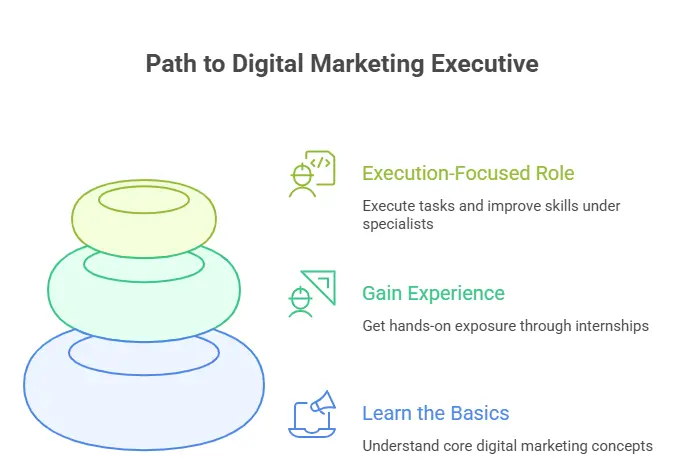
Step 1: Learn the Basics of Digital Marketing
The first step is to understand the core concepts of digital marketing. At this stage, the focus should be on learning how different digital channels work and how they connect to business goals. You don’t need advanced expertise—clarity in fundamentals is more important.
What to learn at this stage:
-
Basics of SEO: keywords, on-page optimization, search intent
-
Introduction to paid ads: Google Ads and Meta Ads fundamentals
-
Social media marketing basics and content planning
-
Understanding analytics and basic performance metrics
-
Overview of tools like GA4, Meta Business Suite, and Google Search Console
This foundation helps you understand industry terminology and workflows.
Step 2: Gain Hands-On Experience through an Internship
Once the basics are clear, the next step is practical exposure. Internships help bridge the gap between theory and real-world execution. During an internship, you learn how teams work, how tasks are assigned, and how campaigns are executed.
What you gain from an internship:
-
Hands-on experience with live projects
-
Exposure to real tools and platforms
-
Understanding of deadlines, reporting, and team collaboration
-
Confidence in executing basic digital marketing tasks
Internships also strengthen your resume and improve job readiness.
Step 3: Move into an Execution-Focused Role
After gaining basic experience, you can apply for digital marketing executive or junior roles. This is where most learning happens. You will work under specialists and managers, execute daily tasks, and continuously improve your skills.
Key focus areas in this role:
-
Executing SEO, ads, and social media tasks
-
Preparing reports and performance trackers
-
Learning optimization techniques from seniors
-
Building speed, accuracy, and confidence
Join Our Online Digital Marketing Course & Learn the Fundamentals!
Conclusion
A day in the life of a digital marketing executive is fast-paced, practical, and full of learning. From handling daily execution tasks and working with essential tools to developing technical and soft skills, this role lays a strong foundation for a successful career in digital marketing. It offers valuable exposure to multiple channels, helping beginners understand how digital strategies are planned, executed, and measured in real business scenarios.
For freshers and career starters, this role is an excellent entry point into the digital world. With consistent learning, hands-on experience, and the right mindset, a digital marketing executive can grow into a specialist and eventually move into strategic and leadership roles. If you enjoy learning, adapting to change, and working in a results-driven environment, this career path offers long-term growth, flexibility, and exciting opportunities.
Frequently Asked Questions
Is a digital marketing executive role suitable for freshers?
Yes, this role is ideal for freshers and career starters. It focuses on execution and learning, allowing beginners to gain hands-on experience across SEO, ads, social media, and analytics.
Do I need prior experience to become a digital marketing executive?
No prior experience is required. Basic knowledge of digital marketing concepts and tools is enough to start, and most skills are developed on the job.
What skills are most important for this role?
Basic technical skills like SEO, paid ads, and analytics are important, along with soft skills such as communication, adaptability, and a strong learning mindset.
How long does it take to grow from executive to specialist?
Typically, professionals can move into a specialist role within 1–3 years, depending on performance, learning speed, and hands-on experience.
5. Is digital marketing a long-term career option?
Yes, digital marketing offers long-term growth, diverse roles, and strong demand across industries as businesses continue to invest in online channels.
6. Can I switch to another specialization later?
Yes, the executive role provides broad exposure, making it easier to shift into areas like SEO, performance marketing, social media, or analytics based on interest and strengths.
How long does it take to grow from executive to specialist?
Typically, professionals can move into a specialist role within 1–3 years, depending on performance, learning speed, and hands-on experience.
Is digital marketing a long-term career option?
Yes, digital marketing offers long-term growth, diverse roles, and strong demand across industries as businesses continue to invest in online channels.
Can I switch to another specialization later?
Yes, the executive role provides broad exposure, making it easier to shift into areas like SEO, performance marketing, social media, or analytics based on interest and strengths.