Table of Contents
In today’s results-driven digital landscape, performance marketing plays a crucial role in helping businesses achieve measurable growth. A performance marketer’s day revolves around data, optimization, and experimentation—tracking campaign performance, fine-tuning ads, managing budgets, and driving conversions across multiple digital platforms. From working with tools like Google Ads and analytics dashboards to collaborating with creative and product teams, the role blends analytical precision with strategic thinking. This blog explores a day in the life of a performance marketer, highlighting the daily tasks, essential tools, key skills, and career path that make this profession both challenging and highly rewarding.
Join Our Online Digital Marketing Course & Learn the Fundamentals!
Introduction
A day in the life of a performance marketer is rarely monotonous. It typically begins with reviewing campaign dashboards, analyzing key metrics like CPC, CPA, ROAS, and conversion rates, and identifying what worked (or didn’t) the previous day. From managing paid campaigns on platforms like Google Ads, Meta Ads, LinkedIn, and programmatic networks to coordinating with creatives, product teams, and analytics specialists, performance marketers operate at the intersection of strategy, data, and execution.
This role demands a unique blend of analytical thinking and creative problem-solving. One moment you’re deep-diving into funnel drop-offs and attribution models, and the next you’re A/B testing ad copies, landing pages, or audience segments. The constant pressure to optimize budgets and scale profitable campaigns makes performance marketing both challenging and highly rewarding.
Beyond daily tasks, performance marketing also offers a clear and scalable career path. From junior media buyers and growth executives to performance marketing managers, growth leads, and even CMOs, the skill set is highly transferable across industries and geographies. With businesses increasingly prioritizing measurable growth, skilled performance marketers are in strong demand.
Daily Routine of a Performance Marketer
1: What is the primary goal of SEO (Search Engine Optimization)?
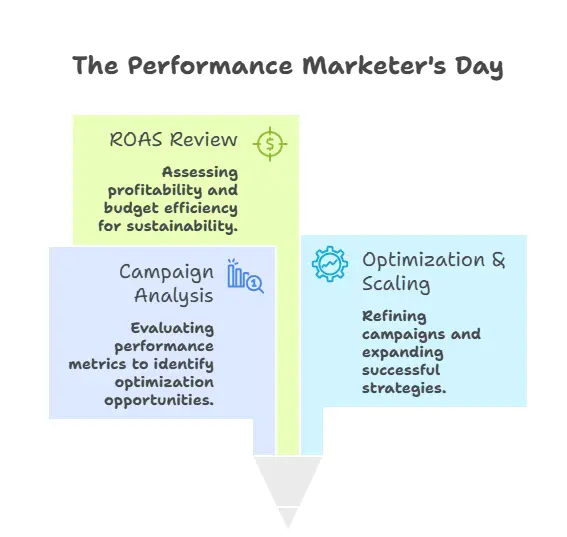
The daily routine of a performance marketer revolves around monitoring data, optimizing campaigns, and driving measurable results. The day typically starts with analyzing campaign performance metrics such as clicks, conversions, and ROAS to understand what worked and what needs improvement. As the day progresses, the focus shifts to optimizing ads, adjusting budgets, testing new creatives or audiences, and scaling high-performing campaigns. The routine often ends with reviewing overall ROI, updating reports, and planning strategies for the next day, ensuring continuous growth and efficiency.
Morning: Campaign Analysis
The morning routine of a performance marketer is largely focused on analyzing campaign performance data from the previous day. This phase sets the direction for the entire day. Marketers begin by reviewing dashboards across platforms such as Google Ads, Meta Ads, LinkedIn Ads, and analytics tools like Google Analytics or Looker Studio. Key metrics including impressions, clicks, CTR, CPC, conversions, CPA, and ROAS are carefully examined to understand overall performance. Any sudden fluctuations—such as a spike in cost, drop in conversions, or changes in audience behaviour—are flagged for deeper investigation.
During this time, performance marketers also break down results by campaign, ad set, audience, device, geography, and creatives to identify what’s driving success or underperformance. These insights help determine whether issues are related to targeting, bidding strategies, creative fatigue, or landing page performance. Morning analysis is not just about numbers; it’s about drawing actionable conclusions that guide optimization decisions later in the day.
Afternoon: Optimization & Scaling
The afternoon is the most execution-heavy part of the day, where insights from the morning analysis are turned into action. Performance marketers optimize live campaigns by pausing low-performing ads, reallocating budgets, refining bids, and adjusting audience targeting. A/B testing plays a major role during this phase—new ad copies, creatives, CTAs, and landing page variations are launched to improve conversion rates and engagement.
Scaling is also a key focus in the afternoon. High-performing campaigns are identified and scaled by increasing budgets gradually, expanding audience segments, or replicating winning strategies across platforms. Marketers often collaborate with creative, content, and product teams to ensure ads align with user intent and business objectives. Continuous testing, iteration, and optimization ensure that campaigns remain efficient while maximizing growth opportunities.
Evening: ROAS Review
Evenings are dedicated to a comprehensive ROAS and profitability review. Performance marketers evaluate how effectively ad spend is translating into revenue or desired outcomes. ROAS is analyzed at both the campaign and account level to ensure budgets are being utilized efficiently and aligned with business goals. This review helps determine whether current strategies are sustainable and where adjustments are needed.
Marketers also compare daily performance against targets, historical data, and forecasts to identify trends and potential risks. Based on these insights, budgets may be reallocated, scaling decisions reassessed, or testing strategies refined for the following day. The day often ends with preparing performance reports, sharing insights with stakeholders, and outlining action items—ensuring clarity, accountability, and readiness for the next cycle of optimization.
Become an AI-powered Digital Marketing Expert
Master AI-Driven Digital Marketing: Learn Core Skills and Tools to Lead the Industry!
Explore CoursePerformance Marketer Salary in India
Performance marketing has emerged as one of the most in-demand career paths in India’s digital ecosystem. As businesses increasingly prioritize measurable growth, ROI, and revenue-driven marketing, performance marketers have become critical to scaling brands across industries such as e-commerce, fintech, edtech, SaaS, and D2C. This rising demand has directly influenced salary structures, making performance marketing a high-growth and high-reward career option.
However, the salary of a performance marketer in India is not fixed. It varies significantly based on experience level, skill depth, industry, company size, location, and the ability to drive tangible business results. Let’s break down performance marketer salaries in India in detail.
Entry-Level Performance Marketer Salary (0–2 Years)
Freshers entering performance marketing typically start in roles such as Performance Marketing Executive, Growth Executive, Paid Media Executive, or Media Buyer. At this stage, professionals are primarily responsible for campaign execution and support rather than strategy ownership.
Average Salary Range
-
₹3 LPA to ₹6 LPA
Key Responsibilities
-
Setting up and managing basic ad campaigns
-
Monitoring daily performance metrics (CTR, CPC, conversions)
-
Assisting in audience targeting and keyword research
-
Preparing performance reports and dashboards
-
Supporting senior marketers with optimization tasks.
Mid-Level Performance Marketer Salary (2–5 Years)
With experience, performance marketers move into roles where they begin owning campaigns, budgets, and performance outcomes. This is the most growth-intensive phase of a performance marketer’s career.
Average Salary Range
-
₹6 LPA to ₹12 LPA
Key Responsibilities
-
Managing large-scale paid campaigns across platforms
-
Budget planning and allocation
-
Improving CPA, ROAS, and conversion rates
-
Running A/B tests on creatives, audiences, and landing pages
-
Coordinating with design, content, and product teams
-
Reporting performance insights to stakeholders
Senior Performance Marketer Salary (5+ Years)
Senior-level professionals typically move into leadership or strategy-focused roles such as Performance Marketing Manager, Growth Manager, Head of Performance Marketing, or Acquisition Lead.
Average Salary Range
-
₹12 LPA to ₹25+ LPA
In high-growth startups or funded companies, salaries can go even higher, especially when combined with bonuses or ESOPs.
Key Responsibilities
-
End-to-end ownership of revenue-driven marketing
-
Managing multi-crore ad budgets
-
Leading performance marketing teams
-
Defining growth strategy and scaling frameworks
-
Forecasting revenue and CAC targets
-
Aligning marketing with business and product goals
Salary by Job Role
| Role | Average Salary |
|---|---|
| Performance Marketing Executive | ₹3–6 LPA |
| Paid Media Specialist | ₹5–9 LPA |
| Growth Marketer | ₹6–12 LPA |
| Performance Marketing Manager | ₹10–18 LPA |
| Head of Performance Marketing | ₹18–30+ LPA |
| CMO / Growth Director | ₹30 LPA to ₹1 Cr+ |
Challenges in performance Marketing
Performance marketing comes with several challenges due to its strong focus on measurable results. Marketers face constant pressure to deliver revenue, manage rising advertising costs, and ensure strict budget accountability. Frequent algorithm changes, ad fatigue, and tracking limitations also make it difficult to maintain consistent performance. Successfully overcoming these challenges requires continuous optimization, data-driven decision-making, and adaptability.
Revenue Pressure
One of the biggest challenges performance marketers face is constant pressure to drive revenue and measurable results. Unlike brand marketing, where impact is often long-term, performance marketing is judged daily—sometimes hourly—based on numbers. Stakeholders expect consistent growth, lower acquisition costs, and higher returns, even when market conditions, competition, or consumer behaviour fluctuate. This pressure intensifies during peak seasons, product launches, or periods of aggressive growth targets. Performance marketers must continuously test, optimize, and adapt strategies to maintain momentum while avoiding burnout, making revenue responsibility both demanding and high-stakes.
Budget Accountability
Budget accountability is another critical challenge in performance marketing. Every dollar spent on ads is closely tracked, and marketers are expected to justify spend with clear outcomes such as conversions, revenue, or leads. Misallocation of budget, delayed optimizations, or poor targeting can quickly impact profitability. Performance marketers must balance experimentation with efficiency—testing new ideas while protecting core revenue-driving campaigns. This requires strong analytical skills, forecasting ability, and a deep understanding of attribution models to ensure budgets are invested wisely and aligned with overall business goals.
Role Fit: Is Performance Marketing Right for You?
Performance marketing is not a one-size-fits-all career. It demands a specific mindset, skill set, and working style. Understanding whether this role fits your personality and career goals is essential before stepping into the field.
Analytical Thinkers Who Enjoy Data
Performance marketing is ideal for individuals who are comfortable working with numbers, metrics, and dashboards on a daily basis. If you enjoy analyzing trends, spotting patterns, and making data-backed decisions, this role can be highly fulfilling. Performance marketers constantly interpret KPIs like CTR, CPA, LTV, and ROAS to evaluate success. Rather than relying on intuition alone, decisions are driven by performance data, making the role well-suited for those who trust logic and evidence.
Experimenters and Problem Solvers
This role fits people who enjoy testing, experimenting, and optimizing. Campaigns rarely perform perfectly from day one—continuous iteration is part of the job. Performance marketers must be comfortable running A/B tests, learning from failures, and quickly adjusting strategies. If you enjoy solving problems, finding growth opportunities, and improving results through small but impactful changes, performance marketing offers an exciting and dynamic environment.
Results-Oriented and Accountable Professionals
Performance marketing strongly suits individuals who are goal-driven and accountable. Success is clearly defined through measurable outcomes such as revenue, conversions, or leads. If you thrive in environments where expectations are clear and performance is transparent, this role can be motivating. However, it also requires resilience, as underperformance is visible and demands immediate action. Those who can handle pressure and stay focused on long-term growth despite short-term fluctuations tend to excel.
Cross-Functional Communicators
Although data-driven, performance marketing is not a solitary role. It fits professionals who can collaborate effectively across teams. Performance marketers frequently work with designers, content writers, developers, and product managers to improve creatives and user journeys. Clear communication is essential to translate data insights into actionable feedback for other teams. Individuals who can bridge the gap between data and creativity will find this role particularly rewarding.
Fast Learners in a Rapidly Changing Landscape
The digital advertising ecosystem evolves constantly, with algorithm changes, new ad formats, privacy regulations, and emerging platforms. Performance marketing fits those who are curious, adaptable, and eager to learn. Professionals who enjoy staying updated, learning new tools, and experimenting with emerging channels will find long-term growth in this field.
Become an AI-powered Digital Marketing Expert
Master AI-Driven Digital Marketing: Learn Core Skills and Tools to Lead the Industry!
Explore CourseHow to become a Performance Marketer
Becoming a performance marketer is not about instantly running high-budget ad campaigns or driving massive revenue. It is a step-by-step journey that focuses on building a strong foundation, gaining hands-on experience, and growing through execution-driven roles. This structured approach helps you develop analytical thinking, platform expertise, and decision-making skills over time.
Step 1: Learn the Basics of Performance Marketing
The journey begins with understanding what performance marketing is and how paid digital advertising works. You should start by learning the fundamentals of platforms such as Google Ads, Meta Ads (Facebook & Instagram), LinkedIn Ads, and other paid channels. This includes concepts like impressions, clicks, CTR, CPC, CPA, conversions, ROAS, audience targeting, bidding strategies, and campaign structures.
At this stage, it’s also important to understand how funnels work—from awareness to conversion—and how landing pages, creatives, and offers impact performance. You don’t need advanced tools initially; exploring ad platform interfaces, watching tutorials, reading blogs, and running small test campaigns (even with minimal budgets) can help you grasp the basics and build confidence.
Step 2: Gain Hands-On Experience Through an Internship or Trainee Role
Once you understand the fundamentals, practical exposure becomes critical. Internships or trainee roles help bridge the gap between theory and real-world execution. As a performance marketing intern, you may assist with campaign setup, keyword research, audience creation, ad copy testing, budget allocation, and performance reporting.
This phase helps you understand how campaigns are managed in live environments, how optimizations are made based on data, and how teams collaborate across design, content, and analytics. You’ll also learn how performance is reported to stakeholders and how decisions are made under budget and revenue pressure—an essential skill for growth in this field.
Step 3: Enter an Execution-Based Performance Role
With foundational knowledge and internship experience, you can move into roles such as Performance Marketing Executive, Media Buyer, or Growth Executive. In this phase, you’ll take ownership of day-to-day campaign management—launching ads, monitoring performance, optimizing bids and budgets, testing creatives, and improving conversion rates.
This role sharpens your analytical skills, helps you understand attribution and scaling, and teaches you how to balance experimentation with efficiency. Over time, consistent execution, learning from data, and adapting to platform changes prepare you for advanced roles such as Performance Marketing Manager, Growth Lead, or Head of Performance Marketing.
Join Our Online Digital Marketing Course & Learn the Fundamentals!
Conclusion
A day in the life of a performance marketer is a constant balance of analysis, action, and accountability. From reviewing campaign data in the morning to optimizing and scaling strategies throughout the day and closing with ROI and ROAS evaluations, the role is deeply rooted in measurable impact. It demands a strong grasp of data, hands-on experience with marketing tools, and the ability to adapt quickly in an ever-changing digital landscape.
Performance marketing is not just about running ads—it’s about driving sustainable growth through informed decisions, experimentation, and continuous learning. For individuals who enjoy working with numbers, taking ownership of results, and solving complex business challenges, this career offers both excitement and long-term potential. As businesses increasingly prioritize performance-driven strategies, skilled performance marketers will continue to be in high demand, making this a rewarding career path for those ready to thrive in a results-focused environment.
Frequently Asked Questions
What does a performance marketer do on a daily basis?
A performance marketer manages and analyzes paid marketing campaigns, tracks key metrics, optimizes ads and budgets, runs A/B tests, and focuses on improving conversions, revenue, and ROAS across digital platforms.
Which tools are commonly used by performance marketers?
Performance marketers use tools such as Google Ads, Meta Ads Manager, LinkedIn Ads, Google Analytics, Looker Studio, attribution tools, A/B testing platforms, and CRM or marketing automation software.
What skills are required to become a performance marketer?
Key skills include data analysis, campaign optimization, budget management, A/B testing, understanding of funnels, basic copywriting, audience targeting, and strong problem-solving abilities.
Is performance marketing a good career option?
Yes, performance marketing is a high-demand career with strong growth potential. As businesses focus more on measurable ROI, skilled performance marketers are increasingly valued across industries.
How is performance marketing different from digital marketing?
Performance marketing is a subset of digital marketing that focuses specifically on measurable results such as leads, conversions, or revenue, whereas digital marketing may also include branding and awareness-focused efforts.
Does performance marketing require technical knowledge?
While deep technical expertise isn’t mandatory, basic knowledge of analytics, tracking, pixels, conversion events, and landing page optimization is essential for success.
What is the biggest challenge in performance marketing?
The biggest challenges include constant revenue pressure, strict budget accountability, rapidly changing algorithms, and maintaining consistent performance at scale.
Can freshers start a career in performance marketing?
Yes, freshers can start as junior performance marketers or growth executives by learning ad platforms, analytics tools, and gaining hands-on experience through internships or entry-level roles.
What is the career growth path for a performance marketer?
Career progression typically moves from performance executive or media buyer to performance marketing manager, growth lead, head of performance, and eventually leadership roles like CMO or Growth Director.