

Table of Contents
An SEO specialist plays a crucial role in improving a website’s visibility on search engines and driving organic traffic. From keyword research and on-page optimization to performance tracking and technical audits, the role combines analytical thinking with strategic execution. In this blog, we’ll explore a day in the life of an SEO specialist, covering daily tasks, essential tools, key skills, and the career path that makes SEO one of the most in-demand roles in digital marketing today.
Join Our Online Digital Marketing Course & Learn the Fundamentals!
Introduction
An SEO specialist is responsible for driving organic growth by helping websites rank higher on search engines through data-driven optimization. Unlike paid campaigns that deliver immediate results, SEO focuses on building a strong, sustainable online presence over time. This role plays a critical part in digital marketing because it helps brands attract users who are actively searching for relevant information, products, or services.
One of the key strengths of SEO is its long-term impact. The work done by an SEO specialist today—such as optimizing content, improving site structure, or fixing technical issues—can continue to deliver traffic and leads for months or even years. This makes SEO a valuable investment for businesses and a rewarding area of specialization within digital marketing.
The role is especially well-suited for analytical thinkers who enjoy working with data, patterns, and problem-solving. SEO specialists regularly analyze search trends, user behavior, and performance metrics to identify opportunities for improvement. They test strategies, measure results, and refine approaches based on insights rather than guesswork.
Who is an SEO Specialist?
1: What is the primary goal of SEO (Search Engine Optimization)?
An SEO specialist is a digital marketing professional responsible for improving a website’s visibility on search engines like Google. Their primary goal is to increase organic traffic by ensuring that websites are optimized according to search engine guidelines and user intent. Unlike paid advertising, SEO focuses on earning traffic naturally through better rankings, relevant content, and strong technical performance.
Optimizing Websites for Search Engines
At the core of the role, an SEO specialist works on optimizing websites to rank higher for relevant keywords. This includes on-page SEO tasks such as keyword research, optimizing titles and meta descriptions, improving internal linking, and ensuring content matches search intent. They also handle off-page activities like link building and authority improvement, along with technical SEO elements such as site speed, mobile-friendliness, crawlability, and indexing.
SEO specialists continuously monitor performance using analytics and search tools to understand what is working and where improvements are needed. Their work is data-driven, relying on insights rather than assumptions.
Working with Content and Technical Teams
SEO is not a solo role. SEO specialists collaborate closely with content writers, designers, and technical teams. With content teams, they guide topic selection, keyword usage, and content structure to ensure articles are optimized for both users and search engines. With developers or technical teams, they communicate SEO requirements related to website architecture, schema markup, page speed, and technical fixes.
This collaboration ensures that SEO strategies are implemented effectively across all parts of a website.
Career Options: Agency, In-House, and Freelance
SEO specialists can work in different professional environments. In digital agencies, they often manage multiple client websites across industries, gaining diverse experience at a fast pace. In in-house roles, they focus on a single brand, allowing deeper understanding of business goals and long-term SEO strategy. Many experienced SEO professionals also choose freelancing or consulting, offering SEO services independently to clients.
Why the Role Matters
SEO specialists play a critical role in long-term digital growth. By improving organic visibility, they help businesses attract high-intent users, reduce dependency on paid ads, and build sustainable online success. For professionals who enjoy analysis, strategy, and continuous improvement, SEO offers a stable and rewarding career path.
Become an AI-powered Digital Marketing Expert
Master AI-Driven Digital Marketing: Learn Core Skills and Tools to Lead the Industry!
Explore CourseDaily Routine of an SEO Specialist
The daily routine of an SEO specialist is a mix of monitoring, executing, and learning. It requires both analytical thinking and strategic execution, as the work directly impacts a website’s visibility and organic traffic. While each day can vary depending on ongoing campaigns, client requirements, or project deadlines, most SEO specialists follow a structured workflow to balance tasks efficiently.
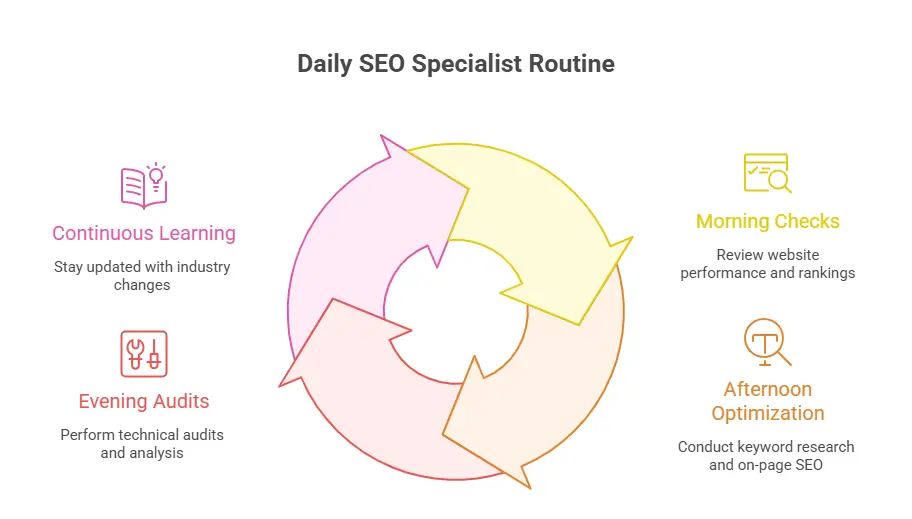
Morning: Rankings and Google Search Console (GSC) Checks
The day often begins with reviewing website performance and search rankings. SEO specialists check tools like Google Search Console (GSC), Google Analytics, and other reporting dashboards to monitor traffic, indexing issues, and keyword rankings. Morning hours are also used to identify sudden drops or spikes in organic traffic, review any crawl errors, and ensure that new pages or updates are being indexed correctly. By starting the day with these checks, SEO specialists can prioritize urgent fixes and align their tasks with ongoing optimization goals.
Afternoon: Keyword Research and On-Page SEO
The afternoon is typically dedicated to hands-on optimization work. Keyword research is a core task, where specialists identify target keywords based on search volume, competition, and user intent. They analyze trends, competitor strategies, and existing content gaps to inform content optimization.
On-page SEO tasks are also handled during this time. This includes updating meta titles, descriptions, header tags, internal linking, image alt tags, and content structure. SEO specialists may work with content writers to ensure that articles follow SEO best practices while remaining user-friendly and engaging. The afternoon is often the most execution-heavy part of the day, requiring attention to detail and accuracy to ensure all optimizations are correctly implemented.
Evening: Audits and Learning Updates
Evenings are generally reserved for technical audits, analysis, and continuous learning. SEO specialists may perform site audits to identify technical issues like broken links, duplicate content, slow-loading pages, or mobile usability problems. These audits help ensure the website is fully optimized for search engines and users.
This time is also ideal for staying updated with industry changes. SEO is constantly evolving, and specialists often read blogs, follow Google algorithm updates, or experiment with new strategies to stay ahead. Continuous learning is a key part of the role, as small changes in algorithms or trends can have significant impacts on rankings.
Tools Used by an SEO Specialist
An SEO specialist relies on a variety of tools to monitor performance, execute optimizations, automate tasks, and collaborate effectively with teams. Mastering these tools is essential for success in SEO, as they streamline work, provide actionable insights, and help achieve better search engine rankings.
Analytics Tools: GA4 and Google Search Console (GSC)
Google Analytics 4 (GA4) and Google Search Console (GSC) are the backbone of an SEO specialist’s analytics workflow. GA4 helps track user behavior, website traffic, conversion metrics, and engagement patterns. SEO specialists use GA4 to analyze which pages attract visitors, how users navigate the site, and where traffic might be dropping.
GSC complements GA4 by providing insights directly from Google’s search index. Specialists use it to monitor keyword performance, check indexing status, identify crawl errors, analyze impressions and click-through rates, and track how Google perceives the website. These tools together allow data-driven decision-making and help prioritize SEO efforts effectively.
Execution Tools: Ahrefs and SEMrush
SEO execution often requires specialized tools like Ahrefs and SEMrush. These platforms help with keyword research, backlink analysis, competitor analysis, site audits, and content gap identification. Ahrefs is widely used for analyzing link profiles and discovering opportunities to improve domain authority, while SEMrush provides a comprehensive overview of keyword rankings, competitive research, and content optimization suggestions.
By using these tools, SEO specialists can make informed decisions about which keywords to target, which content to optimize, and where to improve technical SEO. They also provide insights that are crucial for reporting and performance tracking.
Automation Tools: SEO Plugins
Automation tools like SEO plugins (e.g., Yoast SEO, Rank Math) help simplify on-page optimization tasks. These plugins automatically handle technical elements like meta tags, sitemaps, schema markup, and readability scores, allowing specialists to focus on strategy and analysis. Automation saves time and ensures consistency across pages.
Collaboration Tools: Google Docs and Sheets
Collaboration is a key part of SEO, as specialists often work with content writers, developers, and marketing teams. Tools like Google Docs and Google Sheets enable real-time collaboration on content planning, keyword mapping, tracking SEO performance, and reporting. These tools keep teams organized and ensure transparency across projects.
Skills Required for an SEO Specialist
To excel as an SEO specialist, a combination of technical expertise and soft skills is essential. The role is highly analytical, detail-oriented, and requires continuous learning, so professionals need to develop both the hard and soft skill sets to achieve measurable results in organic search.
Technical Skills: On-Page and Technical SEO
Technical skills form the foundation of an SEO specialist’s role. On-page SEO involves optimizing individual web pages to improve rankings and user experience. This includes keyword research, meta title and description optimization, header tag usage, internal linking, and ensuring content aligns with user intent. Attention to detail is crucial because even small errors can impact rankings and visibility.
Technical SEO focuses on the backend of a website to make it more accessible and understandable to search engines. Specialists work on site speed, mobile optimization, crawlability, indexing, structured data, canonical tags, and fixing broken links. Understanding tools like Google Search Console, GA4, Ahrefs, and SEMrush is essential for monitoring and implementing technical SEO tasks. These technical skills ensure that the website is optimized for both users and search engines, providing a strong foundation for long-term growth.
Soft Skills: Patience and Analytical Thinking
Soft skills are equally important in SEO because results are often not immediate, and strategies require testing and adjustment. Patience is critical, as SEO is a long-term process; changes made today may take weeks or months to reflect in search rankings. Professionals must be consistent and persistent, understanding that success comes from steady, incremental improvements.
Analytical thinking is another key soft skill. SEO specialists analyze large volumes of data from tools and reports to identify trends, patterns, and opportunities. They interpret metrics such as organic traffic, bounce rates, conversion rates, and keyword performance to make informed decisions. Problem-solving skills help specialists identify the root causes of ranking drops or technical issues and implement effective solutions.
Other important soft skills include effective communication and collaboration. SEO specialists often coordinate with content writers, web developers, and marketing teams, making the ability to explain insights and strategies in simple terms essential.
Become an AI-powered Digital Marketing Expert
Master AI-Driven Digital Marketing: Learn Core Skills and Tools to Lead the Industry!
Explore CourseChallenges Faced by an SEO Specialist
While SEO is a rewarding and impactful career, it comes with its own set of unique challenges. Unlike paid campaigns where results are immediate, SEO requires patience, strategic thinking, and the ability to adapt to frequent changes. Two of the most common challenges are algorithm updates and the slow nature of results, both of which test an SEO specialist’s resilience and problem-solving skills.
Algorithm Updates: Staying Ahead of the Changes
Search engines like Google constantly update their algorithms to improve search results and user experience. While these updates enhance the quality of search, they can have a direct impact on website rankings. An update may change how content is evaluated, affect keyword performance, or alter the importance of backlinks.
For SEO specialists, staying updated with these changes is crucial. They need to monitor news from official sources, industry blogs, and SEO communities to understand the nature of each update. An algorithm change can lead to sudden drops in traffic or rankings, requiring immediate investigation and corrective action. Specialists must analyze which areas were affected—technical issues, content relevance, or link profiles—and implement changes to restore performance.
This constant evolution makes SEO both challenging and exciting. Specialists who embrace learning and stay proactive can turn algorithm changes into opportunities for improvement, while those resistant to change may struggle to maintain consistent results.
Slow Result Cycles: Patience is Key
Unlike paid marketing campaigns where traffic and conversions are almost immediate, SEO is a long-term strategy. Optimizations made today—such as updating content, improving site structure, or building backlinks—may take weeks or even months to show measurable results.
This slow feedback loop can be challenging, especially for beginners or professionals used to quick results. It requires patience, persistence, and careful monitoring of KPIs. SEO specialists must track incremental changes, measure small improvements, and continue optimizing based on data rather than expecting instant outcomes.
The slow results also mean that mistakes or oversights can have prolonged effects, so attention to detail is critical. Specialists need to document their strategies, maintain clear records of changes, and consistently follow best practices to ensure long-term success.
Turning Challenges into Opportunities
Both algorithm updates and slow results highlight the need for a methodical, data-driven approach in SEO. Specialists who embrace continuous learning, monitor performance closely, and adapt to changes develop stronger analytical skills and a deeper understanding of search engine dynamics.
Career Growth: Junior SEO → SEO Specialist → SEO Manager
A career in SEO offers a clear growth trajectory for professionals who are analytical, patient, and eager to learn. Most SEO professionals start at the junior level and gradually move into specialized and managerial roles, gaining experience, skills, and strategic insight along the way. Understanding this career path helps set expectations and plan learning priorities.
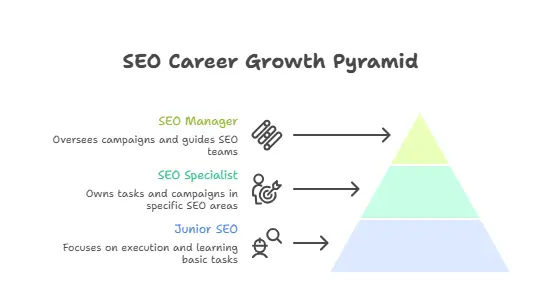
Stage 1: Junior SEO
The starting point for most professionals is the Junior SEO or SEO executive role. At this stage, individuals focus on execution and learning, assisting senior specialists with day-to-day tasks.
Key responsibilities include:
-
Conducting basic keyword research and competitive analysis
-
Optimizing on-page elements such as titles, meta descriptions, and header tags
-
Monitoring website rankings and traffic metrics
-
Preparing reports and updating trackers
This stage is primarily about gaining exposure to different SEO techniques, tools, and workflows. Junior SEOs learn how search engines work, how content and technical SEO interact, and how to implement strategies effectively.
Stage 2: SEO Specialist
After 1–3 years of experience, professionals can advance to the SEO Specialist role. At this stage, the focus shifts from assisting to owning tasks and campaigns within a specific area of SEO. Specialists are expected to plan strategies, optimize campaigns, and track results independently.
Key responsibilities include:
-
Conducting advanced keyword and competitor research
-
Performing technical audits and resolving SEO issues
-
Optimizing content and improving website authority
-
Analyzing performance data and suggesting strategic improvements
-
Collaborating closely with content, design, and development teams
SEO specialists develop deeper expertise, analytical skills, and a more strategic approach. They become responsible for measurable outcomes, such as traffic growth, ranking improvements, and higher engagement rates.
Stage 3: SEO Manager
The next stage is SEO Manager, a leadership role responsible for overseeing multiple SEO campaigns, guiding specialists and junior SEOs, and aligning SEO efforts with broader business goals.
Key responsibilities include:
-
Planning and executing SEO strategies across multiple domains or campaigns
-
Managing and mentoring a team of SEO specialists and executives
-
Coordinating with content, marketing, and technical teams for project alignment
-
Reporting performance to senior management and stakeholders
-
Staying updated with algorithm changes and implementing long-term optimization strategies
At this level, success depends on strategic thinking, leadership, decision-making, and the ability to deliver measurable results. SEO managers have a direct impact on business growth through organic search performance.
Salary in SEO: Fresher to Senior Ranges & Freelancing Potential
The salary of an SEO professional in India varies widely depending on experience, specialization, company type, and location. Understanding salary expectations helps aspirants plan their career and growth trajectory effectively.
Fresher /Entry-Level Salary
For freshers entering SEO as a junior SEO or SEO executive, the typical salary ranges between ₹2.5 LPA to ₹4 LPA. At this stage, the focus is on learning, execution, and gaining hands-on exposure to SEO tools and techniques. Entry-level roles are more about skill-building than immediate high pay, but they lay the foundation for future growth.
Mid-Level /Specialist Salary
After gaining 2–4 years of experience, SEO specialists can expect salaries between ₹5 LPA to ₹8 LPA. Mid-level professionals handle campaign planning, on-page and technical SEO, performance analysis, and optimization independently. Specialization in high-demand areas such as technical SEO, content strategy, or performance-based SEO can push salaries higher.
Senior-Level /Manager Salary
SEO managers or senior specialists with 5+ years of experience can earn between ₹10 LPA to ₹15 LPA or more, depending on company size, industry, and performance. At this level, professionals are responsible for strategic planning, team management, and delivering measurable business results. Large organizations and high-growth startups often provide higher compensation along with performance incentives.
Freelancing and Consulting Potential
In addition to full-time roles, SEO offers strong freelancing opportunities. Experienced SEO professionals can work independently for multiple clients, manage projects remotely, and set their own rates. Freelancers can earn anywhere from ₹20,000 to ₹1,00,000+ per month per client depending on experience, expertise, and project scope. Freelancing allows flexibility, diverse projects, and the potential to scale income faster than traditional roles.
Fresher vs Experienced SEO Professionals
The responsibilities and focus of an SEO professional evolve significantly with experience. While freshers primarily handle task-based execution, experienced professionals move toward strategic planning, audits, and decision-making. Understanding these differences helps set expectations and guides career growth in SEO.
Fresher: Task-Based SEO
For freshers or junior SEO executives, the role is heavily execution-oriented. The primary focus is on learning the fundamentals of SEO and assisting senior team members in implementing campaigns.
Typical tasks for freshers include:
-
Conducting keyword research and competitor analysis
-
Optimizing on-page elements such as meta titles, descriptions, headers, and content structure
-
Updating internal linking and monitoring basic website metrics
-
Assisting in backlink research and simple off-page SEO tasks
-
Preparing reports and updating SEO trackers
At this stage, freshers gain exposure to tools like Google Analytics, Google Search Console, and keyword research platforms. Their primary goal is to understand how SEO functions in practice and build technical and analytical skills.
Experienced: Strategy and Audits
Experienced SEO professionals, such as SEO specialists or managers, focus more on strategic decision-making, planning, and audits. They are responsible for improving organic search performance through data-driven strategies rather than just executing tasks.
Key responsibilities for experienced professionals include:
-
Conducting in-depth technical SEO audits to identify and resolve website issues
-
Planning and implementing long-term SEO strategies for content, technical, and off-page optimization
-
Analyzing performance data to make strategic recommendations
-
Managing and mentoring junior team members
-
Aligning SEO activities with broader digital marketing goals
Experienced professionals also stay updated with algorithm changes, industry trends, and evolving best practices. Their decisions directly impact website traffic, rankings, and ROI, making strategic thinking and analytical skills critical at this stage.
Role Fit: Is SEO Right for You?
The role of an SEO specialist is best suited for professionals who think long-term and are patient with results. Unlike paid campaigns or short-term marketing tactics, SEO requires consistent effort and strategic planning to build sustainable organic growth. Optimizations made today may take weeks or months to reflect in search rankings, making patience and persistence key traits for success.
This role is ideal for individuals who enjoy analyzing data, solving problems, and refining strategies over time. SEO specialists need to think about how each change—whether it’s optimizing content, improving site speed, or fixing technical issues—affects the website’s performance in the long run. Those who are focused on immediate results or prefer quick wins may find SEO challenging, as the field demands continuous learning and adaptation.
Additionally, the role requires attention to detail, curiosity about search engine algorithms, and a willingness to stay updated with the latest trends. Professionals who thrive in collaborative environments, working closely with content creators, developers, and marketing teams, are likely to excel in SEO.
-
Best suited for: Long-term thinkers who enjoy strategy and analysis
-
Not ideal for: Professionals expecting immediate results or minimal learning curves
How to Become an SEO Specialist
Becoming an SEO specialist requires a structured approach that combines learning, hands-on practice, and real-world project experience. Unlike some roles that rely solely on formal education, SEO emphasizes practical skills and the ability to adapt to ever-changing search engine algorithms. Here’s a detailed roadmap for beginners:
Step 1: Learn SEO Fundamentals
The first step is to build a strong foundation in SEO concepts. This includes understanding:
-
Keyword research and search intent
-
On-page SEO, including titles, meta descriptions, headers, and content optimization
-
Off-page SEO and link-building strategies
-
Technical SEO basics like site speed, mobile optimization, indexing, and crawlability
-
Analytics and performance measurement using tools like GA4 and Google Search Console
You can learn these fundamentals through online courses, blogs, tutorials, and beginner-friendly certifications. At this stage, focus on understanding the “why” behind SEO practices, not just the “how.”
Step 2: Practice SEO Skills
Once the basics are clear, start applying what you’ve learned. Create a personal website, blog, or portfolio where you can practice keyword research, optimize pages, and track results. Practicing regularly helps you understand how search engines evaluate content, how different strategies affect rankings, and how to interpret data effectively.
Practice activities include:
-
Writing optimized content and tracking its performance
-
Performing SEO audits on small websites
-
Experimenting with internal linking and meta tag optimization
-
Using tools like Ahrefs, SEMrush, or SEO plugins to explore features
Step 3: Work on Real Projects
The final step is gaining real-world experience through internships, freelance work, or projects. Working on actual websites allows you to handle larger-scale SEO campaigns, collaborate with content and technical teams, and understand client or business goals. This experience is crucial for building confidence, improving execution skills, and preparing for full-time SEO roles.
Tips for real project experience:
-
Start with small local businesses or personal projects
-
Document results and strategies for your portfolio
-
Continuously analyze performance and implement improvements
Join Our Online Digital Marketing Course & Learn the Fundamentals!
Conclusion
A career as an SEO specialist is both challenging and rewarding, offering the opportunity to make a long-term impact on a website’s visibility and business growth. From monitoring rankings and performing audits to optimizing content and analyzing data, the role combines analytical thinking with strategic execution. It’s ideal for those who enjoy problem-solving, continuous learning, and seeing the results of their work over time.
Starting as a beginner, you can grow from executing tasks to taking ownership of strategies and eventually managing SEO teams or projects. With the right mix of technical knowledge, soft skills, and hands-on experience through projects or internships, SEO provides a clear, structured career path. For long-term thinkers willing to embrace learning curves, SEO is a career that not only builds expertise but also offers flexibility, growth, and significant professional satisfaction.
Frequently Asked Questions
What does an SEO specialist do on a daily basis?
An SEO specialist monitors website rankings, conducts keyword research, optimizes content, performs technical audits, and analyzes performance data. They collaborate with content, development, and marketing teams to implement strategies that improve organic traffic and search engine visibility.
Do I need prior experience to become an SEO specialist?
No prior experience is necessary to start. Beginners can enter the field by learning SEO fundamentals, practicing on personal or demo websites, and gaining hands-on experience through internships or small projects. Practical exposure is more important than formal experience in SEO.
What tools should an SEO specialist know?
Key tools include Google Analytics 4 (GA4) and Google Search Console for analytics, Ahrefs or SEMrush for keyword research and competitor analysis, SEO plugins like Yoast or Rank Math for on-page optimization, and collaboration tools like Google Docs and Sheets to coordinate with teams.
How long does it take to grow from junior SEO to SEO manager?
Typically, freshers can move into a specialist role within 1–3 years, depending on performance and skill development. Moving into an SEO manager or leadership position generally takes 4–6 years of consistent results, strategic thinking, and experience managing campaigns or teams.
Is SEO a long-term career option?
Yes. SEO offers long-term growth opportunities in agencies, in-house roles, and freelance consulting. With continuous learning, experience, and specialization in areas like technical SEO, content strategy, or analytics, professionals can progress to senior and leadership roles.
6. Can SEO specialists work as freelancers?
Absolutely. Experienced SEO professionals can offer freelance or consulting services to multiple clients, manage projects independently, and set their own rates. Freelancing provides flexibility, diverse projects, and the potential to earn higher income compared to full-time roles, especially with a strong portfolio and proven results.