Table of Contents
Preparing for an EY HR Manager interview can feel challenging. This guide introduces EY HR Manager Interview Questions clearly. It helps you understand expectations for this leadership role. You will learn what the organization values most. The focus remains on people, performance, and culture. Questions reflect real responsibilities from senior HR positions. Answers require clarity, structure, and professional thinking. Preparation improves confidence and overall interview performance.
This introduction sets the tone for focused preparation. Each section is written using simple, practical language. The content supports both experienced and aspiring HR leaders. You gain insight into strategic and operational expectations. Examples help connect theory with real workplace situations. The flow keeps learning easy and logically organized. Overall, it prepares you to face interviews confidently.
Is being an HR your dream? Enrol now for our course on Human Resource!
Overview of EY as a Company
EY stands for Ernst and Young Global Limited. It is one of the world’s largest professional firms. EY belongs to the Big Four accounting firms. The organization provides assurance and advisory services. Its work supports businesses, governments, and institutions.
EY operates with a clear global vision. The firm aims to build trust everywhere. It also supports long-term sustainable growth. Every service aligns with this core purpose.
History and Evolution of EY
EY was officially formed in 1989. It resulted from a global merger. The merger combined Ernst and Young firms. Both firms had strong professional legacies.
Over decades, EY expanded its capabilities. The firm adapted to changing global markets. It strengthened technology and consulting practices. Growth came through innovation and client trust.
EY continues evolving with global business needs.
Global Presence and Organizational Scale
EY has a strong global presence. It functions in more than 150 countries. Its offices span major economic regions. Teams collaborate across borders and cultures.
EY employs hundreds of thousands worldwide. They come from all backgrounds. Multicultural teams strengthen problem-solving capabilities.
Global Snapshot of EY
| Category | Information |
|---|---|
| Global Reach | 150+ countries |
| Workforce Size | 350,000+ professionals |
| Service Lines | Four major divisions |
| Client Base | Global and regional |
Core Service Areas at EY
EY operates through four major service lines. Each service supports different business needs. Together, they provide end-to-end solutions.
Assurance Services
Assurance services focus on financial reliability. They support audit and reporting standards. Teams ensure transparency and accountability.
Assurance builds confidence among investors. It strengthens trust in financial statements.
Consulting Services
Consulting supports business transformation initiatives. It focuses on strategy, operations, and technology. Teams help organizations adapt to change.
Consulting also supports digital transformation. Innovation plays a major role here.
Strategy and Transactions
This service supports growth decisions. It includes mergers and acquisitions advisory. Teams assist with valuations and restructuring.
Clients receive insights for complex transactions. Decisions align with long-term business goals.
Tax Services
Tax services manage compliance and planning. EY supports domestic and global tax needs. It helps clients navigate regulatory complexities.
Tax professionals reduce risk and improve efficiency.
Industry Expertise at EY
EY serves a wide range of industries. Industry focus ensures relevant and practical solutions.
Key Industries Served
-
Finance
-
Technology & digital media
-
Healthcare & life sciences
-
Manufacturing & automotive
-
Energy and infrastructure
-
Government and public sector
Each industry has dedicated specialists.
These teams understand sector-specific challenges.
EY Culture and Core Values
EY culture centers on people and purpose. Values guide decisions and behaviors. Ethical leadership is the top priority.
EY Core Values
-
Integrity and honesty
-
Mutual respect
-
Team collaboration
-
Inclusion and diversity
-
Professional excellence
EY promotes equal opportunity workplaces. Employee wellbeing receives strong organizational focus.
Learning and Career Development at EY
EY invests heavily in professional development. Learning remains continuous throughout careers. Training programs support skill advancement.
Employees access global learning platforms. Leadership programs prepare future leaders.
Career Growth Opportunities
-
Structured career paths
-
Continuous feedback
-
Mentorship support
- Coaching support
-
Global mobility options
Career transparency helps in long-term retention.
Technology and Innovation @ EY
EY integrates technology into all services. Digital tools enhance efficiency and accuracy. Innovation drives smarter client solutions.
Technology Focus Areas
-
Artificial intelligence applications
-
Data analytics platforms
-
Automation and process optimization
-
Cloud computing solutions
-
Cybersecurity and risk management
Innovation labs support research and experimentation.
Commitment to Sustainability and ESG
EY supports responsible business practices. Sustainability aligns with global development goals. The firm tracks environmental and social impact.
EY helps clients improve ESG performance. This includes reporting and strategy development.
Why EY Remains a Trusted Organization
EY combines global scale with local insight. It balances tradition with innovation effectively. The firm prioritizes long-term relationships.
Strong values guide its professional conduct. People remain the foundation of success. This defines EY’s global reputation.
Is being an HR your dream? Enrol now for our course on Human Resource!
Responsibilities of an EY HR Manager
An EY HR Manager plays a strategic people leadership role. The role supports business growth through effective talent management. It blends operations, strategy, analytics, and employee experience. HR Managers work closely with leadership and global teams.
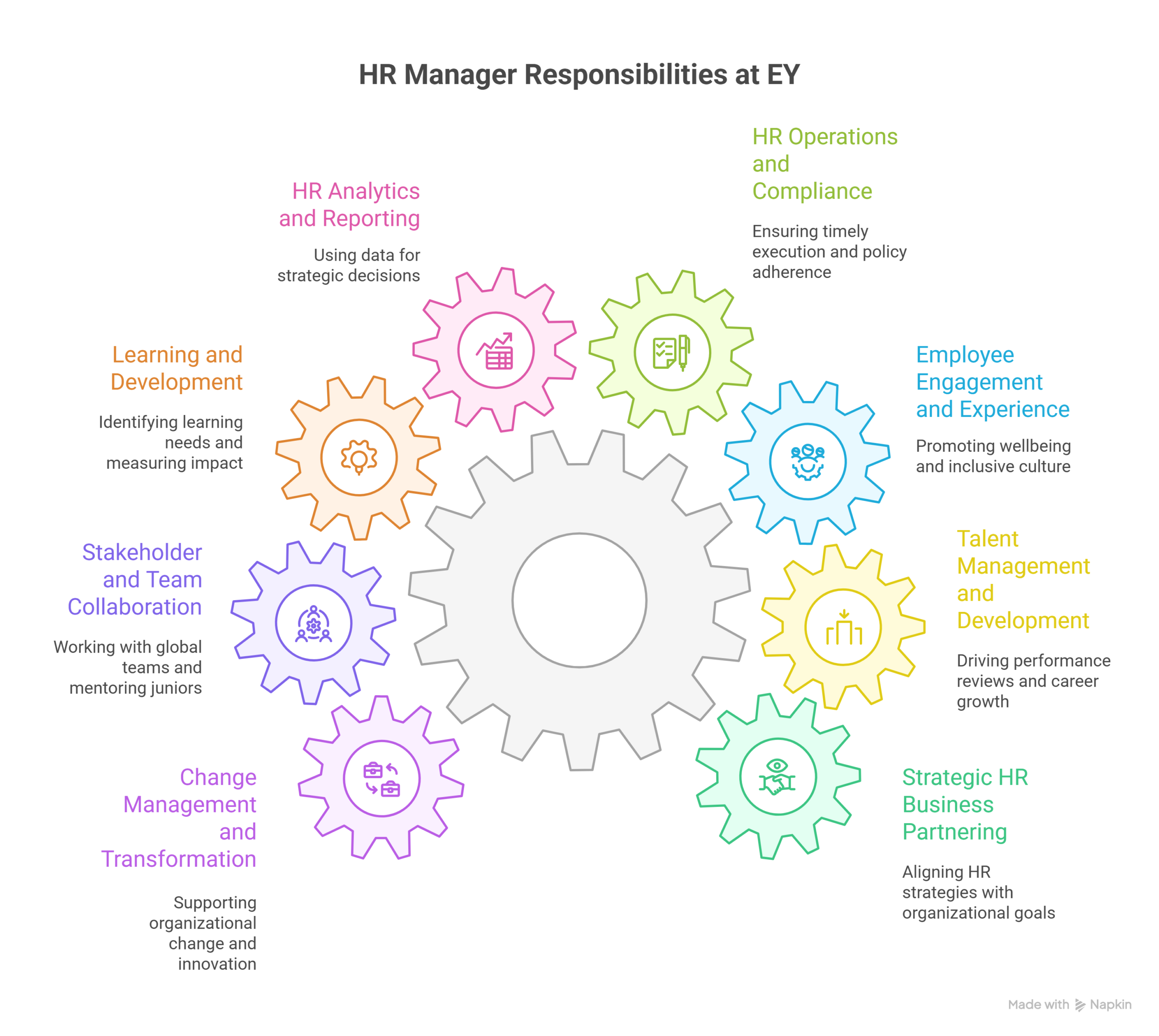
1. Strategic HR Business Partnering
Supporting Business Leaders
-
Act as a trusted advisor to business leaders.
-
Align HR strategies with organizational goals.
-
Translate business needs into people solutions.
Workforce Planning
-
Forecast workforce needs using data insights.
-
Support hiring plans and talent allocation.
-
Ensure optimal resource utilization across teams.
2. Talent Management and Development
Performance Management
-
Drive performance review and goal-setting processes.
-
Ensure fair and transparent performance evaluations.
-
Support managers with feedback conversations.
Career Development
-
Design career frameworks and growth pathways.
-
Identify high-potential employees for leadership roles.
-
Support succession planning initiatives.
3. Employee Engagement and Experience
Engagement Programs
-
Plan employee engagement initiatives across service lines.
-
Analyze engagement survey results and trends.
-
Recommend actions to improve employee satisfaction.
Employee Wellbeing
-
Promote wellbeing and work-life balance programs.
-
Address employee concerns with empathy and professionalism.
-
Foster an inclusive and respectful workplace culture.
4. HR Operations and Compliance
Operational Excellence
-
Oversee daily HR operations and service delivery.
-
Ensure timely execution of HR processes.
-
Maintain accuracy in employee records and data.
Policy and Compliance
-
Implement HR policies aligned with global standards.
-
Ensure compliance with labor laws and regulations.
-
Handle employee relations issues professionally.
5. HR Analytics and Reporting
Data-Driven Decision Making
-
Track key HR metrics regularly.
-
Prepare reports for leadership reviews.
-
Use insights to support strategic decisions.
Tools and Technology
-
Use HR systems for reporting and automation.
-
Improve efficiency through digital HR solutions.
6. Learning and Development
Learning Strategy
-
Identify learning needs through performance analysis.
-
Align training programs with business objectives.
-
Support technical and leadership development initiatives.
Measuring Impact
-
Track learning effectiveness using defined metrics.
-
Gather feedback from participants and stakeholders.
7. Stakeholder and Team Collaboration
Internal Collaboration
-
Work with global HR and cross-functional teams.
-
Ensure consistency across regions and service lines.
Team Leadership
-
Guide and mentor junior HR team members.
-
Delegate tasks and review team performance.
-
Encourage continuous learning within the HR team.
8. Change Management and Transformation
Managing Change
-
Support organizational change initiatives effectively.
-
Communicate changes clearly to employees.
-
Address resistance with structured change plans.
Continuous Improvement
-
Identify opportunities to improve HR processes.
-
Drive innovation within HR service delivery.
Summary Table: Key EY HR Manager Responsibilities
| Area | Key Responsibilities |
|---|---|
| Business Partnering | Align HR strategy with business goals |
| Talent Management | Performance, development, succession planning |
| Engagement | Employee experience and wellbeing programs |
| HR Operations | Policy, compliance, service delivery |
| Analytics | Metrics, dashboards, leadership reporting |
| Learning | Training needs and impact measurement |
| Collaboration | Global and cross-functional coordination |
| Change | Transformation and process improvement |
EY HR Managers shape the organization’s people strategy. They balance operations, analytics, and employee experience effectively. The role demands leadership, adaptability, and strong business understanding.
Become an HR Expert – Enroll in Our HR Management Course Today!
Unlock the secrets to effective Human Resource Management with our expert-led course! Learn recruitment, employee relations, performance management, and more to build a thriving workplace. Start your journey toward a successful HR career today!
Know MoreWhat EY Looks for in HR Leaders
EY expects HR leaders to drive business-focused people strategies. They balance human insight with data-driven decision making. HR leaders shape culture, capability, and organizational success.
1. Strategic Business Mindset
Business Alignment
-
Understand business goals and market challenges clearly.
-
Align HR strategies with long-term business objectives.
-
Anticipate talent needs through proactive planning.
Commercial Awareness
-
Consider cost, value, and return on HR initiatives.
-
Support leaders with practical, scalable HR solutions.
2. Strong People Leadership
Coaching and Mentoring
-
Guide leaders through effective people management practices.
-
Coach teams to improve performance and engagement.
Empathy and Inclusion
-
Demonstrate empathy in employee interactions.
-
Promote diversity, equity, and inclusive behaviors consistently.
3. Data-Driven and Analytical Thinking
HR Analytics
-
Use data to support workforce decisions.
-
Track trends using meaningful HR metrics.
Insight Generation
-
Translate data into actionable people insights.
-
Support leadership decisions with clear evidence.
4. Change and Transformation Capability
Change Leadership
-
Lead workforce through organizational changes effectively.
-
Communicate change messages with clarity and confidence.
Agility
-
Adapt HR strategies to evolving business priorities.
-
Respond quickly to changing workforce needs.
5. Strong Stakeholder Management
Influence and Partnership
-
Build trust with senior leaders and stakeholders.
-
Influence decisions without direct authority.
Collaboration
-
Work effectively across functions and global teams.
-
Balance diverse viewpoints to achieve outcomes.
6. Learning and Growth Orientation
Continuous Learning
-
Stay updated on HR trends and best practices.
-
Encourage learning culture across the organization.
Talent Development
-
Invest in developing future-ready leaders.
-
Support career growth and internal mobility.
7. Integrity and Professional Ethics
Ethical Leadership
-
Uphold EY’s values in every decision.
-
Maintain confidentiality and professional judgment.
Accountability
-
Take ownership of decisions and outcomes.
-
Ensure consistency and fairness across HR practices.
8. Innovation and Digital Mindset
HR Technology
-
Leverage HR tools for efficiency and insights.
-
Support digital transformation initiatives actively.
Process Improvement
-
Identify opportunities to improve HR processes.
-
Implement scalable and sustainable HR solutions.
Summary Table
| Capability Area | What EY Expects |
|---|---|
| Strategy | Business-aligned HR leadership |
| People Leadership | Empathy, coaching, inclusion |
| Analytics | Data-backed decision making |
| Change | Agility and transformation leadership |
| Stakeholders | Influence and collaboration |
| Learning | Growth mindset and talent development |
| Ethics | Integrity and accountability |
| Innovation | Digital and process excellence |
EY values HR leaders who think beyond traditional roles. They act as strategic partners shaping future-ready organizations. Strong values, insight, and adaptability define successful EY HR leaders.
Is being an HR your dream? Enrol now for our course on Human Resource!
EY HR Manager Interview Questions – Complete Guide
Preparing for an EY HR Manager interview requires structured preparation. EY evaluates both strategic thinking and operational HR expertise. Interview questions test leadership, judgment, and people management skills. They also assess alignment with EY’s culture and values.
This guide presents thirty carefully curated interview questions. Each question includes intent and answer direction. Explanations help candidates frame clear and confident responses.
1. Tell us about your HR leadership experience.
What this question evaluates
EY assesses your professional journey and leadership maturity. They want clarity on scope and responsibility handled.
How to approach the answer
Briefly describe roles and years of experience. Highlight teams managed and functions handled. Mention measurable achievements where possible.
2. How do you align HR strategy with business goals?
What this question evaluates
EY values HR as a strategic partner. They assess business understanding and decision impact.
How to approach the answer
Explain workforce planning aligned with business objectives. Mention using data to guide people decisions. Show collaboration with leadership teams.
3. How do you handle employee conflicts effectively?
What this question evaluates
- Conflict resolution skills and emotional intelligence.
- Ability to remain neutral and professional.
How to approach the answer
Describe listening to all involved parties. Explain policy-based and fair resolution methods. Focus on restoring trust and collaboration.
4. What HR systems and tools have you used?
What this question evaluates
- Technical exposure and digital HR readiness.
- Comfort with HR automation and analytics.
How to approach the answer
Mention HRIS, ATS, and performance tools. Explain how tools improved efficiency and accuracy.
5. How do you ensure compliance with labor laws?
What this question evaluates
- Risk management and legal awareness.
- Ability to protect organizational interests.
How to approach the answer
Explain staying updated with legal changes. Mention audits, training, and documentation practices.
6. How would you strengthen EY’s workplace culture?
What this question evaluates
- Cultural alignment and people-centric thinking.
- Understanding of EY’s core values.
How to approach the answer
Mention inclusion, collaboration, and integrity. Explain engagement and recognition initiatives.
7. Describe a change management initiative you led.
What this question evaluates
- Leadership during uncertainty and transformation.
- Communication and planning abilities.
How to approach the answer
Explain the change context clearly. Describe communication and employee support actions. Share positive outcomes achieved.
8. How do you manage employee performance issues?
What this question evaluates
Coaching ability and accountability management. Fairness in performance decisions.
How to approach the answer
Discuss feedback and performance improvement plans. Emphasize documentation and follow-ups.
9. How do you support learning and development?
What this question evaluates
Commitment to talent growth and capability building.
How to approach the answer
Explain identifying skill gaps. Mention training programs and leadership development.
10. How do you handle confidential employee information?
What this question evaluates
Ethics, discretion, and data security awareness.
How to approach the answer
Stress confidentiality and restricted data access. Mention compliance with company policies.
11. How do you manage multiple HR priorities?
What this question evaluates
Time management and organizational skills.
How to approach the answer
Explain prioritization and planning techniques. Mention delegation and deadline management.
12. How do you partner with business leaders?
What this question evaluates
Stakeholder management and influence skills.
How to approach the answer
Describe consultative support and data-backed advice. Highlight trust and collaboration.
13. How do you ensure diversity and inclusion?
What this question evaluates
Commitment to inclusive workplace practices.
How to approach the answer
Mention unbiased hiring and inclusive policies. Explain awareness and training programs.
14. How do you measure HR success?
What this question evaluates
Analytical thinking and results orientation.
How to approach the answer
Discuss metrics like retention and engagement. Explain reporting insights to leadership.
15. How do you manage HR audits?
What this question evaluates
Process discipline and compliance readiness.
How to approach the answer
Explain audit preparation and documentation. Mention corrective action planning.
16. How do you handle employee grievances?
What this question evaluates
Sensitivity and procedural fairness.
How to approach the answer
Describe structured grievance handling processes. Emphasize confidentiality and timely resolution.
17. How do you support employee engagement?
What this question evaluates
Ability to create positive employee experiences.
How to approach the answer
Mention surveys, feedback, and engagement programs. Explain action plans and communication.
18. How do you manage compensation planning?
What this question evaluates
Compensation strategy and market awareness.
How to approach the answer
Explain benchmarking and internal equity. Mention incentive and reward alignment.
19. How do you handle employee exits?
What this question evaluates
Professionalism and risk management.
How to approach the answer
Describe structured offboarding processes. Mention exit interviews and compliance.
20. How do you support succession planning?
What this question evaluates
Long-term talent strategy thinking.
How to approach the answer
Explain identifying high-potential employees. Mention development and readiness plans.
21. How do you manage underperforming managers?
What this question evaluates
Leadership courage and coaching skills.
How to approach the answer
Discuss feedback, coaching, and accountability. Focus on improvement before escalation.
22. How do you support hybrid or remote teams?
What this question evaluates
Adaptability to modern work models.
How to approach the answer
Mention communication tools and engagement strategies. Explain performance tracking approaches.
23. How do you manage HR vendors?
What this question evaluates
Vendor management and cost control.
How to approach the answer
Explain service reviews and compliance checks. Mention contract and performance management.
24. How do you promote ethical behavior?
What this question evaluates
Governance mindset and value alignment.
How to approach the answer
Discuss ethics training and reporting mechanisms. Emphasize leadership role modeling.
25. How do you manage organizational restructuring?
What this question evaluates
Sensitivity during critical business changes.
How to approach the answer
Explain communication and transition support. Focus on minimizing disruption.
26. How do you support leadership development?
What this question evaluates
Future leadership pipeline focus.
How to approach the answer
Mention coaching, mentoring, and leadership programs. Explain readiness assessment methods.
27. How do you ensure HR policies stay relevant?
What this question evaluates
Policy governance and legal alignment.
How to approach the answer
Explain periodic reviews and updates. Mention communication and training efforts.
28. How do you handle high-pressure HR situations?
What this question evaluates
Composure and decision-making ability.
How to approach the answer
Describe calm analysis and structured action. Mention stakeholder communication.
29. How do you stay updated with HR trends?
What this question evaluates
Continuous learning mindset.
How to approach the answer
Mention certifications, webinars, and networks. Explain applying learning practically.
30. Why do you want to join EY?
What this question evaluates
Motivation and cultural fit.
How to approach the answer
Align personal values with EY’s purpose. Mention growth, impact, and people leadership.
EY Interview Tips – How to Prepare Effectively
Preparing for an EY interview requires structured planning. EY interviews test skills, values, and mindset. Preparation improves confidence and answer quality. Understanding EY expectations is extremely important.
This section explains key interview preparation strategies. Each tip helps candidates perform better.
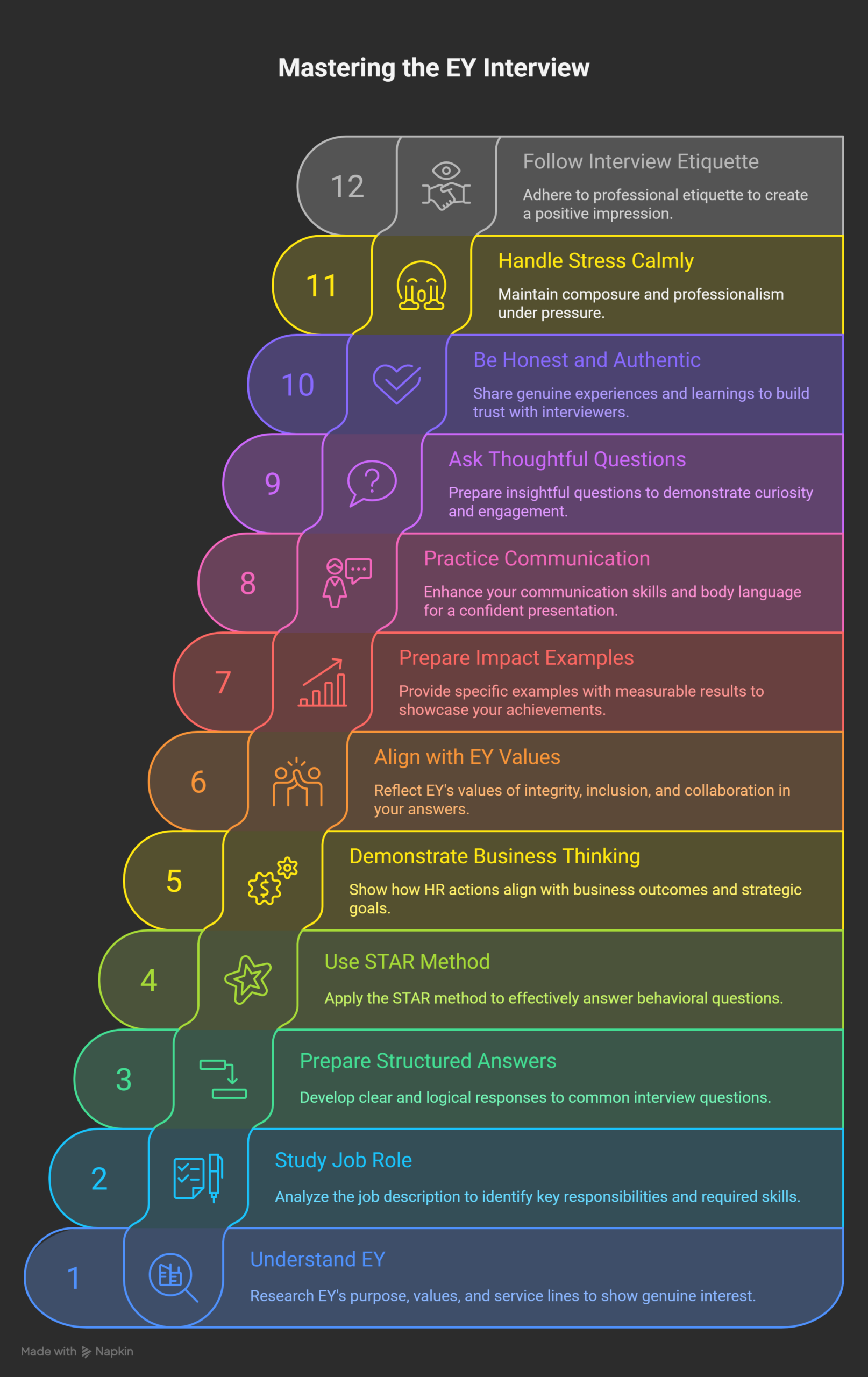
Understand EY as an Organization
Researching EY is the first preparation step. Interviewers expect knowledge about the firm. Understanding EY values shows genuine interest.
What You Should Know About EY
-
EY’s purpose and vision
-
Core service lines and industries
-
Company culture and values
-
Recent business focus areas
Understanding these builds contextual awareness. It also helps align interview answers.
Study the Job Role Thoroughly
Always review the job description carefully. Each responsibility signals interview focus areas. EY designs questions around real role expectations.
How to Analyze the Job Description
-
Identify key responsibilities
-
Note required skills and competencies
-
Match experience with role expectations
-
Prepare examples for each responsibility
This improves answer relevance and clarity.
Prepare Structured Answers
EY values clear and structured communication. Unorganized answers reduce impact. Structured answers demonstrate professional thinking.
Recommended Answer Approach
-
Use clear beginning and ending
-
Maintain logical flow
-
Focus on impact and results
-
Avoid unnecessary details
Structure helps interviewers follow responses easily.
Use the STAR Method Effectively
EY frequently asks behavioral questions. Behavioral questions assess past experiences.
STAR Method Breakdown
| Step | Meaning |
|---|---|
| S | Situation |
| T | Task |
| A | Action |
| R | Result |
Explain situations briefly and clearly. Focus more on actions and outcomes. Results show value and effectiveness.
Demonstrate Business-Oriented Thinking
EY views HR as a business partner. Answers should reflect business understanding.
How to Show Business Alignment
-
Link HR actions to business outcomes
-
Mention productivity or engagement improvements
-
Show leadership collaboration examples
This highlights strategic HR capability.
Show Alignment with EY Values
EY places strong emphasis on values. Integrity and inclusion matter greatly.
EY Values to Reflect
-
Integrity in decision making
-
Respect for diverse perspectives
-
Collaboration across teams
-
Commitment to quality
Embed values naturally within answers.
Prepare Examples with Measurable Impact
EY prefers result-oriented responses. Numbers improve answer credibility.
Examples of Impact Metrics
-
Reduced employee attrition
-
Improved engagement scores
-
Faster hiring timelines
-
Successful change implementation
Metrics strengthen professional credibility.
Practice Communication and Body Language
Strong communication supports answer delivery. Body language affects interviewer perception.
Communication Best Practices
-
Maintain eye contact
-
Speak clearly and calmly
-
Avoid rushing answers
-
Pause before responding
Confidence improves overall impression.
Prepare Thoughtful Questions for Interviewers
EY expects candidates to ask questions. Questions show curiosity and engagement.
Good Questions to Ask
-
Role success expectations
-
Team structure and collaboration
-
Growth and learning opportunities
Avoid questions about basic information.
Be Honest and Authentic
EY values authenticity in candidates. Overprepared answers may sound unnatural. Honesty builds interviewer trust.
Share genuine experiences and learnings. Admit challenges with learning outcomes.
Handle Stress and Pressure Calmly
Interviews may include challenging questions. Calm responses show emotional maturity.
Stress Management Tips
-
Take deep breaths
-
Listen carefully before answering
-
Ask clarifying questions if needed
Calm behavior reflects leadership readiness.
Follow Professional Interview Etiquette
Professional behavior creates strong impressions. Small details matter during interviews.
Etiquette Guidelines
-
Dress professionally
-
Join interviews on time
-
Greet interviewers politely
-
Thank interviewers at closing
Professionalism reflects cultural fit.
Final Interview Preparation Checklist
| Area | Focus |
|---|---|
| Research | EY and role knowledge |
| Answers | Structured and clear |
| Examples | Impact-focused |
| Behavior | Calm and confident |
| Questions | Thoughtful and relevant |
Consistent preparation improves interview outcomes. Confidence comes from clarity and practice.
Conclusion
Preparing for an EY HR Manager interview requires focused and strategic preparation. Understanding EY expectations helps candidates respond with confidence. Each interview question reflects real leadership and decision scenarios. Strong preparation improves clarity, structure, and overall impact. Alignment with organizational values strengthens interview performance.
EY seeks HR leaders who balance people and business priorities. Integrity, influence, and insight define successful HR leadership. Clear communication builds trust across all stakeholder levels. A thoughtful approach demonstrates long-term leadership potential. Well-prepared candidates position themselves for lasting success.
Become an HR Expert – Enroll in Our HR Management Course Today!
Unlock the secrets to effective Human Resource Management with our expert-led course! Learn recruitment, employee relations, performance management, and more to build a thriving workplace. Start your journey toward a successful HR career today!
Know MoreFrequently Asked Questions
What kind of questions are typically asked in an EY HR Manager interview?
EY HR Manager interviews usually include a mix of behavioral, situational, and technical HR questions. Behavioral questions focus on your past experiences, such as managing conflicts, leading HR initiatives, or driving organizational change. Situational questions test your problem-solving and decision-making skills in hypothetical scenarios relevant to EY’s work environment. Technical HR questions cover topics like talent acquisition, performance management, employee engagement, compensation, HR policies, compliance, and analytics. EY also evaluates your understanding of business strategy, cultural alignment, and how HR decisions impact organizational outcomes.
How can I best prepare for behavioral questions at EY?
To prepare for behavioral questions, use the STAR method (Situation, Task, Action, Result) to structure your answers. Focus on providing specific examples from your previous roles, emphasizing your actions and measurable results. Highlight situations that reflect leadership, strategic thinking, ethical judgment, and collaboration. Practice answering questions concisely while showing impact. Research EY’s values and culture to ensure your examples align with what the company looks for in HR leaders. Additionally, rehearse answers out loud to improve clarity and confidence during the interview.
What qualities does EY look for in HR leaders beyond technical knowledge?
EY emphasizes qualities such as ethical judgment, integrity, influence, resilience, and emotional intelligence in HR leaders. They look for professionals who can act as trusted advisors to business leaders, manage sensitive employee issues, and drive organizational change effectively. Strategic thinking, a commercial mindset, and data-driven decision-making are highly valued. Leadership potential, inclusivity, collaboration, and strong communication skills are also critical. EY expects HR leaders to demonstrate purpose-driven behavior that aligns people strategies with long-term business goals while maintaining fairness and transparency.
How should I approach situational or hypothetical questions during the interview?
Situational or hypothetical questions assess your problem-solving and decision-making capabilities in realistic HR scenarios. Approach these questions by clearly defining the problem, identifying key stakeholders, and outlining possible solutions. Explain the rationale behind your choices and the steps you would take to achieve a positive outcome. Incorporate organizational policies, ethical considerations, and people-focused strategies in your response. Where possible, relate the scenario to similar situations you have handled in the past to demonstrate experience and practical understanding.
How important is knowledge of EY’s culture and values in the interview?
Knowledge of EY’s culture and values is extremely important, as interviewers assess cultural alignment along with technical skills. EY emphasizes integrity, respect, collaboration, inclusivity, and professional excellence. Demonstrating awareness of these values through examples or thoughtful answers helps you stand out. Candidates who can connect their personal values and leadership approach to EY’s mission of building a better working world are seen as strong cultural fits. Understanding the company’s purpose also helps in framing answers to show alignment with strategic HR priorities.
What practical steps can I take to improve my chances of success?
To improve your chances, thoroughly research EY, its service lines, industries, and recent initiatives. Review the HR Manager job description carefully and identify core responsibilities to prepare relevant examples. Practice answering behavioral and situational questions using the STAR method. Prepare questions to ask interviewers that show curiosity and strategic thinking. Focus on clear communication, professional body language, and confident presentation. Finally, emphasize ethical decision-making, leadership potential, and measurable impact in all answers to demonstrate your suitability for the role.