Table of Contents
Imagine yourself settling into a quiet, warm café in Berlin, the kind where the windows fog a little from the contrast between the cold street outside and the coffee bean inside. You’re sitting across from someone you’ve just met, casually discussing your day, and suddenly something interesting is happening. Rather than simply saying “I went for a run this morning,” you describe how you ran energetically, how your breath dries heavily, and how your legs were still moving in spite of the chill in the air. You are suddenly alive, words. Your listener isn’t just hearing information; they are seeing and feeling the scene. Here German adverbs of manner quietly work their magic; in the transition from flat statements into vivid storytelling.
German adverbs of manner are the fine tools that describe how an act is done and not just what it does. They answer questions like Wie? (How?) and they automatically slide into sentences to add dimension and emotional impact. When you say someone laughed laut (loudly), herzlich (warmly), or uncontrolliert (uncontrollably), the sentence instantly changes. The action becomes more human and real. Without these adverbs, German can sound mechanical, especially when learning from a very basic sentence structure. Yet they hold onto, and their language starts to breathe, to embody personality and to live out.
One of the reasons many learners struggle with German adverbs of manner is that they don’t always sound or behave like English adverbs. In English, we usually add “-ly” and move on. German, on the other hand, uses adjectives as adverbs even when they do not change their form. Schnell, langsam, ruhig, or vorsichtig are the same words, no matter what the noun is or what the action is. This is confusing at first because it does not live up to expectations. But once this pattern appears, it actually makes speaking easier. You stop thinking about endings, and start thinking about meaning and flow.
As you begin to use these adverbs instinctively, your spoken German changes dramatically. You feel free to express emotions without ever expressing them directly; your sentences get smoother and expressive. Instead of “I was very tired but happy,” you can describe walking erschöpft but smiling zufrieden. These few choices allow your listener to make judgments rather than hearing what is said, as is usually the case with native speakers. This is also why conversations suddenly become more engaged: people respond better when language paints a picture than when it presents facts.
The role of German adverbs of manner in shaping tone and intention is another powerful thing. Saying something was done absichtlich (intentionally) versus zufällig (involuntary), completely changes the meaning of an action. Providing speech as leise, direkt, or freundlich adds a meaning to avoid misunderstanding. These differences are important in everyday conversations, and especially in a language that loves clarity, like German. They make you sound precise without sounding stiff, expressive without being dramatic.
These adverbs don’t seem to be “extra vocabulary” and become instinctual with practice. You’ll start to pick words that match the mood you want to communicate, be it a relaxed tale, a story about a problem or a happy moment. Translating from a native tongue becomes more of a direct German thinking process, rather than talking in the native tongue. Sometimes this is what learners refer to as a breakthrough—when the language feels non-comfortable but becomes usable.
It means you improve more than grammatical accuracy, as long as you keep this idea in mind and apply it regularly. You build confidence. You learn to describe actions clearly, emotions subtly, and experiences vividly. Conversation becomes more natural, the listeners become more engaged, and your German starts to sound authentic rather than rehearsed. Adverbs of manner are small words, but they are powerful tools for expressing. Once you learn how to use them comfortably, your German no longer just communicates, it communicates.
Learn German from the best mentors in the field! Join the Entri online course!
What Are Adverbs of Manner in German?
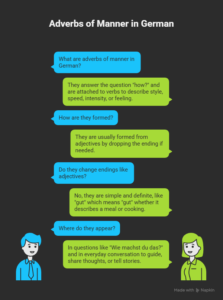 Adverbs of manner in German help answer the simple but powerful question: how? They are attached to verbs and tell a story what is being said in style, speed, intensity or feeling, changing a normal action into something vivid and memorable. Take the sentence “Sie tanzt schön” – here. “Schön” isn’t just saying she dances, it says that she dances so perfectly that anyone who listens can see the grace and joy in each movement. Without adverbs like this, sentences are not filled with meaning and few opportunities for emotional exchange or specificity.
The appeal of these adverbs is the way that they are almost always narrated by adjectives. You use a familiar adjective; drop the ending if needed; and use the same adjective to describe how something happens. For example, “Schnell” works really well: when you say “ein schneller Wagen” you are talking about a fast car that has the appropriate adjective form needing the right ending but if you say “Der Wagen fährt schnell,” the adverb “schnell” becomes the word for the car that moves, no ending required. This overlap saves you from a series of repetitions of new words because one root word handles both jobs based upon the position of the root word in the sentence.
Of course, the exact same word changes adjective to adverb due to just what it does. “Hart” is the description of a hard stone in “ein harter Stein”, but when you say “Er arbeitet hart” that statement moves to show working hard, but nothing else gets added. Such flexibility keeps German practical and allows speakers to reuse words easily while moving the focus from things to actions. Upon a bit of practice, students see these patterns, and suddenly sentences seem less like a chore than as if a story has been pieced together.
Adverbs of manner, unlike adjectives, which change endings to match the noun they describe in gender, number, and case, are simple and definite. Words like “gut” still mean “gut,” whether a good meal is “ein gutes Essen” or someone “cooks well in Sie kocht gut” . This lack of endings means a lot less stress, especially when you’re trying to say quickly in real life. Some adverbs use adjectives with endings like -weise for words like “glücklicherweise” which means luckily, but the most commonly used adverbs are those that are simple and easy to learn.
These words appear in questions all the time too; for example, “Wie machst du das” comes up with words like “schnell” or “gern” that go straight to the feeling of the action or the actions itself. Kids pick them up through playground chatter and bedtime stories, and adults call on them to guide, share their thoughts, or tell stories about experiences they have had at work or on trips. It’s easier to get comfortable with them, and you have fewer misunderstandings or more opportunities to add warmth or urgency when you need it.
|
German A2 Exercises – Download Free PDF |
||
Common German Adverbs of Manner
1: How do you say "Good Morning" in German?
Adverbs of manner that look immediately familiar and relatable for speed, quality, sound, and attitude come up in everyday German conversations. “Schnell” is the star because it captures that rush everyone knows, like “Die Kinder laufen schnell zum Spielplatz,” in which you can almost see the kids burning out with energy as they go about racing. Change to its counter-langsam and the pace is immediately curtailed in “Der Opa spaziert langsam durch den Park,” a slow, unsuspecting stroll that invites quiet reflection.
Nevertheless, when it comes to quality, both “gut” and “schlecht” present themselves as experts at how well or poorly something is done. “Er spielt gut Klavier” is very appointing of good piano playing and “Sie fährt schlecht Auto” of shaky driving without being too harsh. These words are appropriate for welcoming comments or casual comments, where people hear the truth clearly. “laut” and “leise” bring it all into volume – “Das Kind schreit laut” produces a loud scene on its own, and “Sprich leise im Museum” reminds everyone to hush respectfully, affecting the mood on the spot.
And then there’s “gern” or “gerne,” a layer of willingness and pleasure that warms up any invitation or preference. The poem “Ich trinke gern Kaffee am Morgen” shows that morning routine being pleasant, and the poem “Wir gehen gerne spazieren” makes calling for a walk feel inviting and positive. Another helpful example is “genau” for doing things exactly in “Er misst genau nach,” “vorsichtig” when caution is key in “Fahre vorsichtig auf der nassen Straße” and “freundlich” for kind responses in “Sie antwortet freundlich.”
People mix and match these for stronger effects, like “Er lernt schnell und gut,” combining speed with success to describe effective studying. In stories, instructions, or daily chats, they create natural rhythm and help listeners follow along emotionally or practically. Spending time with these common ones turns them into automatic tools that make every sentence more engaging and personal.
|
Goethe 2026 Exam Dates: Multiple Test Centers |
|
| Trivandrum Goethe Exam Dates | Kochi Goethe Exam Dates |
| Chennai Goethe Exam Dates | Coimbatore Goethe Exam Dates |
Free German A1 Mock Tests – Powered by AI!
Test your skills on our interactive platform. Get instant feedback from our AI to help you communicate better and track your progress. Start your free German mock test now.
Test Your German A1 for FreeAdverbs vs Adjectives (Key Section)
Figuring out the difference between adverbs and adjectives unlocks smoother German because the same root word switches roles depending on whether it’s painting a picture of a thing or explaining how an action happens. Adjectives link directly to nouns or pronouns and pick up endings to agree in gender, number, and case, while adverbs team up with verbs, adjectives, or even other adverbs and stay in their plain, unchanging form.
Look at “schnell” to see it clearly: it gains an ending in “der schnelle Läufer” to call the runner fast as an adjective, but strips back to “Der Läufer rennt schnell” where it explains how the running occurs as an adverb. The same happens with “gut”— “ein gutes Essen” needs the ending for a good meal, but “Sie kocht gut” keeps it simple to show cooking well. Spotting that missing ending becomes your quick clue that adverb mode is active.
Position gives another hint because adjectives usually sit right before nouns or come after linking verbs like “sein,” whereas adverbs trail after action verbs and blend into the sentence to describe the process itself. Mixing them creates noticeable errors, like slapping an ending on an adverb in “Der Zug fährt schnelle” when the correct version stays clean as “Der Zug fährt schnell.” Fixing that habit sharpens your accuracy and keeps misunderstandings away.
Even in layered sentences, adverbs stay flexible— “sehr schnell” means very quickly with both parts uninflected, adding intensity without complications. Switching between adjective and adverb in practice sentences builds muscle memory fast, so trying pairs like “leise Schritte” for quiet steps and then “Geh leise” for walking quietly reinforces the shift naturally. Once the distinction feels automatic, your German gains real polish, sounding thoughtful and precise in ways that impress listeners and make your points land stronger.
Sentence Position Rules
German sentences make adverbs feel balanced, natural and helpful in facilitating ideas to flow freely. The most significant pattern to check is the behavior of adverbs of manner. They usually follow the verb in the main clause, although they are often in the next clause. This smooths the rhythm and explains the actions. For instance, in „Er spricht laut“ the adverb laut follows spricht closely and perfectly describes the speech without interrupting the sentence structure.
Hints of direct objects limit the space between objects, but the adverb of manner always sits near to the verb. It often appears after the object if that sounds more natural and clearer. In „Sie liest das Buch schnell“ the verb is first, the object follows, and schnell comfortably closes by explaining what happens to the reading. It is not uncommon for German to choose to go overboard, but it is generally best to go for clarity and natural sound.
Another change is introduced by use of verbs in mode. As the main verb ends the sentence in its infinitive form, the adverb of manner usually comes right before that infinitive. This ensures continuity between the action and description, such as in „Er kann schnell schwimmen”. The word schnell’s proximity to schwimmen makes it immediately obvious.
If adverbials are sounded together, German uses the time–manner-place rule, also known as TMP. Time comes first, manner follows, and place last. Hence, it is natural that this order functions in words such as “Gestern hat sie langsam im Garten gearbeitet” or “Morgen fahre ich gern nach Berlin”. Placement is slight adjusted by negativeation and subordinate clauses, but the core logic is retained. Although adverbs can be moved to make sense in stylistic ways, everyday German remains bound by these patterns for clarity and ease.
Learn German from the best mentors in the field! Join the Entri online course!
Common Mistakes
German adverbs are often overlooked by learners, who treat them as adjectives and add unnecessary endings. The standard example is “Der Vogel fliegt schnelle,” not the correct and natural “Der Vogel fliegt schnell.” Unlike in German, adjectives which change verbs do not change the form. They are uniform regardless of gender, case or number. Once learners learn this single rule, many errors disappear nearly immediately and sentences begin to sound smoother and more confident.
Word order is another frequent problem. Adverbs can get pushed in front of the verb in ways that are awkward, like “Schnell der Zug fährt.” This may seem reasonable to students, but it interrupts normal German sentences. Adverbs are usually followed by verbs in neutral statements, such as “Der Zug fährt schnell.” This form of organization keeps sentences tidy and also prevents them from feeling forced or synthetic.
Modal verbs make a third layer of confusion. One example is when it is “Er kann laufen schnell” that the adverb stands too far from the action it explains. The correct version of this is “Er kann schnell laufen” which has the adverb almost close to the main verb in the infinitive. This position makes the meaning more clear and it is consistent with how native speakers naturally process information.
Another common slip is to ignore the TMP rule—Time, Manner, Place. The fact that the words in the sentence may scramble can come into play when the learners mix the order – place rather than manner or time. Through repetition, the brain learns to automatically default to the correct sequence, without any conscious effort.
Finally, it is possible for students to confuse adverbs with similar sounds or “burp” sentences with too many modifiers. Aiming for adverbs wisely and involuntary sentences are helpful in building intuition. If you are able to spot and correct these habits early, the stubborn German is able to become a fluid, persuasive language that seems natural and engaging each time.
Free German A1 Mock Tests – Powered by AI!
Test your skills on our interactive platform. Get instant feedback from our AI to help you communicate better and track your progress. Start your free German mock test now.
Test Your German A1 for FreeFrequently Asked Questions
What is the fundamental philosophical difference between using adjectives and adverbs of manner in German, and why does this distinction matter for achieving fluency?
The distinction is not merely grammatical; it’s a shift in cognitive focus. An adjective (ein schneller Läufer) describes a static quality inherent to a noun—it answers “What kind of?” It paints a portrait. An adverb of manner (Er läuft schnell.) describes the dynamic execution of a verb—it answers “How?” It captures motion and process. For fluency, this matters because language is not just about labeling things, but about narrating events and experiences. Overusing adjectives can make your German sound like a series of still-life descriptions. Mastering adverbs allows you to animate those scenes, to show the how of life: not just a “tired man” (ein müder Mann), but a man who walks tiredly (Er geht müde nach Hause), thereby telling a story of his state through his action. This transition from static description to dynamic narration is the essence of moving from intermediate to advanced expression.
Many resources say adverbs of manner are "invariable." Does this mean there are absolutely no exceptions or nuanced cases where their form might change?
While the core rule of invariability holds supreme for the vast majority of adverbs of manner derived from adjectives (schnell, gut, laut), nuance exists at the margins. The primary exception is a set of formulaic adverbs formed with the suffix -weise (like glücklicherweise – fortunately, normalerweise – normally). Here, the adjectival part (glücklicher-) retains an ending. More subtly, what learners often perceive as a changing adverb is actually an adjective in a predicative role after verbs like sein, werden, bleiben, scheinen. Compare: Sie ist freundlich. (She is friendly. – adjective describing she) vs. Sie spricht freundlich. (She speaks in a friendly manner. – adverb describing speaks). The form is identical, but the grammatical function—and thus the mental image it creates—is different. True adverbs of manner modifying action verbs never, ever change their ending.
The "Time-Manner-Place" (TMP) rule is often taught rigidly. In authentic, spoken German, how flexible is this order, and when might a native speaker deliberately break it for stylistic or emphatic effect?
The TMP rule is a robust default, crucial for clarity, especially for learners. However, native speakers use word order as a tool for information structuring and emphasis. The principle is: the closer an element is to the end of a sentence, the more emphasis it receives. Therefore, a speaker might break TMP for dramatic effect. The standard sentence, “Ich habe gestern mit großer Freude im Garten gegessen.” (T-M-P), is neutral. To emphasize the location as surprising or pivotal, one might say, “Ich habe gestern im Garten mit großer Freude gegessen.” (T-P-M). Here, im Garten is bumped forward, and mit großer Freude now occupies the potent final position, receiving a slight emphasis on the emotion. Such deviations are not random but rhetorical, used in storytelling, persuasion, or to correct a listener’s assumption. The learner’s safety net is TMP; the advanced speaker’s tool is strategic deviation from it.
How do adverbs of manner interact with the complex framework of German modal verbs (können, müssen, wollen, etc.), and what are the common pitfalls in sentence construction?
The interaction is governed by the “verbal bracket” (Satzklammer) structure. In a modal verb sentence, the finite modal verb (e.g., kann) occupies position two, and the main verb in the infinitive (e.g., schwimmen) goes to the end, creating a bracket. The adverb of manner belongs logically and positionally to the main verb it modifies. Therefore, it is placed immediately before that infinitive, inside the bracket. The pitfall is placing the adverb after the bracket or too early. Incorrect: “Er kann schnell am See schwimmen.” (This awkwardly separates schnell from schwimmen). Incorrect: “Er kann schwimmen schnell.” (Adverb outside the bracket). Correct: “Er kann am See schnell schwimmen.” Here, the adverbial phrase of place (am See) is positioned earlier, and the core unit “schnell schwimmen” is kept intact at the end, clearly linking the manner to the action.
Can an adverb of manner modify an adjective or another adverb, and if so, how does this differ syntactically and semantically from modifying a verb?
Absolutely, and this is a powerful tool for amplification and precision. When modifying an adjective or another adverb, they function as intensifiers or qualifiers. Syntactically, they are placed directly before the word they modify.
-
Modifying an adjective: “Das ist erstaunlich schnell.” (That is amazingly fast.) Here, erstaunlich (an adverb of manner) modifies the adjective schnell, describing the degree or nature of its speed.
-
Modifying another adverb: “Sie spricht unglaublich laut.” (She speaks unbelievably loudly.) Unglaublich modifies the adverb laut, intensifying it.
The semantic difference is key. Modifying a verb (Sie arbeitet sorgfältig) describes the process. Modifying an adjective (eine sorgfältige Arbeit) or intensifying another adverb (äußerst sorgfältig arbeiten) describes the degree or quality of a characteristic. This layering allows for sophisticated gradients of meaning, moving from simple description (schnell) to nuanced evaluation (erstaunlich schnell, verdächtig schnell).
Beyond common lists, how can a learner systematically expand their active vocabulary of adverbs of manner to sound more nuanced and less textbook-like?
Moving beyond schnell/gut/laut requires a targeted, thematic approach. Don’t just memorize words; collect semantic families and gradations.
-
Thesaurus Groups: For “quickly,” learn rasch (briskly), flott (at a good clip), hurtig (nimbly, slightly archaic), blitzschnell (lightning-fast). For “carefully,” learn vorsichtig (cautiously), umsichtig (circumspectly, considering all aspects), behutsam (gingerly, with tactile care), gewissenhaft (conscientiously).
-
Adjective-to-Adverb Conversion: Take a rich adjective you know and use it adverbially. Er antwortet schlagfertig. (He replies with a quick wit.) Sie blickt traurig. (She looks on sadly.)
-
Analyze Native Input: When reading or listening, note adverbs that paint a vivid picture. How does a character eat? genüsslich (with relish), hastig (hurriedly), laut schmatzend (smacking loudly). This contextual learning attaches the word to a sensory experience, making it more memorable and usable.
What is the role of adverbs of manner in shaping politeness, indirectness, and social nuance in German communication, which is often perceived as direct?
Adverbs of manner are the primary tool for modulating directness and are crucial for social tact. A bare command, “Sag das.” (Say that.), can be brusque. Adverbs soften and frame it:
-
“Sag das bitte freundlich.” (Please say that in a friendly manner.)
-
“Könnten Sie das vielleicht nochmal langsam wiederholen?” (Could you possibly repeat that slowly once more?)
Here, vielleicht (perhaps), nochmal (again), and langsam (slowly) all work as politeness strategies, hedging the request and showing consideration for the listener’s effort. Similarly, ehrlich (honestly), offen (openly), or direkt (directly) can preface a blunt statement to signal respectful frankness rather than rudeness. They provide the contextual framing that tells the listener how to interpret the message.
In compound sentences and with separable-prefix verbs, what are the positional challenges for adverbs of manner, and what strategies ensure clarity?
These structures test the learner’s understanding of the verbal unit. With separable-prefix verbs (e.g., ankommen), the prefix moves to the end in main clauses. The adverb must not be placed between the verb and its prefix, as this breaks the conceptual unit.
-
Incorrect: “Der Zug kommt pünktlich an.” (This wrongly inserts pünktlich inside the verbal unit ankommen.)
-
Correct: “Der Zug kommt pünktlich an.” OR, more commonly and fluidly, “Der Zug kommt pünktlich an.” (The adverb comfortably precedes the whole verbal construct.)
In compound sentences with conjunctions like weil or dass, the verb goes to the end. The adverb’s placement still follows the logic of proximity to the action: it typically comes directly before the final verb or verb cluster. “Ich freue mich, weil du so herzlich lachst.” (I am happy because you laugh so heartily.) Keeping the adverb (herzlich) next to the verb it modifies (lachst) maintains the logical connection, even within the scrambled word order of a subordinate clause.
Are there any reliable "false friend" pitfalls or direct translation traps between English "-ly" adverbs and their German counterparts that learners should be acutely aware of?
Yes, several traps await the translator.
-
Adjective/Adverb Overlap: The biggest trap is assuming a German adjective needs a special form to be an adverb. English “He works hard.” uses an adverb. A learner might incorrectly translate to “Er arbeitet harte.” tempted by the “-ly” pattern. Correct is “Er arbeitet hart.” (The adjective hart serves directly as the adverb.)
-
Semantic Shift: Some words that look similar have different meaning cores. “Aktuell” means current or topical, not actually (which is eigentlich). “Sympathisch” means likeable, not sympathetic (mitfühlend). Using them as adverbs (Er spricht aktuell/sympathisch darüber) will convey the wrong meaning.
-
Idiomatic Usage: The English adverbial phrase “by heart” is not “durch Herz” but the adverb “auswendig” (Ich lerne es auswendig.). Relying on word-for-word translation, especially with adverbial phrases, is a direct path to error.
For an advanced learner, how can the deliberate and varied use of adverbs of manner become a tool for developing a unique and personal voice in German, transcending mere grammatical correctness?
This is the pinnacle of mastery. When adverb use becomes instinctive, it ceases to be grammar and becomes style. Your choice of adverb is a stylistic fingerprint. Do you describe a solution as “elegant gelöst,” “praktisch gelöst,” or “brutal effizient gelöst”? Each reveals a different mindset. To cultivate voice:
-
Connotative Awareness: Know the subtle aura of words. “Sie lächelte flüchtig.” (She smiled fleetingly) vs. “Sie lächelte zaghaft.” (She smiled timidly) tell different stories.
-
Rhythm and Pace: Strings of short, staccato adverbs (schnell, laut, hart) create urgency. Longer, flowing ones (bedächtig, umsichtig, genüsslich) slow the pace and create a reflective tone.
-
Original Combinations: Play with unexpected but accurate pairings. “Er entschuldigte sich erschöpft.” (He apologized exhaustedly.) This conveys not just the action, but the physical and emotional state behind it, creating subtext.
Ultimately, your curated palette of adverbs allows you to not just report events, but to filter them through your unique perception, controlling what the listener feels and focuses on. This is the art that lies beyond the rules—where language becomes personal expression.