Table of Contents
Key Takeaways:
- German nouns use “die”
- Feminine gender is grammatical rule
- Common endings show feminine nouns
- Learn words with articles always
Introduction
Feminine nouns in German are used for women, many objects, and also ideas in daily use. In German, gender is only a grammar rule, so a feminine noun does not always mean something is female in real life.
Learning feminine nouns is important because they help you make correct and clear German sentences. If you use the wrong article, the sentence can become incorrect or confusing.
For example:
- die Frau = the woman
- die Mutter = the mother
- die Blume = the flower
- die Schule = the school
Feminine nouns are important because they help make correct German sentences. The word “die” changes how sentences are formed, so it is important to learn it well.
Simple rule:
- Feminine nouns = die + noun
Learn German language in your own language! Get free Demo Classes Here!
What Are German Feminine Nouns?
1: How do you say "Good Morning" in German?
In German, feminine nouns are words that take the article die.. These nouns are part of German grammar rules and help us build correct sentences.
Feminine nouns can be used for female people, animals, places, and many everyday things. But in German, grammatical gender does not always match real-life meaning.
So, we must always learn nouns with die to avoid mistakes in sentences.
Feminine Nouns Explained Simply
Feminine nouns are words that always take die in the singular form. They help show how a word is used in a sentence.
- Feminine nouns = use die
- They can refer to people, animals, places, or objects in everyday use.
- Gender is a grammar rule, not always real-life meaning
Examples of Feminine Nouns
People
- die Frau = woman
- die Mutter = mother
Animals
- die Katze = cat
- die Kuh = cow
Places / Things
- die Schule = school
- die Stadt = city
- die Tasche = bag
- die Blume = flower
Simple Meaning of Examples
- die Frau → used for a female person
- die Mutter → used for a female family member
- die Katze → animal word with feminine article
- die Schule → place word with feminine article
Example Sentences
- Die Frau arbeitet im Büro.
- Die Mutter kocht Essen.
- Die Katze schläft auf dem Sofa.
- Die Schule ist groß.
Free German A1 Mock Tests – Powered by AI!
Test your skills on our interactive platform. Get instant feedback from our AI to help you communicate better and track your progress. Start your free German mock test now.
Test Your German A1 for FreeCommon Feminine Noun Endings
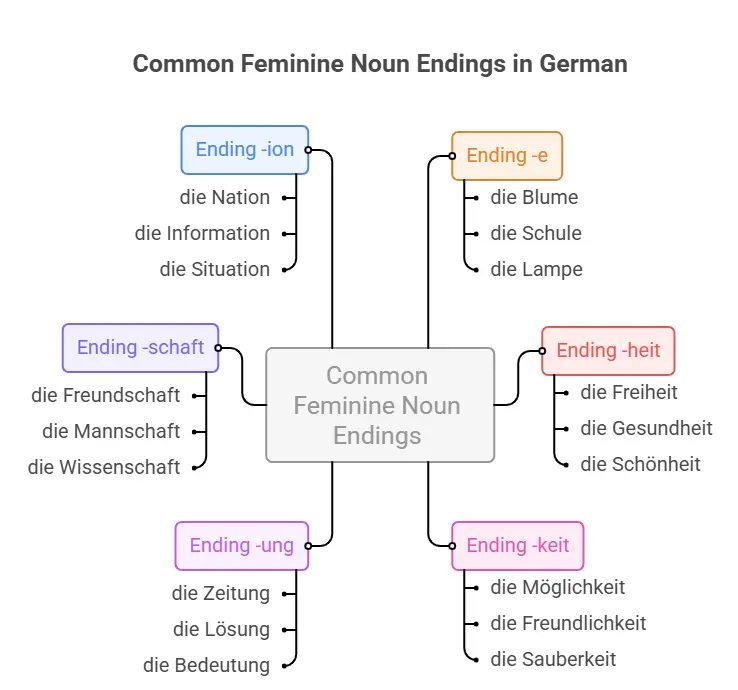
In German, many feminine nouns follow simple word endings. If a word has a certain ending, it is often feminine and uses the article die.
These patterns are very helpful for beginners. They do not work for every word, but they are right in many situations.
Feminine Ending Patterns
🔶-e Ending
Words ending in -e are often feminine.
- die Blume = flower
- die Lampe = lamp
- die Schule = school
👉 Simple idea: Many basic everyday words end in -e and use die.
🔶-heit Ending
Words with -heit are always feminine. They often show feelings or qualities.
- die Freiheit = freedom
- die Gesundheit = health
- die Schönheit = beauty
👉 Simple idea: Words for ideas or states often end in -heit.
🔶-keit Ending
Words ending in -keit are also feminine. They show qualities or abilities.
- die Möglichkeit = possibility
- die Freundlichkeit = kindness
- die Schwierigkeit = difficulty
👉 Simple idea: Many description words end in -keit.
🔶-ung Ending
Words ending in -ung are always feminine. They often show actions or processes.
- die Zeitung = newspaper
- die Lösung = solution
- die Bewegung = movement
👉 Simple idea: Action or process words often end in -ung.
🔶-schaft Ending
Words with -schaft are feminine. They often show groups or relationships.
- die Freundschaft = friendship
- die Mannschaft = team
- die Wissenschaft = science
👉 Simple idea: Group or relationship words often use -schaft.
🔶-ion Ending
Words ending in -ion are also feminine. These are usually borrowed words.
- die Nation = nation
- die Information = information
- die Diskussion = discussion
👉 Simple idea: Many international words end in -ion and use die.
important points to note:
- -e → often feminine
- -heit → always feminine
- -keit → always feminine
- -ung → always feminine
- -schaft → always feminine
- -ion → usually feminine
- These endings help identify die words easily
|
German A2 Exercises – Download Free PDF |
||
Feminine Nouns for Female People
They are used for family members, students, and jobs or professions. German also has a special rule to show female jobs using the ending -in.
This makes it easy to understand whether a word is for a man or a woman.
- Feminine nouns for people use die
- Family and female names are feminine
- Job words often use -in for female form
- Helps clearly show gender in professions
- Very important for daily German communication
Examples
- die Schwester = sister
- die Mutter = mother
- die Studentin = female student
- die Lehrerin = female teacher
Simple Meaning of Examples
- die Schwester → female family member
- die Studentin → female person studying
- die Lehrerin → female teacher in a school
👉 All these words use die because they are feminine nouns.
🔶The “-in” Ending Rule
In German, many job names change to show female gender by adding -in at the end.
Examples:
- der Lehrer → die Lehrerin (teacher → female teacher)
- der Student → die Studentin (student → female student)
- der Arzt → die Ärztin (doctor → female doctor)
Simple Idea:
- Masculine job word → often ends with der
- Female job word → add -in and use die
👉 This rule helps clearly show female professions in German.
Important Learning Point:
- Feminine people nouns use die
- Many female job words end in -in
- The meaning stays the same, only gender changes
- This rule is very common in daily German

Example Sentences
- Feminine nouns use die
- They can be people, animals, or objects
- Example actions: work, sleep, describe
- Each sentence shows a simple idea
- Easy sentences help you learn German grammar faster
1. Die Frau arbeitet.
- Meaning: The woman works.
- die Frau = female person (feminine noun)
- arbeitet = works
👉 Simple idea: A woman is doing the action.
2. Die Katze schläft.
- Meaning: The cat sleeps.
- die Katze = animal (feminine noun in German)
- schläft = sleeps
👉 Simple idea: The cat is resting.
3. Die Zeitung ist interessant.
- Meaning: The newspaper is interesting.
- die Zeitung = newspaper (feminine noun)
- ist interessant = is interesting
👉 Simple idea: We are talking about a thing, not a person.
|
Goethe 2026 Exam Dates: Multiple Test Centers |
|
| Trivandrum Goethe Exam Dates | Kochi Goethe Exam Dates |
| Chennai Goethe Exam Dates | Coimbatore Goethe Exam Dates |
Free German A1 Mock Tests – Powered by AI!
Test your skills on our interactive platform. Get instant feedback from our AI to help you communicate better and track your progress. Start your free German mock test now.
Test Your German A1 for FreeTips to Remember Feminine Nouns
1. Learn common endings
In German, many feminine nouns have similar endings. These endings can help you guess the gender of the word.
Common feminine endings are -e, -heit, -keit, -ung, -schaft, -ion.
If a word ends in these letters, it is very often used with die.
👉 Example:
- die Blume
- die Freiheit
- die Zeitung
👉 Simple idea: endings give a strong hint that the word is feminine.
2. Always learn with the article
Do not learn German nouns alone. Always learn the noun together with die.
This helps your brain remember the correct form from the beginning.
👉 Example:
- die Blume (not just “Blume”)
- die Zeitung (not just “Zeitung”)
- die Freiheit (not just “Freiheit”)
👉 Simple idea: article + noun = correct learning.
3. Practice small sentences daily
Use very short and easy sentences every day. This helps you remember how feminine nouns are used in real life.
👉 Example:
- Die Katze schläft.
- Die Frau arbeitet.
- Die Schule ist groß.
👉 Simple idea: sentences help you remember faster than single words.
4. Group similar words together
Put words with the same ending in one group. This makes learning faster and more organized.
👉 Example groups:
- -ung words: die Zeitung, die Lösung
- -heit words: die Freiheit, die Gesundheit
- -schaft words: die Freundschaft, die Mannschaft
👉 Simple idea: grouping words makes them easier to remember.
5. Revise again and again
Repeat the same words many times in a day or week. Small daily revision is more powerful than long study sessions.
👉 Example:
- Look at words in the morning
- Repeat them in the evening
- Use them in simple sentences
👉 Simple idea: repetition helps your memory stay strong.
Practice Section
✏️ Choose the correct article (die)
1 ___ Freiheit
2 ___ Blume
3 ___ Nation
✅ Answers
1 die Freiheit
2 die Blume
3 die Nation
Learn German language in your own language! Get free Demo Classes Here!
Conclusion
Free German A1 Mock Tests – Powered by AI!
Test your skills on our interactive platform. Get instant feedback from our AI to help you communicate better and track your progress. Start your free German mock test now.
Test Your German A1 for FreeFrequently Asked Questions
What are feminine nouns in German?
Feminine nouns are words that use the article “die” in singular form. They can refer to female people, objects, ideas, or places. Example: die Frau, die Blume, die Schule. The gender is a grammar rule, not always related to real-life meaning.
What endings are feminine in German?
Many feminine nouns follow common endings. These include -e, -heit, -keit, -ung, -schaft, and -ion. For example: die Freiheit, die Zeitung, die Freundschaft. These endings usually help you guess that a noun is feminine.
Are all nouns ending in -ung feminine?
Yes, almost all nouns ending in -ung are feminine and use die. For example: die Lösung, die Meinung, die Zeitung. This is a very strong rule in German grammar with very few exceptions.
How do you form feminine professions in German?
Feminine professions are usually formed by adding “-in” to the masculine form. For example: der Lehrer → die Lehrerin, der Student → die Studentin. This shows the person is female.
Do feminine nouns always refer to females?
No, not always. Many feminine nouns are objects or ideas. For example: die Katze (cat), die Schule (school). So gender in German is grammatical, not always natural.
Why do we use “die” for feminine nouns?
“Die” is the fixed article used for all feminine nouns in singular form. It helps identify the gender of the noun and is important for correct grammar and sentence structure
Can I guess feminine nouns easily?
Sometimes yes. If a noun has common endings like -ung or -keit, it is likely feminine. But not all words follow clear rules, so learning with practice is important.
What is the best way to learn feminine nouns?
The best way is to always learn the noun with its article, like die Blume or die Frau. Practice using them in sentences, repeat daily, and learn common endings to improve faster.