Table of Contents
Imagine packing your bags for a new life abroad. You have the offer letter in hand, dreams of top universities or stable jobs ahead, and excitement building every day. Then comes the one hurdle that stops many people cold: proving your English skills with a strong PTE score. A low score delays visas, blocks admissions, and forces retakes that waste time and money. A high score opens doors fast. It gets you into dream schools, boosts permanent residency points, and makes immigration officers approve applications quickly. Thousands chase opportunities in Canada, the UK, and Australia each year. Your PTE score decides if you join them or wait longer.
This guide breaks down exactly what counts as a good PTE score in these countries. You will see clear requirements for study visas, work options, and permanent residency paths. Readers who aim higher than minimums often succeed faster. They secure spots at elite universities and earn extra points for quicker immigration. Read on to learn how a strong PTE score changes everything for your plans.
Join Enrtri PTE Coaching Course
PTE Scoring System Explained
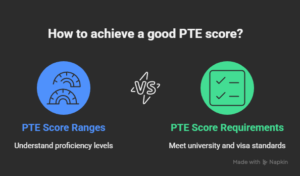
The Pearson Test of English (PTE) Academic measures English skills on a scale from 10 to 90. Scores reflect how well you handle real-life tasks in listening, reading, speaking, and writing. The test uses computer grading for fair results that come out in days.
Your overall PTE score combines performance across all sections. It does not average the four skills directly. Instead, it weighs correct answers, partial credit, and task quality. Each section also gets its own score from 10 to 90. Universities and visa offices look at both the total and individual bands.
Here are common PTE score ranges and what they mean:
- 30-42: Basic command. You manage simple daily talks but struggle with complex ideas.
- 43-58: Functional skills. You handle everyday situations and basic academic work.
- 59-75: Strong proficiency. You follow lectures, write essays, and discuss topics well. This range works for most university admissions and visas.
- 76-84: Very strong command. You express ideas fluently and understand nuances.
- 85-90: Expert level. You match native speakers in most settings.
A good PTE score usually starts at 59 or higher. Top programs demand 65-75 or more. Balanced scores matter too. Some places require no band below 50 or 59. Practice all skills evenly to avoid weak spots that drag down your total PTE score.
The test includes tasks like reading aloud, describing images, summarizing texts, and filling blanks. These feed into multiple skills at once. For example, speaking tasks also affect writing scores. Results stay valid for two years in most cases, though immigration rules sometimes extend to three.
Many test-takers retake the exam to boost scores. You can book again soon after results arrive. Small gains, like jumping from 58 to 65, unlock better options abroad.
Good PTE Score for Canada (Study + PR)
Canada welcomes international students and skilled workers. Your PTE score plays a key role in both paths. Universities set their own rules, but immigration links scores to Canadian Language Benchmarks (CLB).
For study visas, most universities accept PTE scores from 58 to 65 for undergraduate programs. Postgraduate courses often need 65 to 73. Top schools like University of Toronto or UBC require 65 or higher overall, with no band below 60. Community colleges sometimes take scores as low as 50 for diplomas.
The government approves PTE Academic for student visas. If your university admits you based on your PTE score, visa approval chances rise sharply. Aim for at least 60 overall to meet common thresholds. Scores above 70 open doors to competitive programs and scholarships.
For permanent residency, Canada uses PTE Core results mapped to CLB levels. Express Entry demands at least CLB 7 in all skills for most programs. That translates to roughly 60 in listening and reading, 68 in speaking, and 69 in writing.
Higher CLB levels earn big points. CLB 9 across skills adds major boosts to your ranking. Many successful applicants target PTE scores of 76 or above per section for maximum advantage.
Provincial nominee programs follow similar rules. Some accept lower CLB for certain jobs, but strong PTE scores make profiles stand out.
A good PTE score for Canada study sits around 65 overall. For PR, push for 70+ in each skill to hit CLB 9. Balanced high bands speed up invitations and approvals. Test-takers who reach these levels often move to Canada faster than those with minimums.
Ace Your PTE Exam with Confidence!
Unlock your potential with our expert-led PTE preparation course. Achieve your dream score and open doors to global opportunities!
Start Your PTE Preparation Today!Good PTE Score for the UK (Study + Work)
The UK attracts students and professionals with its world-class education and job markets. PTE Academic UKVI meets visa needs here.
For student visas at degree level or above, you need at least 59 in each skill. Below-degree courses accept 43 overall with matching bands. Universities set higher bars. Undergraduate programs typically require 51 to 60 overall. Postgraduate degrees ask for 57 to 67, with top places like Oxford demanding 75 or more.
Many mid-tier schools welcome PTE scores of 58 to 65. Competitive fields like medicine or law push requirements higher.
For work visas, such as Skilled Worker routes, minimums start at 43 in each band for basic roles. Most sponsored jobs demand 59 or above per skill. Higher PTE scores help with extensions and settlement applications.
Permanent residency follows similar language rules. Strong English proof speeds processing.
A good PTE score for UK study lands at 65 overall with balanced bands. For work, aim for 59 minimum but 70+ for better opportunities. These levels match employer and university expectations. Applicants with solid PTE scores secure visas quicker and access prime jobs.
Good PTE Score for Australia (Study + PR)
English is one of the main motivating factors for Australians, because it directly affects academic success, workplace communication, and permanent settlement. Recent policy changes have increased the language requirement to better meet real-life demands of students and migrants. From August 2025 the minimum PTE score for a Student Visa (Subclass 500) will be 47 overall. Universities, but, expect higher scores. Most undergraduate courses require scores between 50 and 65; postgraduate courses generally require 58 to 72. The highest tier schools, such as the G8 universities, expect 65 or higher percentiles due to their program demands.
Even students who do not first meet university requirements have an option. PTE scores range from 50 to 500 and are a common pathway into pathway programs and colleges. Some students begin with scores as low as 36 through bundled English language courses before entering the main program. These options give foreign students the opportunity to expand their language knowledge and earn a place in Australia for higher studies.
English scores are important in points-based systems for permanent residency and skilled migration. One level of competent (50 points in each skill) is sufficient to meet the basic requirement, but not worthy of points. Success in English with 65 in each band is a 10 point increase and success in English with 79 in each class adds a valuable 20 point gain. More competitive General Skilled Migration visas, such as subclass 189 and 190, require more than adequate or better English for invitation. Work visas follow similar procedures, with Temporary Skill Shortage positions having at least acceptable English as required. Overall, a PTE score of 65 or higher is a good score for study and 65+ per skill or 79 for PR significantly improves migration rates and accelerates invitation results.
How to Improve Your Score Quickly
The good news is that if you’re not learning all day, or just remembering rules to no end, your PTE score is on the up. Focused effort and a plan are what really works. Many test-takers notice a remarkable change in their test scores in a matter of minutes when they stop guessing and start planning smartly. The first step should always be a full practice test. It shows you where you’re making mistakes, so that you won’t waste time learning things you already know. The main areas of complication for the majority of people are speaking and writing, usually due to lacks of fluency or small grammar mistakes.
Daily habits matter more than long studies. English podcasts or news on the go help you to get used to speaking naturally, without strain. I think it is awkward at first to read articles out loud, but it works. It improves pronunciation, pacing, and confidence. Write not for perfection. Write a few essays on common topics and read them openly. Comparing your answers to other good templates can help you identify what’s wrong and what can be improved upon.
PTE is a very pattern-oriented game, and you can increase your score quickly by understanding what types of tasks are being assigned. As with the talking tasks such as Repeat Sentence and Read Aloud, accuracy and fluency are more important than having every word pronounced. Do not attempt to repeat what you hear loudly and quickly. Comprehensive sentences are better than errors. In reading, and especially filled-in-the-blank questions, context is everything. Slow down, read the sentence carefully, and find words that actually speak the language.
Time pressure is another issue many candidates face. You may know the answers but have no time. Practicing under exam conditions allows you to be calmer and move faster. Learn to avoid difficult questions, and remember about them later. This small habit alone can help to protect many easy marks.
In fact, if you can, then targeted coaching will be worth it. Good trainers explain PTE scoring and show up mistakes you don’t notice. With proper guidance, many students go from 10-20 points up in weeks.
If you can tell your weak spots, don’t wait too long to retake the test. PTE results are quick so you may alter your strategy or try again with an impending effect in your head.
Ultimately, consistency produces results. Put in a few focused hours every day, watch your progress and work on improving. If you are determined and stick to the goal, then on the next attempt you can reach your target PTE score.
Join Enrtri PTE Coaching Course
Ace Your PTE Exam with Confidence!
Unlock your potential with our expert-led PTE preparation course. Achieve your dream score and open doors to global opportunities!
Start Your PTE Preparation Today!Conclusion
If you want to study, work, or settle in Canada, the UK, or Australia, your PTE score is key to your future. In some cases, though, you can apply if you meet the minimum score required, scores higher will open up many more opportunities. Strong PTE scores can lead you to admission at top-rated schools, additional points in the migration system, and better visa approvals. For many programs and immigration levels, your language score is what sets you apart from thousands of applicants with similar academic or professional backgrounds.
If you’re aiming higher from the bottom up, it’s a smart move. A score of 65 or higher, in balanced performance across sections, is generally expected for most universities and visa types. But, if you are aiming at highly sought after courses, top colleges, or skilled migration routes, scores between 70 and 79 for each skill may be an obvious advantage. These scores reflect high levels of English proficiency, preparation for college and professional communication skills, all qualities that universities and immigration officials in general value.
A good PTE score is a sign of preparation and understanding. Start by reading the criteria for an exact score for your country, university or visa. Practice regularly, do weak areas and take mock tests to check your performance. If your first attempt doesn’t match your true potential, don’t hesitate to take the test again with better preparation. By adopting the process and improving each year, thousands of candidates achieve their study-abroad and migration goals. You can do it with the right effort and mindset. Book your test, prepare purposefully, and invest in a score that will open doors for years to come.
Ace Your PTE Exam with Confidence!
Unlock your potential with our expert-led PTE preparation course. Achieve your dream score and open doors to global opportunities!
Start Your PTE Preparation Today!Frequently Asked Questions
What exactly is considered a "good" PTE score, and does the definition change based on my goals?
A “good” PTE score is not a single number but a target that aligns with and exceeds the specific requirements of your goal country, institution, or visa pathway. Broadly, a score of 59-75 indicates strong proficiency suitable for most academic and professional settings. However, the definition shifts significantly:
-
For University Admissions: A “good” score is one that meets the direct entry requirement of your chosen program, often with a safety margin. For competitive courses (e.g., Medicine, Law, Ivy League/G8 universities), a “good” score can be 75 or higher.
-
For Study Visas: A “good” score is one that satisfies both the government’s visa requirements (often lower) and your university’s offer conditions, ensuring smooth visa processing.
-
For Permanent Residency (PR): A “good” score is one that maximizes your points in the points-based immigration system. While meeting the minimum (e.g., CLB 7 in Canada) is essential, a “good” score is CLB 9 or 10, which awards substantial extra points and dramatically improves your ranking in pools like Express Entry.
Ultimately, a “good” score is a strategic asset. Aiming for the minimum is risky; aiming higher provides a competitive edge, opens more doors, and future-proofs your application against potential policy changes.
I'm targeting Canada for Permanent Residency via Express Entry. Why are the required PTE Core scores different for each skill (e.g., 60 in Listening, 68 in Speaking), and what should I truly target?
The differing scores for each skill stem from the mapping process between PTE Core and the Canadian Language Benchmark (CLB) levels. Immigration, Refugees and Citizenship Canada (IRCC) uses CLB levels, not raw PTE scores. The PTE Core test is designed so that achieving a certain score in a skill equates to a specific CLB level. For instance, a score of 68 in Speaking demonstrates the specific competencies required for CLB 7 in that skill, while a 60 in Listening demonstrates CLB 7 for that different skill set.
Your true target should not be the minimum CLB 7. To be competitive in Express Entry, you should aim for CLB 9 across all four skills. This translates to approximately 84 in Listening, 88 in Reading, 84 in Speaking, and 88 in Writing in PTE Core. CLB 9 can add 50-60 additional points to your Comprehensive Ranking System (CRS) score, which is often the difference between receiving an Invitation to Apply (ITA) or waiting indefinitely. For maximum competitiveness, especially in high-demand occupations, targeting CLB 10 is advisable.
The UK requires PTE Academic UKVI for visas. How does this differ from the standard PTE Academic, and what are the tiered requirements for student visas?
PTE Academic UKVI is a Secure English Language Test (SELT) approved for UK visa applications. It is identical in content, format, and scoring to the standard PTE Academic test but is administered under enhanced security protocols at approved test centers to meet UK Home Office requirements. You must ensure you book the correct version.
The UK has a tiered system for student visas:
-
Degree-level and above (Student Route): Requires a minimum of PTE Academic UKVI score of 59 in each of the four skills. This is the CEFR B2 level.
-
Below-degree level (e.g., pre-sessional courses, foundation programs): Requires a minimum of PTE Academic UKVI score of 43 in each of the four skills. This is the CEFR B1 level.
It is critical to note that your university will likely set a higher requirement for academic admission. You must meet both the university’s academic English condition and the UKVI’s minimum visa requirement for your course level.
Australia is increasing its minimum Student Visa English requirement. How will this change in August 2025 affect my plans, and what are my options if my score is currently low?
From August 2025, the minimum PTE Academic score for a Subclass 500 Student Visa will rise from 42 to 47 overall. This reflects the government’s focus on ensuring students have the functional English skills needed to succeed academically and socially from the outset.
If your current score is below the new minimum or below your university’s direct entry requirement, you have several pathways:
-
Retake the PTE: Intensive, targeted preparation can help you achieve the required score.
-
Enroll in an English Language Intensive Course for Overseas Students (ELICOS): You can package your visa application with an accredited English course in Australia. You might get a visa with a PTE score as low as 36 if you commit to a lengthy ELICOS course before starting your main academic program.
-
Foundation or Pathway Programs: Many universities offer preparatory programs with lower English entry requirements (often around PTE 50) that bridge you to your degree.
This change underscores the importance of starting your preparation early and aiming for a score well above the new minimum to strengthen your visa application.
How is the overall PTE score calculated? If I ace the Speaking section but do poorly in Reading, will it bring down my overall score?
The overall PTE score (10-90) is not a simple average of the four communicative skills (Listening, Reading, Speaking, Writing). It is calculated by a complex, automated algorithm that considers performance across 20 different task types. Many tasks contribute scores to more than one skill. For example:
-
Read Aloud contributes points to both Speaking and Reading.
-
Summarize Written Text contributes to both Writing and Reading.
-
Write from Dictation contributes to both Listening and Writing.
Therefore, while each skill has its own score, they are interdependent. Excelling in Speaking can positively influence your Reading score through integrated tasks. Conversely, a very poor performance in one area (like Reading) can limit the potential points you can earn in integrated tasks that feed into other skills, thereby suppressing your overall score. Balanced preparation across all task types is crucial for maximizing your overall result.
For skilled migration to Australia (subclass 189/190), how do PTE scores translate to points, and what is the strategic target?
For Australian General Skilled Migration, PTE Academic scores are mapped to three levels for points purposes:
-
Competent English (10 points): PTE score of 50 or higher in each skill. This is the minimum to be eligible for most skilled visas.
-
Proficient English (20 points): PTE score of 65 or higher in each skill.
-
Superior English (25 points): PTE score of 79 or higher in each skill.
The strategic target is rarely just “Competent.” Given the high points thresholds for invitation, most successful applicants need every point they can get. Therefore, you should strategically target at least Proficient English (65 in each skill) for the 20 points. If possible, achieving Superior English (79 in each skill) for the 25-point bonus can be a decisive factor, moving your application to the top of the invitation queue. Always check the specific requirements of your nominated occupation and state, as some may mandate Proficient or Superior English.
My university requires an overall PTE score of 65 with no band below 59. What does "no band below" mean, and what happens if I get a 78 overall but a 58 in one skill?
“No band below” refers to the individual scores for Listening, Reading, Speaking, and Writing. These are your “band” or skill scores. The requirement means you must achieve:
-
An overall score of 65 or higher, AND
-
A score of 59 or higher in each and every one of the four skills.
If you achieve an overall score of 78 but have a 58 in one skill (e.g., Writing), you have not met the admission requirement. Universities enforce these minimums strictly to ensure you have the balanced English proficiency needed to participate in lectures, write essays, and complete readings. In this scenario, you would likely receive a conditional offer, requiring you to retake the PTE and achieve the minimum in that weak skill, or you might need to take a pre-sessional English course.
How long are PTE scores valid for visa and university applications, and are there any exceptions?
PTE Academic scores are typically valid for two years from your test date for both university admissions and visa applications. This standard is based on the premise that language proficiency can change over time.
However, a key exception exists for some immigration applications:
-
For Canadian Express Entry, your language test result must be less than two years old at the time you submit your complete application for permanent residence.
-
For Australian skilled migration, the test must be taken within three years of the date you are invited to apply.
It is crucial to check the specific validity period on the official government immigration website of your destination country, as policies can differ and are subject to change. Never assume the validity period; always verify with the official source.
What is the single most effective daily habit to improve my PTE score quickly across all sections?
The most effective habit is active, immersive engagement with academic English every day. This goes beyond passive studying. It involves:
-
Listening: Actively listen to English podcasts (like BBC Global News, TED Talks), university lectures on YouTube, or documentaries. Take notes, summarize what you heard, and shadow the speakers.
-
Reading: Read high-quality English newspapers (The Guardian, The Economist), academic journals, or reports. Don’t just skim; analyze sentence structure, note new vocabulary, and practice summarizing paragraphs.
-
Speaking: Talk to yourself in English, describe your surroundings, or give mini-presentations on a topic. Use the “Read Aloud” technique with any text to improve fluency and pronunciation.
-
Writing: Maintain a journal in English, write short essays on common PTE topics, and get them reviewed for grammar and coherence.
This integrated approach builds the underlying proficiency that the PTE tests, making your test preparation more about familiarizing yourself with the format than learning the language from scratch.
I need to improve my score by 10 points in a month. Is it possible, and what should my focused plan look like?
Yes, improving by 10 points in a month is an ambitious but achievable goal with a disciplined, focused plan. Your plan should follow this structure:
-
Week 1: Diagnostic & Foundation.
-
Take a full, timed official PTE practice test to identify your exact weaknesses.
-
Analyze the report: Which skill sections and task types are your lowest scorers?
-
Spend the week on foundational skills: intensive vocabulary building, grammar review, and daily immersive listening/reading.
-
-
Weeks 2 & 3: Targeted Task Practice.
-
Dedicate each day to 2-3 specific task types, starting with your weakest.
-
For Speaking: Drill Read Aloud and Repeat Sentence for fluency/accuracy.
-
For Writing: Master the templates for Write Essay and Summarize Written Text.
-
For Reading: Practice Fill in the Blanks and Re-order Paragraphs strategies.
-
For Listening: Focus on Write from Dictation and Highlight Correct Summary.
-
Use high-quality preparation materials and platforms that offer scored practice.
-
-
Week 4: Test Simulation & Review.
-
Take 2-3 more full-length mock tests under strict exam conditions.
-
Meticulously review every mistake. Understand why you got an answer wrong—was it a knowledge gap, a time pressure issue, or a misunderstanding of the instructions?
-
Refine your time management strategy. Learn to skip and return to difficult questions.
-
In the final days, focus on calming test anxiety, ensuring technical setup (for at-home test-takers), and reviewing high-yield templates and strategies.
Throughout the month, consistency is key. Aim for 2-3 hours of high-quality, focused practice daily rather than long, unfocused sessions. Consider investing in a targeted coaching course if you find yourself stuck on specific tasks.
-