
• Teaching
    • Montessori Teacher Training 🔥
    • Yoga Teacher Training
  • Coding
    • Full Stack Development Course
    • Data Science Course
    • Python Programming Course
    • Software Testing Course
    • Architecting on AWS
  • Commerce
    • ACCA Course
    • SAP Fico Course
    • Practical Accounting Course
    • SAP MM Course
    • HR Management Course in Kerala
    • CMA USA Online Classes
    • Enrolled Agent Course
    • PwC Edge : Strategic Accounting and Finance Programme
  • Technical
    • Structural Design Course
    • Embedded Systems Software Engineering in Kerala
    • MEP Course
    • BIM Training Course
    • Quantity Survey Course
  • Finacademy
    • Stock Market Course
    • Mutual Funds Course
    • Forex Trading Course
  • Digital Marketing
    • Digital Marketing Course
    • Performance Marketing Course
  • Language Learning
    • Spoken English Course
    • German Language Course
    • IELTS Exam Coaching
  • Exam Preparation
    • Kerala PSC Coaching
    • Kerala PSC LGS Coaching
    • KAS Coaching
    • Kerala PSC LDC Coaching
    • Kerala PSC LSGS Coaching
    • KPSC Industries Extension Officer Coaching
    • KPSC Technical Mechanical Coaching
    • KPSC Technical Electrical Coaching
    • Kerala PSC Technical Exam Preparation
    • KPSC Technical Civil Coaching
    • SBI PO Coaching
    • IBPS Clerk Coaching
    • IBPS PO Coaching
    • IBPS SO Coaching
    • Bank Exam Coaching
    • Lecturer in DIET Course
    • Kpsc HSA Coaching
    • KPSC LP UP Assistant Coaching
    • EMRS Coaching
    • KTET Coaching
    • SSC Coaching
    • SSC JE Coaching
    • SSC CGL Coaching
    • SSC CHSL Coaching
    • SSC MTS Coaching
    • UPSC Coaching
  • Health Care
    • Hospital Administration Course
  • Other Exams
    • GATE Coaching
    • CAT Coaching
    • MAT Online Coaching
    • KMAT Online Coaching
Entri Blog
No Result
View All Result
Saturday, February 14, 2026
  • Kerala PSC
    • Kerala PSC General
      • Kerala PSC Exams
      • KAS Exam
      • Kerala PSC VEO Notification
      • Kerala Police SI
      • Kerala PSC LDC Notification
      • Kerala PSC Village Field Assistant Notification
      • Kerala PSC LD Typist Notification
      • Kerala PSC Food Safety Officer
      • Kerala PSC Excise Inspector Notification
      • Kerala PSC BDO Notification
      • Kerala PSC CPO Notification
      • Kerala PSC LGS Notification
      • Fire and Rescue Officer
      • Women Fire and Rescue Officer
    • Kerala PSC Teaching
      • Kerala PSC HSA
      • Kerala PSC HSST
      • KTET
      • LP/UP Assistant
      • KVS
      • Railway Teacher
    • Kerala PSC Technical
      • LSGD AE
      • Draftsman/Overseer
      • IEO
      • ATP
      • Polytechnic Lecturer
      • AE Electronics
      • Assistant Engineer
  • Banking
    • IBPS PO Notification
    • IBPS Clerk Notification
    • SBI PO Notification
    • SBI Clerk Notification
    • SBI SO Notification
    • SBI Apprentice Notification
    • Canara Bank PO Notification
    • Indian Bank PO Notification
    • RBI Assistant Notification
    • RBI Office Attendant Notification
    • IBPS RRB Notification
    • IBPS RRB Office Assistant Notification
  • Skilling
    • Coding
    • Spoken English
    • Stock Market
      • Stock Market Weekly Report
    • Digital Marketing
    • Accounting Course
    • SAP
    • German
    • IELTS
    • Quantity Survey
    • MEP
    • Structural Design
    • Montessori
    • Yoga Teaching
    • HR Management
    • Embedded Systems
  • Courses
    • AI Powered Data Science Course
      • Data Science Malayalam
      • Data Science Course in Tamil
      • Data Science Course in Telugu
      • Data Science Training in Kochi
      • Data Science Training in Trivandrum
      • Data Science Course in Calicut
      • Data Science Training in Thrissur
    • AI Powered Data Analytics Course
      • Data Analytics Course in Malayalam
      • Data Analytics Course in Tamil
      • Data Analytics Course in Telugu
    • BIM Course in Kerala
      • BIM Course in Kochi
      • BIM Course in Trivandrum
      • BIM Course in Calicut
    • Quantity Surveying Course
      • Quantity Surveyor Course in Tamil
      • Quantity Surveying Course in Telugu
      • Quantity Surveyor Course in Hyderabad
      • Quantity Surveying Course in Chennai
      • Quantity Surveying Course in Vijayawada
      • Quantity Surveying Course in Guntur
      • Quantity Surveying Course in Warangal
      • Quantity Surveying Course in Karimnagar
    • Structural Design Course
      • Structural Design Course in Hyderabad
      • Structural Design Course in Chennai
      • Structural Design Course in Kochi
      • Steel Structure Design Course
      • RCC Design Course
    • MEP Course
      • MEP Design Course in Kerala
      • HVAC Course
      • MEP Course in Kochi
    • Robotics and AI Course
    • Embedded System Course
      • Embedded Systems Software Engineering in Calicut
      • Embedded Systems Software Engineering in Kochi
      • Embedded Systems Software Engineering in Trivandrum
    • AI-Enhanced Full Stack Developer Course
      • Full Stack Development Malayalam
      • Full Stack Development Hindi
      • Full Stack Development Tamil
      • Full Stack Development Telugu
      • Full Stack Development Kannada
    • Stock Market Course
      • Stock Market Course in Malayalam
      • Stock Market Course in Tamil
      • Options Trading Course
    • Mutual Funds Course
      • Mutual Funds Course in Kerala
      • Mutual Funds Course in Tamil
    • Forex Trading Course
    • Spoken English Course
      • Spoken English Course in Malayalam
      • Spoken English Course in Hindi
      • Spoken English Course in Telugu
      • Spoken English Course in Tamil
      • Spoken English Course in Kannada
    • AI-Driven Python Programming Course
    • Ui Ux Designer Course
    • AI-Powered Software Testing Course
      • Software Testing Course in Malayalam
      • Software Testing Course in Tamil
      • Software Testing Course in Telugu
    • Ai-Powered Cybersecurity Course
    • AI Tools Mastery
    • AI Powered AWS Solutions Architect Associate Course
    • AI Powered Practical Accounting Course
      • Accounting Course in Malayalam
      • Accounting Course in Tamil
      • GCC VAT Course
      • Taxation Course
      • GST Practitioner Course in Kerala
      • GST Course
      • UAE Accounting
      • Tally Course
      • Zoho Books Training
    • SAP Training Courses
      • SAP FICO Course
      • SAP MM Course
      • SAP SD Training
      • SAP FICO Course in Tamil
      • SAP MM Course in Tamil
    • Enrolled Agent Course in Kerala
      • Enrolled Agent Course in Calicut
      • Enrolled Agent Course in Kochi
      • Enrolled Agent Course in Trivandrum
    • ACCA Training Online
      • ACCA Course in Kerala
      • ACCA Performance Management PM F5 Course
      • ACCA Taxation TX F6 Course
      • ACCA Financial Reporting FR F7 Course
      • ACCA Audit and Assurance AA F8 Course
      • ACCA Financial Management FM F9 Course
    • CMA USA Online Classes
    • HR Management Course
      • HR Management Course in Kochi
      • HR Management Course in Trivandrum
      • HR Management Course in Calicut
    • PwC Edge : Strategic Accounting and Finance Programme
    • Performance Marketing Course
    • Mern Stack Developer Course
      • Full Stack Developer Course in Kochi
      • Full Stack Developer Course in Trivandrum
      • Full Stack Developer Course in Calicut
      • Full Stack Developer Course in Pune
      • Full Stack Developer Course in Bangalore
      • Full Stack Developer Course in Hyderabad
      • Full Stack Developer Course in Chennai
      • Full Stack Developer Course in Indore
      • Full Stack Developer Course in Jaipur
      • Full Stack Developer Course in Coimbatore
    • AI Powered Digital Marketing Training
      • Digital Marketing Course in Kerala
      • Digital Marketing Course in Kochi
      • Digital Marketing Course in Trivandrum
      • Digital Marketing Course in Calicut
      • Digital Marketing Course in Kollam
      • Digital Marketing Course in Thrissur
      • Digital Marketing Course in Kottayam
      • Digital Marketing Course in Kannur
    • Hospital and Healthcare Administration
    • Montessori Teacher Training
      • Montessori Teacher Training in Calicut
      • Montessori Teacher Training in Kochi, Ernakulam
      • Montessori Teacher Training in Trivandrum
      • Montessori Teacher Training in Kollam
      • Montessori Teacher Training in Malayalam
      • Montessori Teacher Training in Kannada
    • Other Courses
      • German Language Course
      • ChatGPT Course
      • Yoga Teacher Training Course
      • Advanced Fashion Designing and Boutique Management
  • Others
    • Railway
      • RRB Technician Notification
      • RRB JE Notification
      • RRB ALP Notification
      • RRB NTPC Notification
      • RRB RPF Notification
      • RRB RPF SI Notification
      • RRB RPF Constable Notification
      • RRB Group D Notification
      • RRB RPSF SI Notification
      • RRB SSE Notification
    • SSC
      • SSC CPO Notification
      • SSC MTS Notification
      • SSC CGL Notification
      • SSC CHSL Notification
      • SSC GD Constable Notification
      • SSC Stenographer Notification
      • SSC JE Notification
      • SSC CAPF Notification
      • SSC JHT Notification
      • Delhi Police Constable Notification
      • Delhi Police SI Notification
    • GATE
    • MAT
    • KMAT
      • KMAT Kerala 2024
    • TET
      • APTET
      • CTET
      • DSSSB
      • Karnataka TET
      • Kerala TET
        • KTET Notification
      • KVS
      • MPTET
      • SUPER TET
      • TNTET
      • TSTET
      • UPTET
    • UPSC
      • UPSC CAPF Notification
      • UPSC CDS Notification
      • UPSC NDA Notification
      • UPSC Civil service Notification
  • Free Learn
    • Free Courses
      • Free Coding Courses
        • C Langauge Courses
        • Free Data Science Courses
        • Free Python Programming Courses
        • Free Full Stack Developer Courses
      • Free Accounting Courses
        • Free Accounting Course in Malayalam
        • Free ZohoBooks Course in Malayalam
        • Free Tally Course for Beginners in Malayalam
        • Free ACCA Foundation Course in Malayalam
        • Free Gulf VAT and Accounting Course in Malayalam
      • Free Digital Marketing Courses
        • Free SEO Courses
        • Web Development for Marketers
      • Engineering Upskilling Courses
        • Free Quantity Surveying Course in Telugu
        • Free Embedded Systems Foundation Course
        • Free AutoCAD Course in Malayalam
        • Free Planswift Course
        • Free MEP Course in Malayalam
        • Free Quantity Surveying Course for Beginners
      • Free Hospital Administration Courses
      • Free Management Courses
      • Free SAP Courses
        • Free SAP FICO Tutorial for Beginners in Malayalam
      • Free German Courses
      • Free IELTS Courses
      • Free Teachers Training Courses
      • Free Trading Courses
        • Introduction To Stock Trading in Tamil
        • EMI Traps Explained by Sharique Samshudheen
        • Free Trading Psychology for Beginners by Nagaraj Sir
        • Free Beginner’s Guide to Investments by Nagaraj Sir
        • Free Stock Market Courses in Malayalam
        • Free Mutual Funds Course by Nagaraj Sir
        • Free Options Trading Course Malayalam
        • Free Forex Trading Courses Malayalam
        • Free Personal Finance Courses Malayalam
        • Free Health Insurance Masterclass by Sharique Samshudheen
    • Question Answer
    • Aptitude Questions
    • Webinars
  • Test Prep
    • Kerala PSC Coaching
      • KPSC Degree Level Exam Preparation
      • Kerala PSC 12th Level Exam Preparation
      • Kerala PSC 10th Level Exam Preparation
      • KAS Coaching
      • Kerala PSC LDC Coaching
      • Kerala PSC LD Typist Coaching
      • Kerala PSC Fireman Coaching
      • KSFE Assistant Exam Preparation
      • Secretariat Office Attendant Coaching
      • Secretariat Assistant Coaching
      • Kerala PSC SI Exam Coaching
      • Khadi Board LDC Exam Preparation
      • Devaswom Board LDC Coaching
      • University LGS Exam Preparation
      • University Assistant Exam Coaching
      • KPSC Scientific Officer Exam Coaching
      • KPSC Probation Officer Grade II
      • KPSC Food Safety Officer Coaching
      • KWA Sanitary Chemist Coaching
      • KPSC Diary Farm Instructor Exam Coaching
      • Kerala PSC KWA Lab Assistant Exam Coaching
      • Kerala PSC ICDS Supervisor Exam Coaching
      • KPSC Finger Print Searcher Coaching
      • Kerala PSC Welfare Officer Gr. II Exam Coaching
      • KPSC Assistant Dental Surgeon Coaching
    • KPSC Teaching Exams
      • HSA Exam Preparation
      • KPSC HSA Social Science Coaching
      • KPSC HSA Physical Science Coaching
      • KPSC HSA English Coaching
      • KPSC Junior Language Teacher Hindi
      • KTET Coaching
      • SET Coaching
      • LP/UP Assistant Exam Coaching
      • HSST Exam Preparation
      • HSST Commerce Exam Coaching
      • Kerala PSC Lecturer in Diet Coaching
      • KVS PGT/TGT Coaching
    • Kerala PSC Technical Exams Coaching
      • Assistant Engineer Electrical Exam Coaching
      • Assistant Engineer Electronics Coaching
      • Assistant Engineer Mechanical Coaching
      • Kerala PSC Industries Extension Officer Coaching
      • KPSC LSGD AE Exam Coaching
      • KPSC Civil Engineering Exam Coaching
      • KPSC Mechanical Engineering Exam Coaching
      • KPSC Electrical Engineering Exam Coaching
      • KPSC Electronics Engineering Exam Coaching
      • KPSC Technical Computer Science Coaching
      • KPSC Tradesman Turning Coaching
      • Kerala PSC Overseer Exam Coaching
      • KPSC Assistant Town Planner Coaching
      • Lecturer in Polytechnic Electronics Coaching
    • Teaching Exams Coaching
      • CSIR NET Exam Coaching
      • EMRS Coaching
      • CTET Exam Online Coaching
    • IELTS Training Online
    • Bank Exam Coaching Online
      • SEBI Grade A Coaching
      • IBPS SO Online Coaching
      • IBPSC PO Online Coaching
      • IBPSC Clerk Online Coaching
      • SBI PO Coaching
      • SBI Clerk Online Coaching
      • SBI Apprentice Class
      • SBI SO Online Coaching
      • RBI Grade B Coaching
      • RBI Assistant Coaching
      • CSEB Exam Coaching
      • IBPS RRB Coaching
      • IBPS RRB PO Coaching
      • Canara Bank Po Exam Coaching
      • Kerala Gramin Bank Coaching
      • Kerala Bank Exam Coaching
        • Kerala Bank Clerk Exam Coaching
        • Kerala Bank Office Attendant Exam Coaching
        • Kerala Bank Assistant Manager Exam Coaching
      • JCI Exam Coaching
      • NABARD Grade A Coaching
      • LIC AAO Coaching Online
    • UPSC Online Coaching
      • UPSC CAPF Online Coaching
    • SSC Online Coaching
      • SSC JE Online Coaching
      • SSC CGL Coaching
      • SSC CGL AAO Coaching
      • SSC CHSL Coaching
      • SSC CGL CBI Inspector Coaching
      • SSC MTS Coaching
      • SSC Stenographer Coaching
      • SSC GD Online Coaching
    • RRB Exams Coaching
      • RRB RPF Exam Coaching
      • RRB NTPC Exam Coaching
      • RRB JE Online Coaching
      • RRB JE Electronics Coaching
      • RRB ALP Exam Coaching
      • RRB Technician Exam Coaching
    • CAT Online Coaching
    • CMAT Online Coaching
    • XAT Exam Coaching
    • GATE Online Coaching
      • GATE CE Online Coaching
      • GATE ME Online Coaching
      • GATE EE Online Coaching
    • NMAT Exam Coaching
      • AAI ATC Jr Executive Coaching
    • Cochin Shipyard Executive Trainee Coaching
    • BEL Probationary Engineer Coaching
    • HPCL Junior Executive Coaching
Free Courses
Entri Blog
  • HTML Tutorial
  • DSA Tutorials
  • Tutorials in Hindi
    • HTML Tutorial for Beginners in Hindi
    • Python Tutorial for Beginners in Hindi
    • GIT and GITHUB Tutorial for Beginners in Hindi
  • Tutorials in Tamil
    • JavaScript Tutorial in Tamil
  • Tutorials in Telugu
    • HTML Tutorial For Beginners in Telugu
    • CSS Tutorial for Beginners in Telugu
    • Bootstrap Tutorial for Beginner in Telugu
  • Tutorials in Kannada
    • HTML Tutorial For Beginners in Kannada
entri exclusive offers entri exclusive offers
Home Articles

How Long Does It Take to Become a Montessori Teacher in Kerala?

by Sravan Prakash
February 14, 2026
in Articles, Montessori Teaching
How Long Does It Take to Become a Montessori Teacher
Share on FacebookShare on WhatsAppShare on Telegram

Table of Contents

  • Eligibility to Become a Montessori Teacher
  • Types of Montessori Courses Available
  • Duration of Montessori Teacher Training Courses
  • Factors That Affect Course Duration
  • Conclusion

Step into a peaceful classroom in Thrissur or Kochi, where rays of warm sunlight filter in through the windows and dance across low shelves lined with wooden blocks, tiny jugs for pouring, & bead frames for making patterns & counting . The atmosphere is alive yet calming as little ones (& there’s a mix of toddlers and 3 to 6 year olds) wander around, deeply absorbed in whatever activity they fancy, without being rushed or forced to sit still.

They’re pouring water carefully, sorting objects by size or colour, tracing sandpaper letters with their fingertips, & building blocks that teach balance & patience – all driven by their own interests rather than external rewards or punishments. This super gentle, child-led approach to learning is what Montessori education is all about – an approach that was pioneered by Dr Maria Montessori more than a century ago after she spent years observing young children and figured out that the best way for them to learn is when they’re free to do so in an environment thats carefully put together.

So , theres increasing demand for educators who can set up these cosy learning environments, keep a close eye on each child’s interests and progress, & offer a helping hand at just the right moment. If the idea of working with young kids every day, watching them grow & learn & become their own little individuals fascinates you – then Montessori teacher training in Kerala could be a rewarding path to follow for you.

When some one new joins a local preschool as a new teacher, they can expect a salary of around Rs. 18000 to 28000 a month. Then as you gain more experience & take on more responsibilities – like planning activities or helping out with running the preschool, you can earn up to Rs. 30000 a month or more in a city or even an international preschool. Some preschool teachers even go on to work in the Gulf countries, where their training and experience get a lot of respect, & they get the chance to experience different cultures first hand.

Its the little moments like that 1 – when a child finally masters tying their shoes after months of trying, or when a shy little kid comes out of their shell & shares a long story during circle time – thats makes all the hard work worth it .

Kerala’s strong family values, emphasis on education from a young age and super supportive community networks make it a perfect place to build a career in early childhood education. There are loads of trainings available across the state – some classroom-based and some online – that make it easy for anyone – whether your fresh out of college, a homemaker looking to get back into work or a pro looking for a change – to get trained in a way that fits in with your lifestyle.

Register for the Entri Elevate Montessori Teacher Training Program! Click here to join!

Eligibility to Become a Montessori Teacher

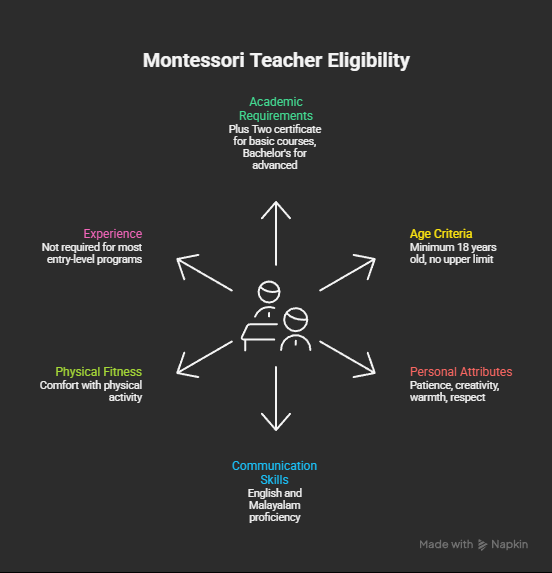
Eligibility-to-Become-a-Montessori-Teacher-visual-selection

Entry requirements for Montessori teacher training courses in Kerala are typically minimal and accommodating, reflecting a philosophy that welcomes anyone with genuine interest in nurturing young children, rather than setting daunting barriers for the passionate aspirants. Most pre-requisite for enrolling into the Montessori training courses is a Plus Two certificate in any stream – arts, commerce, science or vocational – Entrants with higher secondary education qualify as candidates with sufficient literacy, numeracy and knowledge to imbibe concepts of developmental psychology, the prepared environment and age-appropriate activities. Advanced courses, such as postgraduate diplomas that focus on deeper theory, leadership roles in early years settings or adaptations for diverse needs, generally require a Bachelor’s degree in any discipline as eligibility criteria that enable intensive engagement with research-informed insights and wider applications of the Montessori method.

The age criteria are equally flexible, as the only requirement is for the applicant to be at least 18 years old; most institutes do not have an upper age limit, allowing mothers who wish to return to studies and use their maternal experiences in a professional setting, individuals in mid-career stages seeking employment that resonates more closely with their personal values, and even senior-aged students who desire to remain actively involved in meaningful endeavors.

Training centers in Thrissur, Kochi, and other parts of Kerala often create particularly supportive environments for women, building cohorts where participants share stories, offer encouragement, and form lasting professional networks that extend well beyond the course itself. While academic credentials provide the initial qualification, succeeding as a Montessori educator relies heavily on personal attributes that cannot be measured on paper, including steady patience during moments when a child needs repeated gentle demonstrations, creative thinking when arranging materials to spark interest, and a warm, respectful presence that helps every child feel seen and valued.

Effective communication in both English and Malayalam becomes especially useful because classrooms frequently bring together children and families from diverse linguistic and cultural backgrounds across the state. The role involves considerable physical activity—demonstrating floor work, carrying trays, kneeling to child height—so a reasonable level of comfort with movement supports long-term enjoyment of the job. Most beginner or diploma-level programs do not require prior classroom experience for entry, which keeps the pathway genuinely accessible and allows newcomers who feel called to this work to join even if they have never taught formally before. The admission process usually involves submitting straightforward documents such as educational certificates, proof of identity, and passport-sized photos, with many institutes now handling everything digitally for added convenience.

Age restrictions are generally lenient, with most institutions requiring applicants to be at least 18 years old and setting no upper age limit. This policy enables the enrollment of a diverse age group, including new mothers seeking to apply their parenting experiences to their profession, mid-life career changers in search of more fulfilling work, and seniors eager to engage in purposeful activities.

The training centers in Thrissur, Kochi, and other regions of Kerala can be especially conducive to a nurturing environment for women, as they can build cohorts in which women share experiences and provide encouragement to one another. While academic qualifications are the first requirement, the ability to be a successful Montessori teacher is dependent on a host of qualities that cannot be quantified on paper, such as patience when a child requires repeated examples, creative problem-solving when setting up materials to pique a child’s interest, and a warm and respectful demeanor that makes each child feel valued.

Being able to communicate effectively in English as well as in Malayalam is a very useful skill given the fact that classrooms often consist of children and families from a variety of linguistic and cultural backgrounds. The job requires a good deal of physical activity, such as floor work, carrying trays, and kneeling down to child height, so having a reasonable comfort level with physical activity is helpful in ensuring that the job is enjoyed for the long term. Most programs do not require classroom experience for beginners or those seeking a diploma, keeping the process accessible to the truly novice who feels called to this work despite the lack of classroom experience. Applicants typically submit simple documents like educational credentials, identification, and passport photos, and many program institutions help an entirely online application process.

Types of Montessori Courses Available

1: What is the primary focus of the first plane of development in the Montessori method?

2: According to Montessori practices, children are allowed to choose their work instead of the teacher choosing the work for them. Therefore:

3: There are totally ______ types and levels of Montessori education in practice.

4: Based on the Montessori Method, children have a natural desire to:

5: The Association Montessori Internationale has its headquarters at __________.

    Fill out the form to see the results


    Ever wondered how much you really know? It's time to put your brain to the test!

    The state of Kerala provides a remarkable array of Montessori courses that range from being very introductory to more in-depth, so no matter what your needs or goals, you should be able to find a course that feels like a natural fit while still giving you a solid foundation in the principles of freedom within limits, respect for the absorbent mind, and learning through purposeful activity in a prepared environment as outlined by Dr. Maria Montessori.

    Most participants find the certificate-level courses a good place to begin. The course content focuses primarily on the basics: Practical Life (developing coordination and independence through such activities as pouring, cutting, folding, buttoning frames); Sensorial (developing and refining the five senses with graded materials such as the pink tower, the brown stair, the red rods); Language (sandpaper letters and movable alphabet); Early Mathematics (number rods, golden beads); and Cultural Extensions (geography, botany, zoology, history), introduced through hands-on, engaging activities. These courses, which generally take four to six months to complete, appeal to those who want certification quickly so they can work in a preschool, or enhance a position they already have. There are also online options available, such as those offered by Entri, which provide video lessons, assignments, and instructor guidance in a structured learning environment that covers the fundamentals.

    The diploma courses add considerably to this foundation with more comprehensive training in ways to observe children’s spontaneous play at length, follow up with individualised sequences of presentations and sensitive ways to encourage cooperation and self-correction in mixed-age groupings. They usually last for six to twelve months such as the eight-month online diploma offered by Interval Learning that combines live sessions, recorded sessions and assignments with practice sessions or the one-year regular weekday, weekend part-time or distance courses offered by the SV Education Foundation to accommodate the schedules of working professionals. These courses properly equip the practitioner for a permanent role in the classroom of preschools in Kerala, where there is a demand amongst schools for trained teachers who can create a harmonious, child-centred environment which allows the child to progress steadily and joyously.

    Get Certified & Start Your Montessori Career

    Montessori Teacher Training Course by Entri App: Gain expert skills, earn certification, and kickstart your teaching career.

    Join Now!

    Duration of Montessori Teacher Training Courses

    Montessori teacher training programs in Kerala typically vary between four to eighteen months in duration depending on the level of certification desired and the mode of learning which suits the participant’s lifestyle. Certificate courses provide the fastest route to certification, typically taking four to six months to complete while covering requisite theories and classroom practices. Entris, for example, offers a popular online certificate course that takes six months to complete through weekly modules on topics such as observation, documentation, and essential classroom preparations, enabling a motivated student to become certified and begin working in a preschool within a relatively short time frame.

    The diploma-level training provides the opportunity for a richer and more comprehensive immersion into the entire Montessori curriculum and generally takes between six and twelve months to complete while balancing conceptual learning with hands-on practical experience. Interval Learning offers an eight-month online diploma that focuses on both theory and supervised practice, while SV Education Foundation offers a one-year diploma that focuses on each area, from practical life to cultural subjects, with supervised practice in teaching to help translate knowledge into confident practice. These intermediate lengths of time allow students to develop the observation and attentiveness to child needs that are essential to working with using the approach with varying groups of children.

    Most programs include practical requirements such as supervised internships or practice teaching blocks which would add additional weeks or months, one to four depending on the institute, during which time the trainee is practicing with children and learning to turn knowledge into skillful, intuitive guidance under the mentorship of a trained practitioner. Full-time attendance would generally place the participant toward the lower end of the time ranges given for each of these options, whereas part-time or flexible scheduling would extend the length of the program to accommodate their other scheduling needs. Online programs generally allow some flexibility in pacing the program so that more diligent students could proceed ahead of schedule, while others might proceed more slowly and still complete all requirements.

    Factors That Affect Course Duration

    Many practical considerations influence the actual duration of training for Montessori teachers in Kerala, allowing for flexibility as needed while maintaining the depth and integrity of the training experience. The method of delivery is perhaps the most significant, as full-time, campus-based training offered by programs such as those in Thrissur generally takes six to twelve months due to intensive daily engagement and a steady pace of progress. Online or distance learning programs provided by institutions such as Interval Learning or Global Teachers Academy may take twelve to eighteen months as students balance their coursework with jobs, family needs, and childcare, though the flexibility of these programs allows some students to complete the training in a shorter period of time through focused effort.

    The type of certificate also affects the duration, because beginner programs cover only entry-level skills and knowledge and finish in four to six months, while diploma programs include deeper theory, additional observation, and lesson-planning practice, which extend the duration to six to twelve months. The postgraduate certificate requires significantly greater study, including research projects and longer supervised placements, which generally lengthen the commitment to twelve months or more to develop advanced skills and knowledge for advanced positions.

    Personal life rhythms are also very influential, particularly in this self-paced, online environment where consistent effort will make the process go more quickly and those unavoidable interruptions of family needs, an occasional illness, or a festival like Onam can cause a break that slightly lengthens the overall process. Most institutes implement reasonable accommodation policies to meet learners’ needs without compromising the integrity of the program. Experience in related areas, such as assisting in a preschool or daycare, shortens the steepness of the perceived learning curve by allowing the student to quickly grasp early concepts and to more easily carry out the practical components.

    Register for the Entri Elevate Montessori Teacher Training Program! Click here to join!

    Conclusion

    If you choose to become a Montessori teacher in Kerala, you are choosing a profession that offers numerous small daily wonders, consistent employment prospects, and deep fulfillment that comes from guiding children in their early years as they learn to be independent, attentive, and kind.

    The eligibility is not a big deal, mostly Plus Two, and you can pick a course that suits your time, location, and career goal from short-term courses for quick starts, intermediate diplomas, and advanced postgraduate studies. Each type of training can vary in duration depending on full or part-time attendance, online or physical presence, your experience, and personal condition, but all of them offer quality education valued by the schools in this state.


    Get Certified & Start Your Montessori Career

    Montessori Teacher Training Course by Entri App: Gain expert skills, earn certification, and kickstart your teaching career.

    Join Now!

    Frequently Asked Questions

    What is the exact eligibility criteria for joining Montessori teacher training courses in Kerala?

    The eligibility requirements for Montessori teacher training programs across Kerala have been deliberately designed to be accessible and welcoming to a wide spectrum of aspiring educators, reflecting the fundamental Montessori philosophy that genuine passion and dedication matter far more than formidable academic credentials. At the foundational level, most certificate and diploma courses require candidates to have successfully completed their Plus Two examination, which is the higher secondary education qualification awarded after Class twelve in the Kerala state education system or its equivalent from any recognized board across India. This prerequisite ensures that incoming students possess sufficient literacy, numeracy, and general knowledge to engage meaningfully with concepts related to child psychology, developmental milestones, the prepared environment theory, and the extensive range of age-appropriate learning materials that form the backbone of Montessori practice. The stream of study at the higher secondary level truly makes no difference whatsoever, meaning that students from arts, commerce, science, or vocational backgrounds are all equally eligible and welcomed into training programs, as the diverse perspectives each stream brings ultimately enriches classroom discussions and peer learning experiences during the training period.

    For those aspiring to pursue more advanced qualifications such as postgraduate diplomas or specialized certification programs that delve deeper into Montessori theory, leadership roles in early childhood settings, or adaptations of the method for children with diverse learning needs, most institutes require a Bachelor’s degree in any discipline from a recognized university. This degree requirement exists not to create barriers but to ensure that students engaging with more complex theoretical frameworks, research methodologies, and advanced observational techniques have developed the academic maturity and analytical skills necessary to fully benefit from such intensive study. The degree can be in any field whatsoever, whether that be science, commerce, humanities, education, or professional courses, as the Montessori approach values interdisciplinary thinking and the unique insights that graduates from varied academic backgrounds bring to understanding child development and learning processes.

    The age criteria for Montessori teacher training in Kerala reflect the state’s inclusive and progressive approach to education, requiring simply that applicants have reached eighteen years of age at the time of enrollment, which aligns with the legal framework for entering into professional training agreements and working with young children in supervised settings. Remarkably, most institutes across Thrissur, Kochi, Thiruvananthapuram, and other educational hubs throughout Kerala impose no upper age limit whatsoever, creating genuinely intergenerational learning environments where young college graduates train alongside mothers returning to the workforce after raising their own children, mid-career professionals seeking more meaningful employment aligned with their values, and even senior citizens who wish to remain actively engaged in purposeful community work. This age-inclusive policy has proven particularly valuable in Kerala’s context, where the state’s high literacy rate, strong family values, and cultural emphasis on education create a natural affinity for early childhood work across all age groups, and where the lived experience and wisdom of older trainees often proves invaluable in understanding children’s needs and family dynamics.

    Beyond these formal academic and age requirements, successful Montessori training candidates typically demonstrate certain personal qualities that, while not officially evaluated during admission, prove essential for thriving in both the training program and subsequent teaching career. These include genuine patience when working with young children who learn through repetition and require multiple demonstrations before mastering new skills, creative thinking abilities when arranging learning materials to spark and sustain children’s interest, and a warm, respectful presence that helps every child in their care feel genuinely seen, valued, and supported. Effective communication skills in both English and Malayalam prove particularly valuable throughout Kerala, as Montessori classrooms typically serve children and families from diverse linguistic and cultural backgrounds, and the ability to build trusting relationships with parents depends heavily on clear, compassionate communication in their preferred language. Physical comfort with the demands of early childhood work, which includes frequent demonstrations at floor level, carrying trays of materials, kneeling to maintain eye contact with children, and remaining active throughout the day, also contributes significantly to long-term enjoyment and success in the profession.

    The admission process itself remains refreshingly straightforward at most Kerala training institutes, typically requiring submission of educational certificates, proof of identity and age, passport-sized photographs, and a completed application form that may include a brief personal statement about motivation for pursuing Montessori training. Many institutes now offer fully digital application processes, allowing candidates from anywhere in Kerala or beyond to apply without visiting the campus physically, and some programs conduct brief personal interviews, either in person or via video call, to understand each candidate’s unique journey and aspirations while ensuring mutual fit between the applicant and the program’s approach to Montessori education. Importantly, prior classroom experience or teaching background is not required for entry into most beginner or diploma-level programs, keeping the pathway genuinely accessible for newcomers who feel called to this work even if they have never worked with children in formal educational settings before, and allowing the training itself to provide the foundational knowledge, skills, and supervised practice necessary for confident classroom practice.

    How long does it take to complete Montessori teacher training in Kerala?

    The duration of Montessori teacher training programs across Kerala exhibits considerable variation, typically ranging from four months for intensive certificate courses to eighteen months for comprehensive diploma programs, with this flexibility reflecting the diverse needs, circumstances, and career aspirations of the thousands of individuals who pursue Montessori training throughout the state each year. Certificate-level courses, which provide the fastest route to entering the early childhood education workforce, generally require four to six months of focused study when pursued through full-time attendance or dedicated self-paced online learning. These introductory programs focus on establishing solid foundational knowledge across the core Montessori curriculum areas, including Practical Life exercises that develop coordination and independence through activities like pouring, cutting, folding, and using buttoning frames, Sensorial materials that refine the five senses through graded experiences with the pink tower, brown stair, and color tablets, Language development using sandpaper letters and the movable alphabet, Early Mathematics concepts introduced through number rods and golden beads, and Cultural Extensions that bring geography, botany, zoology, and history alive through hands-on, engaging activities appropriate for young children. The concentrated nature of certificate training allows motivated students to complete theoretical study, practical demonstrations, and basic assessment requirements within this relatively compressed timeframe, after which graduates can immediately begin working in preschools while continuing to deepen their practice through real classroom experience.

    Diploma-level training programs, which provide significantly more comprehensive preparation for long-term careers in Montessori education, typically extend across six to twelve months of sustained engagement with both theoretical concepts and supervised practical application. These intermediate-length programs allow students to develop the sophisticated observational skills that distinguish truly excellent Montessori guides from merely adequate practitioners, learning to watch children’s spontaneous activity carefully and at length, identify sensitive periods for particular types of learning, and respond with individualized sequences of presentations that support each child’s unique developmental journey. The additional months also provide time for deeper exploration of classroom management strategies appropriate to mixed-age groupings, which represent a fundamental aspect of authentic Montessori practice, and for developing nuanced understanding of how to encourage cooperation and self-correction among children without resorting to external rewards or punishments that contradict Montessori principles. Institutes such as Interval Learning offer eight-month online diploma programs that thoughtfully balance live interactive sessions with recorded lectures, written assignments, and supervised practice components, while the SV Education Foundation provides one-year diploma options available through regular weekday attendance, weekend part-time schedules, or distance learning modes specifically designed to accommodate working professionals and parents who must balance training with existing responsibilities.

    Several important factors significantly influence the actual duration any individual student will experience when pursuing Montessori training in Kerala, with mode of delivery representing perhaps the most significant variable. Full-time, campus-based training programs available in educational hubs like Thrissur and Kochi generally enable completion within six to twelve months due to intensive daily engagement with course material, consistent progress through the curriculum, and immediate access to instructors and peer support. Online or distance learning programs, while offering invaluable flexibility for students balancing jobs, family needs, and childcare responsibilities, typically require twelve to eighteen months for completion, though this extended timeframe actually represents a feature rather than a flaw, allowing working professionals and parents to integrate learning gradually into already full lives without sacrificing quality or depth of understanding. Some online programs permit students to accelerate their progress through concentrated effort, potentially completing requirements more quickly than the standard timeline suggests, while others allow learners to pause during particularly demanding periods such as illness, family events, or major festivals like Onam, resuming study when circumstances permit without penalty or loss of momentum.

    The specific type of certification pursued also substantially impacts overall program duration, with basic certificates remaining completable within four to six months while diploma programs require six to twelve months of sustained engagement. Postgraduate certificates and advanced specialized training, designed for experienced educators seeking leadership roles or expertise in areas such as special educational needs adaptations, require significantly greater time investment, typically extending to twelve months or beyond and including research projects, extended supervised placements, and comprehensive theoretical examination that develop genuinely advanced knowledge and skills. Most programs additionally include practical requirements such as supervised internships or practice teaching blocks that add between one and four months to the overall timeline, during which trainees work directly with children in authentic Montessori settings, learning to translate theoretical knowledge into skillful, intuitive guidance under the mentorship of experienced practitioners who provide ongoing feedback and support through this crucial developmental phase of teacher preparation.

    What are the different types of Montessori courses available in Kerala?

    The educational landscape of Kerala offers an impressively diverse array of Montessori teacher training programs, thoughtfully structured to accommodate individuals at various stages of their personal and professional journeys while maintaining fidelity to the core principles of Montessori philosophy and practice established by Dr. Maria Montessori over a century ago. Certificate-level courses represent the most accessible entry point into the field, providing focused, practical introduction to the fundamental elements of Montessori education that prepares graduates to begin working with young children relatively quickly while establishing a solid foundation for continued professional growth. These introductory programs concentrate intensively on the five core curriculum areas that form the backbone of authentic Montessori practice, beginning with Practical Life exercises that help children develop coordination, concentration, and independence through carefully designed activities involving pouring, spooning, cutting, folding, and mastering various dressing frames that teach buttoning, lacing, and snapping. The Sensorial area follows, introducing trainees to the beautifully designed materials Montessori developed specifically to help children refine and organize their sensory impressions, including the iconic pink tower for visual discrimination of size, the brown stair for thickness, the red rods for length, and numerous other materials addressing tactile, auditory, baric, and stereognostic senses. Language development receives thorough attention through exploration of the Montessori approach to reading and writing, which begins with sandpaper letters that children trace while hearing the corresponding sound, progresses to the movable alphabet that enables composition of words before handwriting skills have fully developed, and culminates in the explosion into reading that typically occurs when these preparatory experiences converge in the sensitive period for language. Early mathematics instruction using Montessori materials introduces trainees to the number rods, sandpaper numerals, spindle boxes, and golden bead material that make abstract numerical concepts concrete and accessible to young minds, while Cultural Extensions encompass geography through puzzle maps and landform models, botany through classified cards and plant care activities, zoology through animal studies, and history through timeline work and seasonal celebrations.

    Diploma-level courses build substantially upon this foundational knowledge, offering comprehensive training that typically extends across eight to twelve months and prepares graduates for permanent, confident practice as Montessori guides in established preschools throughout Kerala and beyond. These intermediate programs delve considerably deeper into the theoretical underpinnings of Montessori’s approach, including her observations of children’s absorbent mind during the first six years of life, the sensitive periods for specific types of learning that emerge and fade according to developmental schedules, and the crucial role of the prepared environment in supporting optimal development. Students pursuing diploma training develop sophisticated observational skills that enable them to watch children’s spontaneous activity carefully and interpret what they observe, identifying each child’s current developmental needs and interests, recognizing when to offer new presentations that extend learning, and understanding when to step back and allow uninterrupted concentration to work its magic. The practical components of diploma training typically include extended supervised practice in authentic Montessori classrooms, where trainees gradually assume responsibility for presentations, classroom management, and individual child guidance under the watchful mentorship of experienced practitioners who provide constructive feedback and model the gentle, respectful approach that characterizes excellent Montessori practice.

    Advanced postgraduate diploma programs and specialized certification courses serve experienced educators seeking to deepen their expertise, prepare for leadership roles in early childhood settings, or develop specialized skills for working with particular populations such as children with diverse learning needs. These advanced programs typically require a bachelor’s degree for admission and extend across twelve months or more of intensive study that includes original research, extended supervised practice, and comprehensive examination of advanced topics such as neurodevelopmental research supporting Montessori principles, adaptations of the method for inclusive classrooms serving children with special needs, administrative and leadership skills for those aspiring to direct Montessori programs, and parent education strategies for building strong home-school partnerships. The depth and rigor of these advanced programs prepare graduates not only for exemplary classroom practice but also for roles as teacher trainers, program consultants, curriculum developers, and advocates for Montessori education within the broader early childhood community.

    The mode of delivery for Montessori training in Kerala has expanded dramatically in recent years, with traditional classroom-based programs now complemented by high-quality online options that maintain rigorous standards while offering unprecedented flexibility for students with work, family, or geographical constraints. Institutions like Entri have developed comprehensive online certificate programs that deliver structured learning through video lessons, interactive assignments, regular instructor guidance, and virtual peer communities that replicate many benefits of campus-based training while allowing students to progress according to their individual schedules. Blended programs combining online theoretical study with intensive in-person practical workshops offer another increasingly popular option, enabling students to complete much of their coursework remotely while still gaining essential hands-on experience with Montessori materials and receiving direct feedback from experienced trainers during focused practical sessions.

    What is the average salary for Montessori teachers in Kerala?

    The financial compensation for Montessori teachers across Kerala reflects the growing recognition of early childhood education’s fundamental importance, with salary structures that provide sustainable livelihoods for dedicated educators while offering clear pathways for increased earnings as experience deepens and responsibilities expand over the course of a teaching career. For individuals newly entering the profession after completing their Montessori training, entry-level positions in local preschools, daycare centers, and early learning programs throughout Kerala typically offer monthly salaries ranging from eighteen thousand to twenty-eight thousand rupees, with the exact figure depending on factors including the specific employer, location within the state, the teacher’s level of training and certification, and the prevailing salary structures in that particular community. This starting compensation proves particularly meaningful when considered within Kerala’s economic context, where the cost of living varies considerably between metropolitan areas like Kochi and smaller towns or rural communities, and where the genuine fulfillment derived from meaningful work with young children adds significant non-monetary value to the overall compensation package for those truly called to this profession.

    As Montessori teachers gain practical experience in the classroom, developing deeper understanding of child development, refining their observational and presentation skills, and building reputations for excellence within their school communities, their earning potential increases correspondingly. Teachers with three to five years of successful classroom experience typically command salaries in the range of twenty-five thousand to thirty-five thousand rupees monthly, with those working in well-established Montessori schools, international preschools, or premium early childhood centers in affluent areas earning at the higher end of this spectrum. The accumulation of experience brings not only financial benefits but also enhanced professional confidence, deeper relationships with children and families, and the satisfaction of having guided numerous children through the critical developmental periods of early childhood, witnessing countless moments of discovery, mastery, and growing independence that make this work uniquely rewarding.

    Teachers who expand their responsibilities beyond direct classroom instruction to include curriculum planning, mentoring new staff members, coordinating parent education programs, or assisting with school administration typically see their compensation rise to thirty thousand rupees monthly or more, particularly in urban centers like Kochi, Thrissur, and Thiruvananthapuram where competition for qualified educators remains strong. Those who attain leadership positions such as lead teacher in a multi-classroom program, curriculum coordinator, or program director may earn forty thousand rupees monthly or beyond, with compensation packages sometimes including additional benefits such as professional development funding, health insurance contributions, or retirement savings support that further enhance total compensation. The most experienced and highly qualified Montessori educators, particularly those with advanced training, extensive classroom experience, and reputations for excellence that extend throughout Kerala’s early childhood community, may earn fifty thousand rupees monthly or more in premium settings, though such positions represent the upper echelon of the profession and typically require exceptional dedication, continuous learning, and proven results over many years.

    International employment opportunities represent another significant avenue for substantially increased earnings, with Montessori-trained educators from Kerala finding rewarding positions throughout the Gulf countries, including the United Arab Emirates, Saudi Arabia, Qatar, Kuwait, and Oman, where Indian-trained teachers, particularly those with demonstrated competence and authentic Montessori credentials, receive considerable respect and correspondingly attractive compensation packages. Montessori teachers working in international schools, embassy-affiliated programs, or premium private early childhood centers in Gulf nations typically earn salaries equivalent to sixty thousand to one lakh rupees monthly or more, often supplemented by benefits including housing allowances, transportation, health insurance, annual home leave tickets, and tuition benefits for their own children. These international positions offer not only enhanced financial rewards but also rich opportunities for cultural exchange, professional growth through exposure to diverse educational approaches, and the personal enrichment that comes from living and working in different cultural contexts while serving international communities of children and families.

    Beyond base salary considerations, Montessori teaching in Kerala offers additional financial and professional advantages that contribute to overall career satisfaction and stability. The profession provides consistent, year-round employment with predictable schedules that align well with family life, school holidays that allow for rest and personal pursuits, and the security that comes from working in a field where societal recognition of early childhood education’s importance continues to grow, ensuring sustained demand for qualified practitioners. Many Montessori teachers supplement their primary income through additional activities such as offering parent education workshops, providing consulting services to families seeking to implement Montessori principles at home, creating educational materials or resources, or conducting professional development sessions for other early childhood educators, all of which draw upon their training and experience while generating additional revenue streams.

    Can I pursue Montessori teacher training online while working or managing family responsibilities?

    The evolution of online and distance learning options for Montessori teacher training in Kerala has created unprecedented opportunities for individuals balancing work commitments, family responsibilities, and other life demands to pursue their passion for early childhood education without sacrificing quality or depth of professional preparation. Educational technology platforms and forward-thinking training institutes throughout the state have developed comprehensive online programs specifically designed to accommodate the complex, multifaceted lives of modern learners, recognizing that many of the most promising future Montessori educators are individuals who cannot simply pause their existing responsibilities to attend full-time, campus-based programs. These online offerings maintain rigorous academic and practical standards while providing the flexibility that makes continuing education genuinely accessible to working professionals, parents of young children, homemakers seeking to re-enter the workforce, and individuals in rural areas where physical access to training centers may be limited by distance or transportation constraints.

    The structure of quality online Montessori training programs reflects careful pedagogical design that supports meaningful learning across multiple dimensions while accommodating varied schedules and learning paces. Programs typically deliver theoretical content through professionally produced video lectures that students can access at any time, allowing working parents to study after children are asleep, professionals to learn during commutes or lunch breaks, and those with unpredictable schedules to fit learning into available time windows rather than rearranging their entire lives around fixed class times. Live interactive sessions scheduled at consistent times each week provide essential opportunities for real-time engagement with instructors, clarification of complex concepts, and meaningful connection with fellow trainees who become valuable members of professional learning communities extending well beyond the formal training period. Discussion forums, messaging platforms, and virtual study groups enable asynchronous peer interaction and support, creating the collaborative learning environment essential to deep understanding while respecting individual schedules and time zones.

    Written assignments, reflective journals, and project work allow trainees to demonstrate comprehension and integration of course material while developing the documentation skills increasingly valued in contemporary early childhood practice. Many programs supplement these core components with recorded demonstrations of Montessori presentations, virtual tours of prepared environments, and curated video libraries showing authentic classroom interactions that bring theoretical principles to life even when in-person observation remains temporarily impossible. Assessment occurs through a combination of online quizzes testing foundational knowledge, detailed feedback on written work from experienced instructors, and practical demonstrations that trainees may record and submit for evaluation, ensuring that online students develop not only theoretical understanding but also the practical competence essential to effective classroom practice.

    The flexibility of online Montessori training manifests not only in daily and weekly scheduling but also in overall program pacing, with most quality programs permitting students to accelerate progress through concentrated effort or extend timelines when personal circumstances demand temporary reduction in study intensity. This adaptability proves particularly valuable for parents whose young children’s needs fluctuate with illness, developmental changes, or family events, for working professionals whose job demands vary seasonally, and for those caring for elderly family members whose needs may change unpredictably. The ability to pause formal study briefly during particularly demanding periods, then resume without losing momentum or facing academic penalty, transforms Montessori training from an all-or-nothing proposition into an achievable goal that can be pursued steadily over time in harmony with life’s inevitable rhythms and variations.

    Practical components of Montessori training, including hands-on work with materials and supervised practice with children, receive particularly thoughtful attention in quality online programs, which typically incorporate intensive in-person workshops, local practicum arrangements, or creative at-home alternatives that ensure graduates develop genuine practical competence despite the primarily remote nature of their theoretical study. Some programs arrange intensive weekend or holiday workshops at regional centers where trainees gather to work directly with Montessori materials under expert guidance, while others help students establish relationships with local Montessori schools where supervised practice can occur under the mentorship of experienced practitioners who communicate regularly with online instructors. Creative trainees often discover that their own homes can become laboratories for practicing presentations with available materials, that their children’s play provides endless opportunities for observation practice, and that their extended families and neighborhood children offer willing audiences for developing presentation skills before formal classroom practice begins.

    What personal qualities make someone successful as a Montessori teacher?

    The profound effectiveness of authentic Montessori education depends fundamentally not on materials, facilities, or curriculum alone but on the personal qualities of the teachers who guide children through their developmental journeys, making the cultivation of certain attributes and dispositions essential for those aspiring to excellence in this deeply rewarding field. Patience stands prominently among these essential qualities, manifesting not as passive waiting but as active, trusting presence that allows children the time they need to master skills through repetition, to work through frustrations independently, and to develop at their own unique pace without pressure or artificial timelines. The Montessori teacher understands that a child who needs twenty repetitions to master pouring water without spilling is not slower or less capable than the child who masters it in five attempts but simply different, and that both children deserve the same calm, encouraging presence that communicates unwavering confidence in their ultimate success. This patience extends to every aspect of classroom life, from waiting quietly while a child slowly, carefully carries a tray of materials across the room to allowing extended periods of observation before intervening, trusting that children’s spontaneous activity reveals their developmental needs to the attentive observer.

    Genuine respect for children as complete human beings worthy of dignity and consideration forms the philosophical foundation upon which all Montessori practice rests, distinguishing this approach fundamentally from educational models that view children as empty vessels to be filled or as beings whose value lies primarily in their future potential. The Montessori teacher demonstrates this respect through countless small actions throughout each day: kneeling to speak with children at their eye level rather than towering above them, using polite language including please and thank you, asking permission before touching a child or their work, protecting children’s concentration by not interrupting absorbing activity unnecessarily, and taking children’s questions, observations, and contributions seriously rather than dismissing them as cute or insignificant. This fundamental respect shapes every interaction and creates classroom environments where children feel genuinely valued, where their ideas matter, where their work deserves protection, and where they naturally develop the self-respect that forms the basis for respecting others throughout life.

    Keen observational ability distinguishes truly excellent Montessori guides from merely adequate practitioners, enabling teachers to notice the subtle cues that reveal each child’s developmental needs, interests, and readiness for new challenges. The trained observer watches not for what children cannot do but for what they are drawn to do spontaneously, recognizing that these natural attractions reveal the sensitive periods when particular types of learning occur most easily and joyfully. Observation allows the teacher to identify when a child has mastered a material through repeated use and requires introduction to the next level of challenge, when a child’s struggle with an activity indicates need for re-presentation rather than frustration requiring intervention, and when social dynamics among children require subtle guidance to maintain the harmonious, cooperative classroom atmosphere essential to Montessori practice. This observational skill develops through years of practice, supported by systematic training in what to observe, how to document observations meaningfully, and how to interpret observations to inform responsive, individualized guidance.

    Creative thinking abilities prove essential as Montessori teachers continuously adapt their approach to meet the unique needs of each child and each classroom community, recognizing that faithful implementation of Montessori principles requires not rigid adherence to prescribed methods but flexible, intelligent application of enduring principles to ever-changing circumstances. The creative teacher notices when standard presentations fail to engage a particular child and devises alternative approaches that honor the underlying learning goal while accommodating individual learning styles and interests. Creativity manifests in arranging and rearranging the prepared environment to spark renewed engagement, in developing new materials when existing ones prove insufficient, in finding novel ways to connect curriculum to children’s lived experiences, and in responding flexibly when unexpected teachable moments arise from children’s spontaneous questions and discoveries. This creativity remains firmly grounded in Montessori principles rather than drifting into arbitrary innovation, continuously asking whether new approaches genuinely serve children’s development or merely reflect adult preferences and convenience.

    Physical stamina and comfort with active, varied movement throughout each day support the Montessori teacher’s ability to demonstrate floor work while children observe, to kneel repeatedly for individual presentations, to carry trays of materials across the classroom, to move gracefully among children at work without disrupting concentration, and to maintain energy and presence throughout the full school day and beyond. While reasonable accommodations can support teachers with physical limitations, the fundamentally embodied nature of Montessori practice means that comfort with varied movement and willingness to position oneself at children’s level contribute significantly to teaching effectiveness and personal satisfaction. The teacher who experiences physical strain from floor work or who tires easily from constant movement will find it more difficult to maintain the calm, centered presence that children need and may miss opportunities for connection that occur naturally when teacher and child share physical space comfortably and without distraction.

    What are the job prospects for Montessori-trained teachers in Kerala?

    The employment landscape for Montessori-trained educators in Kerala presents exceptionally promising prospects, driven by the state’s deep cultural commitment to educational excellence, rising parental awareness of early childhood development’s critical importance, and the expanding network of preschools, daycare centers, and early learning programs seeking qualified teachers who can implement authentic, child-centered approaches with fidelity and skill. Graduates completing Montessori training through certificate, diploma, or advanced programs find themselves entering a job market where demand consistently exceeds supply, particularly for teachers with recognized credentials from reputable training institutes who demonstrate genuine understanding of Montessori principles and practical competence in classroom settings. This favorable employment situation reflects Kerala’s unique position within India as a state where literacy approaches universal levels, where families invest significantly in children’s education from earliest ages, and where cultural values emphasizing learning create sustained demand for educational services that parents perceive as beneficial for their children’s development and future success.

    Entry-level positions in local preschools, daycare centers, and early learning programs throughout Kerala’s cities, towns, and even many rural communities provide immediate employment opportunities for newly trained Montessori teachers, with hiring occurring throughout the year as programs expand, teachers transition between positions, and new facilities open to serve growing populations of young children. These initial positions, typically offering salaries between eighteen thousand and twenty-eight thousand rupees monthly, provide invaluable opportunities for new teachers to apply their training in authentic settings, to refine their practice through daily experience with children, and to begin building the professional reputation that supports career advancement over time. Teachers who demonstrate commitment, skill, and continuous growth in these entry-level roles quickly become valued members of their school communities, often assuming additional responsibilities and corresponding compensation increases within their first two or three years of practice.

    Established Montessori schools throughout Kerala, particularly in educational hubs like Kochi, Thrissur, Thiruvananthapuram, and Kozhikode, actively recruit trained teachers who can maintain the authentic Montessori environments that distinguish their programs from conventional preschools and attract families seeking genuine Montessori education for their children. These schools typically offer more competitive compensation packages, more extensive professional development opportunities, and the satisfaction of working in environments where Montessori principles inform every aspect of program operation, from classroom design and material selection to parent communication and community building. Teachers in these settings benefit from collegial relationships with like-minded professionals, access to comprehensive material libraries, and the professional stimulation of working in environments where Montessori philosophy is continuously discussed, debated, and refined through collective practice and reflection.

    Career advancement pathways for Montessori-trained teachers extend well beyond classroom practice into numerous specialized and leadership roles that draw upon training and experience while offering new challenges and expanded influence. Experienced teachers may advance to lead teacher positions with responsibility for guiding other classroom staff, to curriculum coordinator roles where they support program development across multiple classrooms, to mentor teacher positions where they guide new practitioners through their crucial early years of practice, or to program director roles where they oversee all aspects of school operations including staff development, parent relations, and strategic planning. Each advancement brings corresponding increases in compensation, professional recognition, and the satisfaction of contributing to Montessori education beyond one’s individual classroom.

    The international job market represents another significant employment avenue for Montessori-trained educators from Kerala, with particular strength in Gulf Cooperation Council countries where Indian-trained teachers, especially those with authentic Montessori credentials and demonstrated competence, receive considerable respect and correspondingly attractive employment packages. International schools, embassy-affiliated programs, and premium private early childhood centers throughout the United Arab Emirates, Saudi Arabia, Qatar, Kuwait, and Oman regularly recruit Montessori teachers from India, valuing their training, work ethic, and ability to connect with the substantial Indian expatriate communities in these countries while serving diverse international populations. These international positions typically offer salaries substantially higher than India-based positions, often accompanied by comprehensive benefit packages including housing, transportation, health insurance, annual home leave, and tuition benefits for teachers’ own children, making them attractive options for educators seeking enhanced financial rewards and cross-cultural experience.

    How does Montessori training differ from regular early childhood education courses?

    The distinction between Montessori teacher training and conventional early childhood education courses reflects fundamental philosophical differences in understanding children’s nature, the learning process, the teacher’s role, and the purpose of education itself, differences that manifest throughout every aspect of training content, methodology, and practical preparation. Montessori training immerses students in the comprehensive theoretical framework developed by Dr. Maria Montessori through decades of scientific observation of children across multiple cultures, a framework that views children as possessing an innate drive toward self-construction and intellectual development that unfolds naturally when supported by a carefully prepared environment and a respectful, observant adult guide. This theoretical foundation emphasizes concepts including the absorbent mind through which young children effortlessly take in their cultural environment during the first six years, the sensitive periods when children are particularly receptive to specific types of learning, and the human tendencies toward exploration, orientation, order, communication, and abstraction that drive development across the lifespan. Conventional early childhood courses typically draw upon multiple theoretical perspectives including Piaget’s cognitive developmental theory, Vygotsky’s sociocultural theory, Erikson’s psychosocial theory, and various approaches to play-based learning, often presenting these as complementary frameworks without the unified, coherent philosophical system that characterizes Montessori training.

    The approach to curriculum and materials differs fundamentally between Montessori training and conventional early childhood preparation, with Montessori programs dedicating extensive time to detailed study of the specific, scientifically designed materials that form the backbone of authentic Montessori practice across Practical Life, Sensorial, Language, Mathematics, and Cultural areas. Trainees learn not only the purpose and presentation sequence for each material but also the underlying principles governing their design, the control of error embedded within each material that enables child self-correction, and the precise language and movements used in presentations that make abstract concepts concrete and accessible to young minds. This material-focused preparation requires hundreds of hours of hands-on practice working with the pink tower, brown stair, golden beads, sandpaper letters, and numerous other materials, developing familiarity and competence that enables fluid, confident presentations to children. Conventional early childhood training typically addresses materials more generally, emphasizing creative resource development, adaptation of everyday objects for learning purposes, and flexible response to children’s interests rather than mastery of a specific, sequenced material set.

    The understanding of the teacher’s role diverges sharply between Montessori and conventional preparation, with Montessori training cultivating the teacher as observer, guide, and prepared environment keeper rather than as instructor, activity director, or knowledge dispenser. Montessori trainees develop sophisticated observational skills that enable them to watch children’s spontaneous activity carefully, to recognize indicators of developmental readiness and interest, and to respond with individualized presentations that support each child’s unique learning journey without unnecessary intervention or interruption. The Montessori teacher learns when to step forward with a new lesson and when to step back, allowing uninterrupted concentration to work its magic, trusting that children’s self-directed activity within the prepared environment produces deeper, more meaningful learning than any externally directed instruction could achieve. Conventional early childhood training typically emphasizes the teacher’s role in planning and leading developmentally appropriate activities, facilitating group learning experiences, and intentionally promoting specific developmental outcomes through carefully designed interventions and interactions.

    The treatment of mixed-age groupings represents another significant distinction, with Montessori training preparing teachers to work with classroom communities spanning three-year age ranges, typically three to six years, where younger children learn through observing older peers and older children consolidate their learning by presenting to and helping younger classmates. This mixed-age structure, fundamental to Montessori philosophy, creates social dynamics very different from same-age classrooms and requires teachers to develop skills in supporting multi-directional learning, managing wide developmental ranges simultaneously, and fostering the cooperative, family-like atmosphere characteristic of authentic Montessori environments. Conventional early childhood training typically prepares teachers for same-age or narrowly age-grouped classrooms where all children fall within a twelve-month range, requiring different management strategies and offering different developmental opportunities than mixed-age groupings provide.

    Assessment approaches differ fundamentally between Montessori and conventional training, with Montessori emphasizing careful observation, portfolio documentation, and narrative reporting that captures each child’s unique developmental journey rather than comparative evaluation against standardized norms or checklists. Montessori trainees learn to observe systematically, to document children’s work and progress through photographs, work samples, and detailed anecdotal records, and to communicate with parents through narrative reports that describe each child’s activities, interests, and development in meaningful, individualized terms rather than through grades, scores, or comparative rankings. Conventional early childhood training typically includes preparation for various assessment approaches including developmental screening tools, observational checklists, and increasingly, preparation for the standardized assessments that have become common even in early childhood settings despite ongoing debate about their appropriateness for young children.

    What does the Montessori training curriculum cover in detail?

    The comprehensive curriculum of Montessori teacher training programs in Kerala encompasses multiple interconnected domains of knowledge and practice, each essential for preparing educators who can implement authentic Montessori approaches with understanding, skill, and fidelity to the philosophical principles established by Dr. Maria Montessori through her decades of scientific observation and educational innovation. Child development theory forms the foundational layer of this curriculum, providing trainees with deep understanding of the developmental characteristics and needs of children from birth through six years, the period Montessori identified as featuring the absorbent mind when children unconsciously absorb their cultural environment, the sensitive periods for specific types of learning that emerge and fade according to predictable schedules, and the four planes of development that describe human growth from infancy through maturity. Trainees explore Montessori’s observations of how children construct themselves through purposeful activity, how concentration and normalization emerge when children find satisfying work that meets their developmental needs, and how the prepared environment supports this self-construction process when properly designed and maintained by knowledgeable adults. This theoretical foundation draws not only upon Montessori’s original writings but also upon contemporary research in developmental psychology and neuroscience that continues to validate many of her insights while extending understanding of early brain development, the effects of environment on gene expression, and the mechanisms through which early experiences shape lifelong learning capacity and emotional well-being.

    The practical curriculum areas receive extensive, detailed attention throughout training, beginning with Practical Life exercises that develop the coordination, concentration, independence, and social adaptation children need for all subsequent learning. Trainees study the four categories of Practical Life activities including care of self through dressing frames, hand washing, and food preparation, care of environment through sweeping, plant care, and table washing, control of movement through walking on the line and silence games, and grace and courtesy through social interactions, greetings, and conflict resolution. Each activity receives careful analysis of its direct and indirect aims, its sequence of presentation, the precise movements and language used in demonstration, and the points of interest that attract children’s attention and support concentration. Trainees practice presentations repeatedly until they can demonstrate each activity with the economy of movement, clarity, and calm presence that enables children to absorb the essential elements and replicate the activity independently.

    Sensorial education follows, introducing the materials Montessori designed specifically to help children refine and organize the sensory impressions they have absorbed since birth, bringing order to the chaos of sensory experience and developing the classification abilities underlying all intellectual development. Trainees master presentations for the visual materials including the pink tower for size discrimination, brown stair for thickness, red rods for length, color tablets for chromatic discrimination, and geometric cabinet for shape recognition. Tactile materials including touch boards, touch tablets, and fabric boxes receive similar attention, along with baric tablets for weight discrimination, thermic tablets for temperature, auditory materials for sound discrimination, and olfactory and gustatory activities for smell and taste. For each material, trainees learn not only the initial presentation but also the extensions and variations that maintain interest as children master each level, the vocabulary that accompanies each stage of work, and the indications of readiness that guide the teacher’s decisions about when to introduce new materials and when to allow continued repetition of familiar work.

    Language development curriculum prepares teachers to support the natural explosion into writing and reading that occurs when children’s development and environmental preparation converge during the sensitive period for language. Trainees study the Montessori approach beginning with spoken language enrichment through conversations, stories, songs, and classified picture cards, progressing to preparation of the hand for writing through metal inset tracing and other fine motor activities, introduction of sandpaper letters that link sound with symbol through multisensory experience, and composition with the movable alphabet that enables writing long before handwriting skills have developed fully. Reading preparation follows naturally as children begin to decode words they have composed, progressing through puzzle words, command cards, and classification reading materials that develop comprehension alongside decoding skill. Throughout language training, emphasis remains on following each child’s individual developmental timeline rather than imposing uniform expectations, trusting that the explosion into literacy occurs naturally when foundational experiences have been adequately provided.

    Mathematics curriculum introduces the materials that make abstract numerical concepts concrete and accessible to young minds, beginning with number rods that provide sensorial experience of quantity, sandpaper numerals that link symbol with quantity, and spindle boxes that introduce zero and reinforce counting. Trainees progress through the golden bead material that introduces the decimal system with concrete representations of units, tens, hundreds, and thousands, the stamp game for more abstract operations, and the bead frames for increasingly complex calculation. Each material builds upon previous learning, leading children gradually from concrete manipulation toward abstract understanding at their own pace, with the teacher’s role being to observe readiness and present each new material at the optimal moment. The mathematics curriculum extends through memorization of facts using finger charts and bead bars, fractions using fraction insets, and preparation for later abstract work through continued engagement with carefully sequenced materials.

    How do I choose the right Montessori training institute in Kerala?

    Selecting the optimal Montessori training institute from the numerous options available throughout Kerala represents a decision with profound implications for the quality of your professional preparation, the depth of your understanding of Montessori principles, and ultimately, the effectiveness of your practice with young children and the satisfaction you derive from your teaching career. The first and most crucial consideration involves the authenticity and depth of the institute’s commitment to genuine Montessori education rather than superficial adoption of Montessori terminology without corresponding philosophical understanding or practical fidelity. Authentic programs ground their training in the comprehensive works of Dr. Maria Montessori, treating her writings and those of recognized Montessori thought leaders as essential texts rather than optional supplements to conventional early childhood approaches. They emphasize the philosophical principles underlying Montessori practice including respect for the child, the importance of the prepared environment, the teacher’s role as observer and guide, and the value of uninterrupted work cycles, ensuring that graduates understand not only what to do but why they do it and how each element of practice connects to fundamental principles.

    The qualifications and experience of faculty members deserve careful investigation, as the quality of instruction and mentorship you receive directly shapes your development as a Montessori educator. Seek programs where lead instructors possess not only Montessori certification from recognized training organizations but also substantial practical experience working with children in authentic Montessori settings, ideally spanning multiple years across diverse age groups and community contexts. Experienced faculty bring to their teaching not only theoretical knowledge but also the wisdom gained through countless classroom moments, the nuanced understanding that comes from guiding hundreds of children through developmental challenges and triumphs, and the practical problem-solving skills that enable flexible, intelligent application of principles to real-world situations. The opportunity to learn from such practitioners, to hear their stories, to observe their demonstrations, and to receive their feedback on your developing practice represents an invaluable component of quality training that cannot be replicated through reading alone, however extensive.

    The comprehensiveness of the curriculum requires careful examination, with quality programs dedicating substantial time to each of the core Montessori areas including Practical Life, Sensorial, Language, Mathematics, and Cultural subjects rather than rushing through material or treating some areas as optional. Each area should receive attention proportionate to its importance in children’s development, with sufficient time allocated for both theoretical understanding and extensive hands-on practice with materials. Programs should address child development theory in depth, connecting Montessori’s observations and principles to contemporary understanding of early brain development, attachment theory, and the neurobiology of stress and learning. Observation training should receive particular emphasis, with guided practice in observing children, documenting observations meaningfully, and using observational data to inform responsive practice. Classroom management within the mixed-age grouping structure fundamental to Montessori practice deserves explicit attention, as does parent partnership and communication, professional ethics, and the practical aspects of establishing and maintaining Montessori programs in various settings.

    The balance between theoretical instruction and practical experience significantly influences training effectiveness, with quality programs ensuring that students spend substantial time working directly with Montessori materials under supervision, practicing presentations repeatedly until they achieve the economy of movement, clarity, and calm presence essential to effective practice. The best programs incorporate supervised practice with children in authentic Montessori settings, providing opportunities to apply developing skills with real children while receiving constructive feedback from experienced mentors who observe and guide this crucial learning process. Some programs arrange these practice experiences through relationships with local Montessori schools, while others operate demonstration classrooms where trainees work with children under close supervision. However arranged, substantial supervised practice with children distinguishes programs that produce genuinely competent practitioners from those that provide only theoretical knowledge without developing corresponding practical skill.

    The recognition and credibility of the certification awarded upon completion carries significant practical implications for your employment prospects and professional mobility. Investigate whether the institute’s certification is recognized by Montessori schools and early childhood programs in Kerala and beyond, whether graduates find employment readily, and whether the certification enables practice in the settings where you hope to work, whether local preschools, international schools, or opportunities abroad. Some programs maintain relationships with schools that regularly hire their graduates, providing employment assistance and ongoing professional support that proves valuable during the crucial transition from training to practice. The reputation of the training institute within Kerala’s early childhood community matters considerably, as word spreads quickly about programs that produce well-prepared, confident practitioners and those that do not.

    Consider practical factors including program location, schedule, duration, and cost in relation to your personal circumstances and learning preferences. Urban centers including Kochi, Thrissur, and Thiruvananthapuram offer multiple training options with convenient access for those living in or near these cities, while online and blended programs extend access to learners throughout Kerala and beyond regardless of geographic location. Program schedules ranging from intensive full-time formats to extended part-time options accommodate diverse needs, as do various start dates throughout the year. Tuition costs vary considerably among programs, with differences reflecting program length, comprehensiveness, faculty qualifications, and included materials, making it worthwhile to consider total investment against expected outcomes rather than selecting solely on lowest cost. Financial aid, payment plans, and scholarship opportunities exist at some institutes, potentially expanding access for qualified candidates with limited immediate resources.

    Share61SendShare

    Sravan Prakash

    Related Posts

    Advantages of Online Montessori Training for Mothers
    Articles

    Advantages of Online Montessori Training for Mothers

    February 14, 2026
    Full Stack Development Trends in 2026
    Articles

    Full Stack Development Trends in 2026

    February 14, 2026
    Montessori Lesson Plans for Teaching Practice
    Articles

    Montessori Lesson Plans for Teaching Practice

    February 14, 2026
    Next Post
    Montessori Lesson Plans for Teaching Practice

    Montessori Lesson Plans for Teaching Practice

    montessori banner montessori banner montessori banner

    City Wise Montessori Training

    • Montessori Teachers Training in Calicut
    • Montessori Teachers Training in Kochi, Ernakulam
    • Montessori Teachers Training in Trivandrum
    • Montessori Teachers Training in Kollam

    Language Wise Montessori Training

    • Montessori Teacher Training in Malayalam
    • Montessori Teacher Training in Tamil

    Explore More Courses

    • Yoga Teachers Training Course Online In Kerala
    • Advanced Yoga Instructor Course
    • Spoken English Course Online
    • Digital Marketing Course Online
    • Advanced Fashion Designing and Boutique Management
    • AI for Teachers Course
    • PG Diploma Montessori TTC
    • Nursery Teacher Training Course

    Recent Posts

    • Advantages of Online Montessori Training for Mothers
    • Full Stack Development Trends in 2026
    • Montessori Lesson Plans for Teaching Practice
    • How Long Does It Take to Become a Montessori Teacher in Kerala?
    • Phonics-Based Montessori Lesson Plan
    ×


      Courses

      • Data Science With GenAI
      • AI Enhanced Full Stack Developer Course
      • AWS Solution Architect Course
      • AI Powered Software Testing Course
      • AI-Powered Cybersecurity Course in Kerala
      • AI Enhanced Python Programming Course
      • AI Powered Data Analytics Course
      • AI-Integrated UI/UX Design Course in Kerala
      • Data Science Course in Kerala
      • Data Analytics Courses in Kerala
      • Full Stack Developer Course in Kerala
      • AI Powered Digital Marketing Course
      • Digital Marketing Course in Kerala
      • Practical Accounting Course
      • Structural Design Course
      • Quantity Surveying Course
      • Robotics and AI Course
      • Embedded Systems Course in Kerala
      • BIM Course
      • MEP Course
      • Stock Market Course
      • Stock Market Course in Malayalam
      • Stock Market Course in Tamil
      • Forex Trading Course
      • Mutual Funds Course
      • Mutual Funds Course in Kerala
      • Mutual Funds Course in Tamil
      • PwC Edge : Strategic Accounting and Finance Programme
      • SAP FICO Training
      • SAP MM Training
      • SAP SD Training
      • ACCA Online Course
      • HR Management Course
      • CMA USA Course
      • Enrolled Agent Course

      Company

      • Become a teacher
      • Login to Entri Web

      Spoken English Courses

      • Spoken English Course
      • Spoken English Course in Malayalam
      • Spoken English Course in Hindi
      • Spoken English Course in Tamil
      • Spoken English Course in Telugu
      • Spoken English Course in Kannada
      • Spoken English Course for Housewives
      • Spoken English Course for Working Professionals
      • Spoken English Course for School Students
      • Spoken English Course for College Students
      • Spoken English Course for Job Seekers
      • AI Powered Spoken English Course

      Quick Links

      • Explore Free Courses
      • Aptitude Questions
      • Articles
      • Videos
      • Entri Daily Quiz Practice
      • Current Affairs & GK
      • News Capsule – eBook
      • Preparation Tips
      • Kerala PSC Gold
      • Entri Skilling
      • Kerala PSC

      Other Courses

      • Montessori Teachers Training
      • Performance Marketing Course
      • German Language Course
      • Yoga Teacher Training Course
      • Options Trading Course
      • German Language A1 Course
      • German Language A2 Course
      • German Language B1 Course
      • German Language B2 Course
      • Hospital Administration Course
      • Advanced Fashion Designing and Boutique Management

      Popular Exam

      • IBPS Exam
      • SBI Exam
      • Railway RRB Exam
      • Kerala PSC
      • Tamil Nadu PSC
      • Telangana PSC
      • Andhra Pradesh PSC
      • MPPSC
      • UPPSC
      • Karnataka PSC
      • Staff Selection Commission Exam
      • GATE

      © 2023 Entri.app - Privacy Policy | Terms of Service

      No Result
      View All Result
      • Kerala PSC
        • Kerala PSC General
          • Kerala PSC Exams
          • KAS Exam
          • Kerala PSC VEO Notification
          • Kerala Police SI
          • Kerala PSC LDC Notification
          • Kerala PSC Village Field Assistant Notification
          • Kerala PSC LD Typist Notification
          • Kerala PSC Food Safety Officer
          • Kerala PSC Excise Inspector Notification
          • Kerala PSC BDO Notification
          • Kerala PSC CPO Notification
          • Kerala PSC LGS Notification
          • Fire and Rescue Officer
          • Women Fire and Rescue Officer
        • Kerala PSC Teaching
          • Kerala PSC HSA
          • Kerala PSC HSST
          • KTET
          • LP/UP Assistant
          • KVS
          • Railway Teacher
        • Kerala PSC Technical
          • LSGD AE
          • Draftsman/Overseer
          • IEO
          • ATP
          • Polytechnic Lecturer
          • AE Electronics
          • Assistant Engineer
      • Banking
        • IBPS PO Notification
        • IBPS Clerk Notification
        • SBI PO Notification
        • SBI Clerk Notification
        • SBI SO Notification
        • SBI Apprentice Notification
        • Canara Bank PO Notification
        • Indian Bank PO Notification
        • RBI Assistant Notification
        • RBI Office Attendant Notification
        • IBPS RRB Notification
        • IBPS RRB Office Assistant Notification
      • Skilling
        • Coding
        • Spoken English
        • Stock Market
          • Stock Market Weekly Report
        • Digital Marketing
        • Accounting Course
        • SAP
        • German
        • IELTS
        • Quantity Survey
        • MEP
        • Structural Design
        • Montessori
        • Yoga Teaching
        • HR Management
        • Embedded Systems
      • Courses
        • AI Powered Data Science Course
          • Data Science Malayalam
          • Data Science Course in Tamil
          • Data Science Course in Telugu
          • Data Science Training in Kochi
          • Data Science Training in Trivandrum
          • Data Science Course in Calicut
          • Data Science Training in Thrissur
        • AI Powered Data Analytics Course
          • Data Analytics Course in Malayalam
          • Data Analytics Course in Tamil
          • Data Analytics Course in Telugu
        • BIM Course in Kerala
          • BIM Course in Kochi
          • BIM Course in Trivandrum
          • BIM Course in Calicut
        • Quantity Surveying Course
          • Quantity Surveyor Course in Tamil
          • Quantity Surveying Course in Telugu
          • Quantity Surveyor Course in Hyderabad
          • Quantity Surveying Course in Chennai
          • Quantity Surveying Course in Vijayawada
          • Quantity Surveying Course in Guntur
          • Quantity Surveying Course in Warangal
          • Quantity Surveying Course in Karimnagar
        • Structural Design Course
          • Structural Design Course in Hyderabad
          • Structural Design Course in Chennai
          • Structural Design Course in Kochi
          • Steel Structure Design Course
          • RCC Design Course
        • MEP Course
          • MEP Design Course in Kerala
          • HVAC Course
          • MEP Course in Kochi
        • Robotics and AI Course
        • Embedded System Course
          • Embedded Systems Software Engineering in Calicut
          • Embedded Systems Software Engineering in Kochi
          • Embedded Systems Software Engineering in Trivandrum
        • AI-Enhanced Full Stack Developer Course
          • Full Stack Development Malayalam
          • Full Stack Development Hindi
          • Full Stack Development Tamil
          • Full Stack Development Telugu
          • Full Stack Development Kannada
        • Stock Market Course
          • Stock Market Course in Malayalam
          • Stock Market Course in Tamil
          • Options Trading Course
        • Mutual Funds Course
          • Mutual Funds Course in Kerala
          • Mutual Funds Course in Tamil
        • Forex Trading Course
        • Spoken English Course
          • Spoken English Course in Malayalam
          • Spoken English Course in Hindi
          • Spoken English Course in Telugu
          • Spoken English Course in Tamil
          • Spoken English Course in Kannada
        • AI-Driven Python Programming Course
        • Ui Ux Designer Course
        • AI-Powered Software Testing Course
          • Software Testing Course in Malayalam
          • Software Testing Course in Tamil
          • Software Testing Course in Telugu
        • Ai-Powered Cybersecurity Course
        • AI Tools Mastery
        • AI Powered AWS Solutions Architect Associate Course
        • AI Powered Practical Accounting Course
          • Accounting Course in Malayalam
          • Accounting Course in Tamil
          • GCC VAT Course
          • Taxation Course
          • GST Practitioner Course in Kerala
          • GST Course
          • UAE Accounting
          • Tally Course
          • Zoho Books Training
        • SAP Training Courses
          • SAP FICO Course
          • SAP MM Course
          • SAP SD Training
          • SAP FICO Course in Tamil
          • SAP MM Course in Tamil
        • Enrolled Agent Course in Kerala
          • Enrolled Agent Course in Calicut
          • Enrolled Agent Course in Kochi
          • Enrolled Agent Course in Trivandrum
        • ACCA Training Online
          • ACCA Course in Kerala
          • ACCA Performance Management PM F5 Course
          • ACCA Taxation TX F6 Course
          • ACCA Financial Reporting FR F7 Course
          • ACCA Audit and Assurance AA F8 Course
          • ACCA Financial Management FM F9 Course
        • CMA USA Online Classes
        • HR Management Course
          • HR Management Course in Kochi
          • HR Management Course in Trivandrum
          • HR Management Course in Calicut
        • PwC Edge : Strategic Accounting and Finance Programme
        • Performance Marketing Course
        • Mern Stack Developer Course
          • Full Stack Developer Course in Kochi
          • Full Stack Developer Course in Trivandrum
          • Full Stack Developer Course in Calicut
          • Full Stack Developer Course in Pune
          • Full Stack Developer Course in Bangalore
          • Full Stack Developer Course in Hyderabad
          • Full Stack Developer Course in Chennai
          • Full Stack Developer Course in Indore
          • Full Stack Developer Course in Jaipur
          • Full Stack Developer Course in Coimbatore
        • AI Powered Digital Marketing Training
          • Digital Marketing Course in Kerala
          • Digital Marketing Course in Kochi
          • Digital Marketing Course in Trivandrum
          • Digital Marketing Course in Calicut
          • Digital Marketing Course in Kollam
          • Digital Marketing Course in Thrissur
          • Digital Marketing Course in Kottayam
          • Digital Marketing Course in Kannur
        • Hospital and Healthcare Administration
        • Montessori Teacher Training
          • Montessori Teacher Training in Calicut
          • Montessori Teacher Training in Kochi, Ernakulam
          • Montessori Teacher Training in Trivandrum
          • Montessori Teacher Training in Kollam
          • Montessori Teacher Training in Malayalam
          • Montessori Teacher Training in Kannada
        • Other Courses
          • German Language Course
          • ChatGPT Course
          • Yoga Teacher Training Course
          • Advanced Fashion Designing and Boutique Management
      • Others
        • Railway
          • RRB Technician Notification
          • RRB JE Notification
          • RRB ALP Notification
          • RRB NTPC Notification
          • RRB RPF Notification
          • RRB RPF SI Notification
          • RRB RPF Constable Notification
          • RRB Group D Notification
          • RRB RPSF SI Notification
          • RRB SSE Notification
        • SSC
          • SSC CPO Notification
          • SSC MTS Notification
          • SSC CGL Notification
          • SSC CHSL Notification
          • SSC GD Constable Notification
          • SSC Stenographer Notification
          • SSC JE Notification
          • SSC CAPF Notification
          • SSC JHT Notification
          • Delhi Police Constable Notification
          • Delhi Police SI Notification
        • GATE
        • MAT
        • KMAT
          • KMAT Kerala 2024
        • TET
          • APTET
          • CTET
          • DSSSB
          • Karnataka TET
          • Kerala TET
          • KVS
          • MPTET
          • SUPER TET
          • TNTET
          • TSTET
          • UPTET
        • UPSC
          • UPSC CAPF Notification
          • UPSC CDS Notification
          • UPSC NDA Notification
          • UPSC Civil service Notification
      • Free Learn
        • Free Courses
          • Free Coding Courses
          • Free Accounting Courses
          • Free Digital Marketing Courses
          • Engineering Upskilling Courses
          • Free Hospital Administration Courses
          • Free Management Courses
          • Free SAP Courses
          • Free German Courses
          • Free IELTS Courses
          • Free Teachers Training Courses
          • Free Trading Courses
        • Question Answer
        • Aptitude Questions
        • Webinars
      • Test Prep
        • Kerala PSC Coaching
          • KPSC Degree Level Exam Preparation
          • Kerala PSC 12th Level Exam Preparation
          • Kerala PSC 10th Level Exam Preparation
          • KAS Coaching
          • Kerala PSC LDC Coaching
          • Kerala PSC LD Typist Coaching
          • Kerala PSC Fireman Coaching
          • KSFE Assistant Exam Preparation
          • Secretariat Office Attendant Coaching
          • Secretariat Assistant Coaching
          • Kerala PSC SI Exam Coaching
          • Khadi Board LDC Exam Preparation
          • Devaswom Board LDC Coaching
          • University LGS Exam Preparation
          • University Assistant Exam Coaching
          • KPSC Scientific Officer Exam Coaching
          • KPSC Probation Officer Grade II
          • KPSC Food Safety Officer Coaching
          • KWA Sanitary Chemist Coaching
          • KPSC Diary Farm Instructor Exam Coaching
          • Kerala PSC KWA Lab Assistant Exam Coaching
          • Kerala PSC ICDS Supervisor Exam Coaching
          • KPSC Finger Print Searcher Coaching
          • Kerala PSC Welfare Officer Gr. II Exam Coaching
          • KPSC Assistant Dental Surgeon Coaching
        • KPSC Teaching Exams
          • HSA Exam Preparation
          • KPSC HSA Social Science Coaching
          • KPSC HSA Physical Science Coaching
          • KPSC HSA English Coaching
          • KPSC Junior Language Teacher Hindi
          • KTET Coaching
          • SET Coaching
          • LP/UP Assistant Exam Coaching
          • HSST Exam Preparation
          • HSST Commerce Exam Coaching
          • Kerala PSC Lecturer in Diet Coaching
          • KVS PGT/TGT Coaching
        • Kerala PSC Technical Exams Coaching
          • Assistant Engineer Electrical Exam Coaching
          • Assistant Engineer Electronics Coaching
          • Assistant Engineer Mechanical Coaching
          • Kerala PSC Industries Extension Officer Coaching
          • KPSC LSGD AE Exam Coaching
          • KPSC Civil Engineering Exam Coaching
          • KPSC Mechanical Engineering Exam Coaching
          • KPSC Electrical Engineering Exam Coaching
          • KPSC Electronics Engineering Exam Coaching
          • KPSC Technical Computer Science Coaching
          • KPSC Tradesman Turning Coaching
          • Kerala PSC Overseer Exam Coaching
          • KPSC Assistant Town Planner Coaching
          • Lecturer in Polytechnic Electronics Coaching
        • Teaching Exams Coaching
          • CSIR NET Exam Coaching
          • EMRS Coaching
          • CTET Exam Online Coaching
        • IELTS Training Online
        • Bank Exam Coaching Online
          • SEBI Grade A Coaching
          • IBPS SO Online Coaching
          • IBPSC PO Online Coaching
          • IBPSC Clerk Online Coaching
          • SBI PO Coaching
          • SBI Clerk Online Coaching
          • SBI Apprentice Class
          • SBI SO Online Coaching
          • RBI Grade B Coaching
          • RBI Assistant Coaching
          • CSEB Exam Coaching
          • IBPS RRB Coaching
          • IBPS RRB PO Coaching
          • Canara Bank Po Exam Coaching
          • Kerala Gramin Bank Coaching
          • Kerala Bank Exam Coaching
          • JCI Exam Coaching
          • NABARD Grade A Coaching
          • LIC AAO Coaching Online
        • UPSC Online Coaching
          • UPSC CAPF Online Coaching
        • SSC Online Coaching
          • SSC JE Online Coaching
          • SSC CGL Coaching
          • SSC CGL AAO Coaching
          • SSC CHSL Coaching
          • SSC CGL CBI Inspector Coaching
          • SSC MTS Coaching
          • SSC Stenographer Coaching
          • SSC GD Online Coaching
        • RRB Exams Coaching
          • RRB RPF Exam Coaching
          • RRB NTPC Exam Coaching
          • RRB JE Online Coaching
          • RRB JE Electronics Coaching
          • RRB ALP Exam Coaching
          • RRB Technician Exam Coaching
        • CAT Online Coaching
        • CMAT Online Coaching
        • XAT Exam Coaching
        • GATE Online Coaching
          • GATE CE Online Coaching
          • GATE ME Online Coaching
          • GATE EE Online Coaching
        • NMAT Exam Coaching
          • AAI ATC Jr Executive Coaching
        • Cochin Shipyard Executive Trainee Coaching
        • BEL Probationary Engineer Coaching
        • HPCL Junior Executive Coaching

      © 2023 Entri.app - Privacy Policy | Terms of Service

      Montessori
      x
      sticky banner sticky banner