
Table of Contents
Introduction
Imagine you’re finally in the PTE exam center, headphones firmly attached, and an unhurt voice starts talking about something like global warming in coastal cities. Everything pops out of nowhere: you take up every key fact, you write down the major ideas in an instant, you can get through the questions in no time. It doesn’t happen by accident, it’s because you have really strong listening skills that you’ve honed over time. Many PTE students find the listening part hard at first, but with a bit of practice and the right techniques it can be one of your strongest areas. I am going to provide you with a blog post showing you how to build those listening skills in the practice of PTE so that you come to the test with confidence and the ability to attain your target score.
We’ll start with what makes listening important in the PTE, then examine what kinds of problems bring people down, show some proven ways to improve, offer a description of where to look for practice materials, provide some techniques to deal with each kind of listening question, and conclude with some encouragement to keep going. If you’re reading this, you are already making a smart move toward improvement, and the ideas here are based on what many students like you have done to go from struggling to scoring high by listening structuredly.
It is important to remember that listening skills for PTE are not just about the test, but they also affect your overall performance as the test is designed to check for ability to understand spoken English in real life situations that resemble actual university classes or professional conversations. If your listening isn’t sharp, you lose points not only there but also in related areas like writing and speaking, since many tasks connect across sections. But when you get good at it, your confidence grows, your answers become more accurate, and you start seeing your total score climb steadily. Plenty of test-takers aim for 79 or above to meet requirements for studies abroad or immigration, and often, boosting listening is the quickest way to bridge that gap. Plus, the benefits go way beyond test day—these skills help you follow lectures, join conversations, and feel at home in English-speaking environments for years to come.
Join Entri PTE Coaching Course
Why Listening Skills Are Important for PTE
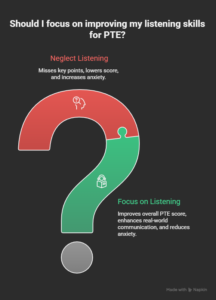
Listening is the most rigorous section of the PTE that tests you in the real world about your ability to communicate in English and makes up a big part of your final score because it contributes a substantial portion of the total communication skills, sometimes even 90 points for that segment alone. What makes it valuable is how it links to other areas; write-from-dictation, for example, getting those sentences right adds points to listening and writing because one good skill can boost more areas of your performance.
Those who do listen are able to catch the subtle meanings that aren’t explained as much, and respond correctly to questions and remain calm in the roughly 30-43 minutes the section is in progress.
If listening is not an area of focus in the prep period, you might miss key points because the audio is only played once—no rewinds allowed—and the tasks require you to nail the details, the overall messages, and even the attitude of the speaker right from that single listen. PTE keeps its clips from true sources, like broadcast news, campus talks and expert interviews; so you’re talking about English as you would in everyday classes or work. One point or better here indicates to universities and visa officers that you are able to work English-speaking classes, participate in group discussions, or do well when you work.
On top of that, building reliable listening reduces the pressure in other parts of the test by lowering overall anxiety and giving your brain more room to tackle reading or speaking without second-guessing yourself.
Since there’s no chance to hear things again, dropping even a few words can cost you dearly, especially in tasks worth a lot like summarizing a spoken text or dictation. Yet many students find that putting effort into listening pays off quickly, with noticeable band jumps because better comprehension means more correct answers spreading across various questions. Ultimately, listening acts as a cornerstone for a strong, well-rounded PTE score—if you skip working on it, you’re making the test harder than it needs to be, but if you invest time here, it opens up higher results and equips you for real communication long after the exam is over.
Ace Your PTE Exam with Confidence!
Unlock your potential with our expert-led PTE preparation course. Achieve your dream score and open doors to global opportunities!
Start Your PTE Preparation Today!Common Listening Problems Faced by PTE Aspirants
Quite a few people preparing for PTE get thrown off by the range of accents in the recordings, from crisp British to laid-back Australian or quick American styles, since these sound quite different from the standard, slower English often taught in courses or apps. This difference makes even common words hard to recognize when they’re linked together or pronounced in unexpected ways, leading to missed bits in questions like selecting the missing word or spotting wrong ones in a transcript.
Speed is another issue that catches many off guard, particularly in those longer talks where the speaker dives into topics rapidly without giving you time to catch up. If your brain isn’t processing fast enough, you might latch onto one idea too tightly and completely overlook what follows, which hurts your chances on multiple-choice questions or blanks that depend on the full flow.
The test also throws in things like faint background sounds, people talking over each other, or minor static on purpose to make it feel authentic, and these can pull your focus away or spark panic that breaks your concentration further. A lot of candidates don’t have solid ways to take notes, so they try to remember everything in their head, but that memory gets overwhelmed in longer clips, resulting in half-finished or off-target summaries.
Not knowing certain words related to the topic pops up often too, with specialized terms or casual phrases coming out of nowhere and leaving you guessing, which usually leads to picking wrong summaries or answers in choice-based tasks. Then there’s the spelling side— if you only half-hear a word, writing it down wrong in blanks or dictation takes away easy points.
It’s normal for focus to dip as the section drags on, especially after a string of demanding tasks when tiredness kicks in, causing wandering thoughts and overlooked hints like shifts in tone or connecting phrases. Nerves make it worse for some, as they spend too much time dissecting the start and tune out later parts, messing up anything needing steady attention.
Plenty of preparers treat listening like something they do in the background, without actively trying to pull out key info or organize notes, and that relaxed approach doesn’t build the habits needed to rebuild content accurately. If the topic is unfamiliar culturally or knowledge-wise, predicting what’s coming next becomes tougher, adding extra hurdles.
And honestly, a common trap is thinking that watching English videos casually or chatting online is enough, but PTE requires pinpoint accuracy and quick recall in a high-stakes setup. Spotting these typical stumbling blocks early is crucial because once you know what’s holding you back, you can target practice to fix them and watch your listening skills for PTE get much stronger.
Effective Ways to Improve Listening Skills for PTE
One of the best ways to learn to listen to music is by beginning each day listening to real English audio – whether it be podcasts about current events, news updates, educational videos, or interviews – and spend around an hour listening for 30 minutes so that your ears can get used to longer lengths and different ways people speak. Then, consciously make a switch from listening to sounds as they wash over you to actually speaking—try saying key phrases out loud whenever and wherever you can, because this will help you to learn how words talk together, get shortened, or carry specific tones that appear in PTE clips.
I believe it means all is fine if you can get into the habit of taking notes while listening because you can quickly write down the main nouns, action words, figures, and connectors that let you retain the skeleton of the talk without overloading your memory. When the clip ends, try again to put the ideas together in a quick summary with a cap, much as in the exam task, to sharpen your sense of what’s important, and not what’s unnecessary.
To help you address accents more effectively, mix up the content with intention; one day you’ll watch shows in the UK, the next you’ll watch TV shows in the US, and include Australian content often, using free sites or apps you can choose from so that your mind can adjust quickly if the test leaps between speakers. Another great technique to try is shadowing, hearing a part and then trying to say it exactly as you heard it right away. this speeds up process and helps with your own speaking flow and rhythm.
Picking up new words works best when you grab them straight from what you’re hearing rather than flashcards alone; once an audio finishes, go over any available script, mark words or phrases you didn’t know, and play it back paying special attention to their sound and use. Doing full-length practice runs timed exactly like the real section, with no stopping or replaying, builds your staying power and trains you to push through when concentration starts to wane.
Sometimes practicing with a bit of surrounding noise, like in a cafe or with low music, gets you ready for those subtle interruptions in test audio, and simple breathing routines beforehand can calm jitters that might otherwise scatter your focus. It’s also helpful to record yourself summarizing or explaining what you heard, then check it against the original to spot ongoing issues and tweak your approach.
Linking listening practice to other areas speeds things up too—reading along with a transcript quietly as the sound plays reinforces how spoken words match written ones, and verbally retelling the material out loud deepens understanding while practicing output. Scheduling full mock listening sections once a week with proper scoring keeps you honest about progress and shows exactly where more work is needed.
Stick with these approaches day in and day out, and you’ll find your listening skills for PTE sharpening pretty quickly—your ears pick up more, you think faster on the fly, and that unsure feeling gives way to real assurance when test day arrives.
Best Resources to Practice PTE Listening
Nothing beats starting with the official Pearson PTE site for reliable practice because it has free examples, real audio samples, and the exact guidelines for scoring that line up perfectly with the actual exam, helping you get comfortable with how everything looks and feels right away.
The official PTE books from Pearson and their online test packs are worth checking out too since they come loaded with full listening parts, clear recordings, thorough explanations for answers, and transcripts that make going over mistakes simple and productive. There are some excellent YouTube channels focused on PTE that break down tasks step by step and share timed drills, giving you fresh content regularly plus visuals of how to use strategies in action.
Apps like the official PTE one or APEUni make daily practice easy with short targeted exercises, automatic tracking of how you’re doing, and quick results, perfect for squeezing in sessions even when your schedule is packed. For building basics, BBC podcasts such as 6 Minute English or The English We Speak are fantastic with their concise, well-spoken episodes, and when you’re ready for more, TED Talks provide that lecture-like depth with topics similar to what PTE uses.
If you like more structure, platforms like E2Language or PTE Magic offer complete courses with lessons from experienced teachers, plenty of mocks, and even feedback tailored to your work, which can really speed up gains for those who thrive with guidance. You can also stream live news or radio from places like Australia, the UK, or the US for free, getting exposure to spontaneous talk and regional ways of speaking.
Turning off subtitles on documentaries from streaming sites adds value because seeing the pictures alongside the narration aids in figuring out tougher vocab and longer sentences in context. Online communities and groups often exchange hand-picked audio lists, challenging clips, and discussions on answers, bringing in diverse perspectives and extra motivation.
Putting together a routine that draws from trustworthy free official stuff, some guided paid options if it fits your budget, and regular real-life English sources builds a solid all-around plan that reliably boosts listening skills for PTE and gets you fully ready for whatever the test throws at you.
Ace Your PTE Exam with Confidence!
Unlock your potential with our expert-led PTE preparation course. Achieve your dream score and open doors to global opportunities!
Start Your PTE Preparation Today!Listening Practice Tips for Each PTE Task
The PTE listening section includes eight different task types, each testing a unique aspect of comprehension, so adjusting your practice to match what each one asks for helps you rack up points more efficiently and cover all bases.
When working on Summarize Spoken Text, train yourself to spot the big picture idea plus a couple of key backups as the talk unfolds, use quick shorthand or symbols for notes, and craft a connected paragraph around 50 to 70 words that sticks closely to what’s said without throwing in your own views or unrelated info; doing this often with short academic clips hones your knack for boiling down content fast and right.
For the Multiple-choice with several correct answers, always scan the choices thoroughly upfront to prime your listening, watch for reworded ideas instead of identical phrases, and systematically rule out obvious wrongs while double-checking picks against what you actually heard.
The Fill in the Blanks task benefits hugely from previewing the gapped text to guess likely fits based on grammar hints like small words or tense markers, then zeroing in during playback to catch precise wording and spelling in one go.
To nail Highlight Correct Summary, take in the whole clip patiently to absorb the full sense and any underlying opinions, afterward matching options carefully to pick the one that reflects everything fairly without adding or leaving out major parts.
In the single-answer Multiple-choice, keep your ear tuned to the primary goal or message of the speaker while brushing off tempting but minor side points that distractors love to include.
Select Missing Word builds your ability to foresee endings, so listen closely to how the sentence builds in tone and logic toward the cutoff, making the right completion stand out naturally from the alternatives.
For Highlight Incorrect Words, track the provided text line by line as sound plays and mark changes promptly, keeping in mind how tiny tweaks can shift the entire sense.
Write from Dictation gives some leeway for close attempts, but going for perfection means mentally looping back over chunks right after hearing and entering them with spot-on spelling and marks.
Using these focused tips in your regular sessions converts tricky spots into reliable strengths, making sure your listening skills for PTE play a major role in pushing your score higher.
Join Entri PTE Coaching Course
Conclusion
Getting your listening skills for PTE up to a strong level truly changes how the whole exam feels for the better, as solid understanding cuts down on worry, sharpens answers in connected tasks, and pushes your band score upward in a meaningful way. Everything covered in this post—from grasping why listening counts so much, pinpointing usual hurdles, picking up effective training habits, tapping into great practice spots, and applying tips tailored to each question—lays out a straightforward yet thorough path that has already helped plenty of test-takers reach their targets for overseas education, careers, or settling in new countries. Start weaving these practices into your everyday schedule right away, keep an eye on improvements with periodic full mocks, adjust based on what your results honestly show, and stay consistent because that’s where the biggest leaps come from. The higher score that comes with better listening isn’t some distant dream—it’s absolutely achievable, and putting in the effort now sets you up for success on test day and beyond. Dive in with commitment, believe in the steps, and you’ll face the PTE knowing you’ve prepared in the best possible way.
Ace Your PTE Exam with Confidence!
Unlock your potential with our expert-led PTE preparation course. Achieve your dream score and open doors to global opportunities!
Start Your PTE Preparation Today!Frequently Asked Questions
Why is the Listening section often considered the most challenging part of the PTE Academic test, and how does it uniquely impact the overall score?
The PTE Listening section is deemed rigorous due to its authentic, high-stakes design. It uses unmodified audio from real-world sources like academic lectures, news broadcasts, and group discussions, featuring a variety of native accents (British, American, Australian), natural speaking speeds, and subtle background noises. Crucially, each audio clip is played only once, mirroring real-life academic or professional scenarios where rewinding isn’t possible. Its impact is profound because of integrated scoring: tasks like “Write from Dictation” and “Summarize Spoken Text” contribute points directly to both your Listening and Writing scores. A weakness here can therefore pull down two communicative skill bands simultaneously, while proficiency can create a significant upward lift in your overall result, making it a pivotal section for achieving high composite scores like 79+.
Beyond exam strategy, what are the long-term, practical benefits of developing strong listening skills specifically for the PTE format?
Investing in PTE-focused listening development builds foundational skills for success in English-medium environments. The test’s content deliberately mimics university lectures and professional dialogues; thus, your preparation directly enhances your ability to comprehend complex academic material, follow rapid-fire seminar discussions, and grasp nuanced instructions in a workplace. This leads to greater confidence and participation in international classrooms and team meetings. Furthermore, the skills of focused note-taking, extracting key ideas from extended speech, and filtering out distractions are transferable competencies that benefit your academic performance, career progression, and daily social integration long after you’ve achieved your target PTE score.
I struggle specifically with the variety of accents. What is a structured, step-by-step method to desensitize my ear to British, American, and Australian accents before test day?
A systematic “accent rotation” strategy is key. Dedicate specific days to immersive exposure: Mondays/Wednesdays to British English (e.g., BBC Podcasts, “The Economist” audio edition), Tuesdays/Thursdays to American English (e.g., NPR, TED Talks), and Fridays to Australian English (e.g., ABC News podcasts, SBS broadcasts). Actively engage by using the “shadowing” technique: listen to a 20-second segment, pause, and attempt to parrot the speaker exactly, mimicking their pronunciation, linking, and intonation. Supplement this by transcribing short clips from each accent, then checking against official transcripts to identify recurring pronunciation patterns (e.g., the Australian ‘r’, the British glottal ‘t’). This deliberate, varied practice rewires your brain’s phonetic processing to switch seamlessly between accents.
How can I design an effective and sustainable daily practice routine that improves my PTE Listening skills without leading to burnout?
Implement a balanced 60-minute “Focused-Diffuse” daily routine. Begin with 30 minutes of focused, active practice: complete 2-3 specific PTE task types under timed conditions (e.g., Summarize Spoken Text & Write from Dictation), then meticulously review errors using transcripts. Follow this with 20 minutes of diffuse, immersive listening: listen to a podcast or watch a short documentary without subtitles, focusing solely on global comprehension without pressure. Conclude with 10 minutes of skill-building: dedicate this to pure note-taking practice from a short talk or vocabulary mining from the day’s materials. This structure ensures consistent exposure, targeted skill development, and sustainable engagement by alternating between high-intensity study and lower-stakes immersion.
For the "Summarize Spoken Text" task, what is a fail-proof note-taking system to capture the main idea and supporting points from a 60-90 second lecture in a single listen? Adopt the "Core + 2" shorthand system. As you listen, quickly jot down:
-
CORE: Identify and note the central thesis in 3-4 words (e.g., “urban planning – green space vital”).
-
+2: Capture two key supporting points or examples. Use symbols (→, ∴, +), abbreviations (“govt” for government, “esp.” for especially), and initials for complex terms.
-
Structure Cues: Mark clear转折点 with “BUT” or “HOWEVER,” and conclusions with “∴” or “SO.”
Your notes might look like:CORE: Coastal erosion ↑ → managed retreat. +1: Seawalls costly & temp. +2: Relocation + ecosystem. BUT: public resist. ∴ long-term plan needed.
Post-audio, expand these notes into a grammatically correct, 50-70 word summary that logically connects the Core and the +2 points, strictly avoiding personal opinion.
What are the most common psychological traps (like anxiety or loss of focus) during the Listening section, and what are evidence-based techniques to mitigate them in real-time?
The primary traps are “ear-load anxiety” (panic at missing a word, causing a cascade of inattention) and “focus fatigue” during the 30-43 minute section. Combat these with:
-
Pre-emptive Breathing: Before the section starts, take three deep, slow diaphragmatic breaths to lower heart rate and prime focus.
-
The “Anchor Word” Technique: When you feel lost, gently bring your attention to a single, simple word you can hear (e.g., “the,” “and”) to re-anchor yourself in the audio stream without judgment.
-
Strategic Previewing: Use the seconds before an audio plays to skim questions/options. This gives your brain a predictive framework, reducing uncertainty and freeing cognitive load for listening.
-
Acceptance: Mentally accept you might not catch everything. The goal is to capture enough for accuracy, not perfection. This mindset reduces panic and improves overall performance.
How does the "Write from Dictation" task function as a double-scoring powerhouse, and what is a 3-phase strategy to ensure word-perfect recall and transcription?
This task is a powerhouse because it directly feeds points into both Listening (for correct word recognition) and Writing (for grammatical accuracy and spelling). Use this 3-phase strategy:
-
Phase 1 – Chunked Hearing: Don’t try to remember the sentence word-by-word. Listen for natural 3-4 word “chunks” (e.g., “The recent findings // suggest a conclusive // link between both // phenomena.”).
-
Phase 2 – Mental Replay & Priorities: In the 5-7 seconds after audio ends, silently replay the sentence in your mind, prioritizing writing the first chunk and the last chunk first. These are most vulnerable to memory decay.
-
Phase 3 – Check & Polish: Once all words are typed, rapidly check for: plural ‘s’, verb tense endings (‘ed’, ‘ing’), articles (‘a’, ‘the’), and prepositions. A single missing ‘s’ can cost a point.
Can you elaborate on the specific types of "authentic" audio sources Pearson uses, and how can I curate a personalized practice library from similar free resources?
Pearson sources audio from academic lectures (similar to OpenCourseWare or BBC’s “The Forum”), broadcast news and documentaries (like PBS NewsHour or BBC World Service), and professional/interview settings (akin to Harvard Business Review podcasts). To build your library:
-
Academic: Use YouTube channels of universities (e.g., MIT OpenCourseWare, Oxford) for lecture-style content.
-
News/Documentary: Subscribe to “6 Minute English” (BBC) for shorter clips and “Documentary Heaven” for full-length films.
-
Professional Discussions: Download episodes from “The Inquiry” (BBC) or “Freakonomics Radio” for analytical discussions.
Categorize these by length and accent, and practice with the same note-taking and summarization techniques you use for PTE tasks.
What is the single most critical mistake test-takers make in their approach to PTE Listening preparation, and how can it be corrected?
The most critical mistake is passive consumption—treating listening practice as mere exposure (like background music) rather than active, skill-targeted reconstruction. Simply watching Netflix with subtitles or casually listening to podcasts without a defined task does not build the specific muscles of recall, note-taking, and detail-capture needed for the PTE. The correction is to impose structure and output on every practice session. Always listen with a goal: “I will write a 50-word summary,” “I will identify the three incorrect words,” or “I will transcribe this sentence perfectly.” This active reconstruction forces deep processing, which is what leads to tangible score improvement.
For an aspirant with limited time (e.g., 4 weeks until the exam), what is the most efficient, prioritized plan of attack to maximize listening score gains?
Adopt a “Task-Priority Mock Cycle” over four weeks.
-
Week 1-2: Task Mastery. Identify your two weakest task types (e.g., Highlight Correct Summary, Select Missing Word). Spend 70% of your listening time drilling these specifically using official materials, mastering their strategies. The other 30% on general accent exposure.
-
Week 3: Integrated Practice. Shift to completing full, timed listening sections (30-43 mins). Focus on building stamina and managing time between tasks. Analyze mistakes ruthlessly—was it a vocabulary issue, a focus drop, or a misapplied strategy?
-
Week 4: Full Test Simulation & Refinement. Take 2-3 full-length official scored practice tests (like Pearson’s Scored Test B or C). This isn’t just for practice but for building mental endurance for the 3-hour test. In the final days, stop new practice and instead review your accumulated error log, re-listen to previously challenging clips, and reinforce successful strategies. This targeted, analytical approach ensures the most significant gains in the shortest time.