
Table of Contents
Scoring 65+ in the PTE Academic on your first attempt may sound challenging, but with the right strategy, focused preparation, and smart practice, it’s absolutely achievable. Many test-takers struggle not because of weak English skills, but due to a lack of understanding of the exam format, scoring system, and time management. This blog will guide you through proven techniques, practical tips, and expert strategies that can help you maximize your score and walk into the exam with confidence—no retakes, no guesswork, just results.
Join Enrtri PTE Coaching Course
Introduction
Scoring 65+ in the PTE Academic on your first attempt is a goal many test-takers aim for, especially those planning to study, work, or migrate abroad. While the score may seem intimidating at first, the truth is that PTE is a highly predictable, computer-based exam that rewards smart preparation rather than guesswork. With a clear understanding of the test format, scoring algorithm, and high-weighted tasks, even average English speakers can achieve their desired score without multiple attempts.
One of the biggest mistakes candidates make is preparing for PTE like a traditional English exam. PTE is not just about vocabulary or grammar—it tests your ability to listen, speak, read, and write simultaneously under time pressure. Many students lose marks not because they lack skills, but because they are unaware of time management techniques, template usage, and the importance of integrated tasks such as Read Aloud, Repeat Sentence, and Write From Dictation. Knowing where most of the marks come from can completely change your preparation strategy.
The blog is designed to help you crack the PTE Academic with 65+ marks on your first attempt by focusing on proven strategies, practical study plans, and common mistakes to avoid. Whether you are a beginner or someone who has taken the test before, these insights will help you prepare more efficiently, boost your confidence, and approach the exam with clarity. With the right guidance and consistent practice, your target score is not just possible—it’s achievable.
Understanding the PTE Scoring System
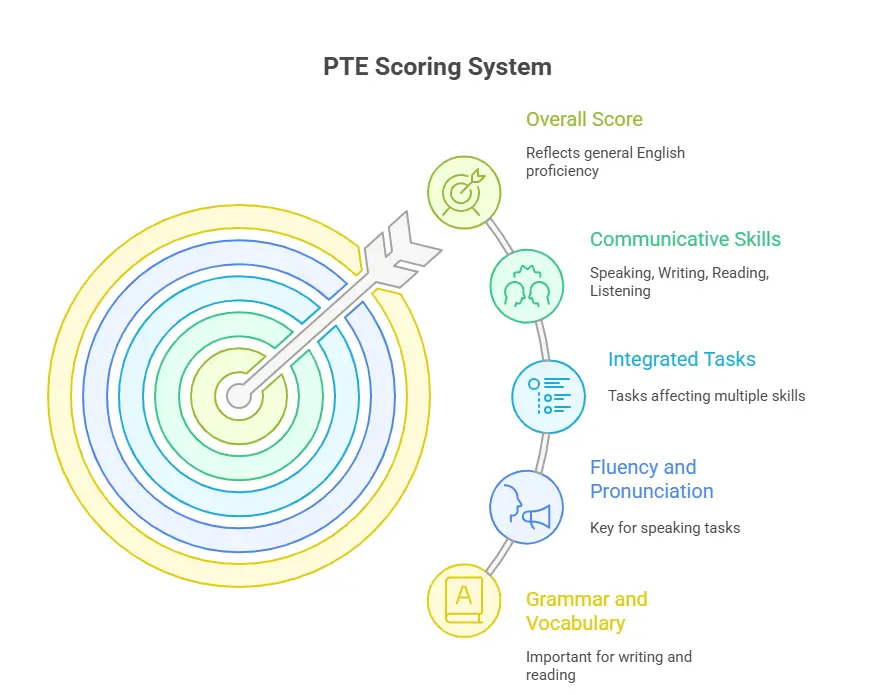
To score well in the PTE Academic exam, it’s essential to understand how the scoring system actually works. Many test-takers prepare hard but still miss their target score simply because they don’t know where the marks come from. Once you understand the logic behind PTE scoring, you can prepare smarter—not harder.
1. Overall Score and Communicative Skills
PTE gives you an overall score from 10 to 90, which reflects your general English proficiency. Along with this, you receive four communicative skill scores:
-
Speaking
-
Writing
-
Reading
-
Listening
These scores are not independent of each other. PTE uses integrated scoring, meaning one task can contribute to multiple skills at the same time.
2. Integrated Scoring: The Game Changer
Unlike traditional exams, PTE heavily focuses on integrated tasks. For example:
-
Read Aloud affects Speaking and Reading
-
Repeat Sentence affects Speaking and Listening
-
Write From Dictation affects Writing and Listening
This means performing well in a single task can boost two skills at once, making these tasks extremely high-scoring. Many candidates lose marks because they ignore this concept and spend too much time on low-impact tasks.
3. Content, Fluency, and Pronunciation Matter
For speaking tasks, PTE does not judge you like a human examiner. Instead, it uses AI-based scoring, which focuses on:
-
Fluency (smooth speech without long pauses)
-
Pronunciation (clear and understandable)
-
Content accuracy
Accent doesn’t matter as long as your speech is clear. Even simple vocabulary spoken confidently and fluently can score higher than complex words spoken with hesitation.
4. Grammar and Vocabulary Are Scored Automatically
In writing and reading sections, the system checks:
-
Grammar accuracy
-
Spelling
-
Sentence structure
-
Vocabulary usage
Minor mistakes won’t heavily impact your score, but frequent errors can reduce it. The key is clarity and correctness, not fancy language.
5. Partial Marks Are Awarded
One of the biggest advantages of PTE is partial scoring. You don’t need a perfect answer to earn marks. Even if your response is incomplete or slightly incorrect, you can still gain points for correct parts, pronunciation, or structure. This makes it easier to score consistently if you attempt every question.
6. Time Management Directly Affects Your Score
PTE is a fast-paced exam. If you miss questions due to poor time management, you lose easy marks. Since unanswered questions receive zero points, completing every task— even with average answers— is better than leaving questions blank.
Why Understanding the Scoring System Is Important
Once you understand the PTE scoring system, your preparation becomes more focused. You start prioritizing high-weight tasks, practicing integrated skills, and using strategies that maximize your score. Instead of guessing what matters, you prepare with clarity and confidence—bringing you much closer to scoring 65+ on your first attempt.
Why Students Struggle to Score 65+
Many students work hard for the PTE exam, yet still fall short of scoring 65+. This usually happens not because they lack English skills, but because they don’t fully understand how the test works. One of the biggest reasons students struggle is poor awareness of the PTE format and scoring system. Without knowing which tasks carry more marks, candidates often spend too much time on low-impact questions and ignore high-scoring ones like Read Aloud, Repeat Sentence, and Write From Dictation.
Another common issue is weak time management. PTE is a fast-paced exam, and many students panic when the clock starts ticking. They either rush through important questions or get stuck on one task for too long, which leads to unanswered questions later. Since unanswered questions get zero marks, this can significantly reduce the overall score.
Speaking confidence is also a major challenge. Many students hesitate, pause too often, or speak too softly because they fear making mistakes. However, PTE’s AI scoring system values fluency and clarity more than perfect grammar. Long pauses, broken sentences, and unclear pronunciation can quickly lower speaking scores, even if the content is correct.
In the writing section, students often try to use complex vocabulary and long sentences, which leads to grammar and spelling mistakes. PTE does not reward fancy language—it rewards clear, structured, and error-free writing. Overcomplicating answers usually does more harm than good.
Lastly, lack of proper practice and mock tests holds many students back. Practicing without feedback or avoiding full-length mocks means students are unprepared for the real exam pressure. Without identifying weaknesses early, mistakes are repeated in the actual test.
Understanding these common problems is the first step toward fixing them—and getting closer to scoring 65+ with confidence.
Section-Wise Strategies to Boost Scores
To score 65+ in PTE, it’s important to prepare section by section, instead of studying everything randomly. Each section has its own scoring rules and high-weight tasks. When you know what to focus on, your preparation becomes more effective and less stressful.
Speaking Section
The speaking section plays a major role in your overall score and also impacts reading and listening through integrated tasks. The key to scoring well here is fluency and pronunciation. Speak smoothly, at a natural pace, without long pauses or hesitation. Tasks like Read Aloud, Repeat Sentence, and Describe Image carry high weightage, so practice them daily. Don’t worry about using complex words—simple and clear speech works best. Always speak confidently, even if you’re unsure about a word.
Writing Section
In the writing section, clarity and structure matter more than creativity. For Summarize Written Text, keep your sentence short, grammatically correct, and within the word limit. For Essay Writing, follow a clear structure: introduction, body paragraph(s), and conclusion. Avoid overusing difficult vocabulary or long sentences, as grammar mistakes can reduce your score. Templates can be helpful, but only if you understand how to adapt them naturally.
Reading Section
The reading section tests your understanding and attention to detail. Re-order Paragraphs and Reading & Writing: Fill in the Blanks are high-scoring tasks, so focus on practicing them more. Improve your vocabulary and grammar awareness to perform better in fill-in-the-blanks questions. Skim the text to understand the main idea first, then look for logical connections between sentences instead of translating word by word.
Listening Section
Listening is one of the most scoring yet challenging sections. Tasks like Write From Dictation and Summarize Spoken Text have a strong impact on both listening and writing scores. Practice active listening by focusing on keywords, sentence structure, and spelling. Take quick notes while listening, but don’t try to write everything. Regular practice with different accents will also help improve comprehension and confidence.
Time Management and Practice
Across all sections, time management is critical. Always attempt every question, even if you’re unsure. Leaving questions unanswered means losing easy marks. Take regular full-length mock tests to get familiar with the exam pressure and identify weak areas. Review your mistakes and focus on improving them instead of repeating the same practice.
Daily Study Plan for 30 Days
A well-structured 30-day study plan can make a huge difference in your PTE score, especially if your goal is to score 65+ on the first attempt. This plan is designed to balance all four skills—speaking, writing, reading, and listening—while focusing more on high-scoring tasks. Ideally, study 2–3 hours daily with consistency.
Week 1: Understanding the Exam & Building Basics (Days 1–7)
The first week is all about understanding the PTE format and building a strong foundation.
-
Day 1: Learn the PTE exam structure, question types, and scoring system. Watch sample test videos to understand real exam flow.
-
Day 2: Start with Read Aloud practice (20–30 questions). Focus on pronunciation and fluency.
-
Day 3: Practice Repeat Sentence and basic listening exercises.
-
Day 4: Learn essay structure and write 1–2 essays. Review grammar and spelling mistakes.
-
Day 5: Practice Reading: Fill in the Blanks and Re-order Paragraphs.
-
Day 6: Practice Write From Dictation and improve spelling accuracy.
-
Day 7: Revise everything and take a short sectional mock test.
Week 2: Skill Improvement & Strategy Building (Days 8–14)
This week focuses on improving accuracy and speed.
-
Days 8–9: Speaking practice—Read Aloud, Describe Image, Retell Lecture. Record yourself and check fluency.
-
Day 10: Writing practice—Summarize Written Text and essay writing using proper structure.
-
Day 11: Reading practice with time management techniques.
-
Day 12: Listening practice with focus on note-taking and keyword identification.
-
Day 13: Mixed practice of high-scoring tasks.
-
Day 14: Take a full-length mock test and analyze your weak areas.
Week 3: Intensive Practice & Error Correction (Days 15–21)
Now the focus shifts to consistency and reducing mistakes.
-
Days 15–16: Target weak sections identified in the mock test.
-
Day 17: Practice integrated tasks like Repeat Sentence and Write From Dictation.
-
Day 18: Improve grammar and vocabulary through error correction.
-
Day 19: Take another full mock test.
-
Day 20: Review mock results carefully and update your strategy.
-
Day 21: Light practice and revision.
Week 4: Final Revision & Exam Readiness (Days 22–30)
This is the polishing phase.
-
Days 22–24: Daily speaking and listening practice with focus on fluency and confidence.
-
Day 25: Writing revision—practice one essay and one Summarize Written Text.
-
Day 26: Reading revision and vocabulary review.
-
Day 27: Take the final full-length mock test.
-
Day 28: Analyze mistakes and revise templates.
-
Day 29: Light revision and relaxation.
-
Day 30: Rest, stay calm, and prepare mentally for exam day.
Practice Resources & Mock Tests
Using the right practice resources and mock tests is one of the most important factors in achieving a 65+ score in PTE. Many students practice a lot, but if the resources are not reliable or close to the real exam, their effort does not convert into results. Smart practice always beats random practice.
Importance of Quality Practice Resources
PTE is a computer-based exam with AI scoring, so practicing from exam-level questions is crucial. High-quality resources help you understand question patterns, improve accuracy, and build confidence. Focus on platforms that provide:
-
Real PTE-style questions
-
Clear explanations for answers
-
Practice for high-weight tasks like Read Aloud, Repeat Sentence, and Write From Dictation
Avoid memorizing answers blindly. Instead, use resources that help you improve skills like fluency, listening accuracy, grammar, and spelling.
Role of Mock Tests
Mock tests play a huge role in PTE preparation. They help you experience real exam pressure, manage time effectively, and identify weak areas. A full-length mock test shows how well you can perform continuously for nearly three hours, just like the actual exam.
Taking mock tests regularly helps you:
-
Improve time management
-
Understand your scoring pattern
-
Reduce exam anxiety
-
Track progress over time
Ideally, you should take one mock test every week during preparation and more frequently in the final 10 days before the exam.
How to Use Mock Tests Effectively
Simply taking mock tests is not enough. The real improvement happens during analysis. After every mock test:
-
Review incorrect answers carefully
-
Identify repeated mistakes
-
Focus on weak sections in your next practice sessions
If your speaking or listening scores are low, increase practice for integrated tasks. If writing scores are low, work on grammar, structure, and word limits.
Choose limited but reliable resources and use them consistently. Combine daily practice with regular mock tests and proper analysis. When used correctly, practice resources and mock tests can significantly boost your confidence and bring you closer to scoring 65+ in PTE on your first attempt.
Join Enrtri PTE Coaching Course
Conclusion
Achieving 65+ in the PTE Academic on your first attempt depends more on preparation strategy than on natural language ability. When you practice consistently, focus on tasks that carry higher scores, and improve fluency and accuracy step by step, your performance improves naturally. Small improvements made daily can lead to a big difference in your final score.
Stay focused, avoid overcomplicating your answers, and learn from every mock test you take. Confidence, calmness, and clear thinking on exam day play a key role in success. With the right guidance and a structured approach, reaching your target PTE score becomes a realistic and achievable outcome.
Ace Your PTE Exam with Confidence!
Unlock your potential with our expert-led PTE preparation course. Achieve your dream score and open doors to global opportunities!
Start Your PTE Preparation Today!Frequently Asked Questions
Is it really possible to score 65+ in PTE on the first attempt?
Yes, absolutely. Many candidates score 65+ on their first attempt by preparing smartly instead of studying randomly. Understanding the PTE format, focusing on high-scoring tasks, and practicing regularly with mock tests makes the exam very predictable. You don’t need perfect English—clear, fluent, and accurate responses are enough.
How long should I prepare to score 65+ in PTE?
On average, 3–4 weeks of focused preparation is sufficient for most students. If your English basics are strong, even 2–3 weeks can be enough. The key is daily practice, especially for speaking and listening, rather than long study hours.
Which PTE section is the most important for scoring 65+?
The Speaking and Listening sections are the most important because they contain integrated tasks that affect multiple skills. Tasks like Read Aloud, Repeat Sentence, and Write From Dictation carry high weightage and can significantly boost your overall score.
Do I need to use templates to score well in PTE?
Templates can be helpful, especially for writing and speaking tasks, but they should be used carefully. Overusing or memorizing templates without understanding them can lower your score. Simple, natural, and well-structured answers perform better than rigid or unnatural responses.
Does accent matter in the PTE speaking test?
No, accent does not matter. PTE is scored by AI, which focuses on pronunciation clarity and fluency, not accent. As long as your speech is clear, smooth, and understandable, you can score well regardless of your accent.
How many mock tests should I take before the exam?
You should take at least 3–5 full-length mock tests before the exam. Mock tests help improve time management, reduce exam anxiety, and highlight weak areas. Always analyze your mock test results to avoid repeating the same mistakes.
What is the biggest mistake students make in PTE preparation?
The biggest mistake is ignoring the PTE scoring system. Many students focus equally on all tasks instead of prioritizing high-scoring ones. Poor time management and lack of mock test analysis are also common reasons for low scores.
What should I do on the day before the PTE exam?
On the day before the exam, avoid heavy study. Revise key strategies, practice light speaking tasks, and review common mistakes. Get proper rest and stay calm. A relaxed and confident mind performs much better than last-minute cramming.