Table of Contents
Key TakeAways:
- Hospital administration focuses on managing hospital operations, ensuring smooth patient care and efficient services.
- Graduates from any stream can enter this field, but having the right qualification or certification is important.
- Freshers need basic skills like communication, organization, teamwork, and problem-solving to succeed.
- There are many entry-level roles such as hospital coordinator, administrator, or front office executive to start with.
- Choosing the right course, gaining practical experience, and improving skills step by step can help build a strong career in healthcare management.
Introduction
Starting a career in hospital administration after graduation can be a smart and rewarding choice. If you are someone who is interested in healthcare but do not want to become a doctor or nurse, this field offers a great alternative. Hospital administration focuses on managing the daily operations of hospitals and healthcare centers, making sure everything runs smoothly for both patients and staff.
Many graduates are now exploring this career because the healthcare industry is growing quickly and needs skilled professionals behind the scenes. From handling patient services to managing staff and resources, hospital administrators play an important role in delivering quality care.
The best part is that you can begin this career with the right course, practical training, and basic skills like communication, organization, and problem-solving. In this blog, we will guide you through simple steps to help you understand how to enter this field and build a stable and successful career in hospital administration.
Explore Your Future in Hospital Administration! Enroll now
What is Hospital Administration?
Hospital administration is the management side of healthcare. It focuses on running hospitals and healthcare centers smoothly so that patients receive proper care and services. While doctors and nurses take care of patients medically, hospital administrators handle everything behind the scenes. Their main role is to manage daily operations. This includes coordinating staff, maintaining records, managing budgets, and making sure all departments work together efficiently. They also ensure that the hospital follows rules, safety standards, and provides a good experience for patients.
Hospital administrators act as a bridge between medical staff, patients, and management. They help solve problems, improve services, and make important decisions that support the hospital’s growth. From handling admissions to managing resources like equipment and staff, their work keeps the system organized. This field is important because a well-managed hospital can provide faster, safer, and better care to patients. Without proper administration, even the best medical services can face delays and confusion.

Eligibility After Graduation
Eligibility for a career in hospital administration after graduation is quite flexible, which makes it a good option for many students. The first and most important requirement is a graduation degree from a recognized university. Students from any stream—Arts, Commerce, or Science—can apply for courses or jobs in this field. However, those from science or healthcare backgrounds may find it slightly easier to understand medical terms and hospital systems.
After completing graduation, many students choose to study further in hospital administration or healthcare management. You can go for a diploma, certification, or a master’s degree such as MHA (Master of Hospital Administration) or MBA in Healthcare Management. These courses help you understand how hospitals function and prepare you for real-world roles.
Most institutes require a minimum of around 50% marks in graduation. Some colleges may also conduct entrance exams or interviews as part of the admission process. So, it is always a good idea to check the specific requirements of the institute you are interested in.
Apart from academic qualifications, having basic skills is also important. Good communication, organization, teamwork, and problem-solving skills are very useful in this field. You should also have an interest in the healthcare sector and be willing to learn new things.
Skills Required for Freshers
Starting a career in hospital administration as a fresher requires a mix of basic professional skills and the right attitude. These skills help you manage daily tasks and work smoothly in a healthcare environment.
Communication Skills: Good communication is very important. You need to speak clearly with patients, doctors, and staff. It also includes listening carefully and understanding others’ needs.
Organizational Skills: Hospital work involves handling many tasks at the same time. Being organized helps you manage schedules, records, and responsibilities without confusion.
Teamwork: Hospitals run on teamwork. You will work with different departments, so it is important to cooperate and support others to ensure smooth operations.
Problem-Solving Skills: Unexpected situations can happen in hospitals. You should be able to think calmly and find simple solutions to problems when they arise.
Basic Computer Knowledge: Most hospital tasks involve computers, such as maintaining records, scheduling, and communication. Knowing basic software and systems is very helpful.
Time Management: Managing time well helps you complete tasks on time and avoid delays. This is especially important in a fast-paced healthcare environment.
Attention to Detail: Even small mistakes can cause problems in hospital work. Being careful and paying attention to details is very important.
Entry-Level Job Roles in Hospital Administration
These entry-level roles help freshers learn how hospitals function. With experience and skill development, you can grow into higher and more responsible positions in hospital administration.
1. Front Office Executive
This is one of the most common entry-level roles in hospital administration. A front office executive is the first person patients meet when they visit a hospital. They handle patient registration, book appointments, and answer basic questions. This role requires good communication skills and a polite attitude, as it creates the first impression of the hospital.
2. Patient Care Coordinator
A patient care coordinator helps patients throughout their hospital journey. They guide patients during admission, tests, and discharge. They also help solve basic concerns and ensure patients feel comfortable. This role is important for improving patient satisfaction and experience.
3. Medical Records Executive
In this role, you manage and maintain patient records. This includes storing, updating, and organizing important medical information. Accuracy is very important because doctors depend on these records for treatment decisions.
4. Billing Executive
A billing executive handles all billing-related tasks. This includes preparing bills, managing payments, and coordinating with insurance companies. This role helps ensure that financial processes are clear and smooth for patients.
5. Hospital Operations Assistant
An operations assistant supports the daily activities of the hospital. They may help with staff coordination, managing supplies, and handling basic administrative work. This role gives a better understanding of how different departments work together.
6. HR Assistant
An HR assistant in a hospital helps with hiring staff, maintaining employee records, and managing attendance. This role gives insight into the human resource side of healthcare management.
7. Insurance Coordinator
An insurance coordinator handles insurance claims and paperwork. They communicate with insurance companies and help patients understand their coverage. Attention to detail is very important in this role.
Steps to Start Your Career in Healthcare Management
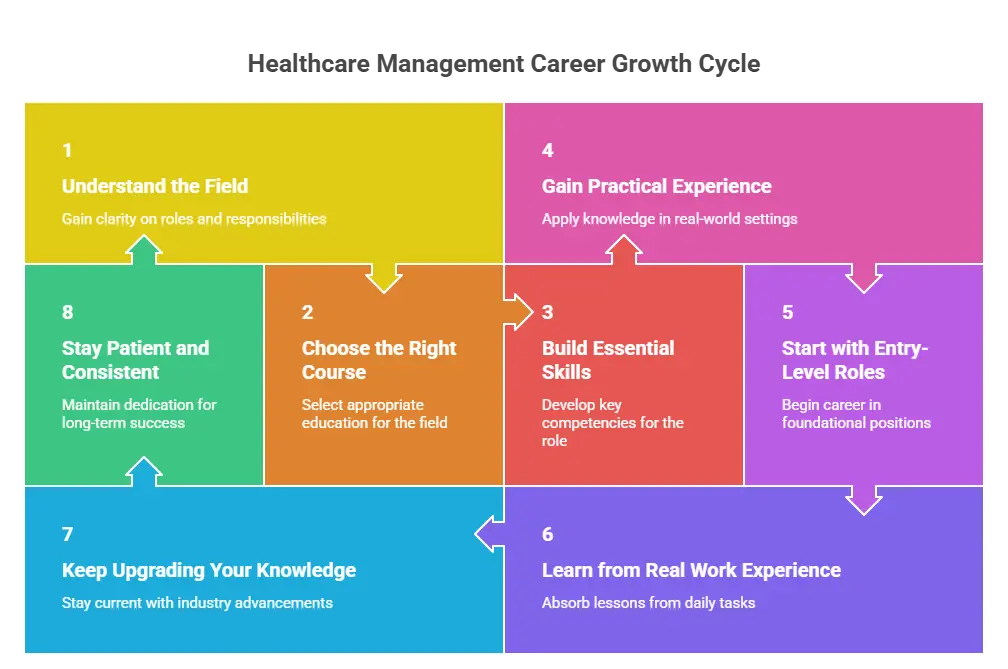
Starting a career in healthcare management is a step-by-step journey. With the right education, skills, and experience, you can grow confidently in this field and achieve long-term success.
1. Understand the Field of Healthcare Management
The first step is to clearly understand what healthcare management involves. It is not about treating patients, but about managing hospital operations, staff, and services. When you know the roles and responsibilities, it becomes easier to plan your career and set clear goals.
2. Choose the Right Course After Graduation
Once you decide to enter this field, the next step is to choose a suitable course. You can go for a diploma, certification, or advanced degree like MBA in Healthcare Management or MHA. These courses teach you how hospitals function, how to manage departments, and how to handle real-life situations in healthcare settings.
3. Build Essential Skills
To grow in healthcare management, you need to develop some key skills. Communication is important to interact with patients and staff. Organizational skills help in managing multiple tasks. Problem-solving and teamwork are also necessary, as hospitals require coordination between different departments.
4. Gain Practical Experience
Practical exposure plays a very important role. Try to do internships, part-time jobs, or training programs in hospitals, clinics, or healthcare centers. This helps you understand real working conditions and gives you confidence to handle responsibilities.
5. Start with Entry-Level Roles
After gaining basic knowledge and some experience, you can apply for entry-level jobs. Roles like front office executive, patient care coordinator, or operations assistant are good starting points. These roles help you learn the system and gain hands-on experience.
6. Learn from Real Work Experience
Once you start working, focus on learning from your daily tasks. Observe how different departments function, how decisions are made, and how challenges are handled. This practical learning is very valuable for career growth.
7. Keep Upgrading Your Knowledge
Healthcare is a fast-growing field, so continuous learning is important. Attend workshops, take short courses, and stay updated with new technologies and management practices. This helps you stay competitive and grow faster.
8. Stay Patient and Consistent
Building a career takes time and effort. There may be challenges in the beginning, but staying consistent and positive will help you move forward. With dedication and the right approach, you can build a stable and successful career in healthcare management.
Certifications & Courses to Consider
The right certification or course helps you build a strong foundation in hospital administration. It improves your skills, increases job opportunities, and supports your growth in the healthcare field.
1. Diploma in Hospital Administration
A diploma in hospital administration is a good starting point for beginners. This course usually takes a few months to one year to complete. It covers basic topics like hospital operations, patient handling, and administrative tasks. It is helpful for those who want to enter the field quickly and start working in entry-level roles.
2. Master of Hospital Administration (MHA)
MHA is one of the most popular courses after graduation. It gives detailed knowledge about how hospitals and healthcare systems work. You learn about management, finance, operations, and leadership. This course is suitable for those who want to build a long-term career and move into higher positions.
3. MBA in Healthcare Management
An MBA in Healthcare Management combines business skills with healthcare knowledge. In this course, you learn about management principles, marketing, finance, and hospital operations. It is a good option if you are interested in leadership roles or managing large healthcare organizations.
4. Certificate Courses in Healthcare
There are many short-term certificate courses available in areas like medical billing, hospital management, healthcare operations, and medical records. These courses are flexible and can be completed in a short time. They help you improve specific skills and make your resume stronger.
5. Courses with Internship or Practical Training
Some institutes offer courses that include internships or practical training. This is very useful because it gives you real experience in hospitals or clinics. You get to understand how things work in real situations, which builds confidence and job readiness.
6. Online Healthcare Management Courses
Many platforms offer online courses in healthcare management. These are helpful for students who prefer flexible learning. You can study at your own pace while gaining useful knowledge and skills.
7. Choosing the Right Institute
While selecting a course, it is important to choose a recognized and trusted institute. Check the course content, faculty, and placement support. A good institute will provide both theoretical knowledge and practical exposure.
Explore Your Future in Hospital Administration! Enroll now
Conclusion
Starting a career in hospital administration after graduation is a smart and practical choice for those interested in the healthcare field. With the right course, basic skills, and some practical experience, you can begin your journey with confidence.
It is important to take small steps, keep learning, and stay patient as you grow in this field. Over time, your knowledge and experience will open better opportunities for you. With dedication and the right approach, you can build a stable and rewarding career in hospital administration.
Hospital Administration Course with Assured Career Growth
Hospital Administration Course by Entri App: Master essential healthcare management skills, gain certification, and secure top roles in leading hospitals
Join Now!Frequently Asked Questions
What is hospital administration as a career?
Hospital administration is a career where you manage the daily operations of hospitals and healthcare centers. It includes handling staff, patient services, records, and overall management to ensure smooth functioning.
Can I start a career in hospital administration after any graduation?
Yes, students from any stream—Arts, Commerce, or Science—can start a career in this field. However, having a relevant course or certification can improve your job opportunities.
Do I need a special degree to enter this field?
While a special degree is not always mandatory, pursuing courses like Diploma in Hospital Administration, MHA, or MBA in Healthcare Management is highly recommended.
What are the basic skills required for beginners?
Freshers need skills like communication, teamwork, organization, problem-solving, and basic computer knowledge to work effectively in hospital settings.
What are the entry-level job roles available?
You can start as a front office executive, patient care coordinator, medical records executive, billing executive, or operations assistant in a hospital.
Is hospital administration a good career option?
Yes, it is a growing field with good job opportunities. It offers stability and the chance to work in the healthcare sector without being directly involved in medical treatment.
Do I need internship experience before getting a job?
Internships are not always mandatory, but they are highly helpful. They give you practical experience and increase your chances of getting hired.
What is the future scope in hospital administration?
With experience and further education, you can move into higher roles like hospital manager, operations head, or healthcare consultant. The demand for skilled professionals is increasing.