Table of Contents
Key Takeaways
- Robotics is the sweet spot where software, electronics, and mechanics meet – and that makes it a pretty cool skillset to have if you’re thinking about a future in tech.
- If you’re just starting out, you can begin with some basic programming and electronics skills, and don’t worry if you’re not a pro. Just get a simple kit or learn through simulations before you start building real robots.
- The best way to learn robotics is to get your hands dirty with projects and guided learning – that way, you can see how things work in real life.
- Entri’s Robotics Course in Kerala offers top-notch, job-ready training for anyone who’s looking to get into engineering or innovation.
- Joining in with communities and competitions is a great way to boost your confidence, meet like-minded people and keep on learning for the long haul.
Introduction
Robotics is popping up in a lot of places these days – not just in futuristic movies or high-end research facilities but also in everyday life – factories, hospitals, warehouses, homes, farms and even classrooms. By 2026, you’ll find anything from automated assembly lines to clever service robots and machines driven by AI. And that’s made robotics into one of the most thrilling and forward-thinking areas for students and professionals to get into.
If you’re a complete beginner trying to figure out where to even start with robotics or a student/professional thinking about building a career in this field, then this guide is for you. It explains robotics in easy-to-understand language, outlines a step-by-step learning plan and helps you get a grip on the skills, tools and attitude you need to get ahead in this area.
This isn’t some theoretical piece of writing. It’s a no-nonsense guide written for real people looking for real results.
New to robotics? Start from the basics- join today!
Master Robotics and AI!
Ready to build the future? Join our comprehensive robotics course to bridge the gap between complex code and physical motion. You’ll gain hands-on experience giving you the technical edge needed to lead in the age of automation.
Know MoreWhy Robotics Is A Field Flying High In 2026
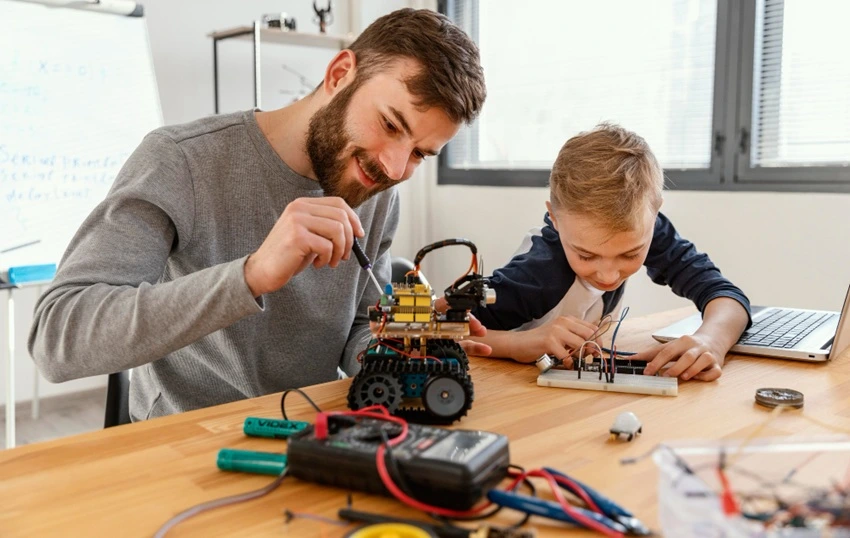
Before you even start figuring out how to get going, you should ask yourself what makes robotics such a big deal today.
By 2026:
- Companies are desperate for automation to save cash and cut down on mistakes
- Intelligent manufacturing and
Industry 4.0are really starting to take off - AI and robotics are rapidly becoming one and the same
- Robotics-related jobs are popping up all over the place – in engineering, healthcare, logistics and education
- Countries like India are pouring cash into robotics and automation skills
The truth is robotics is not so much about building robots – its about using tech to solve real problems in the real world.
Step 1: Understand What Robotics Actually Entails
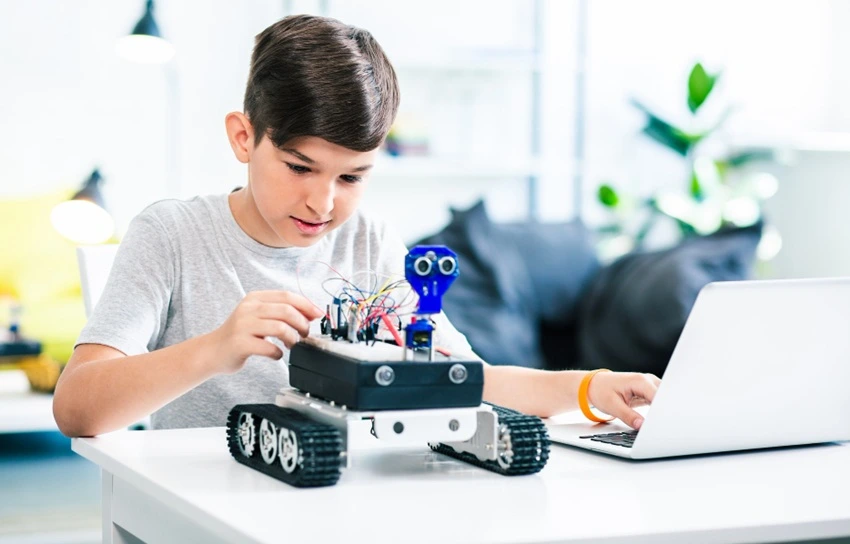
Before you start, it’s really worth understanding what robotics is all about, because it’s a lot more than just building machines that can walk around:
- Mechanical Systems – that’s the physical parts of the robot – wheels, gears, chassis…
- Electronics – that’s the electronics that make the robot tick: microcontrollers, sensors, motors…
- Programming – that’s the code that tells the robot what to do: programming is the brain of robotics…
- Artificial Intelligence – that’s when the robot starts to learn and think for itself: AI is the future…
Robotics is basically the art of building machines that can sense, plan and take action in the real world.
In Kerala, schools and tech clubs are really starting to get into all this, with kids building robotic arms, sensor-based vehicles and IoT devices to learn the concepts from the age of 10.
Step 2: Build a Strong Foundation
1. Learn to Code
Programming is what makes the robot tick. Start with:
- Python – it’s a great language for AI and robot control, and it’s really easy to learn…
- C/C++ – this is what most industry professionals use for microcontrollers like Arduino…
- JavaScript (for web-controlled robots) – this is perfect if you want to build robots you can control via a web interface…
There are loads of free resources online like W3Schools, Codecademy and YouTube tutorials that can get you started. But if you’re serious about building a career in robotics, courses like Entri’s offer structured programming and loads of hands-on project experience.
2. Get Comfortable with Electronics
You don’t need to be an electronics expert to get into robotics, but you do need to know the basics:
- What resistors, capacitors and transistors do…
- How to use breadboards to build circuits…
- How to connect sensors (IR, ultrasonic, light, etc.)…
- What a microcontroller is (like Arduino, ESP32)…
It’s not as hard as it sounds – loads of people can build their first blinking LED circuit in under an hour!
💡 Pro Tip: Entri’s Robotics Course uses hands-on microcontroller kits so learners can directly apply their knowledge.
3. Get to Grips with Basic Maths
You don’t need to be a genius at maths to get into robotics, but you will need to know some basic concepts:
- Algebra – for control systems…
- Geometry & Trigonometry – for movement and angles…
- Probability & Logic – for AI and decision making…
These concepts are all over the Kerala-based robotics labs and schools, where they teach the concepts through visual demonstrations – and this is also how Entri’s practical sessions are laid out.
Step 3: Start with Beginner-Friendly Projects
Hands-on practice is critical in robotics. Here are a few easy projects you can try, even at home:
- Line Follower Robot – follows a black line using IR sensors
- Obstacle Avoider Robot – stops or changes direction using ultrasonic sensors
- Bluetooth-Controlled Car – use a smartphone to control movement
These projects are widely taught in Indian engineering colleges and hobby clubs. You’ll learn wiring, coding, and debugging, all essential real-world skills.
For Kerala-based learners, Entri offers kits and guides in Malayalam and English to make DIY robotics accessible to all.
Simulators & Virtual Labs
If you don’t have physical kits, use tools like:
- TinkerCAD Circuits – simulate Arduino projects online
- Webots or Gazebo – for virtual 3D robots
- Blockly & Scratch – visual coding for younger learners
Build job-ready robotics skills with expert mentors!
Step 4: Following a Roadmap to Becoming a Robotics Expert
Here’s a rough guide to follow
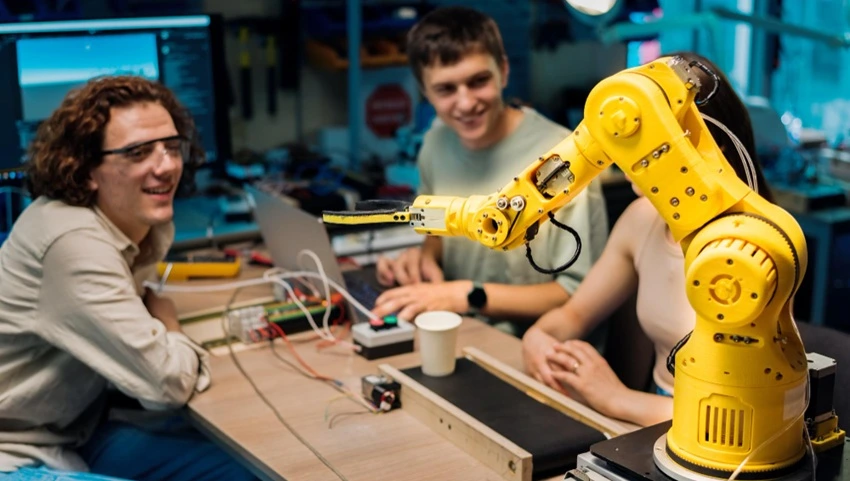
Phase 1: Getting Started (0 to 3 months)
- Learn the basics of Python and Arduino – don’t worry if it feels like a blur at first
- Get familiar with basic circuits and motors, and start to understand how they work
- Try your hand at 2 – 3 DIY robot projects – you’ll quickly get a feel for whether you’re really interested in this stuff
2: Getting into the Nitty Gritty (3 to 6 months)
- Dive into ROS (Robot Operating System) – it’s the backbone of most robotics projects
- Learn some computer vision basics using OpenCV – this can be mind-blowing, in a good way
- Try out some simulations using Webots or Gazebo – these can be really useful for testing out ideas
Phase 3: Taking it Up a Gear (6 to 12 months)
- Start integrating AI, voice or gesture control into your robots – this can be a real challenge
- Get hands-on with building an autonomous mapping robot (SLAM) – this is like robotics on steroids
- If you’re feeling confident, start contributing to some open-source robotics projects or research – this is a great way to really get involved in the community
Entri’s course does a great job of following this kind of roadmap and comes with personal project mentoring, community support, and placement training thrown in.
Step 5: Taking a Structured Course in Robotics (The Smart Way to Learn)
While YouTube tutorials and online courses can be great, they can be a bit hit and miss. That’s why a structured robotics course can make a real difference
🤔 Why Choose Entri’s Robotics Course in Kerala?
- Curriculum designed with beginners in mind: no prior experience needed
- Trained and experienced instructors: learn from people who know their stuff
- Hands-on projects: build real robots using kits and simulators – this is the best way to really get a feel for things
- Bilingual Training: available in English and Malayalam – so don’t let language be a barrier
- Career Support: help with resumes, mock interviews and getting a job
Whether you’re looking to get into robotics as part of your studies or you’re looking to change careers, this course can give you the foundation you need.
Step 6: Getting Involved with the Robotics Community
You don’t learn robotics in isolation – the community is just as important as the course
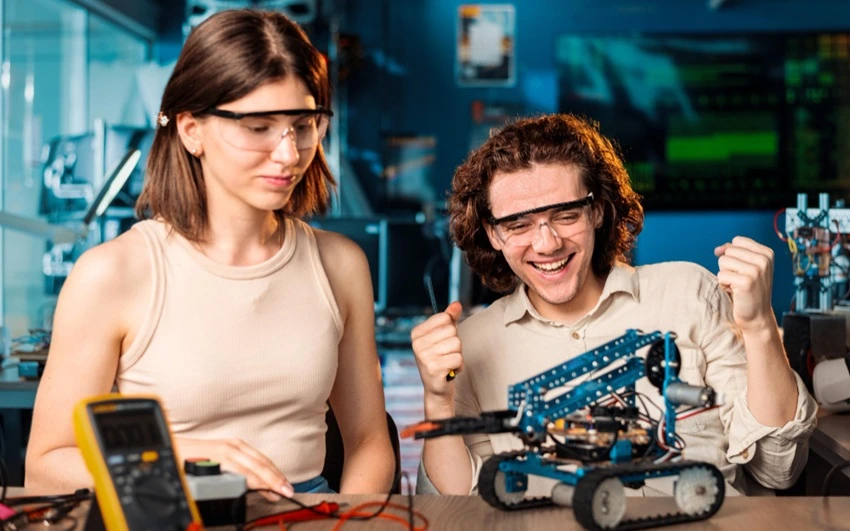
- Join robotics groups on Facebook or Telegram – great places to meet other enthusiasts
- Get involved with events like RoboFest India, Tech Fests, or Hackathons – these are always a great way to meet new people and learn new things
- Follow robotics YouTubers or influencers – they’re always coming up with new and interesting projects
- Engage with other robotics enthusiasts on platforms like Reddit or Stack Overflow – this is a great way to get help with technical problems
Kerala has a growing maker community – check out FabLabs, Startup Missions, or Tech Parks for a chance to get hands-on experience in real-world projects
Step 7: Preparing for a Career in Robotics
Robotics is not just for engineers – it’s a field that draws on a wide range of skills and disciplines
Career Paths:
- Robotics Engineer
- Automation Specialist
- Embedded Systems Developer
- Mechatronics Technician
- AI & Computer Vision Developer
- Drone Technician
- Robotics Educator
As robotics becomes more and more important in fields like agriculture, defence, healthcare and logistics, the demand for skilled robotics professionals is growing – especially for those with hands-on experience of real robotics projects.
Start learning robotics today! Build strong fundamentals with expert-led training.
Conclusion: Your Robotics Journey Starts Now
Robotics is no longer a niche field- it’s a critical skill of the future. Whether you’re a school student, a college graduate or a working professional, the key is to start small and learn consistently.
By building a foundation in coding, electronics and design, and using hands-on projects or structured courses like Entri’s to learn, you can start to build real robots and contribute to innovation in the field.
Ready to start your robotics journey?
👉 Enrol in Entri’s course today and start building your own future!
Master Robotics and AI!
Ready to build the future? Join our comprehensive robotics course to bridge the gap between complex code and physical motion. You’ll gain hands-on experience giving you the technical edge needed to lead in the age of automation.
Know MoreFrequently Asked Questions
What is robotics and who can learn it?
Robotics is a field that combines mechanics, electronics, and programming to build intelligent machines. Anyone, students, engineers, or beginners with interest, can learn robotics.
How can a beginner start learning robotics?
Beginners should start by understanding basic robotics concepts, learning simple electronics, practicing basic programming, and working on small hands-on projects.
Do I need coding knowledge to learn robotics?
Basic coding is required, but beginners can start with simple logic and gradually learn programming languages used in robotics, like C or Python.
What subjects are important for robotics?
Key subjects include basic electronics, programming, mechanics, mathematics, and problem-solving skills.
How long does it take to learn robotics?
Learning basics may take 2–3 months, while building strong practical skills usually takes 6–12 months with consistent practice.
Is robotics a good career option in India?
Yes. Robotics is a growing field in India with opportunities in automation, manufacturing, AI, healthcare, and education.
What are beginner-level robotics projects?
Common beginner projects include line-following robots, obstacle-avoiding robots, sensor-based systems, and remote-controlled robots.
What tools are used to learn robotics at the beginner level?
Beginners commonly use microcontrollers like Arduino, basic sensors, motors, robotics kits, and simple programming tools.
Can non-engineering students learn robotics?
Yes. With interest and structured guidance, even non-engineering students can learn robotics and build practical skills.
Do robotics courses help beginners learn faster?
Yes. Structured robotics courses provide guided learning, hands-on practice, and clear progression, helping beginners avoid confusion and learn efficiently.