Table of Contents
IELTS vs PTE is a frequent concern among students today. Many test takers feel uncertain while selecting the right English exam. Both exams measure English proficiency for global education and migration. However, the structure, scoring, and experience differ significantly. Because of these differences, students often worry about choosing the harder test. Clear and reliable information helps reduce confusion and exam related stress.
As English proficiency remains essential for international goals, selecting the right test becomes important. Students preparing for overseas education want predictable scoring and manageable difficulty. IELTS and PTE both fulfill official language requirements worldwide. Yet, personal comfort plays a major role in success. This guide aims to simplify that decision for 2026 aspirants.
Join Enrtri PTE Coaching Course
Introduction
Choosing an English language test influences academic and career outcomes. Many students hesitate between IELTS and PTE examinations. Both tests assess listening, reading, writing, and speaking skills. Still, their test formats and evaluation styles feel very different. Some learners prefer human evaluated speaking tests. Others feel comfortable with computer based assessments.
Preparation strategies also differ between the two exams. IELTS demands strong language understanding and structured writing skills. PTE emphasizes speed, accuracy, and familiarity with technology. Stress levels vary depending on exam environment and format. Therefore, identifying the easier exam depends on individual strengths.
This blog offers a detailed IELTS vs PTE comparison. Each section explains difficulty using simple and clear language. The guide compares exam sections, scoring systems, and formats. By the end, students can confidently choose the suitable exam for 2026.
Overview of IELTS and PTE Exams
Overview of IELTS Exam
The International English Language Testing System is widely accepted worldwide. It measures English ability for education, work, and migration. Many universities and governments trust IELTS scores globally. The exam focuses on real world English usage skills.
IELTS is jointly managed by international examination bodies. It emphasizes academic and general communication abilities. Test content reflects everyday and academic language situations. Students often choose IELTS for traditional testing experience.
Types of IELTS
IELTS is available in two main formats. Each format serves different applicant purposes.
IELTS Academic
-
Suitable for higher education applicants
-
Accepted by universities and colleges
-
Focuses on academic reading and writing
IELTS General Training
-
Designed for migration and work purposes
-
Used for visa and employment requirements
-
Focuses on practical daily English usage
IELTS Test Structure
IELTS consists of four separate skill sections. Each section evaluates a specific language ability.
-
Listening section tests audio comprehension accuracy
-
Reading section evaluates understanding of written texts
-
Writing section measures structured written communication
-
Speaking section assesses face to face conversation skills
Overview of PTE Exam
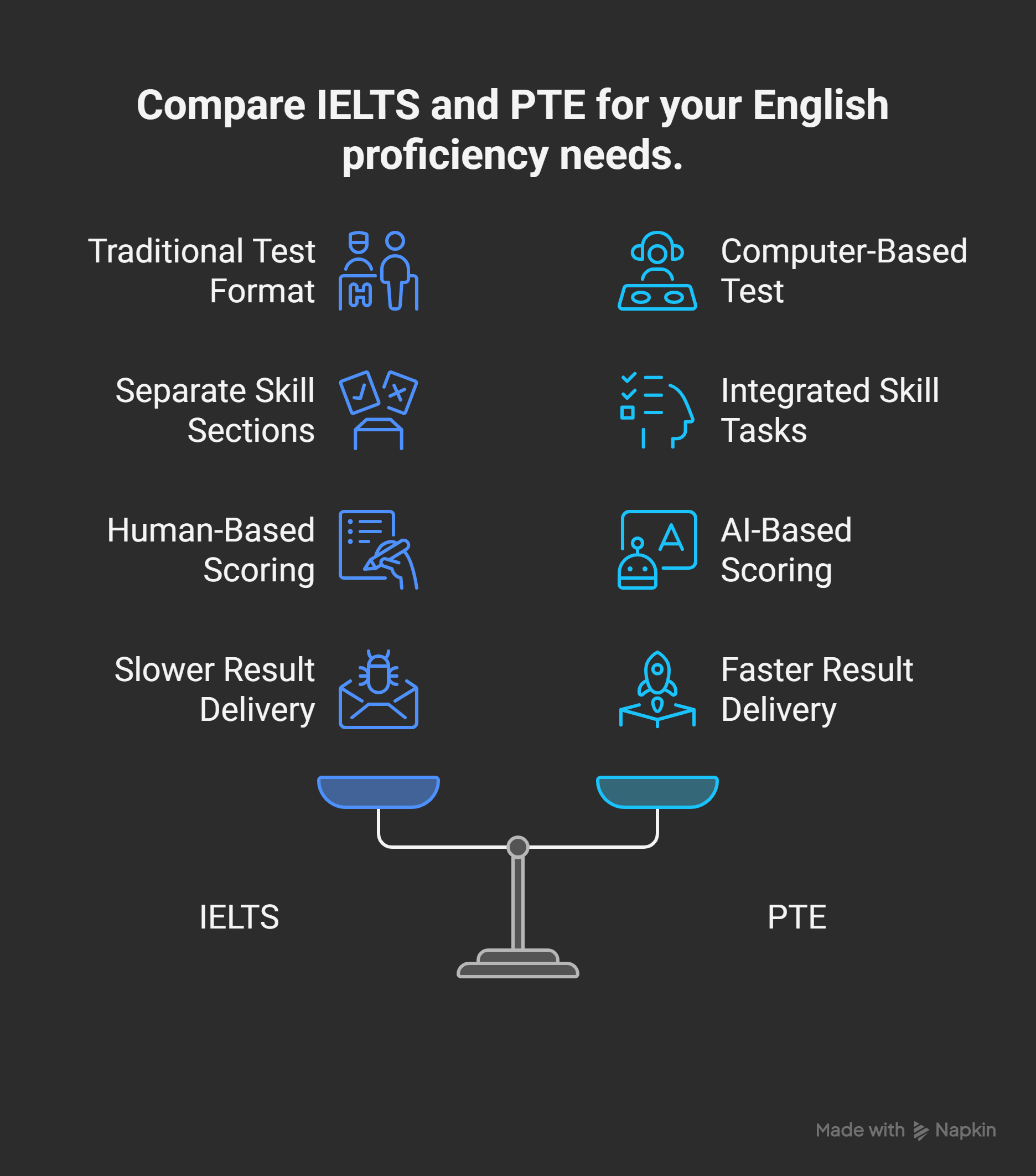
The Pearson Test of English is fully computer based. It uses automated systems for scoring responses. Many students prefer PTE for quick result delivery. The exam focuses on integrated language skill assessment.
PTE is widely accepted by universities and immigration authorities. Artificial intelligence evaluates all test responses objectively. The exam reduces human bias in scoring decisions. Students comfortable with technology often choose PTE.
PTE Test Structure
PTE combines multiple skills within single tasks. This integrated format reduces section based pressure.
-
Speaking and writing are tested together
-
Reading section includes interactive task types
-
Listening section uses academic style recordings
Key Features of PTE
-
Entire test conducted on computers
-
Automated AI based scoring system
-
Faster result availability than IELTS
-
Partial credit awarded for many tasks
IELTS vs PTE: Basic Comparison Table
| Feature | IELTS | PTE |
|---|---|---|
| Test Mode | Paper or computer based | Fully computer based |
| Speaking Test | Face to face examiner | Computer recorded responses |
| Scoring Method | Human evaluated | AI evaluated |
| Result Time | Several days required | Usually within two days |
Ace Your PTE Exam with Confidence!
Unlock your potential with our expert-led PTE preparation course. Achieve your dream score and open doors to global opportunities!
Start Your PTE Preparation Today!Which Test Is Easier? Section-by-Section Comparison
Listening Section Comparison
The listening section creates stress for many students. Both exams test understanding of spoken English. However, listening formats and response methods differ. Comfort depends on note taking and concentration skills.
IELTS Listening Section
IELTS listening includes four recorded audio sections. Conversations and monologues reflect real life situations. Accents include British, Australian, and international speakers. Students must listen carefully and write answers simultaneously.
Spelling accuracy plays an important role here. Even minor spelling errors reduce listening scores. Questions gradually increase in difficulty level. Time management becomes challenging for slower writers.
Key IELTS Listening Challenges
-
Multiple accents may confuse learners
-
Writing answers while listening increases pressure
-
Spelling mistakes affect final scores
PTE Listening Section
PTE listening uses academic lectures and discussions. Students listen and type answers on computers. Some tasks allow replaying audio recordings. Partial scoring reduces penalty for minor mistakes.
Typing answers feels easier for many students. Automated scoring focuses on correct information recognition. Listening tasks are integrated with writing responses. This reduces section based stress levels.
Key PTE Listening Advantages
-
Typing reduces handwriting pressure
-
Partial credit lowers score loss
-
Replay options improve comprehension accuracy
Listening Section Ease Verdict
PTE listening feels easier for computer users. IELTS listening suits students with strong spelling skills. Comfort depends on writing speed and accent familiarity.
Reading Section Comparison
Reading sections test comprehension, speed, and vocabulary skills. Passage length and question types differ noticeably. Time pressure strongly affects reading performance.
IELTS Reading Section
IELTS reading passages are long and information heavy. Academic texts require careful skimming and scanning. Students answer multiple question types per passage. No extra time is provided for transferring answers.
Vocabulary difficulty feels higher for some learners. Paper based reading increases physical strain. Strong concentration is required throughout the section.
Key IELTS Reading Challenges
-
Long passages require fast reading speed
-
Complex vocabulary may slow comprehension
-
Strict timing increases performance pressure
PTE Reading Section
PTE reading passages are shorter and more focused. Tasks include reordering sentences and filling blanks. Students interact directly with digital content. Computer navigation allows quick question movement.
Partial scoring benefits students missing small details. Vocabulary difficulty remains moderate across tasks. Many students find this format less exhausting.
Key PTE Reading Advantages
-
Shorter texts reduce reading fatigue
-
Interactive tasks feel less monotonous
-
Partial credit improves overall scoring chances
Reading Section Ease Verdict
PTE reading feels easier for average readers. IELTS reading favors strong academic reading skills. Speed and vocabulary decide perceived difficulty.
Writing Section Comparison
Writing sections often cause maximum student anxiety. Both exams test grammar, coherence, and vocabulary usage. However, task formats differ significantly.
IELTS Writing Section
IELTS writing includes two independent writing tasks. Task one requires visual data description. Task two demands a structured essay response.
Human examiners evaluate content, grammar, and coherence. Creativity and idea development influence final scores. Time management remains a major challenge.
Key IELTS Writing Challenges
-
Essay structure must follow academic standards
-
Grammar accuracy affects band scores heavily
-
Subjective marking increases score uncertainty
PTE Writing Section
PTE writing integrates speaking and writing tasks. Students summarize texts and write short essays. Word limits guide structured responses clearly.
AI evaluates grammar, spelling, and sentence structure. Memorized templates often help improve consistency. Typing speed influences writing efficiency.
Key PTE Writing Advantages
-
Clear templates reduce planning stress
-
Automated scoring removes human bias
-
Typing allows faster content correction
Writing Section Ease Verdict
PTE writing feels easier for template users. IELTS writing suits expressive and analytical writers. Comfort depends on creativity versus structure preference.
Speaking Section Comparison
Speaking sections test fluency, pronunciation, and confidence. Interaction style greatly affects student comfort levels.
IELTS Speaking Section
IELTS speaking is conducted face to face. A trained examiner asks structured questions. The interaction feels like a natural conversation.
Some students feel nervous during live interaction. Confidence and body language influence performance. Accent clarity matters more than perfection.
Key IELTS Speaking Challenges
-
Human interaction increases performance anxiety
-
Examiner presence affects confidence levels
-
Spontaneous answers require quick thinking
PTE Speaking Section
PTE speaking uses a computer microphone system. Students speak responses without human presence. All answers are recorded digitally.
This format reduces social anxiety significantly. Fluency and pronunciation matter more than accent. Speaking speed influences automated scoring results.
Key PTE Speaking Advantages
-
No examiner reduces nervousness
-
Consistent environment improves confidence
-
Automated scoring rewards clear pronunciation
Speaking Section Ease Verdict
PTE speaking feels easier for shy students. IELTS speaking benefits confident conversational speakers. Comfort depends on interaction preference.
Scoring Differences: IELTS vs PTE
IELTS Scoring System
IELTS uses a band based scoring system. Scores range from zero to nine bands. Each test section receives an individual band score. The overall band represents an average of sections.
Human examiners evaluate writing and speaking sections. Listening and reading use standardized answer keys. Examiner judgment may slightly affect final scores. Consistency across sections improves overall results.
IELTS Band Score Interpretation
Each band describes English proficiency levels clearly. Universities usually set minimum band requirements.
-
Band nine indicates expert language proficiency
-
Band seven indicates good operational command
-
Band six indicates competent language usage
-
Band five indicates modest English proficiency
Key Features of IELTS Scoring
-
Half band scores are commonly awarded
-
Human evaluation introduces subjective elements
-
Strong consistency improves band averages
PTE Scoring System
PTE uses a numerical scoring scale. Scores range from ten to ninety points. Artificial intelligence evaluates all responses objectively. Integrated tasks contribute to multiple skill scores.
Each question impacts several language skills simultaneously. Partial credit is awarded for incomplete answers. Automated scoring ensures consistent and unbiased evaluation. Fast processing delivers results quickly.
PTE Score Categories
PTE scores are divided into skill and enabling scores. This gives detailed performance analysis.
-
Speaking score reflects fluency and pronunciation
-
Writing score reflects grammar and structure
-
Reading score reflects comprehension accuracy
-
Listening score reflects information understanding
Key Features of PTE Scoring
-
Automated scoring removes examiner bias
-
Partial credit improves scoring flexibility
-
Faster result delivery reduces waiting stress
IELTS vs PTE Scoring Comparison Table
| Scoring Feature | IELTS | PTE |
|---|---|---|
| Score Range | 0 to 9 bands | 10 to 90 points |
| Evaluation Type | Human and automated | Fully AI based |
| Partial Scoring | Limited availability | Widely available |
| Result Speed | Several days required | Usually within two days |
Which Scoring System Feels Easier?
PTE scoring feels more predictable and consistent. IELTS scoring depends slightly on examiner interpretation. Students preferring objectivity often choose PTE. Others trust human assessment more.
Join Enrtri PTE Coaching Course
Test Format, Duration & Difficulty Level
IELTS Test Format
IELTS offers both paper based and computer based formats. Students can choose their preferred testing mode. The speaking test may occur separately on another day. This separation sometimes increases scheduling inconvenience.
The listening, reading, and writing tests occur together. Total test duration is approximately two hours forty five minutes. Breaks are not provided between sections. Handwriting speed affects writing performance significantly.
IELTS Format Key Characteristics
-
Available in paper and computer formats
-
Speaking test conducted with human examiner
-
Traditional exam structure suits academic learners
PTE Test Format
PTE is entirely conducted using computers. All test sections are completed in one session. Speaking and writing are combined within integrated tasks. This format reduces overall test day anxiety.
The total test duration is around two hours. No separate speaking interview is required. Headsets and microphones are provided at centers. Typing speed strongly influences task completion efficiency.
PTE Format Key Characteristics
-
Fully computer based testing environment
-
Integrated speaking and writing tasks
-
Shorter overall test duration
Test Duration Comparison
Time management influences exam difficulty perception. Shorter exams often feel less exhausting.
| Feature | IELTS | PTE |
|---|---|---|
| Total Duration | Around 2 hours 45 minutes | Around 2 hours |
| Speaking Test | Separate session possible | Included in main test |
| Breaks Provided | No breaks allowed | No breaks allowed |
Overall Difficulty Level Comparison
IELTS difficulty feels traditional and academically focused. PTE difficulty feels technical and strategy oriented. Both tests require strong English fundamentals. Neither exam is objectively harder overall.
IELTS favors natural language understanding and expression. PTE favors familiarity with computer based testing. Personal strengths influence perceived difficulty levels. Practice significantly reduces difficulty for both exams.
Difficulty Level Summary
-
IELTS suits traditional academic learners
-
PTE suits technology comfortable test takers
-
Preparation quality determines final difficulty
Ace Your PTE Exam with Confidence!
Unlock your potential with our expert-led PTE preparation course. Achieve your dream score and open doors to global opportunities!
Start Your PTE Preparation Today!Which Test Should You Choose in 2026?
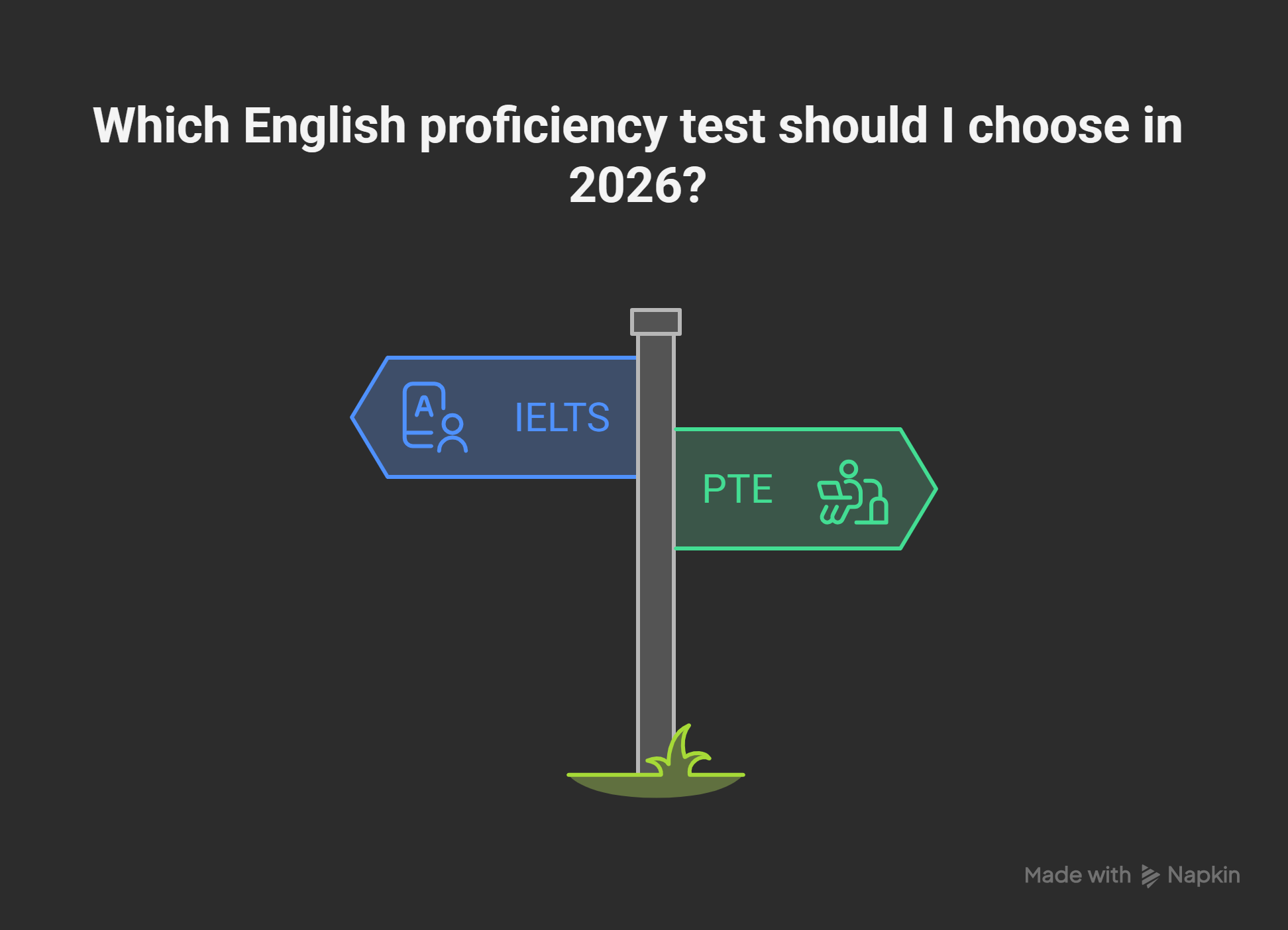
Choosing the right test depends on personal strengths. No exam is universally easier for everyone. Comfort with format plays a major role. Future goals also influence the final decision.
Students should consider learning style and confidence levels. Test environment comfort affects performance significantly. Scoring predictability also matters for many applicants. Understanding these factors simplifies decision making.
Choose IELTS If
IELTS suits students preferring traditional examination methods. Human interaction feels comfortable for confident speakers. Strong writing skills provide scoring advantages. Academic reading ability supports higher band achievement.
IELTS is suitable for students who:
-
Prefer face to face speaking interaction
-
Write essays confidently under time pressure
-
Understand multiple English accents comfortably
-
Trust human evaluation methods more
Choose PTE If
PTE suits students comfortable with computer based testing. Automated scoring provides consistent evaluation results. Faster results benefit urgent application timelines. Structured templates simplify preparation strategies.
PTE is suitable for students who:
-
Type quickly and accurately
-
Prefer no human examiner presence
-
Like predictable scoring systems
-
Want quicker result availability
Acceptance and Recognition in 2026
Both exams enjoy wide global acceptance. Universities accept IELTS and PTE equally. Immigration authorities recognize both test scores. Country specific requirements should always be verified.
Test availability may differ by location. Students should check nearby test centers early. Booking flexibility also influences final test choice.
Final IELTS vs PTE Comparison Table
| Decision Factor | IELTS | PTE |
|---|---|---|
| Exam Style | Traditional academic | Technical and strategic |
| Speaking Method | Human examiner | Computer recorded |
| Scoring Style | Partially subjective | Fully objective |
| Result Speed | Moderate | Fast |
| Best For | Academic learners | Tech comfortable learners |
Conclusion
IELTS vs PTE remains a personal choice for students. Both exams test English proficiency fairly and effectively. Difficulty depends largely on individual comfort levels. There is no universally easier English test. Students confident with traditional exams may prefer IELTS. Those comfortable with technology may choose PTE.
Speaking confidence, typing speed, and stress tolerance matter. Understanding personal strengths improves final performance. Preparation plays a greater role than exam selection. Regular practice reduces fear and improves accuracy. Both IELTS and PTE are widely accepted globally. A confident decision leads to better outcomes in 2026.
Ace Your PTE Exam with Confidence!
Unlock your potential with our expert-led PTE preparation course. Achieve your dream score and open doors to global opportunities!
Start Your PTE Preparation Today!Frequently Asked Questions
Which exam is easier overall, IELTS or PTE?
There is no single answer that fits every student. IELTS and PTE test the same English skills, but they feel different due to format, scoring, and test environment. IELTS may feel easier for students who are comfortable with human interaction and essay writing. PTE may feel easier for students who prefer computer-based tests, structured templates, and faster results. The easier exam depends entirely on individual strengths, learning style, and comfort level.
Is PTE really easier than IELTS for beginners?
PTE can feel easier for beginners who are comfortable using computers and typing quickly. The availability of partial scoring and AI-based evaluation reduces fear of strict marking. However, beginners with weak pronunciation or slow reading speed may still find challenges. IELTS may be better for beginners who understand accents well and can express ideas naturally in speaking and writing. Ease depends on how beginners practice and prepare.
Which exam is better for students who feel nervous while speaking?
PTE is usually better for students who feel nervous during speaking tests. The speaking section in PTE is recorded through a computer microphone, and there is no human examiner present. This reduces anxiety and pressure for shy or introverted students. IELTS speaking involves a face-to-face interview, which can be stressful for some candidates. Students uncomfortable with direct interaction often perform better in PTE speaking.
Does IELTS speaking have an advantage over PTE speaking?
Yes, IELTS speaking has advantages for certain students. It allows natural conversation with an examiner, which benefits confident speakers. Students can clarify questions and use body language naturally. IELTS speaking also feels more realistic and conversational. Those who express ideas better through interaction may score higher in IELTS speaking than in PTE.
Which exam gives faster results, IELTS or PTE?
PTE clearly provides faster results compared to IELTS. PTE results are usually available within 24 to 48 hours after the test. IELTS results may take between 5 to 13 days, depending on the test format. Students with urgent university deadlines often prefer PTE because of this speed. Faster results reduce application stress significantly.
Is PTE scoring more reliable than IELTS scoring?
PTE scoring is considered more consistent because it is fully AI-based. Every response is evaluated using the same automated criteria, reducing examiner bias. IELTS uses human examiners for speaking and writing, which introduces some subjectivity. However, IELTS examiners are professionally trained and follow strict guidelines. Students who prefer objective scoring often trust PTE more.
Which exam is better for immigration purposes in 2026?
Both IELTS and PTE are widely accepted for immigration purposes in many countries. Countries like Australia, Canada, and the UK accept both exams for visa applications. However, specific visa categories may require particular score formats. Students should always check official immigration requirements before booking a test. Acceptance rules can change, so verification is essential.
Is IELTS harder because of writing tasks?
IELTS writing can feel harder for students who struggle with essay structure and grammar. Task one requires interpreting graphs or charts, which many students find challenging. Task two requires a well-structured academic essay. Scoring depends on coherence, grammar, vocabulary, and task response. Students comfortable with essay writing often perform well, while others may find it difficult.
Is PTE writing easier because templates can be used?
Yes, many students find PTE writing easier because structured templates can be practiced and reused. Tasks have predictable formats, such as summaries and short essays. AI scoring focuses on grammar, structure, and clarity rather than creativity. However, overusing templates without understanding content can still reduce scores. Templates should support language skills, not replace them.
Which exam is better for slow readers?
PTE is usually better for slow readers. Reading passages in PTE are shorter and more focused. Tasks like sentence reordering and fill-in-the-blanks reduce long reading fatigue. IELTS reading includes lengthy academic passages that require fast scanning and skimming. Students with slower reading speed often feel more comfortable with PTE.