Table of Contents
Many aspiring teachers wonder about B.Ed. for pre-primary teachers. This question is common among early educators. People feel confused about the right qualification. Different courses make the decision more complex. Every pathway offers unique skills and strengths. Understanding the requirement helps future teachers plan. Clear guidance makes choosing a course easier. Let’s explore what truly matters here.
Pre-primary teaching demands warmth and creativity. Children need caring and trained educators. Right training ensures strong learning foundations. Many certification options are now available. Each qualification supports different teaching goals. Knowing the differences helps build clarity. This blog simplifies everything for you.
Unlock your passion for education and shape young minds as a Montessori teacher!
Introduction
Many aspiring teachers feel confused about required preschool qualifications. The teaching field offers many training options today. This makes decisions difficult for new educators. Pre-primary education also needs special teaching skills. These skills differ from standard school teaching methods. So, choosing the right course becomes very important. A clear understanding helps build a strong teaching path.
Parents now expect better trained early educators. Schools also prefer teachers with proper preschool training. This creates questions about the need for B.Ed. Many people still assume B.Ed. is compulsory. However, preschool teaching follows a different approach. It focuses on early child growth and development. This blog explains every detail with clarity.
Why This Topic Matters
-
Many teachers feel unsure about correct qualifications.
-
Preschool teaching differs from regular classroom teaching.
-
Early childhood needs special training and methods.
-
Many courses create confusion among beginners.
-
Clear information helps choose the right course.
What You Will Learn Here
-
Whether B.Ed. is needed for preschool jobs
-
What qualifications fit pre-primary teaching roles
-
The difference between major teacher training courses
-
Why early childhood courses matter more than B.Ed.
-
How to pick the best course for your goals
Do Pre-Primary Teachers Need a B.Ed.?
1: What is the primary focus of the first plane of development in the Montessori method?
Many aspiring teachers ask if B.Ed. is required. This question appears often in early education discussions. Pre-primary teaching follows unique methods and principles. These methods focus on early child development needs. So, the required qualification differs from regular teaching. This creates doubt among many new educators today.
Most schools do not demand B.Ed. for preschool roles. They look for training focused on early learning skills. These skills support young children’s growth and confidence. So, specialized early childhood courses become more useful. Schools prefer teachers with child-centered training backgrounds.
Why This Question Arises
Many teachers feel confused by multiple course options. B.Ed. is popular for school teaching jobs. So, beginners assume it suits preschool teaching too. However, preschool teaching needs very different skills. This difference creates doubt among new teachers today.
General School Expectations
Schools expect teachers with strong early childhood understanding. They prefer candidates who handle young learners well. They value training that supports emotional growth. Schools look for teachers with patient communication skills.
What Schools Commonly Prefer
-
Training in early childhood methods
-
Ability to design play-based activities
-
Basic understanding of child psychology
-
Skills to manage mixed learning needs
Key Qualification Preference Table
| Requirement Area | Preschool Expectation | B.Ed. Focus |
|---|---|---|
| Teaching Approach | Play-based learning | Subject-based teaching |
| Child Handling | Emotional support skills | Classroom control skills |
| Learning Goals | Early growth development | Academic progress goals |
| Preferred Training | Early childhood courses | Teacher education degree |
| Job Relevance | Highly suitable | Less relevant |
Why Schools Choose Early Childhood Training
-
Preschool learners need gentle learning methods.
-
They learn more through simple daily activities.
-
They respond better to guided play situations.
-
Their growth requires trained early educators.
In Short
Most preschools do not require a B.Ed. degree. They focus more on early childhood training skills. Right training matters more than general teaching degrees.
Get Certified & Start Your Montessori Career
Montessori Teacher Training Course by Entri App: Gain expert skills, earn certification, and kickstart your teaching career.
Join Now!Who Is a Pre-Primary Teacher? (Role & Responsibilities)
A pre-primary teacher works with very young children. These children usually range from three to six years. They need gentle guidance and supportive learning environments. A pre-primary teacher builds strong early learning foundations. The teacher introduces basic concepts through simple activities. The aim is to support natural child development smoothly. This role shapes important early life skills.
Pre-primary teachers also guide social interaction daily. They help children express thoughts with confidence. They also support emotional needs during classroom activities. Their presence ensures a safe and happy space. They help children feel secure in new surroundings.
Core Duties of Pre-Primary Teachers
Pre-primary teachers manage various daily responsibilities. Each task supports children’s overall development effectively. These duties shape consistent growth in young learners.
Main Duties Include:
-
Planning simple learning activities
-
Encouraging basic communication skills
-
Observing daily child progress
-
Maintaining classroom safety
-
Guiding group play sessions
-
Supporting emotional comfort
Essential Classroom Responsibilities
Activity Planning
-
Teachers design fun learning tasks.
-
Activities follow simple play methods.
-
Tasks aim to support natural curiosity.
Child Engagement
-
Teachers encourage active child participation.
-
They build interest through playful lessons.
-
They use clear and simple instructions.
Emotional Support
-
Teachers help children feel calm.
-
They comfort children during stress.
-
They teach basic emotional expression.
Classroom Management
-
Teachers maintain clean learning spaces.
-
They organize materials for easy access.
-
They ensure safe movement around class.
Skills Needed for This Role
-
Strong patience with young children
-
Warm and friendly communication
-
Basic understanding of child needs
-
Ability to design playful lessons
-
Good observation and reporting skills
Daily Tasks Table
| Role Area | Teacher Responsibility | Purpose |
|---|---|---|
| Learning Activities | Create simple tasks | Build early skills |
| Communication | Encourage speaking efforts | Improve language growth |
| Observation | Track child progress | Understand learning needs |
| Emotional Care | Provide comfort | Support mental wellbeing |
| Classroom Setup | Organize materials | Enable smooth learning |
In Short
Pre-primary teachers nurture early learning skills daily. Their role builds strong childhood foundations. They guide children with care and patience.
Is B.Ed. Mandatory for Pre-Primary Teaching in India?
Many people believe B.Ed. is required for preschool jobs. This belief creates confusion among aspiring teachers today. However, preschool roles follow different teaching needs. These needs focus on early childhood development skills. So, qualification expectations differ from regular school teaching. Understanding this difference helps reduce unnecessary stress. Clear information guides teachers toward correct decisions.
In India, preschools rarely demand a B.Ed. degree. Most institutions prefer early childhood training certificates. These certificates match preschool learning requirements better. So, B.Ed. is not mandatory for these roles. Schools instead emphasize child-centered teaching abilities. This makes early childhood courses more relevant today.
What Indian Preschools Commonly Require
Preschools look for skills suited to young learners. They value warm, patient, and trained educators. They prefer teachers who understand early learning behavior. These schools need educators with gentle classroom approaches.
General Requirements Include:
-
Basic graduation in any stream
-
Early childhood training certification
-
Good communication skills
-
Ability to manage young children
Why B.Ed. Is Not Mandated
Different Learning Focus
-
Preschool learning uses play-based methods.
-
B.Ed. follows academic-focused instruction.
Child Development Needs
-
Young children need emotional support.
-
Preschool teachers require child behavior understanding.
Practical Classroom Nature
-
Preschool classrooms use activity-based teaching.
-
B.Ed. prepares for structured lesson delivery.
Current Hiring Preferences in India
Most private preschools hire ECCE-trained teachers. Many require NTT or Montessori qualifications also. B.Ed. candidates may apply but lack specific training. Schools usually select specialized preschool-trained applicants.
Requirement Comparison Table
| Teaching Level | Preferred Qualification | B.Ed. Needed? |
|---|---|---|
| Pre-Primary | Early childhood certification | No |
| Primary Classes | B.Ed. or D.El.Ed. | Yes |
| Middle School | B.Ed. required | Yes |
| Preschool Chains | NTT/ECCE training | No |
| Montessori Schools | Montessori certification | No |
Key Points to Remember
-
B.Ed. is not compulsory for preschool jobs.
-
Early childhood training holds higher value.
-
Schools prefer specialized preschool teaching skills.
-
Preschool roles focus on emotional and social growth.
In Short
India does not mandate B.Ed. for preschool roles. Early childhood training remains the preferred requirement. Schools mainly seek child-focused teaching abilities.
Unlock your passion for education and shape young minds as a Montessori teacher!
What Qualifications Are Accepted for Pre-Primary Teachers?
Pre-primary teaching welcomes several recognized qualifications today. These qualifications focus on early childhood development needs. They prepare teachers for young learners’ unique behavior. Each qualification offers different teaching strengths and skills. Schools choose based on classroom needs and learning goals. So, multiple certifications remain valid for preschool roles. This gives aspiring teachers more flexible career choices.
Most preschools prefer early childhood-focused training programs. These programs teach practical methods for preschool learning. They help teachers handle emotional and social growth. Schools value candidates with structured preschool training. They look for strong communication and classroom skills. Right qualifications improve confidence during teaching duties.
Widely Accepted Preschool Qualifications
Preschools accept many early childhood certificates. Each certificate supports specific teaching needs. Candidates can choose based on career goals.
Commonly Accepted Qualifications:
-
NTT certificates
-
ECCE diplomas
-
Montessori certification
-
Pre-primary teacher training
-
Basic graduation degree
Popular Certification Options
Nursery Teacher Training (NTT)
-
One-year early childhood course
-
Focus on nursery-level teaching basics
Early Childhood Care and Education (ECCE)
-
Covers child behavior and development skills
-
Suitable for preschool learning needs
Montessori Training
-
Teaches Montessori learning methods
-
Focus on hands-on classroom activities
Diploma in Pre-Primary Teaching
-
Provides general preschool teaching understanding
-
Trains teachers for activity-based learning
Role of Graduation
Graduation adds value to teacher applications. Many schools prefer graduates for preschool roles. A degree provides broader career flexibility later.
Skill-Based Requirements
Some schools also check essential teaching skills. These skills help manage preschool classrooms smoothly.
Preferred Skills Include:
-
Soft communication skills
-
Patience with young learners
-
Basic creative lesson planning
-
Observational reporting abilities
Qualification Acceptance Table
| Qualification Type | Acceptance Level | Main Purpose |
|---|---|---|
| NTT Certificate | Highly accepted | Nursery teaching roles |
| ECCE Diploma | Widely accepted | Early childhood learning |
| Montessori Training | Accepted in Montessori schools | Activity-based learning |
| Pre-Primary Diploma | Accepted across preschools | General preschool teaching |
| Graduation Degree | Preferred but optional | Career flexibility |
Key Points
-
Several certificates qualify for preschool teaching.
-
Schools focus on child-centered teaching training.
-
Practical skills hold strong hiring value.
Get Certified & Start Your Montessori Career
Montessori Teacher Training Course by Entri App: Gain expert skills, earn certification, and kickstart your teaching career.
Join Now!Difference Between B.Ed., NTT, ECCE & Montessori Training
Teacher training courses differ in purpose and application. Each course supports a specific teaching level. Understanding these differences guides better career choices. Pre-primary teaching needs training focused on early learning. Higher classes need structured academic training methods. So, each program targets unique teacher responsibilities. This section explains how each course stands apart.
Every program offers different teaching approaches. These approaches influence classroom style and methods. Right choice depends on personal teaching goals. Clear understanding helps avoid unnecessary confusion. Each course builds different sets of practical skills.
1. B.Ed. – Bachelor of Education
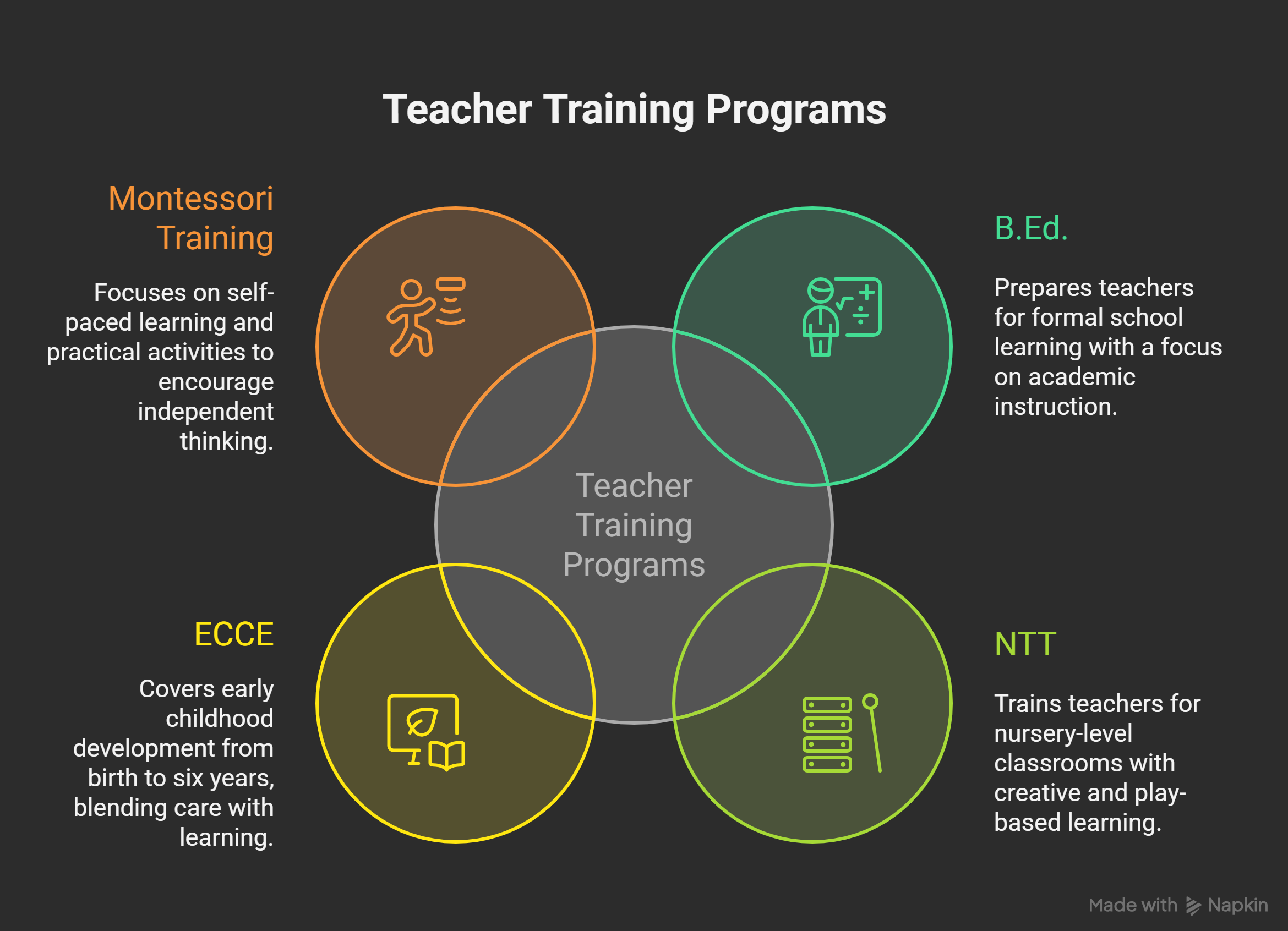
B.Ed. prepares teachers for formal school learning. It focuses on teaching classes above preschool level. The course trains teachers in academic instruction. Its content suits structured classroom environments.
Key Highlights
-
Duration usually two years
-
Designed for primary and higher classes
-
Focus on subject-based teaching methods
-
Includes classroom management training
2. NTT – Nursery Teacher Training
NTT trains teachers for nursery-level classrooms. It focuses on early learning through creative activities. The program builds simple teaching and handling skills. It prepares teachers for initial preschool levels.
Key Highlights
-
One-year specialized training program
-
Focus on early nursery teaching methods
-
Covers creative storytelling and play tasks
-
Supports early behavior understanding
3. ECCE – Early Childhood Care and Education
ECCE trains teachers for broader early childhood ranges. It covers development from birth to six years. The program blends care with learning principles. It focuses on emotional, social, and cognitive growth.
Key Highlights
-
One to two-year diploma program
-
Wide coverage of child development areas
-
Includes planning early learning environments
-
Suitable for entire preschool age groups
4. Montessori Training
Montessori training teaches the Montessori teaching system. It focuses on self-paced child learning. The program uses practical life activities strongly. It encourages independent thinking among children.
Key Highlights
-
Six to twelve-month certification
-
Based on Montessori philosophy principles
-
Uses hands-on learning materials
-
Promotes active child decision-making
Comparison Table
| Course | Full Form | Main Focus | Best For |
|---|---|---|---|
| B.Ed. | Bachelor of Education | Structured academic teaching | Primary and higher classes |
| NTT | Nursery Teacher Training | Nursery-level learning basics | Early preschool classrooms |
| ECCE | Early Childhood Care and Education | Full early childhood development | All preschool age groups |
| Montessori | Montessori Teacher Training | Self-directed activity learning | Montessori-based schools |
Key Differences Summary
-
Each course targets different teaching levels.
-
B.Ed. suits academic instruction roles.
-
NTT supports entry-level preschool teaching.
-
ECCE offers broad early childhood training.
-
Montessori builds independent learning environments.
Which Course Is Best for Becoming a Pre-Primary Teacher?
Choosing the best course depends on teaching goals. Pre-primary teachers need skills for early learning stages. They also need understanding of child behavior patterns. So, the course must support gentle teaching methods. Different programs offer different strengths and benefits. The right course should match preschool learning needs well. Clarity helps teachers plan strong early teaching careers.
Most preschools prefer training focused on early development. These programs teach child-centered activities and approaches. They also build confidence in handling young learners. Some courses offer broader childhood coverage. Others offer focused training for specific teaching styles.
Top Recommended Courses for Pre-Primary Careers
Pre-primary roles need specific early childhood training. These courses suit preschool environments effectively.
1. ECCE Diploma
-
Best coverage of early childhood stages
-
Trains teachers for all preschool age groups
-
Builds strong developmental understanding
2. NTT Certification
-
Ideal for nursery-level teaching needs
-
Builds simple classroom handling skills
-
Supports creative activity planning
3. Montessori Training
-
Suitable for Montessori-based classrooms
-
Focuses on self-paced child learning
-
Uses strong hands-on activity methods
4. Pre-Primary Teacher Training Diploma
-
Covers general preschool teaching requirements
-
Useful for private preschool positions
-
Trains teachers in play-based learning
Factors to Consider Before Choosing
Career Goals
-
Choose ECCE for broad preschool opportunities.
-
Choose NTT for early nursery classes.
Teaching Style Preference
-
Choose Montessori for structured independence.
-
Choose general diplomas for flexible styles.
School Type
-
Chain schools prefer ECCE programs.
-
Montessori schools prefer Montessori training.
Course Suitability Table
| Course | Coverage Level | Best For | Key Strength |
|---|---|---|---|
| ECCE | Wide coverage | All preschool levels | Strong child development focus |
| NTT | Entry-level | Nursery classes | Basic classroom skills |
| Montessori | Specialized | Montessori schools | Hands-on learning |
| PPTT Diploma | General | Private preschools | Flexible training |
Which One Stands Out?
ECCE suits most pre-primary teaching careers. It covers emotional, social, and cognitive growth. It matches preschool teaching needs strongly.
In Short
Choose a course based on career direction. ECCE often offers the widest preschool opportunities. Right training builds confident classroom foundations.
Why B.Ed. Is Not Usually Required for Pre-Primary Teaching
Pre-primary teaching follows very different learning needs. Young children learn through simple play activities. They explore concepts through daily experiences naturally. Preschool classrooms rely on gentle teaching styles. These needs require early childhood–focused training programs. So, B.Ed. often becomes less suitable here. Preschools therefore choose specialized training courses.
B.Ed. focuses on subject teaching for older students. Preschools need activity-based methods instead. This difference reduces the need for B.Ed. Early learning demands emotional and social guidance. These areas need separate early childhood understanding. So, schools give priority to preschool certifications.
Key Reasons Behind This Preference
1. Preschool Curriculum Nature
-
Preschool topics remain simple and foundational.
-
Children learn through play and interaction.
-
Academic teaching is not the main focus.
2. Age-Specific Needs
-
Young children need constant emotional reassurance.
-
They require patient and calm guidance.
-
Their learning depends on trust-building efforts.
3. Different Skill Expectations
Preschools expect child-friendly teaching styles. They prefer gentle communication approaches.
Important Skills Include:
-
Soft voice modulation
-
Creative activity planning
-
Observation of child behavior
-
Smooth transition handling
4. Classroom Environment Differences
-
Preschool spaces remain activity-centered.
-
Children move often during class activities.
-
Teachers guide learning through hands-on tasks.
-
B.Ed. focuses on structured seating patterns.
5. Practical Training Importance
Preschools value real classroom exposure. Early childhood courses include practical training hours. These hours improve real teaching confidence. Such training suits preschool challenges better.
Additional Reasons
-
Preschool learning changes by child pace.
-
Teachers adjust lessons quickly and gently.
-
B.Ed. follows fixed structures and methods.
-
Preschool jobs value calm, nurturing personalities.
-
Early childhood courses build these qualities better.
In Short
Preschools prioritize early childhood training programs. B.Ed. does not match preschool learning needs. Practical, child-centered skills matter far more here.
Conclusion
B.Ed. for pre-primary is generally not required. Preschools prioritize training focused on early childhood development. Courses like ECCE, NTT, and Montessori are highly preferred. They teach play-based, child-centered learning methods effectively. Trained teachers guide children’s emotional and social growth. Practical experience builds confidence and classroom management skills. Specialized courses ensure young learners get a strong foundation. Choosing the right training prepares teachers for real challenges.
Selecting the proper course boosts preschool career opportunities. ECCE provides broad coverage for all early childhood stages. Montessori focuses on hands-on, independent learning activities. NTT prepares teachers specifically for nursery classrooms. Graduation adds value but isn’t mandatory for pre-primary jobs. Early childhood certification enhances teaching quality and child outcomes. Smart course selection helps build a long-term teaching career.
Get Certified & Start Your Montessori Career
Montessori Teacher Training Course by Entri App: Gain expert skills, earn certification, and kickstart your teaching career.
Join Now!Frequently Asked Questions
Is B.Ed. compulsory for pre-primary teachers in India?
No, B.Ed. is not compulsory for pre-primary teaching because preschools prefer training that focuses on early childhood learning methods rather than higher-level academic teaching strategies meant for older students, so certifications like NTT, ECCE, or Montessori are usually considered more relevant.
Which qualification is best for becoming a pre-primary teacher?
The most recommended qualification is ECCE because it covers child psychology, teaching methods, activity design, communication skills, and classroom management specifically for early childhood learners, making it a strong and well-rounded foundation for preschool teaching.
Can I become a pre-primary teacher after 12th?
Yes, many preschools accept candidates who have completed 12th along with a short-term certification like NTT, Montessori training, or an ECCE program, though some schools may prefer or require graduation for permanent or higher-paying positions.
What is NTT, and how does it help?
NTT (Nursery Teacher Training) is a foundational course that trains you in child handling, instructional strategies, rhymes, storytelling, and learning activities, and it is widely accepted by private preschools for nursery-level teaching roles.
What is ECCE, and why is it popular?
ECCE (Early Childhood Care and Education) is a comprehensive program that covers teaching skills, developmental psychology, creative activities, and early learning techniques, and it is popular because it provides a complete understanding of how young children learn and grow.
What is Montessori training, and who should choose it?
Montessori training teaches the Montessori philosophy of hands-on, self-paced, discovery-based learning using structured materials, and it is best for those who want to teach in Montessori schools or adopt activity-driven teaching methods.
Do government pre-primary schools require specific qualifications?
Government-run early childhood centers like Anganwadis have their own recruitment criteria, which usually include minimum school-level education and government-approved early childhood certificates rather than a B.Ed. degree.
Does having a B.Ed. give an advantage in preschool teaching?
A B.Ed. may offer an advantage for administrative roles or transitions to primary-level teaching, but it is not the most relevant qualification for pre-primary teaching because it focuses on older learners and structured academics.
How long are early childhood teaching courses?
Most courses like NTT, ECCE, or Montessori training range from six months to one year, while some institutes offer advanced two-year diplomas for deeper skill development and extended practical training.
What skills do preschools look for in pre-primary teachers?
Preschools look for patience, creativity, communication skills, child handling confidence, lesson planning, activity design abilities, and an understanding of early childhood development, all of which are built effectively through early childhood training programs.