
Table of Contents
Introduction
Effective teaching begins with thoughtful planning, and Montessori Lesson Plans for Teaching Practice play a vital role in creating meaningful classroom experiences. In the Montessori method, lesson planning is not just about listing activities—it is about preparing purposeful presentations that support a child’s natural development. Each lesson is carefully designed to encourage independence, hands-on exploration, and step-by-step learning.
For trainee teachers and educators, Montessori lesson plans serve as a practical guide to understanding how to present materials clearly and confidently. They help structure the learning environment, organize materials, and define clear objectives while still allowing flexibility to meet individual student needs. Through proper planning, teachers can create a calm and engaging classroom where children are free to explore and learn at their own pace.
Montessori teaching practice focuses on observation, patience, and respect for the child’s readiness. A well-prepared lesson plan supports these principles by ensuring that each activity has a clear purpose and developmental goal. Whether used in teacher training programs or real classroom settings, Montessori lesson plans provide the foundation for effective, child-centered education.
What Are Montessori Lesson Plans for Teaching Practice?
Montessori lesson plans for teaching practice are carefully structured guides that help educators present lessons according to Montessori principles. These lesson plans are designed to support hands-on learning, independence, and step-by-step skill development. Unlike traditional lesson plans that often focus on teacher-led instruction, Montessori lesson plans emphasize demonstration, child participation, and observation.
They serve as a roadmap for trainee teachers and practicing educators to ensure that lessons are purposeful, organized, and aligned with the developmental needs of children.
1. A Guide for Structured and Purposeful Teaching
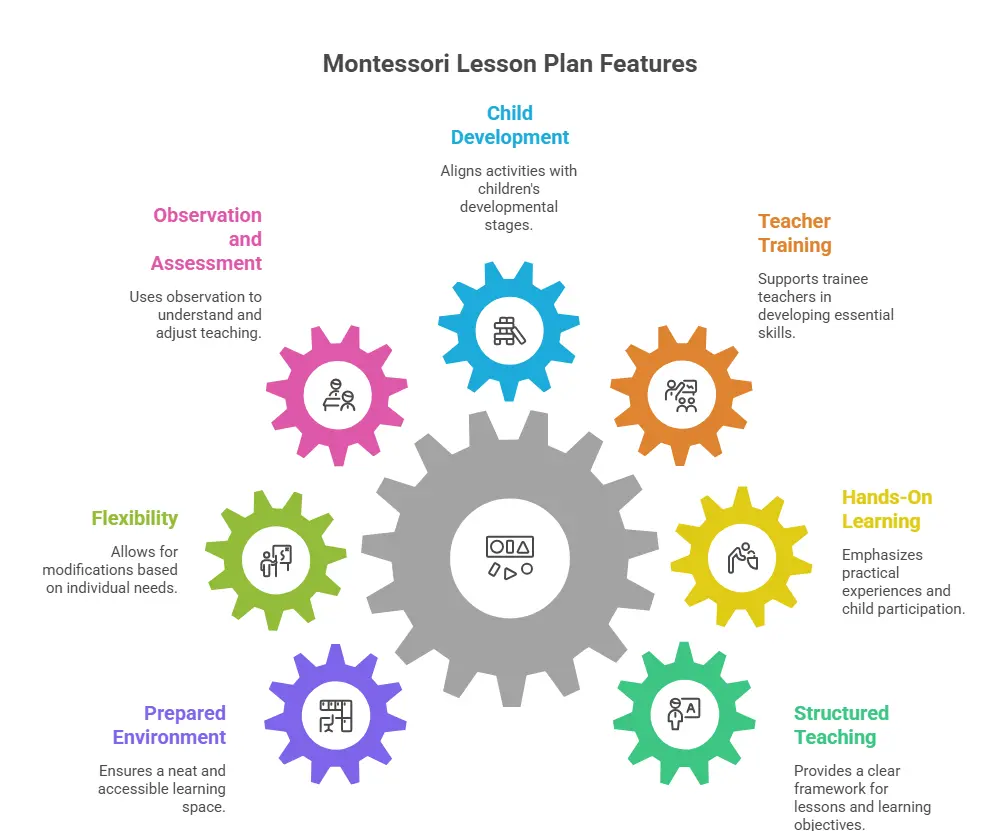
Montessori lesson plans provide a clear structure for presenting materials and activities. Each lesson includes specific objectives that define what the child is expected to learn or practice. This structure helps teachers stay focused and organized while ensuring that learning goals are achieved.
A typical Montessori lesson plan outlines:
-
The name of the lesson
-
The age group
-
Learning objectives
-
Required materials
-
Step-by-step presentation
-
Follow-up or extension activities
This organized format helps teachers deliver lessons confidently and consistently.
2. Focus on Hands-On Learning
One of the key features of Montessori lesson plans is the emphasis on hands-on experiences. Instead of explaining concepts verbally for long periods, the teacher demonstrates how to use specific materials. The child then practices independently.
For example, in a Practical Life lesson, the teacher may slowly demonstrate how to pour water from one jug to another. The child observes carefully and then repeats the activity. The lesson plan ensures that the demonstration is clear, calm, and precise.
This approach helps children learn through doing rather than just listening.
3. Designed for Teaching Practice and Training
Montessori lesson plans are especially important for trainee teachers. During teaching practice, student teachers are required to prepare and present lessons while being observed by mentors or supervisors.
These lesson plans help trainee teachers:
-
Understand the correct presentation technique
-
Learn how to handle materials properly
-
Practice classroom management
-
Build teaching confidence
By following a well-prepared lesson plan, trainee teachers can deliver structured and effective lessons.
4. Based on Child Development Principles
Montessori lesson plans are created according to the developmental stages of children. Activities are carefully chosen to match the child’s age, interests, and readiness.
For example:
-
Practical Life activities build coordination and independence.
-
Sensorial lessons refine the senses.
-
Language activities develop reading and writing skills.
-
Mathematics materials introduce abstract concepts through concrete tools.
Each lesson is purposeful and supports holistic growth—physical, cognitive, emotional, and social.
5. Encourages Observation and Assessment
In Montessori teaching practice, observation plays a major role. Lesson plans often include a section for observation notes where teachers record how the child interacts with the material.
Instead of formal tests, teachers assess learning by watching:
-
The child’s concentration level
-
Accuracy in completing the task
-
Independence in handling materials
-
Interest and repetition
This observational approach allows teachers to adjust future lessons based on individual progress.
6. Flexible Yet Organized
Although Montessori lesson plans are structured, they remain flexible. Teachers can modify lessons depending on the child’s needs. If a child requires more repetition, the lesson can be revisited. If the child shows readiness for advanced work, extension activities can be introduced.
This balance between structure and flexibility makes Montessori lesson planning highly effective.
7. Supports a Prepared Environment
Montessori lesson plans also guide teachers in preparing the learning environment. Materials must be arranged neatly, accessible to children, and ready for demonstration.
A well-prepared environment supports independence and concentration. The lesson plan ensures that everything needed for the activity is available and organized before the presentation begins.
Key Areas Covered in Montessori Teaching Practice Lesson Plans
Montessori teaching practice lesson plans are designed to cover all major areas of child development in a balanced and meaningful way. These lesson plans are carefully prepared to support the physical, cognitive, social, and emotional growth of children. Each area of learning has specific goals, materials, and presentation methods. When trainee teachers prepare lesson plans, they focus on these key areas to ensure a well-rounded Montessori education.
1. Practical Life
Practical Life is often the first area introduced in a Montessori classroom. It focuses on everyday activities that help children develop independence, coordination, and concentration.
Lesson plans in this area may include activities such as:
-
Pouring water
-
Spoon transfer
-
Buttoning and zipping
-
Sweeping and cleaning
-
Folding clothes
These activities may seem simple, but they build fine motor skills, hand-eye coordination, and self-confidence. Teaching practice lesson plans for Practical Life clearly outline the step-by-step demonstration process. Teachers are trained to present each movement slowly and carefully so children can observe and repeat independently.
Practical Life lessons also help children develop responsibility and care for their environment.
2. Sensorial Education
Sensorial lessons are designed to refine a child’s senses. At a young age, children learn about the world through seeing, touching, hearing, tasting, and smelling. Montessori sensorial materials help children classify and organize sensory information.
Lesson plans in this area may include materials like:
-
Pink Tower (size differentiation)
-
Brown Stair (thickness variation)
-
Color Tablets (color matching and grading)
-
Sound Boxes (auditory discrimination)
-
Smelling Bottles (olfactory sense)
During teaching practice, teachers learn how to demonstrate these materials precisely. The lesson plan includes the purpose of the activity, presentation steps, and observation points. Sensorial education prepares children for more advanced concepts in mathematics and language by strengthening observation and comparison skills.
3. Language Development
Language is a central part of Montessori lesson planning. Language activities help children build vocabulary, phonemic awareness, reading, and writing skills.
Teaching practice lesson plans may include:
-
Sound games
-
Sandpaper letters
-
Movable alphabet
-
Object-to-word matching
-
Storytelling activities
Language lessons are introduced gradually, beginning with listening and speaking skills, then moving toward reading and writing. Teachers are trained to use clear pronunciation and slow demonstrations. Lesson plans emphasize repetition and independent practice to strengthen literacy skills.
4. Mathematics
Montessori mathematics lessons move from concrete to abstract understanding. Children first work with physical materials before learning written numbers and symbols.
Common math lesson plan topics include:
-
Number rods
-
Sandpaper numbers
-
Spindle boxes
-
Golden beads (place value system)
-
Addition and subtraction boards
During teaching practice, teachers learn how to introduce math concepts step by step. The lesson plan ensures that children understand quantity before symbol recognition. This hands-on approach makes mathematical concepts easier to grasp and more meaningful.
5. Cultural Studies
Cultural subjects in Montessori education include geography, science, history, art, and music. These lessons broaden a child’s understanding of the world.
Examples of cultural lesson plan topics are:
-
Continents and globe activities
-
Land and water forms
-
Life cycles of plants and animals
-
Basic science experiments
-
Art and craft activities
Teaching practice lesson plans in this area encourage exploration and curiosity. Teachers guide discussions and provide materials that promote discovery-based learning.
6. Grace and Courtesy
Grace and Courtesy lessons are also an important part of Montessori teaching practice. These lessons help children develop social skills and respectful behavior.
Topics may include:
-
Greeting others politely
-
Saying “please” and “thank you”
-
Waiting for a turn
-
Resolving conflicts calmly
Lesson plans outline role-play scenarios and modeling techniques to help children practice positive social interactions.
Importance of Teaching Practice in Montessori Training
Teaching practice is one of the most essential parts of Montessori training. While theoretical knowledge helps future educators understand child development and Montessori philosophy, real growth happens when they step into the classroom and apply what they have learned. Teaching practice bridges the gap between theory and real-life classroom experience. It allows trainee teachers to develop confidence, refine their skills, and truly understand the Montessori method in action.
1. Connecting Theory to Real Classroom Experience
During Montessori training, students learn about child psychology, developmental stages, prepared environments, and teaching materials. However, understanding these concepts in theory is different from applying them with real children.
Teaching practice helps trainees:
-
Present materials correctly
-
Observe children’s behavior and readiness
-
Manage classroom routines
-
Adjust lessons based on individual needs
This practical exposure deepens their understanding and makes the training meaningful.
2. Building Confidence as an Educator
Standing in front of a classroom for the first time can feel overwhelming. Teaching practice provides a supportive environment where trainees can practice under supervision.
With repeated presentations and feedback, they gradually:
-
Gain confidence in demonstrating lessons
-
Improve communication skills
-
Learn how to guide rather than instruct
-
Develop a calm and patient teaching style
Confidence grows through experience, and teaching practice provides that essential experience.
3. Learning the Art of Observation
Observation is a core principle in Montessori education. Teachers must carefully watch children to understand their interests, challenges, and developmental readiness.
Teaching practice trains educators to:
-
Notice signs of concentration
-
Identify when a child is ready for a new lesson
-
Recognize difficulties and offer support
-
Assess progress without formal testing
Through observation, trainee teachers learn to make thoughtful decisions rather than rushing the learning process.
4. Mastering Montessori Materials
Montessori classrooms use specialized materials that require precise presentation. During teaching practice, trainees learn how to handle these materials properly and demonstrate them step by step.
For example, when presenting the Pink Tower or the Golden Beads, movements must be slow, clear, and intentional. Teaching practice allows trainees to refine their technique and avoid unnecessary errors.
Mastery of materials ensures that children receive accurate and meaningful lessons.
5. Developing Classroom Management Skills
Montessori classrooms are structured but child-centered. Managing such an environment requires patience, organization, and clear communication.
Teaching practice helps trainees learn how to:
-
Maintain a calm classroom atmosphere
-
Encourage independence
-
Handle conflicts respectfully
-
Guide children toward responsible behavior
These skills are essential for maintaining harmony and supporting focused learning.
6. Receiving Constructive Feedback
One of the greatest benefits of teaching practice is feedback from mentors or supervisors. Constructive feedback helps trainee teachers identify their strengths and areas for improvement.
They learn to:
-
Improve lesson presentation
-
Adjust tone and body language
-
Strengthen classroom interaction
-
Enhance clarity in demonstrations
Feedback promotes professional growth and continuous improvement.
7. Encouraging Reflective Teaching
Teaching practice encourages self-reflection. After presenting a lesson, trainees often reflect on questions such as:
-
Did the child understand the concept?
-
Was my presentation clear and calm?
-
How can I improve next time?
This reflective habit helps teachers become more thoughtful and effective educators.
8. Preparing for Professional Responsibility
Montessori teaching is not just a job—it is a responsibility. Teachers guide children during important developmental years. Teaching practice prepares trainees for this responsibility by helping them understand the impact of their words, actions, and teaching style.
It shapes them into patient, observant, and compassionate educators who respect each child’s individuality.
Tips for Creating Effective Montessori Lesson Plans for Practice
Creating effective Montessori lesson plans for teaching practice requires thoughtful preparation, clarity, and a deep understanding of Montessori principles. A good lesson plan is not just a written requirement—it is a guide that helps you deliver meaningful, organized, and child-centered learning experiences. Whether you are a trainee teacher or an educator refining your skills, the following tips will help you design strong and practical Montessori lesson plans.
1. Clearly Define the Objective
Start every lesson plan with a clear and specific objective. Ask yourself:
-
What skill should the child develop?
-
What concept will the child understand after this lesson?
For example, instead of writing “Teach numbers,” write “Help the child understand quantity from 1 to 5 using number rods.” Clear objectives keep the lesson focused and purposeful.
2. Understand the Developmental Level of the Child
Montessori lesson plans must match the child’s age and readiness. Before planning, consider:
-
The child’s fine motor skills
-
Attention span
-
Previous knowledge
-
Interest level
Lessons should neither be too easy nor too challenging. Observing children before planning helps you prepare activities that truly meet their needs.
3. Follow the Montessori Presentation Style
Montessori lessons require slow, precise, and intentional movements. When writing your lesson plan:
-
Break the presentation into small, clear steps
-
Avoid unnecessary movements or words
-
Highlight key teaching points
For example, in a pouring activity, describe exactly how you will hold the jug, where you will place it, and how you will clean spills. Detailed steps make your practice presentation smoother and more confident.
4. List Materials Clearly and Completely
Always mention all required materials in your lesson plan. This includes:
-
Main Montessori material
-
Tray or mat
-
Additional tools (spoon, cloth, cards, etc.)
Organizing materials in advance ensures that the lesson runs smoothly without interruptions. A prepared teacher creates a prepared environment.
5. Include a Control of Error
In Montessori education, many materials are self-correcting. When planning, think about how the child will know if they made a mistake without adult correction.
For example:
-
The Pink Tower will look uneven if blocks are placed incorrectly.
-
Spindle boxes will show empty slots if counting is wrong.
Including control of error in your lesson plan encourages independence and self-learning.
6. Plan for Observation and Assessment
Montessori assessment is based on observation rather than tests. Add a section in your lesson plan for observation notes. Consider:
-
Did the child stay focused?
-
Was the task completed independently?
-
Did the child repeat the activity?
This helps you reflect on the effectiveness of your lesson and plan future presentations accordingly.
7. Keep the Lesson Simple and Focused
Avoid overloading one lesson with too many objectives. Montessori lessons are usually short and focused on one concept at a time. Simplicity allows children to concentrate deeply and master skills gradually.
A well-focused lesson is more effective than a long and complicated one.
8. Include Extension Activities
Once the child masters the main lesson, extension activities help reinforce learning. For example:
-
After spoon transfer, introduce pouring.
-
After learning letter sounds, move to blending simple words.
Adding extensions to your lesson plan shows thoughtful progression and readiness for advanced learning.
9. Reflect and Revise After Practice
After presenting your lesson during teaching practice, take time to reflect:
-
What went well?
-
What could be improved?
-
Were your instructions clear?
Reflection helps you refine future lesson plans and grow professionally.
10. Stay True to Montessori Principles
Most importantly, ensure your lesson plan reflects Montessori values:
-
Respect for the child
-
Encouragement of independence
-
Hands-on learning
-
Calm and prepared environment
Avoid turning the lesson into a lecture. Remember, the goal is to guide, not dominate.
Unlock your passion for education and shape young minds as a Montessori teacher!
Conclusion
Montessori lesson plans for teaching practice provide a clear and meaningful framework for delivering high-quality, child-centered education. They help educators organize their lessons with purpose, ensuring that every activity supports the child’s developmental needs. By focusing on hands-on learning, independence, and careful observation, these lesson plans reflect the true spirit of Montessori philosophy.
For trainee teachers and experienced educators alike, well-prepared Montessori lesson plans build confidence and improve classroom effectiveness. They encourage thoughtful presentations, smooth transitions, and engaging activities that capture children’s interest. More importantly, they create a structured yet flexible environment where children can explore, discover, and grow at their own pace.
In the end, Montessori lesson planning is not just about writing objectives or listing materials. It is about preparing meaningful learning experiences that nurture curiosity, responsibility, and a lifelong love for learning. When implemented with care and understanding, Montessori lesson plans transform teaching practice into a rewarding journey for both educators and children.
Get Certified & Start Your Montessori Career
Montessori Teacher Training Course by Entri App: Gain expert skills, earn certification, and kickstart your teaching career.
Join Now!Frequently Asked Questions
What are Montessori lesson plans for teaching practice?
Montessori lesson plans for teaching practice are structured guides that help educators deliver lessons based on Montessori principles. These plans include clear objectives, required materials, step-by-step presentations, and follow-up activities. They are especially helpful for trainee teachers who want to understand how to present lessons in a calm, organized, and child-centered way.
Why are lesson plans important in Montessori teaching practice?
Lesson plans help teachers stay organized and focused. In Montessori classrooms, every activity has a purpose. A well-prepared lesson plan ensures that the teacher introduces materials correctly, follows a logical sequence, and meets the developmental needs of the child. It also builds teacher confidence and improves classroom management.
What should be included in a Montessori lesson plan?
A complete Montessori lesson plan typically includes:
-
Lesson title
-
Age group
-
Learning objectives
-
Materials required
-
Step-by-step presentation
-
Assessment or observation notes
-
Extension activities
Each section helps the teacher prepare thoroughly and deliver the lesson effectively.
How are Montessori lesson plans different from traditional lesson plans?
Montessori lesson plans focus more on hands-on learning, independence, and observation. Instead of teacher-led lectures, Montessori lessons involve demonstration and child-led practice. The teacher acts as a guide rather than the main speaker. The emphasis is on self-paced learning and repetition rather than completing tasks within a strict time limit.
How can trainee teachers benefit from Montessori lesson planning?
Trainee teachers gain practical experience by preparing and presenting Montessori lesson plans. It helps them understand how to demonstrate materials properly, manage the classroom environment, and observe children carefully. Teaching practice with structured lesson plans builds confidence and professional skills.
How do Montessori lesson plans support child development?
Montessori lesson plans are designed to support physical, cognitive, social, and emotional development. Activities encourage fine motor skills, concentration, independence, problem-solving, and language growth. Each lesson is purposeful and aligned with the child’s developmental stage.
How flexible are Montessori lesson plans?
Montessori lesson plans are structured but flexible. Teachers can adapt them based on the child’s readiness, interests, and progress. If a child needs more repetition, the lesson can be revisited. If a child shows readiness for advanced work, the teacher can introduce extension activities.
How is assessment done in Montessori teaching practice?
Assessment in Montessori education is mainly based on observation. Teachers observe how the child interacts with materials, follows instructions, and completes tasks independently. Notes are taken to track progress and determine when to introduce new lessons. There are usually no formal tests in early Montessori classrooms.
Can Montessori lesson plans be used in non-Montessori classrooms?
Yes, many Montessori lesson plan elements can be adapted to traditional classrooms. Teachers can incorporate hands-on materials, child-centered activities, and step-by-step demonstrations to make learning more engaging and meaningful.
How often should Montessori lesson plans be prepared?
Montessori lesson plans should be prepared regularly based on curriculum goals and classroom needs. Daily or weekly planning helps maintain structure and ensures that children are continuously progressing. Consistent planning also helps teachers stay organized and prepared.