
Table of Contents
One of the most difficult aspects of the PTE Academic test is usually the Multiple Choice Reading portion. Passages are overwhelmingly informational, language is often fluent, and many of the options to answer are intuitively good. And the ticking timer adds pressure, making it easy to rush or second guess your choices. Because this task can be single-answer, or multiple-answer, too many or too few options can reduce your score dramatically. But, if done right this section can be handled and possibly even improve your overall PTE score.
The secret to successful completion of this task is good reading. What you must not read slowly is the main idea, the author’s motivation. Read the text first to get an idea of how it worked, and then read the question carefully before checking out. Retread your choice to be sure you are making a good choice rather than remembering or making assumptions. This habit alone can be used to prevent many of the common mistakes.
Elimination is another powerful strategy. Not always does an answer “sound right.” Remove options that are too extreme, irrelevant, or not directly supported by the passage. Remember, during the multiple-answer questions, there must be text behind each choice. If you’re uncertain, it’s usually safer to choose less options than to guess blindly.
Time management is also an important factor. Set a rough limit for each question and move on if you feel stuck. Too much time spent on one item can degrade your performance in the rest of the section. Lastly, avoid common mistakes such as overthinking, meaningless searching for keywords, or choosing questions based on inside knowledge. With regular practice and a calm, structured approach, the Multiple Choice Reading section can shift from a weakness to one of your strongest scoring areas.
Join Entri PTE Coaching Course
What Is the Multiple Choice Reading Task in PTE?
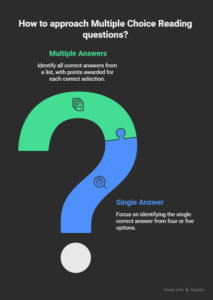
The Reading portion of the PTE Academic takes 29-30 minutes and incorporates several types of questions to check on your level of understanding of written English. Those Multiple Choice questions are divided into two groups: Multiple Choice, Single Answer and Multiple Choice, Multiple Answers. In the Single Answer version, a hundred and thirty words (usually less) are on the screen next to a question and four or five possible answers; one of these is correct. The Multiple Answers version does this with the same passage and question, but there is more than one right answer that could be right; sometimes two or three, and you must choose all the right answers to receive full credit.
These questions take you into multiple aspects of understanding, such as finding the text’s object of interest, facts or examples, what the writer suggests rather than saying anything personally, the reason the writer wrote the piece, or the meaning a word might convey based on the phrase itself. The texts are printed from daily academic content such as magazine articles, reports, book excerpts, or research summaries, and cover anything from environmental issues and scientific discoveries to historical events, economic trends, and everyday social issues. Normally, passages on the test screen are left or right; question and options are below and to the right; once you click next there is no return; decisions must stay.
There is slightly different scoring in these two types. Single Answer questions are usually encountered once or twice throughout a test and each point awarded for the right answer no deduction for the wrong answer. Multiple Answers questions, at one or two per test in most recent formats, give points for correct selection but subtract points for incorrect selections you mark, which means you receive partial credit if you get some but not all right, but guessing wildly can actually decrease your total. Reading will form part of the big communicative score for Reading itself, as well as help vocabulary, grammar, and written discourse.
Pearson put this task to the test because it echoes how people actually read in college classes, research projects, or work: they are quick to take things apart from background noise and decide what matters. Updates since 2025 kept the structure of Multiple Choice questions unchanged with a few tweaks to question numbers, timing, and scoring clarity in the general Reading section so the main approaches that worked before are still working. These changes are also found in official Pearson practice materials, and the use of these may help you to avoid surprises.
Effective Tips to Answer Multiple Choice Reading Questions
Doing well on PTE Multiple Choice Reading starts with treating every question like a focused search rather than a random guess. Begin by reading the question itself before diving into the passage because that one step gives a clear target—what exactly you need to find, whether it is the main point, a specific detail, an implied idea, or the writer’s overall purpose. With that in mind, skim the whole text quickly, taking maybe 15 to 25 seconds, just to get the general topic, how the ideas connect, and the tone the writer uses. This fast first pass stops you from misreading later and helps everything fall into place more naturally.
Once you have that overview, go back and scan actively for words, phrases, or numbers that match elements in the question. Dates, names, repeated terms, or cause-effect signals like “because,” “therefore,” or “however” often guide you straight to the sentence or paragraph that holds the answer. When the options look very close to each other, work through them one at a time using elimination: check each against the exact words in the passage and rule out anything that adds extra information not present, twists the facts slightly, goes too far in one direction, or depends on knowledge from outside the text. Getting down to two strong choices usually makes the final pick obvious because the correct one matches the meaning and wording most closely without stretching.
In Single Answer questions, always lean toward the option that covers the question completely instead of one that only touches part of it, since half-right answers are common traps designed to look good at first. For Multiple Answers questions, stay conservative—only mark the ones you are completely sure match the text because wrong selections take points away. If you feel confident about two options but unsure about a third, it is usually safer to leave the uncertain one unmarked rather than risk a deduction. Paraphrasing happens everywhere in PTE, so get used to spotting the same idea expressed with different words; a passage might talk about a “major influence” while an option uses “strong effect,” and recognizing that link quickly saves time.
When a word feels unfamiliar, do not panic—look at the sentences right before and after it for clues like examples, opposites, or explanations that reveal what it means in that spot. Watch closely for small but powerful words such as “some,” “most,” “always,” “never,” or negatives like “not” and “except,” because they narrow or flip the meaning entirely, and missing them leads straight to mistakes. Build the skill through regular practice with official samples or good mock tests that copy the real screen setup, then go back over every wrong answer to figure out exactly where the thinking went off track. Spend extra time on inference questions that force you to link ideas rather than quote directly, and mix in passages on topics you do not normally read so nothing feels completely strange on test day. With steady effort the whole process speeds up while staying accurate, and those once-difficult questions start feeling straightforward.
Ace Your PTE Exam with Confidence!
Unlock your potential with our expert-led PTE preparation course. Achieve your dream score and open doors to global opportunities!
Start Your PTE Preparation Today!Time Management Strategies for PTE Reading MCQs
In the Reading section, you have only 29 to 30 minutes to complete the entire assignment, so time management is just as important as answering the questions. Even the strongest readers are prone to fail when they spend too long on one thing. One strategy that works is to aim for between 1.5 and 2 minutes of pacing per Multiple Choice question. This provides some extra time for longer sections or more complex text while making sure you do not lose focus on the remaining questions in the module.
Many test takers of experience will attempt faster, higher scoring activities if they can. If Fill in the Blanks or Re-order Paragraph questions come up first, it is smart to answer them first. These are often less expensive and help build confidence. Once that is done, continue with Multiple Choice questions, keeping your eyes focused. Saving the more demanding parts for later can be helpful as by then you will be in a reading groove.
A timer should be on during practice sessions. This will help you train your inner clock so that you can know when around 90 seconds have been wasted on one question. Reread all passages from the start. Instead, speed through and grasp the idea briefly, and then straight to the questions. This is not waste of time and keeps reading interesting.
When sifting through the results, pay attention to the wording that links ideas together. “For example” explains the explanation, “in contrast,” the contrast, and “as a result” the outcomes. These clues direct your eyes to the relevant portions of text faster. If a question takes more than 90 seconds to respond, select the strongest answer that you have found and move on. Since you cannot return to previous questions, spending too long on one item can damage your overall score more than making a calculated guess.
Spread your effort across the whole section roughly evenly, remembering that tasks like Fill in the Blanks often carry more weight in scoring, so protect time for them while treating Multiple Choice as steady point opportunities that should not steal too much. In Multiple Answers questions, make decisions briskly after your elimination round rather than debating each option forever. Check the on-screen clock every couple of questions to stay aware of how much time remains and speed up slightly if you are falling behind.
The best way to get comfortable with this rhythm is running full Reading section mocks under timed conditions, ideally with the same distractions or screen setup you expect on test day. Regular timed practice cuts down on hesitation, sharpens focus across the full block, and keeps panic away even when the minutes feel tight. If tiredness creeps in during longer study sessions, step away for a quick break so your attention stays even from start to finish.
Common Mistakes to Avoid in PTE Reading Multiple Choice
Candidates lose easy points in this section by letting outside knowledge creep in and choosing answers that sound reasonable in real life but do not actually appear in the passage. Another frequent problem comes from skimming too fast or skipping straight to options without really grasping what the text says overall, which leaves people picking based on single words instead of the full context. Many also grab the first option that contains a matching keyword without double-checking the surrounding sentences, missing small twists, exaggerations, or missing pieces that make it wrong.
In Multiple Answers questions especially, over-selecting because something “might” be true leads to negative marking that drags the score down, so it pays to be strict and only choose what is clearly supported. Overlooking tiny qualifiers—“some” instead of “all,” “rarely” instead of “never”—or negatives that change everything is another trap that catches rushed readers. Relying on a memorized dictionary definition instead of the way the word behaves in that exact sentence causes misreads when meanings shift slightly with context.
Pouring too much time into one hard question throws off the balance for everything else, leaving later items feeling frantic and incomplete. Sticking only to comfortable topics during practice leaves gaps when unexpected subjects show up, and failing to review incorrect answers means the same thinking errors keep repeating. Breaking these habits through careful, text-only decisions, balanced pacing, and honest self-review keeps scores steady and builds real confidence.
Join Entri PTE Coaching Course
Conclusion
The Multiple Choice Reading task in PTE checks genuine understanding in a way that matters long after the test ends, but it becomes much easier to handle when you combine a solid grasp of the format with practical techniques, careful time use, and awareness of the little mistakes that trip most people up. Regular work with up-to-date official materials, timed full-section practice, and honest reviews of weak spots lead to clear progress in mock results and a growing sense that you really control this part. Put in the steady effort now—apply these ideas in every session, track what improves, and head into the test knowing the preparation has created a strong, reliable approach. Good scores come from that kind of focused work, so keep going and get closer every day to the result that opens the doors you want.
Ace Your PTE Exam with Confidence!
Unlock your potential with our expert-led PTE preparation course. Achieve your dream score and open doors to global opportunities!
Start Your PTE Preparation Today!Frequently Asked Questions
What is the fundamental difference in scoring between ‘Single Answer’ and ‘Multiple Answer’ Multiple Choice questions in the PTE Reading section, and how should my strategy change accordingly?
The scoring difference is critical and dictates a major strategic shift. For Multiple Choice, Single Answer questions, you receive 1 point for a correct answer and 0 points for an incorrect one. There is no penalty for a wrong choice, so you should always make a selection, even if it’s an educated guess after elimination. For Multiple Choice, Multiple Answer questions, the scoring is partial and deductive. You earn +1 for each correct option you select, but you lose -1 for each incorrect option you select. Your score for that question cannot go below zero. This means blind guessing is dangerous. The strategic change is profound: for multiple-answer questions, you must be conservative. Only select options you can directly and unequivocally support with evidence from the text. If you are unsure about a third option but confident about two, it is often safer to select only the two you are sure of to avoid point deductions that can negate your correct choices.
I often run out of time in the Reading section. How can I effectively allocate my 29-30 minutes to ensure I don’t sacrifice easier points on other task types because I spent too long on MCQs?
Time management requires a holistic section strategy, not just a per-question tactic. First, understand that the PTE Reading section is not linear; you can answer questions in any order. A highly effective strategy is to quickly scan and tackle the “Fill in the Blanks” (Drag & Drop and R&W) and “Re-order Paragraphs” questions first. These often have a higher scoring weight and can be completed more quickly once you identify the clues, building your confidence and point base. Then, move to the Multiple Choice questions. For MCQs specifically, impose a strict time limit of 1.5 to 2 minutes maximum per question. Use the on-screen clock. If you’ve spent 2 minutes and are still debating between options, use the elimination strategy to make your best educated guess (being conservative for multi-answer), flag it mentally, and move on. Practicing with full, timed mock tests is non-negotiable to internalize this pace.
The passages often use complex, academic language. What is the most efficient way to approach reading the text when I encounter unfamiliar vocabulary or dense concepts?
Do not start by slowly reading every word, especially if you’re stuck on a difficult term. Employ a two-tiered reading approach. First, skim the passage for 15-25 seconds to grasp the main idea, tone, and overall structure. Ask yourself: What is the general topic? What is the author’s broad purpose (to inform, argue, compare)? This big-picture understanding provides context that can make unfamiliar words decipherable. Second, when you read the question and return to the passage to scan for answers, use contextual clues for tough vocabulary. Look at the sentences immediately before and after the unknown word. Authors often provide definitions, examples, synonyms, or contrasting ideas. For instance, if a sentence says, “The phenomenon, a rare occurrence, was documented…” you can infer “phenomenon” means “occurrence.” Relying on context is a key academic skill the test is assessing.
For ‘Multiple Answer’ questions, how do I definitively know if an option is "directly supported by the text" and not just a plausible inference?
This is the core challenge. An option is directly supported if you can point to a specific phrase, sentence, or logical combination of sentences in the passage that paraphrases the option’s meaning without adding external assumptions. To test this, mentally try to “match” the option back to the text. Does the text say exactly this, just with different words? Common traps are options that: 1) Extend a correct idea too far (e.g., text says “some scientists believe,” option says “scientists have proven”), 2) Use correct keywords but in the wrong context, or 3) State something true in the real world but not mentioned in the passage. If you find yourself having to make a chain of assumptions or use personal knowledge to justify the link, it is likely not directly supported. When in doubt, leave it out.
The answer choices often seem very similar, with subtle differences. What is a systematic process for eliminating incorrect options?
Use a process of elimination checklist. For each option, ask these questions in order:
-
Is it Extreme? Does it use absolute language like always, never, all, none, completely? Academic texts are usually nuanced, making extreme options often incorrect.
-
Is it Irrelevant? Does it discuss a topic not addressed in the passage at all?
-
Is it a Distortion? Does it take a fact from the text but twist its meaning, relationship, or cause-effect? Check for reversed logic.
-
Is it Too Narrow/Broad? For main idea/purpose questions, does the option cover only one paragraph (too narrow) or go beyond the scope of the text (too broad)?
-
Is it Unsupported? Can I NOT find a specific line or combination of lines that proves this?
Systematically discarding options that fail these tests will usually leave you with the correct one.
What are "inference" questions, and how should I approach them differently from "detail" questions?
Detail questions ask for information explicitly stated in the passage (e.g., “According to the passage, what year did the event occur?”). The answer is directly quotable. Inference questions ask you to identify something the author implies, suggests, or intends but does not state outright (e.g., “What can be inferred about the author’s view on technology?”). For inference questions, you must connect the dots between stated facts, the author’s tone, and the logical conclusions they lead to. The correct answer will be a logical necessity based on the text, not just a possibility. It will feel like the “next logical step” the author wants you to take. Avoid options that are wild guesses or that represent the most obvious opposite of a stated fact.
How important is it to practice with "official" PTE materials, and have the question formats changed significantly in recent updates (e.g., post-2025)?
Practicing with official Pearson materials (PTE Practice Tests, the Scored Practice Tests, and the Official Guide) is crucial. They provide the most accurate representation of the question style, passage difficulty, interface, and timing. While the core structure of the Multiple Choice task remains unchanged post-2025, official materials reflect precise tweaks in the number of questions per test, timing distribution within the integrated section, and scoring algorithm clarity. Using unofficial materials can lead to practicing with poorly written questions or inaccurate scoring simulations, which builds bad habits. The updates have streamlined the test experience, but the core skills tested—critical reading, elimination, and time management—remain constant. Official practice ensures no surprises on test day.
I tend to overthink and second-guess my answers, especially when two options seem close. How can I build confidence in my final choice?
This is common. Build a verification habit. After you select your answer (and before you click ‘Next’), perform this quick check: Reread the question, then mentally articulate why your chosen answer is correct and why the next best alternative is wrong, based solely on the text. If you can concretely point to textual evidence for your choice and identify the specific flaw in the other (e.g., “Option B mentions ‘government funding,’ but the passage only discusses private investment”), your choice is justified. If you find your reasoning relies on “it feels right” or memory, you may need to re-scan. This 10-second verification routine stops second-guessing and turns it into a evidence-based decision.
Beyond just practicing questions, what are some active reading exercises I can do to improve my overall comprehension and speed for this task?
Incorporate active reading into your daily routine with academic texts (The Economist, Nature, BBC News Science section). Don’t just read passively. As you read, practice:
-
Summarizing Paragraphs: After each paragraph, mentally state its main idea in one sentence.
-
Identifying the Author’s Purpose: Ask yourself, “Is the author informing, persuading, comparing, or criticizing?”
-
Highlighting Connectors: Notice words like however, therefore, for instance, in contrast. These signal relationships and are often key to answering questions.
-
Predicting: After reading a few lines, predict what the next section might discuss. This engages you with the structure.
This type of practice builds the mental muscles for the skimming, scanning, and synthesis the PTE demands.
How does performance on the Multiple Choice Reading tasks influence my overall PTE score, beyond just the Reading communicative skills score?
Your performance on Reading MCQs contributes directly to your Reading communicative skills score. However, due to PTE’s integrated scoring algorithm, skills are interconnected. Strong reading comprehension underpins performance in other sections. For instance, understanding complex passages here builds the vocabulary and grammatical awareness needed for Writing (Summarize Written Text, Essay) and Listening (Summarize Spoken Text, Fill in the Blanks). While the direct cross-contribution might be less than in integrated tasks, the cognitive skills you hone—paraphrasing, identifying key ideas, and critical analysis—are fundamental to high performance across the entire test. Therefore, mastering this task has a compounding positive effect on your overall language proficiency as measured by the PTE Academic.