Table of Contents
The New Labor Code is an all-encompassing reform that brings together a number of different labor laws into four primary codes: the Wages Code, the Industrial Relations Code, the Social Security Code, and the Occupational Safety and Working Conditions Code. To modernize workplace legislation, to promote employee rights, and to simplify compliance for companies across all industries is the objective of this initiative.
The implementation of this policy is set for January 1, 2026, which will signal a substantial change in the manner in which businesses manage their employees and safeguard their workers.
Some of the most significant alterations brought about by the code include.
- Working hours that are flexible, allowing for up to twelve hours per day, with the agreement of both parties.
- Unified leave policies, which would replace the fragmented leave standards that were prevalent in the prior laws.
- Employers of contract, temporary, and gig workers should be subject to clear legislation that guarantees equitable treatment.
- Utilization of labor tribunals and online grievance procedures for the purpose of centralizing conflict settlement.
- Labor law infractions should be subject to standardized punishments.
- an increase in the benefits provided by social security, which include pensions, health insurance, and paid time off for mothers.
Overall, the New Labor Code seeks to build workplaces that are more equitable, more transparent, and more up-to-date, striking a balance between the protection of workers and the growth and efficiency of businesses. For the implementation of these reforms to go off without a hitch, both companies and employees need to get themselves ready to adjust.
Is being an HR your dream? Enrol now for our course on Human Resource!
Background: Why Was the New Labor Code Introduced?
The issues that were presented by India’s prior labor laws, which were fragmented, confusing, and frequently out of date, were addressed with the introduction of the New Labor Code. Especially for small and medium-sized businesses, it was difficult for employers to comply with the 29 different labor regulations that regulated pay, working conditions, social security, and industrial relations.
The goals of the government were to:
- The laws should be simplified and consolidated into four separate comprehensive codes in order to make them easier to comprehend and adhere to.
- Modernize legislation governing the workplace such that they allow flexible work hours, gig employment, and procedures for working remotely.
- Increase the protections afforded to workers, such as health insurance, social security, fair pay, and maternity leave.
- The resolution of disputes should be streamlined in order to ensure a quicker and more transparent management of labor concerns.
- Foster an environment that is conducive to conducting business while preserving a reasonable equilibrium between the rights of employers and employees.
In order to establish workplaces that are transparent, fair, and flexible to the ever-changing economy of today, the New Labor Code intends to implement this uniform framework. This will be to the benefit of companies as well as their employees.
What Exactly Are the Four Labor Codes?
The New Labor Code streamlines India’s labor regulations by combining them into four separate but complementary statutes, each of which addresses a different facet of employment. These regulations make it easier for businesses to comply while also enhancing worker safety:
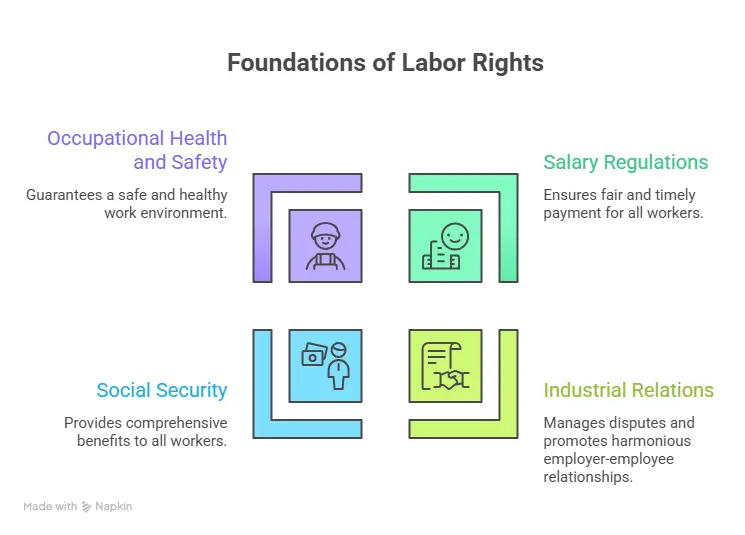 1. Salary Regulations
- It addresses issues such as minimum wage, prompt salary payment, equal pay for equal effort, and bonus payments.
- Makes ensuring that everyone gets the same, fair pay.
2. The Code of Industrial Relations
- Controls labor unions, collective bargaining, job losses, and mediation.
- Facilitates the management and resolution of disputes between employers and employees.
3. Social Security Laws
- Combines various benefits into one, such as health insurance, pensions, provident funds, gratuities, and maternity benefits.
- Guarantees that all workers, including those on contract or gig, have easier access to social security programs.
4. Occupational Health and Safety Regulations
- Among the topics covered are health and safety on the job, benefits, working hours, and paid time off.
- Determines what constitutes a safe and healthy workplace for all sectors of the economy.
When taken as a whole, these four codes supersede a number of antiquated statutes, making the law more accessible and easier to understand for businesses and their workers.
Become an HR Expert – Enroll in Our HR Management Course Today!
Unlock the secrets to effective Human Resource Management with our expert-led course! Learn recruitment, employee relations, performance management, and more to build a thriving workplace. Start your journey toward a successful HR career today!
Know MoreWhat Changes from the Previous Labor Laws?
In contrast to the patchwork of labor standards that were in place prior to the passage of the New Labor Code, the New Labor Code enacts significant improvements. Beneficial aspects of this arrangement include the modernization of working procedures, the simplification of compliance, and the protection of employee rights. More flexibility in scheduling, legislation that will streamline paid time off, laws that will be more open regarding independent contractors and gig workers, increased standard fines, and improved social security benefits are all things that are going to transpire in the near future. The aforementioned enhancements are among the most important ones.
In order to make things easier for you, I have included a comparison that enables you to view both sides side by side:
| Aspect | Previous Labor Laws | New Labor Code |
|---|---|---|
| Duration of Workday | 48 hours per week or a fixed 9–5 schedule | Working hours that are flexible up to twelve hours every day, with both parties’ consent |
| Leave Policies | Rules that are distinct for maternity leave, sick leave, and casual leave | A unified leave structure that encompasses all different kinds of leaves |
| Contract & Gig Workers | A restricted number of regulations and safeguards | Unambiguous regulations that guarantee equitable treatment and social security |
| Wages | Each state and industry had its own set of minimum wage laws. | A standardized compensation structure, prompt payment, and equal pay for equal effort are all important. |
| Resolution of Disputes | Multiple governing bodies and laborious procedures | Complaint processes that are accessible online and centralized labor courts |
| Perks for Staff Members | A fragmented set of benefits based on several pieces of legislation | A consolidated package of benefits, including social security, pensions, health insurance, and maternity benefits |
| Disciplinary Measures | Unpredictable penalties and fines for infractions | A standardized set of punishments for infractions of labor laws |
Click here to learn more about HR Management!
When Will It Be Implemented?
The new labor code will initially go into effect on January 1, 2026, marking the commencement of its implementation. The modified requirements of the four combined codes will soon be mandatory for both employees and employers to comply with. This will take place in the near future.
The principles of becoming ready beforehand
- In accordance with the recently established legislation, businesses are required to conduct a thorough review and update of their employment contracts, rules regarding human resources, and payroll systems.
- An explanation of worker rights, which include adjustments to working hours, standardized leave, and higher payments for social security, is required when it comes to the provision of this information.
- There is a possibility that managers and HR teams may need to undergo training in order to successfully implement the new compliance standards and dispute resolution procedures.
Employees and employers that are well-prepared have the ability to avoid any legal issues, ensure a smooth transition, and make the most of the benefits that the new labor framework has to offer.
Impact on Employees
Numerous improvements that have an effect on employees are brought about by the New Labor Code. These reforms are intended to improve worker protection while also giving workers with increased benefits and more freedom.
Increasingly transparent regulations regarding layoffs, retrenchment, and termination have made it safer for workers to be terminated without cause.
- Enhanced Compensation and Benefits: The provision of unified social security systems (including pension, health insurance, gratuity, and maternity benefits), consistent payment, and uniform wage regulations are the means by which financial stability is ensured.
- As a result of flexible or remote work arrangements, a better work-life balance is now available to employees.
- When sick leave, maternity leave, and casual leave are all rolled into a single policy, the benefits become more public and easier to obtain.
- The rights of full-time employees are extended to temporary, part-time, and gig workers as well. These rights include the ability to receive social security payments and the right to be treated fairly in the workplace.
- The use of online complaint channels and centralized labor courts opens the door to the possibility of a more expedited approach for the resolution of issues that arise in the workplace.
Become an HR Expert – Enroll in Our HR Management Course Today!
Unlock the secrets to effective Human Resource Management with our expert-led course! Learn recruitment, employee relations, performance management, and more to build a thriving workplace. Start your journey toward a successful HR career today!
Know MoreImpact on Employers
Companies are now required by the New Labor Code to do more than just comply; they are also required to foster an environment of openness and equality:
- The Simplified Legal Framework, which facilitates easier compliance and reduces confusion, is the product of the unification of several statutes into four codes.
- Organizations must revise their payroll processes, policies for employee leave, and hiring methods to be in line with the new regulations.
- With the standardization of fines for noncompliance with labor norms, it is imperative that enterprises pay close attention to rules.
- Fast collection and reporting of all pertinent information is required since labor disputes are more often settled through online systems and centralized labor courts.
- In order to satisfy both employees’ demands for more flexible work schedules and the rules governing remote work, employers must maintain productivity and comply with all applicable requirements.
- Employers are required to provide social security payments to all eligible workers, regardless of whether they are on contract or gig, which could result in more paperwork for employers.
Advantages and Concerns
Though it has introduced some welcome reforms, the New Labor Code will impose new duties on employers and employees alike. Things run more smoothly when you can perceive them from all angles.
Advantages
- The four rules that simplify compliance with legal and HR requirements have made it easier for businesses to meet these demands.
- More extensive protections, including greater minimum pay, a consistent leave policy, social security benefits, and job security, benefit staff personnel.
- Workers should start embracing remote work, flexible hours, and contract workers because they are the future of work.
- Online grievance systems and centralized labor courts facilitate the expedited resolution of conflicts through open and simplified processes.
- By establishing clear and universal norms, it streamlines procedures and makes it easier for businesses to expand.
Concerns
The difficulty of changing payroll systems, along with regulations and contracts, is one of the many initial hurdles that small firms may encounter when attempting to make changes.
- A mountain of paperwork already exists for employers due to the need to track every employee’s social security payments, paperwork, and compliance. This idea applies to all employees, not only gig and contract workers.
- Potential Conflicts Regarding Flexible Hours Disagreements may arise over issues like working from home or extra hours if there aren’t any well-defined policies.
- It may be required to start efforts to spread the word about these changes since employees may not be aware of their newly gained rights and advantages.
Final Thoughts
With the passage of the New Labor Code, a new era of labor that is open, egalitarian, and focused on creativity is beginning to emerge. Streamlining compliance, enhancing worker rights, and promoting flexibility for both businesses and employees are all benefits that result from the consolidation of 29 distinct laws into four universal regulations.
Although there is a possibility that businesses would have some difficulties in the short term as they adjust to the new structure, this reform represents a significant turning point in India’s labor climate. Long-term benefits that will more than justify the transition include increased efficiency, equitable pay, safer workplaces, and clearly defined legal frameworks. These are just some of the benefits that will be associated with the transformation.
The cooperation of legislators, corporations, and workers is ultimately what will determine whether or not the New Labor Code is successful. It is possible that, if carried out correctly, it may result in a workforce that is more dispersed and prepared for the future, which would be to the advantage of both enterprises and employees.
Click here to learn more about HR Management!
Become an HR Expert – Enroll in Our HR Management Course Today!
Unlock the secrets to effective Human Resource Management with our expert-led course! Learn recruitment, employee relations, performance management, and more to build a thriving workplace. Start your journey toward a successful HR career today!
Know MoreFrequently Asked Questions
What is the purpose of the New Labor Code?
The New Labor Code aims to simplify India’s complex labor laws, make compliance easier for employers, and ensure fair treatment, safety, and benefits for employees across all sectors.
How many laws have been merged under the New Labor Code?
A total of 29 central labor laws have been consolidated into four simplified codes — Wages, Industrial Relations, Social Security, and Occupational Safety.
How does the New Labor Code affect working hours?
Employees can now work up to 12 hours a day, provided the total weekly limit of 48 hours is maintained. This offers flexibility for both workers and employers.
Will employees receive more leave under the new code?
Yes. The code introduces a unified leave structure, ensuring minimum leave entitlements and better clarity across industries.
What changes will employers need to make?
Employers must update HR policies, employee contracts, payroll systems, and safety protocols to comply with the new laws. They should also train HR and legal teams for smooth adaptation.
Are there stricter penalties for non-compliance?
Yes. The New Labor Code introduces standardized penalties and fines for violations, ensuring accountability and reducing the scope for misuse.
Will employees’ take-home salary change?
Yes, in some cases. With higher contributions toward provident fund and social security, take-home pay may reduce slightly, but overall savings and benefits will increase.
How does the New Labor Code promote ease of doing business?
By unifying and digitizing labor compliance, the code reduces paperwork, minimizes inspections, and creates a uniform system for all states and industries.