Table of Contents
Flying a drone in the wrong place can land you in jail. In India, certain areas are completely off-limits for drone operations. These are called No Fly Drone Zones or Red Zones. If you fly a drone in a Red Zone without permission from the central government, you face up to ₹1 lakh in fines, confiscation of your drone, and criminal charges under the Aircraft Act.
Key Takeaways
- Red Zones are completely prohibited areas where drones cannot fly without central government approval.
Airports, military bases, nuclear facilities, and state secretariats are permanent Red Zones. - Recent additions include religious sites like the Puri Jagannath Temple and public venues like the Narendra Modi Stadium.
- India uses a three-zone system: Green (free to fly), Yellow (permission required), and Red (no fly).
- The DigitalSky platform provides a real-time airspace map to check zone status before every flight.
- Temporary Red Zones can be declared during VIP visits, public events, or security emergencies.
- Violating Red Zone restrictions leads to legal action, equipment seizure, and possible imprisonment.
Understanding India’s Drone Zone Classification System
1: Who was the first woman President of India?
India’s drone regulations divide airspace into three distinct categories based on security risk. The Directorate General of Civil Aviation (DGCA) manages this system through the DigitalSky platform . Every drone pilot must understand these zones before taking off.
The Green Zone covers most non-restricted areas. Here, drones can fly without prior permission up to certain altitudes. Green Zone airspace typically extends up to 400 feet above ground level in areas not marked as Yellow or Red. For locations between 8 and 12 kilometres from an airport, the Green Zone altitude limit drops to 200 feet .
The Yellow Zone requires prior permission from air traffic control authorities. This controlled airspace includes areas within 5 to 8 kilometres of airports and locations where flights exceed 200 feet near airport boundaries . Operators must obtain approval before each flight in Yellow Zones.
The Red Zone is the strictest category. The central government completely prohibits drone operations in this airspace, except in exceptional circumstances with explicit clearance. Red Zones cover India’s most sensitive locations where drone activity poses serious security threats.
Start learning robotics today! Build strong fundamentals with expert-led training.
Free UPSKILLING Courses!
Take your first step toward mastering in-demand skills, acing interviews, and securing top-tier jobs with Entri's free upskilling courses.
Start Learning!What Exactly is a No Fly Drone Zone?
The Directorate General of Civil Aviation designates a No Fly Drone Zone (Red Zone) as airspace where authorities ban drone operations, allowing them over land areas, territorial waters, or installations only in exceptional circumstances with central government approval.
Red Zones differ from other restricted areas in one crucial way. In Yellow Zones, you can request permission and potentially receive approval to fly. In Red Zones, permission is almost never granted to private individuals or commercial operators. Only government agencies or those with direct central government authorization can operate in these areas .
The DGCA maintains an official airspace map marking all Red Zones. This map is available on the DigitalSky portal and is updated regularly. Before every flight, drone pilots must check this map to confirm their location is not within a Red Zone .
Locations That Are Permanent No Fly Drone Zones
Airports and Air Force Stations
All airports in India are Red Zones. The restricted area extends 5 kilometres from the airport perimeter, though some airports have larger restrictions . Authorities recently declared Sambra Airport in Belagavi a Red Zone, imposing an 8-kilometre ban radius. The Air Force Station in Barnala enforces a 10-kilometre restriction with bans extending up to 5.8 kilometres in altitude .
These restrictions exist to prevent drone collisions with manned aircraft. A drone strike on a passenger plane could cause catastrophic damage. Police in Belagavi warned that drones used for weddings or personal photoshoots within airport zones face criminal cases under the aviation safety act .
Military Installations and Defence Areas
Army bases, naval dockyards, air force stations, and ammunition depots are Red Zones . The Ahmedabad police notification specifically cited drone attacks in Jammu and Kashmir as evidence of how such devices can spread terror . Defence installations are prime targets for hostile drone activity, making them strictly protected.
Authorities have declared the GAIL plant at Khairpur Jattan and the GAIL SV-3 facility in Majhuke village in Punjab as No Drone Zones, recognizing industrial gas installations as critical infrastructure that requires airspace protection.
State Secretariat Complexes
State government headquarters are Red Zones. Flying drones within 3 kilometres of any State Secretariat Complex is prohibited . These buildings house essential government functions and officials, making them sensitive locations requiring airspace security.
Jails and Correctional Facilities
Prisons across India are being declared No Drone Zones. In Patiala district, an official order banned drones around all jails . The Ahmedabad Central Jail was included in the city’s Red Zone list . Drones can smuggle contraband into prisons, creating serious security problems for correctional facilities.
International Borders
Areas near India’s international borders are Red Zones . Border security is paramount, and unauthorized drones could be used for surveillance or smuggling. These areas have the strictest enforcement, with security forces authorized to neutralize rogue drones.
Nuclear Facilities and Space Centres
Nuclear power plants, research facilities, and space centres are Red Zones . These locations are national assets requiring maximum security. Any drone intrusion near such facilities is treated as a major security incident.
Religious and Heritage Sites Added as Red Zones
Puri Jagannath Temple
The Puri Jagannath Temple in Odisha was declared a Red Zone in September 2025. This restriction will remain in effect until September 25, 2028 . The decision followed repeated drone sightings over the temple premises. Puri police intercepted several drones, including one flown by a man from Chhattisgarh. A case was registered against him under the Aircraft Act, and his drone was seized .
The restriction at Puri extends up to 50,000 metres above sea level. This height restriction is unusual because it covers both drones and manned aircraft. Temple servitors and devotees welcomed the move, which enhances security for the millions who visit the shrine annually . Authorities have deployed anti-drone technology to neutralize unauthorized devices entering restricted airspace.
Narendra Modi Stadium and Other Venues
The Narendra Modi Stadium in Motera, Ahmedabad, is now a Red Zone . Major stadiums hosting large crowds require airspace protection. A drone crashing into a packed stadium could cause panic and injuries. The restriction covers a 3-kilometre radius around Red Zone locations in Ahmedabad.
Gujarat High Court and Other Sensitive Buildings
The Gujarat High Court, Sola Civil Hospital, Physical Research Laboratory, and Sabarmati Central Jail were all declared Red Zones in Ahmedabad . These locations represent critical functions: judicial processes, healthcare, scientific research, and corrections. Each requires protection from potential drone threats.
Start learning robotics today! Build strong fundamentals with expert-led training.
Free UPSKILLING Courses!
Take your first step toward mastering in-demand skills, acing interviews, and securing top-tier jobs with Entri's free upskilling courses.
Start Learning!Understanding No Fly Drone Zone Distances
The restricted distance around Red Zones varies by location type. Airports typically have 5 to 10 kilometres of restricted airspace. Military bases and sensitive government buildings often have 2 to 3 kilometres of restrictions .
In Ahmedabad, Red Zones have a 3-kilometre no-fly radius . Yellow Zones in the same city have a 2-kilometre restricted radius where permission is required. The Puri Jagannath Temple Red Zone uses coordinates rather than a simple radius, with restrictions based on specific geographic markers .
Some locations have altitude-based restrictions rather than horizontal distance limits. The Puri temple Red Zone restricts flights up to 50,000 metres, effectively banning all aircraft in the vertical airspace above the temple .
Temporary No Fly Drone Zones
Not all Red Zones are permanent. Authorities can declare temporary Red Zones for specific events or situations. These may override Green or Yellow Zone classifications for a limited time.
Political rallies and VIP visits often create temporary no-fly zones. When the Prime Minister or other high-profile officials visit a city, airspace around their location becomes restricted. Public gatherings, festivals, and emergency situations also trigger temporary Red Zone declarations .
Drone pilots must check zone status on the day of flight. A location that was Green Zone yesterday could be Red Zone today due to a temporary restriction. The DigitalSky platform updates these changes in real-time.
How to Check If Your Location Is a No Fly Drone Zone
Before every flight, drone operators must verify their location’s zone status. The DigitalSky portal provides an official real-time airspace map . This map, developed by MapmyIndia and Happiest Minds Technologies, shows Green, Yellow, and Red zone classifications across India.
To check your location:
Visit the DigitalSky portal
Enter your GPS coordinates or location name
View the zone classification
Check for any temporary restrictions
Apply for permission if in Yellow Zone
Never rely on assumptions about zone status. Classifications can change. Even experienced drone pilots must check before each flight.
Penalties for Flying in No Fly Drone Zones
Violating Red Zone restrictions carries serious consequences. Under the Aircraft Act, flying a drone without proper permission in a restricted area can result in fines up to ₹1 lakh . Police may seize your drone equipment and file criminal charges .
In Belagavi, the police commissioner issued a clear warning. Anyone violating the drone ban faces not only equipment seizure but also criminal prosecution . This is not a minor traffic violation. Red Zone violations are treated as security offences.
The Puri police registered a case under the Aircraft Act against a drone operator caught flying over the Jagannath Temple area . His drone was confiscated, and legal proceedings began. Such cases can lead to criminal records and permanent bans from drone operations.
Anti-Drone Technology at Red Zones
India is deploying anti-drone technology to protect Red Zones. At the Puri Jagannath Temple, authorities have installed systems capable of detecting and neutralizing unauthorized drones . These devices can intercept rogue drones entering restricted airspace.
Police in Puri explained that many India-registered drones automatically detect and avoid Red Zones . However, some foreign-made drones lack this restriction feature. Anti-drone technology fills this gap by providing active protection against unauthorized devices.
Why No Fly Drone Zones Exist
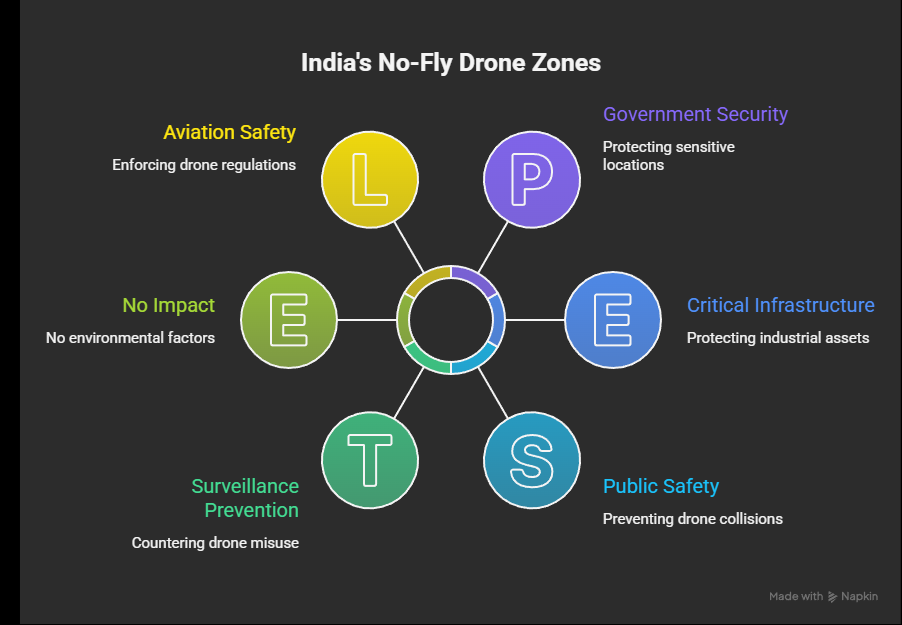
The purpose of Red Zones is safety and security. Drones can interfere with aircraft operations, creating collision risks. They can be used for surveillance of sensitive locations. They can carry dangerous payloads into secure areas.
The Ahmedabad police notification stated clearly that anti-national organizations and terrorists may misuse drones to endanger security . Recent drone attacks in Jammu and Kashmir demonstrated how such devices can spread terror and cause loss of life.
Red Zones exist to prevent these scenarios. They protect airports where passenger safety is at stake, military installations critical to national defence, crowds at temples, stadiums, and public events. Not just that, they also protect prisons from contraband smuggling and infrastructure from potential attacks.
How to Stay Compliant with No Fly Drone Zone Rules
Responsible drone operation starts with knowing the rules. Register your drone on DigitalSky. Nano drones under 250 grams for non-commercial use have fewer restrictions, but all drones must respect zone classifications .
Follow the No Permission, No Take-off (NPNT) rule. This policy requires digital permission through DigitalSky before every flight . The system ensures accountability and prevents unauthorized operations.
Maintain visual line of sight with your drone. Do not fly beyond 120 metres (400 feet) altitude. Operate only during daylight hours unless your drone meets night operation requirements . Stay clear of crowded areas and private properties.
Keep flight logs if operating commercially. Maintain documentation of permissions and zone checks. This protects you if questions arise about your operations.
Start learning robotics today! Build strong fundamentals with expert-led training.
Conclusion
No Fly Drone Zones in India are strictly enforced for good reason. Airports, military bases, jails, nuclear facilities, and sensitive locations like the Puri Jagannath Temple all require airspace protection. Flying a drone in these Red Zones without central government approval leads to heavy fines, equipment seizure, and criminal charges.
The three-zone system of Green, Yellow, and Red provides clear guidance for drone pilots. Green Zones offer freedom to fly within altitude limits. Yellow Zones require permission from air traffic control. Red Zones are completely prohibited. Before every flight, check the official DigitalSky airspace map. Zone classifications can change, and temporary restrictions may apply.
India’s drone market is growing rapidly. Drones serve agriculture, infrastructure, mapping, and many other sectors. But with growth comes responsibility. Understanding and respecting No Fly Drone Zones ensures that drones can continue to serve useful purposes while keeping people and property safe. Fly smart. Check your zone. Stay on the right side of the law.
Free UPSKILLING Courses!
Take your first step toward mastering in-demand skills, acing interviews, and securing top-tier jobs with Entri's free upskilling courses.
Start Learning!Frequently Asked Questions
What happens if I fly my drone in a Red Zone by mistake?
Mistaken violations still lead to legal action. Police will likely seize your drone, register a case under the Aircraft Act, and impose fines up to ₹1 lakh. You must check the DigitalSky map before every flight to avoid accidental violations.
Does drone weight matter in Red Zones?
No. All drones, regardless of weight, are prohibited in Red Zones without central government approval. The nano category exemption for non-commercial use does not apply to Red Zone airspace.
How do I know if a location is a Red Zone?
Use the official DigitalSky portal or mobile app. Enter your GPS coordinates or location name to view the zone classification. The map shows Green, Yellow, and Red zones with real-time updates for temporary restrictions.
Can I get special permission to fly in a Red Zone?
Private individuals and commercial operators almost never receive Red Zone permissions. Only government agencies or those with explicit central government clearance can operate in these areas. Yellow Zone permissions are more accessible.
Are temporary Red Zones announced in advance?
Sometimes. VIP visits, political rallies, and major events may have advance notifications. However, security emergencies can create Red Zones without prior notice. Always check the DigitalSky map on the day of your flight.
What is the penalty for flying a drone near an airport?
Flying within 5 kilometres of an airport perimeter is a serious offence. Penalties include fines up to ₹1 lakh, drone confiscation, and criminal charges under the Aircraft Act. Airport authorities treat such violations as aviation security threats.
Can I fly a drone indoors if the building is in a Red Zone?
Indoor flying is generally permitted if the drone does not exit the building. However, you must confirm with the property owner first. Local authorities may have additional restrictions, especially for government buildings.
Do foreign tourists face different Red Zone rules?
No. Foreign nationals must follow the same zone restrictions as Indian citizens. Additional permissions from the Ministry of Civil Aviation may apply. Tourists should check zone status and obtain necessary clearances before operating any drone.
How are Red Zones enforced?
Police monitor restricted areas actively. Many Red Zones, such as the Puri Jagannath Temple, now have anti-drone technology that detects and neutralizes unauthorized devices. Security forces can intercept rogue drones entering protected airspace.
Can Red Zone classifications change over time?
Yes. Zone classifications are reviewed periodically. A Red Zone may become Yellow or Green if security concerns change. Similarly, new locations can be declared Red Zones as security needs evolve. Always verify current status before flying.