
Table of Contents
Paid Advertising Trends are changing how brands reach audiences today. Businesses depend more on digital platforms for growth. Advertising tools are becoming smarter and faster. Automation helps reduce manual work for marketers. AI improves targeting and ad performance. Customer behaviour keeps evolving across online channels. Privacy rules now influence ad strategies strongly. Brands must adapt early to stay competitive.
Advertising will continue to evolve by 2026. Technology will guide most campaign decisions. Marketers will focus more on measurable results. Creative quality will play a major role. Targeting methods will become more refined. Budgets will be planned with greater care. Smart preparation will drive long-term success.
Join Our Online Digital Marketing Course & Learn the Fundamentals!
Introduction
Paid advertising is entering a new phase of rapid change. Technology now shapes how ads are planned and delivered. Automation and AI are no longer optional tools. They are becoming central to campaign success.
User expectations for relevance are increasing every year. At the same time, privacy rules are getting stricter.
The year 2026 marks a turning point for advertisers. Platforms are shifting control toward automated systems. Manual optimization is slowly losing importance. Performance and efficiency now guide most decisions. Marketers must understand these changes early. Preparation today ensures better results tomorrow.
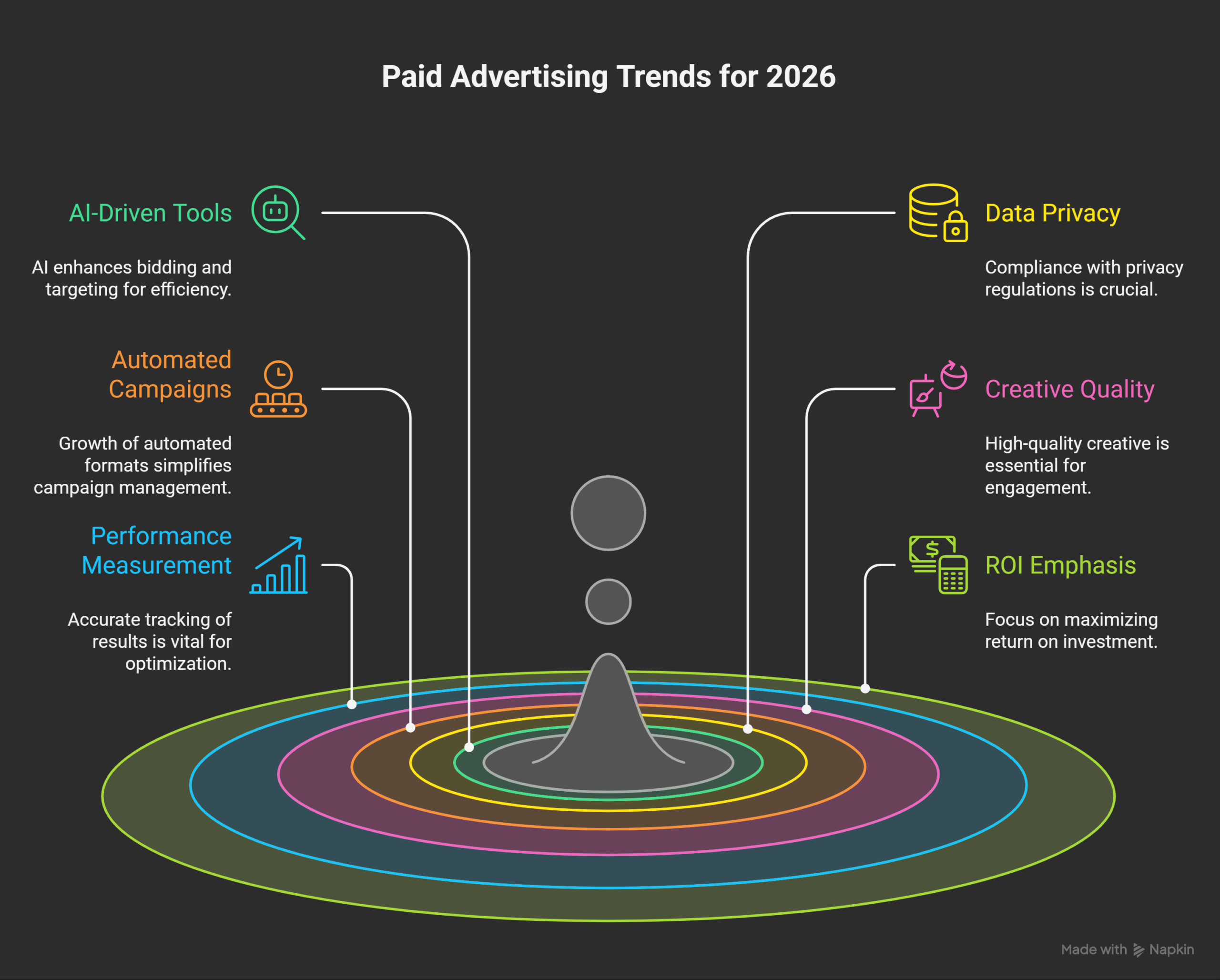
Key factors driving paid advertising changes:
-
AI-driven bidding and targeting tools
-
Strong focus on data privacy compliance
-
Growth of automated campaign formats
-
Increased importance of creative quality
-
Need for accurate performance measurement
-
Greater emphasis on return on investment
Shift Toward AI & Automation
1: What is the primary goal of SEO (Search Engine Optimization)?
2: Which of the following is NOT a PPC (Pay-Per-Click) platform?
3: What does PPC mean?
4: What does the term "bounce rate" refer to?
5: Which tool is most commonly used for web traffic analytics?
Ever wondered how much you really know? It's time to put your brain to the test!
Overview of AI in Paid Advertising
AI is transforming how paid advertising works today. Automation reduces manual effort across campaign management. Platforms rely on algorithms for faster decisions. Marketers now guide systems instead of controlling details. AI helps handle complex data at scale. This shift improves efficiency and consistency. By 2026, automation becomes the standard approach.
AI systems learn from user behaviour patterns. They predict actions based on historical data. These predictions guide bidding and targeting decisions. Campaigns adjust automatically based on performance signals. Human input still matters for strategy direction. However, execution increasingly belongs to machines.
AI-Powered Bidding Strategies
AI bidding replaces manual bid adjustments. Systems analyze conversion probability in real time. Bids change automatically for each auction. This improves chances of valuable clicks. Advertisers select goals instead of bid amounts. AI then works toward those goals.
Common AI bidding goals include:
-
Maximize conversions
-
Maximize conversion value
-
Target cost per acquisition
-
Target return on ad spend
Benefits of AI-driven bidding:
-
Faster bid adjustments
-
Better auction-level decisions
-
Reduced human error
-
Improved cost efficiency
AI bidding adapts to market changes instantly. Manual bidding cannot match this speed.
Automated Budget Allocation
Automation now controls budget distribution. AI shifts spend toward high-performing campaigns. Low-performing areas receive reduced budgets automatically. This ensures efficient use of ad spend.
Budgets adjust based on performance trends. AI considers time, device, and audience signals. Spending aligns closely with business goals. This reduces wasted ad spend significantly.
Key advantages of automated budgets:
-
Continuous optimization without delays
-
Better alignment with conversion goals
-
Reduced need for daily monitoring
Campaign Optimization Through Machine Learning
Machine learning improves campaign performance over time. Systems test multiple variables automatically. Winning combinations receive more exposure. Poor combinations get removed gradually.
Optimization happens across multiple areas. This includes audiences, placements, and creatives. Learning improves as more data accumulates. Results become stronger over longer periods.
AI optimizes the following elements:
-
Ad placements
-
Audience targeting
-
Creative combinations
-
Timing and frequency
Audience Targeting with AI
AI expands targeting beyond manual segments. Systems identify high-intent users automatically. Similar audience models replace basic lookalikes. Targeting becomes predictive instead of reactive.
AI uses signals like browsing behaviour. It also analyzes engagement and purchase patterns. This improves relevance and conversion rates. Advertisers focus less on audience setup.
AI-driven audience benefits:
-
Broader reach with relevance
-
Better adaptation to signal loss
-
Improved discovery of new customers
Creative Automation and Optimization
AI supports creative testing at scale. Multiple creative variations run simultaneously. Systems identify top-performing creatives automatically. Winning creatives receive higher delivery.
AI-generated headlines and descriptions save time. Video variations are produced faster. Dynamic creatives adapt messaging automatically. Creative testing becomes continuous and efficient.
Creative elements optimized by AI:
-
Headlines
-
Descriptions
-
Images
-
Video formats
Role of Human Oversight
Automation does not remove human involvement. Humans define goals and constraints. Strategy still requires human judgment. Creativity needs human direction and brand understanding.
Marketers monitor performance trends regularly. They adjust inputs based on insights. AI executes tasks more efficiently. Humans guide long-term direction.
Challenges of AI and Automation
Automation reduces visibility into some decisions. Platforms offer limited transparency at times. Learning periods require patience and stable data. Poor inputs can reduce AI effectiveness.
Over-automation without strategy can fail. Advertisers must understand system behavior. Testing and learning remain important.
Best Practices for Using AI Effectively
To use AI successfully, advertisers should:
-
Define clear conversion goals
-
Maintain accurate conversion tracking
-
Provide strong creative assets
-
Allow sufficient learning time
-
Review performance regularly
Comparison: Manual vs AI-Driven Advertising
| Aspect | Manual Advertising | AI-Driven Advertising |
|---|---|---|
| Bid Management | Manual adjustments | Real-time automated bids |
| Budget Control | Fixed allocations | Dynamic optimization |
| Audience Targeting | Predefined segments | Predictive audience models |
| Creative Testing | Limited testing | Continuous automated testing |
| Optimization Speed | Slow | Instant |
| Scalability | Limited | Highly scalable |
Why AI and Automation Matter for 2026
AI will dominate paid advertising execution. Automation handles complexity better than humans. Efficiency becomes critical for profitability. Platforms prioritize automated campaign formats.
Advertisers who adapt early gain advantages. Those resisting automation may lose performance. Strategic guidance remains the key role. Execution increasingly belongs to intelligent systems.
Become an AI-powered Digital Marketing Expert
Master AI-Driven Digital Marketing: Learn Core Skills and Tools to Lead the Industry!
Explore CourseCookieless Advertising & Data Privacy
Overview of the Cookieless Shift
Digital advertising is moving toward a cookieless future. Third-party cookies are slowly disappearing from browsers. Privacy concerns drive this major industry change. Users demand more control over personal data. Regulators enforce stricter data protection laws. Platforms now limit tracking capabilities. Advertisers must rethink targeting and measurement methods.
This shift changes how ads reach users. Old tracking methods no longer work reliably. New strategies focus on consent and transparency. Trust becomes essential for long-term growth. Data responsibility now defines advertising success.
Role of Privacy Regulations
Privacy laws impact how data is collected. They limit unauthorized user tracking. Advertisers must follow consent-based data usage. Non-compliance risks penalties and reputation damage.
Major regulations shape global advertising practices. They influence data storage and sharing rules. Businesses must update compliance processes regularly.
Key privacy regulations affecting advertising:
-
GDPR in Europe
-
CCPA and CPRA in California
-
India’s Digital Personal Data Protection Act
-
Browser-level privacy changes
Effects of these regulations include:
-
Reduced third-party data availability
-
Stronger consent requirements
-
Increased focus on transparency
-
Higher compliance costs
Impact on Targeting Strategies
Cookie loss affects audience targeting accuracy. Behavioral tracking becomes more limited. Cross-site user tracking is restricted. Audience reach becomes less predictable.
Advertisers rely less on third-party audiences. Broad targeting gains importance again. Contextual relevance returns to focus. Platforms use aggregated signals instead.
Targeting changes advertisers will face:
-
Fewer detailed user profiles
-
More reliance on platform data
-
Increased use of contextual targeting
Rise of First-Party Data
First-party data becomes extremely valuable. It comes directly from customer interactions. This data is accurate and permission-based. It supports personalization without violating privacy.
Brands collect data through owned channels. Examples include websites and mobile apps. Email subscriptions also generate valuable insights. Loyalty programs strengthen data collection.
Common first-party data sources:
-
Website forms
-
Purchase history
-
App usage behaviour
-
Email engagement
-
Customer support interactions
Benefits of First-Party Data
First-party data builds stronger customer relationships. It improves targeting accuracy responsibly. It supports better personalization strategies. Data quality remains high and reliable.
Advertisers gain independence from third-party providers. They reduce risks from platform changes. Trust increases between brands and users.
Key benefits include:
-
Higher data accuracy
-
Better compliance with regulations
-
Improved customer trust
-
Long-term data ownership
Zero-Party Data and Its Importance
Zero-party data is shared intentionally by users. It includes preferences and interests. Users provide this data voluntarily. Transparency improves data trust further.
Examples include surveys and preference centers. Interactive content collects such data effectively. This data supports highly relevant messaging.
Examples of zero-party data:
-
Content preferences
-
Product interests
-
Communication choices
-
Feedback responses
Data Collection Best Practices
Ethical data collection is now essential. Clear consent must be obtained always. Data usage purposes should be explained. Opt-out options must remain accessible.
Simple language improves user understanding. Data storage should follow security standards. Regular audits ensure compliance.
Best practices for advertisers:
-
Use clear consent banners
-
Limit unnecessary data collection
-
Store data securely
-
Update privacy policies regularly
Measurement Challenges Without Cookies
Tracking conversions becomes more complex. Cross-device attribution faces limitations. User-level tracking accuracy decreases. Data gaps appear in reporting.
Platforms use modelled conversions instead. Aggregated data replaces individual tracking. Performance insights remain available but less detailed.
New Measurement Solutions
Advertisers adopt privacy-safe measurement methods. Modelled conversions fill missing data gaps. Server-side tracking improves reliability. First-party tracking tools gain popularity.
Media mix modelling returns strongly. It measures overall channel impact. Incrementality testing gains importance.
Measurement tools used in cookieless advertising:
-
Conversion modelling
-
Server-side tagging
-
Media mix modelling
-
Lift studies
Comparison: Cookie-Based vs Cookieless Advertising
| Aspect | Cookie-Based Advertising | Cookieless Advertising |
|---|---|---|
| Data Source | Third-party cookies | First-party data |
| User Consent | Often unclear | Explicit consent |
| Targeting | Behavioral tracking | Contextual and modeled |
| Measurement | User-level tracking | Aggregated modeling |
| Privacy Compliance | Risky | Strong compliance |
| Data Ownership | Limited | Brand-owned |
Why Cookieless Readiness Matters for 2026
Privacy-first advertising is not optional. Cookieless strategies protect long-term performance. First-party data becomes a competitive advantage. Trust drives sustainable customer relationships.
Advertisers must adapt early. Delayed action increases future risks. Privacy and performance must coexist. Prepared brands will lead in 2026.
Platform-Specific Advertising Changes
Overview of Platform Evolution
Advertising platforms are changing their core systems. Each platform focuses heavily on automation and AI. Manual controls continue to reduce across interfaces. Platforms want simplified campaign management. Performance-based optimization becomes the main priority. Advertisers must adapt to platform-specific behaviors. A single strategy no longer works everywhere.
Each platform now uses its own data signals. Algorithms differ in learning and delivery. Understanding platform strengths becomes essential. Customization improves results across channels.
Google Ads: Increased Automation Focus
Google Ads prioritizes automated campaign formats. Manual keyword and bid control keeps reducing. AI now manages targeting and bidding. Advertisers focus more on goals and inputs.
Search campaigns rely on broad match keywords. AI matches queries using intent signals. Exact match becomes less strict. Query coverage expands automatically.
Key Google Ads trends:
-
Broad match keyword adoption
-
Smart bidding as default
-
Reduced manual bid strategies
-
Increased reliance on Performance Max
Performance Max growth factors:
-
Unified access to Google inventory
-
AI-driven creative combinations
-
Goal-based optimization approach
Google Ads Creative and Measurement Changes
Creative assets play a bigger role. Google combines headlines and descriptions dynamically. Strong creative inputs improve performance significantly. Video assets receive higher priority.
Measurement relies more on modeled conversions. Privacy changes reduce direct tracking signals. Google uses aggregated data methods. Advertisers must trust system reporting.
Meta Ads: Advantage+ Expansion
Meta Ads shifts toward Advantage+ campaigns. Automation manages audiences and placements. Manual targeting options continue shrinking. Broad targeting becomes more effective.
AI identifies high-converting users automatically. Interest targeting holds less importance. Creative quality drives stronger results. Video-first strategies dominate performance.
Key Meta Ads trends:
-
Advantage+ shopping campaigns growth
-
Broad audience targeting adoption
-
Reduced manual placement controls
-
AI-driven creative testing
Meta Ads Creative Trends
Short-form video performs best. Vertical formats dominate feeds. Authentic content drives higher engagement. User-generated style ads perform strongly.
Dynamic creative testing runs continuously. AI selects winning combinations automatically. Fresh creatives reduce ad fatigue.
LinkedIn Ads: B2B Automation Growth
LinkedIn Ads expands AI-driven targeting. Predictive audiences replace manual job targeting. Automation improves lead quality scoring. B2B advertisers gain better efficiency.
Lead Gen Forms integrate with CRM systems. Conversion optimization improves over time. Audience expansion increases reach gradually.
Key LinkedIn Ads trends:
-
Predictive audience targeting
-
Automated lead optimization
-
Stronger CRM integrations
-
Increased video and document ads
LinkedIn Creative and Format Shifts
Video content gains more visibility. Document ads perform well for education. Thought leadership ads build brand trust. Lead nurturing becomes more automated.
Emerging Platforms and Retail Media
Retail media networks grow rapidly. Amazon Ads expands performance-based options. Sponsored product ads dominate ecommerce searches. First-party purchase data strengthens targeting.
Platforms like TikTok continue expanding rapidly. Discovery-driven advertising drives impulse purchases. Algorithm-led distribution rewards creative quality.
Other growing platforms include:
-
TikTok Ads
-
Amazon Ads
-
Pinterest Ads
-
Snapchat Ads
Cross-Platform Strategy Challenges
Each platform uses unique optimization logic. Metrics differ across reporting dashboards. Attribution becomes harder across channels. Learning periods vary by platform.
Advertisers must test platform-specific approaches. Budget allocation requires careful planning. Creative adaptation becomes necessary.
Platform Comparison Overview
| Platform | Primary Focus | Key Strength |
|---|---|---|
| Google Ads | Intent-based automation | Search and Performance Max |
| Meta Ads | Audience expansion | Creative-led performance |
| LinkedIn Ads | B2B lead quality | Professional targeting |
| Amazon Ads | Purchase intent | Retail conversion data |
| TikTok Ads | Discovery-driven ads | High engagement video |
Why Platform-Specific Knowledge Matters for 2026
Platforms control data and delivery. Understanding differences improves efficiency. Automation varies by ecosystem. Creative requirements differ widely.
Advertisers who adapt platform strategies succeed. Generic approaches reduce performance. Continuous learning becomes essential. Platform mastery drives competitive advantage.
Performance Max & Automated Campaigns
Introduction to Automated Campaign Growth
Automated campaigns are growing across advertising platforms. Performance Max leads this transformation strongly. These campaigns focus on goals, not manual controls. AI manages targeting, bidding, and placements. Advertisers provide inputs and objectives. Systems handle execution automatically. This model simplifies campaign management greatly.
By 2026, automation becomes the default choice. Platforms actively promote goal-based campaigns. Manual campaign types receive less emphasis. Efficiency and scalability drive this shift.
What Are Performance Max Campaigns
Performance Max is a goal-based campaign type. It runs across multiple channels simultaneously. These channels include search, display, video, and shopping. AI decides where ads appear. Decisions depend on conversion probability.
Advertisers choose business objectives clearly. Examples include sales, leads, or store visits. The system optimizes toward selected goals. Control moves from settings to inputs.
Channels Covered by Performance Max
Performance Max accesses full platform inventory. Ads appear across various user touchpoints. This improves reach and consistency.
Common channels included:
-
Search results
-
Display network
-
YouTube ads
-
Discovery placements
-
Shopping feeds
Unified access reduces campaign fragmentation. Management becomes simpler for advertisers.
Role of AI in Performance Max
AI powers every decision in Performance Max. It analyzes millions of signals instantly. Signals include device, time, and behavior. AI predicts conversion likelihood accurately.
Based on predictions, delivery adjusts automatically. High-value users receive more exposure. Low-value impressions reduce gradually. Optimization happens continuously without pauses.
Importance of Clear Goals
Clear goals guide automated campaign performance. AI requires strong direction from advertisers. Vague goals lead to weaker outcomes. Specific conversion actions improve results.
Examples include completed purchases or form submissions. Micro-conversions help train systems faster. Consistent tracking improves learning quality.
Best practices for goal selection:
-
Choose business-relevant conversions
-
Avoid unnecessary secondary actions
-
Maintain stable conversion definitions
Asset-Based Campaign Structure
Performance Max uses asset groups. Assets include text, images, and videos. AI mixes assets dynamically. Best-performing combinations get priority.
Creative variety improves testing speed. Limited assets restrict optimization potential. Fresh assets reduce creative fatigue.
Common asset types required:
-
Headlines
-
Descriptions
-
Images
-
Logos
-
Videos
Creative Signals and Optimization
Creative quality heavily influences campaign success. AI tests creatives across audiences. Winning messages receive higher delivery. Poor creatives fade automatically.
Video assets unlock more inventory. Vertical formats perform especially well. Authentic visuals improve engagement rates.
Advertisers must refresh creatives regularly. Stale assets reduce campaign efficiency.
Audience Signals in Automated Campaigns
Audience signals guide initial learning. They do not limit final reach. AI expands beyond provided signals.
Signals include customer lists and interests. Website visitors also help early optimization. AI finds similar high-intent users.
Common audience signal sources:
-
Customer lists
-
Website visitors
-
App users
-
In-market audiences
Budget Control and Optimization
Budgets drive delivery scale. AI allocates budget dynamically. High-performing segments receive more spend. Low-performing areas receive less spend.
Daily fluctuations are normal. Longer evaluation periods show true performance. Stable budgets improve learning speed.
Learning Period and Patience
Automated campaigns require learning time. Early performance may appear unstable. Systems test different combinations initially. Results improve after sufficient data.
Frequent changes reset learning. Advertisers should avoid constant edits. Patience improves long-term outcomes.
Benefits of Automated Campaigns
Automation offers major advantages. It reduces operational complexity. Campaigns scale faster across channels.
Optimization happens continuously.
Key benefits include:
-
Time savings
-
Broader reach
-
Smarter optimization
-
Better efficiency
Limitations and Challenges
Automation reduces transparency. Control over placements is limited. Insights may appear aggregated. Creative dependence increases significantly.
Poor inputs lead to poor outcomes. Automation cannot fix weak strategy. Human oversight remains essential.
Comparison: Traditional vs Automated Campaigns
| Aspect | Traditional Campaigns | Automated Campaigns |
|---|---|---|
| Control Level | High manual control | Input-based control |
| Optimization Speed | Slow | Real-time |
| Channel Coverage | Separate campaigns | Unified delivery |
| Creative Testing | Limited | Continuous |
| Scalability | Moderate | High |
Why Automated Campaigns Dominate 2026
Platforms prioritize automated formats. AI handles complexity better than humans. Goal-based advertising improves efficiency. Time savings support strategic focus.
Advertisers must adapt quickly. Those resisting automation may fall behind. Strategic inputs determine success. Automation defines the future of paid advertising.
Become an AI-powered Digital Marketing Expert
Master AI-Driven Digital Marketing: Learn Core Skills and Tools to Lead the Industry!
Explore CourseCreative & Ad Format Innovation
Changing Role of Creativity in Paid Advertising
Creative quality now drives paid advertising success. Automation has shifted focus toward strong creative inputs. Platforms depend on creatives for optimization signals. Ads must capture attention quickly. User attention spans continue to shrink across platforms. Creative strategy now matters as much as targeting. In 2026, creativity becomes a key performance factor.
Good creatives help algorithms learn faster. Poor creatives limit automation effectiveness. Brands must invest more in creative planning. Testing creative ideas becomes a continuous process.
Rise of AI-Generated Creatives
AI-generated creatives are becoming widely used. These tools produce headlines, descriptions, and visuals. Marketers create variations faster than before. AI reduces time spent on manual content creation.
Text generation tools write multiple ad copies quickly. Image tools produce background and style variations. Video tools create short clips automatically. This supports large-scale creative testing.
Common uses of AI-generated creatives:
-
Writing ad headlines
-
Creating description variations
-
Generating image backgrounds
-
Producing short video clips
AI helps speed up experimentation cycles. Human review remains necessary for quality control.
Benefits of AI in Creative Production
AI increases creative output efficiently. Teams can test more ideas quickly. Production costs reduce significantly. Campaigns refresh faster, preventing creative fatigue.
AI supports personalization at scale. Messages adapt based on audience signals. Relevance improves without manual effort. Performance improves through continuous testing.
Key advantages of AI-generated creatives:
-
Faster production timelines
-
Higher testing volume
-
Reduced creative costs
-
Better alignment with automation
Importance of Human Creativity
AI cannot replace human creativity fully. Brand voice requires human understanding. Emotional storytelling still needs human input. Strategy guides creative direction.
Humans define tone and messaging. AI assists with execution and scaling. Best results come from collaboration. Human creativity guides machine efficiency.
Growth of Video Advertising
Video dominates digital advertising formats. Short-form video performs especially well. Platforms prioritize video-heavy content. Users engage more with moving visuals.
Vertical video fits mobile behavior better. Short videos deliver messages quickly. Authenticity matters more than perfection. Simple visuals often outperform polished ads.
Types of Video Ads Gaining Popularity
Short videos drive higher engagement rates. Storytelling videos build brand awareness. Product demos improve conversion rates. User-generated style videos feel more authentic.
Popular video formats include:
-
Short vertical videos
-
In-feed social videos
-
Skippable video ads
-
Shoppable video formats
Videos now support direct conversions. Shopping integrations improve user experience.
AI in Video Creation
AI tools simplify video production. They create multiple versions automatically. Text-to-video tools generate clips quickly. AI edits videos for different platforms.
Captions are added automatically. Aspect ratios adjust per placement. Music and transitions generate instantly. This reduces reliance on large teams.
Interactive Ad Formats
Interactive ads increase user engagement. They invite users to participate actively. Engagement improves memory and recall. These formats perform well on mobile devices.
Interactive elements encourage exploration. Users feel more involved with brands. This improves conversion intent.
Examples of interactive ad formats:
-
Poll ads
-
Carousel ads
-
Swipeable stories
-
Shoppable ads
-
Playable ads
Shoppable and Commerce-Driven Ads
Shoppable ads reduce purchase friction. Users shop without leaving platforms. Product discovery becomes faster. Impulse purchases increase significantly.
These formats blend content and commerce. Visual presentation drives buying decisions. AI personalizes product recommendations. Conversion paths become shorter.
Creative Testing and Optimization
Creative testing is now continuous. AI rotates creatives automatically. Winning variations receive more exposure. Underperforming creatives fade out.
Testing focuses on messaging and visuals. Small changes create performance differences. Regular refreshes maintain engagement.
Comparison of Traditional and Modern Creatives
| Aspect | Traditional Creatives | Modern AI-Driven Creatives |
|---|---|---|
| Production Speed | Slow | Fast |
| Testing Volume | Limited | High |
| Personalization | Minimal | Dynamic |
| Video Usage | Occasional | Core focus |
| Optimization | Manual | Automated |
Why Creative Innovation Matters in 2026
Automation relies heavily on creative quality. Platforms reward engaging formats. User attention becomes harder to capture. Creative fatigue happens faster.
Brands must innovate constantly. AI helps scale creativity efficiently. Video and interactive formats dominate. Creative excellence defines advertising success.
Cross-Channel Attribution & Measurement
Why Attribution Is Becoming More Complex
Cross-channel advertising is now the industry standard. Brands advertise across search, social, video, and retail platforms. Users interact with ads across multiple devices. Journeys rarely follow a straight path. One conversion often involves many touchpoints. Tracking this journey accurately is increasingly difficult. Privacy changes add more complexity to measurement.
Traditional tracking methods no longer capture full impact. Advertisers must rethink how success is measured. Understanding contribution matters more than exact paths.
Decline of Traditional Attribution Models
Last-click attribution is losing relevance quickly. It credits only the final interaction. Earlier touchpoints get ignored completely. This creates a distorted performance view.
First-click attribution also has limitations. It overvalues awareness-focused campaigns. Linear models oversimplify complex journeys. Rule-based models fail in fragmented ecosystems.
Limitations of traditional attribution models:
-
Incomplete conversion credit
-
Channel bias in reporting
-
Poor reflection of real journeys
Impact of Privacy Changes on Measurement
Privacy regulations reduce available user data. Browser restrictions limit cross-site tracking. Platform tracking signals become fragmented. User-level data is increasingly unavailable.
Consent requirements reduce tracking coverage. Opt-outs create reporting gaps. Advertisers see fewer measurable conversions. Performance appears weaker than reality.
Cross-Device and Cross-Platform Challenges
Users switch devices frequently. They research on mobile and convert on desktop. Some conversions happen offline later. Tracking across devices becomes unreliable.
Platforms operate in closed ecosystems. Data sharing between platforms is limited. Each platform reports performance differently. Comparing results becomes difficult.
Role of Modeled Conversions
Modeled conversions estimate missing performance data. Platforms use statistical models to fill gaps. These models rely on historical trends. Aggregated signals guide estimations.
Modeled data improves directional accuracy. Exact user paths remain unknown. Advertisers must trust platform models carefully. Understanding limitations is essential.
Data-Driven Attribution Models
Data-driven attribution uses machine learning. It analyzes large sets of conversion data. Credit is assigned based on contribution likelihood. Models adjust as data changes.
This approach reflects real user behavior better. It adapts to different journey patterns. Performance insights improve over time.
Benefits of data-driven attribution:
-
Fair credit distribution
-
Better optimization insights
-
Reduced channel bias
Media Mix Modeling Returns
Media mix modeling is gaining renewed importance. It measures impact at an aggregate level. No user-level tracking is required. Historical spend and outcome data is analyzed.
MMM shows how channels influence results. It works well in privacy-restricted environments. Long-term trends become visible. Budget planning improves significantly.
Incrementality Testing
Incrementality testing measures true impact. It compares exposed and unexposed audiences. This reveals actual campaign lift. It avoids reliance on attribution assumptions.
Lift studies help validate channel value. They support smarter budget decisions. Testing requires controlled experimentation.
Common incrementality testing methods:
-
Geo-based experiments
-
Conversion lift studies
-
Holdout group testing
First-Party Data and Measurement
First-party data improves measurement reliability. It comes from owned customer interactions. Tracking remains permission-based. Data accuracy is higher.
CRM integration strengthens attribution analysis. Offline conversions can be connected. Customer lifetime value becomes measurable. Insights improve across channels.
Server-Side Tracking Solutions
Server-side tracking reduces signal loss. Data flows directly from servers. Browser limitations affect it less. Accuracy improves compared to client-side tracking.
Setup requires technical resources. Privacy compliance must remain strong. Data control improves for advertisers.
Unified Reporting Dashboards
Advertisers need consolidated reporting views. Cross-platform dashboards combine performance data. Metrics are standardized across channels. Decision-making becomes easier.
Dashboards focus on business outcomes. Vanity metrics receive less attention. Consistency improves reporting clarity.
Common Measurement Metrics Shifting Focus
Click-based metrics lose importance. Outcome-based metrics gain priority. Revenue and leads matter more. Efficiency metrics guide optimization.
Key metrics advertisers now prioritize:
-
Cost per acquisition
-
Return on ad spend
-
Conversion value
-
Incremental lift
-
Customer lifetime value
Comparison: Old vs Modern Measurement
| Aspect | Traditional Measurement | Modern Measurement |
|---|---|---|
| Tracking Method | User-level cookies | Aggregated and modeled |
| Attribution | Rule-based | Data-driven |
| Privacy Compliance | Risky | Privacy-safe |
| Channel View | Siloed | Cross-channel |
| Accuracy | Declining | Directionally strong |
Best Practices for Cross-Channel Measurement
Advertisers should combine multiple measurement methods. No single model provides full accuracy. Testing and modeling work together best. First-party data should anchor measurement.
Clear goals guide performance analysis. Patience is required for long-term insights. Continuous evaluation improves confidence.
Why Measurement Evolution Matters for 2026
Measurement defines smart decision-making. Privacy-first environments demand new approaches. Cross-channel visibility drives efficiency. Better measurement protects advertising investments.
Advertisers who adapt gain clarity. Those relying on old models struggle. Modern measurement supports sustainable growth. Prepared brands will lead future advertising.
Budget Optimization & ROI Focus
Changing Approach to Advertising Budgets
Advertising budgets are under closer scrutiny today. Brands can no longer afford inefficient spending. Every rupee must deliver measurable value. ROI now guides most advertising decisions. Growth depends on smarter budget planning. Efficiency matters more than total spend.
In 2026, budget discipline becomes essential. Automation supports better financial control. Data guides where money should flow.
Shift From Spend-Based to Value-Based Planning
Earlier strategies focused on higher ad spend. Now, value creation defines success. Advertisers prioritize profitable conversions. Low-quality traffic is actively avoided.
Budgets align with business objectives. Revenue and lifetime value matter more. Short-term vanity metrics lose importance.
Key value-based budget goals include:
-
Lower cost per acquisition
-
Higher return on ad spend
-
Improved customer lifetime value
Role of AI in Budget Optimization
AI plays a central role in budget decisions. Systems analyze performance continuously. Spend shifts automatically toward better results. Poor-performing areas receive reduced investment.
AI considers multiple performance signals together. This includes time, device, and audience data. Manual reallocation becomes less necessary.
AI-driven budget benefits include:
-
Faster response to performance changes
-
Reduced wasted spend
-
Improved consistency across campaigns
Channel-Level Budget Allocation
Budgets are distributed across multiple channels. Each channel plays a different role. Search captures high-intent demand. Social drives discovery and awareness. Video builds long-term brand recall.
Smart allocation balances short-term and long-term goals. Over-investing in one channel increases risk. Diversification improves overall stability.
Focus on High-Performing Campaigns
Not all campaigns deserve equal budgets. Top performers should receive priority funding. Underperformers need optimization or reduction. Budget reviews should happen regularly.
Performance trends guide allocation decisions. Historical data supports smarter forecasting. Testing budgets remain necessary for innovation.
Importance of Testing Budgets
Testing budgets support experimentation safely. They allow learning without major risk. New audiences and creatives are explored. Successful tests receive scale-up funding.
Testing prevents stagnation in performance. It supports continuous improvement. Learning budgets protect long-term growth.
Efficiency-Driven Optimization Strategies
Efficiency focuses on better output per spend. Advertisers reduce unnecessary impressions. Frequency control prevents audience fatigue. Negative targeting removes irrelevant users.
Creative refreshes improve engagement efficiency. Better messaging improves conversion rates. Small improvements create large ROI gains.
Common efficiency strategies include:
-
Audience exclusions
-
Creative rotation
-
Conversion-focused bidding
-
Funnel-based budgeting
Role of Measurement in Budget Decisions
Accurate measurement supports smarter budgeting. Modeled data fills performance gaps. Incrementality insights guide reallocation. Cross-channel reports show true contribution.
Budgets should follow measured impact. Assumptions must be tested regularly. Data-backed decisions reduce risk.
Long-Term ROI vs Short-Term Gains
Short-term results can be misleading. Long-term ROI reflects true business value. Brand-building campaigns support future conversions. Cutting them may harm growth.
Balanced budgets support both objectives. Performance and brand work together. Sustainable growth needs both.
Comparison: Traditional vs Optimized Budgeting
| Aspect | Traditional Budgeting | Optimized Budgeting |
|---|---|---|
| Allocation | Fixed | Dynamic |
| Decision Basis | Spend limits | Performance data |
| Optimization Speed | Slow | Continuous |
| ROI Focus | Low | High |
| Waste Control | Limited | Strong |
Why Budget Optimization Matters for 2026
Rising competition increases advertising costs. Efficiency protects profitability. AI enables smarter financial decisions. ROI focus supports sustainable scaling.
Advertisers must optimize continuously. Static budgets reduce competitiveness. Smart allocation drives better outcomes. Budget optimization defines future advertising success.
Join Our Online Digital Marketing Course & Learn the Fundamentals!
Actionable Paid Ad Strategies for 2026
Why Actionable Strategies Matter
Paid advertising requires clear execution plans. Trends alone do not guarantee success. Advertisers need practical steps to follow. Clear actions reduce wasted time and spend. Strong strategies support automation effectiveness.
Execution quality defines final performance.
In 2026, preparation becomes a competitive advantage. Advertisers who act early gain efficiency.
Strengthen First-Party Data Collection
First-party data should be a top priority. It supports targeting and measurement safely. Advertisers must use consent-based data methods. Clear value encourages users to share data.
Focus on owned channels for data collection. Websites, apps, and email work well. Loyalty programs increase data depth.
Action steps for data collection:
-
Improve signup forms
-
Offer value-driven incentives
-
Maintain transparent consent messaging
Set Clear Conversion Goals
Automation depends on clear goals. Advertisers must define meaningful conversions. Avoid tracking low-value actions. Focus on business outcomes only.
Primary conversions should guide optimization. Secondary actions support learning. Consistency improves algorithm training.
Invest in Creative Production
Creative quality drives automated performance. Advertisers should plan creative pipelines. Regular creative refreshes prevent fatigue. Video assets deserve special attention.
Focus on simple, authentic messaging. Test multiple formats and visuals. Creative testing must be continuous.
Embrace Automated Campaign Types
Automated campaigns offer scalability. Advertisers should adopt goal-based formats. Manual campaigns should support automation. Gradual transitions reduce risk.
Provide strong inputs for automation. Allow learning periods without interference. Monitor performance trends patiently.
Use Audience Signals Strategically
Audience signals guide initial learning. They should reflect high-value users. Use customer lists and website visitors. Avoid overly narrow targeting.
Signals help systems start faster. Expansion improves discovery later. Trust algorithms to scale reach.
Allocate Budgets Based on Performance
Budgets should follow measurable results. High-performing campaigns deserve scaling. Underperformers require optimization or reduction. Regular budget reviews are essential.
Testing budgets must remain protected. Avoid frequent drastic changes. Stability supports learning.
Improve Measurement and Attribution
Advertisers should combine multiple measurement methods. Use platform reporting with independent analysis. Incrementality testing improves confidence. Media mix modeling supports planning.
First-party data strengthens attribution accuracy. Clear metrics guide decision-making. Focus on long-term impact.
Optimize Landing Pages and Funnels
Ad performance depends on user experience. Landing pages must load quickly. Messaging should match ad creatives. Simple designs improve conversion rates.
Clear calls-to-action guide users. Reduce unnecessary steps. Conversion rate optimization boosts ROI.
Build Cross-Channel Consistency
Users interact across multiple platforms. Messaging should remain consistent everywhere. Creative themes must align across channels. Funnel stages should connect logically.
Cross-channel coordination improves recall. It supports stronger brand trust. Consistency improves conversion likelihood.
Upskill Teams for Automation
Teams must understand automation systems. Training improves confidence and control. Marketers should learn data interpretation. Creative and technical skills both matter.
Collaboration across teams improves results. Knowledge reduces dependency on guesswork. Skilled teams guide AI effectively.
Create a Testing and Learning Framework
Testing should follow a clear structure. Hypotheses guide experimentation. Results must be documented.
Learnings should inform future campaigns.
Continuous improvement drives long-term success. Testing budgets protect innovation. Learning becomes a core process.
Comparison: Reactive vs Strategic Advertising
| Aspect | Reactive Approach | Strategic Approach |
|---|---|---|
| Planning | Short-term | Long-term |
| Budget Use | Inconsistent | Performance-led |
| Automation Use | Limited | Full adoption |
| Measurement | Basic | Advanced |
| Growth | Unstable | Sustainable |
Why These Strategies Matter for 2026
Advertising complexity continues increasing. Clear actions reduce uncertainty. Automation rewards prepared advertisers. Efficiency drives competitive advantage.
Brands must act with intention. Strategy aligns tools and goals. Execution determines success. Actionable steps ensure lasting results.
Conclusion
Paid advertising in 2026 demands smarter planning and execution. Automation, privacy, and creativity now shape every decision. Advertisers must rely on data, not assumptions. Efficiency and ROI guide sustainable growth. Prepared brands adapt faster to platform changes. Strategic inputs drive automated success.
Success depends on continuous learning and improvement. Testing, measurement, and optimization must work together. Strong creatives and clear goals support performance. Balanced budgets protect long-term results. Human strategy remains essential alongside automation. Future-ready advertisers will lead the digital landscape.
Frequently Asked Questions
Why is automation so important in paid advertising for 2026?
Automation plays a crucial role in managing the growing complexity of digital advertising. AI-powered systems handle bidding, targeting, and budget allocation faster than manual processes. This improves efficiency, reduces errors, and allows campaigns to scale easily. Automation also helps advertisers respond to real-time performance changes. As platforms continue to favor automated formats, adopting automation becomes essential for success.
How does the cookieless future affect paid advertising performance?
The move toward a cookieless environment reduces the effectiveness of traditional tracking methods. Advertisers must depend more on first-party and consent-based data. Measurement shifts toward modeled and aggregated reporting instead of user-level tracking. While visibility becomes limited, performance insights remain available through advanced tools. Building trust and transparency with users becomes a key advantage.
Which ad formats will perform best in 2026?
Video advertising is expected to deliver the strongest performance across platforms. Short-form and vertical videos capture attention quickly and fit mobile usage patterns. Interactive and shoppable ad formats improve engagement and conversions. AI-generated creatives allow faster testing and optimization. Overall, creative relevance and quality will drive results.
How should advertisers measure performance across multiple platforms?
Advertisers should avoid relying on a single measurement method. Combining data-driven attribution, media mix modeling, and incrementality testing provides better accuracy. Cross-channel dashboards help compare performance across platforms. First-party data strengthens measurement reliability. A holistic approach offers clearer insights into real business impact.
What is the best way to improve ROI in paid advertising?
Improving ROI requires a strong focus on efficiency rather than higher spending. Budgets should be allocated based on performance and business value. Clear conversion goals help automation optimize effectively. Strong creatives and optimized landing pages improve conversion rates. Continuous testing and learning ensure sustainable growth over time.