Table of Contents
Imagine you being seated in a quiet test room with headphones put snugly over your ears, amidst a world of voices popping up. Each speaker is clear, natural, confident. There is no pause button, no second chance to listen. When you miss something, you can feel like you are further away from your dream of studying abroad or making a career abroad. That’s exactly the pressure many candidates feel during the PTE Listening section.
It is not just about what you read in English on the PTE Listening test. It measures the accuracy of spoken English in everyday situations you will most likely encounter while traveling overseas. These include lectures at the university, class discussions, interviews, and everyday conversations. This test measures a person’s ability to focus, to follow ideas, and to remember important information in real time because each audio clip is only played once.
This section is comprised of multiple types of questions including summarising spoken text, multiple-choice questions, filling in missing words, marking out incorrect words, and writing from dictation. Each task tests for a different listening skill: understanding the central idea and noting specific facts, spelling, and sentence structure. The entire listening portion usually takes 30 to 43 minutes depending on the test version.
The scoring in PTE Listening is both direct and integrated. This means that your scores can also affect your reading and writing levels, in such things as fill in the blanks and write from dictation. It is accurate, spelling and attention to detail. Even small errors can affect your overall outcome.
While this section is stressful for most test-takers, it is also often one of the areas most likely to improve. Once you are confident and can make sense of the test format and practice with the proper strategies, your confidence increases. With focused preparation, the PTE Listening section can turn from a source of anxiety into a strong scoring opportunity.
Join Enrtri PTE Coaching Course
Overview of the PTE Listening Section
 The PTE Academic exam tests English ability for anyone looking to enter colleges, go to work, or pay for visas in countries where English is the second language. and the listening part is right at the heart of how you can keep up with spoken information, whether in a classroom or in your normal daily life. These recorded lectures draw on sources of real-life conversations, such as lectures, classroom presentations, experts and regular conversations, and give you an accurate taste for the English language when you arrive in an English speaking environment.
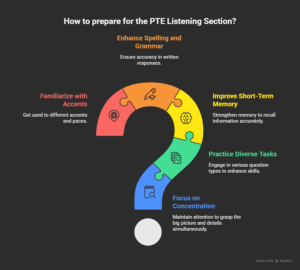
The audio only plays once and you can’t stop or repeat anything; effective concentration means keeping your attention focused, grasping the big picture and the smaller supporting facts all at once. These questions have a wide range of meanings, including writing short summaries, filling in blank words into the transcripts, selecting the right answers from lists, choosing the best overall summary, seeing words that are not related to what was said, and prediction of ending words. And they asked you to write full sentences exactly as heard, so the section measures understanding, short-term memory, spelling, basic grammar knowledge, and ability to handle verbal language in high tension.
What makes this part even more connected is that several tasks blend listening with writing or reading abilities, meaning solid work here naturally boosts those other skill areas and helps create a stronger overall profile. The entire scoring happens through the computer with smart algorithms that keep things fair and free from any personal judgment, delivering results you can trust regardless of the test center location.
You will hear a mix of accents—British, American, Australian, Canadian, and more—spoken at paces that go from slow and deliberate to quicker and more natural, and occasionally a bit of background sound creeps in to reflect how conversations really happen in life. Schools and companies pay close attention to good listening marks because those numbers show someone can follow along in lessons, catch directions the first time, and join in meetings smoothly, turning this section into an important bridge toward the future goals many people hold.
PTE Listening Test Format Explained
The PTE Listening section features eight type of questions grouped by context with each question being structured around one layer of how well you hear from grasping the whole message to catching the small details and even guessing what might occur next. Expect 15 to 20 questions on your test and all of the types of questions will be explained on the screen so you know exactly what to do before the sound starts.
It begins with Summarize Spoken Text, where a 60-second, 90-second lecture audio record plays once, and you next write a single summary sentence of 50 to 70 words identifying the topic and main ideas without adding any additional opinions or irrelevant bits. Write downs, whether in short forms or with symbols, are a lifesaver for holding onto facts, figures or the speaker’s last thoughts as you write your response, without replay.
The next step is to perform a 40–90 second audio clip with a question and several options in the Multiple-choice, Choose Multiple Answers task. You must select every option that matches what the speaker says. A good number of answers are correct, but choosing the wrong answer lowers your score. This test evaluates your comprehension of details, opinions, and implied rather than purely stated information.
Next, Fill in the Blanks task displays a transcript with words missing and an audio recording of 30-60 seconds plays. You type every syllable out exactly as you hear it. You earn one point for every correct word spelling and placement.
Third, the Highlight Correct Summary task requires you to listen to a 30-90 second audio clip and then choose one summary from the list. You must select the summary that represents the entire audio, without changing the meaning or adding information that the speaker did not name.
If you want, I can make this short, more exam-related, or SEO-friendly for a blog or course page.
This one pushes you to keep the whole idea in your head and weigh it carefully against reworded versions.
Multiple-choice, Choose Single Answer works in much the same way except you pick only one best option after hearing a 30-to-60-second audio, zeroing in on the core message, what the speaker aimed to achieve, or a clear conclusion drawn from the details provided.
Select Missing Word brings a shorter clip of 20 to 70 seconds that finishes with a beep hiding the last word or short phrase, and from the given choices you decide which one fits most naturally based on the direction and sense of what came before.
Highlight Incorrect Words puts a transcript up on the screen as the audio plays, letting you click any word shown that differs from what the speaker actually pronounced, with points added for right clicks and taken away for mistakes, which demands quick ears and sharp focus throughout.
The section wraps up with Write from Dictation, presenting brief sentences spoken over three to five seconds each, and you type out every one word for word, paying close attention to spelling, word order, grammar, and punctuation since you earn up to three points per sentence depending on how accurately everything matches—even a small slip lowers the credit received.
All these question types feed straight into the listening score, and quite a few also contribute points toward reading or writing, creating a well-rounded check of language use overall. The mix keeps things dynamic and ensures that it fairly tests various listening strengths, and getting comfortable with each one ahead of time removes the unknown factor and helps you walk into the exam room feeling steady and prepared.
Ace Your PTE Exam with Confidence!
Unlock your potential with our expert-led PTE preparation course. Achieve your dream score and open doors to global opportunities!
Start Your PTE Preparation Today!Scoring Pattern for PTE Listening
PTE gives listening results on a 10-to-90 scale that lines up with the Global Scale of English standards, and each question type carries its own exact way of awarding points that all add together for the final number. Right answers build your score while specific mistakes take points off, and the whole approach favors careful accuracy far more than taking wild chances.
Summarize Spoken Text holds the potential for up to 10 points on each item by looking at how well the content covers the essentials, stays inside the 50-to-70 word range, uses proper grammar, shows a decent variety of words, spells everything correctly, and keeps good overall structure, so a tight, complete summary written cleanly earns the top marks possible.
Multiple-choice tasks that allow several answers work on partial credit, giving one point for every correct pick and subtracting one for every wrong pick, though the item score stays at zero or above rather than going negative. Fill in the Blanks hands out one point strictly for each word that is spelled right and put in the correct blank with no credit given for anything close but not exact.
Highlight Correct Summary along with Multiple-choice, Choose Single Answer, and Select Missing Word each deliver full points when the choice is right and nothing at all when it is wrong, keeping those straightforward. Highlight Incorrect Words uses the same partial system as multiple-answer questions, adding one point per accurate click and removing one per error, meaning only sure decisions help protect or raise the total.
Write from Dictation awards as many as three points for every sentence based on correct words in the proper spots along with right spelling, grammar, and punctuation, so tiny errors still cut into what you could have gained.
Since particular listening items also count toward other skill areas, strong results here lift the complete communicative score and improve the odds of hitting the targets set by schools or immigration offices. Knowing precisely how the points system operates pushes people to drill accuracy in practice sessions instead of rushing through, and going back over wrong answers from mock tests quickly highlights the spots that need more work for noticeable gains.
Duration and Number of Questions in PTE Listening
The listening section stretches across 30 to 43 minutes in total, with the exact length shifting according to how long the various audio clips run in your specific test, and because everything moves forward without any breaks or skips allowed, keeping your mind locked in from beginning to end matters a great deal. You face 15 to 20 questions spread among the eight types, typically including one or two Summarize Spoken Text items, one to two Multiple-choice Multiple Answers, two to three Fill in the Blanks, one to two Highlight Correct Summary, one to two Multiple-choice Single Answer, one to two Select Missing Word, two to three Highlight Incorrect Words, and three to six Write from Dictation sentences.
Most questions give you a brief moment to read the prompt and get ready right before the audio starts, while Summarize Spoken Text sets aside a full ten minutes afterward for writing the response. The complete PTE test runs close to two hours overall, with listening usually placed after speaking and writing but ahead of reading, so reaching this point with decent energy reserves makes it much easier to stay sharp through the final stretch.
Tips to Score High in PTE Listening
Getting a high score on listening begins with making active listening a daily habit—tune into podcasts, TED Talks, news reports, and lecture videos regularly so your ears grow used to handling varied accents, different speaking speeds, and all sorts of topics that might show up. Growing your stock of everyday and school-related words makes it simpler to spot terms during Fill in the Blanks, summaries, and dictation work, while getting comfortable with fast note-taking using quick symbols and abbreviations lets you capture vital pieces without dropping focus when longer recordings play.
When tackling Summarize Spoken Text, train to lock onto the subject, primary argument, and closing point during the single play-through, then shape those elements into one smooth sentence that fits the word count perfectly and reads with proper grammar. For any multiple-choice question, scan all the options first so you know exactly what facts or ideas to hunt for as the audio runs, allowing you to rule out clear mismatches early. In Fill in the Blanks exercises, lean on the words around each gap to guess likely answers ahead of time, then check your spelling the instant you finish typing.
Highlight Correct Summary gets stronger when you quietly rephrase the recording’s message in your own terms right away and hold that against each choice to see which one aligns best, and Select Missing Word improves once you tune closely into the sentence pattern and logical ending near the clip’s close.
With Highlight Incorrect Words, take a fast look over the transcript before playback begins and stay poised to click only on real differences without hesitation, while Write from Dictation benefits hugely from silently repeating the full sentence in your mind immediately after hearing it so the words stick before you type them out slowly and precisely.
During the actual test, set the headphone volume to a level that feels clear and comfortable in the warm-up time, breathe slowly whenever pressure starts building, and move forward treating each new question as a clean slate instead of lingering on what came before.
Working through official PTE practice tests on a regular schedule while sticking to real timing conditions builds the stamina required and uncovers your own weaker areas, and carefully examining every mistake afterward points straight to where extra attention will bring the biggest jumps. Adding in habits like watching English films or series without turning on subtitles, reading full transcripts after your own listening drills, and chatting about approaches with fellow test-takers layers on more preparation that builds real confidence and pushes scores upward over time.
Join Enrtri PTE Coaching Course
Ace Your PTE Exam with Confidence!
Unlock your potential with our expert-led PTE preparation course. Achieve your dream score and open doors to global opportunities!
Start Your PTE Preparation Today!Conclusion
This section of PTE Listening is organized in a clear and logical way to assess the ability of a candidate to understand spoken English in an academic or practical setting. Each question type follows a predetermined pattern with clear scoring rules and realistic time frames. This balanced approach ensures that test takers are not judged on guesswork or luck, but on their true listening abilities. Whether it’s a limited audiotape or a longer discussion of a topic, the content of this section mirrors the types of situations that learners are likely to experience in classrooms, lectures, meetings, and everyday conversations.
But rather than difficulty with the language itself, PTE Listening is often made difficult by lack of familiarity with the formats used for tasks. The section becomes much more manageable when the candidates do their homework to understand how each question functions, what skills are being tested, and how marks are awarded. Accuracy can be greatly enhanced by using proven strategies such as active listening, finding keywords, anticipating answers, and taking smart notes. Practice is a proven way for the brain to focus, process information faster and respond confidently to a given time.
With proper preparation, PTE Listening can become one of the best scoring areas of the exam. Adjustability and confidence are acquired through regular exposure to various accents, speech speeds, and academic topics. Certainly, students notice an improvement in their overall listening skills which are important to academic success and professional development as well as improving test performance.
Preparing with clarity is important. With consistent practice and the correct strategies you will be able to confidently do any audio task. Today will not only raise your PTE score, but will open doors to the education and career options you have worked so hard for.
Ace Your PTE Exam with Confidence!
Unlock your potential with our expert-led PTE preparation course. Achieve your dream score and open doors to global opportunities!
Start Your PTE Preparation Today!Frequently Asked Questions
Why is the PTE Listening section often considered uniquely challenging, and how does its format contribute to this perception?
The PTE Listening section is perceived as uniquely challenging not merely due to the complexity of the English used, but because of its high-fidelity simulation of real-world auditory processing under strict constraints. Unlike some exams that allow note-taking during extended lectures or repeat playback, PTE enforces a “one-play-only” rule across most tasks. This mirrors high-pressure academic and professional environments—like a university lecture or a client briefing—where information is delivered in real-time without repetition. The challenge is compounded by integrated scoring; tasks like “Write from Dictation” and “Fill in the Blanks” simultaneously assess listening, writing, and reading skills, meaning a lapse in concentration has a cascading negative effect on multiple competency scores. Furthermore, the section employs a mix of native-speaker accents (British, American, Australian, Canadian) and incorporates background noise in some clips to reflect authentic auditory environments, demanding not just comprehension but also auditory filtering and focus resilience from the test-taker.
For the "Summarize Spoken Text" task, what constitutes an ideal 50-70 word summary, and how can test-takers structure their response to maximize scoring potential?
An ideal summary for the “Summarize Spoken Text” task is a concise, single-paragraph synthesis that accurately captures the core topic, the speaker’s main argument or thesis, and the most critical supporting points or conclusion. To maximize scoring, structure is key: begin with a broad statement identifying the lecture’s subject, followed by a concise presentation of the central idea using reported speech (e.g., “The lecturer argued that…”), and conclude with a pivotal piece of evidence or the implied outcome. Crucially, every word must serve a purpose; avoid introductory phrases like “The speaker talks about…” and instead dive directly into the content. Scoring evaluates Content (covering all key points), Form (adhering to the 50-70 word limit), Grammar, Vocabulary, and Spelling. Therefore, using a variety of academic vocabulary, maintaining flawless grammatical structures, and ensuring precise spelling are non-negotiable. Efficient note-taking during the audio—focusing on keywords, dates, names, and cause-effect relationships—is the foundational skill that enables this polished written response.
How does the scoring system for "Multiple-choice, Choose Multiple Answers" penalize guessing, and what strategic approach should test-takers adopt to minimize point loss?
This task employs a negative marking system to deter random guessing. You earn +1 point for each correct option selected, but incur a -1 point penalty for each incorrect option chosen. The net score for the item is capped at a minimum of zero. This system makes strategic selection paramount. The optimal approach is a conservative one: only select answers you are confident are explicitly stated or clearly implied by the speaker. If you partially recall an answer, it is often safer to leave it unselected. The methodology should be to listen holistically first, then evaluate each option against your memory and notes. Options containing absolute language (e.g., “always,” “never”) that wasn’t used, or ideas that are related but not directly discussed, are typical traps. The goal is not to select all possible correct answers through guesswork, but to select only those you can verify, thereby protecting your score from detrimental deductions.
What are the most effective note-taking techniques specifically tailored for the fast-paced, one-play-only environment of PTE Listening?
Effective note-taking for PTE Listening is less about verbatim transcription and more about creating a symbolic, structured map of information. Recommended techniques include:
-
Abbreviations & Symbols: Develop a personal shorthand (e.g., “→” for leads to, “↑” for increase, “w/” for with, “govt” for government).
-
The Cornell Method Adaptation: Divide your notepad. Use a main column for keywords and concepts, and a smaller margin for cues like “Q?” (possible question point), “eg” (example given), or “C” (contrasting point).
-
Focus on Structure Words: Listen for discourse markers that signal importance (“The crucial point is…”, “However…”, “In conclusion…”) and note the ideas that follow them.
-
Prioritize Content: Capture proper nouns, numbers, dates, technical terms, and lists. For “Summarize Spoken Text,” listen for the thesis statement in the first 20 seconds and the concluding remark.
Practice is essential: use practice tests to refine your shorthand speed and legibility, training yourself to listen analytically while writing sparingly.
Beyond simple comprehension, what specific cognitive skills does the "Highlight Incorrect Words" task assess, and how can test-takers optimize their performance?
This task assesses advanced cognitive skills including parallel processing, focused attention, and rapid visual-aural discrimination. Your brain must simultaneously process the audio stream, read the transcribed text, and identify discrepancies in real-time—a skill vital for proofreading or catching errors in a fast-paced meeting. To optimize performance:
-
Pre-scan the Text: Use the few seconds before the audio starts to quickly read the first clause. This primes your brain for the expected words.
-
Chunking: Don’t read word-by-word. Move your eyes slightly ahead of the audio, reading in phrases (chunks of 3-4 words). When your eyes and ears desynchronize, you’ve likely found an incorrect word.
-
Click with Caution: Only click when you are certain. The negative marking means false positives (clicking a correct word) harm your score more than missing a single incorrect word. A disciplined, confirmatory approach yields better results than frantic clicking.
How does the "Write from Dictation" task serve as an integrated skills assessment, and what meticulous steps are required to achieve a perfect 3/3 score per sentence?
“Write from Dictation” is a quintessential integrated task. While primarily testing listening, it directly awards points for writing skills: perfect spelling, grammar, word order, and punctuation (including commas and periods). To achieve a 3/3 score:
-
Echoic Memory Use: Immediately after the sentence plays, repeat it silently in your mind to engage your echoic (auditory) memory, holding the precise wording.
-
Visualize and Type: Visualize the sentence as a written text, then type it accurately from start to finish. Pay special attention to:
-
Plurals and Verb Tenses: e.g., “has developed” vs. “have developed.”
-
Articles: “a,” “an,” “the.”
-
Prepositions and Homophones: “their/there,” “its/it’s,” “accept/except.”
-
-
Proofread Before Submission: In the final seconds, re-read what you’ve typed against your mental recording. Check for omitted words, added words, or spelling slips. Even a minor error reduces the score.
What is the strategic importance of the "Select Missing Word" task in the broader context of listening proficiency, and how can test-takers reliably predict the correct ending?
This task assesses predictive listening—a critical skill for engaging in conversations or following complex arguments where you anticipate what comes next. The strategy involves:
-
Identifying the Topic Flow: Listen intently to the entire clip. The missing word will logically complete the final idea.
-
Grammatical and Collocational Clues: The sentence structure before the beep will dictate the part of speech needed (e.g., a noun after an article, a verb after “to”). Also, consider common collocations (words that frequently go together, like “conduct research” or “far-reaching implications”).
-
Contextual Elimination: Use the options provided. Eliminate any that are grammatically incompatible or thematically inconsistent with the established context. The correct choice will feel like the most natural, logical conclusion to the speaker’s thought.
How should test-takers manage their time and mental stamina across the entire 30-43 minute Listening section, especially given the variable number of questions and no user-controlled pauses?
Time management here is passive but crucial. You cannot pause or skip, so stamina and focus are your tools.
-
Pace Yourself Mentally: Understand the section’s flow. Longer tasks like “Summarize Spoken Text” come early. Use the 10-minute writing time efficiently but don’t rush—a well-written summary is worth the time.
-
Focus Reset: After each question, take a micro-breath. Let the previous task go and focus 100% on the instructions for the next. Dwellling on a perceived mistake is detrimental.
-
Volume Check: Use the introductory test screen to set your headphone volume to a clear, comfortable level to avoid straining.
-
Energy Conservation: Ensure you are well-rested before the test. The Listening section comes last in the PTE exam sequence, so conserving mental energy throughout the speaking and writing sections is vital.
In what concrete ways does performance in the PTE Listening section "integrate" with and influence scores in the Reading and Writing communicative skills domains?
The integration is direct and algorithmic. Several tasks are explicitly designated as “Integrated Skills” items:
-
Listening & Writing: “Summarize Spoken Text” and “Write from Dictation” contribute scores to both the Listening and Writing skill areas.
-
Listening & Reading: “Fill in the Blanks (Listening)” and “Highlight Incorrect Words” contribute to both Listening and Reading skill areas.
This means a strong performance in a dictation task doesn’t just boost your Listening score; it actively pulls your Writing score upward. Conversely, poor spelling in “Fill in the Blanks” hurts both Listening and Reading. This integration reflects real-world language use, where skills are never employed in isolation, and rewards balanced proficiency.
What does a long-term, holistic preparation plan for excelling in PTE Listening look like, beyond just practicing official question types?
A holistic preparation plan builds foundational listening acuity that transcends test format:
-
Immersion in Academic English: Regularly listen to university lectures (YouTube channels like YaleCourses, TED Talks), scientific podcasts (e.g., “Science Vs”), and documentary narration.
-
Accent Familiarization: Actively expose yourself to the core accents. Watch news from BBC (UK), ABC (Australia), CBC (Canada), and various American news networks.
-
Active Listening Drills: Use practice materials, but after completing a task, listen to the audio again while reading the transcript. Analyze why you missed certain words or ideas.
-
Vocabulary in Context: Build a subject-specific vocabulary list (academic, environmental, technological, social science) by noting down and learning key terms from your listening materials.
-
Simulated Practice: Weekly, take a full-length practice test under strict, timed conditions to build the mental endurance required for the actual exam environment. This integrated, skill-focused approach ensures you are improving as an English listener, not just as a test-taker.