Table of Contents
Managing time effectively is one of the biggest challenges in the PTE exam. With strict time limits for each section, having the right strategies can make a huge difference. In this blog, we’ll explore simple and practical time management tips to help you stay focused, confident, and in control throughout the test.
Join Enrtri PTE Coaching Course
Introduction
Time management is one of the most important skills you need to succeed in the PTE exam. The test is not only about your English ability but also about how well you can handle pressure within limited time. Many candidates struggle because they spend too much time on one question and rush through the rest, which affects their overall score. Each section of the PTE has strict time limits, and even a small delay can make it hard to complete all tasks comfortably.
By using the right time management strategies, you can improve both your speed and accuracy. Good planning helps you stay focused, avoid unnecessary stress, and make better decisions during the exam. When you know how to divide your time wisely, you feel more confident and in control. In this blog, we will discuss effective and practical PTE time management strategies that will help you use every minute wisely and perform at your best on test day.
Why Time Management Matters in the PTE Exam
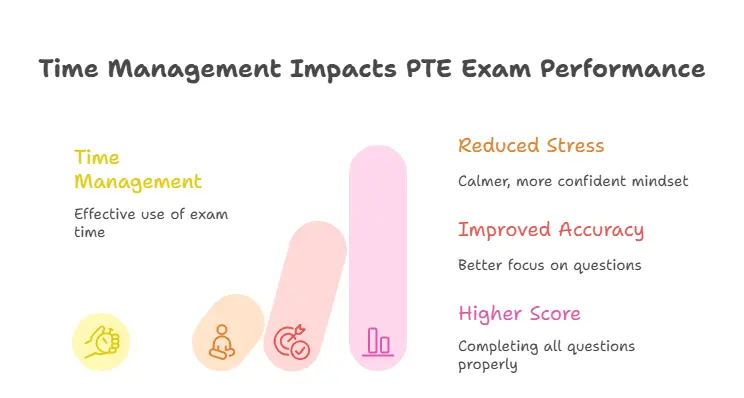
Time management matters a lot in the PTE exam because the test is designed to check how well you can perform under time pressure. Even if your English skills are strong, poor time control can lower your score. Each section of the PTE—Speaking, Writing, Reading, and Listening—has strict time limits. If you spend too long on one question, you may not have enough time to answer the remaining ones properly.
Many candidates lose marks not because they don’t know the answers, but because they panic, rush, or fail to complete all questions. For example, in the Reading section, spending too much time understanding one difficult passage can leave other easier questions unanswered. In the Speaking section, hesitation or overthinking can waste valuable seconds and affect fluency. Good time management helps you keep a steady pace and avoid these mistakes.
Managing time well also helps reduce stress. When you know how much time to spend on each task, you feel more relaxed and confident during the exam. This calm mindset improves concentration, clarity of thought, and overall performance. You are more likely to give clear answers, make fewer errors, and stay focused until the end of the test.
Strict Time Limits for Every Section
Each section of the PTE exam—Speaking, Writing, Reading, and Listening—comes with fixed time limits. If you spend too much time on one question, you may not be able to complete the remaining ones. This can directly affect your overall score, even if your answers are accurate.
Avoiding Panic and Rushing
Poor time management often leads to panic. When candidates realize they are running out of time, they start rushing through questions, which increases mistakes. Managing your time well helps you maintain a steady pace and answer questions calmly and clearly.
Improving Accuracy and Focus
When you know how much time to spend on each task, you can focus better on the question instead of watching the clock. This improves your accuracy, especially in sections like Reading and Listening, where concentration is very important.
Computer-Based Exam Pressure
The PTE exam is computer-based, and most questions cannot be skipped or revisited. This makes time management even more important. Practicing under timed conditions helps you respond faster and feel comfortable with the exam format.
Boosting Confidence and Performance
Good time management builds confidence. When you feel in control of your time, you perform more confidently and consistently. This positive mindset helps you give your best performance throughout the exam.
Section-Wise Time Management Tips
Managing your time smartly in each section of the PTE exam can make a big difference to your final score. Since the test is fast-paced and computer-based, knowing how to use your time wisely helps you stay calm, focused, and confident.
Speaking & Writing Section
In the Speaking tasks, quick thinking is very important. Use the short preparation time to understand the question and plan your response. Do not try to create perfect sentences in your mind before speaking. Instead, focus on speaking clearly, naturally, and without long pauses. Keep your answers simple and to the point. For writing tasks, such as essays or summaries, spend a few minutes planning your ideas. This helps you write faster and stay organized. Avoid spending too much time on introductions—focus on completing the task within the given word limit and time.
Reading Section
The Reading section can feel stressful because of the number of questions. The key is not to get stuck on one difficult question. If a passage or question seems confusing, make your best guess and move on. Skim the passage first to understand the main idea, then scan for keywords related to the question. This method saves time and helps you find answers more quickly. Practice reading faster so you do not feel pressured during the exam.
Listening Section
Listening requires full attention because the audio plays only once. Use shorthand or short notes to write down important points, keywords, and numbers while listening. Do not try to write full sentences, as this will slow you down. After the audio finishes, answer the questions calmly using your notes. If you miss some information, do not panic—focus on what you did understand and continue.
Overall Time Management Tips
Practice regularly under exam conditions to improve your speed. Learn the format of each question type so you know what to expect. Stay calm, trust your preparation, and remember that good time management helps you perform consistently across all sections.
By using these section-wise time management tips, you can reduce stress, avoid rushing, and improve your overall PTE performance.
Recommended Time Allocation for Each Task
Managing your time correctly in the PTE exam is just as important as knowing the answers. Since the test is fast-paced and computer-based, having a clear idea of how much time to spend on each task helps you stay calm, focused, and in control throughout the exam.
1. Speaking Tasks
Speaking tasks such as Read Aloud, Repeat Sentence, Describe Image, and Retell Lecture require quick thinking and smooth delivery. Use the preparation time to understand the task and organize your thoughts. Do not try to memorize sentences. Most speaking responses last around 30 to 40 seconds. Speak at a natural pace and avoid long pauses. Finishing your response clearly within the allowed time is more important than speaking very fast.
2. Writing Tasks
For Summarize Written Text, you usually get about 10 minutes. Spend the first 2 minutes reading the passage carefully and identifying key points. Use the next 6 to 7 minutes to write your summary in one clear sentence. Keep the last minute for checking grammar and spelling.
For the Essay task, you get around 20 minutes. Use 3 to 5 minutes to plan your ideas and structure. Spend about 12 to 14 minutes writing the essay, and save the final minute for a quick review. Planning before writing helps you write faster and more clearly.
3. Reading Tasks
The Reading section includes multiple question types, so time management is critical. For short questions, aim to spend no more than 1 to 2 minutes per question. For longer passages, quickly skim the text to understand the main idea, then scan for keywords related to the question. Avoid spending too much time on difficult questions. It is better to answer all questions than to perfect just a few.
4. Listening Tasks
Listening tasks require full concentration because audio plays only once. Take short and clear notes while listening, focusing on keywords, main ideas, and numbers. For tasks like Summarize Spoken Text, use about 2 minutes to organize your notes after the audio ends and the remaining time to write. For multiple-choice or fill-in-the-blank tasks, answer quickly using your notes and move on without overthinking.
Final Advice
These recommended time allocations are guidelines, not strict rules. Everyone works at a different pace. Regular practice under timed conditions will help you find the balance that suits you best. With proper time planning, you can reduce stress, avoid rushing, and give your best performance in every part of the PTE exam.
Common Mistakes that Waste Time
Many PTE candidates lose valuable time not because the exam is too difficult, but because of small mistakes that slow them down. Understanding these common time-wasting habits can help you avoid them and perform more efficiently on test day.
1. Spending Too Much Time on One Question
One of the biggest mistakes is getting stuck on a single difficult question. Some candidates keep re-reading the same passage or overthinking their answer, hoping to be perfect. This wastes time that could be used on easier questions. In the PTE exam, it is better to make a reasonable choice and move on instead of spending too long on one task.
2. Overthinking Answers
Trying to give a perfect answer often leads to hesitation and delays. In speaking tasks, overthinking can cause long pauses, which affects fluency. In writing tasks, candidates may keep editing sentences instead of finishing the task. Clear and simple answers given on time score better than perfect answers that are incomplete.
3. Poor Planning Before Writing
Many test takers start writing immediately without planning. This can lead to confusion, repeated ideas, and wasted time fixing mistakes later. Spending a few minutes planning your response helps you write faster and more clearly, saving time overall.
4. Reading Every Word Carefully
In the Reading section, reading every word slowly is a common mistake. This approach takes too much time and is unnecessary. Skimming for the main idea and scanning for keywords is much more effective and helps you answer questions faster.
5. Trying to Write Everything in Listening Tasks
During listening tasks, some candidates try to write down everything they hear. This is impossible and wastes time. It also makes you miss important points. Taking short notes with keywords and main ideas is enough and much more efficient.
6. Lack of Practice Under Timed Conditions
Many candidates practice without using a timer. As a result, they are not used to working under time pressure. This causes panic during the real exam and leads to poor time management. Practicing with a timer helps you understand your pace and manage time better.
7. Not Knowing the Exam Format
Unfamiliarity with question types and instructions can waste valuable seconds. If you do not clearly understand what is required, you may hesitate or make mistakes. Knowing the exam format well helps you respond quickly and confidently.
Avoiding these common mistakes allows you to use your time wisely, stay calm, and improve your overall PTE performance.
Smart Strategies for Faster Improvement
Improving your PTE score does not always mean studying harder or longer. It means studying smarter. By using the right strategies, you can improve faster, save time, and feel more confident during the exam.
Practice with a Clear Plan
Random practice often leads to slow progress. Instead, create a simple study plan that focuses on your weak areas. If speaking is difficult for you, practice speaking tasks daily. If reading takes too much time, work on speed-reading exercises. A clear plan helps you use your study time more effectively and see improvement faster.
Practice Under Timed Conditions
One of the best ways to improve quickly is to practice with a timer. Many candidates know the answers but struggle with time pressure. Practicing under real exam conditions helps you improve speed, reduce panic, and manage time better on test day.
Focus on High-Scoring Tasks
Some tasks in the PTE exam carry more weight than others. Focus more on tasks like Read Aloud, Repeat Sentence, Summarize Written Text, and Essay Writing. Improving performance in these areas can significantly boost your overall score in less time.
Use Simple and Clear Language
Trying to use complex words and long sentences can slow you down and increase mistakes. Simple, clear language improves fluency, accuracy, and speed. Examiners value clarity more than complexity, so focus on being understandable.
Analyze Your Mistakes
After each practice test, review your answers carefully. Understand why you made mistakes and how to avoid them next time. This reflection helps you improve faster than repeated practice without analysis.
Build Daily Speaking and Listening Habits
Speaking and listening skills improve with regular use. Listen to English podcasts, news, or videos daily, and speak aloud whenever possible. This builds confidence and improves response speed naturally.
Stay Calm and Consistent
Stress and overthinking slow down progress. Stay positive, practice consistently, and trust your preparation. Small daily improvements add up over time. By following these smart strategies, you can improve your PTE performance faster, manage time better, and achieve your target score with confidence.
Join Enrtri PTE Coaching Course
Conclusion
Effective time management is a key factor in achieving a high score in the PTE exam. By understanding the exam format, allocating time wisely to each section, and practicing under real test conditions, candidates can reduce stress and improve accuracy. Consistent practice, smart prioritization, and staying calm during the test help ensure that no section is rushed or neglected. Ultimately, mastering time management not only boosts confidence but also maximizes overall performance, bringing test-takers one step closer to their desired PTE score.
Ace Your PTE Exam with Confidence!
Unlock your potential with our expert-led PTE preparation course. Achieve your dream score and open doors to global opportunities!
Start Your PTE Preparation Today!Frequently Asked Questions
Why is time management important in the PTE exam?
Time management is crucial because the PTE exam is strictly timed and computer-based. Poor time allocation can lead to unanswered questions, rushed responses, and lower scores. Managing time effectively allows candidates to complete all tasks calmly while maintaining accuracy and fluency.
How much time should I spend on each PTE section?
Each section has a fixed duration: Speaking & Writing (54–67 minutes), Reading (29–30 minutes), and Listening (30–43 minutes). Candidates should practice pacing within each section, especially for tasks like reading multiple-choice questions and writing essays, to ensure all questions are attempted.
Which PTE tasks require the most time management focus?
Tasks such as Summarize Written Text, Write Essay, Reading Fill in the Blanks, and Write From Dictation demand careful time control. Spending too long on one question can reduce time for high-scoring tasks later in the section.
Should I skip difficult questions to save time?
Yes, it is often better to move on from a difficult question rather than spend excessive time on it. Since many PTE tasks do not penalize incorrect answers, attempting all questions—even with partial confidence—can help maximize your score.
How can I improve my speed without losing accuracy?
Regular practice under timed conditions is the best way to improve speed. Use mock tests, track how long you take for each question type, and gradually reduce your response time while maintaining clarity, grammar, and pronunciation.
Is it okay to finish a section early in the PTE exam?
Finishing early is acceptable if you are confident in your responses. However, if time remains, use it wisely to review answers in sections where editing is allowed, such as Writing and Reading.
How can I manage time better during the Speaking section?
Speak clearly and naturally without rushing. Avoid long pauses and unnecessary filler words. Practicing speaking within the given preparation and response time helps you deliver complete answers without being cut off.
What are the best tools to practice PTE time management?
Full-length mock tests, section-wise practice tests, and online timers are excellent tools. They help simulate real exam pressure and train you to allocate time efficiently across all PTE tasks.