
Table of Contents
The PTE writing practice test enables candidates to know their language level and helps them to improve and successfully achieve their desired PTE scores in 2025. PTE writing practice tests are designed keeping in mind the integrated approach of evaluation in the PTE exam. Dedicated practice of PTE writing tests helps students to develop their language skills in a better way and be exam-ready.
Join Enrtri PTE Coaching Course
Introduction

Overview of PTE Writing Section
The Writing section of the PTE (Pearson Test of English) Academic test checks how well you can express your ideas clearly and correctly in written English. It is designed to measure not only your grammar and vocabulary but also your ability to organize thoughts, follow instructions, and manage time. If you are new to the test, don’t worry—the tasks are straightforward once you understand what is expected.
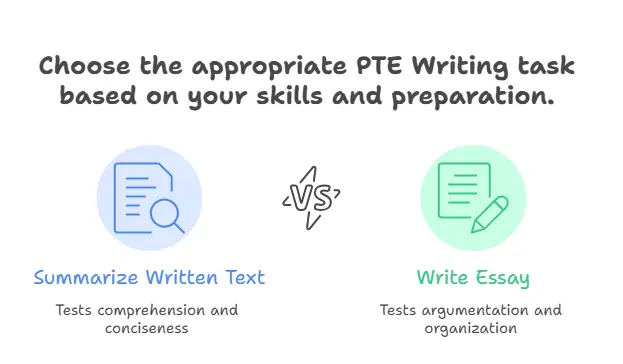
In the PTE Academic exam, the Writing section includes two main task types: Summarize Written Text and Write Essay.
In the Summarize Written Text task, you will read a short passage (usually around 200–300 words) and write a one-sentence summary of it. Your response must be between 5 and 75 words. The goal is to capture the main idea of the passage in a clear and accurate way. You should focus on the key points, avoid unnecessary details, and use proper grammar and punctuation. Since it must be one sentence, using connectors such as “although,” “because,” or “while” can help you combine ideas smoothly.
In the essay task, you will write an essay of 200–300 words in response to a question. You usually have 20 minutes to complete it. The topic may ask for your opinion, a discussion of two views, or a solution to a problem. A good essay should have a clear introduction, one or two body paragraphs with supporting ideas, and a short conclusion. Try to stay on topic, give relevant examples, and organize your ideas logically.
Here are a few important tips. First, manage your time carefully—don’t spend too long on planning, but always take a minute to organize your thoughts before you start writing. Second, focus on clarity rather than using very complicated words. Simple and correct sentences are better than complex sentences with mistakes. Finally, practice regularly. The more you write, the more confident and comfortable you will feel.
Ace Your PTE Exam with Confidence!
Unlock your potential with our expert-led PTE preparation course. Achieve your dream score and open doors to global opportunities!
Start Your PTE Preparation Today!Types of Questions in PTE Writing
The PTE (Pearson Test of English) Academic Writing section includes two main question types: Summarize Written Text and Write Essay. Each task measures different writing skills, but both focus on clarity, organization, grammar, and vocabulary. Understanding the format and purpose of each task will help you feel more confident on test day.
1. Summarize Written Text
Format: You will read a passage of about 200–300 words and write a one-sentence summary of the main idea. Your response must be between 5 and 75 words, and you usually have 10 minutes to complete this task.
Purpose: This task tests your ability to identify key points, understand the main message of a text, and combine information into a single clear and grammatically correct sentence.
Key Features:
-
Only one sentence is allowed.
-
You should include the main idea and important supporting points.
-
Good grammar, punctuation, and sentence structure are important.
-
Linking words (such as “although,” “because,” “while,” and “however”) help connect ideas smoothly.
Typical Prompt Example: After reading a passage about climate change, you might need to summarize the causes, effects, and possible solutions discussed in the text in one sentence.
2. Write Essay
Format: You will write an essay of 200–300 words in response to a question. You have 20 minutes to complete it.
Purpose: This task measures your ability to develop and organize ideas, present arguments clearly, and support your opinions with reasons or examples.
Key Features:
-
A clear structure (introduction, body paragraphs, conclusion) is important.
-
You should stay on topic and answer the question directly.
-
Logical organization and clear paragraphs improve your score.
-
Accurate grammar and appropriate vocabulary are essential.
Typical Prompt Examples:
-
Do you agree or disagree that technology has improved education?
-
Discuss the advantages and disadvantages of living in a big city.
-
Some people believe governments should invest more in public transport. Discuss both views and give your opinion.
Although there are only two question types in the PTE Writing section, each requires specific skills and careful time management. Regular practice will help you write more clearly, think more quickly, and feel fully prepared for the exam.
PTE Summarize Written Text – Practice Tips
The Summarize Written Text task may look simple, but it requires strong reading and writing skills. You must read a passage and write one clear sentence (5–75 words) that captures the main idea. Since you only have 10 minutes, it’s important to work efficiently and confidently. Here are practical strategies to help you succeed.
1. Read with Purpose
Don’t try to memorize every detail. Instead:
-
Focus on the main idea of the passage.
-
Pay attention to the topic sentence (often in the first paragraph).
-
Notice repeated ideas or key themes.
-
Identify important supporting points (causes, effects, examples, or conclusions).
Ask yourself: What is this passage mainly about?
That answer will guide your summary.
2. Highlight and Plan Quickly
Spend 3–4 minutes reading and identifying:
-
The central topic
-
2–3 key supporting ideas
You do not need small details, statistics, or minor examples. Write short notes if needed, but keep it simple.
3. Combine Ideas into One Sentence
Remember, your response must be one sentence only. To do this:
-
Start with the main idea.
-
Add supporting points using linking words like:
-
although
-
because
-
while
-
including
-
which
-
and
-
For example, the passage explains how renewable energy is becoming more popular due to environmental concerns, government support, and technological improvements.
Make sure your sentence flows naturally and connects ideas logically.
4. Focus on Grammar and Clarity
Your sentence should:
-
Have a clear subject and verb
-
Use correct punctuation (only one full stop at the end)
-
Avoid informal language
-
Stay within the 5–75 word limit
Simple and correct sentences score better than long, confusing ones.
5. Manage Your Time Wisely
A good time plan:
-
3–4 minutes: Read and identify key ideas
-
4–5 minutes: Write your summary
-
1–2 minutes: Check grammar, word count, and clarity
PTE Essay Writing – Structure & Examples
Ace Your PTE Exam with Confidence!
Unlock your potential with our expert-led PTE preparation course. Achieve your dream score and open doors to global opportunities!
Start Your PTE Preparation Today!Grammar & Vocabulary Tips for PTE Writing
Strong grammar and appropriate vocabulary are essential for scoring well in the PTE Writing section. Examiners assess not only your ideas but also how accurately and clearly you express them. Below are practical and easy-to-follow tips to help you improve.
✅ Grammar Tips for PTE Writing
1. Use Clear Sentence Structure
Every sentence should have:
-
A subject
-
A verb
-
A complete idea
Example: Technology plays an important role in modern education.
Avoid sentence fragments or overly long sentences that are difficult to follow.
2. Focus on Tense Consistency
Use the correct tense and avoid switching tenses without reason.
✔ Present simple for general facts: Online learning provides flexibility.
✔ Present perfect for ongoing changes: Technology has improved communication in recent years.
3. Avoid Common Grammar Mistakes
Be careful with:
-
Subject–verb agreement: Students benefit from online resources. (not “benefits”)
-
Articles (a, an, the): The government should invest in public transport.
-
Plural forms: Many advantages exist.
4. Use Complex Sentences (Carefully)
Using linking words can improve your grammar score.
Examples:
-
Although online education is convenient, it requires self-discipline.
-
Because traffic congestion is increasing, governments should improve public transport.
Do not make sentences too complicated. Accuracy is more important than complexity.
✅ Vocabulary Tips for PTE Writing
1. Use Formal Language
Avoid informal words:
-
❌ kids → ✔ children
-
❌ a lot of → ✔ many / numerous
-
❌ get → ✔ obtain / receive
2. Use Topic-Specific Vocabulary
For common PTE topics, learn useful words:
Education: curriculum, academic performance, online learning, qualifications
Environment: pollution, renewable energy, climate change, sustainability
Technology: innovation, digital devices, automation, artificial intelligence
3. Avoid Repetition
Do not repeat the same word many times.
Instead of: Technology is important because technology helps students use technology.
Write: Technology is important because digital tools help students learn more effectively.
4. Do Not Use Overly Difficult Words
Using very advanced vocabulary incorrectly can lower your score. Choose words you are confident using.
✔ Clear and correct is better than complicated and wrong.
Sample Practice Questions
Practicing with realistic questions is one of the best ways to prepare for the PTE Writing section. Since the Writing section includes Summarize Written Text and Essay Writing, it is important to understand what typical questions look like and how to approach them effectively.
1. Summarize Written Text – Sample Practice
Sample Question 1
Instructions: Read the passage below and write a one-sentence summary (5–75 words).
Passage:
In recent decades, urbanization has increased rapidly around the world. Many people move to cities in search of better job opportunities, education, and healthcare. However, rapid urban growth has also created challenges such as overcrowding, pollution, and housing shortages. Governments are now focusing on sustainable urban planning to balance economic development with environmental protection and improved living conditions.
What This Question Tests
-
Your ability to identify the main idea
-
Your skill in combining key points into one clear sentence
-
Your grammar and sentence structure
How to Approach It
-
Identify the central theme (urbanization and its effects).
-
Select 2–3 key supporting ideas (benefits, problems, government solutions).
-
Combine them into one grammatically correct sentence.
Example Summary:
The passage explains that rapid urbanization offers economic opportunities but also creates environmental and social challenges, leading governments to adopt sustainable planning strategies.
Sample Question 2
Passage Topic: The impact of artificial intelligence on employment, discussing both job creation and job displacement.
In this type of passage, focus on:
-
The overall argument (AI changes employment)
-
Positive and negative effects
-
Future implications
2. Essay Writing – Sample Practice Questions
In the essay task, you must write 200–300 words in 20 minutes.
Sample Essay Question 1 (Opinion Essay)
Some people believe that students should study only subjects that are useful for their future careers. Others think students should study a wide range of subjects.
Do you agree or disagree?
What This Tests
-
Your ability to present a clear opinion
-
Logical organization
-
Supporting arguments with examples
How to Practice
-
Take 2–3 minutes to plan.
-
Decide your position clearly.
-
Write two strong body paragraphs with examples.
Sample Essay Question 2 (Discuss Both Views)
Some people think that governments should invest more in public transportation, while others believe building new roads is more important. Discuss both views and give your opinion.
What This Tests
-
Balanced discussion
-
Clear structure (introduction, two body paragraphs, conclusion)
-
Coherence and linking words
Sample Essay Question 3 (Advantages & Disadvantages)
Working from home is becoming increasingly popular. What are the advantages and disadvantages of this trend?
In this type:
-
One body paragraph = advantages
-
One body paragraph = disadvantages
-
Conclusion summarizes both sides
How to Evaluate Your Writing Answers
Evaluating your own writing is one of the most powerful ways to improve your PTE score. Many students practice regularly but do not review their mistakes carefully. If you learn how to assess your answers properly, you can identify weaknesses and improve faster.
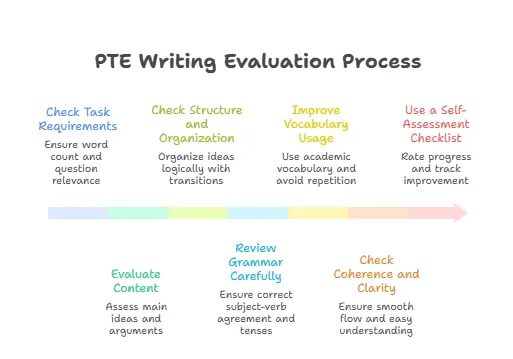
Step 1: Check Task Requirements First
Before reviewing grammar or vocabulary, ask:
-
Did I follow the word limit?
-
Summary: 5–75 words (one sentence only)
-
Essay: 200–300 words
-
-
Did I answer the question directly?
-
Did I complete the task fully?
If you do not follow instructions, your score can decrease—even if your English is good.
Step 2: Evaluate Content
For Summarize Written Text:
-
Did I include the main idea?
-
Did I avoid minor details?
-
Is my summary accurate?
-
Is it only ONE sentence?
For Essay:
-
Is my opinion clear?
-
Did I fully address the question type (agree/disagree, discuss both views, advantages/disadvantages)?
-
Are my arguments logical and relevant?
-
Did I provide examples or explanations?
Step 3: Check Structure and Organization
A well-organized answer is easier to read and scores higher.
For Essays:
-
Clear introduction?
-
One main idea per body paragraph?
-
Logical conclusion?
-
Smooth transitions between paragraphs?
Look for linking words such as:
-
Firstly, Secondly, However, In addition, Therefore, In conclusion
If your ideas feel disconnected, improve transitions.
Step 4: Review Grammar Carefully
Ask yourself:
-
Are subjects and verbs correct?
-
Are tenses consistent?
-
Are sentences complete?
-
Did I avoid very long, confusing sentences?
Tip: Read your answer slowly. Grammar mistakes are easier to spot when reading carefully.
Step 5: Improve Vocabulary Usage
Check for:
-
Repetition of the same words
-
Informal language (avoid “kids,” “a lot of,” “things”)
-
Incorrect word forms (e.g., “develop” vs. “development”)
Use clear and appropriate academic vocabulary, but avoid overly complex words you are not confident using.
Step 6: Check Coherence and Clarity
Ask:
-
Does my writing flow naturally?
-
Are ideas logically connected?
-
Is every sentence easy to understand?
If a sentence feels confusing, simplify it.
Step 7: Use a Simple Self-Assessment Checklist
After each practice, rate yourself (1–5) in:
-
Content
-
Structure
-
Grammar
-
Vocabulary
-
Coherence
Track your progress over time.
Join Enrtri PTE Coaching Course
Conclusion
Preparing for the PTE Writing section may seem challenging at first, but with the right structure, consistent practice, and careful self-evaluation, it becomes much more manageable. Understanding the task types, organizing your ideas clearly, and focusing on accurate grammar and appropriate vocabulary are the key steps toward success. Remember that improvement does not happen overnight—it comes from regular practice, reviewing your mistakes, and learning from them. Stay patient, stay consistent, and believe in your progress. With dedication and the right approach, you can build strong writing skills and confidently achieve your desired PTE score.
Ace Your PTE Exam with Confidence!
Unlock your potential with our expert-led PTE preparation course. Achieve your dream score and open doors to global opportunities!
Start Your PTE Preparation Today!Frequently Asked Questions
How many tasks are there in the PTE Writing section?
The PTE Writing section includes two main tasks: Summarize Written Text and Write Essay. In the summary task, you must write one sentence (5–75 words) based on a passage. In the essay task, you must write a 200–300 word essay in response to a question. Both tasks assess grammar, vocabulary, organization, and clarity.
How much time is given for each writing task?
You typically have 10 minutes for each Summarize Written Text question and 20 minutes for the Essay task. Time management is very important, especially for the essay, where you need to plan, write, and review within the time limit.
What is the ideal structure for a PTE essay?
A strong PTE essay follows a simple structure:
-
Introduction (paraphrase + opinion)
-
Body Paragraph 1 (main idea + example)
-
Body Paragraph 2 (main idea + example)
-
Conclusion (summary + restated opinion)
This structure improves clarity and coherence.
How is the PTE Writing section scored?
Your writing is scored based on:
-
Content (relevance and completeness)
-
Form (word limit and format)
-
Development, structure, and coherence
-
Grammar
-
Vocabulary
-
Spelling
Automated scoring evaluates both language accuracy and organization.
How can I improve my grammar for PTE Writing?
Focus on common grammar areas such as:
-
Subject–verb agreement
-
Tense consistency
-
Articles (a, an, the)
-
Sentence structure
Practice writing regularly and review your mistakes carefully after each attempt.
Should I use complex vocabulary in my essay?
Use formal and academic vocabulary, but avoid words you are not confident using. Clear and correct language is better than complicated vocabulary with mistakes. Accuracy is more important than difficulty.
How can I write a good summary in one sentence?
First, identify the main idea of the passage. Then select 2–3 key supporting points. Combine them into one clear sentence using linking words like although, because, or while. Avoid including small details or examples.
Is it important to give examples in the essay?
Yes. Examples strengthen your argument and show deeper understanding. They do not need to be real statistics—simple, logical examples are enough to support your points.
What are common mistakes in PTE Writing?
Common mistakes include:
-
Exceeding or not meeting the word limit
-
Writing more than one sentence in the summary task
-
Repeating ideas
-
Going off-topic
-
Making frequent grammar or spelling errors
Careful review can help you avoid these issues.
How often should I practice PTE Writing?
It is recommended to practice at least 3–4 times per week under timed conditions. Regular practice improves speed, organization, and confidence. Reviewing and rewriting weak answers is just as important as writing new ones.