Table of Contents
Preparing for a PwC HR Manager interview can feel both exciting and challenging. As one of the world’s leading professional services firms, PwC looks for HR leaders who can balance strategic vision with people-centered decision-making. Whether you’re experienced in HR or stepping into a more senior role, understanding the kinds of questions PwC asks—and why they ask them—can give you a powerful edge. In this blog, we’ll explore the most common PwC HR Manager interview questions, what the company expects from candidates, and how you can craft strong, insightful answers that highlight your expertise and leadership potential.
Is being an HR your dream? Enrol now for our course on Human Resource!
Overview of PwC as a Company
PwC’s Business Areas
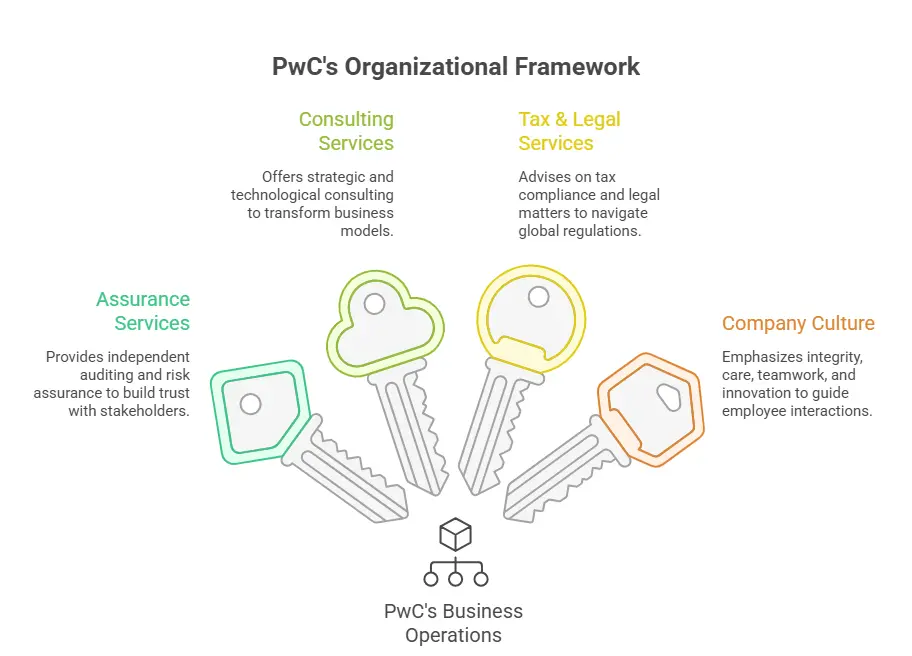
PwC (PricewaterhouseCoopers) is one of the “Big Four” professional services firms, operating across three major service lines:
1. Assurance (Audit & Risk Assurance)
-
Core service area focused on providing independent auditing of financial statements.
-
Helps clients build trust with stakeholders by ensuring accuracy, transparency, and compliance.
-
Includes risk assurance, ESG reporting, internal controls, and digital audit solutions.
2. Consulting
-
Offers strategic, operational, financial, and technological consulting.
-
Helps organizations transform their business models, digital capabilities, and workforce strategies.
-
Areas include Strategy&, Cybersecurity, Cloud & Digital, Deals, and Workforce Transformation.
-
Strong emphasis on emerging technologies such as AI, data analytics, automation, and cloud integration.
3. Tax & Legal Services
-
Advises clients on corporate tax, international tax compliance, transfer pricing, and tax structuring.
-
Supports businesses navigating global tax regulations, sustainability-related tax policies, and risk management.
-
PwC Legal (in select regions) provides complementary legal advisory services.
Company Culture and Values
PwC’s culture is built around a values-based framework known as The PwC Purpose and Values, which guide how employees work with clients and one another.
Key Values:
-
Act with Integrity: Upholds ethics, honesty, confidentiality, and trustworthiness in all interactions.
-
Make a Difference: Encourages employees to create positive impact for clients, communities, and the planet.
-
Care: Focuses on empathy, respect, well-being, and inclusion within teams and client relationships.
-
Work Together: Reinforces collaboration, diversity of thought, and leveraging global networks.
-
Reimagine the Possible: Inspires innovation, creativity, and forward-thinking solutions using technology and new ideas.
PwC is known for a people-first culture that emphasizes learning, leadership development, and continuous growth. The company invests heavily in training, digital upskilling, and opportunities to work on meaningful, large-scale projects across industries.
The role of an HR Manager at PwC goes far beyond traditional HR functions. At a firm known for its high-performance, client-driven culture, the HR Manager acts as a strategic business partner, a culture ambassador, and a key driver of people excellence. PwC expects its HR leaders to influence business outcomes, develop top talent, and maintain a workplace that reflects the company’s values—integrity, care, teamwork, and a commitment to reimagining the possible.
Role of an HR Manager at PwC
1. Key Responsibilities of an HR Manager at PwC
Talent Management
Talent is the core of PwC’s business. As an HR Manager, you are responsible for:
-
Identifying high-potential employees early and creating pathways for their growth
-
Managing talent review cycles and succession planning
-
Ensuring employees receive continuous learning and leadership development
-
Partnering with leaders to map skill gaps and prepare future-ready talent
-
Supporting mobility opportunities across service lines and global networks
PwC’s leadership framework is competency-based, so HR must align individuals’ growth with long-term business goals.
Workforce Planning & Resource Deployment
PwC operates in a project-based, fast-paced environment, so efficient workforce management is critical.
Responsibilities include:
-
Forecasting headcount needs for major projects and client engagements
-
Ensuring the right talent is deployed to the right projects at the right time
-
Balancing workloads to avoid burnout and ensure efficiency
-
Collaborating closely with business leaders to plan future hiring needs
-
Supporting cross-functional staffing and mobility between teams
This role requires strong demand planning, data analysis, and agility.
Performance Management
HR Managers at PwC oversee a high-accountability performance culture. Core duties include:
-
Driving mid-year and year-end performance review cycles
-
Coaching managers on providing actionable, constructive feedback
-
Supporting employees with development plans and ongoing coaching
-
Ensuring performance evaluation processes are fair, transparent, and value-driven
-
Identifying performance risks early and implementing structured improvement plans
Performance management at PwC is both continuous and metrics-driven.
Diversity, Equity & Inclusion (DEI)
PwC prioritizes building an inclusive workplace where every individual feels valued and supported.
Your DEI responsibilities include:
-
Supporting DEI programs, training, and awareness initiatives
-
Monitoring diversity representation and progress against targets
-
Ensuring unbiased recruitment and promotion practices
-
Creating opportunities for underrepresented groups to develop
-
Collaborating with Employee Resource Groups (ERGs)
A strong HR Manager helps make inclusion part of everyday behaviors—not just formal programs.
2. Skills Required for HR Managers at PwC
PwC HR Managers must combine people expertise with business acumen. Key skills include:
Strategic HR Knowledge
-
Workforce analytics
-
Talent management frameworks
-
Succession planning
-
HR policy design
-
Change management
Data & Technology Capabilities
PwC emphasizes digital transformation, so HR Managers should be comfortable with:
-
HRIS tools (Workday, SuccessFactors, etc.)
-
Metrics dashboards
-
Workforce analytics
-
Predictive HR insights
Problem-Solving & Decision-Making
You must quickly identify issues, weigh options, and present solutions grounded in data and business priorities.
Employment Law & Compliance
A strong understanding of regional labor laws, risk mitigation, and compliance processes is essential in a global firm like PwC.
3. Soft Skills & Leadership Expectations
PwC places heavy emphasis on behavior, leadership qualities, and cultural fit. HR Managers are expected to demonstrate:
Empathy & Emotional Intelligence
HR is the anchor of trust. Managers must build rapport, read situations well, and support people with sensitivity.
Communication & Influencing Skills
You must communicate with clarity, influence leaders confidently, and handle difficult conversations professionally.
Collaboration & Stakeholder Management
PwC values teamwork. HR Managers must work closely with partners, directors, managers, and cross-functional teams globally.
Ethical Judgment & Integrity
HR is the guardian of fairness. PwC expects HR leaders to uphold high ethical standards in decision-making.
Change Leadership
PwC undergoes continuous transformation—digital, operational, and cultural. HR Managers should be able to:
-
Navigate ambiguity
-
Lead teams through change
-
Communicate transitions effectively
-
Build employee trust
Adaptability & Resilience
Consulting environments are fast-moving. HR Managers must stay calm under pressure, prioritize effectively, and handle complexity with confidence.
Become an HR Expert – Enroll in Our HR Management Course Today!
Unlock the secrets to effective Human Resource Management with our expert-led course! Learn recruitment, employee relations, performance management, and more to build a thriving workplace. Start your journey toward a successful HR career today!
Know MoreTop 30 PwC HR Manager Interview Questions & Detailed Answers
1. Tell me about yourself.
Answer: I have over X years of HR experience specializing in talent management, employee engagement, and HR operations. My expertise includes partnering with leadership to build people-focused strategies, optimizing HR processes, and supporting organizational change. I’m particularly drawn to PwC because of its strong focus on leadership development, culture, and continuous improvement.
2. Why do you want to work at PwC?
Answer: PwC’s reputation for leadership development, its focus on building a culture of trust, and its investment in digital transformation strongly align with my HR philosophy. I’m motivated to support a people-centric organization with global impact, and PwC’s values—especially “care” and “make a difference”—mirror how I approach HR leadership.
3. What HR metrics do you consider most important?
Answer: I prioritize metrics tied to business outcomes:
-
Employee turnover and retention
-
Time-to-hire and quality-of-hire
-
Employee engagement scores
-
Diversity metrics
-
Learning and development ROI
These indicators reveal organizational health and help guide strategic decisions.
4. How do you handle conflict between employees?
Answer: I follow a structured mediation approach: first understanding each perspective individually, then facilitating a neutral discussion to identify root issues and align on expectations. My goal is to protect psychological safety, rebuild trust, and ensure accountability from both sides.
5. Describe your experience with performance management systems.
Answer: I’ve implemented both traditional and continuous feedback models. My focus is setting clear expectations, providing frequent coaching, and aligning individual goals with business priorities. I also train managers on delivering constructive, actionable feedback—something PwC emphasizes strongly.
6. How do you support diversity, equity, and inclusion (DEI)?
Answer: I embed DEI into recruitment, leadership development, promotions, and employee listening mechanisms. I’ve also implemented bias-mitigation training and built dashboards to track DEI progress. For me, DEI is not a program but a daily practice that must be measurable and culturally ingrained.
7. Describe a time you managed organizational change.
Answer: I led HR operations during a major restructuring that required workflow redesign and role changes. I created clear communication plans, supported managers with talking points, and implemented a feedback loop to monitor employee sentiment. As a result, engagement dips were minimized and productivity stabilized quickly.
8. How do you handle difficult conversations?
Answer: I approach them with empathy and clarity. I prepare facts, avoid assumptions, and communicate the impact of the issue rather than personal traits. This ensures honesty while maintaining respect and trust.
9. How do you ensure compliance with labor laws?
Answer: I conduct regular audits, update policies proactively, and train managers on legal requirements. I also stay current with regulatory updates and partner with legal teams when necessary. Compliance is non-negotiable and helps uphold PwC’s trust-centered culture.
10. What’s your approach to talent acquisition?
Answer: I focus on strategic workforce planning, competency-based interviews, employer branding, and data-driven recruitment. I also collaborate closely with hiring managers to ensure alignment on role expectations and ideal candidate profiles.
11. How do you handle underperforming employees?
Answer: I diagnose the root issue (skill gap, motivation, workload, clarity) and then create a tailored improvement plan. This includes clear goals, support resources, and timelines. If improvement isn’t achieved, I follow structured HR procedures for disciplinary action.
12. What HR technologies have you used?
Answer: I have experience with Workday, SuccessFactors, BambooHR, and various ATS systems. I rely on HR analytics dashboards to support decision-making, workforce planning, and predictive modeling.
13. Describe your leadership style.
Answer: I lead with transparency, collaboration, and accountability. I empower team members through coaching and autonomy while ensuring clarity in goals and expectations.
14. How do you build an employee-centric culture?
Answer: Regular listening (surveys, focus groups), transparent communication, recognition systems, and leadership alignment. Culture requires consistent reinforcement, not just periodic initiatives.
15. How do you manage high-volume recruitment?
Answer: I use structured screening processes, automation tools, talent pipelines, and close collaboration with hiring teams to speed up decision-making while maintaining quality.
16. How do you handle confidential HR issues?
Answer: With strict discretion, limited access, and secure documentation. Trust is foundational to HR, and confidentiality must never be compromised.
17. How do you measure employee engagement?
Answer: Through surveys, pulse checks, attrition trends, stay interviews, and 1:1 manager feedback. Engagement insights should guide leadership decisions and HR strategy.
18. What’s your approach to onboarding new employees?
Answer: A structured 30-60-90-day plan, role clarity, culture immersion, early performance conversations, and manager training. Strong onboarding reduces turnover and accelerates productivity.
19. Describe a time you improved an HR process.
Answer: I redesigned the performance review workflow, reducing processing time by 40% and improving feedback quality through training and templates.
20. How do you manage relationships with senior leaders?
Answer: By being data-driven, solution-oriented, and proactive. I communicate insights clearly and act as a strategic partner—not just an HR administrator.
21. How do you keep yourself updated on HR trends?
Answer: Industry certifications, HR forums, PwC thought leadership, conferences, and continuous learning through SHRM/HRCI resources.
22. How do you approach succession planning?
Answer: By identifying critical roles, assessing talent potential, creating development plans, and partnering with leadership to ensure readiness pipelines.
23. How do you maintain employee morale during tough times?
Answer: Empathy, transparency, and communication. I ensure employees feel heard and supported while giving managers tools to lead through uncertainty.
24. Tell me about a successful project you led.
Answer: I implemented a new HRIS system that integrated payroll, performance, and recruitment. This improved data accuracy and saved 200+ HR hours per month.
25. How do you handle employee grievances?
Answer: With impartial investigations, timely communication, documentation, and resolution that aligns with policy and fairness.
26. How do you coach managers to be better leaders?
Answer: Through training, role-playing scenarios, feedback models, and ongoing support. Strong managers are foundational to retention.
27. How do you approach compensation and benefits planning?
Answer: Benchmarking, market analysis, equity considerations, and alignment with business goals. Transparency and fairness are key.
28. How do you support remote or hybrid workforce management?
Answer: Clear communication norms, digital collaboration policies, remote engagement activities, and productivity measurement that focuses on outcomes, not activity.
29. Describe a difficult HR decision you’ve made.
Answer: I once had to execute a performance-based termination after multiple improvement opportunities. I ensured fairness, documentation, dignity, and support for the employee’s transition.
30. What makes you a strong fit for PwC?
Answer: My experience aligning HR strategy with business objectives, my ability to build strong relationships, and my commitment to continuous improvement align closely with PwC’s culture and values. I bring both operational strength and strategic leadership.
Is being an HR your dream? Enrol now for our course on Human Resource!
Tips for Acing a PwC HR Interview
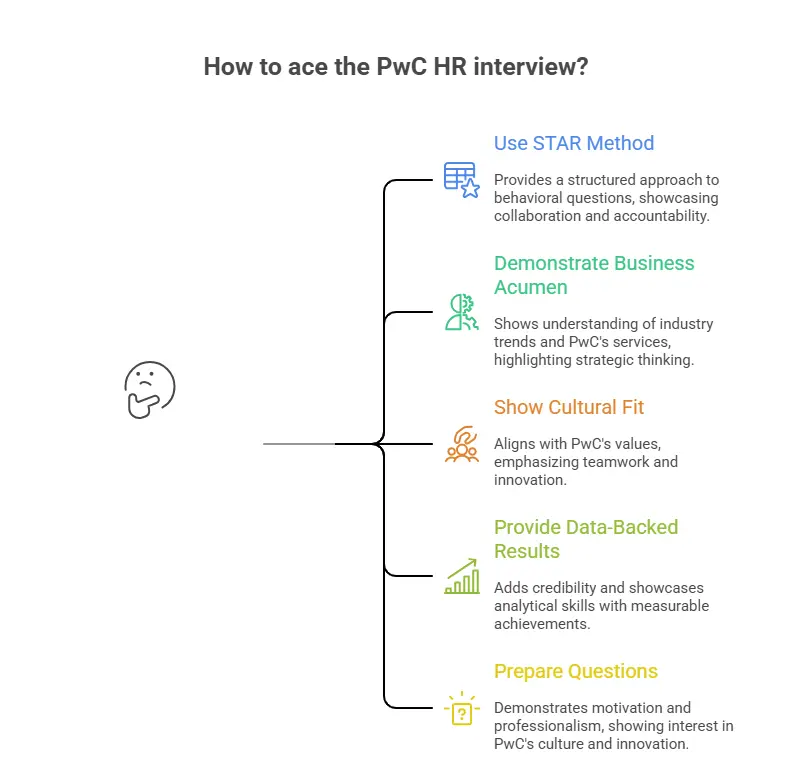
1. Use the STAR Method for Behavioral Questions
PwC relies heavily on behavioral questions to understand how you think and act.
Use the STAR framework to structure your answers:
-
Situation – Set the context
-
Task – Describe your responsibility
-
Action – Explain what you did
-
Result – Share measurable outcomes
Example:
“Tell me about a time you handled a conflict on a team.” A good STAR answer shows collaboration, accountability, and professionalism—values PwC prizes.
2. Demonstrate Business Acumen
PwC wants employees who understand how businesses operate and the challenges they face.
Show that you have awareness of:
-
Industry trends (AI, ESG, digital transformation, regulation)
-
PwC’s service lines and their relevance
-
How external forces impact clients
You don’t need deep technical knowledge—just show you think like a consultant, auditor, or analyst.
3. Show Cultural Fit With PwC’s Values
Always weave PwC’s core values into your answers:
-
Care – Show empathy, teamwork, and support
-
Integrity – Highlight honesty and accountability
-
Work Together – Demonstrate collaboration
-
Reimagine the Possible – Show innovation
-
Make a Difference – Illustrate positive impact
HR wants to know: “Will this person thrive in our people-first, collaborative environment?”
4. Provide Data-Backed HR or Work Results
PwC is extremely results-oriented. Any achievement you mention should ideally include numbers, such as:
-
“Reduced processing time by 30%.”
-
“Improved client satisfaction scores by 15%.”
-
“Led a team of 5 to deliver a project 2 weeks early.”
Metrics make you sound credible, analytical, and business-focused.
5. Prepare Thoughtful Questions for the Interviewer
Always have 2–3 questions ready. This shows motivation and professionalism.
Great PwC-specific examples:
-
“How does PwC support employees in developing digital skills?”
-
“What qualities make someone successful here?”
-
“Can you describe the team culture within this business unit?”
-
“How does PwC invest in innovation and technology?”
What PwC Looks for in an HR Manager
PwC expects HR Managers to be more than administrative leaders—they are strategic partners who influence organizational effectiveness, drive people strategy, and support high-performance culture. Here are the core qualities PwC prioritizes:
1. Strategic Mindset
PwC wants HR Managers who think beyond day-to-day tasks and align HR initiatives with business goals.
This includes:
-
Understanding how HR impacts growth, productivity, and client service
-
Linking workforce strategies to PwC’s broader priorities (digital upskilling, innovation, inclusion, ESG, etc.)
-
Using data and predictive analytics to guide decisions
A PwC HR Manager needs to show they can move from operational HR to strategy-focused HR.
2. Confidentiality & Integrity
Integrity is a core PwC value, and HR is entrusted with sensitive information.
PwC looks for HR Managers who:
-
Handle employee data and issues discreetly
-
Uphold ethical decision-making even when pressured
-
Maintain confidentiality with investigations, performance issues, and personal matters
Trustworthiness is non-negotiable.
3. Employee-First Thinking
PwC’s people-first culture means HR must focus on employee well-being, growth, and engagement.
An HR Manager should demonstrate:
-
Empathy and active listening
-
A strong commitment to diversity, equity, and inclusion
-
Awareness of employee needs, concerns, and career aspirations
-
Experience improving employee experience through policies and programs
PwC wants HR leaders who advocate for people, not just processes.
4. Relationship-Building
PwC is a partnership-driven, team-oriented environment.
Successful HR Managers:
-
Build trust with employees, partners, and leadership teams
-
Collaborate across departments (Consulting, Assurance, Tax, Internal Firm Services)
-
Support team cohesion and resolve conflicts proactively
-
Create strong internal networks
HR is expected to be approachable, credible, and supportive.
5. Influencing & Stakeholder Management
PwC values HR Managers who can influence without authority.
They should be able to:
-
Guide partners and directors on people decisions
-
Pitch HR initiatives and demonstrate their ROI
-
Coach leaders to adopt best practices
-
Navigate competing priorities diplomatically
The ability to persuade and negotiate is essential in a consulting-driven culture.
6. Change Management Ability
PwC is constantly evolving—digitization, automation, global transformation, and new regulatory demands.
HR Managers must be able to:
-
Drive organizational change smoothly
-
Support teams during restructures, new systems, or culture shifts
-
Communicate change clearly and empathetically
-
Train managers and employees to adapt
PwC wants HR leaders who can help the workforce evolve with the business.
7. Strong Analytical & Data-Driven Thinking
PwC expects HR Managers to use data to support decisions.
This includes:
-
Workforce analytics
-
Engagement data
-
Performance metrics
-
Turnover trends
-
DEI dashboards
Data makes recommendations stronger, faster, and more aligned with business strategy.
8. Ability to Uphold and Model PwC’s Values
PwC evaluates HR leaders on how well they embody the firm’s values:
-
Integrity
-
Care
-
Work Together
-
Make a Difference
-
Reimagine the Possible
HR Managers are expected to lead by example and promote these values in hiring, performance management, and culture initiatives.
Is being an HR your dream? Enrol now for our course on Human Resource!
Conclusion
Preparing for a PwC HR Manager interview becomes much easier when you understand the role, the company’s expectations, and the types of questions you may be asked. PwC looks for HR leaders who are people-focused, analytical, and aligned with the firm’s values. By reviewing the key responsibilities, practicing thoughtful answers, and showcasing your HR expertise, you’ll be well-equipped to make a strong impression. With the right preparation and mindset, you can confidently take the next step toward joining PwC’s dynamic and people-driven workplace.
Become an HR Expert – Enroll in Our HR Management Course Today!
Unlock the secrets to effective Human Resource Management with our expert-led course! Learn recruitment, employee relations, performance management, and more to build a thriving workplace. Start your journey toward a successful HR career today!
Know MoreFrequently Asked Questions
What is the interview process like for a PwC HR Manager role?
PwC’s HR Manager interview process typically includes multiple rounds. Candidates usually start with a recruiter screening, followed by one or two behavioral interviews with HR leaders, and finally a business interview with senior stakeholders or partners. The interviews focus on your HR expertise, leadership capability, alignment with PwC’s values, and your ability to operate in a fast-paced, client-focused environment.
What skills does PwC look for in an HR Manager?
PwC seeks HR professionals who combine strategic thinking with strong execution. Key skills include talent management, workforce planning, performance management, HR analytics, and employee relations. Soft skills such as communication, collaboration, problem-solving, and the ability to influence senior leaders are equally important. Demonstrating integrity, empathy, and alignment with PwC’s values is essential.
How can I prepare for a PwC HR Manager interview?
Start by researching PwC’s culture, values, and leadership framework. Review the job description carefully and link your experience to the role’s core responsibilities. Practice behavioral questions using the STAR method, prepare examples that demonstrate measurable impact, and be ready to explain how you’ve managed complex HR challenges. Understanding PwC’s service lines—Assurance, Advisory, and Tax—can also help you tailor your answers.
What questions should I expect in a PwC HR Manager interview?
Expect a mix of behavioral, technical HR, leadership, and scenario-based questions. Examples include:
-
“How do you handle performance issues?”
-
“Tell me about a time you led organizational change.”
-
“How do you support diversity and inclusion?”
-
“Why do you want to work at PwC?”
These questions test both your HR knowledge and your cultural fit.
Does PwC focus on values-based interviewing?
Yes. PwC uses its values as a foundation for evaluating candidates. Interviewers assess how well you demonstrate integrity, care, teamwork, and innovation through your examples. They want to see how you make decisions, manage relationships, and support people in ways that reflect the firm’s culture. Authentic, real-world examples help you stand out.
What makes someone successful in the HR Manager role at PwC?
Success in this role requires balancing strategic HR leadership with hands-on support for employees and managers. Strong HR Managers at PwC are proactive, analytical, and people-driven. They communicate clearly, manage change effectively, build strong relationships with stakeholders, and ensure HR practices align with the firm’s long-term goals. Being adaptable and comfortable working in a dynamic, high-performance environment is also crucial.