Table of Contents
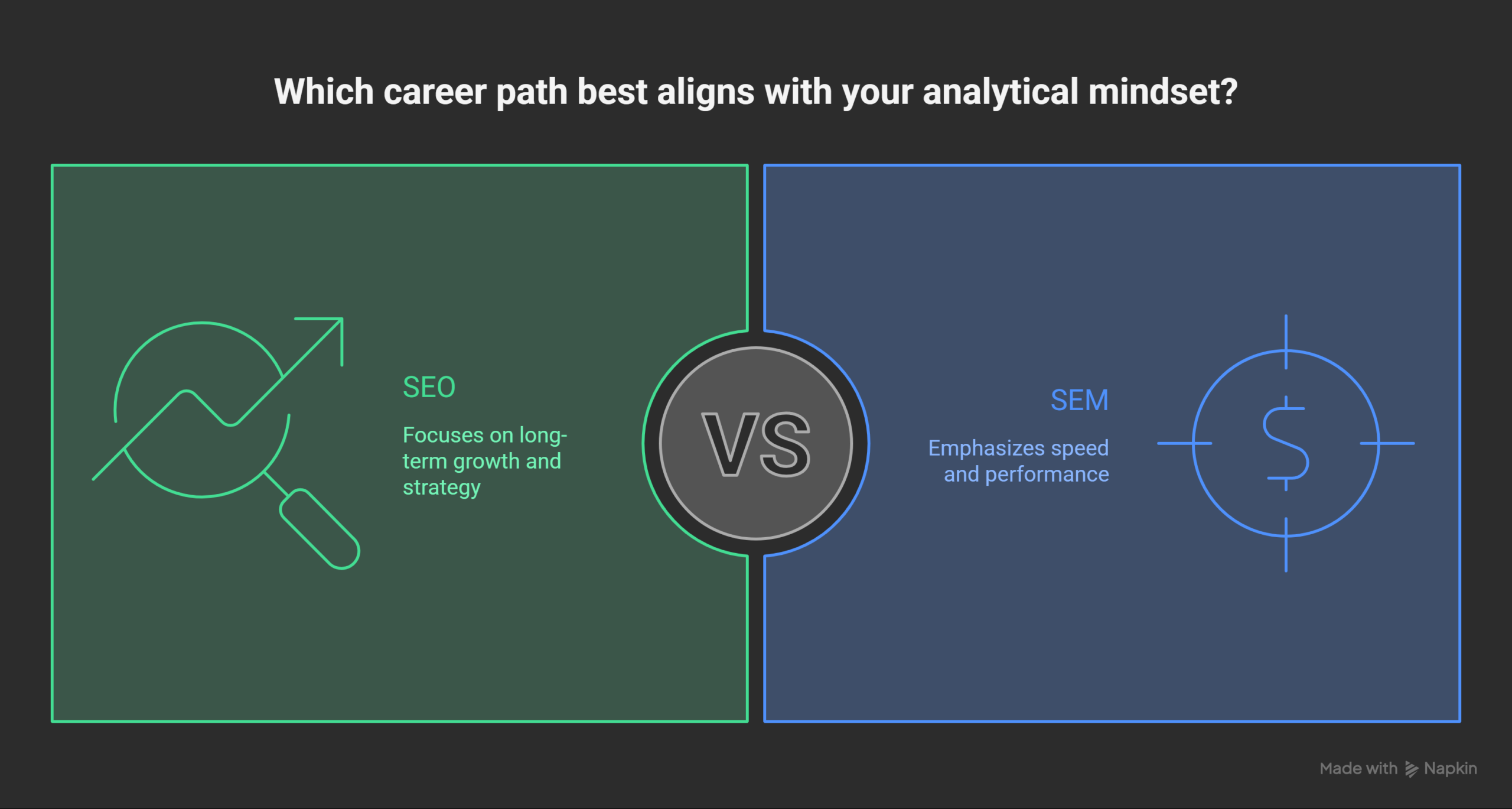
SEO vs SEM is a common topic today. Many students feel confused choosing between them. Both careers need strong analytical thinking skills. Both offer good growth in digital marketing. Companies now depend on data for decisions. Search engines bring huge traffic daily. Businesses compete for better visibility online. So choosing the right path matters.
Analytical minds enjoy working with numbers. They like reading reports and simple data. They prefer logic more than creativity. Digital marketing now depends on clear data. Every campaign is measured carefully. Search marketing jobs are growing fast. Each path has different daily tasks. Knowing the difference helps you decide. Let us understand both in simple terms.
Join Our Online Digital Marketing Course & Learn the Fundamentals!
Introduction
Digital marketing is evolving at a rapid pace. Businesses now demand measurable and trackable results. Marketing teams rely heavily on performance data. Every click and conversion is carefully monitored. Companies want clear proof of growth. Decisions are no longer based on assumptions. They are supported by real numbers. This shift increases demand for analytical professionals. Data-driven marketing roles are expanding across industries. Both startups and large companies invest in analytics. Professionals must understand reports and insights. They must convert numbers into smart actions. Logical thinking is now a major advantage. Analytical skills are becoming essential in marketing.
Technology has strengthened this demand further. Advanced tools generate detailed performance reports. Automation simplifies large data processing tasks. Real-time dashboards track campaign performance continuously. Businesses expect measurable returns on every investment. Marketing budgets are monitored closely. Performance metrics guide strategic decisions daily. Companies need professionals who understand trends. They value individuals who interpret patterns accurately. This creates stable and rewarding career paths. Analytical minds find strong opportunities here. The future of marketing clearly belongs to data.
Among many career options, SEO and SEM stand out. Both focus on improving search visibility. Both rely strongly on numbers and insights. SEO concentrates on organic growth strategies. SEM focuses on paid advertising performance. Each role demands structured thinking and analysis. Professionals constantly study performance indicators. They adjust strategies based on findings. Both fields offer steady career growth. They also provide competitive salary potential. For analytical thinkers, these paths are attractive. Choosing between them requires understanding their differences clearly.
Growing Demand for Data-Driven Marketing Roles
-
Businesses demand measurable marketing outcomes.
-
Performance tracking improves decision accuracy.
-
Data reduces unnecessary marketing expenses.
-
Analytics enhances customer targeting precision.
-
Companies prefer logically skilled professionals.
-
Digital growth increases employment opportunities.
-
Search platforms drive business expansion.
-
Skilled analysts receive competitive compensation.
SEO and SEM as Top Analytical Career Options
-
SEO focuses on organic search performance.
-
SEM concentrates on paid campaign metrics.
-
Both require strong data interpretation skills.
-
Both depend on continuous performance analysis.
-
SEO suits long-term strategic thinkers.
-
SEM fits fast decision-makers well.
-
Both offer structured career progression.
-
Analytical minds can excel in either field.
What Is SEO? (Career Perspective)
1: What is the primary goal of SEO (Search Engine Optimization)?
2: Which of the following is NOT a PPC (Pay-Per-Click) platform?
3: What does PPC mean?
4: What does the term "bounce rate" refer to?
5: Which tool is most commonly used for web traffic analytics?
Ever wondered how much you really know? It's time to put your brain to the test!
Search Engine Optimization is a career focused on organic search growth. It improves website visibility without paid advertisements. SEO professionals help businesses attract consistent online traffic. Their work supports long-term digital presence. They rely on research and structured execution. Every action is backed by performance data. This career suits individuals who enjoy analysis. It requires patience and logical thinking. Success depends on measurable improvement over time.
Role Overview
An SEO professional manages a website’s search performance. They identify keywords aligned with business goals. They optimize pages for better visibility. These professionals collaborate with writers and developers. They ensure technical structure supports crawling. They monitor rankings regularly. SEO professional share performance reports with teams. Their suggestions are based on data insights.
SEO roles differ based on experience.
Key Responsibilities
-
Keyword Research
-
Identify relevant search queries
-
Study search volume trends
-
Evaluate keyword competition
-
-
On-Page Optimization
-
Improve title tags and descriptions
-
Structure headings properly
-
Enhance internal linking
-
-
Technical Monitoring
-
Check indexing status
-
Improve page speed
-
Fix broken links
-
-
Performance Reporting
-
Track ranking movements
-
Measure traffic growth
-
Analyze engagement metrics
-
Below is a simplified role structure:
| Level | Role | Main Focus |
|---|---|---|
| Entry | SEO Executive | Execution and keyword research |
| Mid | SEO Analyst | Data tracking and optimization |
| Senior | SEO Manager | Strategy and planning |
Each role requires analytical thinking. Higher levels involve stronger decision authority. However, all levels depend on measurable outcomes.
Nature of Analysis in SEO
SEO work revolves around structured data evaluation. Professionals study user behavior patterns carefully. They interpret performance indicators logically. Their analysis usually covers three core areas.
-
Search Intent Analysis
-
Ranking Analysis
-
Traffic Behavior Analysis
1. Search Intent Analysis
Search intent explains why users search specific terms. Understanding intent improves content relevance. Professionals classify queries clearly.
Common intent types include:
| Intent Type | User Goal | Focus Area |
|---|---|---|
| Informational | Learn about a topic | Detailed content creation |
| Navigational | Find a brand or page | Brand visibility |
| Transactional | Complete a purchase | Product optimization |
Key analytical tasks include:
-
Studying keyword demand
-
Measure search volume
-
Identify seasonal trends
-
-
Evaluating competition
-
Analyze competitor content
-
Review ranking difficulty
-
-
Matching content with intent
-
Align blogs with informational queries
-
Align product pages with transactional queries
-
Correct intent mapping improves engagement. It increases ranking potential gradually.
2. Ranking Analysis
Ranking analysis monitors keyword positions over time. Professionals track performance changes carefully. Small movements provide useful insights.
Important ranking indicators include:
-
Keyword Position
-
Monitor weekly movement
-
Compare competitor positions
-
-
Visibility Score
-
Measure overall search presence
-
Identify growth opportunities
-
-
Click-Through Rate
-
Evaluate result attractiveness
-
Improve meta descriptions
-
Ranking trends show optimization effectiveness. Stable improvement indicates strategy success. Sudden drops require detailed investigation.
3. Traffic Behavior Analysis
Traffic analysis studies organic visitor patterns. Professionals examine engagement and interaction metrics. They measure performance consistently.
Key traffic metrics include:
| Metric | Meaning |
|---|---|
| Sessions | Total organic visits |
| Bounce Rate | Visitors leaving quickly |
| Average Duration | Time spent on site |
| Pages per Session | Depth of engagement |
Analytical focus areas include:
-
Engagement Evaluation
-
Identify high-performing pages
-
Detect weak content areas
-
-
Trend Monitoring
-
Compare monthly growth
-
Study seasonal patterns
-
-
Device Analysis
-
Compare mobile performance
-
Compare desktop behavior
-
Traffic data reveals content quality. Strong engagement signals effective optimization. Low engagement highlights improvement needs.
Analytical Thinking in SEO
SEO follows a structured analysis cycle.
-
Data Collection
-
Gather ranking reports
-
Collect traffic insights
-
-
Pattern Identification
-
Detect performance changes
-
Recognize user behavior trends
-
-
Strategic Adjustment
-
Modify content structure
-
Improve technical elements
-
-
Result Measurement
-
Compare before and after data
-
Monitor long-term growth
-
This process repeats consistently. Each step depends on logical interpretation. SEO is research-driven and performance-focused. It rewards patience and structured thinking.
Become an AI-powered Digital Marketing Expert
Master AI-Driven Digital Marketing: Learn Core Skills and Tools to Lead the Industry!
Explore CourseWhat Is SEM? (Career Perspective)
Search Engine Marketing focuses on paid search advertising. It helps businesses appear in sponsored results quickly. SEM professionals manage campaigns on search platforms. Their goal is immediate and measurable performance. This role is highly data-driven. Every action connects directly to spending. Every improvement aims to increase profitability. SEM suits individuals who enjoy numbers and quick decisions. It requires constant monitoring and optimization. Results are visible within short time periods.
Role Overview
An SEM professional plans, launches, and optimizes paid campaigns. They select keywords aligned with business goals. They create ads that attract potential customers. SEM professionals decide bidding strategies carefully. They distribute budgets across different campaigns. They monitor dashboards daily. Thee professionals adjust campaigns based on live data. Their focus remains on conversions and revenue growth.
SEM roles vary based on experience level. Entry-level roles handle execution tasks. Mid-level roles focus on optimization. Senior roles manage strategy and budgets. However, all levels depend on measurable performance.
Key Responsibilities
-
Campaign Planning
-
Identify high-intent keywords
-
Define target audience groups
-
Select bidding model
-
-
Ad Development
-
Write compelling headlines
-
Test multiple descriptions
-
Improve landing page relevance
-
-
Budget Management
-
Set daily spending limits
-
Allocate funds strategically
-
Reduce wasteful spending
-
-
Performance Tracking
-
Monitor clicks and impressions
-
Track conversion rates
-
Evaluate campaign profitability
-
Below is a simplified SEM role structure:
| Level | Role | Primary Focus |
|---|---|---|
| Entry | SEM Executive | Campaign setup and tracking |
| Mid | PPC Analyst | Data analysis and optimization |
| Senior | Performance Marketing Manager | Strategy and budget leadership |
Nature of Analysis in SEM
SEM analysis is financial and performance-based. Professionals study campaign costs carefully. They evaluate bidding efficiency continuously. They track conversions and revenue closely. Every decision aims to improve return on investment.
The nature of SEM analysis includes three main areas:
-
Budget Analysis
-
Bid Optimization
-
Conversion and ROI Evaluation
1. Budget Analysis
Budget management is essential in SEM. Professionals control daily and monthly spending. They ensure campaigns remain profitable. Overspending can reduce overall returns.
Key budget evaluation areas include:
-
Cost Monitoring
-
Analyze cost per click
-
Identify expensive keywords
-
Compare campaign spending
-
-
Allocation Strategy
-
Increase funds for strong campaigns
-
Reduce budgets for weak performers
-
Balance spend across segments
-
-
Cost Efficiency Tracking
-
Measure cost per acquisition
-
Monitor revenue against cost
-
| Budget Metric | Purpose |
|---|---|
| Daily Budget | Maximum allowed daily spend |
| CPC | Cost per click |
| CPA | Cost per acquisition |
| Total Spend | Overall campaign expense |
Careful budget control protects profitability. Smart allocation increases overall returns.
2. Bid Optimization
Bids determine ad placement visibility. Higher bids improve competitive position. However, high bids increase expenses. Professionals balance performance and cost carefully.
Bid analysis includes:
-
Keyword Performance Review
-
Identify high-converting keywords
-
Detect low-performing terms
-
Adjust bids accordingly
-
-
Quality Score Evaluation
-
Improve ad relevance
-
Enhance landing page experience
-
Increase click-through rate
-
-
Competitive Position Tracking
-
Measure impression share
-
Monitor competitor activity
-
Optimize bid strategy
-
| Bid Metric | Meaning |
|---|---|
| Max CPC | Maximum bid per click |
| Quality Score | Ad relevance indicator |
| Impression Share | Visibility percentage |
| Average Position | Typical ad ranking |
Frequent bid adjustments maintain competitiveness. Quick decisions improve campaign efficiency.
3. Conversion and ROI Analysis
Conversions measure campaign success directly. They include purchases, registrations, or inquiries. SEM professionals analyze conversion data consistently.
Key analytical focus areas include:
-
Conversion Tracking
-
Measure conversion rate
-
Track completed actions
-
Compare device performance
-
-
A/B Testing
-
Test different headlines
-
Compare landing pages
-
Evaluate performance variations
-
-
ROI Calculation
-
Compare revenue with total spend
-
Measure return on ad spend
-
Identify profitable campaigns
-
| Performance Metric | Purpose |
|---|---|
| Conversion Rate | Percentage of successful actions |
| CPA | Cost per completed conversion |
| ROAS | Revenue generated per ad spend |
| Revenue | Total income from ads |
High ROI reflects effective optimization. Low ROI demands immediate correction. Continuous testing improves results steadily.
Analytical Thinking in SEM
SEM follows a structured optimization cycle.
-
Data Collection
-
Review dashboards daily
-
Analyze cost reports
-
-
Gap Identification
-
Detect high spending keywords
-
Find low conversion areas
-
-
Strategic Adjustment
-
Modify bids
-
Update budgets
-
Improve ad copy
-
-
Result Measurement
-
Compare performance changes
-
Confirm profitability growth
-
This process repeats frequently. Speed and accuracy are essential. Every decision impacts financial outcomes. SEM rewards professionals comfortable with measurable risk and fast analysis.
Join Our Online Digital Marketing Course & Learn the Fundamentals!
Analytical Skills Required for SEO
SEO demands strong analytical thinking abilities. Professionals work with structured data daily. They interpret patterns before taking action. Decisions must rely on measurable evidence. Logical reasoning guides every optimization step. Small changes can create large impact. Therefore, analysis must be accurate. Attention to detail is essential. Consistency strengthens long-term results.
The analytical process in SEO usually focuses on three key areas:
-
Keyword Research and Search Intent
-
On-Page and Technical Evaluation
-
Traffic and Behavior Assessment
1. Keyword Research & Search Intent
Keyword research forms the foundation of SEO analysis. Professionals identify terms users frequently search. They examine demand and competition levels. Data determines keyword priority. Guesswork is never involved.
Search intent evaluation strengthens keyword strategy. Analysts study why users search certain phrases. They categorize queries based on purpose. Understanding intent improves relevance. Relevance increases ranking potential.
Key analytical tasks include:
-
Demand Identification
-
Measure monthly search volume
-
Identify rising search trends
-
Detect seasonal variations
-
-
Competition Evaluation
-
Analyze ranking difficulty
-
Study competitor content depth
-
Compare keyword strength
-
-
Intent Classification
-
Identify informational queries
-
Detect transactional phrases
-
Recognize navigational searches
-
Below is a simplified keyword evaluation structure:
| Analysis Area | Focus |
|---|---|
| Search Volume | Demand measurement |
| Keyword Difficulty | Competition strength |
| Intent Type | User objective |
| Trend Pattern | Growth direction |
Strong keyword analysis requires pattern recognition. Professionals compare multiple data sources. They prioritize achievable opportunities. Strategic selection improves optimization success.
2. On-Page and Technical Analysis
On-page evaluation focuses on content structure. Technical analysis examines website performance factors. Both require detailed observation. Errors can reduce visibility significantly.
On-page analytical skills include reviewing content clarity. Professionals check keyword placement carefully. They evaluate heading structure logically. They assess internal linking patterns. Each element must support user experience.
Technical analysis requires deeper evaluation skills. Professionals examine page loading speed. They review mobile responsiveness carefully. They identify indexing issues. Technical health directly affects performance.
Key analytical focus areas include:
-
Content Evaluation
-
Check keyword distribution
-
Assess readability quality
-
Improve content organization
-
-
Structural Review
-
Evaluate heading hierarchy
-
Optimize internal links
-
Strengthen navigation clarity
-
-
Technical Health Monitoring
-
Measure page speed performance
-
Identify crawl errors
-
Detect broken links
-
Below is a simplified technical review table:
| Technical Factor | Purpose |
|---|---|
| Page Speed | Improve user experience |
| Mobile Optimization | Ensure cross-device access |
| Crawl Status | Confirm search visibility |
| Error Reports | Identify technical problems |
Analytical thinking helps detect performance barriers. Professionals connect technical issues with ranking impact. They prioritize fixes based on severity.
3. Traffic & Behavior Analysis
Traffic analysis measures organic visitor patterns. Professionals study engagement signals carefully. These insights reveal content effectiveness.
Behavior analysis requires interpretation of multiple metrics. High traffic alone is insufficient. Engagement quality matters equally. Analysts evaluate how users interact with pages.
Important analytical areas include:
-
Engagement Monitoring
-
Measure session duration
-
Track bounce rates
-
Review pages per visit
-
-
Trend Comparison
-
Compare monthly growth
-
Identify seasonal drops
-
Detect unusual spikes
-
-
User Journey Evaluation
-
Analyze entry pages
-
Track navigation paths
-
Identify exit points
-
Below is a simplified behavior metrics table:
| Metric | Insight Provided |
|---|---|
| Sessions | Visitor count |
| Bounce Rate | Content relevance |
| Duration | Engagement level |
| Exit Rate | Drop-off points |
Strong analytical skills help interpret patterns correctly. Professionals avoid reacting to single-day changes. They focus on consistent trends. They correlate behavior data with optimization efforts.
Overall, SEO requires structured and logical analysis. Professionals examine keywords carefully. They evaluate technical elements systematically. They interpret traffic behavior precisely. Success depends on consistent data-driven decisions.
Analytical Skills Required for SEM
SEM demands sharp numerical reasoning skills. Professionals work with live performance dashboards. Every metric reflects financial impact. Quick interpretation is essential. Delayed decisions can waste budget. Therefore, analysis must be accurate and fast. Logical thinking drives every campaign change. Data always guides optimization choices.
The analytical skill set in SEM focuses mainly on three areas:
-
Campaign Data Analysis
-
A/B Testing and Optimization
-
Budget and Performance Tracking
Each area requires structured evaluation. Each decision affects cost and revenue directly.
1. Campaign Data Analysis
Campaign data analysis is the foundation of SEM work. Professionals monitor performance metrics daily. They evaluate clicks, impressions, and engagement rates. They interpret numbers before making adjustments.
Strong analytical skills help identify patterns quickly. Analysts compare high-performing and weak campaigns. They study keyword-level performance carefully. They examine device and audience data separately.
Key analytical tasks include:
-
Performance Evaluation
-
Measure click-through rate
-
Analyze impression volume
-
Compare engagement trends
-
-
Segment Comparison
-
Review device performance
-
Compare audience groups
-
Study geographic response
-
-
Trend Identification
-
Detect rising keywords
-
Identify declining segments
-
Observe time-based patterns
-
Below is a simplified campaign data overview:
| Metric | Insight Provided |
|---|---|
| Impressions | Ad visibility level |
| Click-Through Rate | Ad effectiveness |
| Conversion Rate | Action completion level |
| Cost Per Click | Spending efficiency |
Campaign data analysis requires continuous monitoring. Professionals avoid reacting emotionally. They rely on consistent data patterns. Accurate interpretation improves campaign efficiency steadily.
2. A/B Testing & Optimization
A/B testing is a core analytical activity. It compares different ad variations systematically. Professionals test small changes for measurable impact. Each variation must have a clear purpose.
Analysts create two versions of an ad. They change headlines, descriptions, or calls to action. They track performance differences carefully. The better-performing version becomes the new standard.
Key analytical steps include:
-
Hypothesis Formation
-
Identify improvement opportunity
-
Define measurable goal
-
-
Controlled Testing
-
Change one element only
-
Run both versions simultaneously
-
-
Performance Comparison
-
Measure click-through rate
-
Compare conversion rate
-
Evaluate cost differences
-
Below is a simplified testing comparison table:
| Test Element | Measured Outcome |
|---|---|
| Headline | Engagement change |
| Description | Click behavior |
| Landing Page | Conversion improvement |
| Call to Action | Action completion |
Optimization requires patience and discipline. Professionals avoid making multiple changes together. They measure results before scaling adjustments. Consistent testing improves overall performance gradually.
3. Budget and Performance Tracking
Budget tracking is a critical analytical responsibility. Professionals monitor daily spending limits closely. Overspending reduces profitability quickly. Under-spending may reduce growth potential. Balance is essential.
Performance tracking ensures cost efficiency. Analysts calculate cost per conversion regularly. They compare revenue against campaign spending. Profitability determines strategy adjustments.
Key evaluation areas include:
-
Cost Control
-
Monitor daily budget usage
-
Detect unexpected spending spikes
-
Reduce wasteful allocations
-
-
Efficiency Measurement
-
Calculate cost per acquisition
-
Compare campaign profitability
-
Identify high-return segments
-
-
Financial Trend Monitoring
-
Track weekly performance
-
Compare monthly results
-
Identify seasonal impact
-
Below is a simplified budget performance overview:
| Metric | Purpose |
|---|---|
| Total Spend | Overall campaign cost |
| Cost Per Acquisition | Conversion expense |
| Return on Ad Spend | Revenue efficiency |
| Profit Margin | Net performance outcome |
Strong analytical ability ensures financial stability. Professionals must respond quickly to cost changes. Continuous tracking prevents losses. Accurate interpretation improves long-term profitability.
Overall, SEM requires structured financial analysis. Professionals evaluate campaign data precisely. They conduct disciplined testing procedures. They monitor budget performance continuously. Success depends on quick reasoning and accurate decision-making.
Join Our Online Digital Marketing Course & Learn the Fundamentals!
Become an AI-powered Digital Marketing Expert
Master AI-Driven Digital Marketing: Learn Core Skills and Tools to Lead the Industry!
Explore CourseSEO vs. SEM: Skill Comparison
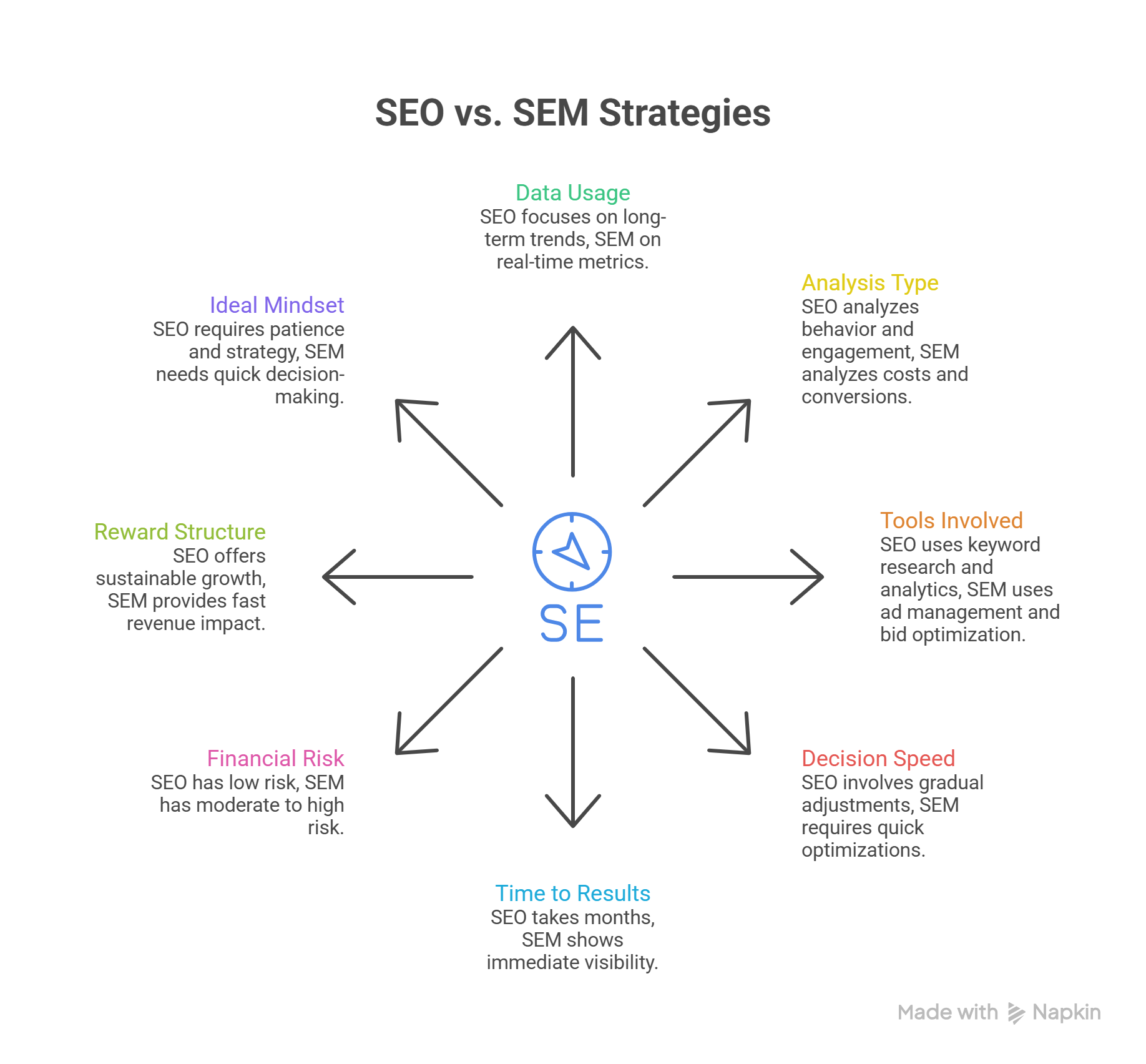
Both SEO and SEM demand analytical thinking. However, the type of skills applied differs clearly. Each path uses data differently. Each role depends on separate tools and timelines. Risk exposure also varies significantly. Understanding these differences helps professionals choose wisely.
The comparison can be analyzed across four key areas:
-
Data Usage
-
Tools Involved
-
Time to See Results
-
Risk vs Reward
1. Data Usage
Data interpretation forms the backbone of both careers. However, the depth and speed of analysis differ.
SEO relies on long-term data patterns. Professionals study historical performance carefully. They compare monthly and quarterly trends. Growth is measured gradually over time. Stability matters more than speed.
SEM relies on real-time performance signals. Professionals monitor campaign data daily. Immediate action is often required. Decisions must be fast and accurate. Short-term efficiency is critical.
Key comparison points include:
-
Data Frequency
-
SEO analyzes periodic trends
-
SEM monitors daily performance
-
-
Data Sensitivity
-
SEO tolerates slow fluctuations
-
SEM reacts to instant changes
-
-
Decision Speed
-
SEO decisions are strategic
-
SEM decisions are immediate
-
| Comparison Area | SEO Approach | SEM Approach |
|---|---|---|
| Data Timeline | Long-term trends | Real-time metrics |
| Adjustment Speed | Gradual changes | Quick modifications |
| Focus Area | Stability and growth | Cost and efficiency |
The difference lies in pace and urgency.
2. Tools Involved
Both careers depend heavily on digital tools. However, the purpose of tool usage varies.
SEO tools focus on research and tracking. They provide keyword insights and ranking data. These tools help identify technical issues. They support structured optimization decisions.
SEM tools focus on campaign management. They track spending and conversions. These tools allow bid and budget adjustments. They measure financial returns precisely.
Skill requirements related to tools include:
-
Analytical Tool Handling
-
Interpret performance dashboards
-
Extract meaningful insights
-
-
Reporting Capabilities
-
Generate structured reports
-
Present findings clearly
-
-
Optimization Control
-
Implement strategic improvements
-
Monitor performance impact
-
| Tool Function | SEO Usage | SEM Usage |
|---|---|---|
| Research | Keyword discovery | Audience targeting |
| Monitoring | Ranking tracking | Budget tracking |
| Reporting | Traffic evaluation | Conversion reporting |
Both roles require technical comfort. However, tool interaction frequency differs.
3. Time to See Results
Time expectation is a major difference.
SEO delivers results gradually. Growth happens over months. Improvements require patience and consistency. The process is cumulative. Results compound over time.
SEM delivers visible outcomes quickly. Campaign performance appears within days. Immediate optimization improves efficiency. Quick scaling is possible.
Key timeline differences include:
-
Result Visibility
-
SEO shows delayed impact
-
SEM shows immediate impact
-
-
Strategy Adjustment
-
SEO allows gradual refinement
-
SEM requires fast correction
-
-
Performance Measurement
-
SEO measures progressive growth
-
SEM measures daily outcomes
-
| Timeline Factor | SEO | SEM |
|---|---|---|
| Initial Results | Slow emergence | Fast visibility |
| Growth Pattern | Compounding effect | Immediate impact |
| Adjustment Cycle | Periodic review | Continuous monitoring |
The time horizon shapes analytical behavior significantly.
4. Risk vs Reward
Risk tolerance differs between both paths.
SEO involves minimal financial risk. Investment mainly includes time and effort. The growth is steady and sustainable. However, progress may be slower initially.
SEM involves direct financial exposure. Budget decisions impact profitability instantly. High performance brings rapid rewards. Poor optimization can increase losses.
Risk comparison points include:
-
Financial Exposure
-
SEO has indirect costs
-
SEM has direct spending
-
-
Performance Pressure
-
SEO focuses on long-term growth
-
SEM focuses on immediate returns
-
-
Reward Structure
-
SEO rewards patience
-
SEM rewards quick optimization
-
| Risk Factor | SEO | SEM |
|---|---|---|
| Monetary Risk | Low | Moderate to high |
| Return Speed | Gradual | Rapid |
| Stability | Long-term consistency | Performance-driven volatility |
The balance between risk and reward shapes career preference. Analytical minds must assess comfort with financial exposure. Some prefer steady progress. Others prefer fast measurable gains.
Which Career Path Suits Analytical Minds Better?
Both SEO and SEM require strong analytical ability. However, the type of thinking involved differs clearly. Some professionals prefer long-term pattern analysis. Others enjoy fast-paced numerical decisions. The better path depends on working style and comfort level. Analytical minds must evaluate their strengths carefully. Personality traits influence career satisfaction strongly.
This comparison becomes clearer under two situations:
-
When SEO is a Better Fit
-
When SEM is a Better Fit
When SEO Is a Better Fit
SEO suits professionals who enjoy structured research. It favors individuals comfortable with gradual progress. Analytical thinkers who like deep investigation perform well here. Patience is an important strength in this path. Results may take time to appear. However, steady growth can be rewarding.
SEO is suitable when you:
-
Prefer Long-Term Strategy
-
Enjoy studying multi-month trends
-
Like building sustainable growth
-
Feel comfortable with gradual improvement
-
-
Enjoy Pattern Recognition
-
Detect ranking movements
-
Analyze search behavior shifts
-
Study engagement fluctuations
-
-
Like Structured Problem Solving
-
Identify root causes of performance drops
-
Implement step-by-step improvements
-
Measure impact over extended periods
-
-
Prefer Lower Financial Pressure
-
Avoid daily budget monitoring
-
Focus more on optimization quality
-
Value stability over speed
-
Below is a simplified personality alignment table:
| Trait | Alignment with SEO |
|---|---|
| Patience | Strong fit |
| Research Interest | Highly suitable |
| Risk Tolerance | Low required |
| Strategic Thinking | Essential |
SEO fits analytical minds who think deeply. It rewards consistency and discipline. Professionals comfortable with delayed gratification thrive here.
When SEM Is a Better Fit
SEM suits professionals who enjoy fast decisions. It benefits individuals comfortable with financial metrics. Analytical thinkers who respond quickly perform strongly. The environment is dynamic and competitive. Immediate results create direct feedback. Performance adjustments happen daily.
SEM is suitable when you:
-
Enjoy Real-Time Data
-
Monitor daily dashboards
-
Respond quickly to changes
-
Make instant optimization decisions
-
-
Feel Comfortable Managing Budgets
-
Track spending closely
-
Balance cost and performance
-
Evaluate profitability frequently
-
-
Like Experimentation
-
Test multiple variations
-
Compare performance rapidly
-
Scale winning strategies quickly
-
-
Accept Measured Financial Risk
-
Understand cost implications
-
Adapt to performance fluctuations
-
Optimize under pressure
-
Below is a simplified personality alignment table:
| Trait | Alignment with SEM |
|---|---|
| Quick Decision Making | Strong fit |
| Numerical Comfort | Highly suitable |
| Risk Tolerance | Moderate required |
| Performance Focus | Essential |
SEM fits analytical minds who enjoy speed. It rewards financial awareness and agility. Professionals who prefer measurable daily impact often choose this path.
Final Consideration
Both careers demand logic and discipline. The difference lies in pace and pressure. SEO favors patient strategists. SEM favors rapid decision-makers. Analytical minds can succeed in both. The better choice depends on working preference and comfort with risk.
Salary & Career Growth (India)
SEO and SEM both offer strong career growth. Demand for search professionals is increasing steadily. Companies across industries hire digital specialists. Startups and large firms invest in search marketing. Analytical professionals receive competitive compensation packages. Salary growth depends on skills and performance. Location and company size also influence pay. Experience level plays a major role. Consistent performance improves earning potential.
Career growth in search marketing is structured. Professionals move from execution to strategy roles. Leadership opportunities increase with experience. Skill development directly impacts salary growth. Certifications and practical exposure strengthen profiles. Strong analytical ability improves promotion chances. Both paths offer stable long-term prospects.
This section examines salary and progression clearly:
-
Entry-Level Roles
-
Growth Trajectory
Entry-Level Roles
Fresh graduates usually begin as executives. Entry roles focus on learning and execution. Salaries vary based on city and company. Metro cities often offer higher pay. Skill level also affects starting compensation.
In India, entry-level SEO executives earn approximately ₹2.5–4 LPA. SEM executives usually earn around ₹3–5 LPA. Paid campaign roles may offer slightly higher packages. However, performance expectations are also higher.
Key factors influencing entry-level salary include:
-
Technical Skill Level
-
Understanding of analytics tools
-
Ability to interpret reports
-
Practical internship experience
-
-
Location
-
Metro cities offer higher packages
-
Tier-two cities offer moderate pay
-
-
Company Type
-
Agencies offer learning exposure
-
Startups provide growth opportunities
-
Enterprises offer structured roles
-
Below is a simplified salary comparison table:
| Role | Approximate Salary Range (India) |
|---|---|
| SEO Executive | ₹2.5–4 LPA |
| SEM Executive | ₹3–5 LPA |
Entry-level growth depends on learning speed. Professionals who show analytical strength advance faster.
Growth Trajectory
Career progression in search marketing is performance-driven. Promotions depend on measurable results. Experience increases responsibility gradually.
Typical career path includes:
-
Executive Level
-
Execute daily tasks
-
Support campaign management
-
Prepare performance reports
-
-
Analyst Level
-
Interpret data independently
-
Suggest optimization strategies
-
Manage smaller projects
-
-
Manager Level
-
Lead team members
-
Plan overall strategy
-
Handle client communication
-
-
Senior Leadership
-
Oversee multiple campaigns
-
Control larger budgets
-
Drive organizational growth
-
Mid-level professionals in India earn approximately ₹6–12 LPA. Senior managers may earn ₹15–25 LPA or more. High-performing professionals can exceed these ranges.
Below is a simplified growth overview:
| Experience Level | Approximate Salary Range |
|---|---|
| 0–2 Years | ₹2.5–5 LPA |
| 3–5 Years | ₹6–12 LPA |
| 6+ Years | ₹15–25 LPA |
Growth depends heavily on measurable impact. Strong analytical ability accelerates promotions. Continuous learning increases long-term potential. Professionals who adapt to industry trends remain competitive.
Overall, both SEO and SEM offer strong earning potential. Career stability improves with skill development. Analytical professionals can build long-term success in either path.
Conclusion
Search marketing offers strong opportunities for analytical professionals. Throughout this discussion, we explored the skills, comparisons, career fit, and salary potential in both SEO and SEM. The key difference lies in pace, pressure, and performance measurement. While SEO rewards long-term strategic thinking and structured analysis, SEM favors fast decision-making and budget-focused optimization. For individuals evaluating SEO vs. SEM as a career for analytical minds, the right choice depends on personal strengths, comfort with data interpretation, and preferred working style.
Ultimately, both paths provide excellent career growth in India and globally. With increasing digital competition, businesses depend heavily on search marketing experts who can interpret data and drive measurable results. Whether choosing SEO or SEM, continuous learning, analytical discipline, and adaptability remain essential for long-term success. By aligning your analytical strengths with the right specialization, you can build a stable, high-growth career in search marketing.
Frequently Asked Questions
What is the main difference between SEO and SEM careers?
SEO focuses on improving organic search visibility over time. It works without direct advertising spend. SEM focuses on paid search advertising campaigns. It delivers immediate traffic through sponsored listings. SEO requires long-term strategic optimization. SEM requires fast budget and bid management. Both rely heavily on data analysis. However, their speed and financial exposure differ significantly.
Which career is better for analytical minds, SEO or SEM?
Both careers suit analytical thinkers strongly. SEO suits those who enjoy long-term trend analysis. It favors professionals who prefer steady growth. SEM suits individuals comfortable with quick decisions. It rewards those who enjoy working with financial metrics. The better option depends on personal working style. Risk tolerance also plays an important role.
Is SEM more stressful than SEO?
SEM can feel more high-pressure. Campaign budgets require daily monitoring. Performance fluctuations demand quick responses. Mistakes may increase financial losses. SEO generally involves slower adjustments. It focuses on gradual improvements. However, both roles require accountability. Stress levels depend on company expectations.
Do SEO professionals need strong technical skills?
Yes, technical understanding is important in SEO. Professionals analyze website structure and indexing issues. They review page performance and usability factors. However, deep coding knowledge is not mandatory. Basic technical awareness is usually sufficient. Analytical ability matters more than programming expertise. Continuous learning improves technical confidence.
Is SEM suitable for fresh graduates?
Yes, SEM offers good entry-level opportunities. Beginners can start as campaign executives. They learn dashboard management and performance tracking. Strong numerical skills provide advantage. Practical internships improve employability. Entry-level salaries are competitive in metro cities. Growth depends on measurable campaign success.
Which field offers faster salary growth in India?
SEM may offer faster short-term growth. Paid campaigns directly influence revenue. Strong performance can lead to quick promotions. SEO growth may take slightly longer. However, experienced SEO professionals also earn well. Long-term earning potential is strong in both. Skill development and results matter most.
Can professionals switch between SEO and SEM later?
Yes, switching is possible and common. Both fields share foundational search knowledge. Understanding search behavior benefits both roles. Learning additional tools helps transition smoothly. Many professionals move into performance marketing roles. Combined expertise increases career flexibility. Cross-skilling enhances leadership opportunities.
Which role is more stable during economic downturns?
SEO may offer slightly more stability. It does not depend directly on advertising budgets. Companies often maintain organic optimization efforts. SEM budgets may reduce during financial slowdowns. However, businesses still rely on paid campaigns for revenue. Stability varies by industry and company size.
How long does it take to become proficient in SEO or SEM?
Basic proficiency usually takes three to six months. Practical exposure accelerates learning. Advanced expertise may require two to three years. Continuous practice improves analytical skills. Real campaign experience builds confidence. Certification courses can support structured learning. Consistency plays a major role in mastery.
Which career has better long-term prospects?
Both SEO and SEM have strong futures. Digital competition continues increasing globally. Businesses depend on search visibility heavily. Demand for analytical marketing professionals remains strong. Technology advancements create new optimization opportunities. Continuous skill upgrades ensure long-term success. Career growth depends on adaptability and performance.