Table of Contents
When it comes to education, the Montessori approach places a strong emphasis on creative expression, learning via hands-on experience, and total child development. In the process of deciding whether or not to participate in a training program that focuses on skills or a certificate program, prospective Montessori teachers frequently ask themselves this issue. It is essential to have a clear understanding of the differences between the two in order to make an educated choice regarding your future teaching profession, despite the fact that both have their own set of advantages.
Unlock your passion for education and shape young minds as a Montessori teacher!
What Is Skill-Based Montessori Training?
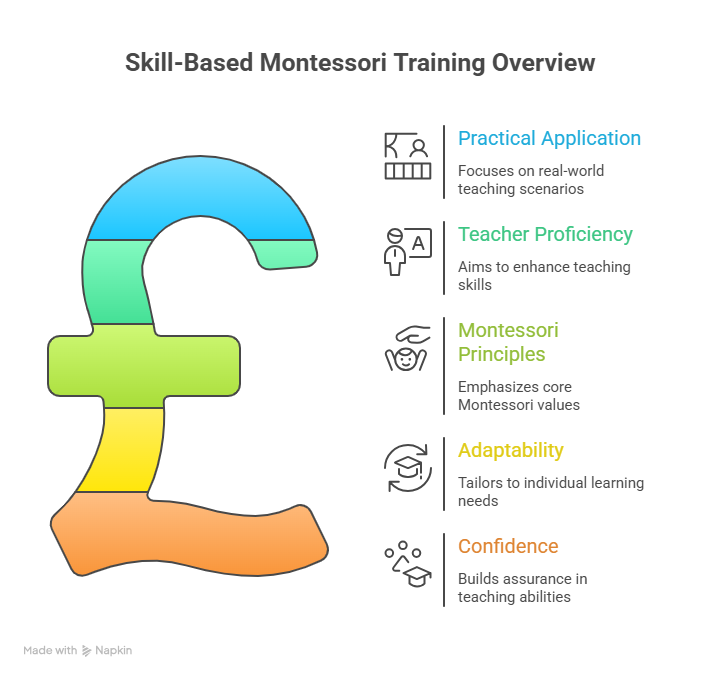
A program that is an alternative to the traditional Montessori education is called Skill-Based Montessori Training. The objective of this program is to assist teachers in becoming more proficient in their work rather than simply obtaining a credential. Conventional courses, on the other hand, place a greater focus on theory and examinations, in contrast to skill-based training. The use of practical application is emphasized, and the objective is to prepare you for the challenges that you might encounter in a classroom environment that is more realistic.
Some of the most essential characteristics are as follows:
- Obtaining information through hands-on practice can be accomplished in a number of different ways. This includes carrying out Montessori activities, organizing learning resources, and directing students in the classroom through the method.
- You are going to learn effective tactics for maintaining order in the classroom and tracking the development of your pupils, as well as strategies for creating a learning environment that is both safe and interesting for your kids.
- Real-world applications of Montessori concepts, such as autonomy, imagination, and self-study, are put into effect by you. Attention should be paid very carefully to the Montessori tenets.
- Due to the fact that it is so adaptable, skill-based training may be adapted to suit your individual learning style and pace.
- After you have completed the program, you will have the assurance that you are capable of teaching, regardless of whether or not you have a certificate.
What Are Certificate-Based Montessori Courses?
1: What is the primary focus of the first plane of development in the Montessori method?
After a student has completed all of the certificate-based Montessori courses, they will be eligible to get the official certification. These courses guarantee that students have a comprehensive understanding of the Montessori philosophy and are able to effectively execute it in the classroom by incorporating theory, methods, and assessments into their curriculum. When compared to training that is simply focused on practical talents, this is a significant difference.
The following are important components:
- The structured curriculum covers a wide range of subjects, some of which are child development, Montessori methods, lesson planning, and classroom management, to name just a few.
- Exams, quizzes, and various other forms of evaluation will be required of you in the majority of your classes. The purpose of these kinds of assessments is to ascertain how well you have understood the material.
- Following the successful completion of a course, the acquisition of a certificate serves as a formal acknowledgement that might potentially lead to improved work opportunities through recognition by Montessori organizations and schools.
- It is a typical practice for many educational institutions to favour or demand credentialed professors when it comes to admission, particularly at universities that are more renowned or internationally known. This is especially true for colleges that are known for their international fame.
- A balanced learning approach combines theoretical knowledge with practical experience in order to enhance the effectiveness of education and bring it into conformity with the standards of the institution.
Get Certified & Start Your Montessori Career
Montessori Teacher Training Course by Entri App: Gain expert skills, earn certification, and kickstart your teaching career.
Join Now!Key Differences Between Skill-Based and Certificate-Based Training
The two basic types of Montessori education are skill-based and certificate-based Montessori training. Both of these styles of instruction are follow Montessori principles. There is a difference between the two in terms of the attention they receive, the recognition they receive, and the results they produce, despite the fact that both strive to prepare teachers for the classroom setting.
Through skill-based training, you will learn how to teach by doing, which will allow you to gain experience in the real world more quickly. Courses that lead to certificates, on the other hand, give you formal recognition through tests and credentials. This recognition can be useful in a variety of situations, including when you are attempting to get a job or when you are trying to fulfil the criteria for school. Individuals who are interested in becoming educators are able to take the best appropriate path to achieve their goals. All you need is t be aware of these distinctions and choose to pursue them.
A Quick Overview
| Feature | Skill-Based Training | Certificate-Based Courses |
|---|---|---|
| Focus | Practical teaching skills and experience gained via hands-on work | Recognition in a formal setting and theoretical understanding |
| Mode of Instruction | Experience-based, hands-on learning that frequently takes place in actual or simulated classrooms | Formalized classroom or online learning with assessments |
| Recognition | Limited; primarily demonstrates your capacity to instruct | Recognized by educational institutions, Montessori associations, and even on a global scale at times |
| Career Impact | Educates you to be a competent teacher in the classroom | Assists in obtaining jobs, promotions, or fulfilling the standards of the institution |
| Being adaptable | In most cases, adaptable and capable of being finished briskly | In accordance with the course provider, the duration and timetable are both fixed. |
| Cost | Usually lower; it’s more about honing your skills | Fees for certification, examinations, and accreditation are frequently higher than average. |
| Suitability | Ideal for individuals who are looking to gain practical experience in the field of education | Ideal for individuals who require official credentials to find work |
| Result | Skill in implementing the Montessori technique | A credential that authenticates expertise and understanding in a formal setting |
Which One is Better for Teaching Careers?
You should think about your future plans for your job and the kind of education you want to provide before deciding whether to get Montessori training based on skills or a certificate.
- If you want to learn how to run a Montessori classroom with ease and proficiency in a short amount of time, then skill-based training is for you. Gain practical skills to properly assist youngsters in real life.
- If you want to work at prestigious schools or international institutions, or if you need a credential for a formal career, then a certificate-based course is the way to go. Montessori societies and schools recognize these credentials.
- Method that works best: Many accomplished Montessori teachers combine the two approaches, first gaining experience and confidence through skill-based training, and then furthering their careers through certification.
Start your journey to becoming a certified Montessori teacher! Get free Demo Here!
Final Thoughts
For aspiring educators, there are clear benefits to both Montessori training that focuses on developing specific skills and courses that lead to certification. The primary goal of skill-based training is to provide you with the practical teaching talents that are necessary to manage a classroom comfortably and confidently. If you want to move up the corporate ladder and impress hiring managers, enrol in a certificate program.
Get your certification to show the world what you’re made of. But first, get some real-world experience to perfect your skill; that’s the advice of many instructors. By following this path, you can lay the framework for a successful Montessori teaching career. This is strengthened by gaining the confidence to teach and the credentials to advance in your craft.
|
RELATED POSTS |
|
|
Montessori Teacher Training Course For Housewives: A Complete Guide |
|
|
Developing Social Skills in Preschoolers: A Montessori Approach |
|
Get Certified & Start Your Montessori Career
Montessori Teacher Training Course by Entri App: Gain expert skills, earn certification, and kickstart your teaching career.
Join Now!Frequently Asked Questions
Can I teach Montessori without a certificate?
Yes, skill-based training can prepare you for classroom teaching, but some schools may require formal certification.
Which is faster, skill-based or certificate-based training?
Skill-based training is generally faster as it focuses on practical skills rather than completing a full formal curriculum.
Are certificate-based courses recognized internationally?
Many certificate-based Montessori courses are recognized globally, especially those offered by associations like AMI</strong> or AMS.
Which option is more cost-effective?
data-start=”4233″ data-end=”4424″>Skill-based training is usually more affordable, while certificate-based courses may involve higher fees due to assessments and accreditation.
Can I switch from skill-based to certificate-based later?
Absolutely! Many teachers start with hands-on skill training and later pursue certification for career growth.
Can I take both types of training at the same time?
Yes, some programs offer combined modules, but many teachers prefer to start with skills and then pursue certification for credibility.
Do I need prior experience to enroll in these courses?
Most skill-based courses welcome beginners, whereas some certificate courses may require basic education or prior experience, depending on the provider.
Which type of training is better for online learning?
Skill-based training works well for practical online workshops, while certificate-based courses often combine theory, online modules, and assessments.
How do I choose the right training for my career?
data-start=”2137″ data-end=”2397″>Consider your goals: if you want hands-on teaching experience, choose skill-based training; if you want formal credentials for schools, choose certificate-based courses—or combine both.