Table of Contents
The term “international HR certifications” refers to globally accepted HR knowledge and skills credentials. Human resource professionals can improve their credibility, progress their careers, and become worldwide HR experts with their help.
These qualifications benefit anyone seeking job advancement, leadership, or international relocation. Whether they are new to HR or experienced.
Credible HR qualifications include:
- American leadership and strategic human resource management certified professional (SHRM-CP/SHRM-SCP).
- Human resource management and international strategy (PHR/SPHR) | HRCI, USA
- UK CIPD Levels 3, 5, and 7 of Human Resources Foundational to Advanced
- “GPHR” stands for Global Program for Human Resource Compliance and Management.
- HRCI—aPHR-HR Core Insights for New Hires—
- IPMA-HR accreditation
- Human Capital Analytics and Strategy expertise and Human Capital Development Institute Certificates
- Certifications can boost your career by opening doors to higher pay, foreign jobs, and promotions.
Experience-based suggestions:
- Newcomers can get Level 3 CIPD and aPHR.
- Intermediate CIPD, SHRM-CP, and PHR certificates
- Global and advanced certificates include SHRM-SCP, SPHR, GPHR, and CIPD Level 7.
Is being an HR your dream? Enrol now for our course on Human Resource!
Introduction
There is a need for human resources in today’s global business environment. Human resource professionals are responsible for managing people, compliance, and cross-boundary strategy. Qualifications in international human resources offer knowledge, credibility, and a competitive advantage in order to address these concerns.
You can improve your HR profession, job management abilities, and market value by earning a certification, regardless of whether you are just starting out or want to expand internationally. Through the use of SHRM, HRCI, and CIPD qualifications, human resource professionals are able to lead diverse teams, maintain a current knowledge base, and link human capital strategy with employee goals.
Obtaining certificates can lead to opportunities for career progression, leadership, and worldwide human resources.
The Evolution of HR Certifications Worldwide
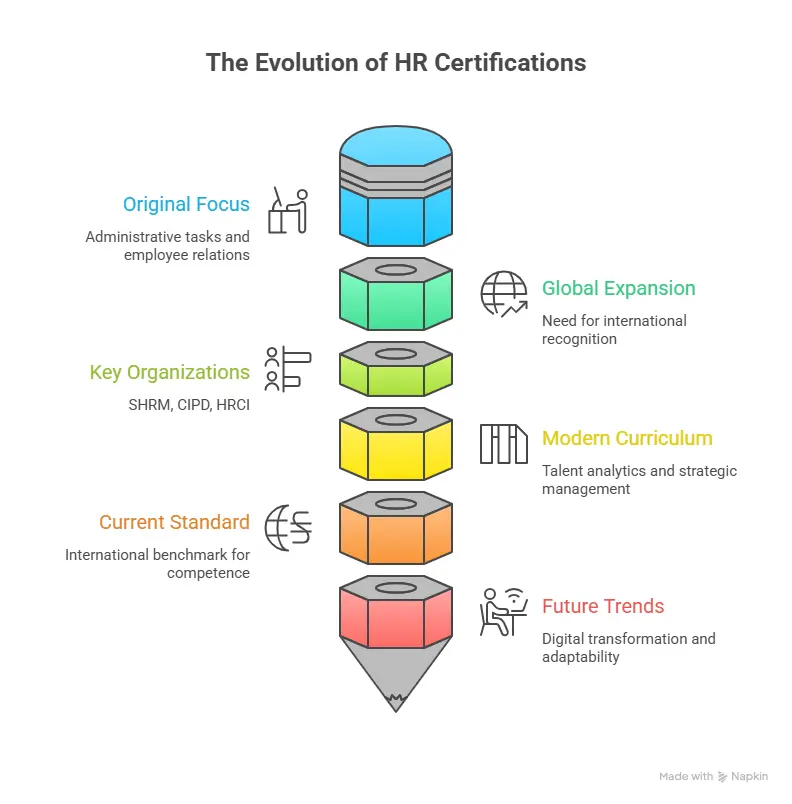 In response to the increasing complexity of modern workplaces around the world, human resource certificates have seen substantial changes in the last several decades. Administrative work, payroll, and employee relations were the original purview of human resources positions. There was a growing demand for globally recognized professions and defined competencies as businesses went global.
A number of organizations started providing credentials to prove HR knowledge and leadership abilities; these included the US-based Society for Human Resource Management (SHRM), the UK’s Chartered Institute of Personnel and Development (CIPD), and HRCI (HR Certification Institute). Incorporating talent analytics, global compliance standards, and strategic HR management into these programs over time reflects the transition from operational to strategic HR responsibilities.
Human resources certificates are now considered an international standard for competence in the field. They provide HR experts a chance to show off their skills in areas including leadership, workforce planning, employee engagement, and compliance with foreign labor laws. The capacity to lead and adapt in multicultural, ever-changing businesses is becoming more valuable, and trained human resources professionals are in high demand as a result of the effects of digital transformation and globalization on the workplace.
Become an HR Expert – Enroll in Our HR Management Course Today!
Unlock the secrets to effective Human Resource Management with our expert-led course! Learn recruitment, employee relations, performance management, and more to build a thriving workplace. Start your journey toward a successful HR career today!
Know MoreTop International HR Certifications Explained
An international HR certification is a great way to advance in your profession, gain practical experience, and stay informed about industry advancements. First and foremost: credentials
SHRM-CP / SHRM-SCP—Two credentials, SHRM-CP and SHRM-SCP, are available from the US Society for Human Resource Management. Human resource strategy, policymaking, and practice congruence with business objectives are the main foci of these certifications. For a senior HR executive, the SHRM-SCP is the way to go, whereas a mid-level professional might benefit more from the SHRM-CP.
PHR / SPHR—Strategic leadership and decision-making take center stage in the HRCI (USA) Senior Professional in Human Resources (SPHR) curriculum, in stark contrast to the PHR program’s emphasis on practical HR competence. Both of them are highly esteemed all around the globe.
CIPD (UK Levels 3, 5, and 7)—British national with a degree in Integrated Project Management, having completed Levels 3, 5, and 7. The Chartered Institute of Personnel and Development provides three certification levels: Level 3, Level 5, and Level 7, with the latter two catering to intermediates and strategic HR executives, respectively. A CIPD certificate is valid in every country in the UK, the Commonwealth, and Europe.
GPHR (Global Professional in HR)—Global workforce planning, cross-border compliance, and international operations are all responsibilities of human resource professionals who hold the GPHR (Global Professional in HR) credential from HR Certification International.
aPHR (Associate Professional in HR)—This certification will show employers that you have mastered the basics of human resources, which is especially useful for those just starting out in the field.
IPMA-HR Certification—Those who work in human resources for governmental organizations on a global scale, whether in policymaking, workforce planning, or HR management, should get the IPMA-HR certification.
HCI People Analytics & HR Strategy Certificates—Analytics, smart workforce planning, and data-driven HR decision-making certificate from the Human Capital Institute.
Comparison of Top International HR Certifications
Your career ambitions, desired region of recognition, and current position in the company will determine which international HR certification is best for you. The following table compares the most popular certifications according to their areas of specialization, preferred applicants, and worldwide worth.
| Certification | Provisioned by | Perfect for | Main Focus | Global Acknowledgment |
|---|---|---|---|---|
| SHRM-CP / SHRM-SCP | Society for Human Resource Management | HR professionals with experience from mid- to senior-level | HR practices around the world | Very High—accepted all throughout the world |
| PHR/SPHR | HR Certification Institute | Professionals with Intermediate to Senior Skills | HR management that is both operational and strategic | High, notably in US and global companies |
| CIPD Levels 3 / 5 / 7 | Chartered Institute of Personnel and Development | Getting into Executive Levels | HR basics for strategic leadership | Well-known in the UK, Europe, and the Commonwealth |
| GPHR | HR Certification Institute | Senior Human Resources Leaders Around the World | Management of human resources on a global scale, compliance, and mobility | Global – perfect for human resources positions in international corporations |
| aPHR | HR Certification Institute | Graduates and newcomers to human resources | Concepts and ideas fundamental to human resource management | Recognition at the entry level throughout the world |
| IPMA-HR Certification | International Public Management Association for Human Resources | Public Sector HR Professionals | Government HR, workforce planning, employee relations | International—recognized in public institutions |
| HCI People Analytics & HR Strategy | Human Capital Institute | Experienced HR & Business Leaders | HR analytics, workforce planning, and leadership | High—especially valued in data-driven organizations |
How These Certifications Impact Your Career
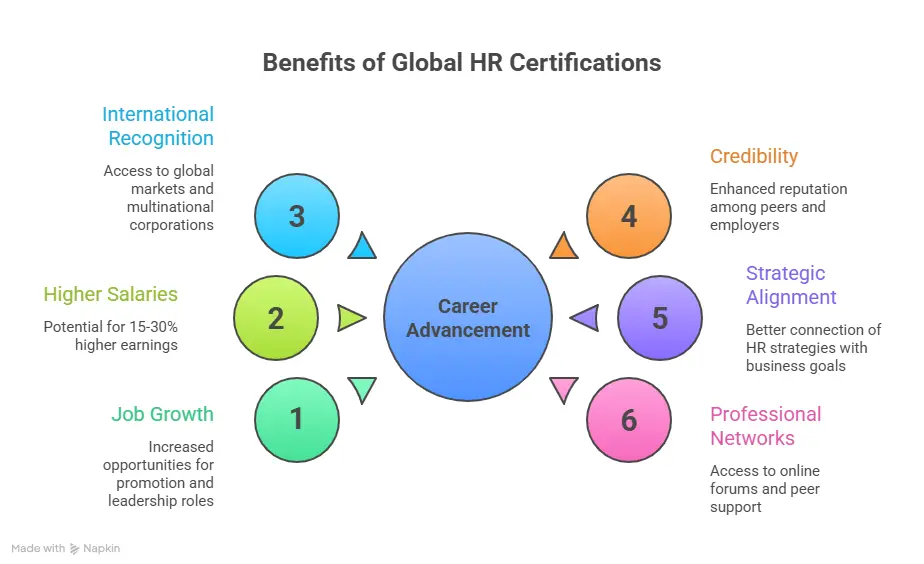
The acquisition of human resources credentials on a global scale can facilitate the opening of doors to new opportunities and accelerate the progression of your career.
1. There is a greater possibility of job growth, managerial chances, and leadership duties for qualified individuals, which is one of the advantageous aspects of this certification. It is desirable for businesses to hire candidates who have demonstrated experience in human resource strategy and worldwide best practices.
2. According to study, human resource professionals who possess qualifications are able to command salaries that are 15-30% higher than their peers who do not possess certification. Certifications are expensive for businesses since they represent a high level of competence and strategic acumen within the company.
3. International Recognition: Professionals who possess credentials that are recognized all over the world, such as the Chartered Institute of Personnel and Development (CIPD), the Global Professional in Human Resources (GPHR), and the Society for Human Resource Management (SHRM-SCP), have the possibility to work in multinational corporations and international markets.
4. Earning a certification demonstrates that you have the knowledge, abilities, and experience necessary to execute HR best practices, which is a significant step toward gaining recognition and credibility. They provide an increase in your reputation in the eyes of customers, coworkers, and potential employers.
5. After obtaining advanced certifications in people analytics, compliance, workforce planning, and talent management, HR professionals are better able to connect HR strategies with the goals of the business.
6. Establishing Professional Networks and Advancing in One’s Career: A great number of human resource certification programs give their participants access to online forums, professional networks, and resources for lifetime learning. This facilitates advancement by means of the sharing of ideas and the direction of peers who have more expertise.
Click here to learn more about HR Management!
Become an HR Expert – Enroll in Our HR Management Course Today!
Unlock the secrets to effective Human Resource Management with our expert-led course! Learn recruitment, employee relations, performance management, and more to build a thriving workplace. Start your journey toward a successful HR career today!
Know MoreBenefits and Considerations Before Choosing a Certification
There is a tremendous potential for your career to benefit from obtaining an international HR certification; however, it is essential to assess the benefits against the practical considerations involved. Credibility, career advancement, and strategic human resource management abilities are all benefits that come with these certificates, but they also need time, money, and continuing maintenance.
Principal Advantages:
- Provides evidence of HR competence and enhances professional credibility
- Increases the likelihood of advancement and leadership possibilities
- Enhances the possibilities for earning fifteen to thirty percent more on average
- Facilitates the development of skills in human resource analytics, workforce planning, and compliance
- Possibilities for networking with human resource professionals from around the world
- Well-respected throughout a wide range of businesses and international organizations
Aspects to Consider:
- Prices range from $300 to $1,500, which includes the cost of study materials.
- It could take anywhere from three to twelve months to prepare for an exam.
- Experience in human resources is required for further certificates.
- The degree of recognition may differ from country to country or area to region.
- Typically, it is necessary to undergo either continuing education or recertification.
Key Advantages
Seeking an international human resources certification can provide you with a lot of advantages that can help you advance your career and boost your professional credibility:
- Obtaining professional credibility demonstrates that you have HR knowledge and competence that is acknowledged all over the world.
- The advancement of one’s career might result in more opportunities for promotions, managerial positions, and leadership positions.
- Experts who have earned their certification typically earn 15–30% more than their colleagues who have not earned their certification.
- Enhances skills in workforce planning, talent management, human resource analytics, and compliance. This approach is known as strategic skill development.
- Providing access to global human resources communities, mentorship, and professional networks are examples of networking opportunities.
- Corporate, public sector, and international institutions all respect certifications, which demonstrates the industry’s flexibility.
Wrapping Up
If you want to grow in the firm, improve your reputation, and take global opportunities, you need an international human resources certification. Participants in famous programs like SHRM, HRCI, and CIPD can get strategic thinking, workforce planning, and international best practices for human resources professionals. Assuming aPHR or CIPD Level 3 candidates are eligible for entry-level positions, SHRM-CP, PHR, or CIPD Level 5 candidates for mid-career positions, and SHRM-SCP, SPHR, GPHR, or CIPD Level 7 candidates for advanced or global HR executive positions. These credentials are a worthwhile investment for human resources professionals’ long-term professional growth because they increase promotion, earnings, leadership, and global mobility. They boost potential earnings.
Become an HR Expert – Enroll in Our HR Management Course Today!
Unlock the secrets to effective Human Resource Management with our expert-led course! Learn recruitment, employee relations, performance management, and more to build a thriving workplace. Start your journey toward a successful HR career today!
Know MoreFrequently Asked Questions
Which HR certification is best for beginners?
aPHR and CIPD Level 3 are ideal for entry-level HR professionals with little or no experience.
What certification is suitable for mid-level HR professionals?
SHRM-CP, PHR, and CIPD Level 5 are designed for HR practitioners with 2–5 years of experience seeking managerial roles.
How do these certifications impact salary?
Certified HR professionals often earn 15–30% more than non-certified peers, depending on experience and region.
Do HR certifications require renewal?
Yes, most certifications require continuing education or recertification every 2–3 years to maintain validity.
Can certifications help me work internationally?
Yes, certifications like GPHR, SHRM-SCP, and CIPD are widely recognized and improve opportunities for global HR roles.