Table of Contents
Introduction
Early childhood is an important learning stage. During these years, children grow very quickly. Their brains develop through daily experiences. Learning happens by seeing, touching, and doing. A good education method supports this natural process. It helps children learn with confidence. Strong early learning builds future success.
Young children learn best in calm environments. They need safety, care, and encouragement. Too much pressure reduces interest in learning. Simple guidance helps children stay motivated. This makes lesson planning very important. Planning shapes how learning happens daily. It brings order and balance to classrooms.
A good classroom supports independence and choice. Children feel comfortable exploring activities. Learning should match their age and ability. Activities must connect with daily life. When lessons follow natural growth, understanding improves. Children enjoy learning more. They become confident through practice.
Proper planning gives structure and direction. It helps teachers organize daily routines. Clear routines reduce confusion. Children feel secure with consistency. Predictable days improve focus. Calm classrooms support better learning.
Early education should support total development. Learning is more than reading and writing. Children also develop emotions and social skills. Movement supports physical and mental growth. Language grows through interaction. Practical activities teach independence. All skills grow together naturally.
A clear lesson structure supports smooth learning. It allows freedom with guidance. Children learn without fear of mistakes. Errors become learning opportunities. Small success builds confidence. Learning becomes enjoyable every day.
Why lesson planning matters in early education
-
Gives clear direction for daily activities.
-
Maintains consistency in learning routines.
-
Supports age-appropriate development goals.
-
Balances freedom and structure.
-
Improves classroom organization.
-
Creates meaningful learning experiences.
Benefits of structured early learning approaches
-
Builds early confidence.
-
Encourages independent learning habits.
-
Improves focus and attention.
-
Supports emotional control.
-
Develops thinking skills naturally.
-
Creates love for learning.
Strong early planning shapes lifelong learning habits. Children grow best in supportive environments. Teachers guide learning with purpose. Meaningful experiences replace rote instruction. Natural learning leads to steady progress. This foundation supports every future learning stage.
What Is a Montessori Lesson Plan?
1: What is the primary focus of the first plane of development in the Montessori method?
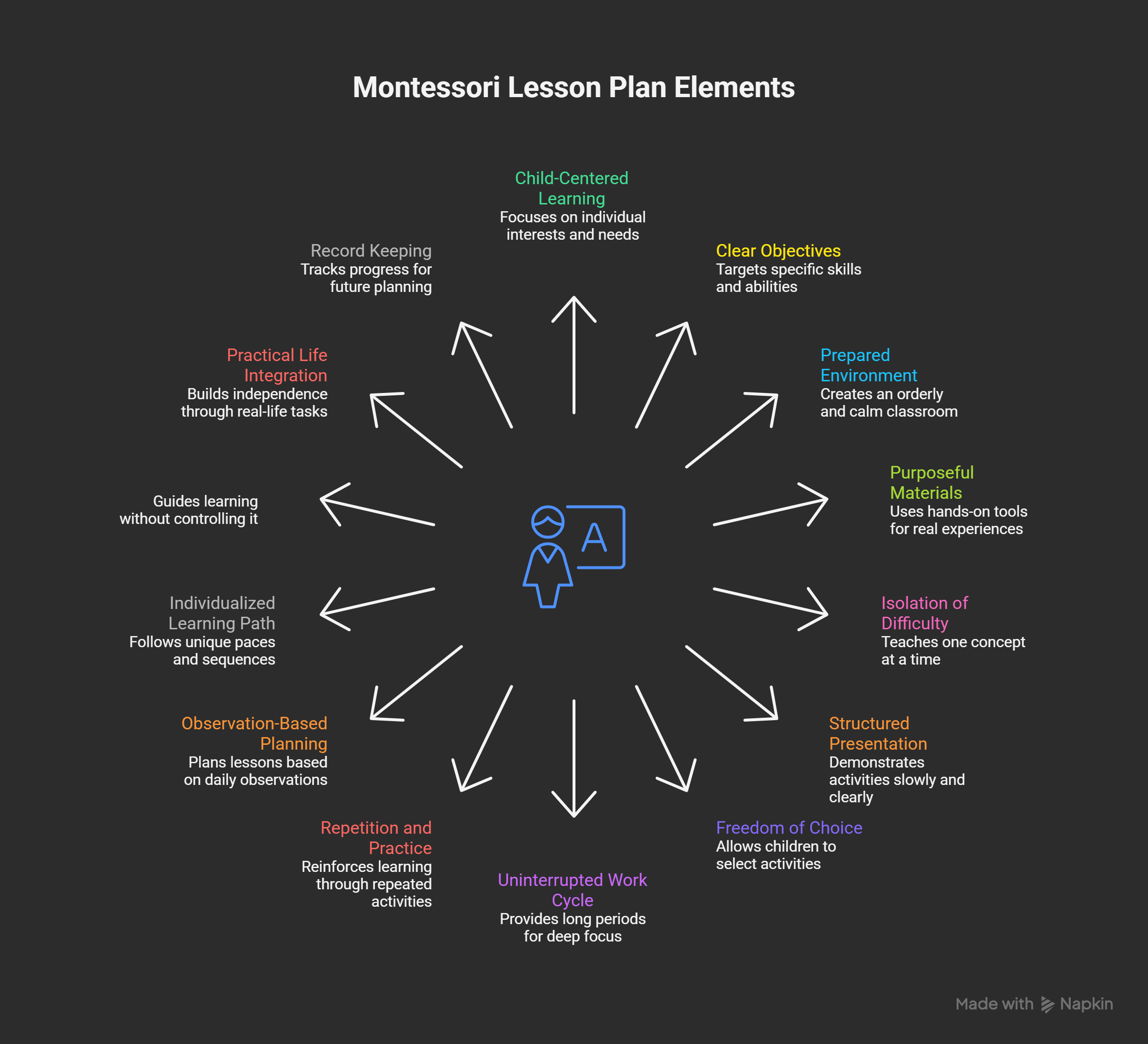
A Montessori lesson plan is a structured learning guide. It follows child-centred educational principles. The plan supports independent and self-directed learning. It respects each child’s natural development pace. Learning happens through hands-on experiences. The teacher acts as a facilitator. Children actively explore materials and concepts.
Montessori lesson planning focuses on purposeful activities. Each activity supports a specific developmental skill. Lessons are introduced when children show readiness. This approach avoids forced or rushed learning. The plan grows with the child’s progress.
Definition of a Montessori Lesson Plan
A Montessori lesson plan outlines guided learning experiences. It is based on observation rather than rigid schedules. The plan aligns with Montessori educational philosophy. It supports physical, emotional, social, and cognitive growth.
Key characteristics include:
-
Child-led activity selection
-
Hands-on learning materials
-
Freedom within structured limits
-
Individual learning pace
-
Continuous observation-based planning
The plan does not follow fixed daily outcomes. Instead, it focuses on skill mastery. Learning occurs through repetition and exploration.
Core Purpose of a Montessori Lesson Plan
The main purpose is developmental support. It helps children learn naturally. The plan encourages independence and responsibility. Children gain confidence through meaningful work.
Other purposes include:
-
Supporting concentration development
-
Encouraging problem-solving skills
-
Building self-discipline
-
Promoting intrinsic motivation
-
Creating joyful learning experiences
The plan allows children to learn through choice. Choice increases engagement and responsibility.
Structure of a Montessori Lesson Plan
A Montessori lesson plan follows a clear structure. Each section serves a learning purpose. The structure remains flexible for adaptation.
1. Learning Area
Each lesson belongs to a learning area.
Common learning areas include:
-
Practical Life
-
Sensorial Development
-
Language Learning
-
Mathematics
-
Cultural Studies
Each area focuses on specific skills.
2. Learning Objective
Objectives describe skill development goals. They focus on ability, not memorization. Objectives are measurable through observation.
Examples include:
-
Improving hand coordination
-
Developing language vocabulary
-
Strengthening number sense
-
Enhancing concentration
Objectives guide lesson selection.
3. Materials Required
Materials are central to Montessori lessons. They are concrete and hands-on. Each material teaches one specific concept.
Material features include:
-
Child-sized design
-
Real-world appearance
-
Self-correcting structure
-
Sensory engagement
Materials allow independent learning.
4. Presentation Method
Lessons follow a calm demonstration approach. Teachers use slow and precise movements. Language remains minimal during demonstration.
Presentation steps usually include:
-
Invitation to observe
-
Silent demonstration
-
Clear sequencing
-
Return of material
-
Invitation to practice
Children watch before participating.
5. Independent Work Period
After presentation, children work independently. They choose repetition frequency. They explore without interruption.
This stage supports:
-
Deep concentration
-
Skill mastery
-
Confidence building
-
Self-paced learning
Mistakes guide self-correction.
Role of Observation in Lesson Planning
Observation is essential in Montessori planning. Teachers carefully watch daily activities. They note interest and readiness levels.
Observation helps teachers:
-
Identify learning readiness
-
Plan appropriate lessons
-
Avoid unnecessary instruction
-
Support individual growth
Planning evolves through continuous observation.
Flexibility in Montessori Lesson Plans
Montessori lesson plans remain adaptable. They change based on child progress. There is no fixed completion timeline.
Flexibility allows:
-
Repetition when needed
-
Advancement when ready
-
Lesson modification
-
Individual learning paths
This respects natural development patterns.
Individualized Learning Approach
Every child follows a unique learning journey. Lesson plans support individual differences. No two children follow identical plans.
Individualization supports:
-
Different learning speeds
-
Varied interests
-
Unique strengths
-
Personal challenges
The plan adjusts without comparison.
Daily Flow Within a Lesson Plan
Montessori lesson plans follow a rhythm. The flow supports uninterrupted learning time.
Typical flow includes:
-
Arrival and settling
-
Individual lesson presentations
-
Independent work cycle
-
Movement-based activities
-
Reflection and closure
Long work periods improve focus.
Sample Montessori Lesson Plan Structure
| Component | Description |
|---|---|
| Learning Area | Practical Life |
| Objective | Improve hand-eye coordination |
| Material | Pouring activity set |
| Age Group | 3–4 years |
| Presentation | Slow demonstration |
| Practice | Independent repetition |
| Assessment | Observation notes |
This format keeps planning organized.
Benefits of Using Montessori Lesson Plans
Montessori lesson plans provide clarity. They support intentional teaching practices.
Key benefits include:
-
Organized learning progression
-
Clear developmental focus
-
Reduced classroom stress
-
Improved child engagement
-
Better observation records
Planning improves teaching confidence.
Montessori Lesson Plan as a Teaching Tool
The lesson plan guides daily instruction. It supports consistent educational quality. Teachers plan with purpose and insight.
It helps teachers:
-
Track child development
-
Prepare appropriate materials
-
Maintain classroom balance
-
Support independent learning
The plan becomes a living document. It grows alongside the child.
In Short
A Montessori lesson plan is development-focused. Lesson plan is flexible yet purposeful. It prioritizes hands-on exploration. It respects each child’s individuality.
The plan supports learning through experience. Children learn by doing meaningful work. Teachers guide with observation and care. This creates balanced and effective early education.
Unlock your passion for education and shape young minds as a Montessori teacher!
Get Certified & Start Your Montessori Career
Montessori Teacher Training Course by Entri App: Gain expert skills, earn certification, and kickstart your teaching career.
Join Now!Frequently Asked Questions
What is a Montessori lesson plan?
A Montessori lesson plan is a structured guide that helps teachers present learning activities based on child development, individual readiness, hands-on materials, and self-directed exploration rather than fixed academic schedules.
Why are Montessori lesson plans important in early childhood education?
Montessori lesson plans are important because they support natural learning, encourage independence, reduce academic pressure, and help children develop cognitive, emotional, social, and physical skills together during the most sensitive developmental years.
How is a Montessori lesson plan different from a traditional lesson plan?
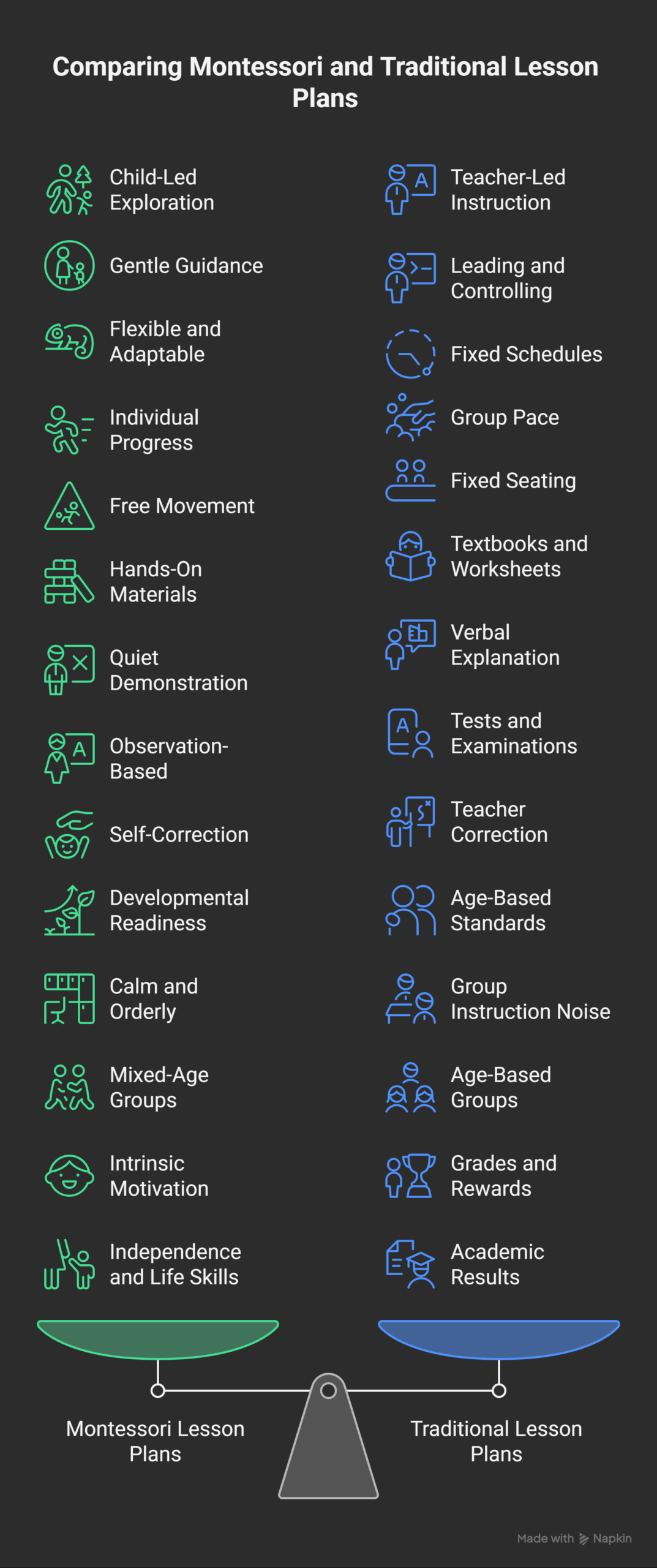
A Montessori lesson plan focuses on child-led learning, flexible pacing, observation-based assessment, and hands-on materials, while traditional lesson plans usually follow teacher-led instruction, fixed schedules, textbooks, and standardized testing.
What age group uses Montessori lesson plans?
Montessori lesson plans are designed for children from infancy to elementary age, typically covering 0–3 years, 3–6 years, 6–9 years, and 9–12 years, with each level adapted to developmental needs.
Do Montessori lesson plans follow a fixed timetable?
No, Montessori lesson plans do not follow rigid timetables because children learn at different speeds, and lessons are introduced based on readiness rather than predetermined daily or weekly schedules.
What subjects are included in Montessori lesson plans?
Montessori lesson plans include practical life, sensorial education, language development, mathematics, cultural studies, geography, science, art, and social development, all integrated through hands-on learning experiences.
How are children assessed in Montessori lesson plans?
Children are assessed through continuous observation, work records, and engagement tracking instead of exams or grades, allowing teachers to understand progress naturally without creating stress or competition.
Can Montessori lesson plans be used at home?
Yes, Montessori lesson plans can be adapted for home learning by using simple materials, real-life activities, and structured routines that encourage independence, responsibility, and self-directed learning.
What role does the teacher play in a Montessori lesson plan?
The teacher acts as a guide and observer who prepares the environment, introduces materials carefully, monitors development, and supports learning without interrupting the child’s concentration or independence.
What are the long-term benefits of Montessori lesson planning?
Montessori lesson planning helps children develop confidence, problem-solving ability, concentration, emotional control, independence, and a lifelong love for learning, which strongly supports academic success and personal growth in later years.