
• Teaching
    • Montessori Teacher Training 🔥
    • Yoga Teacher Training
  • Coding
    • Full Stack Development Course
    • Data Science Course
    • Python Programming Course
    • Software Testing Course
    • Architecting on AWS
  • Commerce
    • ACCA Course
    • SAP Fico Course
    • Practical Accounting Course
    • SAP MM Course
    • HR Management Course in Kerala
    • CMA USA Online Classes
    • Enrolled Agent Course
    • PwC Edge : Strategic Accounting and Finance Programme
  • Technical
    • Structural Design Course
    • Embedded Systems Software Engineering in Kerala
    • MEP Course
    • BIM Training Course
    • Quantity Survey Course
  • Finacademy
    • Stock Market Course
    • Mutual Funds Course
    • Forex Trading Course
  • Digital Marketing
    • Digital Marketing Course
    • Performance Marketing Course
  • Language Learning
    • Spoken English Course
    • German Language Course
    • IELTS Exam Coaching
  • Exam Preparation
    • Kerala PSC Coaching
    • Kerala PSC LGS Coaching
    • KAS Coaching
    • Kerala PSC LDC Coaching
    • Kerala PSC LSGS Coaching
    • KPSC Industries Extension Officer Coaching
    • KPSC Technical Mechanical Coaching
    • KPSC Technical Electrical Coaching
    • Kerala PSC Technical Exam Preparation
    • KPSC Technical Civil Coaching
    • SBI PO Coaching
    • IBPS Clerk Coaching
    • IBPS PO Coaching
    • IBPS SO Coaching
    • Bank Exam Coaching
    • Lecturer in DIET Course
    • Kpsc HSA Coaching
    • KPSC LP UP Assistant Coaching
    • EMRS Coaching
    • KTET Coaching
    • SSC Coaching
    • SSC JE Coaching
    • SSC CGL Coaching
    • SSC CHSL Coaching
    • SSC MTS Coaching
    • UPSC Coaching
  • Health Care
    • Hospital Administration Course
  • Other Exams
    • GATE Coaching
    • CAT Coaching
    • MAT Online Coaching
    • KMAT Online Coaching
Entri Blog
No Result
View All Result
Friday, February 13, 2026
  • Kerala PSC
    • Kerala PSC General
      • Kerala PSC Exams
      • KAS Exam
      • Kerala PSC VEO Notification
      • Kerala Police SI
      • Kerala PSC LDC Notification
      • Kerala PSC Village Field Assistant Notification
      • Kerala PSC LD Typist Notification
      • Kerala PSC Food Safety Officer
      • Kerala PSC Excise Inspector Notification
      • Kerala PSC BDO Notification
      • Kerala PSC CPO Notification
      • Kerala PSC LGS Notification
      • Fire and Rescue Officer
      • Women Fire and Rescue Officer
    • Kerala PSC Teaching
      • Kerala PSC HSA
      • Kerala PSC HSST
      • KTET
      • LP/UP Assistant
      • KVS
      • Railway Teacher
    • Kerala PSC Technical
      • LSGD AE
      • Draftsman/Overseer
      • IEO
      • ATP
      • Polytechnic Lecturer
      • AE Electronics
      • Assistant Engineer
  • Banking
    • IBPS PO Notification
    • IBPS Clerk Notification
    • SBI PO Notification
    • SBI Clerk Notification
    • SBI SO Notification
    • SBI Apprentice Notification
    • Canara Bank PO Notification
    • Indian Bank PO Notification
    • RBI Assistant Notification
    • RBI Office Attendant Notification
    • IBPS RRB Notification
    • IBPS RRB Office Assistant Notification
  • Skilling
    • Coding
    • Spoken English
    • Stock Market
      • Stock Market Weekly Report
    • Digital Marketing
    • Accounting Course
    • SAP
    • German
    • IELTS
    • Quantity Survey
    • MEP
    • Structural Design
    • Montessori
    • Yoga Teaching
    • HR Management
    • Embedded Systems
  • Courses
    • AI Powered Data Science Course
      • Data Science Malayalam
      • Data Science Course in Tamil
      • Data Science Course in Telugu
      • Data Science Training in Kochi
      • Data Science Training in Trivandrum
      • Data Science Course in Calicut
      • Data Science Training in Thrissur
    • AI Powered Data Analytics Course
      • Data Analytics Course in Malayalam
      • Data Analytics Course in Tamil
      • Data Analytics Course in Telugu
    • BIM Course in Kerala
      • BIM Course in Kochi
      • BIM Course in Trivandrum
      • BIM Course in Calicut
    • Quantity Surveying Course
      • Quantity Surveyor Course in Tamil
      • Quantity Surveying Course in Telugu
      • Quantity Surveyor Course in Hyderabad
      • Quantity Surveying Course in Chennai
      • Quantity Surveying Course in Vijayawada
      • Quantity Surveying Course in Guntur
      • Quantity Surveying Course in Warangal
      • Quantity Surveying Course in Karimnagar
    • Structural Design Course
      • Structural Design Course in Hyderabad
      • Structural Design Course in Chennai
      • Structural Design Course in Kochi
      • Steel Structure Design Course
      • RCC Design Course
    • MEP Course
      • MEP Design Course in Kerala
      • HVAC Course
      • MEP Course in Kochi
    • Robotics and AI Course
    • Embedded System Course
      • Embedded Systems Software Engineering in Calicut
      • Embedded Systems Software Engineering in Kochi
      • Embedded Systems Software Engineering in Trivandrum
    • AI-Enhanced Full Stack Developer Course
      • Full Stack Development Malayalam
      • Full Stack Development Hindi
      • Full Stack Development Tamil
      • Full Stack Development Telugu
      • Full Stack Development Kannada
    • Stock Market Course
      • Stock Market Course in Malayalam
      • Stock Market Course in Tamil
      • Options Trading Course
    • Mutual Funds Course
      • Mutual Funds Course in Kerala
      • Mutual Funds Course in Tamil
    • Forex Trading Course
    • Spoken English Course
      • Spoken English Course in Malayalam
      • Spoken English Course in Hindi
      • Spoken English Course in Telugu
      • Spoken English Course in Tamil
      • Spoken English Course in Kannada
    • AI-Driven Python Programming Course
    • Ui Ux Designer Course
    • AI-Powered Software Testing Course
      • Software Testing Course in Malayalam
      • Software Testing Course in Tamil
      • Software Testing Course in Telugu
    • Ai-Powered Cybersecurity Course
    • AI Tools Mastery
    • AI Powered AWS Solutions Architect Associate Course
    • AI Powered Practical Accounting Course
      • Accounting Course in Malayalam
      • Accounting Course in Tamil
      • GCC VAT Course
      • Taxation Course
      • GST Practitioner Course in Kerala
      • GST Course
      • UAE Accounting
      • Tally Course
      • Zoho Books Training
    • SAP Training Courses
      • SAP FICO Course
      • SAP MM Course
      • SAP SD Training
      • SAP FICO Course in Tamil
      • SAP MM Course in Tamil
    • Enrolled Agent Course in Kerala
      • Enrolled Agent Course in Calicut
      • Enrolled Agent Course in Kochi
      • Enrolled Agent Course in Trivandrum
    • ACCA Training Online
      • ACCA Course in Kerala
      • ACCA Performance Management PM F5 Course
      • ACCA Taxation TX F6 Course
      • ACCA Financial Reporting FR F7 Course
      • ACCA Audit and Assurance AA F8 Course
      • ACCA Financial Management FM F9 Course
    • CMA USA Online Classes
    • HR Management Course
      • HR Management Course in Kochi
      • HR Management Course in Trivandrum
      • HR Management Course in Calicut
    • PwC Edge : Strategic Accounting and Finance Programme
    • Performance Marketing Course
    • Mern Stack Developer Course
      • Full Stack Developer Course in Kochi
      • Full Stack Developer Course in Trivandrum
      • Full Stack Developer Course in Calicut
      • Full Stack Developer Course in Pune
      • Full Stack Developer Course in Bangalore
      • Full Stack Developer Course in Hyderabad
      • Full Stack Developer Course in Chennai
      • Full Stack Developer Course in Indore
      • Full Stack Developer Course in Jaipur
      • Full Stack Developer Course in Coimbatore
    • AI Powered Digital Marketing Training
      • Digital Marketing Course in Kerala
      • Digital Marketing Course in Kochi
      • Digital Marketing Course in Trivandrum
      • Digital Marketing Course in Calicut
      • Digital Marketing Course in Kollam
      • Digital Marketing Course in Thrissur
      • Digital Marketing Course in Kottayam
      • Digital Marketing Course in Kannur
    • Hospital and Healthcare Administration
    • Montessori Teacher Training
      • Montessori Teacher Training in Calicut
      • Montessori Teacher Training in Kochi, Ernakulam
      • Montessori Teacher Training in Trivandrum
      • Montessori Teacher Training in Kollam
      • Montessori Teacher Training in Malayalam
      • Montessori Teacher Training in Kannada
    • Other Courses
      • German Language Course
      • ChatGPT Course
      • Yoga Teacher Training Course
      • Advanced Fashion Designing and Boutique Management
  • Others
    • Railway
      • RRB Technician Notification
      • RRB JE Notification
      • RRB ALP Notification
      • RRB NTPC Notification
      • RRB RPF Notification
      • RRB RPF SI Notification
      • RRB RPF Constable Notification
      • RRB Group D Notification
      • RRB RPSF SI Notification
      • RRB SSE Notification
    • SSC
      • SSC CPO Notification
      • SSC MTS Notification
      • SSC CGL Notification
      • SSC CHSL Notification
      • SSC GD Constable Notification
      • SSC Stenographer Notification
      • SSC JE Notification
      • SSC CAPF Notification
      • SSC JHT Notification
      • Delhi Police Constable Notification
      • Delhi Police SI Notification
    • GATE
    • MAT
    • KMAT
      • KMAT Kerala 2024
    • TET
      • APTET
      • CTET
      • DSSSB
      • Karnataka TET
      • Kerala TET
        • KTET Notification
      • KVS
      • MPTET
      • SUPER TET
      • TNTET
      • TSTET
      • UPTET
    • UPSC
      • UPSC CAPF Notification
      • UPSC CDS Notification
      • UPSC NDA Notification
      • UPSC Civil service Notification
  • Free Learn
    • Free Courses
      • Free Coding Courses
        • C Langauge Courses
        • Free Data Science Courses
        • Free Python Programming Courses
        • Free Full Stack Developer Courses
      • Free Accounting Courses
        • Free Accounting Course in Malayalam
        • Free ZohoBooks Course in Malayalam
        • Free Tally Course for Beginners in Malayalam
        • Free ACCA Foundation Course in Malayalam
        • Free Gulf VAT and Accounting Course in Malayalam
      • Free Digital Marketing Courses
        • Free SEO Courses
        • Web Development for Marketers
      • Engineering Upskilling Courses
        • Free Quantity Surveying Course in Telugu
        • Free Embedded Systems Foundation Course
        • Free AutoCAD Course in Malayalam
        • Free Planswift Course
        • Free MEP Course in Malayalam
        • Free Quantity Surveying Course for Beginners
      • Free Hospital Administration Courses
      • Free Management Courses
      • Free SAP Courses
        • Free SAP FICO Tutorial for Beginners in Malayalam
      • Free German Courses
      • Free IELTS Courses
      • Free Teachers Training Courses
      • Free Trading Courses
        • Introduction To Stock Trading in Tamil
        • EMI Traps Explained by Sharique Samshudheen
        • Free Trading Psychology for Beginners by Nagaraj Sir
        • Free Beginner’s Guide to Investments by Nagaraj Sir
        • Free Stock Market Courses in Malayalam
        • Free Mutual Funds Course by Nagaraj Sir
        • Free Options Trading Course Malayalam
        • Free Forex Trading Courses Malayalam
        • Free Personal Finance Courses Malayalam
        • Free Health Insurance Masterclass by Sharique Samshudheen
    • Question Answer
    • Aptitude Questions
    • Webinars
  • Test Prep
    • Kerala PSC Coaching
      • KPSC Degree Level Exam Preparation
      • Kerala PSC 12th Level Exam Preparation
      • Kerala PSC 10th Level Exam Preparation
      • KAS Coaching
      • Kerala PSC LDC Coaching
      • Kerala PSC LD Typist Coaching
      • Kerala PSC Fireman Coaching
      • KSFE Assistant Exam Preparation
      • Secretariat Office Attendant Coaching
      • Secretariat Assistant Coaching
      • Kerala PSC SI Exam Coaching
      • Khadi Board LDC Exam Preparation
      • Devaswom Board LDC Coaching
      • University LGS Exam Preparation
      • University Assistant Exam Coaching
      • KPSC Scientific Officer Exam Coaching
      • KPSC Probation Officer Grade II
      • KPSC Food Safety Officer Coaching
      • KWA Sanitary Chemist Coaching
      • KPSC Diary Farm Instructor Exam Coaching
      • Kerala PSC KWA Lab Assistant Exam Coaching
      • Kerala PSC ICDS Supervisor Exam Coaching
      • KPSC Finger Print Searcher Coaching
      • Kerala PSC Welfare Officer Gr. II Exam Coaching
      • KPSC Assistant Dental Surgeon Coaching
    • KPSC Teaching Exams
      • HSA Exam Preparation
      • KPSC HSA Social Science Coaching
      • KPSC HSA Physical Science Coaching
      • KPSC HSA English Coaching
      • KPSC Junior Language Teacher Hindi
      • KTET Coaching
      • SET Coaching
      • LP/UP Assistant Exam Coaching
      • HSST Exam Preparation
      • HSST Commerce Exam Coaching
      • Kerala PSC Lecturer in Diet Coaching
      • KVS PGT/TGT Coaching
    • Kerala PSC Technical Exams Coaching
      • Assistant Engineer Electrical Exam Coaching
      • Assistant Engineer Electronics Coaching
      • Assistant Engineer Mechanical Coaching
      • Kerala PSC Industries Extension Officer Coaching
      • KPSC LSGD AE Exam Coaching
      • KPSC Civil Engineering Exam Coaching
      • KPSC Mechanical Engineering Exam Coaching
      • KPSC Electrical Engineering Exam Coaching
      • KPSC Electronics Engineering Exam Coaching
      • KPSC Technical Computer Science Coaching
      • KPSC Tradesman Turning Coaching
      • Kerala PSC Overseer Exam Coaching
      • KPSC Assistant Town Planner Coaching
      • Lecturer in Polytechnic Electronics Coaching
    • Teaching Exams Coaching
      • CSIR NET Exam Coaching
      • EMRS Coaching
      • CTET Exam Online Coaching
    • IELTS Training Online
    • Bank Exam Coaching Online
      • SEBI Grade A Coaching
      • IBPS SO Online Coaching
      • IBPSC PO Online Coaching
      • IBPSC Clerk Online Coaching
      • SBI PO Coaching
      • SBI Clerk Online Coaching
      • SBI Apprentice Class
      • SBI SO Online Coaching
      • RBI Grade B Coaching
      • RBI Assistant Coaching
      • CSEB Exam Coaching
      • IBPS RRB Coaching
      • IBPS RRB PO Coaching
      • Canara Bank Po Exam Coaching
      • Kerala Gramin Bank Coaching
      • Kerala Bank Exam Coaching
        • Kerala Bank Clerk Exam Coaching
        • Kerala Bank Office Attendant Exam Coaching
        • Kerala Bank Assistant Manager Exam Coaching
      • JCI Exam Coaching
      • NABARD Grade A Coaching
      • LIC AAO Coaching Online
    • UPSC Online Coaching
      • UPSC CAPF Online Coaching
    • SSC Online Coaching
      • SSC JE Online Coaching
      • SSC CGL Coaching
      • SSC CGL AAO Coaching
      • SSC CHSL Coaching
      • SSC CGL CBI Inspector Coaching
      • SSC MTS Coaching
      • SSC Stenographer Coaching
      • SSC GD Online Coaching
    • RRB Exams Coaching
      • RRB RPF Exam Coaching
      • RRB NTPC Exam Coaching
      • RRB JE Online Coaching
      • RRB JE Electronics Coaching
      • RRB ALP Exam Coaching
      • RRB Technician Exam Coaching
    • CAT Online Coaching
    • CMAT Online Coaching
    • XAT Exam Coaching
    • GATE Online Coaching
      • GATE CE Online Coaching
      • GATE ME Online Coaching
      • GATE EE Online Coaching
    • NMAT Exam Coaching
      • AAI ATC Jr Executive Coaching
    • Cochin Shipyard Executive Trainee Coaching
    • BEL Probationary Engineer Coaching
    • HPCL Junior Executive Coaching
Free Courses
Entri Blog
  • HTML Tutorial
  • DSA Tutorials
  • Tutorials in Hindi
    • HTML Tutorial for Beginners in Hindi
    • Python Tutorial for Beginners in Hindi
    • GIT and GITHUB Tutorial for Beginners in Hindi
  • Tutorials in Tamil
    • JavaScript Tutorial in Tamil
  • Tutorials in Telugu
    • HTML Tutorial For Beginners in Telugu
    • CSS Tutorial for Beginners in Telugu
    • Bootstrap Tutorial for Beginner in Telugu
  • Tutorials in Kannada
    • HTML Tutorial For Beginners in Kannada
entri exclusive offers entri exclusive offers
Home Articles

What is Sensorial Education and why is it important?

by Sravan Prakash
February 13, 2026
in Articles, Montessori Teaching
What is Sensorial Education and why is it important
Share on FacebookShare on WhatsAppShare on Telegram

Table of Contents

  • What Is Sensorial Education in Montessori?
  • Key Areas of Sensorial Development
  • Importance of Sensorial Education for Early Learning
  • Role of Sensorial Materials in Montessori Classrooms
  • Conclusion

A young child three years of age sits quietly on a mat with legs crossed, slowly running his fingertips over sandpaper squares from rough to almost silky smooth. Another child brings a tiny glass bottle to his/her nose, coming to the scent of cinnamon to match it with its pair. Someone else gently shakes two wooden cylinders, listening carefully to decide whether the sounds are the same. These are not random activities. They are purposeful sensory experiences that hone the child’s perceptions of sight, sound, smell, and touch.

This is Sensorial Education, part of the Montessori approach developed by Maria Montessori over a century ago. It is based on a simple premise: before abstract concepts can be understood, the child must have a sense-based understanding of his environment. Sight, touch, sound, smell, and even taste become tools of the intelligence. Rather than memorizing, children compare, sort, grade, and match specially designed materials that isolate one quality at a time – texture, color, size, weight, or sound.

Each activity has a clear purpose. When a child lines up blocks from largest to smallest, he or she is getting ready for mathematics. When matching colors or subtle differences in sound, a child is developing powers of observation and concentration. The self-correcting nature of the materials allow a child to discover an error on their own, leading to greater independence and a quiet confidence.

In an age when many young children are sedentary and glued to screens for hours at a time, the Sensorial Education offers something deeply human: the opportunity to move, to grasp real objects, to listen attentively, and to engage with the environment in a holistic manner. Through these direct experiences, they gain focus, order, and a true joy for learning which will further support their studies in all subjects throughout their lives.

Register for the Entri Elevate Montessori Teacher Training Program! Click here to join!

What Is Sensorial Education in Montessori?

What-Is-Sensorial-Education-in-Montessori_-visual-selection

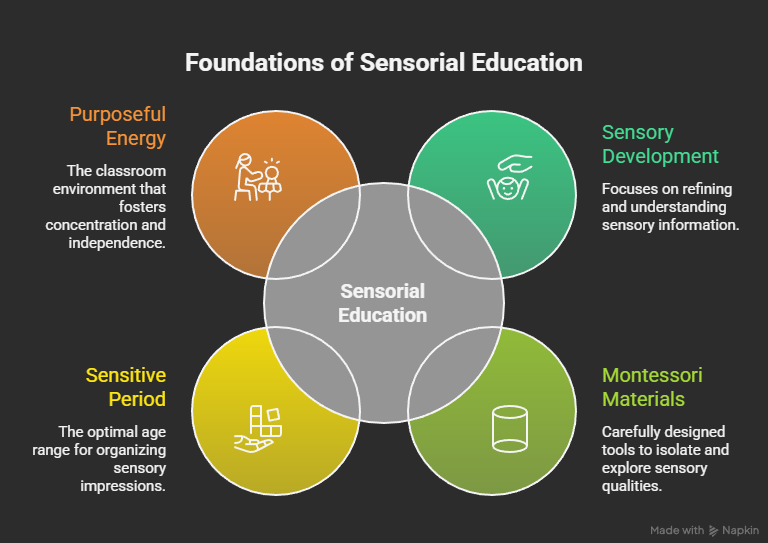
Sensory Education lies at the core of the Montessori approach. It is the part of the classroom designed to help the young child develop, refine, and understand the constant stream of information coming through their senses. Maria Montessori was a trained medical doctor before she became an educator. She observed and documented her impression that children learn best by touching, comparing, sorting, and discovering for themselves rather than being ‘taught’ through explanation and direction. She built a system around this natural curiosity, particularly during the early years when children effortlessly absorb sensory experiences.

Rather than introducing abstract lessons in reading or math, the child’s senses are first strengthened through Sensorial Education. Children begin to recognize differences in size, weight, texture, sound, smell, and color. The Montessori materials have been designed to address only one quality at a time. For example, a set of cylinders may vary either in heights or in diameters but not both.This simplicity allows children to a focus with intensity and to create accurate mental groupings. The well-trained senses allow for the mind to be prepared to successfully engage in language, mathematical and scientific studies.

This work is most powerful between the ages of three and six, which Montessori identified as a particularly sensitive period for arranging and organizing sensory impressions. Children possess an innate drive to sort, match, grade, and classify. Children in the classroom select the materials they desire, repeat activities as often as they please, and progress as fast or as slow as they wish. The adult quietly demonstrates and then steps away and allows the material to reveal errors. Concentration, independence, and confidence emerge in the child through this process.

Purposeful energy defines the Montessori classroom even today. Sensorial experiences bring order to the mind, develop powers of observation, and foster a curiosity that carries over into life outside of the classroom.

Key Areas of Sensorial Development

1: What is the primary focus of the first plane of development in the Montessori method?

2: According to Montessori practices, children are allowed to choose their work instead of the teacher choosing the work for them. Therefore:

3: There are totally ______ types and levels of Montessori education in practice.

4: Based on the Montessori Method, children have a natural desire to:

5: The Association Montessori Internationale has its headquarters at __________.

    Fill out the form to see the results


    Ever wondered how much you really know? It's time to put your brain to the test!

    Sensorial Education touches on several main areas, each one gently training a different sense or blend of senses so the child’s understanding grows richer and more connected.

    Visual work often comes first because sight plays such a huge role in how we explore. Children use materials like the iconic pink tower—ten rosy wooden cubes that get steadily smaller—to feel and see the idea of gradation. They build it again and again, absorbing concepts of big-to-small and sequence that later click perfectly when they meet numbers and measurement. Other visual materials help with shapes, colors, and even the subtlest shades of one hue.

    Touch gets its own spotlight through boards graded from very rough to buttery smooth, or through fabrics that range from scratchy wool to cool satin Many children go through the activities blindfolded for fun. With their sight removed, their fingertips become more alert, and they notice fine differences of texture, shape, and size that help to strengthen the precise hand control they will soon need for writing, buttoning, and tying. Smell and taste are experienced through small, safe bottles—cinnamon next to vanilla, sweet compared with salty. As children pause and focus, they awaken these quieter senses and learn new words to describe what they are experiencing.

    Hearing is developed through sound boxes and bells ranging from a heavy knock to a light ring. Children shake them, match the sounds, or rank them from softest to loudest. This training in attentive listening lays a foundation for phonics, music, and focusing behaviors in the classroom. Other materials work to refine the more subtle senses. Baric tablets teach the discernment between light and heavy. Thermic bottles teach warm and cool. The stereognostic exercises, in which a child must recognize, by touch alone, an object familiar to him/her (e.g. ball, or spoon) placed in a mystery bag, strengthen memory and spatial orientation.

    These senses do not develop independently of each other. A child engaged in work with the color tablets may also observe differences in thickness or texture. The learning overlaps and compounds itself. Each material offers its own control of error. The child can see or feel without the help of the adult if something isn’t right. This leads to less frustration and more perseverance. This autonomy leads to less frustration and greater perseverance. Gradually, children begin to observe the world around them with greater care and begin to notice the subtle sounds, textures, and scents that they previously overlooked, developing a strong sensory foundation for reading, math, science, and creative expression.

    Get Certified & Start Your Montessori Career

    Montessori Teacher Training Course by Entri App: Gain expert skills, earn certification, and kickstart your teaching career.

    Join Now!

    Importance of Sensorial Education for Early Learning

    Sensorial Education is so important in the early years because it provides children with the concrete experiences that their brains need before they are capable of dealing with symbols and abstractions. After a child has spent hundreds of hours comparing sizes, weights, textures, sounds, the concepts of ‘bigger than’, ‘heavier than’, ‘softer than’, or ‘in order from light to dark’ already live in their bodies and minds. This embodied knowledge makes learning numbers, letters, place value, scientific classification, and so forth smooth and natural rather than confusing and bewildering.

    The gifts are beyond the school subjects. To finish a sensorial activity on their own, and to see it come out right, this fills the child with quiet pride that builds genuine self-worth—no stickers or praise needed.

    Having the chance to do this work near their classmates in a quiet, respectful environment teaches them how to share, wait their turn, and care for beautiful things – all without scoldings or lectures from adults. Their hands grow stronger and more nimble from the practice of grasping, pouring, carrying, and fitting; their coordination develops as they push trays across the room or balance towers.

    Focused attention on one sense at a time can be a superpower in today’s world of flashing lights, constant noise, and endless scrolling. Sensorial work teaches the child how to tune in to what matters and tune out what does not. Modern brain research verifies what Montessori saw a century ago: rich early sensory experiences strengthen neural connections that lead to better attention, memory, problem-solving skills, and even creativity. Children who enter the arena of new challenges with calm curiosity rather than anxiety or resistance are the fortunate beneficiaries of such a foundation.

    For children who experience the world differently, or have sensory sensitivities, processing differences, or are high energy, these activities can feel like medicine—the right material in the right moment to calm an overwhelmed nervous system or gently activate a sluggish one. Because students choose their own work and proceed at their own pace, this “culture of choice” is inclusive of all learners.

    Parents witness these ripple effects every day: a child who sorts laundry by texture, remembers that the humming of the refrigerator was different this morning, or holds one orange in each palm and chooses the heavier one. When home and school environments honor authentic sensory experience in this way, children will have a mind that is organized, attentive, and eager to learn more. Such mental clarity and eagerness may be among the greatest advantages a child can carry with him.

    Role of Sensorial Materials in Montessori Classrooms

    It is the Sensorial materials themselves that make the philosophy come alive in a Montessori room. Each material isolates one quality such as size, color, texture, sound, or weight so that the child can give his or her entire attention to that quality without any distractions or “noise.” The pink tower, sets of knobbed cylinders, broad stairs, and long red rods allow the child to explore dimension visually and tactilely in an experience that is playful but quietly lays the groundwork for geometry, measurement, and math.  Color boxes take the child deeper into shade and hue until they see the smallest distinctions.

    Sound boxes filled with rice, beans, or beads let children match noises or arrange them from loud to soft, tuning the ear for language and music. Touch boards, scent bottles, tasting jars, weight tablets, and temperature bottles round out the other senses with the same care and beauty. Then there’s the mystery bag: reach in blind, feel an object, and name it—a banana, a cube, a spoon—combining touch with memory and imagination in a single delightful challenge. Almost everything is made from natural wood, metal, glass, or fabric; the materials feel good, look inviting, and last for decades.

    Teachers introduce each one slowly and silently at first, modeling the movements so the child can copy them exactly. After that the child is free to choose, repeat, and explore. Because every material “controls the error” (a knob won’t fit the wrong hole, a color won’t match its pair), children become their own teachers. Low shelves keep everything within reach so choice is real. In mixed-age rooms younger ones watch older friends and absorb lessons naturally, while older children gain patience and leadership by helping quietly.

    These pieces do much more than train senses. They ignite imagination (a child might turn the long rods into train tracks), encourage careful creativity, and bridge the gap between hands-on reality and abstract thought so smoothly that the transition almost disappears. A child who has graded ten blues will grasp place value or subtle letter differences more easily later. Durable and timeless, the materials stay relevant year after year. They embody everything Montessori stood for: beauty, simplicity, independence, and respect for the child’s own path.

    Register for the Entri Elevate Montessori Teacher Training Program! Click here to join!

    Conclusion

    Sensorial Education continues its silent but powerful work as the child passes through the early years, helping the young child sharpen his senses, see more clearly, listen more attentively, notice differences as expressed in texture, weight, shape, sound, and color. It does not rush the child into the abstract but begins with that which the child naturally and necessarily uses to understand the world around him—the senses. Through purposeful activity and well-designed materials, the child learns to sort, compare, classify, and observe with intention.

    Those seemingly simple experiences develop sophisticated brain connections. When young children learn touch, sound, and sight differences such as rough and smooth, loud and soft, tall and short, they develop powers of concentration, coordination, and reasoning. Their hands become steadier, their attention span grows longer, their minds become more orderly. This kind of organized sensory learning prepares them for later success in math, literacy, science, and problem-solving.

    The emotional gains are just as important. As children independently explore the sensorial materials, they develop patience and perseverance, self-correct mistakes and gain confidence in their ability to overcome small, but important challenges. This helps them to become more composed and self-assured.

    Home and school-based teachers who have utilized Sensorial Education with their children have recounted numerous benefits. Their children ask interesting questions, work with intense focus, and persist through frustration. They slow down and experience the wonders of the world, instead of being swept away by the frantic pace of everything.

    In a distracted age, Sensorial Education offers something stable and grounding. It acknowledges the child as naturally curious and eager to learn, to explore and discover.  By refining their senses, we lay strong foundations of understanding and the courage to venture further. Perhaps this is among the most meaningful legacies we can offer the young.


    Get Certified & Start Your Montessori Career

    Montessori Teacher Training Course by Entri App: Gain expert skills, earn certification, and kickstart your teaching career.

    Join Now!

    Frequently Asked Questions

    What Exactly Is Sensorial Education and Why Is It Considered the Foundation of the Montessori Method?

    Sensorial Education, in the authentic Montessori context, represents far more than a collection of hands-on activities arranged neatly on classroom shelves. It is a carefully conceived pedagogical approach rooted in the scientific observations of Dr. Maria Montessori, a physician who brought her background in biology, anthropology, and medicine to the study of childhood development. When we speak of Sensorial Education, we are referring to a systematic methodology designed not merely to expose children to sensory stimuli, but to refine, organize, and classify the immense torrent of impressions that flood the child’s consciousness from the moment of birth. Montessori recognized that young children do not think in abstractions; they think through their bodies, their hands, their ears, their eyes, and even their noses and tongues. Before a child can conceptualize what “large” means in a mathematical sense, that child must have lifted, carried, and compared objects of varying sizes until the concept of largeness becomes embodied knowledge rather than memorized vocabulary.

    The foundational importance of Sensorial Education lies in its timing. Montessori identified what she termed sensitive periods—windows of developmental readiness during which the child is biologically primed to acquire specific capacities with extraordinary ease and joy. Between approximately ages two and six, children exist within a sensitive period for ordering, classifying, and arranging their sensory environment. They are driven by an internal, unconscious compulsion to sort, match, grade, and categorize everything they encounter. This is not a preference or a learned behavior; it is a developmental imperative. When the Montessori environment responds to this imperative with precisely designed materials that isolate one quality at a time—texture without color variation, size without shape distraction, sound without visual interference—the child’s innate drive finds its perfect outlet. The result is not merely satisfaction but transformation. The chaotic, undifferentiated stream of sensory input becomes organized mental structure.

    This organization of the senses directly prepares the child for every academic pursuit that follows. Mathematics, for instance, is essentially the study of relationships, patterns, and quantities. A child who has spent months building the Pink Tower, carefully placing cube upon cube from largest to smallest, has absorbed the concepts of gradation, sequence, and relative size into their very musculature. When that child later encounters the decimal system, the concept of hierarchical progression from units to thousands is not foreign; it is familiar, comfortable, and intuitively understood. Similarly, the child who has worked extensively with the Geometric Cabinet, tracing inset shapes with two fingers, has developed the visual discrimination necessary to distinguish ‘p’ from ‘b’ or ‘m’ from ‘n’ when reading begins. The sensorial materials serve as a preparatory curriculum for the entire academic journey, rendering abstract symbols meaningful because they correspond to concrete, sensorially experienced realities.

    Perhaps most significantly, Sensorial Education establishes the neurological architecture for focused attention and self-regulated learning. In an era characterized by fragmented attention, constant interruption, and sensory overload, the capacity to direct one’s focus deliberately upon a single attribute or quality has become increasingly rare and increasingly valuable. The Montessori sensorial materials demand precisely this kind of disciplined attention. A child matching sound cylinders cannot simultaneously attend to a conversation across the room; the auditory discrimination required is too fine, too demanding. A child grading color tablets from darkest to lightest must inhibit the impulse to rush, must sustain attention across multiple comparisons, must exercise patience and precision. Each repetition strengthens the neural networks underlying executive function. Thus, Sensorial Education is not preparation for life in the narrow sense of acquiring future academic skills; it is preparation for life in the most profound sense, cultivating the very capacities of mind that enable purposeful, concentrated, meaningful existence.

    How Does Sensorial Education Differ from General Sensory Play or Sensory Bins Commonly Found in Traditional Early Childhood Settings?

    This question arises frequently among parents and educators who observe both Montessori classrooms and conventional preschool environments and note that both incorporate sensory experiences. The distinction, however, is fundamental and philosophical rather than merely superficial. Traditional sensory play, as manifested in sensory bins filled with rice, beans, water, or sand, along with accompanying scoops, funnels, and toys, is primarily exploratory and process-oriented. Its value lies in open-ended discovery, tactile pleasure, and the development of fine motor skills through pouring and manipulating. These are legitimate and worthwhile objectives, and Montessori education does not dismiss their importance. However, Sensorial Education operates from a different epistemological framework—one concerned not merely with exposure but with refinement, not merely with exploration but with classification, not merely with experience but with the organization of experience into cognitive structure.

    The Montessori sensorial materials are distinguished by several non-negotiable characteristics that separate them categorically from general sensory play. First and foremost is the principle of isolation of quality. Each sensorial material is designed to vary only one attribute while holding all others constant. The Pink Tower, for example, varies only in dimension—specifically, the three-dimensional progression of cube volume. All ten cubes share identical color, texture, material, and finish. The child’s attention is thus directed exclusively toward the quality of size, without competition from irrelevant variables. The Color Tablets vary only in hue; they share identical shape, size, weight, texture, and material. The Sound Boxes vary only in auditory intensity; they share identical appearance, weight, and mechanism. This isolation is not accidental; it is deliberate and essential. It enables the child to focus intensively on a single perceptual attribute, to notice subtle distinctions that would otherwise be lost in a field of competing stimuli, and to form accurate, transferable mental categories.

    A second distinguishing characteristic is the presence of a built-in control of error. Unlike sensory bins, wherein there is no right or wrong way to scoop, pour, or combine materials, Montessori sensorial materials are self-correcting. The cylinder blocks, for instance, feature ten cylinders of varying dimensions that fit precisely into corresponding sockets. A cylinder slightly too large will not fit its socket; a cylinder slightly too small will wobble loosely. The child perceives this discrepancy directly, through the hand and eye, without any verbal correction from the teacher. This self-correcting mechanism transforms error from a source of shame or frustration into a source of information and motivation. The child who encounters resistance when inserting a cylinder does not require adult intervention; the material itself reveals the mistake and invites another attempt. This fosters independence, perseverance, and what psychologists term an incremental theory of intelligence—the understanding that ability grows through effort and that mistakes are integral to learning.

    A third distinction lies in the progression from concrete to abstract. Sensorial materials are not ends in themselves but bridges. The child who has extensively manipulated the Geometric Cabinet insets eventually transitions to the Metal Insets, which share similar shapes but add the dimension of pencil control, directly preparing for handwriting. The child who has graded the Red Rods by length later encounters the Number Rods, identical in appearance and dimension but segmented into red and blue alternating units, concretely representing quantity. The sensorial materials thus serve as what Montessori termed materialized abstractions—concrete embodiments of mathematical, geometric, linguistic, and scientific concepts that the child will later encounter in symbolic form. Sensory play, valuable as it may be, does not typically include this systematic, sequential bridge to abstraction. It remains, by design, within the realm of immediate sensory experience. Sensorial Education honors immediate sensory experience but also transcends it, using sensory refinement as the pathway to intellectual development.

    At What Age Should Sensorial Education Begin and How Long Should Children Continue Working with These Materials?

    The question of appropriate timing for Sensorial Education reflects a deeper inquiry about developmental readiness and the nature of learning itself. Dr. Montessori’s observations revealed that children enter what she termed the sensitive period for sensory refinement at approximately two and a half to three years of age, though preparatory experiences occur considerably earlier. In authentic Montessori environments, children typically begin formal engagement with sensorial materials upon entering the Children’s House, the Montessori early childhood program serving children from approximately three to six years. However, this three-year age marker is not a rigid threshold but rather a developmental guideline. Some children demonstrate readiness slightly earlier, particularly if they have been raised in environments rich in sensory experience and language; others may arrive at three lacking previous opportunities for focused sensory engagement and require additional time and preparation.

    What distinguishes the Montessori approach from conventional educational sequencing is its recognition that sensorial education is not a unit to be completed or a curriculum to be checked off. It is, instead, a developmental process that unfolds according to each child’s individual timeline and continues throughout the three-year cycle of the early childhood program. A three-year-old approaching the Pink Tower for the first time engages with it differently than a five-year-old revisiting the same material after years of experience. The younger child concentrates primarily on the motor challenge of carrying the cubes without dropping them, of stacking them without toppling, of developing the coordination to place one cube precisely atop another. The older child, for whom the motor patterns have become automatic, may approach the Pink Tower as an exercise in visual discrimination, comparing cubes with increasing precision, or may extend the activity by building horizontally, combining it with the Brown Stair, or diagramming the tower on paper. The same material serves different developmental purposes at different stages.

    This developmental trajectory continues even beyond the early childhood years. Elementary-aged children, aged six to twelve, do not abandon sensorial learning but rather transform and extend it. The sensorial materials of the Children’s House become reference points, concrete memories that ground increasingly abstract intellectual work. The child who spent hundreds of hours in the three-to-six classroom grading shapes, matching colors, and comparing weights now encounters geometry, physics, chemistry, and biology—disciplines that are themselves forms of sensory refinement extended into systematic inquiry. The elementary Montessori curriculum includes sensorial extensions appropriate to this developmental stage: experiments in botany requiring careful observation of leaf morphology, geography exercises involving tactile exploration of sandpaper landforms, physical science investigations demanding discrimination of temperature, mass, and volume. Sensorial education thus does not conclude; it evolves.

    For children with sensory processing differences or developmental delays, the timeline for sensorial education may require thoughtful adaptation. Occupational therapists and Montessori educators increasingly collaborate to identify materials and presentations that support rather than overwhelm children with atypical sensory profiles. Some children benefit from extended preliminary work with tactile materials before progressing to visual discrimination; others require modifications to reduce auditory or visual complexity. The beauty of the Montessori sensorial sequence lies precisely in its adaptability—the carefully graded progression from gross to fine discrimination, from simple to complex, from concrete to abstract—enables each child to enter the sequence at an appropriate point and progress at an appropriate pace. Parents and educators need not rush this process. The sensorial foundation, once laid thoroughly and respectfully, supports all subsequent learning; time invested here is never time wasted.

    What Specific Cognitive and Academic Benefits Does Sensorial Education Provide Beyond Sensory Refinement?

    The cognitive benefits of Sensorial Education extend far beyond the immediate refinement of perceptual acuity, penetrating into the deepest structures of intellectual development and academic achievement. Contemporary neuroscience has substantially validated what Montessori observed a century ago: that sensory experience is not merely input to be processed but actually shapes the architecture of the developing brain. Neural connections are formed and strengthened through repeated sensory-motor activity; pathways that are frequently activated become permanent superhighways of information processing, while those rarely used are pruned away. Sensorial Education, by providing children with systematic, repeated, focused sensory experiences during the period of maximum neural plasticity, literally builds more sophisticated brains—brains characterized by denser neural connectivity in regions supporting attention, discrimination, memory, and executive function.

    The mathematical benefits of sensorial preparation are particularly well-documented and intuitively clear to anyone who has observed children engaged with these materials. Mathematics, at its core, is the study of pattern, order, relationship, and quantity—precisely the qualities that sensorial materials isolate and clarify. The child who has repeatedly graded the ten cubes of the Pink Tower has internalized a concrete experience of the decimal system’s base-ten structure, the concept of hierarchical progression, and the relationship between dimension and volume. When that child later encounters place value, the idea that ten units make one ten and ten tens make one hundred is not an arbitrary convention to be memorized but a familiar pattern to be recognized. Similarly, the child who has worked extensively with the Geometric Cabinet has developed visual discrimination so precise that distinguishing rhombus from trapezoid, ellipse from oval, curvilinear triangle from quatrefoil, becomes intuitive. Geometry, for such a child, is not a foreign language but the formal naming of already-familiar shapes and relationships.

    Language and literacy development draw equally upon the sensorial foundation. Reading requires the capacity to discriminate visually between subtly different symbols—’b’ from ‘d’, ‘p’ from ‘q’, ‘m’ from ‘n’—a capacity directly trained through months of work with the Color Tablets, Geometric Cabinet, and Knobbed Cylinders. Writing requires the fine motor control and hand strength developed through carrying heavy materials, grasping knobs with the pincer grip, and tracing sandpaper letters with two fingers. The child whose sensorial education has been thorough approaches literacy not with anxiety and confusion but with competence and confidence. Moreover, the sensorial materials provide an extensive indirect preparation for vocabulary development. Each material introduces precise, descriptive language: rough, rougher, roughest; dark, darker, darkest; cylinder, cube, prism; ellipse, ovoid, ellipse. This linguistic precision expands the child’s capacity not merely to name but to describe, to discriminate, and ultimately to think with greater clarity and specificity.

    Scientific thinking, perhaps more than any other academic domain, emerges directly from the sensorial attitude cultivated in the Montessori early childhood classroom. Science is, fundamentally, systematic observation—the disciplined application of the senses to the natural world in pursuit of understanding. The child who has learned to observe differences in texture, color, sound, and weight; who has developed the patience to compare, classify, and categorize; who approaches unfamiliar phenomena with curiosity rather than fear or passivity—this child already thinks like a scientist. Montessori understood that the sensorial materials were not merely preparing children for future academic success but were enabling them to participate fully in their present intellectual life. The three-year-old discriminating subtle variations in cylinder diameter is not practicing future mathematics; that child is doing mathematics, in the most authentic and developmentally appropriate sense. The five-year-old matching scent bottles is not preparing for future chemistry; that child is practicing the systematic observation that constitutes scientific methodology. Sensorial Education thus collapses the artificial distinction between preparation and performance, between learning and doing. Every moment of genuine sensory engagement is already an act of intellectual achievement.

    How Do Sensorial Materials Support Children with Special Needs, Sensory Processing Differences, or Developmental Delays?

    The question of how Sensorial Education serves children with diverse learning needs reflects a growing recognition within both special education and mainstream pedagogy that Montessori’s approach, developed long before contemporary diagnostic categories existed, anticipated many principles now considered best practice in inclusive education. Sensorial materials, precisely because they were designed through careful observation of how children actually learn rather than through theoretical assumptions about how children should learn, possess inherent characteristics that render them exceptionally well-suited to supporting children across the spectrum of neurodiversity and developmental variation. These characteristics include the isolation of difficulty, the control of error, the progression from concrete to abstract, the allowance for unlimited repetition, and the respect for individual timing and pacing.

    For children with autism spectrum disorders, who often experience both sensory hypersensitivities and hyposensitivities, the Montessori sensorial environment offers what occupational therapists term a just-right challenge—activities calibrated to provide neither overwhelming stimulation nor insufficient engagement. The isolation of quality characteristic of sensorial materials reduces cognitive load and perceptual confusion. A child who becomes distressed when confronted with complex, multi-sensory stimuli can engage safely with the Pink Tower, wherein only size varies, all other attributes remaining constant. Similarly, a child who seeks intense proprioceptive input can satisfy this need through purposeful activity: carrying heavy materials across the classroom, pressing cylinder knobs firmly into their sockets, applying pressure while tracing sandpaper letters. The sensorial environment neither pathologizes these sensory needs nor leaves them unaddressed; it provides legitimate, constructive channels for their expression within the context of meaningful work.

    Children with attention deficit hyperactivity disorder often find in sensorial materials something paradoxically calming and focusing. The immediate feedback provided by self-correcting materials—the cylinder that will not fit, the tower that topples, the sound that does not match—captures and holds attention more effectively than abstract worksheets or passive instruction. The child who cannot sit still during group lessons may work contentedly with the Broad Stair for forty-five minutes, carrying each prism individually, comparing widths, constructing and reconstructing the sequence. This sustained engagement is not incidental; it is facilitated by the material’s design, which provides clear, achievable goals, immediate feedback, and appropriate physical activity. Moreover, the Montessori principle of uninterrupted work cycles respects the attention patterns of children with ADHD, many of whom require extended time to enter a state of focused concentration and become distressed when forced to transition prematurely.

    Children with developmental delays or intellectual disabilities benefit from the carefully graded sequence inherent in the sensorial curriculum. Unlike conventional instructional approaches that may present skills in arbitrary order or progress too rapidly through prerequisite competencies, Montessori sensorial materials are arranged hierarchically. Each material builds directly upon competencies developed through previous materials; each presentation assumes and extends prior learning. A child who requires three months, six months, or even a year to achieve mastery of the cylinder blocks is not rushed, not labeled deficient, not segregated from peers. The mixed-age Montessori classroom normalizes developmental variation; younger children observe older children performing advanced work, older children assist younger children with foundational activities, and every child progresses along their unique developmental timeline. The materials themselves do not discriminate; they respond equally to the competent three-year-old and the delayed six-year-old, revealing errors and inviting correction regardless of the child’s diagnostic label.

    Perhaps most significantly, Sensorial Education supports children with special needs by emphasizing strengths rather than deficits. The sensorial materials do not remediate; they refine. They do not compensate; they enhance. A child with language delays may possess extraordinary visual discrimination or auditory acuity; the sensorial environment values and develops these capacities. A child with motor coordination challenges may demonstrate remarkable sensitivity to texture or temperature; the touch tablets and thermic bottles honor this sensitivity as legitimate intelligence. This strengths-based orientation transforms the child’s self-concept and the community’s perception of the child. Difference becomes distinction; atypical sensitivity becomes expertise. In classrooms where sensorial education is authentically implemented, children learn to recognize and appreciate diverse ways of perceiving and interacting with the world. This may be the most profound benefit Sensorial Education offers to children with special needs—not merely skill development but genuine inclusion, not merely accommodation but authentic belonging.

    Can Sensorial Education Be Implemented at Home, and If So, How Can Parents Create a Montessori-Aligned Sensory Environment Without Purchasing Expensive Materials?

    The question of home implementation reflects a growing desire among parents to extend Montessori principles beyond the classroom and integrate them into family life. The answer is both encouraging and nuanced: yes, Sensorial Education can certainly be implemented at home, but authentic Montessori sensorial experience differs fundamentally from commercially marketed sensory products or activity kits. Parents seeking to support their children’s sensory development need not purchase the official materials, which are indeed costly and designed primarily for classroom rather than home environments. Instead, they can cultivate what might be termed a sensorial lifestyle—an orientation toward daily experience that honors the child’s drive to classify, compare, and refine sensory impressions through ordinary household activities and thoughtfully prepared environments.

    The foundation of home-based sensorial education lies not in special equipment but in the parent’s observational stance and the child’s authentic participation in daily life. A child who assists with food preparation gains sensorial experience far richer than any commercial activity kit could provide: the smooth coolness of a washed apple, the granular texture of salt between fingers, the aromatic release of sliced citrus, the visual transformation of beaten egg whites. These experiences are multisensory, meaningful, and contextualized within family life. The parent who slows down, who invites participation rather than efficiency, who narrates sensory observations without demanding performance—this parent provides sensorial education of the highest order. The laundry basket offers lessons in texture and weight; the garden offers lessons in color, scent, and moisture; the kitchen cabinet offers lessons in dimension, volume, and material properties.

    For parents who desire more structured sensorial activities, many authentic Montessori experiences can be approximated using household items or modestly priced materials. Texture discrimination can be explored through fabric samples glued to wooden squares, arranged from roughest to smoothest. Sound discrimination can be practiced through identical opaque containers filled with varying quantities of rice, beans, or sand, to be matched or graded. Color discrimination emerges naturally through sorting activities: buttons arranged from lightest to darkest blue, paint chips sequenced by saturation, fallen leaves classified by hue. The principles guiding these home-made materials should mirror those guiding official Montessori materials: isolation of quality (vary only texture, not color or size), control of error (the child can verify accuracy independently), and aesthetic appeal (materials should be complete, clean, and inviting). A shoebox filled with mismatched, broken items communicates something very different than a small tray holding six perfect sea shells arranged from smallest to largest.

    Parents often ask whether they should demonstrate sensorial activities to their children or allow completely free exploration. The Montessori approach suggests a middle path: the adult demonstrates respectfully, with slow, precise movements and minimal speech, then withdraws and observes. The demonstration is not instruction in the conventional sense but rather an invitation—a showing-forth of the activity’s possibilities. The child may then engage with the material exactly as demonstrated, may explore variations, or may decline the invitation entirely. This respectful approach applies equally to home-made and official materials. The parent who forces sensorial activity, who transforms exploration into lesson, who corrects the child’s spontaneous variations, undermines precisely the independence and intrinsic motivation that sensorial education seeks to cultivate.

    Perhaps most importantly, home-based sensorial education extends beyond scheduled activities into the parent’s own way of being in the world. Children absorb sensorial attitudes through osmotic observation of the significant adults in their lives. The parent who pauses to admire the play of light through a prismatic window, who exclaims over the intricate pattern of a frost-covered leaf, who closes eyes to better savor the complexity of a spice—this parent teaches sensorial attention more powerfully than any material could. Conversely, the parent who moves through the world distractedly, attending to screens rather than surroundings, responding to children’s sensory discoveries with perfunctory acknowledgment rather than genuine interest, inadvertently communicates that sensory experience is unimportant. Sensorial Education at home thus becomes not an additional task for already-overwhelmed parents but rather an invitation to reclaim their own sensory presence and share it authentically with their children.

    How Does Sensorial Education Connect to Other Areas of the Montessori Curriculum, Such as Mathematics, Language, and Cultural Studies?

    The interconnectedness of the Montessori curriculum represents one of its most distinctive and powerful features, and Sensorial Education serves as the central node from which connections radiate outward into every other curriculum area. This is not accidental but intentional, reflecting Montessori’s profound insight that knowledge is not compartmentalized in the developing mind but rather integrated, each new understanding linking to and enriching existing mental structures. The sensorial materials, precisely because they embody fundamental attributes of the physical world—dimension, color, texture, sound, weight, temperature—provide a concrete reference library to which the child continually returns as increasingly abstract concepts are introduced. This interconnectedness operates not merely sequentially, with sensorial education preceding and preparing for later academic work, but synchronously, with sensorial activity occurring alongside and enriching simultaneous learning in other domains.

    The connection between Sensorial Education and mathematics is perhaps the most immediately visible to classroom observers. The mathematical mind, as Montessori termed it, is characterized by the capacity to recognize order, relationships, patterns, and precision—precisely the qualities cultivated through sensorial work. Each sensorial material offers indirect preparation for specific mathematical understandings. The Pink Tower, Brown Stair, and Red Rods introduce base-ten progression, comparative measurement, and seriation. The Knobbed Cylinders develop discrimination of dimension and the concept of graded series. The Geometric Cabinet presents plane shapes that will later be named, measured, and analyzed. The Binomial and Trinomial Cubes embody algebraic relationships in concrete, manipulable form. When the elementary child later encounters squaring and cubing, the Binomial Cube is not a new and bewildering abstraction but an old friend revisited with new language and new questions. The mathematical curriculum thus does not replace the sensorial; it extends and formalizes it.

    Language development connects to Sensorial Education through multiple pathways simultaneously. Vocabulary acquisition occurs naturally as the child learns precise terminology for the qualities discriminated through sensorial work: rough, rougher, roughest; cylinder, cube, prism; loud, louder, loudest. This precision vocabulary, introduced through three-period lessons in the context of active sensory engagement, adheres more firmly than vocabulary learned through flashcards or worksheets because it is anchored in direct, multisensory experience. Writing preparation occurs through the sensorial refinement of the hand. The pincer grip developed through grasping small knobs, the control and precision developed through tracing inset shapes, the pressure regulation developed through sandpaper letter tracing—all these prepare the hand for the complex demands of handwriting. Reading preparation occurs through visual discrimination refined through months of color grading, shape matching, and pattern recognition. The child who can distinguish subtle variations in hue can certainly distinguish ‘b’ from ‘d’.

    Cultural studies—encompassing geography, biology, history, and the arts—draw extensively upon the sensorial foundation. The Sandpaper Globe, introduced in the early childhood classroom, invites tactile exploration of land and water; the child feels the rough texture of sandpaper continents against the smooth, painted surface of oceans. Puzzle maps invite manipulation of continent and country shapes, embedding geographical knowledge in muscular memory. Botany and zoology materials invite discrimination of leaf shapes, animal body parts, and classification characteristics. Music education builds upon the auditory discrimination developed through Sound Boxes and Bells. Art education extends the visual discrimination of Color Tablets and Geometric Cabinet. In each case, the sensorial material provides what might be termed a prelude to cultural study—a concrete, sensory experience that renders subsequent abstract learning meaningful because it connects to already-established mental categories. The child who has traced the shape of South America with two fingers on a sandpaper puzzle piece encounters the name, the culture, the history, the biome, with a sense of recognition and connection that passive reception could never generate.

    What Is the Role of the Teacher in Presenting Sensorial Materials and Supporting Children's Sensory Development?

    The role of the Montessori teacher in sensorial education bears almost no resemblance to conventional teaching roles, requiring instead a fundamental reorientation of what it means to instruct, to guide, and to educate. Dr. Montessori articulated this reconceptualized role through the Italian phrase “fare, non dire”—to do, not to say—and through the directive to “follow the child.” The sensorial materials are not taught in the conventional sense, wherein the teacher explains, questions, corrects, and assesses. Rather, they are presented—demonstrated through slow, precise, silent movement, with minimal verbal commentary, after which the teacher withdraws and observes. This presentation is neither the beginning nor the end of instruction but rather an invitation extended, a possibility revealed. Whether and when and how frequently the child accepts this invitation remains entirely within the child’s discretion.

    The preparation of the teacher for this role is consequently quite different from conventional teacher training. The Montessori teacher must first cultivate within herself the very qualities she seeks to nurture in children: patience, precise observation, respect for individual timing, and trust in the child’s innate drive toward competence and independence. She must master the materials not merely operationally, knowing how to carry and present each one, but conceptually, understanding the sequence of difficulty, the indirect preparations for future learning, the points of interest that attract and hold children’s attention. She must develop the capacity to observe without interfering, to recognize the subtle difference between productive struggle that builds perseverance and frustrating struggle that discourages continued effort. This observational capacity is not passive but active; the teacher continually formulates and revises hypotheses about each child’s developmental trajectory, readiness for new presentations, and emerging interests and competencies.

    The teacher’s role extends beyond individual presentations to encompass the preparation and maintenance of the sensorial environment itself. Each material must be complete, clean, and in perfect repair. A missing knob, a scratched surface, a chipped edge—these imperfections distract from the material’s purpose and communicate disrespect for both the material and the child. The shelves must be orderly, each material occupying its designated location, arranged from simplest to most complex, left to right, top to bottom. This environmental order is not aesthetic preference but pedagogical necessity; the child who can reliably locate the Pink Tower, the Cylinder Blocks, the Color Tablets, can exercise genuine choice and independence. The teacher who arrives early to polish each wooden surface, to replace damaged materials, to restore order to shelves disarranged by the previous day’s activity, is performing essential pedagogical work—preparing not merely a room but a possibility.

    Perhaps the most subtle and demanding aspect of the teacher’s role involves what Montessori termed the “lesson” in its most authentic sense: the moment of connection between child, material, and guide. The teacher observes a child who has repeatedly chosen the same material, who appears ready for extension or variation. Without interrupting engaged work, the teacher considers what presentation might best serve this particular child at this particular moment. She prepares herself mentally, reviewing the precise sequence of movements, anticipating the child’s probable responses, formulating the minimal language that will illuminate without obscuring. She approaches the child with an invitation, never an interruption or demand. She presents the material with the focused attention of a dancer or musician, each movement intentional, each pause meaningful. She then withdraws, resists the impulse to linger, to question, to praise, to correct. She observes from a distance, noting the child’s response, the duration of engagement, the presence or absence of repetition. This entire sequence, from observation through presentation through withdrawal, may consume three minutes. It represents teaching of the highest order—respectful, responsive, and radically centered upon the child’s own constructive activity rather than the teacher’s performance.

    What Are the Most Common Misconceptions About Sensorial Education, and How Should Parents and Educators Respond to These Misunderstandings?

    Misconceptions regarding Sensorial Education circulate widely among both parents and educators, often preventing or diluting authentic implementation and creating confusion about the approach’s purpose and value. Addressing these misunderstandings requires not defensiveness but rather clear, patient explanation grounded in Montessori’s own writings and contemporary research. Perhaps the most pervasive misconception characterizes sensorial activities as mere busywork—pleasant but non-essential diversions that occupy children while teachers prepare more academically rigorous lessons. This misunderstanding fundamentally inverts the actual relationship between sensorial and academic learning. Sensorial Education is not preparatory in the sense of being preliminary and therefore optional; it is preparatory in the sense of being foundational and therefore essential. The child deprived of systematic sensory refinement during the sensitive period for order and discrimination is not neutral relative to the child who received such refinement; that child is disadvantaged, lacking the concrete mental structures upon which abstract academic concepts must be built.

    A second common misconception frames Sensorial Education as appropriate primarily for very young children, to be abandoned once formal academic instruction begins. This misunderstanding reflects a limited conception of sensory learning as merely perceptual training rather than the cultivation of an enduring intellectual orientation toward the world. While the specific materials of the Children’s House are indeed designed for three-to-six-year-olds, the sensorial attitude they cultivate—disciplined observation, precise discrimination, systematic classification—remains central to advanced study in every discipline. The physicist discriminating subatomic particle tracks, the sommelier identifying vintage and region through taste and aroma, the surgeon distinguishing tissue planes through haptic feedback, the naturalist recognizing bird species by silhouette and song—each practices refined sensorial discrimination developed through years of disciplined attention. Montessori elementary and secondary curricula include increasingly sophisticated sensorial extensions precisely because sensory refinement is not outgrown but rather transformed and deepened.

    A third misconception characterizes the sensorial materials as rigid and limiting, constraining children’s creativity through predetermined outcomes and correct responses. This misunderstanding confuses structure with constraint, failing to recognize that genuine creative expression typically emerges from mastery of medium and thorough internalization of technique. The painter who has never studied color theory, never mixed pigments, never practiced brush control, does not produce creative art; that individual produces uncontrolled expression, distinguishable from creative achievement precisely by the absence of deliberate, skillful manipulation of medium. Similarly, the child who has never learned to discriminate color gradations cannot deliberately select harmonious or contrasting hues; the child who has never learned to distinguish sound intensities cannot intentionally modulate vocal volume for expressive effect. The sensorial materials provide the structured experience through which children acquire the perceptual vocabulary and technical control that enable authentic creative choice. Limitation is not the opposite of freedom; it is freedom’s necessary precondition.

    A fourth misconception, particularly common among parents observing Montessori classrooms for the first time, interprets the absence of teacher correction and praise as educational neglect. The adult who observes a child mismatching sound cylinders or incorrectly grading color tablets and does not intervene appears, from a conventional pedagogical perspective, to be failing in basic instructional responsibility. Yet this non-intervention is not neglect but rather the highest respect for the child’s autonomous learning process. The control of error embedded within each sensorial material provides correction more immediate, more specific, and less damaging to intrinsic motivation than any external feedback could provide. The child who discovers independently that two cylinders do not fit the same socket learns something qualitatively different than the child who is told of this mismatch. The teacher who refrains from praise—from “good job” and “I’m so proud of you”—similarly protects the child’s developing internal standard of excellence. The child who works until the Pink Tower stands perfectly straight, not because teacher will praise the achievement but because the child perceives the imperfection, experiences the internal satisfaction of correction, and desires the aesthetic completeness of the accomplished work—this child develops self-regulation rather than external dependence.

    How Has Contemporary Neuroscience Validated or Challenged Montessori's Original Insights About Sensorial Education?

    The relationship between Montessori’s century-old observations and contemporary neuroscience represents one of the most compelling narratives in modern educational research. Montessori, working without brain imaging technology, without electrophysiological measurement, without the sophisticated research methodologies available to contemporary scientists, nonetheless articulated principles of sensory learning that subsequent research has substantially validated. This convergence between observational insight and empirical investigation should not surprise us; Montessori was, after all, trained as a scientist, and her pedagogical method emerged not from philosophical speculation but from systematic, documented observation of children’s actual learning behavior. What surprises, perhaps, is the precision with which her predictions anticipated findings that awaited technological capacity for confirmation.

    Contemporary neuroscience has particularly validated Montessori’s emphasis on the active, constructive nature of sensory learning. The developing brain does not passively receive sensory impressions, as a camera receives light or a microphone receives sound; rather, it actively selects, organizes, and interprets sensory information according to existing neural structures while simultaneously modifying those structures through the very process of interpretation. This reciprocal, dynamic relationship between sensory experience and neural architecture corresponds precisely to Montessori’s description of the child’s mind as simultaneously absorbing and constructing environmental impressions. Neuroplasticity research has demonstrated that repeated, focused sensory experience during critical developmental windows produces measurable changes in cortical thickness, synaptic density, and neural connectivity. The child who spends hundreds of hours engaged in refined visual discrimination is not merely practicing a skill; that child is literally building a more sophisticated visual cortex.

    Montessori’s insight regarding sensitive periods—developmental windows of heightened receptivity to specific types of learning—has received compelling support from studies of synaptic pruning and critical periods in various sensory modalities. Research on visual development has demonstrated that children deprived of patterned visual input during early childhood never achieve typical visual acuity, even with subsequent correction. Auditory discrimination for phonemes not present in the child’s linguistic environment declines dramatically after approximately twelve months of age. Proprioceptive and vestibular development depends critically upon opportunities for active movement during early childhood. While Montessori’s sensitive periods were identified through behavioral observation rather than neurological measurement, their correspondence to documented periods of heightened neural plasticity validates her fundamental insight that timing matters profoundly in education and that certain types of learning, if not supported during optimal developmental windows, become progressively more difficult to achieve.

    Research on attention and executive function has similarly validated Montessori’s approach to sensorial education. The capacity for sustained, focused attention does not emerge spontaneously but develops through practice—specifically, through engagement with activities that provide clear goals, immediate feedback, and appropriate challenge relative to the child’s current skill level. The Montessori sensorial materials, with their self-correcting mechanisms and graded sequences of difficulty, exemplify precisely the conditions that attention research identifies as optimal for developing focused engagement. Furthermore, research on the default mode network and mind-wandering has demonstrated that the capacity to sustain attention on externally presented tasks is not the opposite of internally directed thought but rather its necessary foundation. The child who cannot focus cannot subsequently reflect; the child who cannot sustain attention cannot develop the internalized mental representations that enable creative thought. Sensorial Education thus cultivates not merely compliant task-completion but the neurological prerequisites for authentic intellectual autonomy.

    Perhaps most significantly, contemporary neuroscience has validated Montessori’s holistic conception of sensory learning as inseparable from cognitive, emotional, and social development. Early sensory enrichment produces benefits extending far beyond perceptual acuity: enhanced executive function, improved emotional regulation, greater cognitive flexibility, and even more sophisticated social cognition. The neural systems supporting sensory processing, attention, memory, emotion, and social understanding are not discrete, isolated modules but extensively interconnected networks. Enrichment in one domain produces cascading benefits throughout connected systems. Montessori’s insight that sensorial education prepares the child for all learning, academic and otherwise, reflects not wishful thinking but neurological reality. The child whose sensory education has been thorough and respectful approaches every subsequent challenge with a mind organized, attentive, and confident—equipped not merely with specific skills but with the fundamental cognitive capacities upon which all specific skills depend. This, perhaps, is the most profound validation contemporary neuroscience offers: not merely that Montessori was correct but that her correctness matters, that the choices we make about young children’s sensory experience have consequences extending throughout their cognitive lives.

    Share61SendShare

    Sravan Prakash

    Related Posts

    Kerala PSC LSGD Tracer Mock Test 2026 – Practice Online Now
    Articles

    Kerala PSC LSGD Tracer Mock Test 2026 – Practice Online Now

    February 13, 2026
    Kerala PSC LSGD Tracer Preparation Tips 2026
    Articles

    How to Prepare for Kerala PSC LSGD Tracer 2026 – Expert Strategy, Mock Tests & PYQs

    February 13, 2026
    How Non-IT Background Professionals Can Become Social Media Strategists
    Articles

    How Non-IT Background Professionals Can Become Social Media Strategists

    February 13, 2026
    Next Post
    coding courses in malayalam

    Unlock Coding Mastery in Malayalam: Top 2026 Courses!

    montessori banner montessori banner montessori banner

    City Wise Montessori Training

    • Montessori Teachers Training in Calicut
    • Montessori Teachers Training in Kochi, Ernakulam
    • Montessori Teachers Training in Trivandrum
    • Montessori Teachers Training in Kollam

    Language Wise Montessori Training

    • Montessori Teacher Training in Malayalam
    • Montessori Teacher Training in Tamil

    Explore More Courses

    • Yoga Teachers Training Course Online In Kerala
    • Advanced Yoga Instructor Course
    • Spoken English Course Online
    • Digital Marketing Course Online
    • Advanced Fashion Designing and Boutique Management
    • AI for Teachers Course
    • PG Diploma Montessori TTC
    • Nursery Teacher Training Course

    Recent Posts

    • Kerala PSC LSGD Tracer Mock Test 2026 – Practice Online Now
    • How to Prepare for Kerala PSC LSGD Tracer 2026 – Expert Strategy, Mock Tests & PYQs
    • How Non-IT Background Professionals Can Become Social Media Strategists
    • How Union Budget 2026 Announcements Influence Defence Stocks
    • Unlock Coding Mastery in Malayalam: Top 2026 Courses!

    Courses

    • Data Science With GenAI
    • AI Enhanced Full Stack Developer Course
    • AWS Solution Architect Course
    • AI Powered Software Testing Course
    • AI-Powered Cybersecurity Course in Kerala
    • AI Enhanced Python Programming Course
    • AI Powered Data Analytics Course
    • AI-Integrated UI/UX Design Course in Kerala
    • Data Science Course in Kerala
    • Data Analytics Courses in Kerala
    • Full Stack Developer Course in Kerala
    • AI Powered Digital Marketing Course
    • Digital Marketing Course in Kerala
    • Practical Accounting Course
    • Structural Design Course
    • Quantity Surveying Course
    • Robotics and AI Course
    • Embedded Systems Course in Kerala
    • BIM Course
    • MEP Course
    • Stock Market Course
    • Stock Market Course in Malayalam
    • Stock Market Course in Tamil
    • Forex Trading Course
    • Mutual Funds Course
    • Mutual Funds Course in Kerala
    • Mutual Funds Course in Tamil
    • PwC Edge : Strategic Accounting and Finance Programme
    • SAP FICO Training
    • SAP MM Training
    • SAP SD Training
    • ACCA Online Course
    • HR Management Course
    • CMA USA Course
    • Enrolled Agent Course

    Company

    • Become a teacher
    • Login to Entri Web

    Spoken English Courses

    • Spoken English Course
    • Spoken English Course in Malayalam
    • Spoken English Course in Hindi
    • Spoken English Course in Tamil
    • Spoken English Course in Telugu
    • Spoken English Course in Kannada
    • Spoken English Course for Housewives
    • Spoken English Course for Working Professionals
    • Spoken English Course for School Students
    • Spoken English Course for College Students
    • Spoken English Course for Job Seekers
    • AI Powered Spoken English Course

    Quick Links

    • Explore Free Courses
    • Aptitude Questions
    • Articles
    • Videos
    • Entri Daily Quiz Practice
    • Current Affairs & GK
    • News Capsule – eBook
    • Preparation Tips
    • Kerala PSC Gold
    • Entri Skilling
    • Kerala PSC

    Other Courses

    • Montessori Teachers Training
    • Performance Marketing Course
    • German Language Course
    • Yoga Teacher Training Course
    • Options Trading Course
    • German Language A1 Course
    • German Language A2 Course
    • German Language B1 Course
    • German Language B2 Course
    • Hospital Administration Course
    • Advanced Fashion Designing and Boutique Management

    Popular Exam

    • IBPS Exam
    • SBI Exam
    • Railway RRB Exam
    • Kerala PSC
    • Tamil Nadu PSC
    • Telangana PSC
    • Andhra Pradesh PSC
    • MPPSC
    • UPPSC
    • Karnataka PSC
    • Staff Selection Commission Exam
    • GATE

    © 2023 Entri.app - Privacy Policy | Terms of Service

    No Result
    View All Result
    • Kerala PSC
      • Kerala PSC General
        • Kerala PSC Exams
        • KAS Exam
        • Kerala PSC VEO Notification
        • Kerala Police SI
        • Kerala PSC LDC Notification
        • Kerala PSC Village Field Assistant Notification
        • Kerala PSC LD Typist Notification
        • Kerala PSC Food Safety Officer
        • Kerala PSC Excise Inspector Notification
        • Kerala PSC BDO Notification
        • Kerala PSC CPO Notification
        • Kerala PSC LGS Notification
        • Fire and Rescue Officer
        • Women Fire and Rescue Officer
      • Kerala PSC Teaching
        • Kerala PSC HSA
        • Kerala PSC HSST
        • KTET
        • LP/UP Assistant
        • KVS
        • Railway Teacher
      • Kerala PSC Technical
        • LSGD AE
        • Draftsman/Overseer
        • IEO
        • ATP
        • Polytechnic Lecturer
        • AE Electronics
        • Assistant Engineer
    • Banking
      • IBPS PO Notification
      • IBPS Clerk Notification
      • SBI PO Notification
      • SBI Clerk Notification
      • SBI SO Notification
      • SBI Apprentice Notification
      • Canara Bank PO Notification
      • Indian Bank PO Notification
      • RBI Assistant Notification
      • RBI Office Attendant Notification
      • IBPS RRB Notification
      • IBPS RRB Office Assistant Notification
    • Skilling
      • Coding
      • Spoken English
      • Stock Market
        • Stock Market Weekly Report
      • Digital Marketing
      • Accounting Course
      • SAP
      • German
      • IELTS
      • Quantity Survey
      • MEP
      • Structural Design
      • Montessori
      • Yoga Teaching
      • HR Management
      • Embedded Systems
    • Courses
      • AI Powered Data Science Course
        • Data Science Malayalam
        • Data Science Course in Tamil
        • Data Science Course in Telugu
        • Data Science Training in Kochi
        • Data Science Training in Trivandrum
        • Data Science Course in Calicut
        • Data Science Training in Thrissur
      • AI Powered Data Analytics Course
        • Data Analytics Course in Malayalam
        • Data Analytics Course in Tamil
        • Data Analytics Course in Telugu
      • BIM Course in Kerala
        • BIM Course in Kochi
        • BIM Course in Trivandrum
        • BIM Course in Calicut
      • Quantity Surveying Course
        • Quantity Surveyor Course in Tamil
        • Quantity Surveying Course in Telugu
        • Quantity Surveyor Course in Hyderabad
        • Quantity Surveying Course in Chennai
        • Quantity Surveying Course in Vijayawada
        • Quantity Surveying Course in Guntur
        • Quantity Surveying Course in Warangal
        • Quantity Surveying Course in Karimnagar
      • Structural Design Course
        • Structural Design Course in Hyderabad
        • Structural Design Course in Chennai
        • Structural Design Course in Kochi
        • Steel Structure Design Course
        • RCC Design Course
      • MEP Course
        • MEP Design Course in Kerala
        • HVAC Course
        • MEP Course in Kochi
      • Robotics and AI Course
      • Embedded System Course
        • Embedded Systems Software Engineering in Calicut
        • Embedded Systems Software Engineering in Kochi
        • Embedded Systems Software Engineering in Trivandrum
      • AI-Enhanced Full Stack Developer Course
        • Full Stack Development Malayalam
        • Full Stack Development Hindi
        • Full Stack Development Tamil
        • Full Stack Development Telugu
        • Full Stack Development Kannada
      • Stock Market Course
        • Stock Market Course in Malayalam
        • Stock Market Course in Tamil
        • Options Trading Course
      • Mutual Funds Course
        • Mutual Funds Course in Kerala
        • Mutual Funds Course in Tamil
      • Forex Trading Course
      • Spoken English Course
        • Spoken English Course in Malayalam
        • Spoken English Course in Hindi
        • Spoken English Course in Telugu
        • Spoken English Course in Tamil
        • Spoken English Course in Kannada
      • AI-Driven Python Programming Course
      • Ui Ux Designer Course
      • AI-Powered Software Testing Course
        • Software Testing Course in Malayalam
        • Software Testing Course in Tamil
        • Software Testing Course in Telugu
      • Ai-Powered Cybersecurity Course
      • AI Tools Mastery
      • AI Powered AWS Solutions Architect Associate Course
      • AI Powered Practical Accounting Course
        • Accounting Course in Malayalam
        • Accounting Course in Tamil
        • GCC VAT Course
        • Taxation Course
        • GST Practitioner Course in Kerala
        • GST Course
        • UAE Accounting
        • Tally Course
        • Zoho Books Training
      • SAP Training Courses
        • SAP FICO Course
        • SAP MM Course
        • SAP SD Training
        • SAP FICO Course in Tamil
        • SAP MM Course in Tamil
      • Enrolled Agent Course in Kerala
        • Enrolled Agent Course in Calicut
        • Enrolled Agent Course in Kochi
        • Enrolled Agent Course in Trivandrum
      • ACCA Training Online
        • ACCA Course in Kerala
        • ACCA Performance Management PM F5 Course
        • ACCA Taxation TX F6 Course
        • ACCA Financial Reporting FR F7 Course
        • ACCA Audit and Assurance AA F8 Course
        • ACCA Financial Management FM F9 Course
      • CMA USA Online Classes
      • HR Management Course
        • HR Management Course in Kochi
        • HR Management Course in Trivandrum
        • HR Management Course in Calicut
      • PwC Edge : Strategic Accounting and Finance Programme
      • Performance Marketing Course
      • Mern Stack Developer Course
        • Full Stack Developer Course in Kochi
        • Full Stack Developer Course in Trivandrum
        • Full Stack Developer Course in Calicut
        • Full Stack Developer Course in Pune
        • Full Stack Developer Course in Bangalore
        • Full Stack Developer Course in Hyderabad
        • Full Stack Developer Course in Chennai
        • Full Stack Developer Course in Indore
        • Full Stack Developer Course in Jaipur
        • Full Stack Developer Course in Coimbatore
      • AI Powered Digital Marketing Training
        • Digital Marketing Course in Kerala
        • Digital Marketing Course in Kochi
        • Digital Marketing Course in Trivandrum
        • Digital Marketing Course in Calicut
        • Digital Marketing Course in Kollam
        • Digital Marketing Course in Thrissur
        • Digital Marketing Course in Kottayam
        • Digital Marketing Course in Kannur
      • Hospital and Healthcare Administration
      • Montessori Teacher Training
        • Montessori Teacher Training in Calicut
        • Montessori Teacher Training in Kochi, Ernakulam
        • Montessori Teacher Training in Trivandrum
        • Montessori Teacher Training in Kollam
        • Montessori Teacher Training in Malayalam
        • Montessori Teacher Training in Kannada
      • Other Courses
        • German Language Course
        • ChatGPT Course
        • Yoga Teacher Training Course
        • Advanced Fashion Designing and Boutique Management
    • Others
      • Railway
        • RRB Technician Notification
        • RRB JE Notification
        • RRB ALP Notification
        • RRB NTPC Notification
        • RRB RPF Notification
        • RRB RPF SI Notification
        • RRB RPF Constable Notification
        • RRB Group D Notification
        • RRB RPSF SI Notification
        • RRB SSE Notification
      • SSC
        • SSC CPO Notification
        • SSC MTS Notification
        • SSC CGL Notification
        • SSC CHSL Notification
        • SSC GD Constable Notification
        • SSC Stenographer Notification
        • SSC JE Notification
        • SSC CAPF Notification
        • SSC JHT Notification
        • Delhi Police Constable Notification
        • Delhi Police SI Notification
      • GATE
      • MAT
      • KMAT
        • KMAT Kerala 2024
      • TET
        • APTET
        • CTET
        • DSSSB
        • Karnataka TET
        • Kerala TET
        • KVS
        • MPTET
        • SUPER TET
        • TNTET
        • TSTET
        • UPTET
      • UPSC
        • UPSC CAPF Notification
        • UPSC CDS Notification
        • UPSC NDA Notification
        • UPSC Civil service Notification
    • Free Learn
      • Free Courses
        • Free Coding Courses
        • Free Accounting Courses
        • Free Digital Marketing Courses
        • Engineering Upskilling Courses
        • Free Hospital Administration Courses
        • Free Management Courses
        • Free SAP Courses
        • Free German Courses
        • Free IELTS Courses
        • Free Teachers Training Courses
        • Free Trading Courses
      • Question Answer
      • Aptitude Questions
      • Webinars
    • Test Prep
      • Kerala PSC Coaching
        • KPSC Degree Level Exam Preparation
        • Kerala PSC 12th Level Exam Preparation
        • Kerala PSC 10th Level Exam Preparation
        • KAS Coaching
        • Kerala PSC LDC Coaching
        • Kerala PSC LD Typist Coaching
        • Kerala PSC Fireman Coaching
        • KSFE Assistant Exam Preparation
        • Secretariat Office Attendant Coaching
        • Secretariat Assistant Coaching
        • Kerala PSC SI Exam Coaching
        • Khadi Board LDC Exam Preparation
        • Devaswom Board LDC Coaching
        • University LGS Exam Preparation
        • University Assistant Exam Coaching
        • KPSC Scientific Officer Exam Coaching
        • KPSC Probation Officer Grade II
        • KPSC Food Safety Officer Coaching
        • KWA Sanitary Chemist Coaching
        • KPSC Diary Farm Instructor Exam Coaching
        • Kerala PSC KWA Lab Assistant Exam Coaching
        • Kerala PSC ICDS Supervisor Exam Coaching
        • KPSC Finger Print Searcher Coaching
        • Kerala PSC Welfare Officer Gr. II Exam Coaching
        • KPSC Assistant Dental Surgeon Coaching
      • KPSC Teaching Exams
        • HSA Exam Preparation
        • KPSC HSA Social Science Coaching
        • KPSC HSA Physical Science Coaching
        • KPSC HSA English Coaching
        • KPSC Junior Language Teacher Hindi
        • KTET Coaching
        • SET Coaching
        • LP/UP Assistant Exam Coaching
        • HSST Exam Preparation
        • HSST Commerce Exam Coaching
        • Kerala PSC Lecturer in Diet Coaching
        • KVS PGT/TGT Coaching
      • Kerala PSC Technical Exams Coaching
        • Assistant Engineer Electrical Exam Coaching
        • Assistant Engineer Electronics Coaching
        • Assistant Engineer Mechanical Coaching
        • Kerala PSC Industries Extension Officer Coaching
        • KPSC LSGD AE Exam Coaching
        • KPSC Civil Engineering Exam Coaching
        • KPSC Mechanical Engineering Exam Coaching
        • KPSC Electrical Engineering Exam Coaching
        • KPSC Electronics Engineering Exam Coaching
        • KPSC Technical Computer Science Coaching
        • KPSC Tradesman Turning Coaching
        • Kerala PSC Overseer Exam Coaching
        • KPSC Assistant Town Planner Coaching
        • Lecturer in Polytechnic Electronics Coaching
      • Teaching Exams Coaching
        • CSIR NET Exam Coaching
        • EMRS Coaching
        • CTET Exam Online Coaching
      • IELTS Training Online
      • Bank Exam Coaching Online
        • SEBI Grade A Coaching
        • IBPS SO Online Coaching
        • IBPSC PO Online Coaching
        • IBPSC Clerk Online Coaching
        • SBI PO Coaching
        • SBI Clerk Online Coaching
        • SBI Apprentice Class
        • SBI SO Online Coaching
        • RBI Grade B Coaching
        • RBI Assistant Coaching
        • CSEB Exam Coaching
        • IBPS RRB Coaching
        • IBPS RRB PO Coaching
        • Canara Bank Po Exam Coaching
        • Kerala Gramin Bank Coaching
        • Kerala Bank Exam Coaching
        • JCI Exam Coaching
        • NABARD Grade A Coaching
        • LIC AAO Coaching Online
      • UPSC Online Coaching
        • UPSC CAPF Online Coaching
      • SSC Online Coaching
        • SSC JE Online Coaching
        • SSC CGL Coaching
        • SSC CGL AAO Coaching
        • SSC CHSL Coaching
        • SSC CGL CBI Inspector Coaching
        • SSC MTS Coaching
        • SSC Stenographer Coaching
        • SSC GD Online Coaching
      • RRB Exams Coaching
        • RRB RPF Exam Coaching
        • RRB NTPC Exam Coaching
        • RRB JE Online Coaching
        • RRB JE Electronics Coaching
        • RRB ALP Exam Coaching
        • RRB Technician Exam Coaching
      • CAT Online Coaching
      • CMAT Online Coaching
      • XAT Exam Coaching
      • GATE Online Coaching
        • GATE CE Online Coaching
        • GATE ME Online Coaching
        • GATE EE Online Coaching
      • NMAT Exam Coaching
        • AAI ATC Jr Executive Coaching
      • Cochin Shipyard Executive Trainee Coaching
      • BEL Probationary Engineer Coaching
      • HPCL Junior Executive Coaching

    © 2023 Entri.app - Privacy Policy | Terms of Service

    Montessori
    x