Cyber security has many important types today. Each type protects a different digital area. These areas include networks, apps, data, and users. Every type plays a specific role in protection. Learning one type can build strong skills. It can also open many career opportunities.
Each domain offers different roles and responsibilities. Some focus on systems, while others protect data. Some roles need coding, while others do not. So, choosing depends on interest and skills. Understanding each type helps make better choices.
This blog explains all seven types clearly. It includes simple definitions for easy understanding. Real-world examples are added for better clarity. Tools and career roles are also discussed. A comparison section helps understand key differences. It also suggests which type to learn first. Career scope in India is explained simply.
Real-world use exists in daily digital activities.
Career options vary across domains.
Beginners can start with simple concepts.
Demand for cyber roles is growing in India.
Introduction
A company suddenly loses important customer data online. News spreads quickly and trust is lost. Such incidents are increasing in today’s digital world. Many services now depend on online systems. People use apps for work and payments daily. This increases risks from cyber threats.
In 2026, digital use has grown even faster. Remote work is common in many industries. Online payments are used almost everywhere now. AI tools are widely used in daily tasks. These changes increase the need for strong security.
Cyber security is not just one single system. It has seven major types or domains. Each type protects a different digital area. These include networks, applications, data, and users. Understanding these types helps improve protection.
📌 Why Cyber Security Matters Today
Growing Digital Use
More people depend on online systems.
Daily tasks are done using digital platforms.
Rising Cyber Threats
Attacks are increasing every day.
Weak systems are easy targets.
🧩 What You Will Learn
Seven Types of Cyber Security
Overview of all major domains.
Purpose of each type explained.
Practical Understanding
Real-world use of each type.
How they protect digital systems.
What is Cyber Security?
Cyber security protects systems from digital threats and attacks. It keeps data, devices, and networks safe. It helps users avoid loss, misuse, and damage.
Today, digital use is growing very fast everywhere. AI tools are used in many daily tasks. Remote work is common in many industries now. Digital payments are used for most transactions. These changes increase risks from cyber threats. So, cyber security becomes very important today.
Cyber security works using simple protection methods. These methods reduce risks and improve safety. It supports safe use of digital platforms daily.
Cyber security includes different types for full protection. Each type focuses on a specific digital area. Together, they create a strong security system. Understanding them helps in better learning and use.
These seven types cover networks, data, and users. They also protect devices and online systems. Each type has a unique role and purpose. Knowing them gives a clear overview of cyber security.
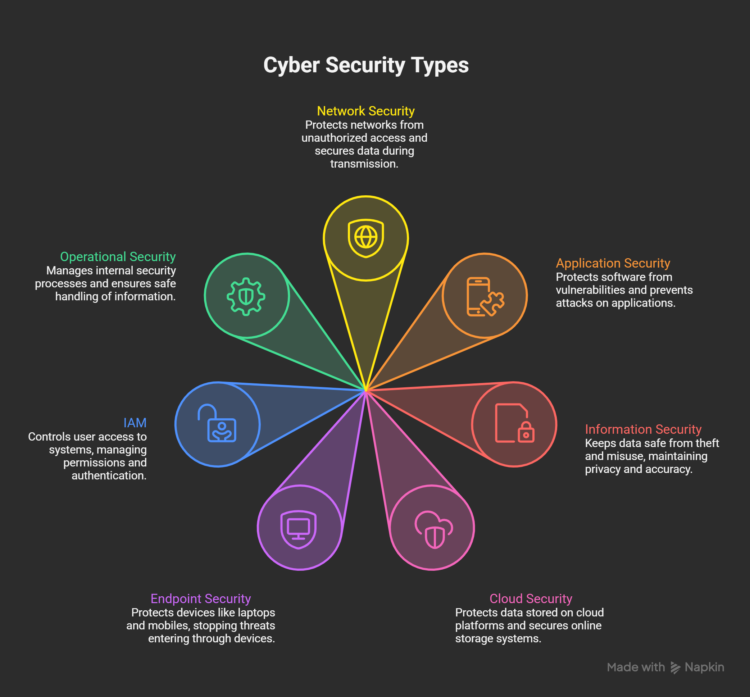
📌 The 7 Types of Cyber Security
🌐 Network Security
Protects networks from unauthorized access.
Secures data during transmission.
🧩 Application Security
Protects software from vulnerabilities.
Prevents attacks on applications.
🔐 Information Security
Keeps data safe from theft and misuse.
Maintains privacy and accuracy.
☁️ Cloud Security
Protects data stored on cloud platforms.
Secures online storage systems.
💻 Endpoint Security
Protects devices like laptops and mobiles.
Stops threats entering through devices.
🔑 Identity and Access Management (IAM)
Controls user access to systems.
Manages permissions and authentication.
⚙️ Operational Security
Manages internal security processes.
Ensures safe handling of information.
Detailed Explanation of Each Type (Core Section)
Cyber security has different layers of protection. Each type handles a specific kind of risk. Together, they create complete digital security. Understanding their role is very important.
🌐 Network Security
Network security protects communication between systems. It focuses on controlling incoming and outgoing traffic. It ensures only safe data enters the network.
Real-World Example
A company blocks unknown IP addresses.
Public Wi-Fi without security gets easily hacked.
Tools/Technologies
Firewalls filter unwanted traffic.
VPNs secure internet connections.
Career Roles
Network security engineer.
Network administrator.
🧩 Application Security
Application security focuses on protecting software itself. It starts from the development stage. It ensures apps are built without weaknesses.
Real-World Example
A payment app fixes login vulnerabilities.
Hackers exploit weak app code for access.
Tools/Technologies
Code analysis tools detect issues early.
Security testing tools check app behavior.
Career Roles
Application security engineer.
Security tester.
🔐 Information Security
Information security protects the value of data. It ensures data remains private and accurate. It focuses on how data is stored and used.
Real-World Example
Hospitals restrict access to patient records.
Data leaks happen due to poor controls.
Tools/Technologies
Encryption protects stored data.
Access controls limit data usage.
Career Roles
Information security analyst.
Data security officer.
☁️ Cloud Security
Cloud security protects data stored on remote servers. It manages risks in online storage environments. It focuses on shared systems and access control.
Real-World Example
A company stores files on cloud platforms.
Misconfigured storage can expose data publicly.
Tools/Technologies
Cloud monitoring tools track activity.
Identity controls manage user access.
Career Roles
Cloud security engineer.
Cloud security consultant.
💻 Endpoint Security
Endpoint security protects individual devices in a network. Each device can become an entry point for attacks. So, device-level protection is very important.
Real-World Example
Malware enters through infected USB drives.
Personal laptops can expose company data.
Tools/Technologies
Antivirus detects harmful files.
EDR tools monitor device behavior.
Career Roles
Endpoint security analyst.
IT security specialist.
🔑 Identity and Access Management (IAM)
IAM controls who can access systems and data. It ensures users get only required permissions. It reduces risk from internal misuse.
Real-World Example
Employees access only assigned company data.
Unauthorized access is blocked using roles.
Tools/Technologies
Multi-factor authentication adds security.
Access control systems manage permissions.
Career Roles
IAM engineer.
Identity analyst.
⚙️ Operational Security
Operational security focuses on daily security practices. It manages how data and systems are handled. It ensures rules are followed correctly.
Real-World Example
Companies limit data sharing between teams.
Poor practices can lead to data leaks.
Tools/Technologies
Monitoring systems track activity.
Security policies guide usage.
Career Roles
SOC analyst.
Security operations manager.
Each type solves a different security problem. Together, they create strong and layered protection.
🔹 Comparison Section (SEO Boost)
Each cyber security type has a different role. Some protect systems, while others protect users or data. Comparing them helps understand their purpose clearly. It also helps choose the right domain to learn.
🌐 Network Security vs 🧩 Application Security
Feature
Network Security
Application Security
Focus Area
Network traffic
Software and apps
Main Goal
Block unauthorized access
Fix vulnerabilities
Level
System-level
Code-level
Example
Firewall protection
Secure login systems
Network Security
Protects data flow between devices.
Stops external threats.
Application Security
Protects app structure and code.
Prevents internal vulnerabilities.
☁️ Cloud Security vs 🔐 Information Security
Feature
Cloud Security
Information Security
Focus Area
Cloud platforms
All data
Main Goal
Secure cloud storage
Protect data privacy
Scope
Platform-specific
Broad scope
Example
Cloud file protection
Data encryption
Cloud Security
Focuses on online storage risks.
Manages shared access.
Information Security
Covers all data protection.
Works across systems.
💻 Endpoint Security vs 🔑 IAM
Feature
Endpoint Security
IAM
Focus Area
Devices
User access
Main Goal
Protect endpoints
Control permissions
Level
Device-level
User-level
Example
Antivirus software
OTP login systems
Endpoint Security
Protects laptops and mobiles.
Stops device-based threats.
IAM
Controls user identity and access.
Prevents unauthorized logins.
⚙️ Operational Security vs 🌐 Network Security
Feature
Operational Security
Network Security
Focus Area
Processes and policies
Network systems
Main Goal
Safe data handling
Secure communication
Level
Organizational
Technical
Example
Access rules in company
Firewall filtering
Operational Security
Manages internal security practices.
Focuses on human and process control.
Network Security
Protects system connections.
Focuses on technical protection.
🧩 Application Security vs 🔐 Information Security
Feature
Application Security
Information Security
Focus Area
Applications
Data
Main Goal
Secure software
Protect information
Level
Code-level
Data-level
Example
Secure app updates
Data encryption
Application Security
Focuses on app vulnerabilities.
Prevents hacking through software.
Information Security
Focuses on data safety.
Prevents data misuse.
These comparisons make differences easier to understand. Each type plays a unique role in protection.
Which Cyber Security Type Should You Learn?
Choosing the right cyber security type depends on your goals. Each domain needs different skills and interests. Some roles require coding, while others do not. Understanding your preference helps in better decisions.
🎓 For Beginners
Start Simple
Begin with basic concepts and tools.
Learn network or information security first.
Build Foundation
Focus on understanding threats and risks.
Practice using simple security tools.
💻 Coding vs Non-Coding Preference
Coding-Based Roles
Choose application security or ethical hacking.
Requires programming and testing skills.
Non-Coding Roles
Choose IAM or operational security.
Focus on policies and access control.
💰 High-Paying Domains
In-Demand Fields
Cloud security offers strong growth.
Application security has high demand.
Career Growth
Advanced skills lead to better salaries.
Experience increases earning potential.
📌 How to Decide
Identify your interest and strengths.
Choose a domain that matches your skills.
Start with basics and grow step by step.
Selecting the right type makes learning easier. It also improves long-term career growth.
Career Scope in Cyber Security (India Angle)
Cyber security careers are growing rapidly in India today. Many industries now depend on digital systems daily. This increases the need for skilled professionals everywhere. Companies want experts to protect systems and data. Both private and government sectors offer many roles.
📈 Demand in India
Rising Opportunities
Cyber threats are increasing across industries.
Companies need skilled security professionals.
Wide Industry Use
Banks and IT firms require strong protection.
Startups also invest in digital security.
💰 Entry-Level Salary
Starting Range
Freshers earn around ₹3–6 LPA.
Salary varies based on role and skills.
Skill Impact
Certifications improve job chances.
Practical knowledge increases earning potential.
🚀 Growth Potential
Career Progression
Start as analyst or junior engineer.
Move to senior and expert roles.
High-Paying Domains
Cloud security offers better salaries.
Application security has strong demand.
📌 Future Scope
Strong job demand will continue growing.
More companies will invest in security.
Skilled professionals will have better opportunities.
Cyber security offers stable and rewarding careers. It is a strong and future-ready career choice.
Conclusion
Cyber security is very important today. It protects systems, data, and users. Each type has a different role. Learning these types builds clear understanding. It also helps in choosing a career path. Digital risks are increasing every day. So, basic knowledge is very important now.
Starting with one type is a smart choice. It helps build skills step by step. Beginners can start with simple domains. Learning becomes easier with proper guidance. Many courses are available for beginners today. Practice improves skills and confidence over time. Cyber security skills create better future opportunities.
Famida is an experienced educator with over a decade of teaching experience, specializing in grades 8 to 12, business management (BBM), and electronics engineering. Holding a Master's degree in Electronics and Communication Engineering, she has also trained interns in IoT. For the past four years, Famida has been writing articles for Entri, focusing on exam preparation tips, question papers, and study plans. She also creates practice questions for the Entri app and provides support to users. Additionally, Famida's writing skills extend to parenting and personal blogs, as well as curriculum development.