Table of Contents
Have you given any thought to the possibility of pursuing further study at a higher level in Germany? There are a number of reasons why Hamburg is widely considered to be one of the most ideal cities for international students to pursue their education. Some of these reasons include a fantastic educational system, a current culture, and a myriad of cultural events.
It is essential, on the other hand, to familiarise oneself with the cost of living that is linked with a certain location before migrating to an urban area. Your living situation may have an effect on your bank account when it comes to the key essentials that you require, such as accommodation, food, and transportation as well as other necessities.
It is common for students in Hamburg to have to deal with monthly expenses that range from 800 to 1,400 euros; however, this amount can vary greatly depending on the level of financial discipline that the students possess. Due to this particular feature, the city continues to maintain its low cost of living, despite the fact that prices have increased.
Key Takeaways:
- Hamburg’s monthly cost of living is €800–€1,400.
- Accommodation is the highest cost, with shared housing being the cheapest.
- Instead of eating out, cook at home to cut food costs.
- Public transit is cheap and sometimes included with student semester tickets.
- Most public universities charge semester fees and no tuition.
- Student discounts, smart budgeting, and part-time work can lower living costs.
Learn German language in your own language! Get free Demo Classes Here!
Average Monthly Cost of Living in Hamburg

With regard to their monthly living expenditures, students in Hamburg often needed to spend between 800 and 1,400 euros. This is the total amount of money that they are required to spend. The rent that you pay, the lifestyle choices that you make, and whether or not you live in a private flat or in student accommodation are the primary factors that determine whether or not you are classed as belonging to this category.
We will provide you with the following information to provide you with particular information regarding the typical monthly costs:
| Expense Classification | Average Monthly Cost (€) |
|---|---|
| Accommodation | 400 – 800 |
| Food & Groceries | 150 – 300 |
| Transportation | 0 – 60 |
| Utilities & Internet | 100 – 200 |
| Miscellaneous | 100 – 250 |
| Total | 800 – 1,400 |
Accommodation Costs in Hamburg
1: How do you say "Good Morning" in German?
Students in Hamburg have one of the most difficult tasks available to them when it comes to finding housing, and rent typically constitutes the largest portion of their monthly budget. Whether you choose to live in student housing or private accommodation is the primary factor that determines the costs.
Student Dormitories vs Private Apartments
Student Dormitories (Cheapest Option)
- This is mostly managed by the Studierendenwerk Hamburg.
- Apartments or studios that are shared and have rooms that are fully furnished
- The kitchen and the amenities are shared.
- Priced the lowest, but with a high level of competition and lengthy waiting lists
The monthly rent ranges from an average of €300 to €450
Optional Shared Apartments (WG – Mid-Range) Apartments
- A room that is private within a flat that is shared with other students
- A greater degree of autonomy than dorms
- Selection of a lifestyle that is typical in Hamburg
The monthly rent ranges from €400 to €700 on average.
Private Apartments (Most Expensive Option)
- A one BHK or a studio apartment
- Complete privacy
- Increased utility bills
The monthly rent ranges from €700 to €1,200 month on average
Free German A1 Mock Tests – Powered by AI!
Test your skills on our interactive platform. Get instant feedback from our AI to help you communicate better and track your progress. Start your free German mock test now.
Test Your German A1 for FreeFood and Grocery Expenses
When students who are living in Hamburg prepare their own meals at home and shop in an orderly manner, it is one of the expenses that is more manageable for them. This is especially true if they are living in Hamburg. In addition, the cost of food is one of the expenses that can be paid for with less money invested.
Monthly Grocery Cost
Meal budgets for students typically 150 to 300 euros per month. Your food habits, lifestyle choices, and home cooking frequency affect this outcome.
- For everyday cooking and food prep, 150 euros per month is reasonable.
- People realise that monthly tuition and fees can cost 200–250 euros.
- Paying a monthly charge of roughly 300 euros gives you access to more snacks and branded items.
Eating Out vs Cooking
Cooking at home boosts your budget
- It’s cheaper and healthier.
- Lunch costs two to five euros.
- The best option for low-income students.
Try outside food rarely or occasionally
- A café or fast food restaurant lunch may cost six to twelve euros, depending on the establishment.
- Lunch at a restaurant can cost 10–20 euros or more.
- Regular dining out could cost you a lot each month.
Most students meet these goals by feeding themselves and eating out sometimes.
Popular Supermarkets in Germany
In most cases, students buy at grocery chains that offer reasonable prices, such as:
- Aldi – very cost-effective and budget-friendly
- Lidl – Decent quality at a low price
- Rewe – wide-ranging, mid-range retailer.
- Edeka – more expensive.
Transportation Costs
There is a robust and effective public transit system in Hamburg, which includes buses, trains, and boats.
Student Semester Ticket Benefits
The majority of students are provided with a semester ticket as part of their payments to the university.
- Travel without restrictions within Hamburg and the surrounding areas
- Acceptable on buses, trains, and certain types of ferries
- Expenses are already accounted for in the donation for the semester.
Because of this, a significant number of students do not have to pay additional monthly travel charges.
Public Transport in Hamburg
The Hamburger Verkehrsverbund (HVV) is the organization that manages Hamburg’s transport network.
- Services that are dependable and frequent
- Simple connections throughout the entire city
- User-friendly for students and frequently utilised
Monthly Cost Estimate
- With a semester ticket, it costs €0 per month (which is paid by fees).
- If you do not have a semester ticket, 30–60 euros each month
Tuition Fees & Study Costs
One of the most significant advantages of studying in Hamburg is that the cost of education is substantially lower than in the majority of other nations. This is one of the reasons why learning in Hamburg is so advantageous.
Schools of higher learning that are free of charge to the general public
In Germany, the vast majority of public universities do not charge tuition fees for undergraduate programs, and a sizeable number of postgraduate programs do not charge tuition fees either. This indicates that students are able to obtain access to an education of a high level without being required to pay tuition rates that are considered to be unnecessarily exorbitant.
A contribution was made throughout the semester.
Instead of paying tuition, students are required to make a donation to the school on a semester-to-semester basis, which often falls somewhere between €250 and €350.
Typically, this price covers the following:
- Administration-related costs and expenses
- Student support services
- Public transport ticket (for the duration of the semester)
Books and Study Materials
Students should also budget for academic expenses such as:
- Books: €20 – €50 per month
- Study materials & printing: €10 – €30 per month
Many students save money by:
- Using university libraries
- Buying second-hand books
- Sharing resources with classmates
Free German A1 Mock Tests – Powered by AI!
Test your skills on our interactive platform. Get instant feedback from our AI to help you communicate better and track your progress. Start your free German mock test now.
Test Your German A1 for FreeUtilities & Internet
Your choice of lodging in Hamburg can have an impact on the amount of money you spend on utilities. Many of these costs are typically incorporated into the monthly rent that you pay if you live in a student residence hall. In contrast, you will typically be responsible for paying them separately in private or shared flats.
The services of electricity, heating, and water are widely considered to be fundamental utilities.
Prices range from €100 to €200 a month on average.
- A lower price level is shared residences, in which the rent is divided among roommates.
- Private flats (paid for on an individual basis) are in the higher price category.
- It’s possible that prices will go up over the winter because of heating.
Internet
- The monthly cost of broadband ranges from twenty to forty euros.
- The majority of the time, roommates in WG apartments share it.
- Sometimes included in the monthly rent (particularly in dorms).
Mobile Plans
Students have the option of selecting from a variety of economical prepaid or contract plans.
The typical monthly cost of mobile devices is from €10 to €25.
- For a price range of approximately €10 to €15, basic plans provide calls and limited data.
- The standard plans are: More data combined with improved coverage (20–25 euros)
Miscellaneous Expenses
It is important for students in Hamburg to include the prices of personal and leisure activities in their budget, in addition to the expenditures of essential necessities. These can shift as a consequence of the actions and activities that are carried out with other individuals.
Amusement Parks, Shopping Centres, and Fitness Centres
This area encompasses a wide range of activities, including personal purchases, vacations, hobbies, and fitness.
On average, the monthly cost is between one hundred and two hundred euros during the entire period.
- Outings and films can be purchased for anything between eight and fifteen euros.
- Regular membership dues might run anywhere from twenty to fifty euros each month.
- Your way of life will determine the kinds of things you purchase (clothes, essentials).
- Cafes, social events, and other venues where people congregate
For students who go out more frequently or make purchases more frequently, their spending may be on the higher end of the spectrum.
Health Insurance (Mandatory)
Individuals must have health insurance. In order to enroll in school in Germany, prospective students are required to first obtain health insurance.
A monthly expenditure of approximately €110 is estimated.
- The public health insurance plan is the sort of health insurance that is most commonly used by students.
- Coverage includes not just basic treatments but also trips to the doctor, as well as emergency care.
Learn German language in your own language! Get free Demo Classes Here!
Tips to Reduce Living Costs in Hamburg
Planning and budgeting may make Hamburg inexpensive. Student money-saving tips:
Consider student discounts
- Keep your student ID.
- Restaurants, movie theaters, museums, and transportation offer discounts.
Many retailers and online platforms offer student discounts, which can result in significant savings over time.
Get a shared room.
- Shared apartments and dorms are available.
- Divide rent, power, and internet among housemates.
- Pricing is lower than private housing.
Take Part-Time Jobs
German students can work under certain conditions:
- Up to 120 full or 240 partial days each year
- Maximum 20 hours/week during semesters
- Semester breaks allow full-time work.
Common student jobs:
- Cafes, restaurants
- Retail stores
- University assistant
However, part-time employment rarely covers all living expenditures.
Hamburg vs Other German Cities
Rent and lifestyle expenditures are the largest differences between Hamburg and other major German cities for students.
Hamburg vs. Berlin vs. Munich: Berlin:
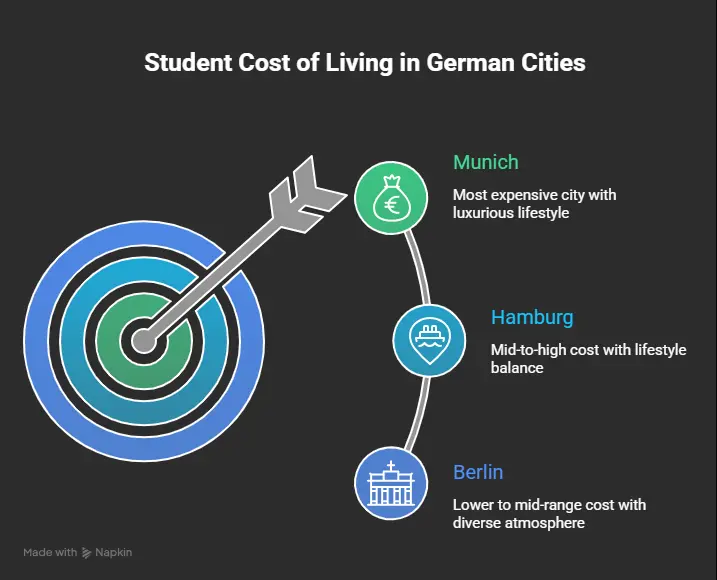
Hamburg
- Mid-to-high cost
- Rent: Higher than Berlin, lower than Munich in many regions.
- Lifestyle: Modern city with many jobs and harbour culture
- Best for: Students seeking lifestyle and opportunity balance
Berlin
- Cost: Lower to mid-range
- Rent: Generally lower than in Hamburg
- Student atmosphere: Diverse, many international students
Budget-conscious students seeking lower living costs
Munich
- Most expensive in Germany
- Rent: Expensive, especially student housing
- Luxurious but expensive lifestyle
- For students with scholarships or greater budgets
Final Thoughts
Students in Hamburg can have a lot of fun and pursue high-quality education, but they need to be careful with their money if they want to continue their education. The monthly range of expenses is 800 to 1,400 euros on average. One must allocate funds on a budget for essentials such as food, energy, housing, transportation, and personal funds. The cost of getting from one location to another is different. You can’t leave out transportation expenses. Living expenses can be drastically cut for students if they start early with a budget, use student finances, cook their own meals, and live in dorms. This being said, for students who can manage their spending. Hamburg remains an excellent city to live in. One can’t move forward unless this condition is met.
Free German A1 Mock Tests – Powered by AI!
Test your skills on our interactive platform. Get instant feedback from our AI to help you communicate better and track your progress. Start your free German mock test now.
Test Your German A1 for FreeFrequently Asked Questions
Is Hamburg expensive for students?
Studying in Hamburg is moderately expensive. Rent is the biggest cost, but overall living expenses are still manageable compared to cities like Munich. Students typically spend between €800 and €1,400 per month depending on lifestyle.
Can students live on €800 per month?
Careful budgeting lets students live on €800 each month. Try staying in student dorms or shared apartments, cooking most meals at home, and avoiding expensive dining out or entertainment. It’s tight, but disciplined spenders can do it.
Is part-time work enough to cover expenses?
Students can earn money by working 20 hours a week in cafés, retail, and as academic assistants. Although these earnings can assist with food, transportation, and rent, most students still rely on family or savings to fund their needs.
Is Hamburg cheaper than Munich?
Yes. Munich is the most expensive city in Germany, while Hamburg is more mid-range, though still pricier than Berlin.
What is the biggest expense for students in Hamburg?
Housing is the biggest cost, especially private apartments, which can significantly increase monthly spending.