Table of Contents
The quickest way to learn German is to take the whole thing with a grain of salt. Focus on the bits you’ll actually use. You can learn the 1,000 most used words and a few grammar rules and you’ll be able to catch about 80% of what people are talking about in German in the streets. And the best part is, it’s a heck of a lot quicker than you’d think.
Key Takeaways
- You don’t need to cram every German word into your brain. Just learn the ones that people grill each other with.
- A tiny set of grammar rules – like the present tense and a few of those modal verbs – will cover your daily needs just fine.
- Mumbling simple sentences out loud is way more helpful than studying perfect grammar on some piece of paper in your room
- Steer clear of those super rare words and complicated cases early on – they’ll leave you feeling burned out.
- A simple 80/20 plan can help you learn and speak German a whole lot faster than traditional study methods
Why So Many People Get Tired of Trying to Learn German
A lot of people start off way too optimistic. They go out and buy some huge textbook. They’re serious about memorizing every single table of noun cases. They spend weeks studying obscure grammar rules that even some German grandmas probably don’t use. That kind of learning almost always ends in disaster. There’s just too much to take in. Frustration starts to build up. Next thing you know, motivation is gone. They quietly give up and walk away.
There is a way to learn that makes way more sense. You don’t need to know everything to speak like a pro. You just need that magic 20%
Start applying the 80/20 rule today
What’s This 80/20 Rule Anyway?
1: How do you say "Good Morning" in German?

The 80/20 rule – also known as the Pareto Principle – has its roots in an Italian economist named Vilfredo Pareto. He noticed back in the day that about 80% of Italy’s land belonged to just 20% of the population. Then people realised that this pattern shows up in loads of places.
When it comes to learning, it works like this : a small chunk of your effort will bring in the majority of your results. Twenty percent of the words you learn are going to show up 80% of the time in your conversations. Twenty percent of the grammar rules will help you get 80% of your sentences correct.
The idea is simple: just find that powerful 20% of what you need to know and put the rest to the back of your mind for now.
Free German A1 Mock Tests – Powered by AI!
Test your skills on our interactive platform. Get instant feedback from our AI to help you communicate better and track your progress. Start your free German mock test now.
Test Your German A1 for FreeHow the 80/20 Rule Changes German Learning
German has a vast vocabulary of over 300,000 words. But most native speakers only use about 5,000 of them. Here’s the fun part: if you just learned the top 1,000 words, you can figure out almost 80% of what people are saying in their everyday conversations – that’s at least your average conversational level.
The same goes for grammar in German. They’ve got six tenses to get your head around, but most conversations only use the present tense and the present perfect tense. And let’s not forget about all the modal verbs that come up all the time – “können” (can), “müssen” (must), and a few others that are just as useful. Then there’s the basic sentence structure rule of putting the verb in second position – that’s a must know. Everything else can wait.
In real life, it’s not a textbook. Textbooks are good for teaching you how to name farm animals or describe a library, but that’s about it. Real conversations are a lot more down to earth – you’re more likely to hear words like “want”, “have”, “go”, “good”, and “today”. So don’t get too caught up in learning all the fancy stuff first, just focus on what’s really useful in real life conversations.
The Most Crucial 20% to Concentrate On
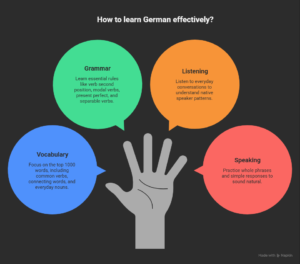
To learn German the smart way, break your focus down into four manageable chunks.
Vocabulary: The Top 200 German Words That Matter
Pronouns & Essential Verbs
-
ich – I
-
du – you (informal singular)
-
er – he
-
sie – she / they
-
es – it
-
wir – we
-
ihr – you (informal plural)
-
Sie – you (formal)
-
sein – to be
-
haben – to have
-
werden – to become
-
können – can / to be able to
-
wollen – to want
-
müssen – must / to have to
-
sollen – should / ought to
-
dürfen – may / to be allowed to
-
mögen – to like
-
tun – to do
-
machen – to make / to do
-
gehen – to go
-
kommen – to come
-
sehen – to see
-
sagen – to say
-
geben – to give
-
finden – to find
-
bleiben – to stay
-
stellen – to place / to set
-
helfen – to help
-
nehmen – to take
-
bringen – to bring
Common Nouns (People & Daily Life)
-
Mann – man
-
Frau – woman
-
Kind – child
-
Leute – people
-
Freund – friend (male)
-
Freundin – friend (female)
-
Familie – family
-
Vater – father
-
Mutter – mother
-
Bruder – brother
-
Schwester – sister
-
Name – name
-
Person – person
-
Herr – Mr. / gentleman
-
Frau – Mrs. / lady
-
Baby – baby
-
Nachbar – neighbor
-
Gast – guest
-
Arzt – doctor
-
Lehrer – teacher
Time Expressions
-
Tag – day
-
Nacht – night
-
Woche – week
-
Monat – month
-
Jahr – year
-
Stunde – hour
-
Minute – minute
-
Sekunde – second
-
Morgen – morning / tomorrow
-
Abend – evening
-
heute – today
-
gestern – yesterday
-
morgen – tomorrow
-
jetzt – now
-
dann – then
-
bald – soon
-
oft – often
-
immer – always
-
manchmal – sometimes
-
nie – never
Places & Directions
-
Haus – house
-
Wohnung – apartment
-
Stadt – city
-
Land – country / land
-
Straße – street
-
Platz – place / square
-
Ecke – corner
-
Tür – door
-
Fenster – window
-
Tisch – table
-
Stuhl – chair
-
Bett – bed
-
Zimmer – room
-
Küche – kitchen
-
Bad – bathroom
-
Arbeit – work
-
Schule – school
-
Universität – university
-
Supermarkt – supermarket
-
Bahnhof – train station
Food & Drink
-
Wasser – water
-
Kaffee – coffee
-
Tee – tea
-
Bier – beer
-
Wein – wine
-
Milch – milk
-
Saft – juice
-
Brot – bread
-
Käse – cheese
-
Fleisch – meat
-
Fisch – fish
-
Obst – fruit
-
Gemüse – vegetables
-
Suppe – soup
-
Salz – salt
-
Zucker – sugar
-
Frühstück – breakfast
-
Mittagessen – lunch
-
Abendessen – dinner
-
Teller – plate
Common Adjectives
-
gut – good
-
schlecht – bad
-
groß – big / tall
-
klein – small
-
neu – new
-
alt – old
-
jung – young
-
schnell – fast
-
langsam – slow
-
teuer – expensive
-
billig – cheap
-
schön – beautiful / nice
-
hässlich – ugly
-
glücklich – happy
-
traurig – sad
-
müde – tired
-
krank – sick
-
gesund – healthy
-
wichtig – important
-
einfach – simple / easy
Prepositions & Connectors
-
in – in / into
-
auf – on / onto
-
an – at / on (vertical surface)
-
unter – under
-
über – over / above
-
neben – next to
-
zwischen – between
-
vor – before / in front of
-
hinter – behind
-
nach – after / to (direction)
-
zu – to / towards
-
von – from / of
-
mit – with
-
ohne – without
-
für – for
-
durch – through
-
gegen – against
-
um – around / at (time)
-
bis – until / up to
-
seit – since / for (time)
Question Words & Important Adverbs
-
wer – who
-
was – what
-
wo – where
-
wann – when
-
warum – why
-
wie – how
-
wie viel – how much
-
wie viele – how many
-
welcher – which
-
woher – from where
-
wohin – to where
-
ja – yes
-
nein – no
-
vielleicht – maybe
-
bitte – please / you’re welcome
-
danke – thanks
-
sehr – very
-
zu – too (excessively)
-
auch – also / too
-
nur – only
More Useful Verbs
-
wissen – to know (fact)
-
kennen – to know (person/place)
-
denken – to think
-
glauben – to believe
-
verstehen – to understand
-
sprechen – to speak
-
sagen – to say
-
fragen – to ask
-
antworten – to answer
-
schreiben – to write
-
lesen – to read
-
hören – to hear
-
suchen – to search
-
finden – to find
-
warten – to wait
-
beginnen – to begin
-
enden – to end
-
arbeiten – to work
-
schlafen – to sleep
-
wohnen – to live / reside
Everyday Objects & Misc
-
Geld – money
-
Auto – car
-
Bus – bus
-
Zug – train
-
Flugzeug – airplane
-
Handy – mobile phone
-
Computer – computer
-
Buch – book
-
Stift – pen
-
Schlüssel – key
Grammar: The Few Rules That Give You The Biggest Bang
Only a handful of grammar rules will give you the biggest return on your time. First off, the rule of verb second position is a good one to learn – in a main sentence, the verb always comes second. “Ich habe einen Hund” (I have a dog) is a good example of that.
Next up is modal verbs – they can totally change the meaning of your main verb, and usually put it right at the end of the sentence. “Ich kann Deutsch sprechen” (I can speak German) is a good example of that.
Then there’s the present perfect tense for talking about the past – you use “haben” plus the past participle to do that. “Ich habe gelernt” (I learned) is a good example of that.
And finally, there’s separable verbs – some verbs just split into two parts. “Aufstehen” (to get up) becomes “Ich stehe um 8 Uhr auf” (I get up at 8 o’clock).
That’s really all you need to learn to get going. Leave the dative case, adjective endings and genitive case for later. They can wait – none of those are crucial for a good conversation.
|
German A2 Exercises – Download Free PDF |
||
Listening: How Real People Actually Talk
Listening to everyday conversations is a great way to get used to the way native speakers speak . Forget about news anchors and audiobooks for now, and instead tune into dialogues about food, work, family – just ordinary talk. Easy German on YouTube is a great place to start. Thats because they have real people on the street having short chatty conversations . They’re full of common phrases you’ll be hearing all the time
Speaking: Ready to Use Phrases and Responses – The Real Deal
Rather than just learning single words, try to pick up whole phrases. “Wie gehts” (how are you?) is one example, “Mir gehts gut” (I’m fine) is another, and “Was kostet das?” (how much does that cost?) will come in handy when you’re out shopping. And if you get lost, “Ich verstehe nicht” (I don’t understand) will be a lifesaver.
Grasp 10 simple response phrases. They will keep conversations flowing without any hassle. Try using “Ja genau” (yes exactly), “Ach so” (oh I see), and “Kein Problem” (no problem). These little chunks will make you sound miles more natural.
Practical Ways to Make the 80/20 Rule Work for You Every Day
These five strategies will actually get you using the idea in your daily life.
Use Flashcards for the Most Common Words Only
Create a flashcard deck with just the top 1000 words. Anki is a good bet – its free and it uses some nifty tricks to show you words just before you start to forget them. Take 10 minutes a day to review. No point adding obscure words, stick to what you need.
Chat a Bit Every Day – Even to Yourself in the Mirror
Say 3 sentences a day out loud. “Ich trinke Kaffee. Dann gehe ich zur Arbeit. Heute ist es kalt” dont worry about getting it perfect – just get the words out. Talking to yourself is weird but it builds up your brain pathways in a way that reading alone just can’t.
Watch German TV with German Subtitles
Fire up a German show on Netflix and have German subtitles instead of the English ones. Your ears will start to pick up the sounds and link them to the words on the screen. Start with kids shows – the language is nice and slow. “Peppa Wutz” (Peppa Pig) is actually a good place to start.
Repeat Things a Few Times and Don’t Stress About Perfection
Don’t let mistakes bring you to a halt. If you dont get it right the first time, repeat it 5 times and then get it right. Thats more useful than a perfect sentence that you never say in real life. Let your German be a bit rough around the edges – getting the message across comes first. Polish it up later.
Leave Complex Grammar Alone for Now
Do not touch the dative case in your first week. Do not learn the subjunctive mood in your first month. Do not ask about the difference between “als” and “wenn” until you can hold a five minute conversation. These topics are the 80% of effort that brings only 20% of results. Save them for much later.
Free German A1 Mock Tests – Powered by AI!
Test your skills on our interactive platform. Get instant feedback from our AI to help you communicate better and track your progress. Start your free German mock test now.
Test Your German A1 for FreeCommon Mistakes That Slow You Down

Smart learners avoid these traps.
Trying to learn everything at the same time. Your brain has limits. Respect them. Small wins every day beat giant study sessions once a month.
Spending time on rare words. Knowing the German word for “nuclear reactor” will not help you order coffee. Build your base first. Then build the top.
Skipping speaking practice. Reading German is not the same as speaking German. Your mouth needs training. Talk to yourself in the mirror if you do not have a partner.
Staying stuck in textbooks. Textbooks are linear. Real life is not. A textbook teaches you one chapter at a time. Real life throws everything at you at once. Learn from real life as early as you can.
|
Goethe 2026 Exam Dates: Multiple Test Centers |
|
| Trivandrum Goethe Exam Dates | Kochi Goethe Exam Dates |
| Chennai Goethe Exam Dates | Coimbatore Goethe Exam Dates |
A Simple 80/20 Weekly Study Plan
This plan takes about 60 minutes each day. It works well for most people. Change the times to fit your own schedule.
Monday to Friday Routine
- Morning (10 minutes): Open Anki and review your top 1,000 words. No new cards. Just review.
- Lunch break (15 minutes): Watch one Easy German video with subtitles. Pause and repeat two short phrases.
- Evening (20 minutes): Speaking practice. Describe your day in three to five simple sentences. Record yourself on your phone.
- Before bed (15 minutes): Read one short dialogue from a learner website like Nico’s Weg. Write down two new phrases that feel useful.
Weekend Routine
- Saturday (45 minutes): Review all the new words you saw during the week. Practice modal verb sentences. “Ich kann…”, “Ich muss…”, “Ich will…”
- Sunday (30 minutes): Watch one full German episode with German subtitles. Do not pause. Do not look up words. Just listen and read for fun.
Free Tools That Help
- Anki for flashcards.
- Easy German on YouTube for listening practice.
- Deutsche Welle’s Nico’s Weg for simple dialogues.
- Language Reactor (a browser extension) for double subtitles on Netflix.
What You Gain by Learning German the 80/20 Way
This changes the feeling of learning.
You get results quicker, you will speak basic sentences in two weeks instead of two months. It feels real because it feels real.
You remember more. Words you learn come up frequently. Without having to try, you see them again and again. Your brain stores them without painful re-reading sessions.
You are less overwhelmed. You are not trying to climb a mountain. You are walking a path with no confusing grammar traps. Every day makes sense.
You build real confidence. A German speaks to you. You recognize the words, you know the meaning. You reply with a simple response. That little success feels great. It makes you want to learn more.
Start applying the 80/20 rule today
Final Thoughts
Working hard is good. Working smart is better. The 80/20 rule is not about being lazy, it is about being smart with your time. You only have so many hours in a day. Spend those hours on the German that matters.
Stop memorizing long lists of rare words, stop worrying about every grammar error, stop waiting until you are ready to speak. Start today with the top 100 words, say them out loud. Make mistakes. Learn from those mistakes.
Free German A1 Mock Tests – Powered by AI!
Test your skills on our interactive platform. Get instant feedback from our AI to help you communicate better and track your progress. Start your free German mock test now.
Test Your German A1 for FreeFrequently Asked Questions
What is the 80/20 rule for learning German?
The 80/20 rule means that 20% of your effort brings 80% of your results. In German, this means focusing on the most common 1,000 words and a few basic grammar rules to understand most daily conversations.
How many German words do I really need to know?
You only need 1,000 to 2,000 of the most common words to understand 80% of everyday German. Native speakers use only about 5,000 words regularly, so starting with the top 1,000 is enough for basic fluency.
Can I become fluent in German without learning all the grammar rules?
Yes. Many learners waste months on rare grammar rules. Focus on present tense, modal verbs, verb second position, and separable verbs. Leave cases like dative or genitive for later. You will still speak well.
How long will it take to see results with this method?
Most learners see real progress in two to four weeks. You will understand simple conversations and respond with basic phrases. Traditional methods often take two to three months to reach the same level.
What are the best free tools for learning German the 80/20 way?
Anki for flashcards, Easy German on YouTube for listening, Deutsche Welle’s Nico’s Weg for dialogues, and Language Reactor for Netflix subtitles are all free and effective. No paid tools are necessary at the beginning.
Should I focus on reading or speaking first?
Speaking comes first. Reading helps, but speaking builds real confidence. Say simple sentences out loud every day, even if they are wrong. Your mouth needs practice just like your ears and eyes.
What is the biggest mistake beginners make in German?
Trying to learn everything at once. Beginners often study rare words, complex cases, and all six tenses in the first month. This leads to burnout. Stick to the powerful 20% and ignore the rest for now.
How do I know which German words are high frequency?
Look up the top 1,000 German words list online. Many language learning websites publish these lists. Anki also has shared decks for the most common German words. Avoid themed vocabulary lists like “animals” or “airport” early on.
Can children's shows really help me learn German?
Yes. Children’s shows use slow, simple language and repeat common phrases. Shows like Peppa Wutz are excellent for beginners. Watch with German subtitles, not English ones, to train your ears.