Table of Contents
To become a Robotics DevOps Engineer you’ll typically have a Bachelor’s degree in computer science, robotics or software engineering. However, you can’t just stop there – you’ll need to learn Linux, Docker, ROS (Robot Operating System) and some cloud platforms like AWS for example.
Then there’s the matter of years of experience – most engineers will need 2 to 3 years under their belt developing software or administering systems before stepping into robotics DevOps.
Introduction – Why Robotics DevOps Engineering is A High-Growth Career
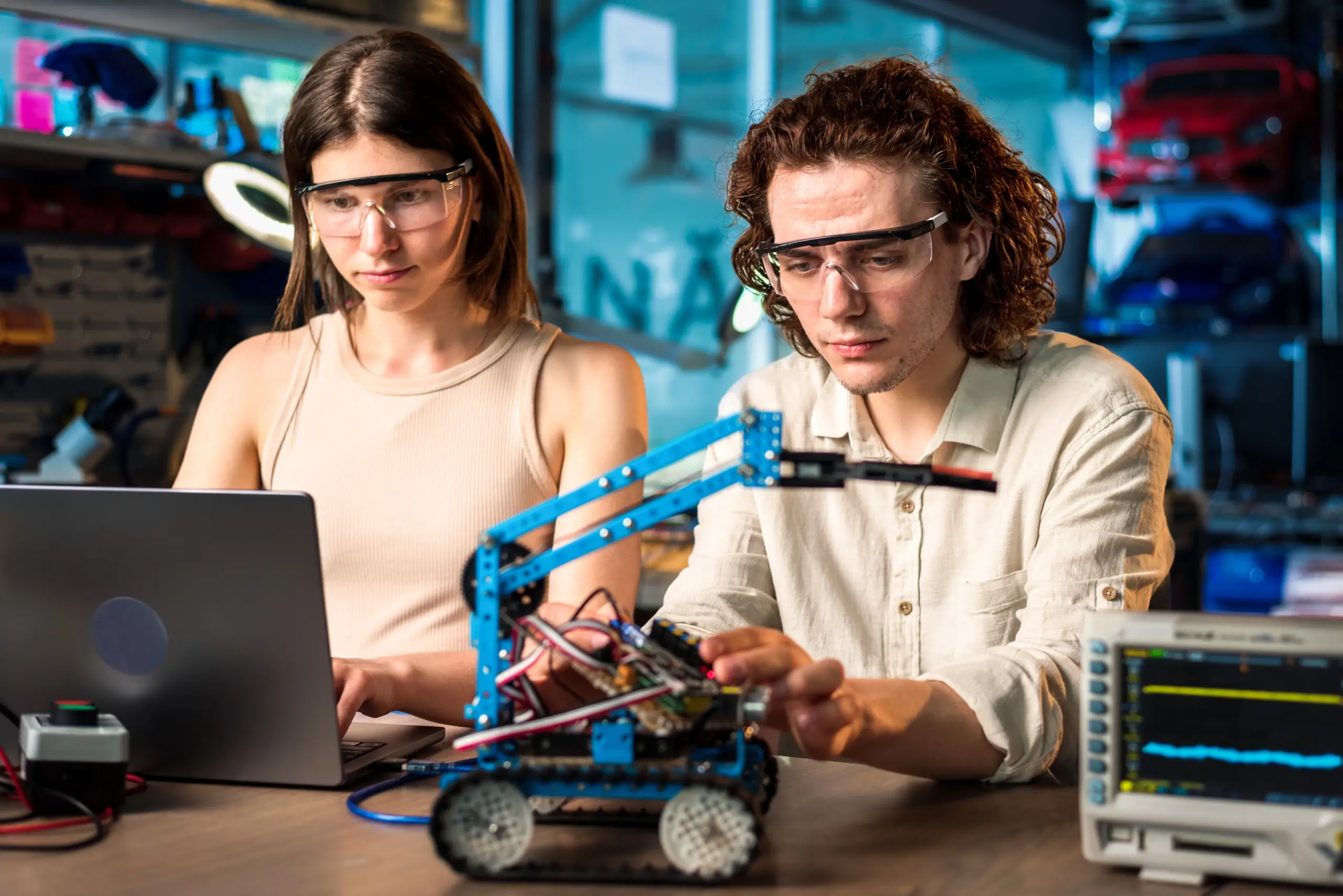
Factories are just not the same anymore, they’re chock full of robots – and I mean a lot of them. Warehouses are using automated guided vehicles, hospitals have got delivery robots patrolling the corridors – and every one of these machines needs regular software updates, monitoring and backups. Yeah, that’s right – that’s all down to a Robotics DevOps Engineer.
Now a standard DevOps engineer is just fine with working with code and servers, but robotics DevOps engineers need to handle both – with moving hardware part of the mix too. A dodgy software update can easily break a robot arm or bring down a delivery drone. As a result the pay is better and the demand is growing fast.
The World Robotics Report said robot installations went up by 31 percent in 2024, and every one of those new robots needs a DevOps engineer on hand to keep it going. And then there are companies like Amazon, Tesla and Boston Dynamics actively on the hunt for people with this specific skill set.
This step by step guide is designed to show you the way forward and enter this field – you don’t need ten years of experience, just the right skills and a clear plan.
What is a Robotics DevOps Engineer?
A Robotics DevOps Engineer sits right in the middle between two teams – one writes robot software and the other handles the robots in the real world.
You’ll be spending your days on four main tasks
Continuous Integration for Robot Code
You set up automated systems that test out every new piece of code before it even reaches a robot – hundreds of simulated tests to be careful & precise. It prevents all those bugs from breaking physical machines in the first place (which can be very expensive).
Simulation Management
You don’t run live tests on real robots – that would be just too expensive. You run simulations instead, these are essentially just practice environments that exactly mimic robot behaviour.
Over the Air Updates
Modern robots get their software updates wirelessly – and you’re the one building the system that gets these updates out to hundreds or thousands of robots in one hit. That’s a must have for any robot fleet.
Monitoring and Logging
You track robot health in real time – if a robot arm is moving slower than it should you set up alerts so these problems don’t become full blown failures.
Robotics DevOps is a role that’s not just coding or operations – it’s the bridge between software and hardware. Which is part of what makes it one of the most interesting roles in tech.
New to Robotics? Start from the Basics. Join Now!
Master Robotics and AI!
Ready to build the future? Join our comprehensive robotics course to bridge the gap between complex code and physical motion. You’ll gain hands-on experience giving you the technical edge needed to lead in the age of automation.
Know MoreStep by Step Guide to Become a Robotics DevOps Engineer
Step 1: Get the Right Foundation in Place
A four-year degree is generally the starting point for a robotics career, and these majors are where you want to be.
- Computer Science will give you the solid programming skills you need to get by.
- Software Engineering will teach you how to design whole systems.
- Robotics Engineering will cover both hardware and software in one go.
- Electrical Engineering is a possibility, but you’ll need to add on some software courses.
It’s true that some companies do hire self-taught engineers, but this is extremely rare in robotics. Because of the risk involved in damaging the hardware, most employers would much rather see formal education on your CV. If you can’t attend university full-time, you should look into online post-grad programs in robotics, though.
Step 2: Learn to Live and Breathe Linux and the Command Line
Linux is what most robots run on, and you can bet your bottom dollar you’ll be using the terminal every single day. So get these skills down until they feel like second nature:
- Learn how to navigate the file system without ever touching a mouse
- Write bash scripts to automate the drudge work
- Get a handle on process management and system logs
- Figure out how to configure network settings from the command line
Spend a couple of months or so getting this straight on a home machine. Install Ubuntu or Debian and try using nothing but the terminal for a whole week. This will get the terminal right out of your system – and you need it to be second nature.
Step 3: Get Familiar with Robot Operating System (ROS)
ROS isn’t an operating system – it’s a framework that connects all the software bits together for a robot. Every single robotics company uses ROS or ROS2, so you need to get on board.
Start with the official ROS tutorials, get a basic simulation of a robot moving in an empty room up and running, add a camera sensor, and get it publishing the camera data to a topic. You’ll be amazed at how often these basic patterns turn up in robotics work.
ROS2 is the newer version, and you should be concentrating on that. Expect to spend a good 3-4 months getting comfortable with it before you start to feel on top of it.
Step 4: Learn to Build a CI/CD Pipeline for Robot Code
For robots, CI/CD works a bit differently – you can’t just roll out broken code because it might end up damaging the robot or even harming someone.
Get to know Jenkins or GitLab CI – they’re the tools that’ll run the automated tests for you. Then, get to run those tests inside a simulated robot environment – this is called simulation-based testing.
Build a small pipeline that does this one thing: grabs code from GitHub, runs a test in a simulated robot, and spits out a pass or fail report. This one tiny project will prove to you – and to any potential employer – that you understand DevOps for robotics.
Step 5: Get to Know Containers and Orchestration
For robotics, Docker is the standard way to package up your software. A container is the whole package – everything the robot needs to run – and the robot just pulls and executes it.
Docker Compose helps you run a bunch of containers together in harmony, and Kubernetes helps you manage a bunch of containers across multiple robots. You should start with Docker, then add Compose on after a month or so, and learn a bit about Kubernetes after 3 months.
Get some hands-on experience by containerizing a small ROS node. Make it run the same way on your laptop and on a simulated robot. This is the key to getting environment consistency.
Step 6: Build a Portfolio Project
Theory means nothing without actually having some proof , and the best way to prove yourself is to build one complete project that showcases all the skills you claim to have
A good portfolio project is the kind that includes robot simulation, a CI pipeline, and container deployment all working together in harmony.
For instance, take a simulated warehouse robot that moves boxes around – that’s a good start, but what really matters is taking it a step further and writing a pipeline that actually tests every code change in the simulation before letting it move on to the next stage. Once you’ve got everything working, pack that code into a Docker container so you can easily run it wherever you need to
Now, host everything on GitHub, and make sure you’ve written a clear README file that explains in simple terms what each part of your pipeline is supposed to do. Don’t even think about calling this a portfolio unless you can do that.
A portfolio like this is going to get you a whole lot more interviews than any old resume sitting around gathering dust.
Bonus Step: Get Yourself a Certification
Now, certifications are definitely helpful but not totally necessary , the Linux Foundation’s Certified DevOps Engineer is a pretty good place to start – but don’t bother unless you’ve got some actual practical skills under your belt.
Same goes for the ROS training from the Open Source Robotics Foundation, or any of the cloud certifications from AWS or Azure. Don’t bother with any of these unless you can actually back them up with some real world experience.
Career Opportunities and Salary Scope

Robotics DevOps Engineers are in high demand, all over the world, because companies in lots of different industries – manufacturing, logistics, agriculture, healthcare, the self driving car business – all use robotics in various ways.
Robot arms for assembly, warehouse robots for moving goods, autonomous tractors and harvesters on farms, surgical and delivery robots in hospitals – and of course, robotics DevOps for their fleets of self driving cars.
As for salaries, entry level people in the US can expect to start out at $90,000 to $110,000 a year, mid level engineers with a few years of experience can bring home $130,000 to $160,000 a year, and senior engineers and team leads can really cash in at up to $220,000 a year.
Salaries vary in other countries of course, but even so, you’re still looking at pretty competitive pay for a tech job. And let’s not forget, the job growth rate for robotics DevOps is a whopping 25 percent per year – that’s way faster than most other engineering roles.
Common Mistakes Beginners Should Avoid
Learning Robotics Without Software Skills
Many people new to robotics get hung up on the hardware side of things but that’s a big mistake – Robotics DevOps is all about the software underneath it all. Truth is you should be prioritising learning Linux, Docker and CI/CD before even thinking about building a physical robot.
Ignoring Simulation – its a rookie mistake
You cant learn on the fly with real robots – they’re way too expensive to break and likely to break down a lot too. So use Gazebo, Ignition or Webots for simulation – get everything else sorted in there first.
Skipping Version Control – a serious mistake
Some robotics folk ignore Git – but that’s unprofessional – version control is a must when you’re making code changes. Take the time to really get your head round Git before you even think about applying for a job.
Overcomplicating the First Job – don’t overthink it
Your first job doesn’t have to be perfect, its just about getting your foot in the door with a role that combines software and robotics – that’s where the real learning starts. Just take a good job, learn as fast as you can and move up later.
Forgetting About Safety – don’t get sloppy
Robots aren’t web servers – a botched deployment can have real world consequences. So always include safety checks in your pipelines, don’t skip simulation testing just to save a bit of time.
New to Robotics? Start from the Basics. Join Now!
Master Robotics and AI!
Ready to build the future? Join our comprehensive robotics course to bridge the gap between complex code and physical motion. You’ll gain hands-on experience giving you the technical edge needed to lead in the age of automation.
Know MoreConclusion: Becoming a Robotics DevOps Engineer – A Straightforward Path
Becoming a Robotics DevOps Engineer takes time and focus. The route is clear.
First, get a degree in computer science or robotics – or at the very least do a bit of reading up on the subject. Then master Linux and the command line – its a foundation that’s a must build on. Learn ROS 2 inside out and get your head round how to build real CI/CD pipelines for simulation. Package up your code with Docker and make a portfolio that proves you’ve got the skills.
Just start with the first step today – get Ubuntu installed on your computer, fire up the terminal and have a crack at that very first Linux command. Every expert started off just where you are now.
Companies are actually hiring, the pay is good and the work is actually pretty interesting. And you get to bridge the gap between software and physical machines – that’s a pretty rare and valuable combination.
Just follow this step-by-step guide, build your skills one day at a time. In 12 to 18 months you’ll be ready to take on that first Robotics DevOps Engineer job – and the robots will be waiting for your code.
Master Robotics and AI!
Ready to build the future? Join our comprehensive robotics course to bridge the gap between complex code and physical motion. You’ll gain hands-on experience giving you the technical edge needed to lead in the age of automation.
Know MoreFrequently Asked Questions
Do I need a master's degree to become a Robotics DevOps Engineer?
No. A bachelor’s degree in computer science, software engineering, or robotics is sufficient. Most employers value practical skills and portfolio projects over advanced degrees. A master’s degree helps only for research roles.
How long does it take to become a Robotics DevOps Engineer?
Most people need 12 to 18 months of focused study. This includes learning Linux, ROS, Docker, and CI/CD pipelines. Adding a four year degree extends that timeline. The self study path is faster but requires more discipline.
Can I switch from web development to robotics DevOps?
Yes. Web development teaches you deployment, containers, and version control. These skills transfer directly. You need to add Linux system administration and ROS knowledge. Plan for six months of additional learning to make the switch.
What programming languages should I learn first?
Python is the most important language for robotics DevOps. C++ is second. Python handles automation scripts and ROS nodes. C++ is used for performance critical robot code. Learn Python well before touching C++.
Is simulation experience accepted instead of real robot experience?
Yes. Most employers accept simulation experience for entry level roles. Real robots are too expensive for individual learning. Build strong simulation projects in Gazebo or Webots. Explain your simulation setup clearly in interviews.
Which cloud platform is best for robotics DevOps?
AWS RoboMaker is built specifically for robotics. It integrates with ROS and provides simulation tools. Azure and Google Cloud also work but have fewer robotics specific features. Start with AWS for the widest job opportunities.
What is the hardest part of learning robotics DevOps?
The integration between software and simulation is the hardest part. Getting a CI pipeline to run tests inside a simulated robot requires many moving pieces. Most beginners struggle here for several weeks. Push through this challenge. It gets easier.
Do I need to know hardware electronics like circuits?
No. Hardware electronics are not required for robotics DevOps. You need to understand robot sensors and actuators at a high level. You do not need to read circuit diagrams or solder components. Focus on software and systems.
What is the first job title I should look for?
Look for Junior DevOps Engineer at a robotics company. Also search for Robotics Software Engineer or Automation Engineer. Avoid pure operations roles that do not involve robots. Get any role that puts you near robot code and deployment.