Table of Contents
AI & Automation Trends in Marketing are transforming businesses. Marketing is becoming faster and smarter. Brands now depend on intelligent tools. AI helps marketers understand audiences better. Automation simplifies daily marketing tasks. Campaigns are more targeted and effective. Decisions are based on real data. The future of marketing is automated.
Digital marketing is changing very quickly. Customers expect personalized brand experiences. Traditional methods cannot meet these needs. AI helps deliver relevant content. Automation improves speed and efficiency. Teams can focus on strategy. Technology reduces manual workload. Marketers can achieve better growth.
Join Our Online Digital Marketing Course & Learn the Fundamentals!
Introduction
AI and automation are changing modern marketing. Brands need speed and smart decisions. Manual marketing is no longer enough. Customers expect quick and personal experiences. Technology now handles complex marketing tasks. AI helps marketers work more effectively. Automation improves accuracy and performance.
Marketing teams face heavy daily workloads. Repetitive tasks consume too much time. AI reduces human effort in marketing. Automation manages campaigns without delays. Data analysis becomes faster and simpler. Businesses can grow with fewer resources. This shift creates better marketing results.
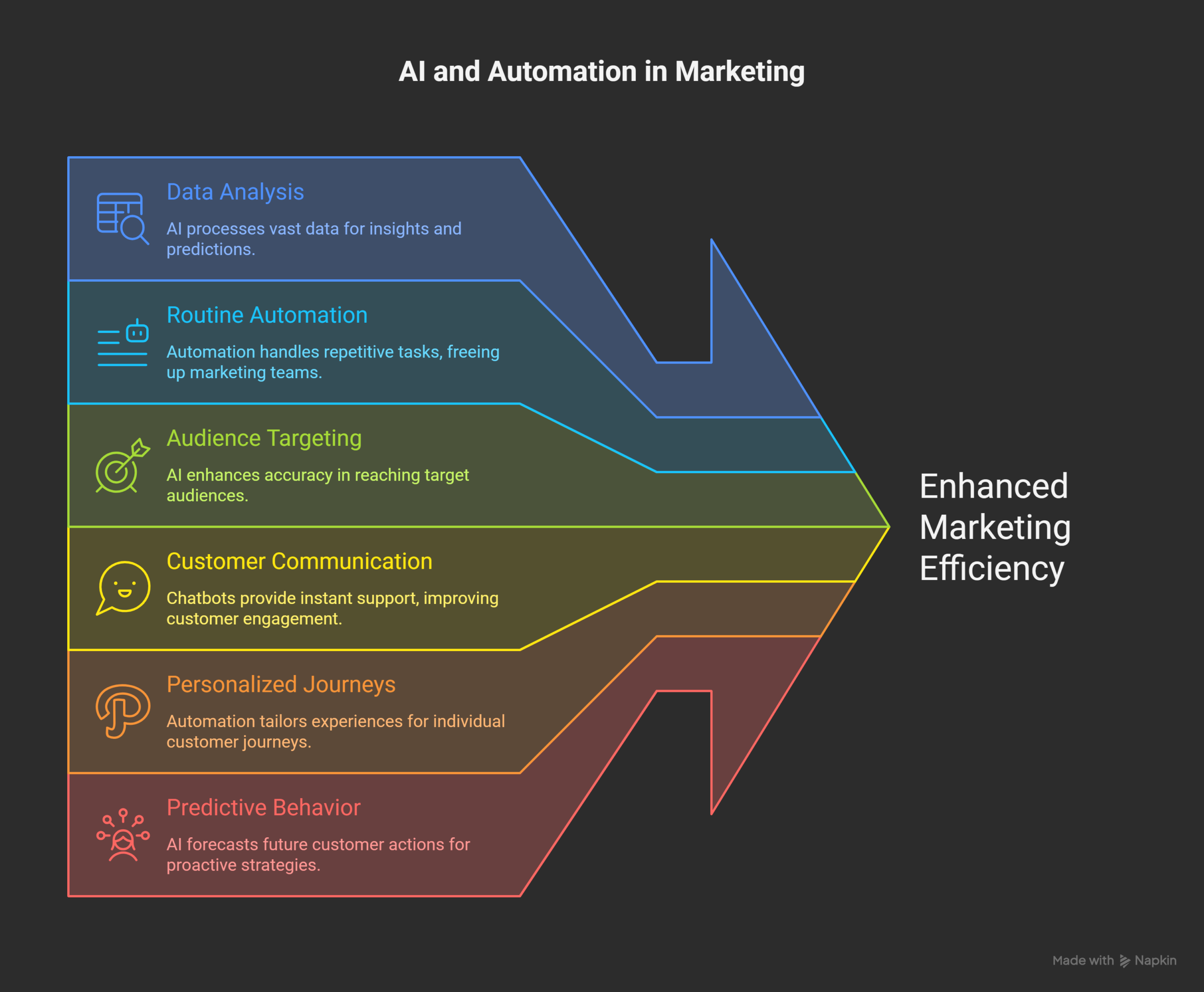
Key roles of AI and automation:
-
AI analyzes large amounts of data.
-
Automation handles routine marketing activities.
-
AI improves audience targeting accuracy.
-
Chatbots support instant customer communication.
-
Automation personalizes customer journeys.
-
AI predicts future customer behavior.
-
Tools create content quickly and easily.
-
Campaigns run with less manual effort.
-
Decisions become more data-driven.
-
Marketing teams save valuable time.
Evolution of AI in Marketing
AI in marketing is growing very fast. Every year brings smarter AI tools. Marketing is becoming more data-driven. Businesses now depend on intelligent systems. By 2026, AI will dominate strategies. Old methods are slowly disappearing. Automation is becoming the new normal.
Earlier, AI handled simple tasks. Now AI manages complex decisions. It studies customer behavior deeply. AI learns from past marketing data. It improves campaigns automatically. This evolution is reshaping marketing completely.
From Basic Automation to Smart Intelligence
AI started with basic automation. Tools only scheduled emails and posts. Today, AI does much more. It analyzes trends and predicts outcomes. Marketing decisions are now faster.
Key Changes Over the Years
-
AI moved from simple to advanced.
-
Data analysis became more accurate.
-
Tools learned user behavior patterns.
-
Personalization became more powerful.
-
Campaigns became highly automated.
-
Predictions became part of marketing.
AI is now a strategic partner. Marketers rely on AI insights. Human effort is reducing gradually.
Growth of AI Capabilities
AI tools are becoming smarter daily. They understand text and images. They analyze voice and video. Marketing platforms include built-in AI. Even small brands use AI now.
Major Capabilities Growing Toward 2026
-
Real-time data processing
-
Smart audience segmentation
-
Automated content generation
-
Intelligent ad optimization
-
Predictive customer analytics
-
Voice and image recognition
These abilities help marketers perform better. Workflows are smoother and faster.
AI Adoption Across Marketing Channels
AI is present in every channel. Social media uses AI heavily. Email marketing depends on automation. Search engines run on AI algorithms.
Channel-Wise AI Usage
-
AI manages social media scheduling.
-
Email campaigns use smart automation.
-
Websites show personalized experiences.
-
Ads use AI for targeting.
-
Chatbots handle customer support.
By 2026, AI will control most channels. Marketing will become fully connected.
Data Becomes the Core of Marketing
Data is the fuel for AI. Better data means better AI results. Companies collect huge customer information. AI converts data into insights.
How Data Usage Is Evolving
-
Data collection is more organized.
-
AI cleans and structures data.
-
Insights are generated instantly.
-
Decisions rely on analytics.
-
Strategies become more accurate.
Marketing is no longer guesswork. AI makes it scientific and precise.
Role of Machine Learning
Machine learning drives AI progress. Systems learn without human input. They improve with every campaign.
Benefits of Machine Learning
-
Better prediction of customer behavior
-
Smarter recommendation systems
-
Continuous campaign improvement
-
Automatic performance optimization
-
Reduced human errors
By 2026, machine learning will lead marketing.
Traditional Marketing vs AI Marketing
| Feature | Traditional Marketing | AI-Powered Marketing |
|---|---|---|
| Decision Speed | Slow | Very Fast |
| Personalization | Limited | Highly Personalized |
| Data Analysis | Manual | Automated |
| Campaign Optimization | Difficult | Automatic |
| Cost Efficiency | Lower | Higher |
| Accuracy | Moderate | Very High |
AI clearly outperforms old methods. The difference is becoming bigger.
Impact on Marketing Teams
AI is changing job roles. Marketers focus on strategy now. Repetitive tasks are automated.
New Focus Areas for Teams
-
Creative strategy planning
-
Data interpretation
-
Customer experience design
-
AI tool management
-
Performance analysis
AI works as a powerful assistant. Humans focus on important decisions.
Challenges in AI Evolution
AI growth also brings challenges. Not everything is perfect yet.
Main Challenges
-
Data privacy concerns
-
Need for skilled professionals
-
High initial costs
-
Integration with old systems
-
Learning new technologies
These issues will reduce by 2026. AI will become easier to use.
What 2026 Will Look Like
Marketing in 2026 will be different. AI will predict trends accurately. Automation will run entire campaigns.
Expected Advancements
-
Fully automated customer journeys
-
Hyper-personalized content
-
Real-time decision-making
-
Smarter chatbots and assistants
-
Deeper customer insights
The future will be highly intelligent. AI will guide most marketing actions.
In Short
The evolution of AI in marketing is rapid. Progress toward 2026 is very clear. AI is becoming smarter and stronger. Marketing is turning more automated. Businesses must adapt to survive.
AI will not replace marketers. It will empower them greatly. The brands using AI early will win. The future of marketing belongs to AI.
Frequently Asked Questions
Why is AI important in marketing today?
AI helps marketers work faster and smarter. It improves targeting and personalization. Decisions become more data-driven. Automation reduces manual effort. Overall marketing efficiency increases greatly.
How does AI help in content creation?
AI generates ideas and writing drafts. It supports design and video creation. Marketers can produce content quickly. Quality improves with AI assistance. Teams save time and resources.
Can small businesses use AI tools?
Yes, AI tools are affordable now. Many platforms are user-friendly. Small teams can automate marketing easily. AI helps compete with bigger brands. Adoption is possible for every business.
Is AI safe for customer data?
AI is safe when used responsibly. Companies must follow privacy rules. Transparency and consent are important. Ethical AI practices protect customer information. Proper security keeps data secure.
What skills do marketers need for 2026?
Marketers need basic AI knowledge. Data analysis skills are important. Understanding automation tools is necessary. Creativity combined with AI is valuable. Continuous learning will be essential.