Table of Contents
Certification builds a strong foundation in fitness training. It provides essential knowledge and safety awareness. It helps trainers understand exercise techniques correctly. Certification builds trust with clients and employers. Experience builds real success over time. It improves practical skills and confidence. Trainers learn to handle different client needs. They adapt programs based on real situations. Both certification and experience are important. Their value changes with career stage. Beginners need certification to start safely. Experience becomes more important with time. It helps trainers grow and deliver better results.
Become a General Fitness Trainer and turn your passion into a Profession!
Key Takeaways:
- Certification proves knowledge and basic competence.
- Experience improves real-world training skills.
- Beginners should start with certification first.
- Experience becomes more valuable over time.
- The best trainers combine both effectively.
Introduction
The fitness industry is growing fast worldwide. More people focus on health and active living. This has increased demand for qualified fitness trainers. Trainers are expected to guide clients safely and effectively. They must also deliver visible and lasting results. This makes skill and knowledge equally important. But one common question still remains. What matters more in fitness training, certification or experience.
Certification provides structured learning and basic understanding. It teaches exercise science, safety rules, and training methods. Experience, however, develops real-world skills over time. It helps trainers handle different clients and situations. Both play important roles in shaping a trainer’s career. Their importance changes based on the stage of growth.
🎯 Why is this comparison important?
- Helps beginners choose the right starting path.
- Clarifies industry expectations and requirements.
- Reduces confusion about career priorities.
- Supports better long-term career planning.
📊 What will this blog cover?
- Clear explanation of certification and its role.
- Understanding practical experience in fitness training.
- Key differences between:
- certification and experience.
- Guidance on what beginners should focus on first.
- Tips to build a balanced and successful career.

What is Certification in Fitness Training?
Certification in fitness training proves a trainer’s skills. It shows they are qualified to train safely. It confirms the person completed a structured course. Certification also shows they passed the required test. This process evaluates understanding of core fitness principles. It also verifies the ability to apply standard training guidelines.
Unlike informal learning, certification follows a defined curriculum. It is designed by industry bodies and experts. The goal is to create a uniform level of knowledge among trainers. This helps maintain consistency across the fitness industry.
📘 How does certification work?
Certification involves a clear and step-by-step process.
- Enrollment in a certified program.
- Candidates choose a recognized course provider.
- The course may be online or classroom-based.
- Completion of coursework.
- Learners study structured modules and materials.
- They may complete assignments or practice tasks.
- Final assessment or exam.
- Candidates must pass a written or practical test.
- This evaluates knowledge and application skills.
🧩 What makes certification structured?
Certification follows standardized guidelines.
- Content is designed by industry professionals.
- Topics are organized in a logical sequence.
- Learning outcomes are clearly defined.
- Assessments follow fixed evaluation criteria.
🔄 Does certification require renewal?
Most certifications are not permanent.
- Trainers may need periodic renewal.
- Continuing education is often required.
- This keeps knowledge updated with industry trends.
Certification ensures a consistent and measurable entry into fitness training.
Turn Your Passion for Fitness into a Profession
Learn practical skills, get certified, and step into the growing fitness industry with confidence.
Join the CoursePopular Fitness Certifications
Fitness certifications help trainers gain trust. They also help start a fitness career. They are offered by recognized global organizations. These certifications follow structured learning and standard guidelines. They are accepted by gyms and employers. The right choice depends on one’s career goals.

🌍 Globally recognized certifications
Several certifications are trusted across the fitness industry.
- National Academy of Sports Medicine (NASM).
- Focuses on corrective exercise and injury prevention.
- Uses a scientific and structured training model.
- American Council on Exercise (ACE).
- Covers general fitness and client communication skills.
- Suitable for beginners and entry-level trainers.
- International Sports Sciences Association (ISSA).
- Offers flexible online learning options.
- Includes practical and theoretical knowledge.
- National Strength and Conditioning Association (NSCA).
- Focuses on strength and performance training.
- Preferred for advanced and athletic coaching roles.
📊 How to choose the right certification?
Selecting the right certification depends on several factors.
- Career goals
- specialization area.
- Budget
- Course duration.
- Learning format:
- online or offline.
- Recognition by:
- gyms
- employers.
⚠️ Things to consider before choosing
- Check if the certification is industry-recognized.
- Ensure the syllabus covers essential topics.
- Look for updated and practical content.
- Verify exam difficulty and requirements.
Popular certifications provide a strong starting point. They help trainers enter the fitness industry confidently.
Importance of Certification in the Fitness Industry
Certification is important in the fitness industry. It sets basic standards for trainers. It ensures knowledge and safety awareness. This helps both clients and employers. Without it, quality can become inconsistent.
Certification also builds trust in the market. Clients prefer qualified trainers. Gyms prefer certified professionals. It is important for entry-level jobs.
🎯 Why is certification important?
Certification supports both safety and professionalism.
- Builds credibility with clients and employers.
- Shows :
- verified knowledge and
- training ability.
- Creates
- confidence in service quality.
- Shows :
- Ensures safe training practices.
- Reduces risk of injuries during workouts.
- Promotes correct exercise techniques.
- Meets industry and gym requirements.
- Many gyms require certified trainers.
- Helps in securing job opportunities faster.
- Provides structured learning.
- Covers essential fitness concepts clearly.
- Helps beginners understand training basics.
🚀 How does certification impact career growth?
Certification creates a strong starting point.
- Opens entry-level job opportunities.
- Improves chances of client acquisition.
- Builds a professional image in the industry.
- Acts as a base for advanced certifications.
⚠️ Key limitation to remember
Certification alone is not enough for long-term success.
- Practical skills develop only through experience.
- Real client handling requires hands-on exposure.
Certification is essential for entering the fitness industry. It builds knowledge, trust, and safety awareness.
What Counts as Experience in Fitness Training?
Experience in fitness training refers to practical exposure gained over time. It is built through direct involvement in real training environments. Experience develops through repeated action. And observation. Unlike structured learning. It helps one understand how different clients respond to training.
Experience is not limited to pay. It can include internships. It also includes assisting senior trainers. Even guiding friends can be a part. The focus is on applying knowledge in real situations. This builds confidence. It also improves decision-making ability.
📘 What activities are considered experience?
Different types of practical work contribute to experience.
- Client interaction and session delivery.
- Conducting one-on-one or group training sessions.
- Explaining exercises and guiding movements clearly.
- Program planning and adjustments.
- Creating workout plans based on client needs.
- Modifying routines based on progress or feedback.
- Observation and learning.
- Assisting experienced trainers during sessions.
- Learning different coaching styles and methods.
- Progress tracking and feedback.
- Monitoring client performance over time.
- Making small changes to improve results.
📊 Types of experience in fitness training
| Type of Experience. | Description. |
|---|---|
| Internship. | Learning under supervision in gyms or studios. |
| Assistant role. | Supporting senior trainers during sessions. |
| Freelance training. | Working independently with clients. |
| Group training. | Handling multiple clients in one session. |
⚠️ Key aspect of experience
- Experience grows gradually with consistent practice.
- Each client adds new learning opportunities.
- Real situations improve adaptability and confidence.
Experience reflects a trainer’s ability to perform effectively in real-world settings.
Become a General Fitness Trainer and turn your passion into a Profession!
Turn Your Passion for Fitness into a Profession
Learn practical skills, get certified, and step into the growing fitness industry with confidence.
Join the CourseBenefits of Hands-on Experience
Hands-on experience strengthens a trainer’s trust. It turns theoretical knowledge into real action. Trainers learn by working. Mainly with different people. Each session brings new challenges. One learns new things. This builds confidence. It also improves decision-making skills.
Experience helps trainers understand client behavior. Not all clients respond the same. Some need motivation. Others need guidance. Real interaction teaches how to adjust communication styles. This improves overall training effectiveness.
🎯 Key benefits of hands-on experience
- Better problem-solving ability.
- Trainers learn to handle unexpected situations.
- They adjust workouts based on client responses.
- Improved communication skills.
- Trainers explain exercises more clearly.
- They build stronger client relationships.
- Greater adaptability.
- Trainers modify plans based on real progress.
- They handle different fitness levels effectively.
- Increased confidence.
- Repeated practice builds self-assurance.
- Trainers feel more comfortable leading sessions.
Certification vs Experience – Key Differences
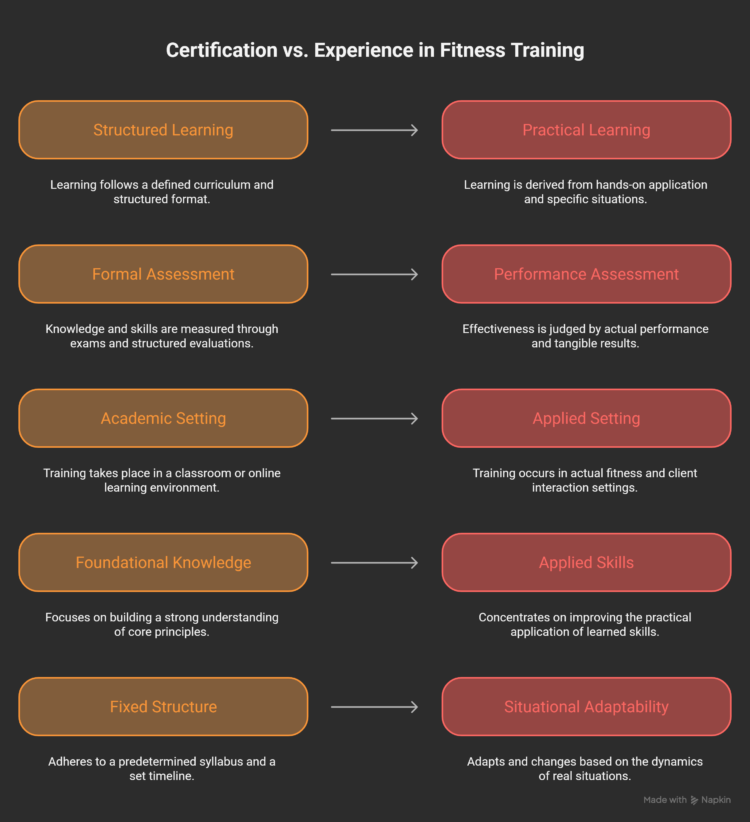
Certification and experience differ in how they develop a trainer’s capability. It follows a structured and standardized path. Experience grows through real-world exposure and repeated practice. Both contribute differently to professional development. Understanding these differences helps in making better career decisions.
📊 Core differences between certification and experience
| Aspect. | Certification. | Experience. |
|---|---|---|
| Learning style. | Structured and curriculum-based. | Practical and situation-based. |
| Assessment method. | Exams and formal evaluations. | Performance and real outcomes. |
| Environment. | Classroom or online learning. | Real training settings. |
| Skill development. | Builds foundational understanding. | Enhances applied skills. |
| Flexibility. | Fixed syllabus and timeline. | Varies with real situations. |
🔍 Difference in skill application
- Certification focuses on standard methods.
- Teaches general guidelines and concepts.
- Follows predefined approaches.
- Experience focuses on real application.
- Adapts methods based on client needs.
- Handles unpredictable situations effectively.
⚡ Difference in growth pattern
- Certification provides a starting framework.
- Experience evolves continuously with practice.
- Certification remains mostly fixed once completed.
- Experience keeps expanding over time.
Certification and experience serve different purposes. Their differences shape how trainers learn and perform.
Which One Matters More for Beginners?
For beginners, certification plays the primary role in starting a fitness career. It provides a clear entry point into the industry. It also ensures that basic concepts are understood correctly. Without this foundation, beginners may struggle to apply training methods properly.
Certification also creates a sense of direction. It introduces structured learning and defined outcomes. This helps beginners avoid confusion in the early stage. It also prepares them for professional environments.
🎯 Why certification is important at the start
- Provides a clear starting path.
- Beginners understand what to learn first.
- It reduces trial-and-error learning.
- Creates professional readiness.
- Helps beginners enter gyms or training spaces.
- Builds initial confidence in handling sessions.
- Establishes basic discipline.
- Encourages consistent learning habits.
- Introduces standard practices in training.
🚀 When does experience become important?
- Experience becomes important after initial learning.
- It helps apply knowledge in real situations.
- Beginners should start gaining exposure early.
⚠️ Balanced approach for beginners
- Start with certification for clarity and structure.
- Gradually build experience alongside learning.
- Combine both for steady and effective growth.
A balanced approach helps beginners grow with confidence and skill.
Conclusion
Certification and experience both shape a fitness trainer’s journey. Certification provides structure, clarity, and a strong starting point. Experience builds practical ability and real-world confidence over time. Their importance shifts as a trainer grows in the industry. Early stages rely more on certification. Later stages depend more on experience.
A successful fitness career requires a balance of both. Trainers should begin with certification and move towards gaining experience. Continuous learning and practice are essential for growth. This combination helps deliver better results and build long-term success.
Turn Your Passion for Fitness into a Profession
Learn practical skills, get certified, and step into the growing fitness industry with confidence.
Join the CourseFrequently Asked Questions
What is the main difference between certification and experience in fitness training?
Certification provides structured knowledge and validates basic skills. Experience develops practical ability through real client interactions over time.
Is certification enough to become a successful fitness trainer?
Certification helps in starting a career with proper knowledge and credibility. Long-term success depends on gaining consistent hands-on experience.
Can someone start fitness training without certification?
It is possible in informal settings, but it limits professional opportunities. Most gyms and clients prefer certified trainers for safety and trust.
How does experience improve a fitness trainer’s performance?
Experience helps trainers handle different client needs effectively. It also improves decision-making and adaptability in real situations.
Which is more important for getting a job in a gym?
Certification is usually required for entry-level hiring. It shows that the trainer meets basic industry standards.
How can beginners gain experience in fitness training?
Beginners can start with internships or by assisting experienced trainers. They can also practice by training friends or small groups.
Do certified trainers earn more than non-certified trainers?
Certified trainers often have better job opportunities initially. Higher earnings usually depend on experience and client results.
How long does it take to build good experience in fitness training?
Experience builds gradually over months and years of practice. Regular client interaction helps speed up the learning process.
Can certification and experience be developed together?
Yes, beginners can start gaining experience while learning. This helps in applying knowledge immediately and improving faster.
What is the best approach to build a fitness career?
Start with certification to build a strong foundation. Then focus on gaining experience to improve real-world skills.