Table of Contents
Introduction
Imagine being young and wanting to study or work abroad, but language tests slow it down with long waits and complex assessment techniques. The Pearson Test of English (PTE) eliminates many of these barriers. It is a speed, accuracy and real-world English proficiency exam, all in one computer. One of its most important perks is that results are delivered quickly – scores are often released within 48 hours. For students battling application deadlines, or for professionals handling visa timelines, this speed can prove valuable.
Most candidates chose PTE based on its scoring system built on artificial intelligence, not human examiners. This reduces bias and allows for the same quality of assessment for every test taker, regardless of accent or background. The exam is about how to use the language in the real world. Speaking, reading, writing, and listening are tested on multiple projects that simulate real-world academic and professional situations. Rather than remembering rules, candidates show they can understand information, express ideas clearly, and act effectively in the context they are in.
PTE is particularly popular with non-native English speakers who want a fair and modern way to show their level of language proficiency. PTE can show candidates that they have the means to make connections to the everyday – whether it be university admission, professional registration, or career migration. The test format is fairly simple, the interface is simple, and the preparation is more akin to real English than it is to theoretical knowledge.
By 2026, PTE has become more widely accepted globally. PTE scores are now accepted in more than 3,500 universities throughout the world, and in many governments and professional associations. PTE is accepted by many countries as they are most educational and migrater friendly, making it a preferred option for international mobility. This growing awareness provides more opportunities to students and skilled professionals looking to cross-border movement.
As global travel resumes and international education and employment rebound, the demand for reliable and fast language testing continues to rise. PTE stands out with its quick turnaround, accurate scoring, and wide acceptance. Countries accepting PTE continue to add it to their approved lists, reinforcing its credibility and value. For anyone planning an international future, PTE offers a clear, efficient, and dependable path forward.
Join Enrtri PTE Coaching Course
Why PTE Is Growing in Global Acceptance
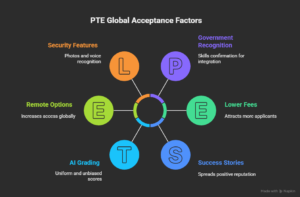
PTE gains ground quickly among English proficiency tests. Its computer format lets takers speak into microphones and type responses, mirroring actual communication. AI grading keeps scores uniform and unbiased. Results arrive fast, often within two days, which speeds up applications for visas and admissions. The test emphasizes useful English for daily and professional use rather than memorized rules. Governments rely on it to confirm skills for integration and success. Universities favor it since strong scores correlate with academic performance. Acceptance has surged in key areas like Australia, Canada, the UK, and the USA. More than 70 countries now approve PTE for various purposes. This broad reach allows flexible options for migrants and learners. Advanced technology gives PTE an edge, with AI that handles diverse accents effectively. Strict security features include photos and voice recognition. Lower fees compared to competitors attract many applicants.
Online preparation resources range from free practice tests to structured courses. Success stories spread its reputation—one student from India gains entry to a top US university, while a professional from Asia secures a work visa swiftly. These examples highlight tangible benefits. In 2026, growth continues as economies seek skilled workers. Countries accepting PTE view it as an efficient tool for talent selection. Partnerships with authorities ensure the test meets specific requirements.
Updates incorporate relevant vocabulary for fields like healthcare or business. Free resources from PTE support score usage in applications. Year-round availability and online booking add convenience. Test centers span major cities, and remote options increase access. Busy individuals schedule around commitments easily. Global demand for English in remote jobs boosts PTE’s role. It provides quick proof of capability. Points-based immigration systems award higher marks for superior scores. Surveys reveal high satisfaction with its accuracy and fairness. Recommendations from advisors and forums drive choices. Overall, PTE expands because it serves users and officials well. Countries accepting PTE benefit from its dependable assessment of essential language abilities.
Ace Your PTE Exam with Confidence!
Unlock your potential with our expert-led PTE preparation course. Achieve your dream score and open doors to global opportunities!
Start Your PTE Preparation Today!Countries Accepting PTE for Study Visas (2026)
International students seek quality education overseas, and PTE eases the visa process in numerous nations. Australia remains a leader, accepting PTE for all student visas. Basic entry often requires an overall score of 47, while advanced programs demand 58 or higher. Scores stay valid for two years. Canada approves PTE through Immigration, Refugees and Citizenship Canada for study permits. Scores align with language benchmarks, where 50 overall meets key levels for many courses. The Student Direct Stream program includes PTE for faster processing from eligible countries. The United Kingdom recognizes PTE for student routes, with UK Visas and Immigration requiring around 59 for degree programs. New Zealand accepts PTE for all study visas via Immigration New Zealand and education providers. A score of 50 suits most options, rising to 58 for higher levels.
The United States does not mandate it federally, but over 1,400 institutions accept PTE, linking to student visa approvals through university offers. Ireland’s immigration service approves PTE for student visas, typically needing 50 to 65. Germany accepts it for university visas through relevant authorities. France processes it via Campus France for study applications. Singapore uses PTE for student passes in its education hubs. European nations expand inclusion—the Netherlands takes PTE for residence permits, Spain for longer study stays, and Italy for similar purposes. Nordic countries like Sweden and Denmark approve it through migration agencies, often at 55 or above. Asian destinations such as Japan accept PTE for English-taught programs, and South Korea for specific student visas.
The Middle East sees growth, with the UAE and Saudi Arabia recognizing PTE for higher education entry. South Africa accepts it for study permits in Africa. Latin American countries like Brazil and Mexico include PTE for student mobility. Each nation sets requirements based on program intensity—lower for diplomas, higher for advanced degrees. Health-related fields may emphasize speaking scores. Applicants verify details on official websites. Global test centers and fast results simplify preparation. Strong performance unlocks prestigious opportunities. Visa processing accelerates with direct score submission. In 2026, additional countries join the list as acceptance widens. Countries accepting PTE provide diverse, achievable routes to international study.
Countries Accepting PTE for Work & Immigration (2026)
Professionals and migrants turn to PTE to demonstrate English for careers and settlement. Australia accepts it fully for work visas and permanent residency through the Department of Home Affairs. Skilled categories reward scores of 65 or more with extra points. Canada incorporates PTE into economic programs like Express Entry, where higher scores boost rankings. Work permits in certain streams recognize it. The United Kingdom approves PTE for skilled worker and health visas, typically requiring balanced scores around 59. New Zealand accepts PTE for work and residence, with 58 common for skilled paths. Ireland uses it for employment permits.
Germany recognizes PTE for job seeker and skilled worker visas. France accepts it for work residence. Singapore values PTE for employment passes in key sectors. European expansion includes the Netherlands for knowledgeable workers, Spain and Italy for qualified professionals. Nordic areas like Sweden and Denmark approve it for shortage occupations. Japan takes PTE for specified skilled worker visas, and South Korea for professional categories. The UAE and Saudi Arabia accept it for expatriate hires. South Africa recognizes PTE for critical skills work visas. Brazil and Mexico include it for temporary professional visas. Immigration systems often award points for superior English, with top bands granting significant advantages. Busy workers appreciate rapid results and electronic submission. Preparation targets job-specific language needs. In 2026, requirements may adjust slightly, but PTE remains adaptable. Countries accepting PTE streamline access to global job markets and long-term residency.
Universities & Institutions That Accept PTE
Leading universities worldwide welcome PTE scores, broadening access to elite education. In the United States, more than 1,400 institutions recognize it. Harvard University requires around 70, Stanford about 68, and MIT 65. Yale and Columbia set similar high bars. The University of California campuses vary from 59 to 65. New York University asks for 65. Canadian top schools like the University of Toronto, McGill, and University of British Columbia typically need 65. In the United Kingdom, Oxford demands 66, Cambridge 69, and Imperial College London 62. The London School of Economics requires 65. Australian institutions, all accepting PTE, include the University of Melbourne at 58 and the University of Sydney at 61. New Zealand’s University of Auckland and others set 58. European highlights feature Technical University of Munich in Germany at 65 and Sorbonne University in France at 59. Ireland’s Trinity College Dublin needs 63. Singapore’s National University accepts 62.
Many business schools seek strong speaking scores, while engineering programs focus on reading. Institutions allow free score sends to several places. Higher marks enhance applications and scholarship chances. Community colleges and online programs often accept lower thresholds around 50. This range supports learners at all stages. In 2026, additional universities adopt PTE for its proven reliability. Countries accepting PTE encourage their schools to follow suit, expanding options from renowned leaders to specialized providers.
Ace Your PTE Exam with Confidence!
Unlock your potential with our expert-led PTE preparation course. Achieve your dream score and open doors to global opportunities!
Start Your PTE Preparation Today!Updates Expected in 2026
PTE evolves to meet user needs effectively. Recent enhancements shortened the test to two hours, reducing questions while maintaining thorough assessment. Scoring remains consistent, so existing preparation applies. Australia implemented visa score adjustments in late 2025, carrying into 2026 with higher minimums for some categories. Canada broadens PTE use in processing streams. The United Kingdom reviews requirements for specific visa types. New Zealand aligns closely with Australian changes. The United States anticipates more institutions joining, nearing 1,500. Europe pushes for standardized recognition across members. Asia adds test centers in emerging areas.
Remote proctoring improves with enhanced security. Preparation tools incorporate advanced practice features. Score reports provide detailed skill insights for better matching. Online portals integrate PTE for smoother applications. Global protocols ensure safe testing environments. Fees stay competitive, with occasional group offers. Research confirms PTE’s strong prediction of real-world success. These adjustments keep the test accessible and relevant. Countries accepting PTE refine rules to draw qualified individuals. Official sources provide the latest specifics as policies finalize.
Join Enrtri PTE Coaching Course
Conclusion
In 2026, PTE will continue to support world ambitions with a growing reach for study, work, and migration across the most popular international destinations. PTE is widely accepted by thousands of colleges, universities, employers and government agencies as a reliable, future-proof English proficiency test. It is computer-based and is accurate, neutral, and consistent, making it a trusted choice for candidates who want fair assessment without human bias.
What makes PTE different is that it is so focused on language in the real world. The test measures speaking, writing, reading, and listening in a balanced manner, such that it is reflective of how English is used actually in school and professional settings. It is ideal for applicants who have tight deadlines and whose results are delivered quickly, often within 48 hours. As global mobility grows, the efficiency and precision of PTE is compatible with modern admissions and visa requirements.
Further changes are taking place in 2026 that will improve the overall user experience, from more intuitive test interfaces to better preparation tools. These updates attempt to make the exam more accessible and user-friendly with high standards. Students benefit from access to top-notch universities and specialized programs around the world. PTE scores help professionals find better jobs, employer sponsorship and permanent housing opportunities in developing countries which value skilled migration.
PTE is the choice of confidence, clarity, and global acceptance. With the right preparation strategy and timely applications, ambition can become reality. Countries wishing to accept PTE continue to attract qualified individuals who show readiness through high levels of English proficiency. PTE is the step that helps you be purposeful. There are opportunities, paths, and the future is global.
Ace Your PTE Exam with Confidence!
Unlock your potential with our expert-led PTE preparation course. Achieve your dream score and open doors to global opportunities!
Start Your PTE Preparation Today!Frequently Asked Questions
What is the Pearson Test of English (PTE) and how does its completely computer-based, AI-driven scoring model fundamentally differ from traditional, human-examiner-led tests like the IELTS in terms of fairness, speed, and consistency?
The Pearson Test of English (PTE) is a high-stakes, computer-based assessment of English language proficiency designed for non-native speakers seeking to study, work, or migrate abroad. Its core differentiator lies in its end-to-end technological integration. Unlike traditional tests where human examiners assess speaking and writing, potentially introducing subjective bias or variability, the PTE employs sophisticated Artificial Intelligence (AI) algorithms to grade all responses. This AI is trained on vast datasets of global English accents and writing styles, ensuring a uniform, objective benchmark for every test taker, regardless of their country of origin or accent. This eliminates concerns about examiner mood, inconsistency between markers, or any unconscious bias. The result is not just unparalleled fairness but also remarkable speed; scores are typically generated and reported within an astonishing 48 hours. Furthermore, the test environment is highly standardized—every candidate experiences the same interface, timing, and question types, delivered in a secure, proctored setting that ensures the integrity of the results. This combination of AI-driven objectivity, rapid turnaround, and rigorous standardization makes the PTE a uniquely reliable and efficient choice for candidates and the institutions that rely on their scores.
For a student targeting top-tier universities in the USA, UK, or Australia in 2026, how does the global acceptance of PTE scores compare to IELTS and TOEFL, and what are the specific score benchmarks required for elite institutions?
As of 2026, the global acceptance of the PTE Academic has expanded dramatically, positioning it as a fully equivalent and often preferred alternative to IELTS and TOEFL. It is now recognized by over 3,500 universities and institutions worldwide, including every single university in Australia and New Zealand, and the vast majority in the UK, USA, and Canada. For elite institutions, the acceptance is universal. In the United States, over 1,400 universities accept PTE, including all Ivy League schools: Harvard University typically requires a score around 70, Stanford University about 68, and MIT 65. In the United Kingdom, PTE is fully approved for all Student Route visas, with Oxford University requiring approximately 66, Cambridge 69, and Imperial College London 62. In Australia, where PTE is the test of choice for both study and migration, the University of Melbourne generally asks for 58 and the University of Sydney for 61. The key advantage for students is the strategic one: while the required proficiency level is identical across tests, the PTE’s faster results and computerized format can provide a critical timing advantage in competitive admissions cycles, allowing for quicker submission of complete applications or even a last-minute retake if needed.
How does the structure and content of the PTE exam deliberately simulate real-world academic and professional scenarios, and what specific task types should a candidate master to demonstrate practical English ability?
The PTE is meticulously designed to assess integrated skills in contexts that mirror actual academic and professional environments, moving beyond rote grammar knowledge. The test is divided into three main parts: Speaking & Writing (combined), Reading, and Listening, with many tasks evaluating multiple skills simultaneously—a concept known as “integrated skills” testing. For instance, the “Repeat Sentence” and “Re-tell Lecture” tasks assess listening comprehension, short-term memory, and oral fluency in a way that simulates a classroom or meeting note-taking scenario. The “Write Essay” and “Summarize Written Text” tasks evaluate a candidate’s ability to construct logical arguments and distill key information, core skills for university essays or business reports. The “Highlight Correct Summary” and “Multiple Choice, Choose Multiple Answers” listening tasks mimic the challenge of extracting essential meaning from complex lectures or presentations. To excel, a candidate must focus on mastering these integrated tasks, which require not just knowledge of English, but the ability to use it under time pressure in realistic settings. Success depends on practicing the seamless application of grammar, vocabulary, and critical thinking, rather than simply memorizing rules.
What are the precise PTE score requirements for skilled migration and permanent residency in major destination countries like Australia, Canada, and New Zealand for 2026, and how do superior scores translate into points within their respective immigration systems?
For skilled migration, PTE scores are directly tied to points-based immigration systems, where higher English proficiency grants significant advantages. As of 2026, the requirements are country-specific:
-
Australia: The Department of Home Affairs uses PTE scores for all skilled visas. A “Competent” level (overall score of 50) is the minimum for most visas, but to earn extra points, candidates aim higher: “Proficient” (overall 65) grants 10 points, and “Superior” (overall 79) grants 20 points under the General Skilled Migration program. These points can be decisive in receiving an invitation to apply.
-
Canada: Immigration, Refugees and Citizenship Canada (IRCC) accepts PTE for Express Entry profiles. Scores are converted to Canadian Language Benchmarks (CLBs). For example, a PTE score of 65 in each skill typically corresponds to CLB 9, which awards 31 points per skill for a first official language under the Comprehensive Ranking System (CRS). Maximizing CRS points is crucial for ranking above other candidates in the Express Entry pool.
-
New Zealand: Immigration New Zealand accepts PTE for the Skilled Migrant Category. A score of 58 or higher can help you claim points for “skilled employment” and meet the English language requirement, directly impacting your eligibility and selection.
In all cases, achieving scores in the “Superior” or “Proficient” bands is not just about meeting a threshold; it’s a strategic move to maximize points, drastically improving the likelihood of a successful visa outcome.
Can you detail the process, security protocols, and technological requirements for taking the PTE Online (the remotely proctored version) in 2026, and what are its acceptance limitations compared to the test center version?
PTE Online offers the same test content, format, and scoring as the test center version but from a candidate’s home. The process is stringent to ensure security and credibility. Before booking, candidates must pass a system check to verify their computer (a reliable desktop/laptop), internet connection (stable and high-speed), and environment (a quiet, private room). On test day, they log in to the secure software and undergo a multi-step identity verification conducted by a human proctor via webcam and microphone. This includes showing photo ID, a 360-degree room scan, and desk inspection. The proctor monitors the entire session via video and screen-sharing software, with AI assistance to flag potential misconduct. The critical limitation in 2026 remains acceptance: While PTE Online is widely accepted by thousands of universities globally (always check the specific institution’s website), it is NOT currently accepted for any visa or immigration purposes by governments such as Australia, Canada, the UK, or New Zealand. These governments require the test to be taken in an authorized, physically secure test center. Therefore, candidates must choose carefully: PTE Online for university admission where allowed, and PTE in a Test Center for all visa and migration applications.
What are the most effective, resource-efficient preparation strategies for achieving a high PTE score (e.g., 65+ or 79+), focusing on the unique scoring algorithm and integrated task formats?
Achieving a high PTE score requires a strategy tailored to its AI scoring mechanics. Key strategies include:
-
Leverage Official Materials: Begin with the official PTE Practice Platform and Scored Practice Tests. These use the same scoring algorithm as the real test, providing the most accurate diagnostic feedback on strengths and weaknesses.
-
Master the Templates for Speaking & Writing: For tasks like “Describe Image” and “Write Essay,” well-structured, high-frequency vocabulary templates are invaluable. They help manage time, ensure grammatical accuracy, and hit key scoring criteria like “oral fluency” and “content.” However, they must be adapted to the specific question content.
-
Focus on the High-Weightage “Enable” Skills: Understand that some tasks contribute scores to other sections. For example, “Read Aloud” contributes to both Speaking and Reading scores. Prioritizing these tasks maximizes score impact.
-
Develop Robust Time Management: The test is fast-paced. Practice under timed conditions to build speed in reading summaries, taking lecture notes, and formulating spoken responses without hesitation.
-
Use Targeted, Quality Resources: Instead of random practice, use a curated mix of official guides, reputable online courses that explain the “why” behind scores, and community forums for tips. Consistent, focused practice on weak areas identified by scored tests is more efficient than hours of unstructured study.
How does the recent shortening of the PTE exam to approximately two hours impact the test's comprehensiveness and difficulty, and what changes have been made to the number of questions per task type?
In 2026, the shorter two-hour format is the standard. This change was designed to reduce test-taker fatigue while rigorously maintaining the assessment’s validity and reliability. The comprehensiveness is preserved because the test still samples from the full range of question types and skills; it simply does so with slightly fewer questions per type. For instance, instead of 6-7 “Read Aloud” items, a test might now have 5-6. The difficulty level and scoring scale remain entirely unchanged. The scoring algorithm is calibrated to produce the same reliable result from the shorter test. For candidates, this is a significant benefit: less mental fatigue, a more concentrated testing experience, and the same globally recognized outcome. Preparation strategies do not need to change fundamentally, as the task types and scoring criteria are identical.
For a professional seeking a work visa in sectors like healthcare or engineering, are there specific PTE subscores (e.g., Speaking, Listening) that carry more weight, and do some countries have tailored requirements for these professions?
Yes, certain professions and countries do emphasize specific subscores. For Healthcare professionals (e.g., nurses, doctors) applying for registration and visas in countries like the UK, Australia, and New Zealand, Speaking and Listening scores are often scrutinized most heavily. Regulatory bodies like the UK’s NMC or Australia’s AHPRA require a high level of communicative clarity and listening comprehension for patient safety. They may mandate minimum scores in these two skills, even if the overall score is high. For Engineering and IT professionals, while overall scores are paramount for points-based immigration, strong Reading and Writing scores can be advantageous as they demonstrate the ability to comprehend complex technical documents and write clear reports. It is absolutely essential for any professional to check the specific requirements of both the immigration authority (e.g., Home Affairs, IRCC) and the professional licensing body in their target country, as their score prerequisites can differ.
What is the step-by-step process for sending PTE scores to universities and immigration authorities, and what are the policies regarding unlimited free score reports and the validity period of scores?
The process is fully digital and user-friendly:
-
Score Release: Scores are typically available in your online Pearson account within 48 hours.
-
Accessing the Score-Send Tool: Log into your account and navigate to the “Send Scores” section.
-
Selecting Recipients: You can search for and select institutions (universities) or organizations (like immigration departments, e.g., the Australian Department of Home Affairs). A key benefit is that you can send your scores to an unlimited number of recipients for free before and after seeing your results, which offers tremendous strategic flexibility during applications.
-
Electronic Delivery: Scores are sent securely and electronically, with most recipients receiving them within a few business days.
-
Validity Period: PTE Academic scores are valid for two years from your test date, aligning with the standard practice for most language proficiency tests and reflecting the principle that language ability can change over time.
Looking ahead to 2026 and beyond, what are the predicted trends for PTE acceptance, potential format innovations, and its evolving role in the landscape of global mobility and digital credentialing?
The trajectory for PTE points toward continued aggressive growth and innovation:
-
Expanded Acceptance: Expect the number of accepting universities to approach 4,000 and for more government departments globally to formally adopt PTE for visas, especially in Europe and parts of Asia seeking skilled migrants.
-
Enhanced Digital Integration: PTE scores will become more seamlessly embedded in online university application portals and government immigration platforms, allowing for direct, verified score submission without manual uploads.
-
AI and Personalization: The scoring AI will become even more nuanced, potentially providing candidates with hyper-detailed diagnostic feedback, not just a score, but a roadmap for improvement. Test preparation may become more adaptive and personalized.
-
Micro-credentials and Sector-Specific Testing: Pearson may develop shorter, focused “PTE Professional” assessments for specific industries (e.g., Healthcare English, Business English) to meet niche market demands for proven, job-ready language skills.
-
Security and Accessibility: Remote proctoring technology will advance to make PTE Online even more secure and accessible, potentially broadening its acceptance for official purposes in the long term. The test will solidify its role not just as an assessment, but as a key, trusted digital credential in the ecosystem of global education and employment.