Table of Contents
For every new engineering student, the transfer from college to the corporate world is a significant one. Academic knowledge and technical proficiency provide a solid basis, but professional success is frequently determined by excellent communication, particularly in spoken English. Students typically converse casually with friends and peers while in college, but the business world requires professionalism, clarity, and self-assurance in all interactions. Being able to communicate effectively in English is a great advantage when attending meetings, presenting to clients, or explaining concepts to a team.
Many recent grads struggle with issues like hesitancy, a small vocabulary, or trouble recognizing accents. However, these obstacles are easily surmountable with regular practice and awareness. Gaining proficiency in spoken English involves more than just learning grammar and pronunciation; it also involves listening intently, communicating ideas clearly, and adjusting to the communication culture of the workplace.
The goal of this course, “From Campus to Corporate,” is to help engineering freshmen improve their spoken English and develop the self-assurance they need to succeed in work settings. Speaking more clearly also makes it easier to connect with people, work with others, and open doors for professional advancement.
Essential Spoken English Skills for the Workplace
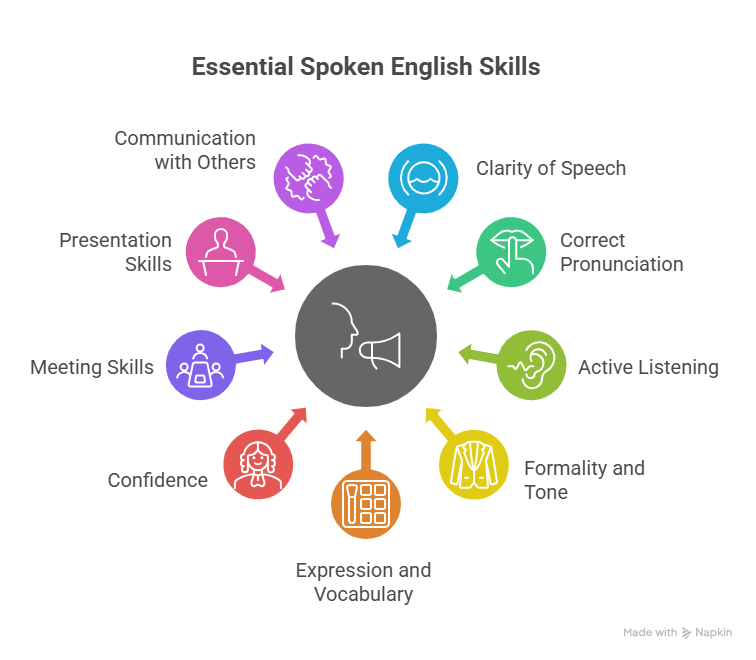
1. Clarity of Speech:
- Speak clearly and at a moderate pace;
- Avoid mumbling or speaking too quickly;
- Use simple and precise words to convey ideas effectively;
2. Correct Pronunciation:
- Practice pronouncing words correctly to ensure understanding;
- Listen to English news or podcasts to improve pronunciation;
3. Active Listening:
- Pay attention to what others say before responding;
- Refrain from interrupting during conversations;
- Summarize or paraphrase to confirm understanding.
4. Proper Formality and Tone
- At work, speak in a courteous and professional manner.
- Adapt your language to the context: use formal language in meetings and informal language in casual conversations.
- Steer clear of slang and extremely casual language.
5. Expression and Vocabulary
- Develop a professional vocabulary for communication at work.
- Use expressions like “Let’s talk about this further,” “I suggest that,” or “Could you please…”
- Steer clear of filler words like “um,” “like,” and “you know.”
6. Speaking with Confidence
- Keep your eyes open and speak confidently.
- Engage in conversations or practice public speaking.
- Don’t worry about small errors; instead, concentrate on communicating clearly.
7. Meeting and Presentation Skills
- Prior to speaking at meetings, prepare your main points.
- Logically arrange your ideas into an introduction, main points, and conclusion.
- Make your message interesting by using illustrations or instances.
8. Communication with Others
- Be kind and respectful when you greet coworkers.
- Be a proactive team communicator by providing updates and criticism.
- Make use of small conversation to establish rapport and constructive working relationships.
Improving Everyday Workplace Communication
1: Who was the first woman President of India?
1. Engage in Active Listening
- Don’t interrupt the speaker and give them your whole attention.
- Nod or give brief answers like “I see” or “That makes sense” to demonstrate comprehension.
- Instead of making assumptions, ask questions to get clarification.
2. Be Brief and Clear
- Make sure your message is succinct and direct.
- Steer clear of extended explanations and complex terminology.
- Before you write or talk, organize your ideas.
3. Speak in a courteous and expert manner
- Be courteous at all times, even when you disagree.
- Use polite phrases like “please,” “thank you,” and “excuse me.”
- Remain composed; don’t come out as impolite or defensive.
4. Enhance Your Nonverbal Communication
- Keep your body language open and your eyes open.
- When it’s suitable, smile to foster a welcoming environment.
- Keep in mind that your posture and gestures convey messages as well.
5. Adjust to Your Viewers
- Depending on who you are speaking to—a client, manager, or coworker—you should choose your words and tone.
- When speaking with non-technical folks, steer clear of technical jargon.
- In diverse organizations, be mindful of cultural differences.
6. Gain Self-Assurance
- Attend meetings and conversations on a regular basis.
- Be prepared before you speak; practice makes perfect.
- Take constructive criticism well and apply it to your improvement.
7. Promote Honest Communication
- Establish a space where suggestions and criticism are valued.
- Respect other people’s viewpoints.
- Instead of competing, work together to foster trust.
8. Use Technology Sensibly
- Make good use of meetings, chats, and emails.
- When communicating online, be professional and refrain from using slang or emojis.
- Verify crucial details in writing to prevent misunderstandings.
9. Continuous Learning
- Attend communication workshops or online courses.
- Observe good communicators in your organization.
- Practice English daily — read, listen, and speak regularly.
Free UPSKILLING Courses!
Take your first step toward mastering in-demand skills, acing interviews, and securing top-tier jobs with Entri's free upskilling courses.
Start Learning!Common Grammar and Pronunciation Fixes for Freshers
1. Subject–Verb Agreement
- Correct: She works in the HR department.
- Incorrect: She work in the HR department.
Always make sure the verb matches the subject (singular/plural).
2. Tense Consistency
- Correct: Last week, I finished the project.
- Incorrect: I finished the project last week.
For completed actions, use the past tense; for recent or ongoing outcomes, use the present perfect.
3. Articles (a, an, the)
- Correct: I work as an engineer.
- Incorrect: I work as an engineer.
Use the for certain nouns, the before vowel sounds, and the before consonants.
4. Use of Prepositions
- Correct: Programming is something I’m interested in.
- Incorrect: I’m interested in programming.
Common prepositions
- Excellent at something
- Rely on someone
- In charge of a task
5. Structure of Sentences
- Correct: I’d like to apply for this job.
- Incorrect: I prefer to use this position.
Don’t omit crucial supporting verbs and use whole sentences.
6. Pronunciation of Common Words
| Word | Incorrect | Correct |
|---|---|---|
| Develop | dee-vel-up | dih-vel-up |
| Resume | ree-sume | reh-zoo-may |
| Data | daah-tah / day-tah | either is fine (choose one consistently) |
| Engineer | en-gi-neer | en-juh-neer |
| Comfortable | com-for-ta-ble | kumf-tuh-bul |
7. Avoid Mother Tongue Influence
- Don’t translate directly from your native language.
- Focus on neutral English sounds and rhythm.
- To enhance your accent and fluency, listen to English news or podcasts.
8. Correct Use of Plurals
- Correct: The data is correct.
- Incorrect: The datas are incorrect.
Some words like data, information, furniture are uncountable, so don’t add “s.”
9. Use of “Very” and Adjectives
- Correct: It’s extremely important.
- Incorrect: It’s very importantly.
Use adverbs and adjectives correctly (She speaks clearly, not She speaks clear).
10. Practice for Pronunciation
- Use programs like YouGlish, ELSA Speak, or Google Pronunciation Tool.
- Take a voice recording of yourself and note any mispronunciations.
- Focus on intonation, stress, and clarity, not accent.
Conclusion
The transfer from university life to the corporate world is a crucial milestone for every engineering student, and good spoken English skills play an essential part in making this shift seamless and successful. Although technical expertise is the foundation of an engineer’s career, what really makes people stand out in the workplace is their capacity for clear, assured, and professional idea communication. Effective spoken English not only increases teamwork and collaboration but also helps freshers articulate their opinions, participate actively in discussions, and create credibility with colleagues and clients.
By concentrating on clarity, pronunciation, active listening, and relevant professional language, engineering graduates can bridge the gap between academic communication and business standards. Common obstacles like hesitancy or grammatical errors can be addressed with consistent practice, exposure to positive English-speaking situations, and a willingness to learn.
Ultimately, growing spoken English is not only about understanding a language—it is about building confidence, enhancing interpersonal relationships, and opening doors to new opportunities. Continuous communication skill development will enable new hires to advance, lead, and thrive in the fast-paced corporate world.
Free UPSKILLING Courses!
Take your first step toward mastering in-demand skills, acing interviews, and securing top-tier jobs with Entri's free upskilling courses.
Start Learning!Frequently Asked Questions
How do you introduce yourself in English for engineering freshers?
What are 5 skills that engineers need?
- Analytical skills. Analytical skills are the cornerstone of innovation and problem-solving.
- Project management and teamwork. Engineering projects require teamwork and effective communication as well as those all-important soft skills.
- Communication skills.
- Attention to detail.
- Adaptability and continuous learning.