Table of Contents
In German language, every noun has a gender. One important group is masculine nouns. These nouns use the article der before the word.
Masculine nouns are used for many male persons, jobs, animals, and some objects. Learning noun gender is very important because it helps you build correct German sentences.
Without the correct article, sentences can become wrong or unclear. So it is important to always learn nouns with der.
Example:
- der Mann = the man
Learn German language in your own language! Get free Demo Classes Here!
Key Takeaways:
- Masculine nouns use der
- Used for men, animals, and things
- Some endings help identify them
- Learn nouns with der
- Practice every day
What Are German Masculine Nouns?
- German nouns have 3 genders.
- One gender is masculine and it uses der.
- Masculine nouns are for men, animals, and things.
- Gender is a grammar rule, not real-life meaning.
- They help make correct German sentences.
Common Masculine Noun Endings
1: How do you say "Good Morning" in German?
In German, some endings help you guess the gender. Many masculine words follow these patterns. They usually take der. These rules are not always correct, but they are helpful.
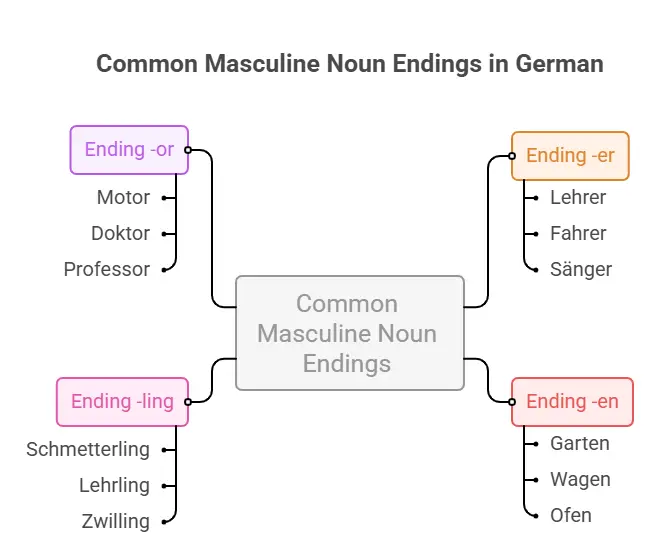
Common Masculine Endings
| Ending | Example |
|---|---|
| -er | der Lehrer |
| -en | der Garten |
| -ling | der Schmetterling |
| -or | der Motor |
1. -er Ending
Many masculine nouns ending in -er are related to jobs, people, or things.
Examples
- der Lehrer = teacher
- der Fahrer = driver
- der Computer = computer
- der Arbeiter = worker
- der Spieler = player
Simple Idea
Most job names ending in -er are masculine.
2. -en Ending
Some masculine nouns end in -en. These often refer to objects or nature words.
Examples
- der Garten = garden
- der Wagen = car/vehicle
- der Regen = rain
- der Kuchen = cake
- der Ofen = oven
Simple Idea
Some nature and everyday object words use -en and are masculine.
3. -ling Ending
Words ending in -ling usually talk about people, animals, or small/living things.
Examples
- der Schmetterling = butterfly
- der Lehrling = apprentice
- der Flüchtling = refugee
- der Zwilling = twin
- der Frühling = spring (season)
Simple Idea
Many -ling words refer to living beings or people.
4. -or Ending
Some borrowed or technical words end in -or.
Examples
- der Motor = engine
- der Doktor = doctor
- der Autor = author
- der Sensor = sensor
- der Korridor = corridor
Free German A1 Mock Tests – Powered by AI!
Test your skills on our interactive platform. Get instant feedback from our AI to help you communicate better and track your progress. Start your free German mock test now.
Test Your German A1 for FreeMasculine Nouns for People and Animals
In German, many masculine words are for men and some animals. They use der. For people, it often means male. But animals also use der, even if they are not male in real life. German gender is grammar, not real meaning.
🟠Masculine Nouns for People
- der Bruder = brother
- der Sohn = son
- der Vater = father
- der Student = student (male)
- der Lehrer = teacher (male)
🟠Masculine Nouns for Animals
- der Hund = dog
- der Löwe = lion
- der Elefant = elephant
- der Bär = bear
- der Tiger = tiger
🟠Natural Gender Concept
When it matches:
- der Vater (father – male person)
- der Sohn (son – male child)
When it does not match:
- der Hund (dog – can be male or female in real life)
- der Löwe (lion – grammar is masculine, even if female lion exists)
Example Sentences:
- Der Bruder spielt im Garten.
- Der Student lernt Deutsch.
- Der Hund schläft im Haus.
Example Sentences
Here are some easy examples.
Example 1. Der Mann arbeitet.
Meaning
The man works.
- Der Mann = the man (masculine noun)
- arbeitet = works (verb)
Explanation
Here, der Mann is the subject. He is doing the action (working). So we use der before “Mann” because it is a masculine noun.
Easy Idea
Masculine nouns often show who is doing the action.
Example 2. Der Hund schläft.
Meaning
The dog is sleeping.
- Der Hund = the dog (masculine noun)
- schläft = sleeps
Explanation:
In this sentence, the dog is the subject. The dog is doing the action of sleeping. So we use der with “Hund”.
Easy Idea:
Even animals like “dog” can be masculine in German grammar.
Example 3. Der Lehrer erklärt die Grammatik.
Meaning
The teacher explains the grammar.
- Der Lehrer = the teacher (masculine noun)
- erklärt = explains
- die Grammatik = the grammar (feminine noun)
Explanation
Here, der Lehrer is doing the action. He is the subject. The teacher explains something to others.
“Grammatik” is a different noun and uses die, showing that not all nouns are masculine.
Free German A1 Mock Tests – Powered by AI!
Test your skills on our interactive platform. Get instant feedback from our AI to help you communicate better and track your progress. Start your free German mock test now.
Test Your German A1 for FreeTips to Remember Masculine Nouns
🔶Learn Nouns with “der”
Always learn the noun together with its article.
Examples
- der Mann
- der Tisch
- der Lehrer
Simple Idea:
Do not learn just “Mann” or “Tisch”. Always learn der Mann, der Tisch.
This helps your brain remember the gender naturally.
🔶Group Nouns by Endings
Many masculine nouns have similar endings. Grouping them helps you learn faster.
Common groups
- -er → der Lehrer, der Fahrer
- -en → der Garten, der Ofen
- -ling → der Schmetterling, der Lehrling
- -or → der Motor, der Doktor
Simple Idea
Learn words in small groups instead of single words.
🔶Use Flashcards
Flashcards are a very easy learning method.
How to use
- Write German word on one side
- Write meaning + article on the other side
Example
- Front: der Hund
- Back: the dog
Simple Idea
Practice flashcards daily for 5–10 minutes. It improves memory quickly.
🔶Practice in Sentences
Try to use masculine nouns in simple sentences.
Examples
- Der Hund läuft im Park.
- Der Lehrer erklärt die Lektion.
Simple Idea
Speaking and writing help you remember better than reading only.
🔶Repeat Daily
Small daily practice is more powerful than long study sessions.
- Revise 5–10 words daily
- Read simple German sentences
- Say words aloud
Practice Section
Fill in the correct article (der / die / das)
1 ___ Lehrer
2 ___ Garten
3 ___ Hund
✅ Answers
1 der Lehrer
2 der Garten
3 der Hund
Explanation:
- Lehrer is a masculine noun, so we use der
- Garten is also masculine, so it uses der
- Hund (dog) is masculine in German grammar, so we use der
Learn German language in your own language! Get free Demo Classes Here!
Conclusion
German masculine nouns are an important part of German grammar. They always use the article der. These nouns are used for many male people, some animals, and also many objects. Learning them helps you make correct German sentences. Some endings like -er, -en, -ling, and -or can help you guess masculine nouns. But not all words follow these rules, so practice is important.
Free German A1 Mock Tests – Powered by AI!
Test your skills on our interactive platform. Get instant feedback from our AI to help you communicate better and track your progress. Start your free German mock test now.
Test Your German A1 for FreeFrequently Asked Questions
How do you identify masculine nouns in German?
You can identify masculine nouns by their article “der.” Some words follow patterns, like endings -er, -en, -ling, and -or. Also, many nouns for male people are masculine. However, not all nouns follow rules, so it is best to learn each noun with its article.
Are all male nouns masculine in German?
Yes, most nouns for male people are masculine and use “der.”
Example: der Vater (father), der Bruder (brother)
But for objects, gender is not always logical, so you must memorize them.
What endings are masculine in German?
Common masculine endings include:
- -er (der Lehrer)
- -en (der Garten)
- -ling (der Schmetterling)
- -or (der Motor)
These endings often indicate masculine nouns.
Do all masculine nouns refer to males?
No, not always. Some masculine nouns are objects or things.
Example: der Tisch (table), der Zug (train)
So, gender in German is grammatical, not always based on real gender.
Why is it important to learn masculine nouns?
Learning masculine nouns helps you:
- Use correct articles (der)
- Build correct sentences
- Understand grammar better
It is important for speaking and writing correctly.
Do masculine nouns change in sentences?
Yes, the article changes depending on the case.
Example:
- der Mann (subject)
- den Mann (object)
This is called declension.
What is the best way to remember masculine nouns?
The best way is to:
- Learn nouns with der
- Use flashcards
- Practice daily
- Group words by endings
Regular practice makes learning easier.
Can I guess masculine nouns easily?
Sometimes yes, using endings and patterns. But not always.
German has many exceptions, so it is safer to learn each noun with its article.