Table of Contents
Learn German language in your own language! Get free Demo Classes Here!
What is German Noun Gender?
1: How do you say "Good Morning" in German?
German noun gender is an important grammar rule in German language. In German, every noun belongs to a gender group. These groups are called masculine, feminine, and neuter.
German uses small words called articles before nouns. These articles help show the gender of the noun.
- der → masculine
- die → feminine
- das → neuter
Unlike English, German nouns always use a gender. The gender may not always match real-life meaning. German grammar decides the gender of the noun.
Simple Examples of German Noun Gender
1. Masculine Nouns
Masculine nouns use the article der.
- Masculine nouns use -> der.
- Many male persons use -> der.
- Some objects also use -> der.
Examples
- der Mann = the man
- der Lehrer = the teacher
- der Hund = the dog
2. Feminine Nouns
Feminine nouns use the article die.
- Feminine nouns use -> die.
- Many female persons use -> die.
Examples
- die Frau = the woman
- die Blume = the flower
- die Katze = the cat
3. Neuter Nouns
Neuter nouns use the article das.
- Neuter nouns use -> das.
- Many objects use -> das.
- Some young people or babies use -> das.
Examples
- das Kind = the child
- das Buch = the book
- das Auto = the car
German Noun Gender Table
| German Noun | English Meaning | Gender | Article |
|---|---|---|---|
| der Mann | the man | Masculine | der |
| die Frau | the woman | Feminine | die |
| das Kind | the child | Neuter | das |
| der Hund | the dog | Masculine | der |
| die Blume | the flower | Feminine | die |
| das Buch | the book | Neuter | das |
Why German Noun Gender is Important
German noun gender changes many parts of grammar. Articles, adjectives, and pronouns change based on noun gender.
Learning gender helps learners build correct German sentences.
1. Articles Change Based on Gender
Every noun needs the correct article.
Examples
- der Tisch = the table
- die Lampe = the lamp
- das Auto = the car
Simple Points
- Articles show -> noun gender.
- Wrong articles create -> grammar mistakes.
- Correct articles improve -> sentence structure.
2. Adjectives Change with Gender
German adjectives also change depending on the noun gender.
Examples
- der gute Mann = the good man
- die gute Frau = the good woman
- das gute Kind = the good child
The adjective “gut” changes slightly with the gender.
Simple Points
- Adjectives follow -> noun gender.
- Gender changes -> adjective forms.
- Practice helps -> learn adjective changes.
3. Pronouns Change with Gender
German pronouns depend on noun gender.
Examples
- der Mann → er (he)
- die Frau → sie (she)
- das Kind → es (it)
Simple Points
- Pronouns change -> with noun gender.
- Masculine nouns use -> er.
- Feminine nouns use -> sie.
- Neuter nouns use -> es.
Free German A1 Mock Tests – Powered by AI!
Test your skills on our interactive platform. Get instant feedback from our AI to help you communicate better and track your progress. Start your free German mock test now.
Test Your German A1 for FreeThe Three German Genders
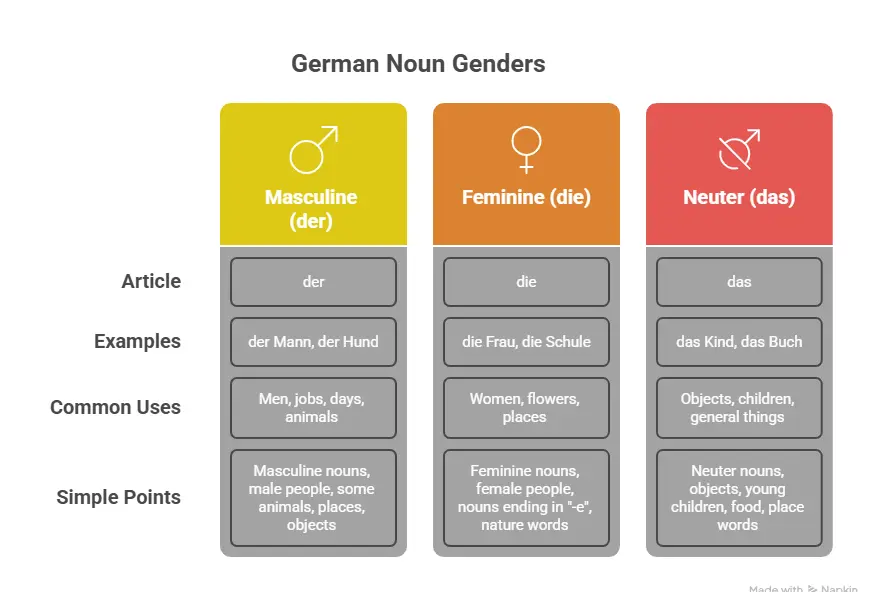
German nouns always have a gender, and each noun uses der, die, or das, which can be confusing for learners.
1. Masculine Gender – der
Masculine nouns mostly use the article der. Many words for men, jobs, days, and some animals belong to this group.
Examples
- der Mann = the man
- der Hund = the dog
- der Lehrer = the teacher
- der Bruder = the brother
- der Garten = the garden
Simple Points
- der is used for -> masculine nouns.
- Many male people use -> der.
- Some animals use -> der.
- Some places and objects also use -> der.
Example Sentences
- Der Mann kommt heute.
(The man comes today.) - Der Hund läuft schnell.
(The dog runs fast.)
2. Feminine Gender – die
Feminine nouns use the article die. Many words for women, flowers, and places belong to this group.
Examples
- die Frau = the woman
- die Katze = the cat
- die Schule = the school
- die Blume = the flower
- die Schwester = the sister
Simple Points
- die is used for -> feminine nouns.
- Many female people use -> die.
- Many nouns ending with “-e” use -> die.
- Some nature words also use -> die.
Example Sentences
- Die Frau arbeitet hier.
(The woman works here.) - Die Katze sitzt ruhig.
(The cat sits quietly.)
3. Neuter Gender – das
Neuter nouns use the article das. Many objects, small children, and some general things belong to this group.
Examples
- das Kind = the child
- das Haus = the house
- das Buch = the book
- das Fenster = the window
- das Essen = the food
Simple Points
- das is used for -> neuter nouns.
- Many objects use -> das.
- Young children often use -> das.
- Some food and place words use -> das.
Example Sentences
- Das Kind spielt draußen.
(The child plays outside.) - Das Buch ist neu.
(The book is new.)
German Gender Comparison Table
| Gender | Article | Examples | Meaning |
|---|---|---|---|
| Masculine | der | der Mann | the man |
| Masculine | der | der Hund | the dog |
| Feminine | die | die Frau | the woman |
| Feminine | die | die Schule | the school |
| Neuter | das | das Kind | the child |
| Neuter | das | das Buch | the book |
German Noun Gender Rules
German noun genders can feel difficult for beginners. But many words follow simple patterns. Some endings help you guess the gender. These rules do not always work, but they help in learning German.
Masculine Noun Rules
Many masculine nouns use the article der. Some word endings are often masculine in German language.
Common Masculine Endings
- -er
- -en
- -ling
These endings are common in words for people, jobs, animals, and objects.
Examples of Masculine Nouns
- der Lehrer = the teacher
- der Garten = the garden
- der Schmetterling = the butterfly
- der Wagen = the car
- der Computer = the computer
Understanding Masculine Patterns
Many job names ending with -er are masculine.
Examples
- der Fahrer = the driver
- der Lehrer = the teacher
Some nouns ending with -en are also masculine.
Examples
- der Garten = the garden
- der Regen = the rain
Words ending with -ling are usually masculine.
Examples
- der Schmetterling = the butterfly
- der Zwilling = the twin
Example Sentences
- Der Lehrer erklärt die Aufgabe.
(The teacher explains the task.) - Der Garten ist schön.
(The garden is beautiful.) - Der Schmetterling fliegt schnell.
(The butterfly flies fast.)
Feminine Noun Rules
Many feminine nouns use the article die. Certain endings are mostly feminine in German.
Common Feminine Endings
- -e
- -heit
- -keit
- -ung
- -schaft
- -ion
These endings are common in abstract words, ideas, and many regular nouns.
Examples of Feminine Nouns
- die Blume = the flower
- die Freiheit = freedom
- die Zeitung = the newspaper
- die Freundschaft = friendship
- die Information = information
Understanding Feminine Patterns
Many nouns ending with -e are feminine.
Examples
- die Blume = the flower
- die Lampe = the lamp
Words ending with -heit and -keit are usually feminine.
Examples
- die Freiheit = freedom
- die Möglichkeit = possibility
Nouns ending with -ung are also commonly feminine.
Examples
- die Zeitung = newspaper
- die Einladung = invitation
Words ending with -schaft often describe groups or relationships.
Examples
- die Freundschaft = friendship
- die Mannschaft = team
Words ending with -ion are usually feminine borrowed words.
Examples
- die Information = information
- die Nation = nation
Example Sentences
- Die Blume ist rot.
(The flower is red.) - Die Zeitung liegt hier.
(The newspaper is here.) - Die Freiheit ist wichtig.
(Freedom is important.)
Neuter Noun Rules
Neuter nouns use the article das. Some endings are commonly neuter in German grammar.
Common Neuter Endings
- -chen
- -lein
- -ment
- -um
These endings are often used for small things, objects, and formal words.
Examples of Neuter Nouns
- das Mädchen = the girl
- das Instrument = the instrument
- das Museum = the museum
- das Büchlein = small book
- das Zentrum = center
Understanding Neuter Patterns
Words ending with -chen are usually neuter.
Examples
- das Mädchen = the girl
- das Häuschen = small house
Words ending with -lein are also neuter.
Examples
- das Büchlein = small book
- das Fräulein = young lady
Many words ending with -ment are neuter borrowed words.
Examples
- das Instrument = instrument
- das Dokument = document
Words ending with -um are commonly neuter.
Examples
- das Museum = museum
- das Zentrum = center
Example Sentences
- Das Mädchen spielt draußen.
(The girl plays outside.) - Das Instrument klingt schön.
(The instrument sounds nice.) - Das Museum ist groß.
(The museum is big.)
German Gender Endings Table
| Ending | Gender | Example | Meaning |
|---|---|---|---|
| -er | Masculine | der Lehrer | teacher |
| -en | Masculine | der Garten | garden |
| -ling | Masculine | der Schmetterling | butterfly |
| -e | Feminine | die Blume | flower |
| -heit | Feminine | die Freiheit | freedom |
| -keit | Feminine | die Möglichkeit | possibility |
| -ung | Feminine | die Zeitung | newspaper |
| -schaft | Feminine | die Freundschaft | friendship |
| -ion | Feminine | die Information | information |
| -chen | Neuter | das Mädchen | girl |
| -lein | Neuter | das Büchlein | small book |
| -ment | Neuter | das Instrument | instrument |
| -um | Neuter | das Museum | museum |
Natural Gender vs Grammatical Gender
In German language, real-life gender and grammar gender are sometimes different. Some nouns follow the real person’s gender. But some nouns follow grammar rules only.
This can feel confusing for beginners. But simple practice helps learners understand it better.
When Both Genders are the Same
Many words for men use masculine gender. Many words for women use feminine gender.
Examples
- der Vater = the father
- die Mutter = the mother
- der Mann = the man
- die Frau = the woman
These words match the real person’s gender.
Example Sentences
- Der Vater ist zu Hause.
(The father is at home.) - Die Mutter arbeitet heute.
(The mother works today.)
When the Grammar Gender is Different
Sometimes the grammar gender does not match the real person.
Example
- das Mädchen = the girl
A girl is female, but German uses das here.
This happens because Mädchen ends with -chen. Many German words ending with -chen use neuter gender.
More Examples
- das Baby = the baby
- das Fräulein = young lady
These nouns also use das in German grammar.
Gender Table
| German Word | Meaning | Real Gender | German Gender |
|---|---|---|---|
| der Vater | father | Male | Masculine |
| die Mutter | mother | Female | Feminine |
| der Mann | man | Male | Masculine |
| die Frau | woman | Female | Feminine |
| das Mädchen | girl | Female | Neuter |
Free German A1 Mock Tests – Powered by AI!
Test your skills on our interactive platform. Get instant feedback from our AI to help you communicate better and track your progress. Start your free German mock test now.
Test Your German A1 for FreeTips to Learn German Noun Gender Faster
Regular practice and small daily habits help learners remember noun genders better.
1. Always Learn Nouns with Articles
One of the best ways to learn German is to study nouns together with their articles. Do not learn the word alone.
For example:
- der Tisch
- die Blume
- das Buch
This helps your brain remember the gender naturally.
Wrong Method
- Tisch
- Blume
- Buch
Better Method
- der Tisch
- die Blume
- das Buch
When learners study nouns with articles, sentence building becomes easier later.
2. Use Color Coding
Colors can help learners remember German genders faster. Many students use different colors for each article.
Simple Color Ideas
- Blue → der
- Red → die
- Green → das
You can use colors in notebooks, flashcards, or mobile notes.
Example
- der Hund → blue
- die Katze → red
- das Auto → green
This method helps learners recognize noun genders quickly.
3. Group Nouns by Endings
Many German nouns follow common ending patterns. Grouping similar words together can improve learning.
Examples
Words ending with -ung are often feminine:
- die Zeitung
- die Einladung
Words ending with -chen are usually neuter:
- das Mädchen
- das Häuschen
Words ending with -er are often masculine:
- der Lehrer
- der Fahrer
Learning groups of similar nouns helps learners notice grammar patterns naturally.
4. Practice with Flashcards
Flashcards are a simple way to practice German noun genders. Learners can use paper cards or mobile apps.
Write the German noun on one side. Write the meaning and article on the other side.
Example Flashcard
Front:
- der Hund
Back:
- the dog
Flashcards improve memory through regular repetition.
Common Mistakes Beginners Make
Many beginners forget to use the correct article in German sentences. Using the wrong article can change the grammar of the sentence.
1. Forgetting the Article
Some learners say the noun without an article. This is a common beginner mistake.
Wrong Example
❌ Buch ist interessant.
Correct Example
✅ Das Buch ist interessant. (The book is interesting.)
In German, the noun Buch needs the article das. Without the article, the sentence sounds incomplete.
2. Using the Wrong Article
Another common mistake is using the wrong gender article.
Wrong Example
❌ Der Katze schläft.
Correct Example
✅ Die Katze schläft.
(The cat is sleeping.)
The noun Katze is feminine, so it uses die.
3. Mixing der, die, and das
Many learners confuse the three German articles.
Examples
- der Hund = correct
- die Blume = correct
- das Haus = correct
Every noun has its own gender. Learners must remember the correct article with the noun.
Practice Examples
Practice helps learners remember German articles better. Try these simple exercises.
Exercise 1: Choose the Correct Article
Write:
- der
- die
- das
Questions
- ___ Haus
- ___ Lehrer
- ___ Blume
- ___ Katze
- ___ Buch
- ___ Mann
- ___ Schule
- ___ Kind
Answers:
- das Haus
- der Lehrer
- die Blume
- die Katze
- das Buch
- der Mann
- die Schule
- das Kind
Exercise 2: Match the Word and Gender
Words
- Hund
- Frau
- Auto
- Garten
- Lampe
Answers
- der Hund
- die Frau
- das Auto
- der Garten
- die Lampe
Exercise 3: Fill the Missing Article
- ___ Tisch ist groß.
- ___ Mutter kocht heute.
- ___ Fenster ist offen.
Answers:
- Der Tisch ist groß.
- Die Mutter kocht heute.
- Das Fenster ist offen.
Learn German language in your own language! Get free Demo Classes Here!
Quick Summary
Free German A1 Mock Tests – Powered by AI!
Test your skills on our interactive platform. Get instant feedback from our AI to help you communicate better and track your progress. Start your free German mock test now.
Test Your German A1 for FreeFrequently Asked Questions
What is noun gender in German?
Noun gender in German means every noun is classified as masculine (der), feminine (die), or neuter (das). This is a grammar rule and does not always depend on real-life meaning. Every noun must always have a gender.
Why do German nouns have gender?
German uses gender to organize grammar. It helps decide articles, adjectives, and sentence structure. Gender is not random in grammar, but it is also not always logical, so learners must memorize it.
How many genders are there in German?
There are three genders in German:
- der (masculine)
- die (feminine)
- das (neuter)
Every noun belongs to one of these categories.
How can I learn noun gender easily?
The best way is to always learn nouns with their article, like:
- der Tisch
- die Lampe
- das Buch
Practice daily and use flashcards or groups of words.
Are German noun genders logical?
Sometimes yes, but often no. For example:
- der Mann (man) → logical
- die Frau (woman) → logical
- das Mädchen (girl) → not logical
So, gender must often be memorized.
Do noun endings help identify gender?
Yes, many endings give clues:
- -er → der (masculine)
- -heit, -keit, -ung → die (feminine)
- -chen, -lein → das (neuter, always)
But there are exceptions, so rules are not perfect.
Why is “das Mädchen” neuter and not feminine?
“Mädchen” ends in -chen, and all -chen words are always neuter in German grammar. So even though it means “girl,” it uses das, not die.
What is the most important rule for beginners?
The most important rule is:
👉 Always learn nouns with their article (der / die / das)
This helps you build correct sentences and avoid mistakes in speaking and writing German.