Table of Contents
If you’ve ever looked at a smart TV, an automatic washing machine, a car’s ABS system, or even a simple digital thermometer and thought, “I want to build things like this,” then a career in Embedded Systems is probably calling you.
But the next doubt immediately appears:
“What skills do I actually need to become a good embedded systems engineer?”
Is it just C programming?
Do you need to be an electronics expert?
What about RTOS, communication protocols, debugging tools… and so on?
This detailed guide breaks it all down in a clear, practical, career-focused way, especially for learners in India – engineering students, diploma holders, freshers, and working professionals trying to move into core electronics.
What Does an Embedded Systems Engineer Actually Do?
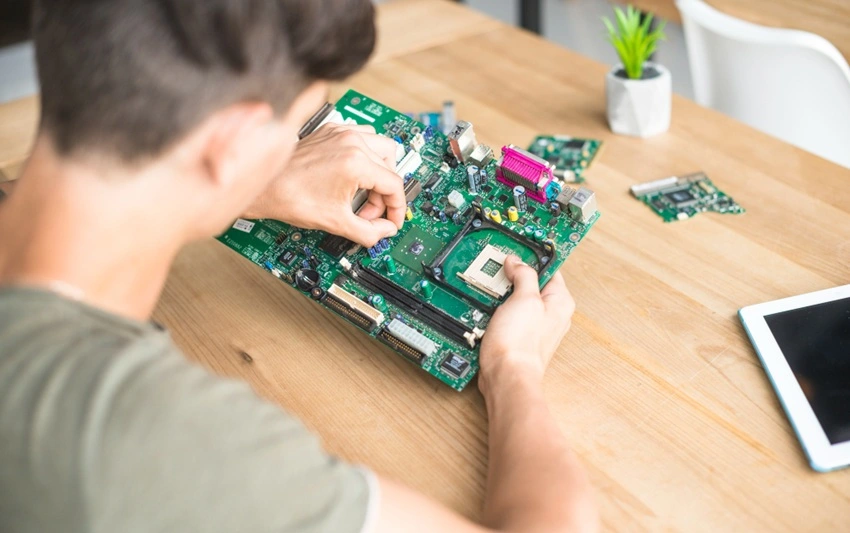
Before listing skills, it is important to understand the day-to-day reality of the job.
An embedded systems engineer works on computers hidden inside devices, usually built around microcontrollers or microprocessors. These are not PCs or laptops. They are small, efficient chips designed to perform very specific tasks reliably.
In a typical project, an embedded engineer might:
- Study the product requirement: for example, “We need a motor controller for an EV scooter,” or “We need a temperature monitoring system for a cold storage unit.”
- Select or work with the team to select a suitable microcontroller and required components (sensors, actuators, power modules).
- Write firmware in C or C++ that reads sensor data, makes decisions, and controls outputs.
- Use debuggers, oscilloscopes, and logic analyzers to find and fix problems.
- Ensure the system is safe, reliable, and efficient under real-world conditions like noise, voltage fluctuations, and temperature changes.
- Sometimes collaborate with IoT engineers who connect that device to the internet or cloud.
In short, embedded engineers are the people who make physical products “come alive”.
To do this confidently, you need a solid mix of programming, electronics, problem-solving, and communication skills.
Kickstart your embedded systems career and turn your tech passion into high-demand skills!
Strong C Programming Skills (Non-Negotiable)

If there is one skill that almost every embedded job description mentions, it is C programming.
Why?
- C is close to the hardware. It allows you to control memory, timing, and registers directly.
- Most microcontrollers and embedded platforms offer C/C++ toolchains, libraries, and examples.
- C is efficient and predictable. This matters a lot when you are working with limited RAM and flash.
What “Strong C” Means in Embedded
It is not enough to just know “if-else” and “for loops”. As an embedded engineer, you should be comfortable with:
- Pointers and memory addressing
- Structures and unions
- Bitwise operators (shifting, masking, setting/clearing bits)
- Enums, macros, and conditional compilation
- Writing modular code – splitting your code into reusable files and functions
- Understanding stack vs heap and basic memory layout
When you read a microcontroller datasheet that says “Write 1 to bit 3 of the control register,” you should instantly know how to do that using bitwise operations in C.
Good embedded courses, like Entri’s Embedded Systems program, usually start with a solid revision and deepening of C, because this is the language you will speak to the hardware with.
Master Embedded Systems Programming!
Launch your tech career with our Embedded Systems Course, designed for hands-on learning and industry readiness.
Know MoreUnderstanding Microcontrollers and Their Peripherals
An embedded systems engineer must be comfortable with microcontroller architecture and its peripherals. This doesn’t mean you need to design chips yourself, but you must understand how to use them.
Key concepts include:
- What is a microcontroller and how it differs from a microprocessor
- GPIO (General Purpose Input/Output) pins – reading switches, controlling LEDs, relays, etc.
- Timers and counters – generating delays, measuring time, PWM outputs for motor control.
- ADC (Analog to Digital Converter) – reading sensor values (temperature, light, pressure).
- Communication modules – UART, SPI, I²C, CAN, etc.
You should be able to:
- Read a microcontroller datasheet and understand the basic features
- Configure GPIOs for input/output
- Use timers for precise delay and PWM
- Read analog sensors via ADC
- Send and receive data using serial communication
A structured course like Entri’s typically gives you hands-on exposure to at least one popular microcontroller family (for example, ARM Cortex-M or AVR/ESP32), so you learn how these peripherals are used in real projects, not just in theory.
Knowledge of Electronics and Sensor Interfacing
Embedded engineering sits exactly at the junction of software and electronics. You don’t need to be a PhD in electronics, but you must understand the basics well enough to design, debug, and collaborate.
Core Electronics Topics You Should Be Comfortable With
- Ohm’s law, voltage, current, resistance, power
- Reading and understanding circuit diagrams and PCBs at a basic level
- Power supplies – batteries, regulators, voltage levels (3.3V, 5V, etc.)
- Digital vs analog signals
- Pull-up and pull-down resistors
- Basics of filters, noise, grounding, and decoupling capacitors
Sensor & Actuator Interfacing Skills
You should know how to:
- Connect and read popular sensors – temperature, humidity, motion, light, accelerometers, etc.
- Drive actuators – relays, motors (DC, stepper, servo), buzzers, simple displays.
- Use level shifting where required (for example, between 5V and 3.3V systems).
In interviews, many companies in India ask embedded candidates:
“Explain a project where you used a sensor, and how you interfaced it with your microcontroller.”
If you have gone through a practical course like the Entri Embedded System course, you will already have multiple such projects to talk about confidently.
Mastery of Communication Protocols
Modern embedded systems rarely live alone. They talk to sensors, memory chips, displays, other controllers, and sometimes the outside world.
This communication happens through standard protocols. A strong embedded systems engineer understands these well, both in theory and in practice.
Important Protocols You Should Know
- UART (Serial Communication)
Used for debugging, logging, and communication with modules like GSM, GPS, Bluetooth, etc.
- SPI (Serial Peripheral Interface)
High-speed communication with devices like flash memory, displays, some sensors.
- I²C (Inter-Integrated Circuit)
Popular for connecting multiple sensors and ICs on the same two-wire bus.
- CAN (Controller Area Network)
Very important in automotive systems. Used inside cars for communication between ECUs.
- In more advanced or IoT-focused roles, you may also encounter:
- USB
- Ethernet
- Modbus
- BLE, Wi-Fi modules (often via UART/SPI)
- USB
In real projects, you will often read datasheets where devices say, “This sensor communicates over I²C with address 0x48,” and you’ll write code to configure and read it. Practical exposure through guided labs or a course makes this much easier.
Master Embedded Systems Programming!
Launch your tech career with our Embedded Systems Course, designed for hands-on learning and industry readiness.
Know MoreReal-Time Concepts and (Basic) RTOS Knowledge
Many embedded systems are time-critical. For example:
- Airbag deployment systems
- Motor control in robotics or drones
- Industrial machine control
- Medical monitoring devices
In such systems, delays or unpredictable timing can be dangerous. This is where real-time concepts and sometimes RTOS (Real-Time Operating Systems) come in.
You should understand:
- The concept of interrupts and interrupt service routines (ISRs)
- Prioritisation of tasks
- Why long blocking delays (like big delay() calls) can be problematic
- Basics of RTOS: tasks/threads, scheduling, queues, semaphores, mutexes
At entry level in India, not every company demands deep RTOS expertise, but having at least a working knowledge of these ideas makes you far more attractive in the job market.
Many embedded training programs, including Entri’s, introduce real-time concepts through small RTOS-based projects, so you see how tasks run in parallel and how systems remain responsive.
Debugging Skills and Use of Tools
One major difference between a good embedded engineer and an average one is their ability to debug calmly and systematically.
Things will go wrong. Devices will not respond. Data will look noisy. Timings will be off. Your strength lies in how you investigate and fix issues.
Essential Debugging Tools and Mindset
- Using a hardware debugger (like J-Link, ST-Link) to step through code, inspect variables, and set breakpoints.
- Using serial prints (UART) for quick logging and debugging.
- Basic use of an oscilloscope to see signal shapes, check voltage levels, and confirm timings.
- Use of a logic analyzer to decode protocols (UART, SPI, I²C) and see if your communication is correct.
- Checking power, ground, and connections with a multimeter before blaming the code.
Good embedded training does not just show you “perfect code”; it also shows you how to handle imperfect reality, which is where experience is truly built.
Kickstart your embedded systems career and turn your tech passion into high-demand skills!
Embedded Software Design Practices and Documentation
Even in embedded systems, clean code and good architecture matter a lot. Employers look for engineers who can write readable, maintainable, and testable firmware.
Important Software Practices
- Splitting functionality into separate modules (e.g., sensor.c, motor_control.c, uart_driver.c)
- Using header files correctly for declarations
- Avoiding “magic numbers” and using macros or enums instead
- Adding meaningful comments and maintaining simple documentation
- Using version control systems like Git for managing code changes
- Understanding state machines and using them to design system behaviour
In the Indian job market, many companies will ask you to explain how you structured the code for your project. Having gone through a structured course with embedded projects (like Entri’s Embedded System course) helps you articulate this clearly.
Basic Awareness of IoT, Cloud and Connectivity
Even if your primary career is in Embedded Systems, having a basic understanding of IoT concepts is extremely useful today.
This does not mean you must become a full cloud developer, but you should know:
- What it means to send sensor data to the cloud
- Common IoT protocols like MQTT at a conceptual level
- The idea of REST APIs and dashboards
- How Wi-Fi/BLE modules are typically used with microcontrollers
Why does this help?
Because many companies in India are moving towards Connected Devices. If you already understand how your firmware could later fit into an IoT system, you become a more valuable engineer and can easily grow into higher roles.
Problem-Solving Mindset and Patience
Technical skills alone are not enough. Embedded systems are full of small, tricky, unexpected issues:
- A sensor works on the breadboard but fails on the PCB.
- The system behaves differently at high temperature.
- A small timing mismatch causes sporadic failures in communication.
You need:
- Patience – to test hypotheses step by step, instead of guessing wildly.
- Logical thinking – to isolate hardware vs software problems.
- Curiosity – to read datasheets, app notes, and understand the “why” behind behaviour.
These qualities are what truly make you a professional, not just someone who copies code.
Communication, Teamwork, and Documentation Skills
Many embedded engineers in India work within cross-functional teams that include hardware designers, mechanical engineers, software/app developers, and sometimes customers.
To succeed, you must be able to:
- Explain technical issues in simple language to non-embedded teammates.
- Write short but clear technical documents, such as:
- Interface specifications
- User guides for your firmware modules
- Test reports and known issue lists
- Interface specifications
- Collaborate and respect feedback from hardware or QA teams.
This combination of technical + communication is what pushes your career from pure “coder” to lead engineer over a few years.
How an Embedded System Course Like Entri’s Helps You Build These Skills
Learning all this alone from random videos can be chaotic. A well-designed course gives you a roadmap.
A course such as the Entri Embedded System course typically focuses on:
- Fundamentals First
– C programming for embedded
– Basics of microcontrollers and electronics - Gradual Skill Build-Up
– GPIO, timers, ADC, communication protocols
– Sensor interfacing and practical circuits - Project-Based Learning
– You don’t just hear theory; you build mini projects like:
- Sensor-based automation
- Motor control systems
- Data logging devices
- Sensor-based automation
- Interview and Career Readiness
– Guidance on how to explain your projects
– How to showcase your skills to employers
– A practical portfolio that shows you can actually build things
For Indian learners who want structured, step-by-step embedded training instead of just scattered tutorials, a course like Entri’s provides a strong, region-aware and industry-aligned path.
Step-by-Step Plan to Become an Embedded Systems Engineer
If you are serious about this career, here is a realistic roadmap you can follow:
- Master C for Embedded
Spend focused time practicing C with pointers, bitwise operations, and memory understanding. - Get Comfortable with One Microcontroller Platform
Use development boards and practise GPIO, timers, ADC and basic serial communication. - Learn Electronics Essentials
Revise basic circuits, reading schematics and using multimeters. - Interface Real Sensors and Actuators
Build small circuits with temperature sensors, relays, motors, displays. - Understand Communication Protocols
Implement UART, SPI, I²C in simple projects. - Do 2–3 Solid Projects
Document them well, with a clear explanation of the problem statement, design, and results. - Explore RTOS Basics
Understand how tasks and interrupts work in time-critical systems. - Prepare for Interviews
Be ready to explain your projects, C concepts, and basic electronics confidently.
A structured learning platform like Entri’s Embedded Systems course helps you follow this roadmap without missing essential steps.
Key Takeaways: Skills Checklist for Embedded Systems Engineers
To summarise, here is a clear checklist you can use for self-evaluation:
- Strong C programming (pointers, structures, bitwise, memory basics)
- Understanding of microcontroller architecture and peripherals
- Practical electronics knowledge and sensor/actuator interfacing
- Hands-on experience with UART, SPI, I²C, and exposure to other protocols
- Awareness of real-time concepts and basic RTOS principles
- Ability to use debugging tools (debuggers, serial logs, oscilloscope/logic analyzer)
- Good coding practices, modular design, and basic use of Git
- Awareness of IoT concepts and connectivity trends
- Problem-solving mindset, patience, and curiosity
- Communication and documentation skills for teamwork and growth
If you actively build these skills, you will not only be employable, you’ll be future-proof in a world that is becoming more and more dependent on smart, embedded devices.
And if you want a structured, guided way to build them, an industry-aligned Embedded Systems course from Entri can be an excellent starting point to turn your interest into a real, practical career path.
Master Embedded Systems Programming!
Launch your tech career with our Embedded Systems Course, designed for hands-on learning and industry readiness.
Know MoreFrequently Asked Questions
What skills are most important for an embedded systems engineer?
The most essential skills include strong C programming, understanding microcontroller architectures, communication protocols like UART/SPI/I²C, RTOS concepts, debugging tools, and basic electronics. Soft skills like documentation and problem-solving are equally important.
Do I need to know C++ for embedded systems?
You don’t need advanced C++, but knowing embedded-friendly features like classes, RAII principles, and templates gives you an advantage, especially when working on modular device drivers or layered firmware stacks.
Is Python required in embedded engineering?
Python is not mandatory for firmware development, but it is extremely useful for writing test scripts, automation tools, and simulations. Many testing frameworks and CI pipelines rely on Python.
Which microcontroller is best for beginners?
Beginners usually start with STM32, ESP32, Arduino, or Nordic nRF52 boards because they offer great documentation, community support, and easy peripheral access.
Does an embedded systems engineer need RTOS knowledge?
Yes. Modern products often run multiple tasks simultaneously, and RTOS helps manage concurrency safely. Even entry-level jobs expect at least basic understanding of task scheduling, queues, and synchronization.
How do I become job-ready in embedded systems?
Focus on mastering C, work on hands-on microcontroller projects, learn communication protocols, practise debugging, and build a project portfolio. A structured, practical program like the Entri Embedded Systems Course helps accelerate readiness.
What industries hire embedded systems engineers in India?
Major hiring sectors include automotive (EVs), consumer electronics, medical devices, IoT startups, telecom, industrial automation, and semiconductor companies. Cities like Bengaluru, Pune, Chennai, Hyderabad and Noida have the highest demand.
Is embedded systems a good career in 2026?
Yes. With IoT, EVs, robotics, automation, aerospace and smart devices growing rapidly, embedded engineering continues to offer strong salaries, stable career growth and diverse job opportunities.