Table of Contents
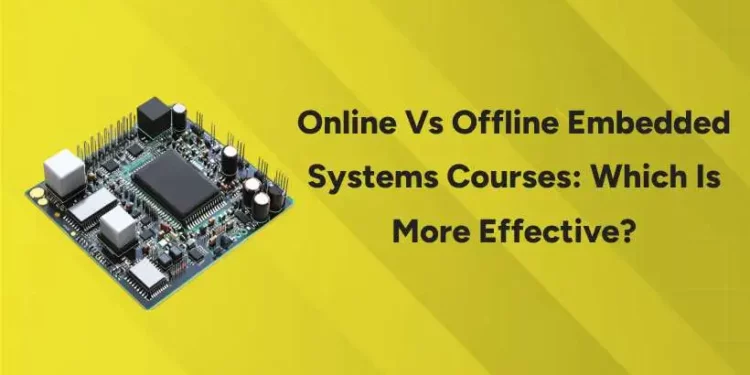
Choosing between an online and an offline Embedded Systems course can feel like choosing a career path in itself.
Both promise “hands-on training”, “industry-ready skills”, and “placement support”. Fees can range from a few thousand rupees to well over a lakh. And if you’re a student or working engineer, you don’t want to waste 6–12 months on the wrong format.
The idea is simple: by the end, you should know which mode is more effective for you, not just in theory.
Why Embedded Systems Courses Matter So Much Right Now

Before we compare online vs offline, let’s quickly understand why Embedded Systems is worth investing in.
Embedded systems are the “hidden brains” inside:
- EVs and cars
- Smart appliances
- Industrial robots
- Medical devices
- IoT sensors and gateways
The global embedded systems market is projected to grow from about $86.5 billion in 2020 to over $116 billion by 2025.
In India specifically, the embedded systems market is estimated around $4.47 billion in 2024, expected to reach about $8+ billion by 2030 at a CAGR of over 10%.
A recent industry analysis notes that demand for embedded engineers in India (2025–2028) is likely to outpace supply, thanks to automotive, IoT, healthcare, and consumer electronics growth.
So if you build solid embedded skills now, C/Embedded C, microcontrollers, RTOS, communication protocols, you’re not just learning “another course”. You’re building a career in a high-demand niche.
That’s exactly why the mode of learning (online vs offline) matters: it decides how deep your skills actually become.
Kickstart your embedded systems career and turn your tech passion into high-demand skills!
What Makes an Embedded Systems Course “Effective”?
Whether online or offline, an embedded course is only effective if it helps you:
- Understand core concepts
- Microcontrollers, memory, interrupts, GPIO, timers, ADC, UART, SPI, I²C, CAN, etc.
- Microcontrollers, memory, interrupts, GPIO, timers, ADC, UART, SPI, I²C, CAN, etc.
- Build real, working projects
- Sensor interfacing, motor control, communication modules, mini IoT prototypes.
- Sensor interfacing, motor control, communication modules, mini IoT prototypes.
- Use industry tools confidently
- IDEs (Keil, STM32CubeIDE, MPLAB, etc.), debuggers (JTAG/SWD), logic analyzers.
- IDEs (Keil, STM32CubeIDE, MPLAB, etc.), debuggers (JTAG/SWD), logic analyzers.
- Become employable
- Portfolio projects, problem-solving skills, and basic interview readiness.
- Portfolio projects, problem-solving skills, and basic interview readiness.
Most reputed training providers (online and offline) in India position their embedded courses exactly around this “industry-ready” promise.
So the real question is: which mode helps you achieve these 4 goals more effectively?
Master Embedded Systems Programming!
Launch your tech career with our Embedded Systems Course, designed for hands-on learning and industry readiness.
Know MoreOnline Embedded Systems Courses: Pros, Cons & Reality Check
Online embedded courses in India have exploded over the last few years. Many are live, mentor-led programs with practice kits, LMS access, and placement assistance.

Advantages of Online Courses
1. Flexibility for Students & Working Professionals
Online courses let you:
- Learn after office hours or on weekends
- Revise recorded lectures when you miss classes
- Adjust pace if you learn slower/faster than average
Studies on engineering education consistently show that online and blended formats significantly improve flexibility without necessarily hurting learning outcomes, provided the content and support are strong.
This is especially useful if:
- You’re working full-time
- You live in a Tier-2/3 town far from major training hubs (Bengaluru, Hyderabad, Pune, Chennai)
- You can’t relocate just for a course
2. Lower Overall Cost (Usually)
Online embedded courses typically cut down on:
- Travel expenses
- Hostel/PG rent
- City living cost
Many institutes explicitly position online embedded programs as more budget-friendly than their offline counterparts, while offering similar content.
For a student from, say, Kollam, Madurai, Ranchi, Nagpur or Vijayawada, this can be a deciding factor.
3. Access to Top Instructors from Anywhere
Earlier, if the best embedded training center was in Bengaluru, you had to go there. Now, with online:
- You can attend expert-led sessions from anywhere in India
- Many programs invite industry engineers as guest mentors
- You get exposure that used to be available only in metro center
4. Strong Fit for Theory + Tooling
Online is particularly efficient for:
- Explaining concepts (interrupts, RTOS scheduling, memory maps)
- Walking through code and debugging flows
- Demonstrating IDE configurations
- Sharing resources, notes, quizzes through LMS
These map nicely to AEO-friendly learning as well: short, focused explanations and searchable content.
Limitations of Online Embedded Courses
Online is not perfect, especially for something as hardware-heavy as embedded.
1. Hands-on Hardware Can Be Harder
Some institutes ship hardware kits (MCU boards, sensors, etc.) to students, which helps a lot. But:
- You’re still alone at your desk with the kit
- If something doesn’t work, remote debugging depends on:
- How good the support is
- Your ability to describe the problem clearly
- How good the support is
Academic studies on embedded education show that purely online practicals work, but hybrid (online + some physical lab sessions) tends to give better hands-on confidence.
2. Self-discipline Is Non-Negotiable
With online learning:
- No one is physically watching you in a lab
- Distractions at home are higher
- It’s easy to fall behind if you skip a few sessions
So if you struggle with self-motivation, an online course can become just “video watching”, not “skills building”.
3. Networking Can Feel Weaker
Good online courses do have:
- Discord/Slack/WhatsApp groups
- Doubt-clearing sessions
- Group projects
…but the informal bonding you get in an offline lab or hostel is harder to replicate. For some people, this matters.
Kickstart your embedded systems career and turn your tech passion into high-demand skills!
Offline Embedded Systems Courses: Pros, Cons & Reality Check
Traditional classroom + lab based embedded courses are still very popular in cities like Bengaluru, Hyderabad, Chennai, Pune, Noida, Kochi, etc.

Advantages of Offline Courses
1. Direct, Physical Lab Experience
When you are sitting in a lab:
- The instructor can check your wiring, board connections, jumper settings
- You can immediately fix wrong connections or hardware issues with help
- You see how others solve the same problem (different approaches)
Many Indian training institutes market offline embedded programs primarily on the strength of lab access and real hardware exposure, which is still a major differentiator.
2. Structured Environment & Fewer Distractions
Offline classes create a routine:
- You travel to a center
- Attend lectures and labs at fixed times
- You’re surrounded by people who have the same goal
For students who lose focus at home, this discipline and peer environment can drastically improve outcomes.
3. Stronger Peer Network & Industry Vibe
In offline batches:
- You meet classmates in person
- You discuss doubts over tea/coffee, work on mini-projects together
- You may get referrals, future co-founders, or interview tips from seniors
For many people, this soft factor is a big reason they remember their offline embedded course years later.
Limitations of Offline Courses
1. Higher All-in Cost
Beyond course fees, you pay for:
- Rent / hostel or PG
- Food, local travel
- Possibly relocating to a metro city
For students from Tier-2/3 towns, this total cost of learning embedded offline can become a serious burden.
2. Less Flexibility for Working Professionals
If you’re already working:
- Fixed class timings
- Commute times
- Unpredictable office workload
…can all clash with a strict offline schedule.
That’s why many working engineers now choose online or blended embedded programs instead.
3. Limited Choice by Geography
Your options are often:
- Move to a city with a good institute, or
- Accept whatever average institute is nearby
Online breaks this limitation by giving you pan-India access to quality training, regardless of where you live.
What Does Research Say About Online vs Offline Effectiveness?
Multiple studies in engineering and technical education highlight a few important patterns:
- Well-designed online and blended courses can achieve learning outcomes comparable to traditional offline programs, especially for theory and conceptual understanding.
- For practice-heavy subjects like embedded systems, a hybrid approach, online theory + structured practical labs (physical or kit-based) tends to be most effective for building both understanding and hands-on skill.
- What matters most is not “online vs offline” alone, but:
- Quality of curriculum
- Availability of projects
- Responsiveness of mentors
- Your own effort and consistency
- Quality of curriculum
In other words:
A well-structured online embedded course with real projects and strong support is better than a weak offline course with poor labs, and vice versa.
Master Embedded Systems Programming!
Launch your tech career with our Embedded Systems Course, designed for hands-on learning and industry readiness.
Know MoreOnline vs Offline Embedded Courses: Head-to-Head Comparison
Here’s a quick comparison grid you can actually use while deciding:
| Factor | Online Embedded Course | Offline Embedded Course |
| Flexibility | High – ideal for working professionals & remote students | Low–Medium – fixed timings, travel required |
| Hands-on Hardware | Good if kits + strong support; depends on provider | Very strong – direct access to lab hardware & instructors |
| Cost (Overall) | Usually lower (no relocation, less travel) | Higher due to living costs in training city |
| Networking | Online communities, but less face-to-face bonding | Strong peer bonding & offline network |
| Suitability for Working Pros | Excellent – can fit around job schedule | Challenging unless part-time/weekend batch |
| Suitability for College Students | Great if college has weak embedded labs | Great if you can relocate and afford it |
| Dependence on Self-Discipline | Very high – you must be self-driven | Medium – physical environment pushes you |
Which Is More Effective For You?
Let’s make this concrete.

Choose the Online Embedded Course if:
- You’re a working professional who can’t quit your job or relocate
- You’re in a Tier-2/3/4 city without strong offline training options
- You are comfortable managing your own study schedule
- You’re okay with learning theory + tooling online and using hardware kits at home
Choose the Offline Embedded Course if:
- You can dedicate full-time for 4–6+ months
- You can afford to move to a major training city
- You learn best in a physical lab environment with strict routine
- You value in-person peer networks and campus-like experience
The Ideal Middle Path
For many learners in India, the best practical path is:
Online-first + Hands-on projects + Occasional offline/mentor support
i.e., you take a solid online course that includes:
- Live classes
- Doubt-clearing
- Hardware projects
- Some optional in-person workshops / hackathons (if available)
This way you get:
- Flexibility of online
- And enough practical exposure to actually become employable.
Where Does the Entri Embedded System Course Fit In?
If you’re looking for a structured, job-oriented path into embedded systems, a program like the Entri Embedded System Course can give you:
- Online delivery → suited for students and working engineers across India
- Curriculum aligned to industry skills – C/Embedded C, microcontroller basics, peripheral programming (GPIO, UART, SPI, I²C), basic RTOS concepts, and mini-projects
- Focus on practical, project-based learning so you don’t just “watch classes” but actually build and test code on hardware
- Designed to be accessible for:
- Final-year students wanting a core job
- Fresh graduates struggling with purely theoretical college knowledge
- Working IT/EC engineers who want to switch to embedded/IoT careers
- Final-year students wanting a core job
Since Entri already has strong presence in vernacular, job-oriented tech training, the Embedded System Course can act as a foundation layer. Once you finish it, you can:
- Move deeper into Embedded + IoT,
- or explore niche areas like Automotive Embedded, Robotics, or Embedded Linux, depending on your interest.
In short, it’s built to give you the flexibility of online learning, while still pushing you towards hands-on, real-world skills.
Key Takeaways
- Embedded Systems is a high-growth, high-demand field in India and globally, thanks to EVs, IoT, smart devices, and automation.
- Online courses excel in flexibility, cost, and accessibility, ideal for working professionals and students outside major training cities.
- Offline courses excel in physical labs, discipline, and in-person networking, great if you can relocate and commit full-time.
- Research suggests well-designed online/blended embedded courses can be as effective as offline ones, especially when they include structured hands-on components.
- The right choice depends on your city, budget, time, motivation style, and career urgency.
- A structured, project-oriented program like the Entri Embedded System Course can give you online flexibility + real projects, making it a practical choice for many Indian learners in 2026 and beyond.
Master Embedded Systems Programming!
Launch your tech career with our Embedded Systems Course, designed for hands-on learning and industry readiness.
Know MoreFrequently Asked Questions
Which is better for learning Embedded Systems: online or offline?
Both can be effective. Online courses offer flexibility and lower cost, while offline courses provide direct lab access and instructor support. The best choice depends on your learning style and schedule.
Are online embedded systems courses effective for beginners?
Yes, as long as they include hands-on labs, hardware kits, mentor sessions and real projects. Courses like the Entri Embedded Systems program provide structured practical learning even in an online format.
Do online courses provide enough hands-on hardware practice?
Good online courses ship development kits and offer guided labs. With proper tools at home (MCU boards, logic analyzers), you can get nearly the same experience as offline labs.
What are the advantages of offline embedded systems courses?
Offline training offers immediate troubleshooting support, access to oscilloscopes and lab tools, peer interaction and faster doubt resolution. It is ideal for complete beginners who need guided supervision.
Is an online embedded course suitable for working professionals?
Absolutely. Online courses allow flexible schedules and weekend learning, making them ideal for working professionals or students juggling internships.
Can I get a job after completing an online embedded systems course?
Yes. Recruiters care more about your projects and practical skills than whether your course was online or offline. If your portfolio is strong, online learning is not a disadvantage.
What tools do I need for an online embedded course?
You typically need a microcontroller board (STM32, ESP32, Arduino), a multimeter, and optionally a logic analyzer or budget oscilloscope. Many courses guide you through the exact setup.
Does the Entri Embedded Systems course provide hands-on learning?
Yes. The Entri course includes practical labs, real projects, mentor support and a structured learning path to make students job-ready in firmware and embedded development.
Which mode is cheaper: online or offline embedded training?
Online courses are generally more affordable. Offline courses cost more due to infrastructure, labs and instructor availability. However, placement support and project quality determine true ROI.
What’s the best way to choose between online and offline embedded courses?
Consider your time availability, ability to buy basic tools, preference for flexible learning, and whether you need in-person lab supervision. Check curriculum depth, projects, and mentor support before enrolling.